tow KIA BORREGO 2017 Owner's Manual
[x] Cancel search | Manufacturer: KIA, Model Year: 2017, Model line: BORREGO, Model: KIA BORREGO 2017Pages: 548, PDF Size: 36.78 MB
Page 212 of 548
4123
Features of your vehicle
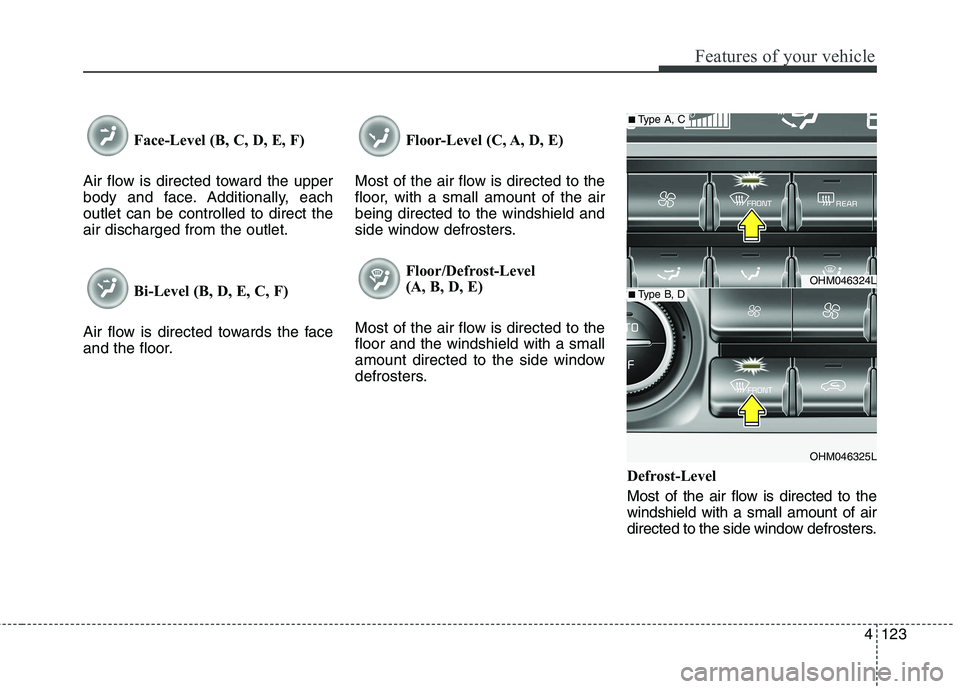
Face-Level (B, C, D, E, F)
Air flow is directed toward the upper
body and face. Additionally, eachoutlet can be controlled to direct theair discharged from the outlet.
Bi-Level (B, D, E, C, F)
Air flow is directed towards the face
and the floor. Floor-Level (C, A, D, E)
Most of the air flow is directed to the
floor, with a small amount of the airbeing directed to the windshield and
side window defrosters. Floor/Defrost-Level
(A, B, D, E)
Most of the air flow is directed to thefloor and the windshield with a small
amount directed to the side window
defrosters.
Defrost-Level
Most of the air flow is directed to the windshield with a small amount of air
directed to the side window defrosters.
OHM046324L
OHM046325L
■Type A, C
■Type B, D
Page 246 of 548
Audio system
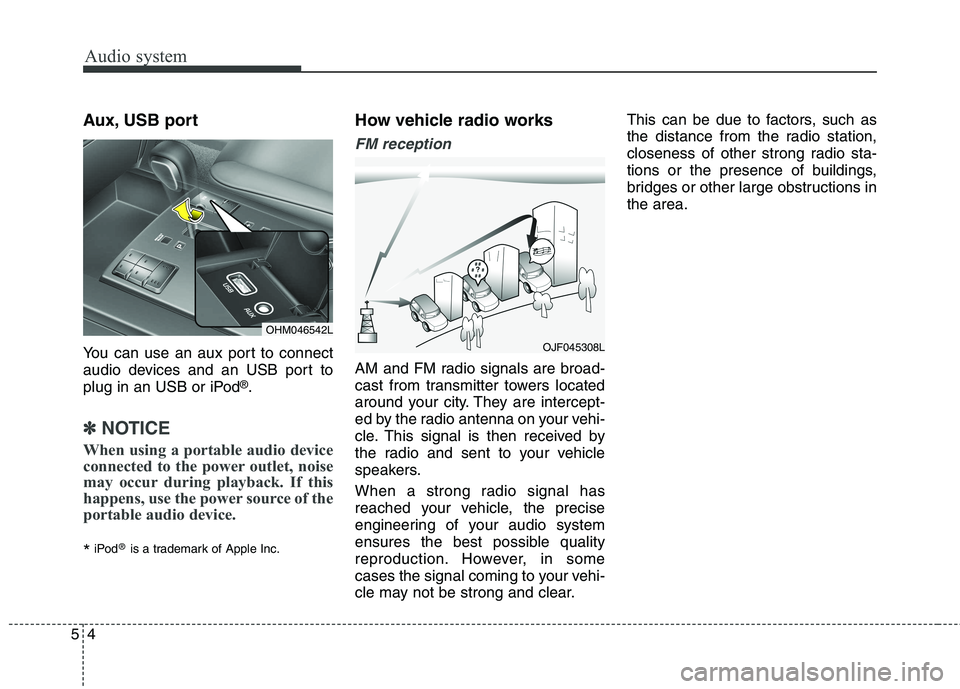
54Aux, USB port
You can use an aux port to connect
audio devices and an USB port to
plug in an USB or iPod
®
.
✽✽ NOTICE
When using a portable audio device
connected to the power outlet, noise
may occur during playback. If this
happens, use the power source of the
portable audio device.
* iPod
®
is a trademark of Apple Inc. How vehicle radio works
FM reception
AM and FM radio signals are broad-
cast from transmitter towers located
around your city. They are intercept-
ed by the radio antenna on your vehi-
cle. This signal is then received by
the radio and sent to your vehicle
speakers.
When a strong radio signal has
reached your vehicle, the precise
engineering of your audio system
ensures the best possible quality
reproduction. However, in some
cases the signal coming to your vehi-
cle may not be strong and clear. This can be due to factors, such as
the distance from the radio station,
closeness of other strong radio sta-
tions or the presence of buildings,
bridges or other large obstructions inthe area.
OJF045308L
OHM046542L
Page 347 of 548
623
Driving your vehicle
Engine power can be delivered to all
front and rear wheels for maximum
traction. 4WD is useful when extra
traction is required on road, such as,
when driving on slippery, muddy,
wet, or snow-covered roads. These
vehicles are not designed for chal-
lenging off-road use. Occasional off-
road use such as established
unpaved roads and trails are OK. It is
always important when traveling off-
highway that the driver carefully
reduces the speed to a level that
does not exceed the safe operating
speed for those conditions. In gener-
al, off-road conditions provide less
traction and braking effectiveness
than normal road conditions. The
driver must be especially alert to
avoid driving on slopes which tilt the
vehicle to either side.
These factors must be carefully con-
sidered when driving off-road. Keeping
the vehicle in contact with the driving
surface and under control in these
conditions is always the driver's
responsibility for the safety of him/her-
self and his or her passengers.FOUR WHEEL DRIVE (4WD) (IF EQUIPPED)
WARNING -
Off road driving
This vehicle is designed prima-
rily for on road use although it
can operate effectively off road.
However, it was not designed to
drive in challenging off-road
conditions. Driving in condi-
tions that exceed the vehicle'sintended design or the driver's
experience level may result in
severe injury or death.CAUTION
Do not select four wheel drive on flat and normal roads.
Four-wheel driving on flat roads for a long period causespoor fuel economy and noiseand it also causes tires towear faster.
Four-wheel driving on flat and normal roads can result in asevere binding and chatteringcondition when turning thesteering wheel.
Four-wheel driving on flat roads for a long period canalso cause the differential oiltemperature to increase,resulting in damage to parts in the power train.
Page 349 of 548
625
Driving your vehicle
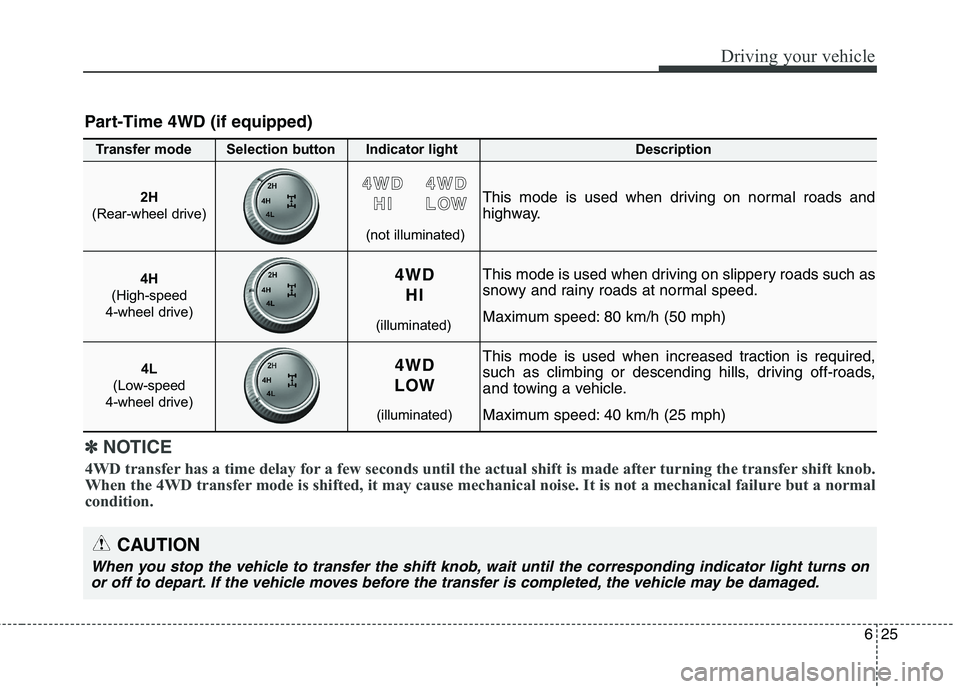
This mode is used when driving on slippery roads such as
snowy and rainy roads at normal speed.
Maximum speed: 80 km/h (50 mph)
2H
(Rear-wheel drive)
✽✽ NOTICE
4WD transfer has a time delay for a few seconds until the actual shift is made after turning the transfe r shift knob.
When the 4WD transfer mode is shifted, it may cause mechanical noise. It is not a mechanical failur e but a normal
condition.
Part-Time 4WD (if equipped)
Transfer mode Selection button Indicator light Description
This mode is used when driving on normal roads and
highway.
4H
(High-speed
4-wheel drive)
This mode is used when increased traction is required,
such as climbing or descending hills, driving off-roads,
and towing a vehicle.
Maximum speed: 40 km/h (25 mph)
4L
(Low-speed
4-wheel drive)
44 WW DD
H
H II
4WD
HI
4WD
LOW
44 WW DD
L
L OO WW
(not illuminated)
(illuminated)(illuminated)
CAUTION
When you stop the vehicle to transfer the shift knob, wait until the corresponding indicator light turns on or off to depart. If the vehicle moves before the transfer is completed, the vehicle may be damaged.
Page 351 of 548
627
Driving your vehicle
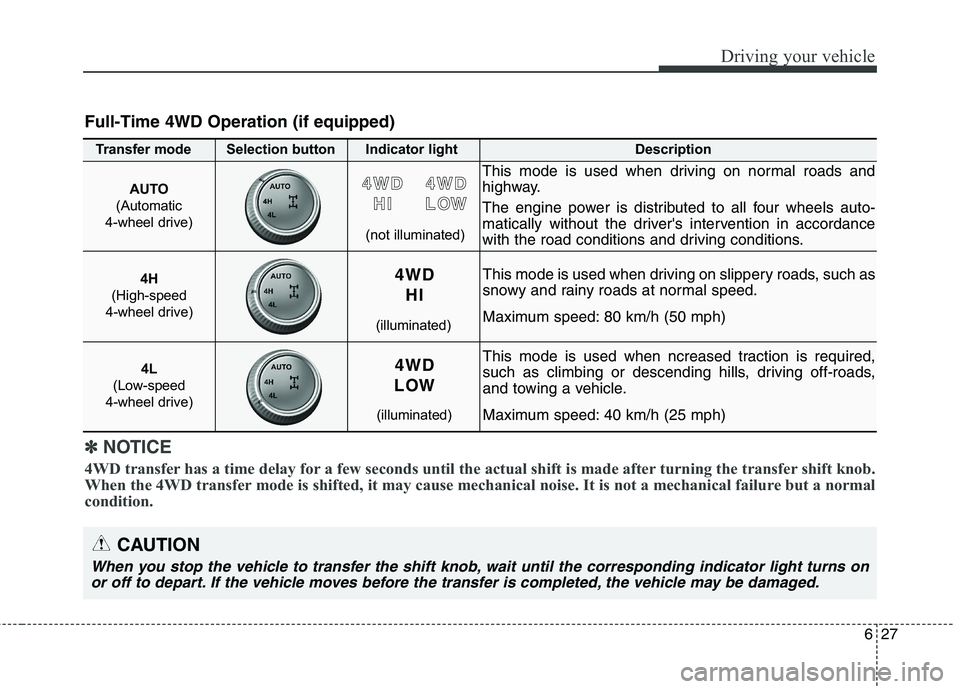
This mode is used when driving on slippery roads, such as
snowy and rainy roads at normal speed.
Maximum speed: 80 km/h (50 mph)
AUTO
(Automatic
4-wheel drive)
✽✽ NOTICE
4WD transfer has a time delay for a few seconds until the actual shift is made after turning the transfe r shift knob.
When the 4WD transfer mode is shifted, it may cause mechanical noise. It is not a mechanical failur e but a normal
condition.
Full-Time 4WD Operation (if equipped)
Transfer mode Selection button Indicator light Description
This mode is used when driving on normal roads and
highway.
The engine power is distributed to all four wheels auto-
matically without the driver's intervention in accordance
with the road conditions and driving conditions.
4H
(High-speed
4-wheel drive)
This mode is used when ncreased traction is required,
such as climbing or descending hills, driving off-roads,
and towing a vehicle.
Maximum speed: 40 km/h (25 mph)
4L
(Low-speed
4-wheel drive)
44 WW DD
H
H II
4WD
HI
4WD
LOW
44 WW DD
L
L OO WW
(not illuminated)
(illuminated)(illuminated)
CAUTION
When you stop the vehicle to transfer the shift knob, wait until the corresponding indicator light turns on or off to depart. If the vehicle moves before the transfer is completed, the vehicle may be damaged.
Page 355 of 548
631
Driving your vehicle
✽✽NOTICE
Do not drive in water if the level is higher than the bottom of the vehi-
cle.
Check your brake condition once you are out of mud or water. Press
the brake pedal several times as
you move slowly until you feel nor-
mal braking forces return.
Shorten your scheduled mainte- nance interval if you drive in off-
road conditions such as sand, mud
or water (see “Maintenance under
severe usage conditions” in chapter
8). Always wash your vehicle thor-
oughly after off road use, especially
cleaning the bottom of the vehicle.
Since the driving torque is always applied to the 4 wheels the per-
formance of the 4WD vehicle is
greatly affected by the condition of
the tires. Be sure to equip the vehi-
cle with four tires of the same size
and type.
A full time four wheel drive vehi- cle cannot be towed by an ordi-
nary tow truck. Make sure that
the vehicle is placed on a flat bed
truck for moving.Reducing the risk of a rollover
This multi-purpose passenger vehicle
is defined as a Sports Utility Vehicle
(SUV). SUV’s have higher ground
clearance and a narrower track to
make them capable of performing in a
wide variety of off-road applications.
Specific design characteristics give
them a higher center of gravity than
ordinary vehicles. An advantage of the
higher ground clearance is a better
view of the road, which allows you to
anticipate problems. They are not
designed for cornering at the same
speeds as conventional passenger
vehicles, any more than low-slung
sports vehicles are designed to per-
form satisfactorily in off-road condi-
tions. Due to this risk, driver and pas-sengers are strongly recommended to
buckle their seat belts. In a rollover
crash, an unbelted person is more
likely to die than a person wearing a
seat belt. There are steps that a driver
can make to reduce the risk of a
rollover. If at all possible, avoid sharp
turns or abrupt maneuvers, do not
load your roof rack with heavy cargo,
and never modify your vehicle in any
way.CAUTION - Mud or snow
If one of the front or rear wheels
begins to spin in mud, snow,etc. the vehicle can sometimes be driven out by depressing theaccelerator pedal further; how-ever avoid running the engine continuously at high rpmbecause doing so could dam-age the 4WD system.
Page 375 of 548
651
Driving your vehicle
CAUTION
Always check if there is any-thing under the rear part of thevehicle before adjusting theALS.
There may be noise heard while the ALS is adjusting theheight to a mode.
Do not turn off the engine or press the switch to anothermode while the ALS is adjust-ing to the mode selected.
Do not activate the ALS when the air filter of the compressorhas been submerged.
Inspect or replace the ALS air filter and air spring accordingto the maintenance schedule.
Do not drive the vehicle when the air spring is damaged orairless. Have the vehicle towed with all the wheels liftedfrom the ground.
Page 395 of 548
671
Driving your vehicle
SPECIAL DRIVING CONDITIONS
Hazardous driving conditions
When hazardous driving conditions
are encountered such as water,
snow, ice, mud, sand, or similar haz-
ards, follow these suggestions:
Drive cautiously and allow extra distance for braking.
Avoid sudden braking or steering.
When braking with non-ABS brakes pump the brake pedal with
a light up-and-down motion until
the vehicle is stopped.
If stalled in snow, mud, or sand, use second gear. Accelerate slowly to
avoid spinning the drive wheels.
Use sand, rock salt, tire chains, or other non-slip material under the
drive wheels to provide traction
when stalled in ice, snow, or mud. Rocking the vehicle
If it is necessary to rock the vehicle
to free it from snow, sand, or mud,
first turn the steering wheel right and
left to clear the area around your
front wheels. Then, shift back and
forth between R (Reverse) and any
forward gear in vehicles equipped
with an automatic transaxle. Do not
race the engine, and spin the wheels
as little as possible. If you are still
stuck after a few tries, have the vehi-
cle pulled out by a tow vehicle to
avoid engine overheating and possi-
ble damage to the transaxle.
WARNING
- Downshifting
Downshifting with an automatic
transaxle, while driving on slip-
pery surfaces can cause an
accident. The sudden change intire speed could cause the tires
to skid. Be careful when down-
shifting on slippery surfaces.
WARNING - ABS
Do not pump the brake pedal on
a vehicle equipped with ABS.
CAUTION
Prolonged rocking may cause engine over-heating, transaxledamage or failure, and tire dam-age.
Page 403 of 548
679
Driving your vehicle
Don't let your parking brake
freeze
Under some conditions your parking
brake can freeze in the engaged
position. This is most likely to hap-
pen when there is an accumulation
of snow or ice around or near the
rear brakes or if the brakes are wet.
If there is a risk the parking brake
may freeze, apply it only temporarily
while you put the shift lever in P
(Park) and block the rear wheels so
the vehicle cannot roll. Then release
the parking brake.Don't let ice and snow accu-
mulate underneath
Under some conditions, snow and
ice can build up under the fenders
and interfere with the steering. When
driving in severe winter conditions
where this may happen, you should
periodically check underneath the
vehicle to be sure the movement of
the front wheels and the steering
components is not obstructed.
Carry emergency equipment
Depending on the severity of the
weather, you should carry appropri-
ate emergency equipment. Some of
the items you may want to carry
include tire chains, tow straps or
chains, flashlight, emergency flares,
sand, shovel, jumper cables, window
scraper, gloves, ground cloth, cover-
alls, blanket, etc.
Page 405 of 548
What to do in an emergency
Road warning . . . . . . . . . . . . . . . . . . . . . . . . . . . . . . 7-2• Hazard warning flasher . . . . . . . . . . . . . . . . . . . . . . . 7-2
In case of an emergency while driving . . . . . . . . . . 7-3
. . . . . . . . . . . . . . . 7-3
. . . . . . . . . . . . . . . . . . . . 7-3
If the engine will not start . . . . . . . . . . . . . . . . . . . . 7-4 . . . . 7-4
. . . . 7-4
Emergency starting . . . . . . . . . . . . . . . . . . . . . . . . . 7-5
. . . . . . . . . . . . . . . . . . . . . . . . . . . . . . . . 7-7
If the engine overheats . . . . . . . . . . . . . . . . . . . . . . . 7-8
Tire Pressure Monitoring System (TPMS) . . . . . . 7-9 . . . . . . . . . . . . . . . . . . . . . . . . . . . . 7-9
. . . . . . . . . . . . . . . . . . . . . . 7-11
. . . . . . . . . . . . . . . 7-11
malfunction indicator . . . . . . . . . . . . . . . . . . . . . . . . 7-12
. . . . . . . . . . . . . . . . . . . . 7-13
If you have a flat tire (with spare tire ) . . . . . . . . 7-16 . . . . . . . . . . . . . . . . . . . . . . . . . . . . . . . 7-16
. . . . . . . . . . . . 7-17
. . . . . . . . . . . . . . . . . . . . . . . . . . . . . . . . . . . 7-25 . . . . . . . . . . 7-26
Towing . . . . . . . . . . . . . . . . . . . . . . . . . . . . . . . . . . . 7-27 . . . . . . . . . . . . . . . . . . . . . . . . . . . . . . . 7-27
. . . . . . . . . . . . . . . . . . . . . . . . . . . . 7-28
. . . . . . . . . . . . . . 7-31
Emergency Commodity . . . . . . . . . . . . . . . . . . . . . 7-32 . . . . . . . . . . . . . . . . . . . . . . . . . . . . . 7-32
. . . . . . . . . . . . . . . . . . . . . . . . . . . . . . . . . 7-32
. . . . . . . . . . . . . . . . . . . . . . . . . . . . 7-32
. . . . . . . . . . . . . . . . . . . . . . . . . . . 7-32
7