belt KIA BORREGO 2017 Workshop Manual
[x] Cancel search | Manufacturer: KIA, Model Year: 2017, Model line: BORREGO, Model: KIA BORREGO 2017Pages: 548, PDF Size: 36.78 MB
Page 346 of 548
Driving your vehicle
22
6
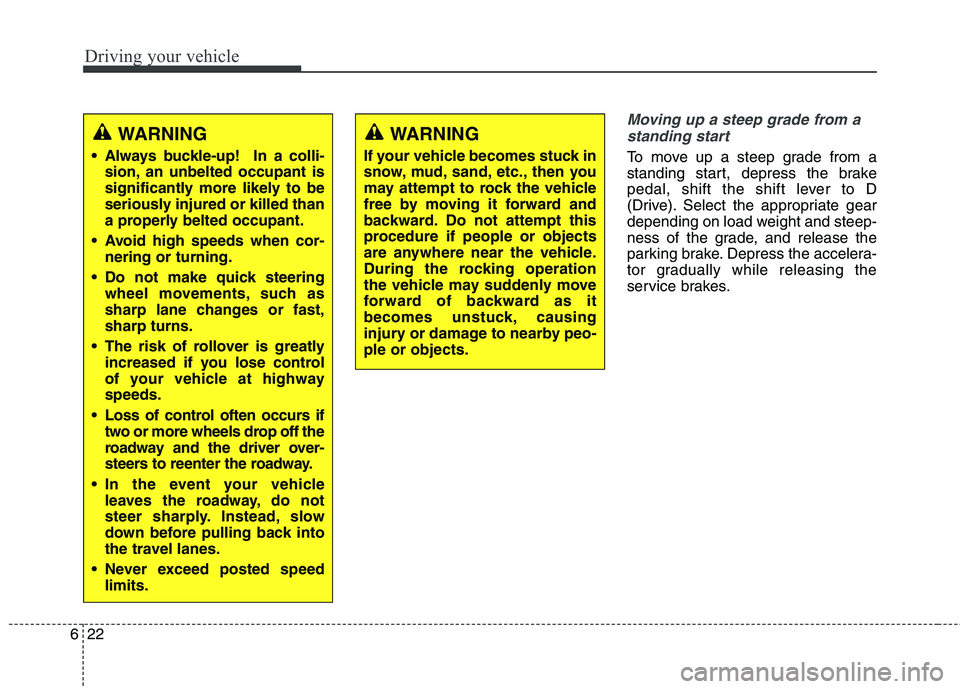
Moving up a steep grade from a
standing start
To move up a steep grade from a
standing start, depress the brake
pedal, shift the shift lever to D
(Drive). Select the appropriate gear
depending on load weight and steep-
ness of the grade, and release the
parking brake. Depress the accelera-
tor gradually while releasing the
service brakes.
WARNING
If your vehicle becomes stuck in
snow, mud, sand, etc., then you
may attempt to rock the vehicle
free by moving it forward and
backward. Do not attempt this
procedure if people or objects
are anywhere near the vehicle.
During the rocking operation
the vehicle may suddenly move
forward of backward as it
becomes unstuck, causing
injury or damage to nearby peo-ple or objects.WARNING
Always buckle-up! In a colli- sion, an unbelted occupant is
significantly more likely to be
seriously injured or killed than
a properly belted occupant.
Avoid high speeds when cor- nering or turning.
Do not make quick steering wheel movements, such as
sharp lane changes or fast,sharp turns.
The risk of rollover is greatly increased if you lose control
of your vehicle at highwayspeeds.
Loss of control often occurs if two or more wheels drop off the
roadway and the driver over-
steers to reenter the roadway.
In the event your vehicle leaves the roadway, do not
steer sharply. Instead, slow
down before pulling back into
the travel lanes.
Never exceed posted speed limits.
Page 354 of 548
Driving your vehicle
30
6
You must consciously take the
effort to learn how to corner in a
4WD vehicle. Do not rely on your
experience in conventional 2WD
vehicles in choosing safe cornering
speed in 4WD mode. For starters,
you must drive more slowly in
4WD.
Drive carefully off-road because your vehicle may be damaged by
rocks or roots of trees. Become
familiar with the off-road conditions
where you are going to drive
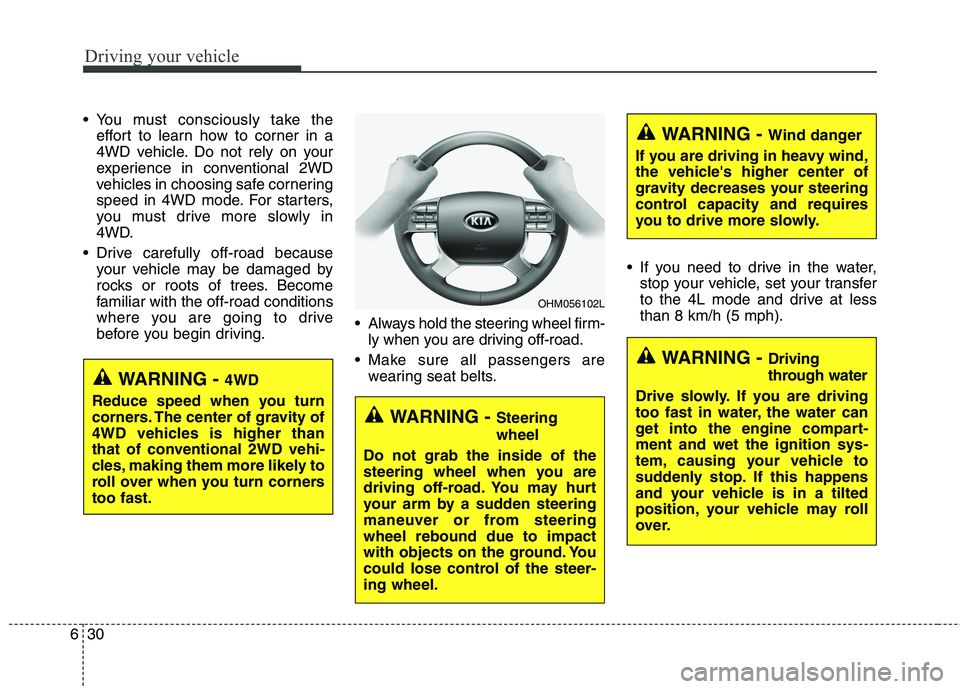
before you begin driving. Always hold the steering wheel firm-
ly when you are driving off-road.
Make sure all passengers are wearing seat belts. If you need to drive in the water,
stop your vehicle, set your transfer
to the 4L mode and drive at lessthan 8 km/h (5 mph).
WARNING - 4WD
Reduce speed when you turn
corners. The center of gravity of
4WD vehicles is higher than
that of conventional 2WD vehi-
cles, making them more likely to
roll over when you turn cornerstoo fast.
WARNING - Wind danger
If you are driving in heavy wind,
the vehicle's higher center of
gravity decreases your steering
control capacity and requires
you to drive more slowly.
WARNING - Driving
through water
Drive slowly. If you are driving
too fast in water, the water can
get into the engine compart-ment and wet the ignition sys-
tem, causing your vehicle to
suddenly stop. If this happens
and your vehicle is in a tilted
position, your vehicle may roll
over.
WARNING - Steering wheel
Do not grab the inside of the
steering wheel when you are
driving off-road. You may hurt
your arm by a sudden steering
maneuver or from steeringwheel rebound due to impact
with objects on the ground. You
could lose control of the steer-ing wheel.
OHM056102L
Page 355 of 548
631
Driving your vehicle
✽✽NOTICE
Do not drive in water if the level is higher than the bottom of the vehi-
cle.
Check your brake condition once you are out of mud or water. Press
the brake pedal several times as
you move slowly until you feel nor-
mal braking forces return.
Shorten your scheduled mainte- nance interval if you drive in off-
road conditions such as sand, mud
or water (see “Maintenance under
severe usage conditions” in chapter
8). Always wash your vehicle thor-
oughly after off road use, especially
cleaning the bottom of the vehicle.
Since the driving torque is always applied to the 4 wheels the per-
formance of the 4WD vehicle is
greatly affected by the condition of
the tires. Be sure to equip the vehi-
cle with four tires of the same size
and type.
A full time four wheel drive vehi- cle cannot be towed by an ordi-
nary tow truck. Make sure that
the vehicle is placed on a flat bed
truck for moving.Reducing the risk of a rollover
This multi-purpose passenger vehicle
is defined as a Sports Utility Vehicle
(SUV). SUV’s have higher ground
clearance and a narrower track to
make them capable of performing in a
wide variety of off-road applications.
Specific design characteristics give
them a higher center of gravity than
ordinary vehicles. An advantage of the
higher ground clearance is a better
view of the road, which allows you to
anticipate problems. They are not
designed for cornering at the same
speeds as conventional passenger
vehicles, any more than low-slung
sports vehicles are designed to per-
form satisfactorily in off-road condi-
tions. Due to this risk, driver and pas-sengers are strongly recommended to
buckle their seat belts. In a rollover
crash, an unbelted person is more
likely to die than a person wearing a
seat belt. There are steps that a driver
can make to reduce the risk of a
rollover. If at all possible, avoid sharp
turns or abrupt maneuvers, do not
load your roof rack with heavy cargo,
and never modify your vehicle in any
way.CAUTION - Mud or snow
If one of the front or rear wheels
begins to spin in mud, snow,etc. the vehicle can sometimes be driven out by depressing theaccelerator pedal further; how-ever avoid running the engine continuously at high rpmbecause doing so could dam-age the 4WD system.
Page 356 of 548
Driving your vehicle
32
6
WARNING - Rollover
As with other Sports Utility
Vehicle (SUV), failure to operate
this vehicle correctly may result
in loss of control, an accident or
vehicle rollover.
Utility vehicles have a signifi- cantly higher rollover rate
than other types of vehicles.
Specific design characteris- tics (higher ground clearance,
narrower track, etc.) give this
vehicle a higher center of
gravity than ordinary vehicles.
A SUV is not designed for cor- nering at the same speeds as
conventional vehicles.
Avoid sharp turns or abrupt maneuvers.
In a rollover crash, an unbelt- ed person is significantly
more likely to die than a per-
son wearing a seat belt. Make
sure everyone in the vehicle is
properly buckled up.WARNING
Your vehicle is equipped with
tires designed to provide safe
ride and handling capability. Do
not use a size and type of tire
and wheel that is different from
the one that is originally
installed on your vehicle. It can
affect the safety and perform-
ance of your vehicle, whichcould lead to steering failure or
rollover and serious injury.
When replacing the tires, be
sure to equip all four tires withthe tire and wheel of the same
size, type, tread, brand and
load-carrying capacity. If you
nevertheless decide to equip
your vehicle with any tire/wheelcombination not recommended
by Kia for off road driving, you
should not use these tires for
highway driving.WARNING - Jacked
vehicle
While the full-time 4WD vehicle
is being raised on a jack, never
start the engine or cause the
tires to rotate.
There is the danger that rotating
tires touching the ground could
cause the vehicle to go off the
jack and to jump forward.
Page 398 of 548
Driving your vehicle
74
6
Highway driving
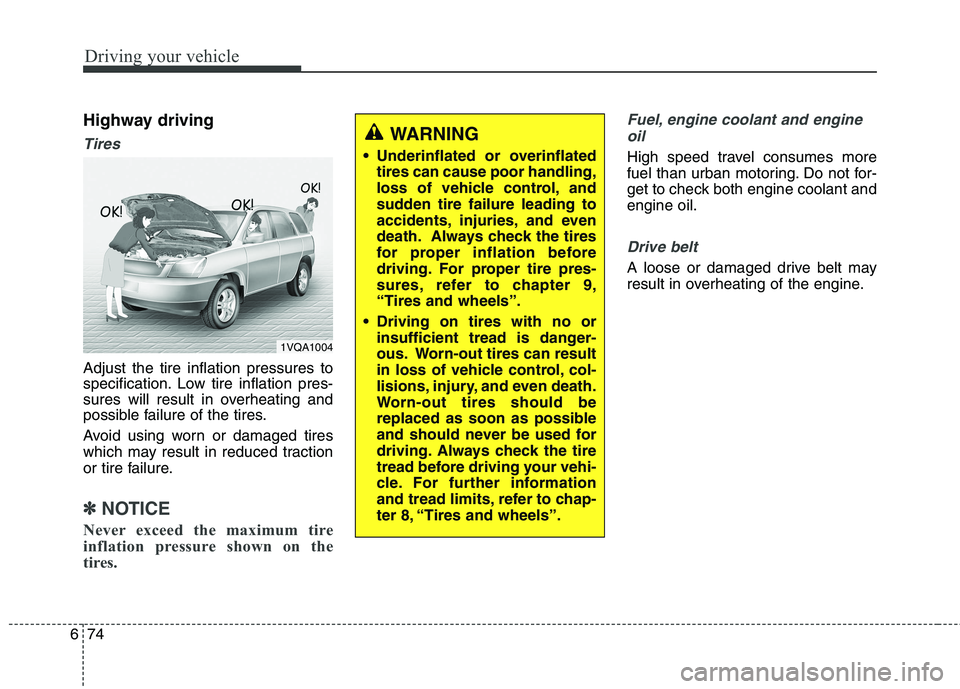
Tires
Adjust the tire inflation pressures to
specification. Low tire inflation pres-
sures will result in overheating and
possible failure of the tires.
Avoid using worn or damaged tires
which may result in reduced traction
or tire failure.
✽✽
NOTICE
Never exceed the maximum tire
inflation pressure shown on the
tires.
Fuel, engine coolant and engine oil
High speed travel consumes more
fuel than urban motoring. Do not for-
get to check both engine coolant andengine oil.
Drive belt
A loose or damaged drive belt may
result in overheating of the engine.
1VQA1004
WARNING
Underinflated or overinflated tires can cause poor handling,
loss of vehicle control, and
sudden tire failure leading to
accidents, injuries, and even
death. Always check the tires
for proper inflation before
driving. For proper tire pres-
sures, refer to chapter 9,“Tires and wheels”.
Driving on tires with no or insufficient tread is danger-
ous. Worn-out tires can result
in loss of vehicle control, col-
lisions, injury, and even death.
Worn-out tires should be
replaced as soon as possible
and should never be used for
driving. Always check the tire
tread before driving your vehi-
cle. For further information
and tread limits, refer to chap-
ter 8, “Tires and wheels”.
Page 412 of 548
What to do in an emergency
8
7
IF THE ENGINE OVERHEATS
If your temperature gauge indicates
overheating, you will experience a
loss of power, or hear loud pinging or
knocking, the engine is probably too
hot. If this happens, you should:
1. Pull off the road and stop as soon as it is safe to do so.
2. Place the shift lever in P (Park) and set the parking brake. If the air
conditioning is on, turn it off.
3. If engine coolant is running out under the vehicle or steam iscoming out from the hood, stop
the engine. Do not open the hood
until the coolant has stopped run-ning or the steaming has stopped.
If there is no visible loss of engine
coolant and no steam, leave the
engine running and check to be
sure the engine cooling fan is
operating. If the fan is not running,
turn the engine off.
4. Check to see if the water pump drive belt is missing. If it is not miss-
ing, check to see that it is tight. If the drive belt seems to be satis-
factory, check for coolant leaking
from the radiator, hoses or under
the vehicle. (If the air conditioning
had been in use, it is normal for
cold water to be draining from it
when you stop).
5. If the water pump drive belt is bro- ken or engine coolant is leakingout, stop the engine immediately
and we recommend that you call
an authorized Kia dealer. 6. If you cannot find the cause of the
overheating, wait until the engine
temperature has returned to nor-
mal. Then, if coolant has been lost,carefully add coolant to the reser-
voir to bring the fluid level in the
reservoir up to the halfway mark.
7. Proceed with caution, keeping alert for further signs of overheat-
ing. If overheating happens again,
we recommend that you call an
authorized Kia dealer.
CAUTION
Serious loss of coolant indi-
cates there is a leak in thecooling system and we recom- mend that the system bechecked by an authorized Kiadealer.
When the engine overheats from low engine coolant, sud-denly adding engine coolantmay cause cracks in theengine. To prevent damage, add engine coolant slowly insmall quantities.
WARNING
While the engine is running,
keep hair, hands and clothing
away from moving parts suchas the fan and drive belts to pre-
vent injury.
WARNING
Do not remove the radiator cap
when the engine is hot. This can
allow coolant to blow out of theopening and cause serious
burns.
Page 437 of 548
Maintenance
8
Engine compartment . . . . . . . . . . . . . . . . . . . . . . . . 8-3
Maintenance services . . . . . . . . . . . . . . . . . . . . . . . . 8-5• Owner’s responsibility . . . . . . . . . . . . . . . . . . . . . . . . . 8-5
. . . . . . . . . . . . . . . . . 8-5
. . . 8-6
Owner maintenance . . . . . . . . . . . . . . . . . . . . . . . . 8-8 . . . . . . . . . . . . . . . . . . . 8-8
Scheduled maintenance service . . . . . . . . . . . . . . 8-10
Explanation of scheduled maintenance items . . . 8-18
. . . . . . . . . . . . . . . . . . . . . . . . . . . . . . . . . . 8-18
. . . . . . . . . . . . . . . . . 8-18
. . . . . . . . . . . . . . . . . . . . . . . 8-18
fuel hoses and connections . . . . . . . . . . . . 8-18
. . . . . . . . . . . . . . . . . . 8-19
. . . . . . . . . . . . . 8-19
. . . . . . . . . . . . . . . . . . . . . . . . . . . . . 8-19
. . . . . . . . . . . . . . . 8-19
. . . . . . . . . . . . 8-20
. . . . . . . . . . . . . . . . . . . . . . . . . . . . . . . 8-20
. . . . . . . . . . . . . . . . . . . . . . . . . . . . . . . . . . . . . 8-20
. . . . . . . . . . . . . . . . . . . . . . 8-20
. . . . . . . . . . . . . . . . . . . . . . . . . 8-20
. . . . . . . . . . . . . . . . . . . . . . . . . . . . . . . . . . 8-20
. . . . . . . . . . . . . . . . . . . . . . . . . . . . . . . 8-20 pads, calipers and rotors. . . . . . . . . . . . 8-21
. . . . . . . . . . . . . . . . . . . . . 8-21
linkage &
boots/lower arm ball joint . . . . . . . . . . . . . . . . . . . . 8-21
belt and hoses . . . . . . . . . . . . 8-21
. . . . . . . . . . . . . . . . . . . . 8-21
Engine oil. . . . . . . . . . . . . . . . . . . . . . . . . . . . . . . . . 8-22 . . . . . . . . . . . . . . . . . . . 8-22
. . . . . . . . . . . . . . . 8-23
Engine coolant . . . . . . . . . . . . . . . . . . . . . . . . . . . . 8-24 . . . . . . . . . . . . . . . . . . . . 8-24
. . . . . . . . . . . . . . . . . . . . . . . . . 8-26
Brake fluid . . . . . . . . . . . . . . . . . . . . . . . . . . . . . . . 8-27 . . . . . . . . . . . . . . . . . 8-27
Power steering fluid . . . . . . . . . . . . . . . . . . . . . . . . 8-28 . . . . . . . . . . 8-28
. . . . . . . . . . . . . . . 8-28
Washer fluid . . . . . . . . . . . . . . . . . . . . . . . . . . . . . . 8-29 . . . . . . . . . . . . . . . . . 8-29
Parking brake . . . . . . . . . . . . . . . . . . . . . . . . . . . . . 8-29
Fuel Filter (For Diesel) . . . . . . . . . . . . . . . . . . . . . 8-30 . . . . . . . . . . . . . . 8-30
. . . . . . . . . . . . . . . . 8-30
Page 445 of 548
89
Maintenance
At least monthly:
Check the coolant level in theengine coolant reservoir.
Check the operation of all exterior lights, including the stoplights, turn
signals and hazard warning flash-
ers.
Check the inflation pressures of all tires including the spare.
At least twice a year
(i.e., every Spring and Fall):
Check the radiator, heater and air conditioning hoses for leaks or
damage.
Check the windshield washer spray and wiper operation. Clean
the wiper blades with clean cloth
dampened with washer fluid.
Check the headlight alignment.
Check the muffler, exhaust pipes, shields and clamps.
Check the lap/shoulder belts for wear and function.
Check for worn tires and loose wheel lug nuts.
At least once a year:
Clean the body and door drainholes.
Lubricate the door hinges and checks, and hood hinges.
Lubricate the door and hood locks and latches.
Lubricate the door rubber weather- strips.
Check the air conditioning system.
Check the power steering fluid level.
Inspect and lubricate the automat- ic transaxle linkage and controls.
Clean the battery and terminals.
Check the brake fluid level.
Page 447 of 548
811
Maintenance
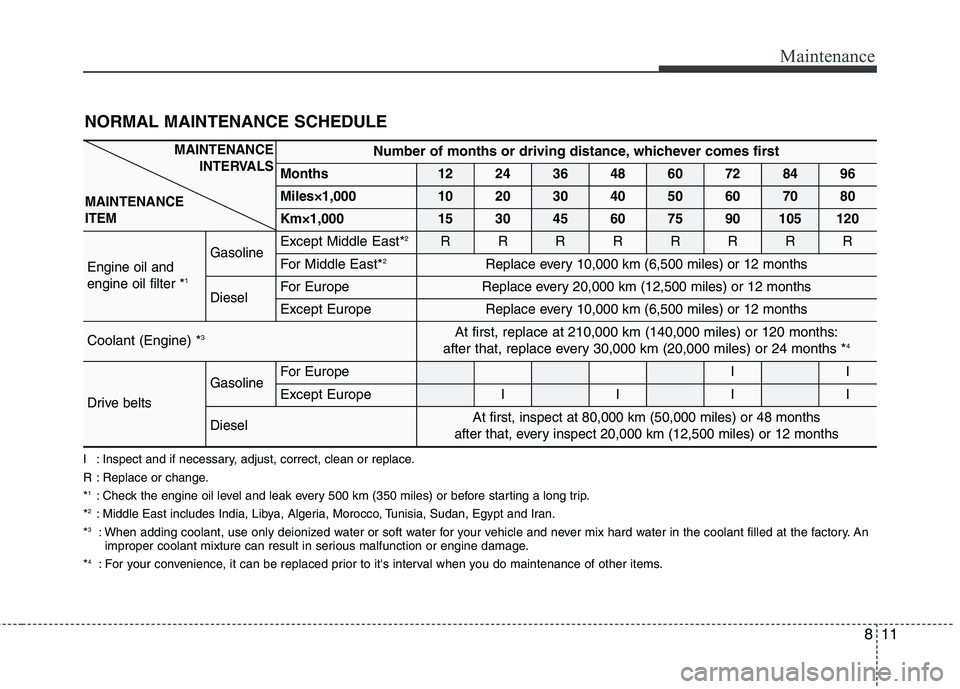
I : Inspect and if necessary, adjust, correct, clean or replace.
R : Replace or change.*1
: Check the engine oil level and leak every 500 km (350 miles) or before starting a long trip.
* 2
: Middle East includes India, Libya, Algeria, Morocco, Tunisia, Sudan, Egypt and Iran.
* 3
: When adding coolant, use only deionized water or soft water for your vehicle and never mix hard water in the coolant filled at the factory. An
improper coolant mixture can result in serious malfunction or engine damage.
* 4
: For your convenience, it can be replaced prior to it's interval when you do maintenance of other items.
NORMAL MAINTENANCE SCHEDULE
Number of months or driving distance, whichever comes first
Months1224364860728496
Miles×1,0001020304050607080
Km×1,000153045607590105120
Engine oil and engine oil filter *
1GasolineExcept Middle East* 2RRRRRRRR
For Middle East*2Replace every 10,000 km (6,500 miles) or 12 months
DieselFor EuropeReplace every 20,000 km (12,500 miles) or 12 months
Except EuropeReplace every 10,000 km (6,500 miles) or 12 months
Coolant (Engine) * 3At first, replace at 210,000 km (140,000 miles) or 120 months:
after that, replace every 30,000 km (20,000 miles) or 24 months * 4
Drive belts
GasolineFor EuropeII
Except EuropeIIII
DieselAt first, inspect at 80,000 km (50,000 miles) or 48 months
after that, every inspect 20,000 km (12,500 miles) or 12 months
MAINTENANCE INTERVALS
MAINTENANCE ITEM
Page 450 of 548
Maintenance
14
8
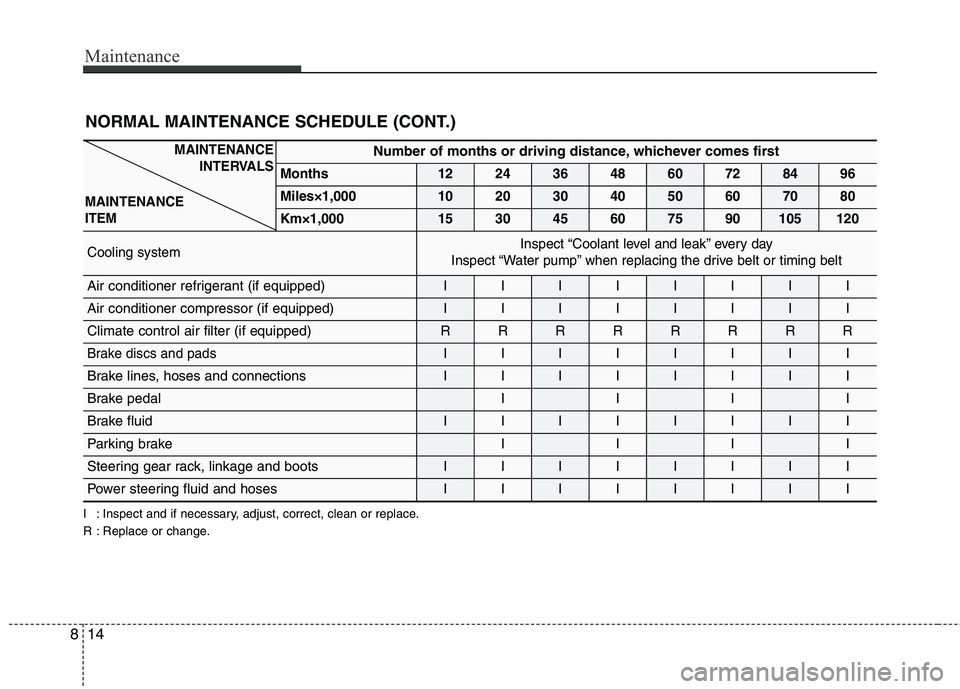
I : Inspect and if necessary, adjust, correct, clean or replace.
R : Replace or change. NORMAL MAINTENANCE SCHEDULE (CONT.)
Number of months or driving distance, whichever comes first
Months1224364860728496
Miles×1,0001020304050607080
Km×1,000153045607590105120
Cooling systemInspect “Coolant level and leak” every day
Inspect “Water pump” when replacing the drive belt or timing belt
Air conditioner refrigerant (if equipped)IIIIIIII
Air conditioner compressor (if equipped)IIIIIIII
Climate control air filter (if equipped)RRRRRRRR
Brake discs and padsIIIIIIII
Brake lines, hoses and connectionsIIIIIIII
Brake pedalIIII
Brake fluidIIIIIIII
Parking brakeIIII
Steering gear rack, linkage and bootsIIIIIIII
Power steering fluid and hosesIIIIIIII
MAINTENANCE INTERVALS
MAINTENANCE ITEM