four wheel drive KIA BORREGO 2017 Owners Manual
[x] Cancel search | Manufacturer: KIA, Model Year: 2017, Model line: BORREGO, Model: KIA BORREGO 2017Pages: 548, PDF Size: 36.78 MB
Page 174 of 548
![KIA BORREGO 2017 Owners Manual 485
Features of your vehicle
Lane Departure WarningSystem (LDWS) Indicator Light (if equipped)
This indicator light illuminates:
[White] When the lane departure warning system does not detect
the l](/img/2/57934/w960_57934-173.png "KIA BORREGO 2017 Owners Manual 485
Features of your vehicle
Lane Departure WarningSystem (LDWS) Indicator Light (if equipped)
This indicator light illuminates:
[White] When the lane departure warning system does not detect
the l")
485
Features of your vehicle
Lane Departure WarningSystem (LDWS) Indicator Light (if equipped)
This indicator light illuminates:
[White] When the lane departure warning system does not detect
the lane line.
[Green] When you activate the lane departure warning system by
pressing the LDWS button.
When blinking in Green, LDWS is
in warning condition.
[Yellow] When there is a malfunc- tion with the lane departure warn-ing system.
In this case, we recommend that you
have the vehicle inspected by an
authorized Kia dealer. ❈ For more details, refer to “Lane
Departure Warning System
(LDWS)” in chapter 6.
4WD LOW indicator
(if equipped)
When the ignition switch is turned to
the ON position, the 4WD LOW indi-cator will illuminate and then go off in
a few seconds. The 4WD LOW indi-
cator illuminates when the transfer
shift knob is set to the 4L(Low-speed
4-wheel drive) position. ❈ For more details, refer to “Four
wheel drive (4WD)” in chapter 6.
4WD HI indicator
(if equipped)
When the ignition switch is turned to the ON position, the 4WD HI indica-tor will illuminate and then go off in a
few seconds. The 4WD HI indicator
illuminates when the transfer shiftknob is set to the 4H(High-speed 4-
wheel drive) position. ❈ For more details, refer to “Four
wheel drive (4WD)” in chapter 6.
4WD
LOW4WD HI
Page 325 of 548
Driving your vehicle
Before driving . . . . . . . . . . . . . . . . . . . . . . . . . . . . . . 6-4• Before entering vehicle . . . . . . . . . . . . . . . . . . . . . . . . . 6-4
. . . . . . . . . . . . . . . . . . . . . . . . . 6-4
. . . . . . . . . . . . . . . . . . . . . . . . . . . . . . . 6-4
key positions . . . . . . . . . . . . . . . . . . . . . . . . . . . . . . . 6-6 . . . . . . . . . . . . . . . . . . . . . . 6-6
. . . . . . . . . . . . . . . . . . . . . . . . . 6-6
. . . . . . . . . . . . . . . . . . . . . . . . . . . . 6-7
Engine start/stop button . . . . . . . . . . . . . . . . . . . . 6-10 . . . . . . . . . . . . . 6-10
. . . . . . . . . . . . . . . . . . . . . . . . . . . 6-13
Automatic transaxle . . . . . . . . . . . . . . . . . . . . . . . . 6-16 . . . . . . . . . . . . . . . . . . 6-16
. . . . . . . . . . . . . . . . . . . . . . . . 6-21
Four wheel drive (4WD) . . . . . . . . . . . . . . . . . . . . 6-23 . . . . . . . . . . . . . . . . . . . . . . 6-24
. . . . . . . . . . . . . . . . . . . . . . . . . . . . . . 6-25
. . . . . . . . . . . . . . . . . . . . . 6-27
. . . . . . . . . . . . . 6-29
. . . . . . . . . . . . . . . . . 6-31
Brake system . . . . . . . . . . . . . . . . . . . . . . . . . . . . . . 6-34 . . . . . . . . . . . . . . . . . . . . . . . . . . . . . . . 6-34
. . . . . . . . . . . . . . . . . . . . . . . . . . . . . . 6-36
. . . . . . . . . . . . . . . 6-40
. . . . . . . . . . . . . . . . . . 6-45
Locking differential . . . . . . . . . . . . . . . . . . . . . . . . 6-48
Air Leveling System (ALS) . . . . . . . . . . . . . . . . . . 6-49 . . . . . . . . . . . . 6-49
. . . . . . . . . . . . . . 6-49
. . . . . . . . . . . . . . . . . . . . . 6-50
Cruise Control system . . . . . . . . . . . . . . . . . . . . . . 6-52 . . . . . . . . . . . . . . . . . . . . . . . . . 6-53
. . . . . . . . . . . . . 6-54
. . . . . . . . . . . . . . . . . 6-55
cruise control on:. . . . . . . . . . . . . . . . . . . . . . . . . . . . 6-56
do one of the following: . . 6-56
approximately 40 km/h (25 mph). . . . . . . . . . . . . . . 6-57
do one of the following:. . . . . . . . . . . . . . . . . . . . . . . 6-57
Lane departure warning system (LDWS) . . . . . . 6-58 . . . . . . . . . . . . . . . . . . . . . . . . . . . 6-60
. . . . . . . . . . . . . . 6-61
if the vehicle leaves the lane, or may warn you even
if the vehicle does not leave the lane when: . . . . . . 6-61
6
Page 347 of 548
623
Driving your vehicle
Engine power can be delivered to all
front and rear wheels for maximum
traction. 4WD is useful when extra
traction is required on road, such as,
when driving on slippery, muddy,
wet, or snow-covered roads. These
vehicles are not designed for chal-
lenging off-road use. Occasional off-
road use such as established
unpaved roads and trails are OK. It is
always important when traveling off-
highway that the driver carefully
reduces the speed to a level that
does not exceed the safe operating
speed for those conditions. In gener-
al, off-road conditions provide less
traction and braking effectiveness
than normal road conditions. The
driver must be especially alert to
avoid driving on slopes which tilt the
vehicle to either side.
These factors must be carefully con-
sidered when driving off-road. Keeping
the vehicle in contact with the driving
surface and under control in these
conditions is always the driver's
responsibility for the safety of him/her-
self and his or her passengers.FOUR WHEEL DRIVE (4WD) (IF EQUIPPED)
WARNING -
Off road driving
This vehicle is designed prima-
rily for on road use although it
can operate effectively off road.
However, it was not designed to
drive in challenging off-road
conditions. Driving in condi-
tions that exceed the vehicle'sintended design or the driver's
experience level may result in
severe injury or death.CAUTION
Do not select four wheel drive on flat and normal roads.
Four-wheel driving on flat roads for a long period causespoor fuel economy and noiseand it also causes tires towear faster.
Four-wheel driving on flat and normal roads can result in asevere binding and chatteringcondition when turning thesteering wheel.
Four-wheel driving on flat roads for a long period canalso cause the differential oiltemperature to increase,resulting in damage to parts in the power train.
Page 348 of 548
Driving your vehicle
24
6
Tight corner brake effect Tight corner brake effect is a unique
characteristic of four-wheel drive
vehicles caused by the difference in
tire rotation at the four wheels and
the zero-degree alignment of thefront wheels and suspension.
Sharp turns at low speeds should be
carried out with caution.
CAUTION
When turning sharply on a
paved road at low speed whilein four-wheel drive (4L mode for full-time 4WD operation or4L/4H mode for part-time 4WDoperation), steering control will be difficult.
Page 351 of 548
627
Driving your vehicle
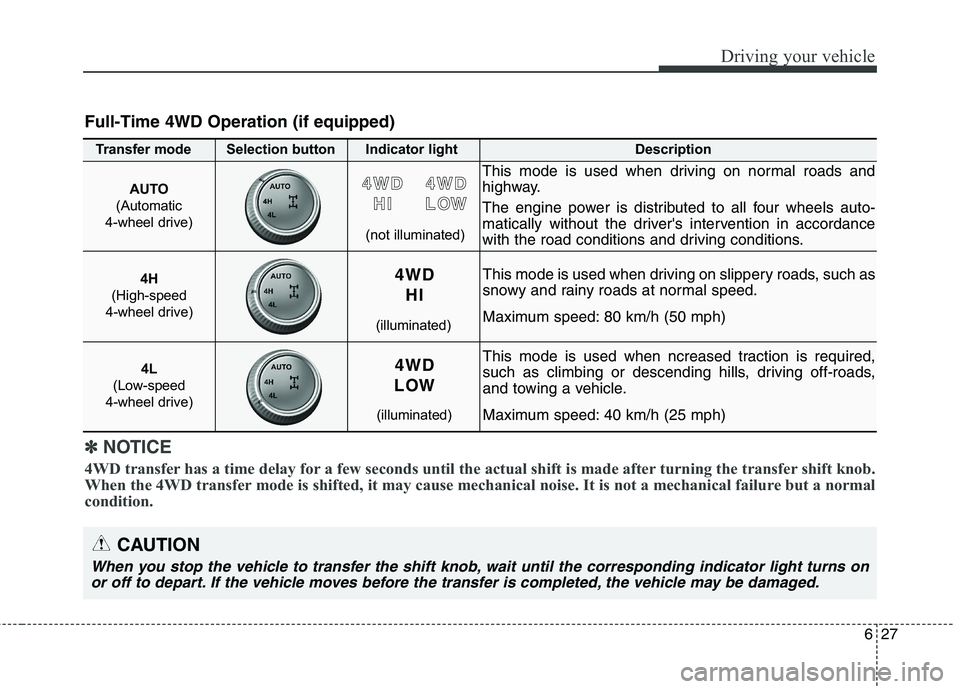
This mode is used when driving on slippery roads, such as
snowy and rainy roads at normal speed.
Maximum speed: 80 km/h (50 mph)
AUTO
(Automatic
4-wheel drive)
✽✽ NOTICE
4WD transfer has a time delay for a few seconds until the actual shift is made after turning the transfe r shift knob.
When the 4WD transfer mode is shifted, it may cause mechanical noise. It is not a mechanical failur e but a normal
condition.
Full-Time 4WD Operation (if equipped)
Transfer mode Selection button Indicator light Description
This mode is used when driving on normal roads and
highway.
The engine power is distributed to all four wheels auto-
matically without the driver's intervention in accordance
with the road conditions and driving conditions.
4H
(High-speed
4-wheel drive)
This mode is used when ncreased traction is required,
such as climbing or descending hills, driving off-roads,
and towing a vehicle.
Maximum speed: 40 km/h (25 mph)
4L
(Low-speed
4-wheel drive)
44 WW DD
H
H II
4WD
HI
4WD
LOW
44 WW DD
L
L OO WW
(not illuminated)
(illuminated)(illuminated)
CAUTION
When you stop the vehicle to transfer the shift knob, wait until the corresponding indicator light turns on or off to depart. If the vehicle moves before the transfer is completed, the vehicle may be damaged.
Page 353 of 548
629
Driving your vehicle
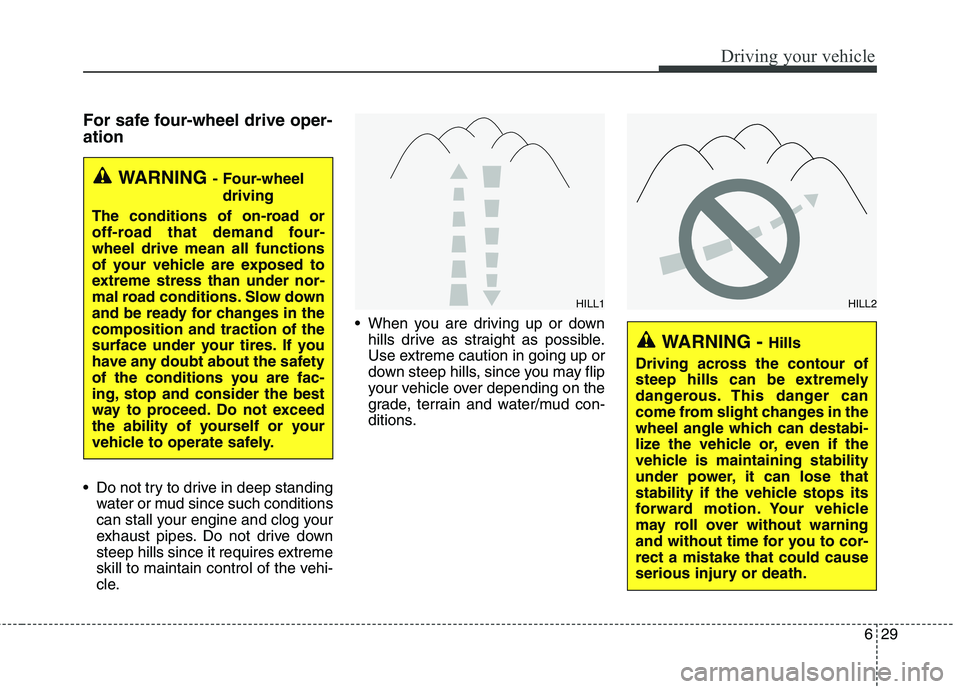
For safe four-wheel drive oper- ation
Do not try to drive in deep standingwater or mud since such conditions
can stall your engine and clog your
exhaust pipes. Do not drive down
steep hills since it requires extreme
skill to maintain control of the vehi-
cle. When you are driving up or down
hills drive as straight as possible.
Use extreme caution in going up or
down steep hills, since you may flip
your vehicle over depending on the
grade, terrain and water/mud con-
ditions.
WARNING - Four-wheel
driving
The conditions of on-road or
off-road that demand four-wheel drive mean all functions
of your vehicle are exposed to
extreme stress than under nor-
mal road conditions. Slow down
and be ready for changes in thecomposition and traction of the
surface under your tires. If you
have any doubt about the safety
of the conditions you are fac-
ing, stop and consider the best
way to proceed. Do not exceed
the ability of yourself or your
vehicle to operate safely.
WARNING - Hills
Driving across the contour of
steep hills can be extremely
dangerous. This danger can
come from slight changes in the
wheel angle which can destabi-
lize the vehicle or, even if the
vehicle is maintaining stability
under power, it can lose that
stability if the vehicle stops its
forward motion. Your vehicle
may roll over without warning
and without time for you to cor-rect a mistake that could cause
serious injury or death.
HILL1HILL2
Page 355 of 548
631
Driving your vehicle
✽✽NOTICE
Do not drive in water if the level is higher than the bottom of the vehi-
cle.
Check your brake condition once you are out of mud or water. Press
the brake pedal several times as
you move slowly until you feel nor-
mal braking forces return.
Shorten your scheduled mainte- nance interval if you drive in off-
road conditions such as sand, mud
or water (see “Maintenance under
severe usage conditions” in chapter
8). Always wash your vehicle thor-
oughly after off road use, especially
cleaning the bottom of the vehicle.
Since the driving torque is always applied to the 4 wheels the per-
formance of the 4WD vehicle is
greatly affected by the condition of
the tires. Be sure to equip the vehi-
cle with four tires of the same size
and type.
A full time four wheel drive vehi- cle cannot be towed by an ordi-
nary tow truck. Make sure that
the vehicle is placed on a flat bed
truck for moving.Reducing the risk of a rollover
This multi-purpose passenger vehicle
is defined as a Sports Utility Vehicle
(SUV). SUV’s have higher ground
clearance and a narrower track to
make them capable of performing in a
wide variety of off-road applications.
Specific design characteristics give
them a higher center of gravity than
ordinary vehicles. An advantage of the
higher ground clearance is a better
view of the road, which allows you to
anticipate problems. They are not
designed for cornering at the same
speeds as conventional passenger
vehicles, any more than low-slung
sports vehicles are designed to per-
form satisfactorily in off-road condi-
tions. Due to this risk, driver and pas-sengers are strongly recommended to
buckle their seat belts. In a rollover
crash, an unbelted person is more
likely to die than a person wearing a
seat belt. There are steps that a driver
can make to reduce the risk of a
rollover. If at all possible, avoid sharp
turns or abrupt maneuvers, do not
load your roof rack with heavy cargo,
and never modify your vehicle in any
way.CAUTION - Mud or snow
If one of the front or rear wheels
begins to spin in mud, snow,etc. the vehicle can sometimes be driven out by depressing theaccelerator pedal further; how-ever avoid running the engine continuously at high rpmbecause doing so could dam-age the 4WD system.
Page 399 of 548
675
Driving your vehicle
WINTER DRIVING
Severe weather conditions in the
winter result in greater wear and
other problems. To minimize the
problems of winter driving, you
should follow these suggestions: Snowy or Icy conditions
To drive your vehicle in deep snow, it
may be necessary to use snow tires
or to install tire chains on your tires.
If snow tires are needed, it is neces-
sary to select tires equivalent in size
and type of the original equipment
tires. Failure to do so may adversely
affect the safety and handling of your
vehicle. Furthermore, speeding,
rapid acceleration, sudden brake
applications, and sharp turns are
potentially very hazardous practices.
During deceleration, use engine
braking to the fullest extent. Sudden
brake applications on snowy or icy
roads may cause skids to occur. You
need to keep sufficient distance
between the vehicle in operation in
front and your vehicle. Also, apply
the brake gently. It should be notedthat installing tire chains on the tire
will provide a greater driving force,
but will not prevent side skids.
✽✽
NOTICE
Tire chains are not legal in all coun-
tries. Check the country laws before
fitting tire chains.
Snow tires
If you mount snow tires on your vehi-
cle, make sure they are radial tires of
the same size and load range as the
original tires. Mount snow tires on all
four wheels to balance your vehicle’s
handling in all weather conditions.
Keep in mind that the traction provid-
ed by snow tires on dry roads may
not be as high as your vehicle's orig-
inal equipment tires. You should drive
cautiously even when the roads are
clear. Check with the tire dealer for
maximum speed recommendations.
Do not install studded tires without first checking local, state and munic-ipal regulations for possible restric-tions against their use.
WARNING - Snow tire
size
Snow tires should be equivalent
in size and type to the vehicle's
standard tires. Otherwise, the
safety and handling of your
vehicle may be adversely affect-ed.
Page 434 of 548
What to do in an emergency
30
7
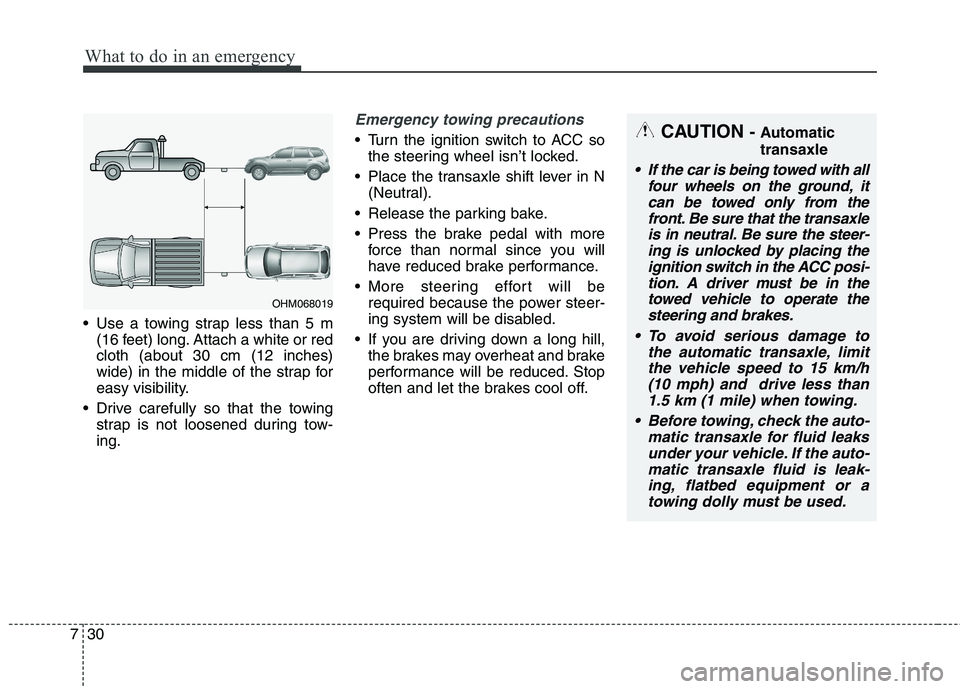
Use a towing strap less than 5 m
(16 feet) long. Attach a white or red cloth (about 30 cm (12 inches)
wide) in the middle of the strap for
easy visibility.
Drive carefully so that the towing strap is not loosened during tow-ing.
Emergency towing precautions
Turn the ignition switch to ACC sothe steering wheel isn’t locked.
Place the transaxle shift lever in N (Neutral).
Release the parking bake.
Press the brake pedal with more force than normal since you will
have reduced brake performance.
More steering effort will be required because the power steer-
ing system will be disabled.
If you are driving down a long hill, the brakes may overheat and brake
performance will be reduced. Stop
often and let the brakes cool off.
OHM068019
CAUTION - Automatic transaxle
If the car is being towed with all
four wheels on the ground, itcan be towed only from the front. Be sure that the transaxleis in neutral. Be sure the steer-ing is unlocked by placing the ignition switch in the ACC posi-tion. A driver must be in thetowed vehicle to operate the steering and brakes.
To avoid serious damage to the automatic transaxle, limitthe vehicle speed to 15 km/h(10 mph) and drive less than 1.5 km (1 mile) when towing.
Before towing, check the auto- matic transaxle for fluid leaksunder your vehicle. If the auto-matic transaxle fluid is leak- ing, flatbed equipment or atowing dolly must be used.
Page 541 of 548
Index
6
I
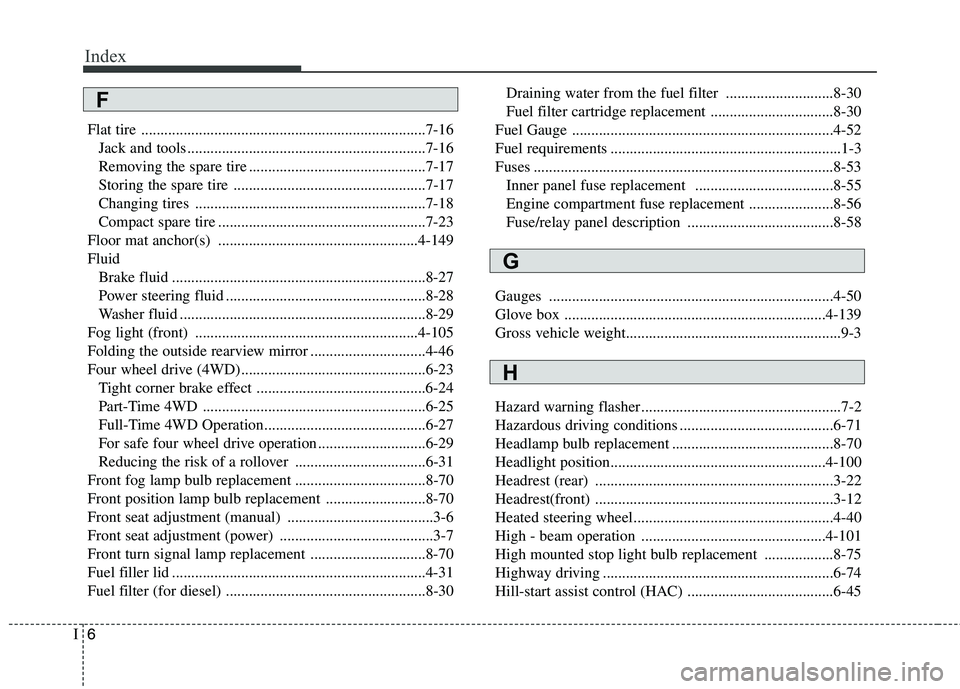
Flat tire ..........................................................................7-16
Jack and tools ..............................................................7-16
Removing the spare tire ..............................................7-17
Storing the spare tire ..................................................7-17
Changing tires ............................................................7-18
Compact spare tire ......................................................7-23
Floor mat anchor(s) ....................................................4-149Fluid Brake fluid ..................................................................8-27
Power steering fluid ....................................................8-28
Washer fluid ................................................................8-29
Fog light (front) ..........................................................4-105
Folding the outside rearview mirror ..............................4-46
Four wheel drive (4WD)................................................6-23 Tight corner brake effect ............................................6-24
Part-Time 4WD ..........................................................6-25
Full-Time 4WD Operation..........................................6-27
For safe four wheel drive operation ............................6-29
Reducing the risk of a rollover ..................................6-31
Front fog lamp bulb replacement ..................................8-70
Front position lamp bulb replacement ..........................8-70
Front seat adjustment (manual) ......................................3-6
Front seat adjustment (power) ........................................3-7
Front turn signal lamp replacement ..............................8-70
Fuel filler lid ..................................................................4-31
Fuel filter (for diesel) ....................................................8-30 Draining water from the fuel filter ............................8-30
Fuel filter cartridge replacement ................................8-30
Fuel Gauge ....................................................................4-52
Fuel requirements ............................................................1-3
Fuses ..............................................................................8-53 Inner panel fuse replacement ....................................8-55
Engine compartment fuse replacement ......................8-56
Fuse/relay panel description ......................................8-58
Gauges ..........................................................................4-50
Glove box ....................................................................4-139
Gross vehicle weight........................................................9-3
Hazard warning flasher ....................................................7-2
Hazardous driving conditions ........................................6-71
Headlamp bulb replacement ..........................................8-70
Headlight position........................................................4-100
Headrest (rear) ..............................................................3-22
Headrest(front) ..............................................................3-12
Heated steering wheel....................................................4-40
High - beam operation ................................................4-101
High mounted stop light bulb replacement ..................8-75
Highway driving ............................................................6-74
Hill-start assist control (HAC) ......................................6-45
F
G
H