oil viscosity KIA BORREGO 2017 Owners Manual
[x] Cancel search | Manufacturer: KIA, Model Year: 2017, Model line: BORREGO, Model: KIA BORREGO 2017Pages: 548, PDF Size: 36.78 MB
Page 402 of 548
Driving your vehicle
78
6
Use high quality ethylene gly- col coolant
Your vehicle is delivered with high
quality ethylene glycol coolant in the
cooling system. It is the only type ofcoolant that should be used because
it helps prevent corrosion in the cool-
ing system, lubricates the water
pump and prevents freezing. Be sure
to replace or replenish your coolantin accordance with the maintenance
schedule in chapter 8. Before winter,
have your coolant tested to assure
that its freezing point is sufficient for
the temperatures anticipated during
the winter.
Check battery and cables
Winter puts additional burdens on
the battery system. Visually inspect
the battery and cables as described
in chapter 8. We recommend that the
level of charge in your battery be
checked by an authorized Kia dealer. Change to "winter weight" oil
if necessary In some climates it is recommended
that a lower viscosity "winter weight"
oil be used during cold weather. See
chapter 9 for recommendations. If
you aren't sure what weight oil you
should use, we recommend that you
consult an authorized Kia dealer.
Check spark plugs and ignition system
Inspect your spark plugs as
described in chapter 8 and replace
them if necessary. Also check all
ignition wiring and components to be
sure they are not cracked, worn or
damaged in any way.
To keep locks from freezing
To keep the locks from freezing,
squirt an approved de-icer fluid or
glycerine into the key opening. If a
lock is covered with ice, squirt it with
an approved de-icing fluid to remove
the ice. If the lock is frozen internally,
you may be able to thaw it out by
using a heated key. Handle the heat-
ed key with care to avoid injury.
Use approved window washer
anti-freeze in system
To keep the water in the window
washer system from freezing, add an
approved window washer anti-freeze
solution in accordance with instruc-
tions on the container. Window wash-
er anti-freeze is available from an
authorized Kia dealer and most auto
parts outlets. Do not use engine
coolant or other types of anti-freeze
as these may damage the paint fin-ish.
Page 531 of 548
97
Specifications & Consumer information
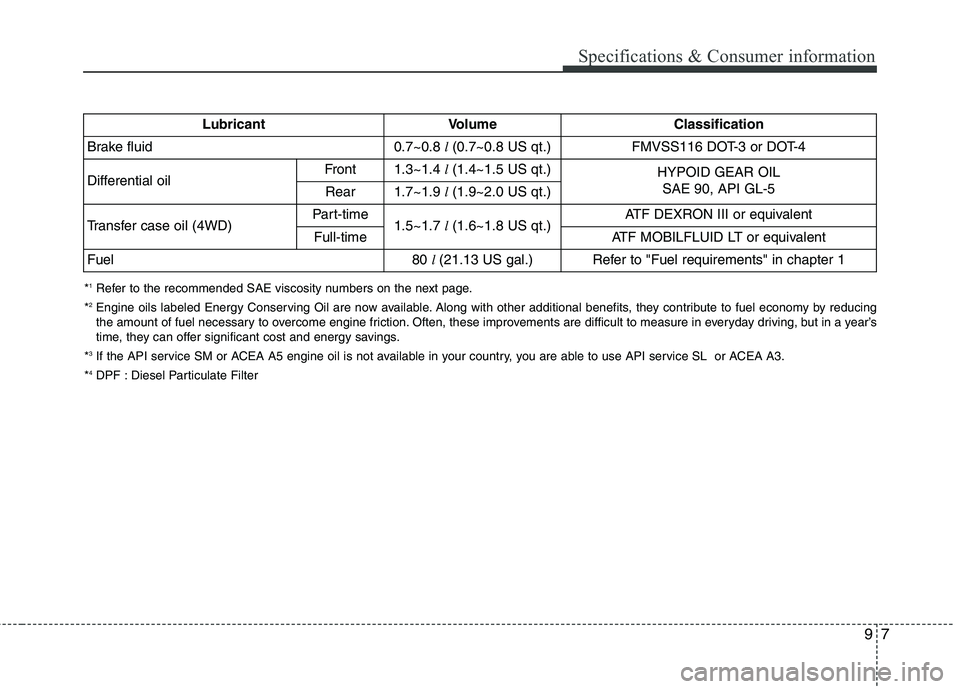
*1
Refer to the recommended SAE viscosity numbers on the next page.
* 2
Engine oils labeled Energy Conserving Oil are now available. Along with other additional benefits, they contribute to fuel econo my by reducing
the amount of fuel necessary to overcome engine friction. Often, these improvements are difficult to measure in everyday driving, but in a year’s
time, they can offer significant cost and energy savings.
* 3
If the API service SM or ACEA A5 engine oil is not available in your country, you are able to use API service SL or ACEA A3.
* 4
DPF : Diesel Particulate Filter Lubricant Volume Classification
Brake fluid 0.7~0.8
l (0.7~0.8 US qt.)
FMVSS116 DOT-3 or DOT-4
Differential oil
Front 1.3~1.4
l (1.4~1.5 US qt.)
HYPOID GEAR OIL
SAE 90, API GL-5
Rear 1.7~1.9
l (1.9~2.0 US qt.)
Transfer case oil (4WD)
Part-time 1.5~1.7 l (1.6~1.8 US qt.) ATF DEXRON III or equivalent
Full-time
ATF MOBILFLUID LT or equivalent
Fuel 80
l (21.13 US gal.)
Refer to "Fuel requirements" in chapter 1
Page 532 of 548
Specifications & Consumer information
8
9
Recommended SAE viscosity
number
Engine oil viscosity (thickness) has
an effect on fuel economy and cold
weather operating (engine start and
engine oil flowability). Lower viscosi-
ty engine oils can provide better fuel
economy and cold weather perform-
ance, however, higher viscosity
engine oils are required for satisfac-
tory lubrication in hot weather. Using
oils of any viscosity other than thoserecommended could result in engine
damage.
CAUTION
Always be sure to clean the area
around any filler plug, drainplug, or dipstick before check- ing or draining any lubricant.This is especially important industy or sandy areas and when the vehicle is used on unpavedroads. Cleaning the plug anddipstick areas will prevent dirt and grit from entering theengine and other mechanismsthat could be damaged.
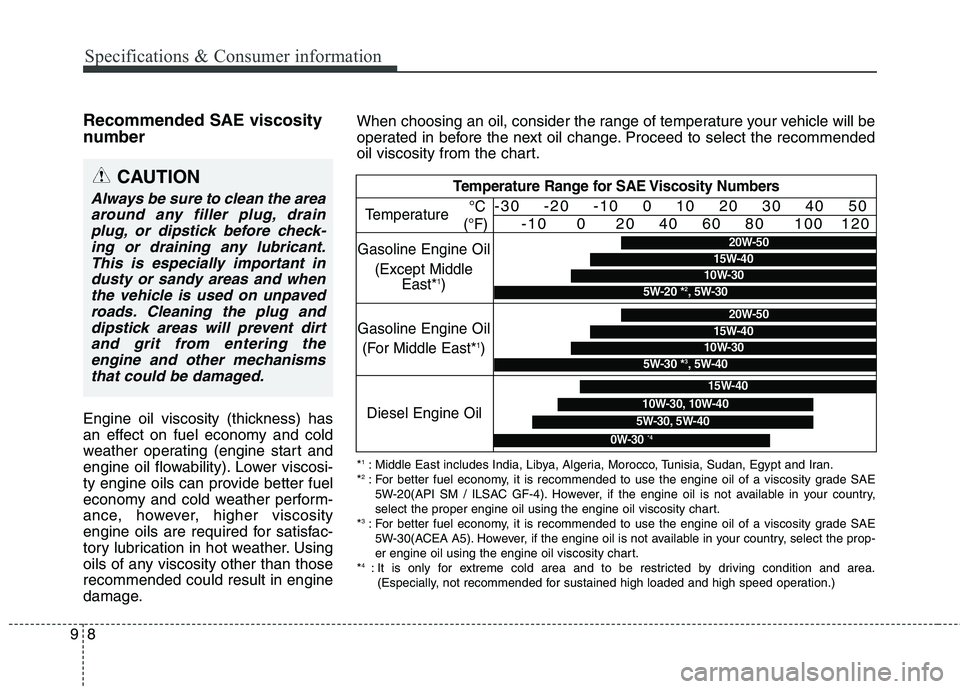
When choosing an oil, consider the range of temperature your vehicle will be
operated in before the next oil change. Proceed to select the recommended
oil viscosity from the chart.
Temperature Range for SAE Viscosity Numbers
Temperature
Gasoline Engine Oil (Except Middle East* 1
)
Gasoline Engine Oil (For Middle East* 1
)
°C
(°F)-30 -20 -10 0 10 20 30 40 50 -10 0 20 40 60 80 100 120
*1
: Middle East includes India, Libya, Algeria, Morocco, Tunisia, Sudan, Egypt and Iran.
* 2
: For better fuel economy, it is recommended to use the engine oil of a viscosity grade SAE
5W-20(API SM / ILSAC GF-4). However, if the engine oil is not available in your country,
select the proper engine oil using the engine oil viscosity chart.
* 3
: For better fuel economy, it is recommended to use the engine oil of a viscosity grade SAE
5W-30(ACEA A5). However, if the engine oil is not available in your country, select the prop-
er engine oil using the engine oil viscosity chart.
* 4
: It is only for extreme cold area and to be restricted by driving condition and area.
(Especially, not recommended for sustained high loaded and high speed operation.)
20W-50
10W-30
15W-40
5W-20 * 2
, 5W-30
20W-50
10W-30
15W-40
5W-30 * 3
, 5W-40
Diesel Engine Oil5W-30, 5W-40
15W-40
10W-30, 10W-40
0W-30 *4