power steering KIA BORREGO 2017 Owners Manual
[x] Cancel search | Manufacturer: KIA, Model Year: 2017, Model line: BORREGO, Model: KIA BORREGO 2017Pages: 548, PDF Size: 36.78 MB
Page 14 of 548
Your vehicle at a glance
4
2
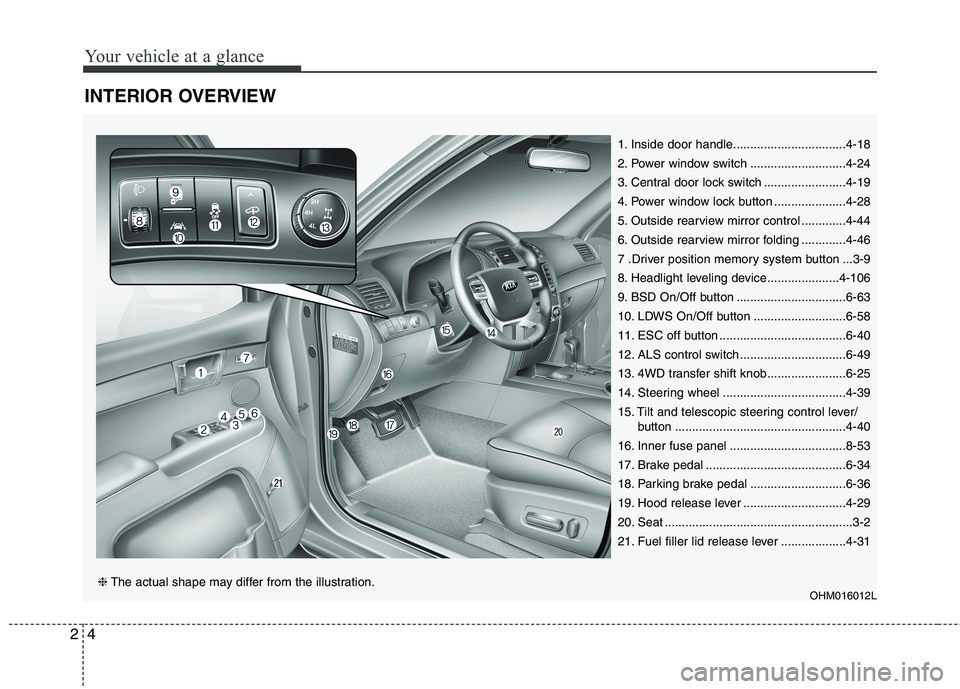
INTERIOR OVERVIEW
1. Inside door handle.................................4-18
2. Power window switch ............................4-24
3. Central door lock switch ........................4-19
4. Power window lock button .....................4-28
5. Outside rearview mirror control .............4-44
6. Outside rearview mirror folding .............4-46
7 .Driver position memory system button ...3-9
8. Headlight leveling device .....................4-106
9. BSD On/Off button ................................6-63
10. LDWS On/Off button ...........................6-58
11. ESC off button .....................................6-40
12. ALS control switch ...............................6-49
13. 4WD transfer shift knob.......................6-25
14. Steering wheel ....................................4-39
15. Tilt and telescopic steering control lever/
button ..................................................4-40
16. Inner fuse panel ..................................8-53
17. Brake pedal .........................................6-34
18. Parking brake pedal ............................6-36
19. Hood release lever ..............................4-29
20. Seat .......................................................3-2
21. Fuel filler lid release lever ...................4-31
OHM016012L
❈The actual shape may differ from the illustration.
Page 16 of 548
Your vehicle at a glance
6
2
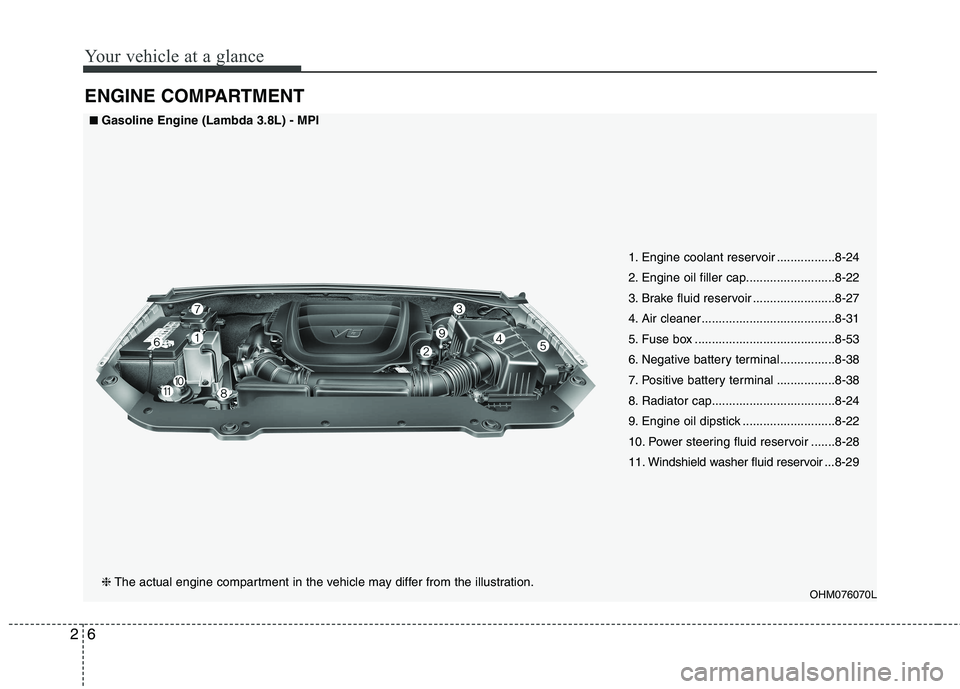
ENGINE COMPARTMENT
OHM076070L
■■
Gasoline Engine (Lambda 3.8L) - MPI
❈ The actual engine compartment in the vehicle may differ from the illustration. 1. Engine coolant reservoir .................8-24
2. Engine oil filler cap..........................8-22
3. Brake fluid reservoir ........................8-27
4. Air cleaner .......................................8-31
5. Fuse box .........................................8-53
6. Negative battery terminal ................8-38
7. Positive battery terminal .................8-38
8. Radiator cap....................................8-24
9. Engine oil dipstick ...........................8-22
10. Power steering fluid reservoir .......8-28
11. Windshield washer fluid reservoir ...
8-29
Page 17 of 548
27
Your vehicle at a glance
OHM076071L
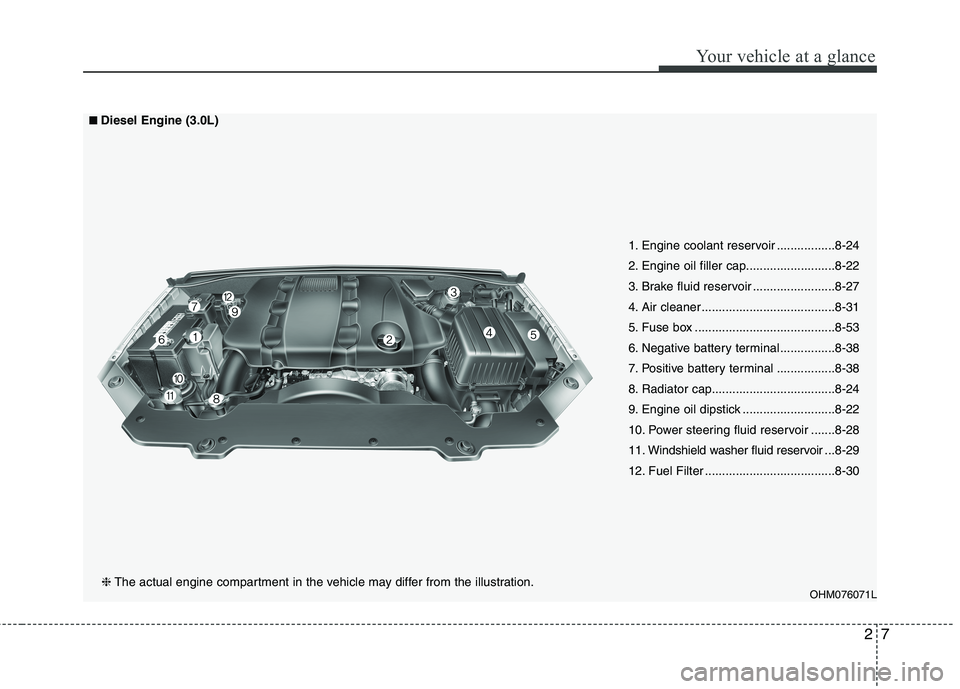
■■Diesel Engine (3.0L)
❈ The actual engine compartment in the vehicle may differ from the illustration. 1. Engine coolant reservoir .................8-24
2. Engine oil filler cap..........................8-22
3. Brake fluid reservoir ........................8-27
4. Air cleaner .......................................8-31
5. Fuse box .........................................8-53
6. Negative battery terminal ................8-38
7. Positive battery terminal .................8-38
8. Radiator cap....................................8-24
9. Engine oil dipstick ...........................8-22
10. Power steering fluid reservoir .......8-28
11. Windshield washer fluid reservoir ...
8-29
12. Fuel Filter ......................................8-30
Page 24 of 548
37
Safety features of your vehicle
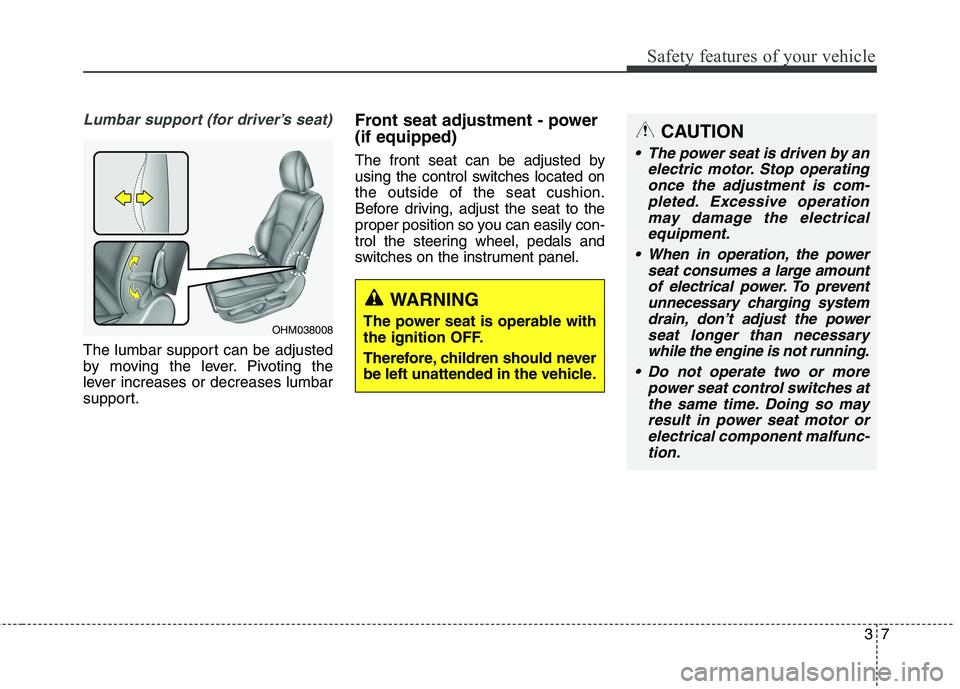
Lumbar support (for driver’s seat)
The lumbar support can be adjusted
by moving the lever. Pivoting the
lever increases or decreases lumbar
support.Front seat adjustment - power (if equipped)
The front seat can be adjusted by
using the control switches located onthe outside of the seat cushion.
Before driving, adjust the seat to the
proper position so you can easily con-
trol the steering wheel, pedals and
switches on the instrument panel.
OHM038008
WARNING
The power seat is operable with
the ignition OFF.
Therefore, children should never
be left unattended in the vehicle.
CAUTION
The power seat is driven by an electric motor. Stop operatingonce the adjustment is com- pleted. Excessive operationmay damage the electricalequipment.
When in operation, the power seat consumes a large amountof electrical power. To preventunnecessary charging systemdrain, don’t adjust the power seat longer than necessarywhile the engine is not running.
Do not operate two or more power seat control switches atthe same time. Doing so may result in power seat motor orelectrical component malfunc-tion.
Page 26 of 548
39
Safety features of your vehicle
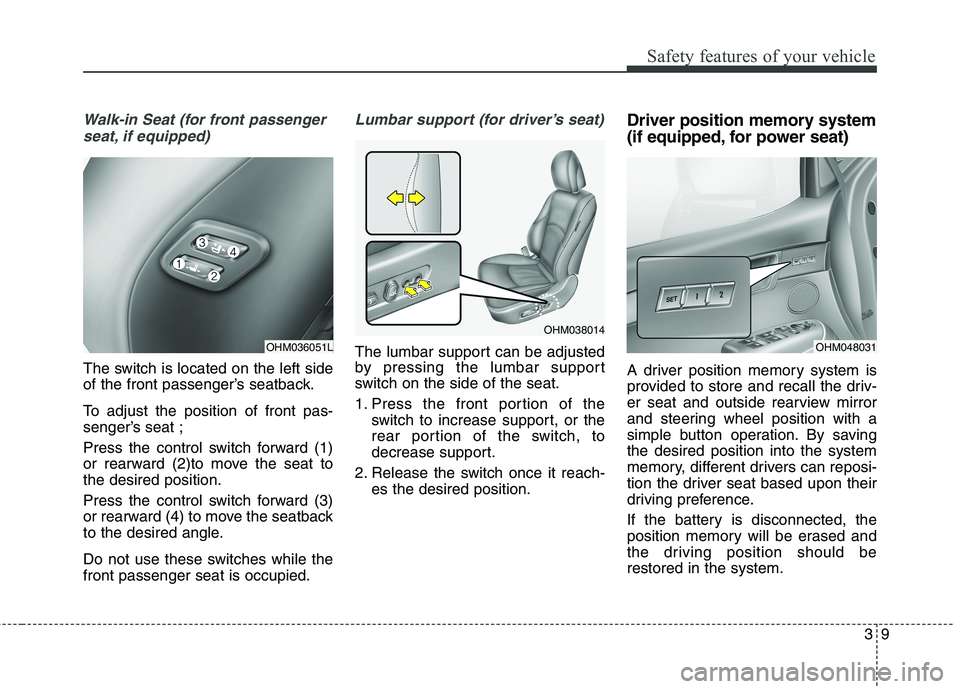
Walk-in Seat (for front passengerseat, if equipped)
The switch is located on the left side
of the front passenger’s seatback.
To adjust the position of front pas-
senger’s seat ;
Press the control switch forward (1)
or rearward (2)to move the seat tothe desired position.
Press the control switch forward (3)
or rearward (4) to move the seatback
to the desired angle.
Do not use these switches while the front passenger seat is occupied.
Lumbar support (for driver’s seat)
The lumbar support can be adjusted
by pressing the lumbar support
switch on the side of the seat.
1. Press the front portion of the switch to increase support, or the
rear portion of the switch, to
decrease support.
2. Release the switch once it reach- es the desired position. Driver position memory system
(if equipped, for power seat)
A driver position memory system is
provided to store and recall the driv-
er seat and outside rearview mirror
and steering wheel position with a
simple button operation. By savingthe desired position into the system
memory, different drivers can reposi-
tion the driver seat based upon their
driving preference.
If the battery is disconnected, the
position memory will be erased and
the driving position should berestored in the system.OHM036051L
OHM038014
OHM048031
Page 128 of 548

439
Features of your vehicle
Power steering
Power steering uses energy from the
engine to assist you in steering the
vehicle. If the engine is off or if the
power steering system becomes
inoperative, the vehicle may still be
steered, but it will require increased
steering effort.
Should you notice any change in the
effort required to steer during normal
vehicle operation, we recommend
that the system be checked by an
authorized Kia dealer.✽✽NOTICE
If the power steering drive belt
breaks or if the power steering
pump malfunctions, the steering
effort will greatly increase.
✽
✽ NOTICE
If the vehicle is parked for extended
periods o utside in cold weather (below
-10°C(14°F)), the power steering may
require increased effort when the
engine is first started. This is caused by
increased fluid viscosity due to the cold
weather and does not indicate a mal-
function.
When this happens, increase the
engine RPM by depressing the accel-
erator until the RPM reaches 1,500
rpm then release or let the engine idle
for two or three minutes to warm up
the fluid.
Tilt steering
Tilt steering allows you to adjust the
steering wheel before you drive. You
can also raise it to give your legs
more room when you exit and enter
the vehicle.
The steering wheel should be posi-
tioned so that it is comfortable for
you to drive, while permitting you to
see the instrument panel warning
lights and gauges.
STEERING WHEEL
CAUTION
Never hold the steering wheel to
the extreme right or left for morethan 5 seconds with the engine running. Holding the steeringwheel for more than 5 secondsin either position may cause damage to the power steeringpump.
WARNING
Never adjust the angle of the steering wheel while driving.
You may lose steering control
and cause severe personal
injury, death or accidents.
After adjusting, push the steering wheel both up and
down to be certain it is lockedin position.
Page 145 of 548
Features of your vehicle
56
4
Distance To Empty (1)
The distance to empty is the esti-
mated distance the vehicle can be
driven with the remaining fuel.
- Distance range: 1~9,999 km or1~9,999 mi.
If the estimated distance is below 1 km (1 mi.), the trip computer will dis-
play "---" as distance to empty.
✽✽ NOTICE
If the vehicle is not on level ground or the battery power has been
interrupted, the distance to empty
function may not operate correctly.
The distance to empty may differ from the actual driving distance as
it is an estimate of the available
driving distance.
The trip computer may not regis- ter additional fuel if less than 6
liters (1.6 gallons) of fuel are
added to the vehicle.
The fuel economy and distance to empty may vary significantly based
on driving conditions, driving
habits, and condition of the vehicle.
Average Fuel Economy (2)
The average fuel economy is calcu-lated by the total driving distance and fuel consumption since the last
average fuel economy reset.
- Fuel economy range: 0.0 ~ 99.9L/100km or MPG
The average fuel economy can be reset both manually and automati-
cally.
Manual reset
To clear the average fuel economy
manually, press the OK button
(reset) on the steering wheel for
more than 1 second when the aver-
age fuel economy is displayed. Automatic reset
To make the average fuel economy
be reset automatically whenever
refueling, select the "Fuel economyauto reset" mode in User Setting
menu of the LCD display (Refer to
"LCD Display").
OFF - You may set to default manu-
ally by using the trip switch reset but- ton.
When driving - The vehicle will auto- matically set to default once 4 hours
pass after the Ignition is in OFF.
When refueling - After refueling more than 6 liters and driving over
1km/h, the vehicle will reset to
default automatically.
✽✽ NOTICE
The average fuel economy is not dis-
played for more accurate calculation
if the vehicle does not drive more than
10 seconds or 50 meters (0.03 miles)
since the ignition switch or Engine
Start/Stop button is turned to ON.
Page 334 of 548

Driving your vehicle
10
6
ENGINE START/STOP BUTTON (IF EQUIPPED)
Illuminated engine start/stop
button
Whenever the front door is opened,
the engine start/stop button will illu-
minate for your convenience. Thelight will go off after about 30 sec-
onds when the door is closed. It willalso go off immediately when the
engine start/stop button is ON posi-tion. Engine start/stop button posi- tion
OFF
To turn off the engine (START/RUN
position) or vehicle power (ON posi-
tion), press the engine start/stop but-
ton with the shift lever in the P (Park)
position. When you press the engine
start/stop button without the shift
lever in the P (Park) position, the
engine start/stop button will not
change to the OFF position but to the
ACC position.
Vehicles equipped with anti-theft
steering column lock
The steering wheel locks when the
engine start/stop button is in the OFF
position to protect you against theft.
It locks when the door is opened.
If the steering wheel is not locked
properly when you open the driver's
door, the warning chime will sound.
Try locking the steering wheel again.
If the problem is not solved, we rec-
ommend that the system be checked
by an authorized Kia dealer.
In addition, if the engine start/stop
button is in the OFF position after the
driver's door is opened, the steering
wheel will not lock and the warning
chime will sound. In such a situation,
close the door. Then the steering
wheel will lock and the warning
chime will stop.
OHM056001
Not illuminated
Page 335 of 548

611
Driving your vehicle
✽✽
NOTICE
If the steering wheel doesn't unlock
properly, the engine start/stop but-
ton will not work. Press the engine
start/stop button while turning the
steering wheel right and left to
release the tension. ACC(Accessory)
Press the engine start/stop button while it is in the OFF position without
depressing the brake pedal.
The steering wheel unlocks and
electrical accessories are opera-tional.
If the engine start/stop button is in
the ACC position for more than 1
hour, the button is turned off auto-
matically to prevent battery dis-
charge.
ON
Press the engine start/stop button
while it is in the ACC position without
depressing the brake pedal.
The warning lights can be checked
before the engine is started. Do not
leave the engine start/stop button in
the ON position for a long time. The
battery may discharge, because the
engine is not running.
CAUTION
You are able to turn off the engine (START/RUN) or vehiclepower (ON), only when the vehi- cle is not in motion. In an emer-gency situation while the vehi-cle is in motion, you are able to turn the engine off and to theACC position by pressing theengine start/stop button for more than 2 seconds or 3 timessuccessively within 3 seconds.If the vehicle is still moving, youcan restart the engine without depressing the brake pedal bypressing the engine start/stopbutton with the shift lever in the N (Neutral) position.
Orange indicatorGreen indicator
Page 347 of 548
623
Driving your vehicle
Engine power can be delivered to all
front and rear wheels for maximum
traction. 4WD is useful when extra
traction is required on road, such as,
when driving on slippery, muddy,
wet, or snow-covered roads. These
vehicles are not designed for chal-
lenging off-road use. Occasional off-
road use such as established
unpaved roads and trails are OK. It is
always important when traveling off-
highway that the driver carefully
reduces the speed to a level that
does not exceed the safe operating
speed for those conditions. In gener-
al, off-road conditions provide less
traction and braking effectiveness
than normal road conditions. The
driver must be especially alert to
avoid driving on slopes which tilt the
vehicle to either side.
These factors must be carefully con-
sidered when driving off-road. Keeping
the vehicle in contact with the driving
surface and under control in these
conditions is always the driver's
responsibility for the safety of him/her-
self and his or her passengers.FOUR WHEEL DRIVE (4WD) (IF EQUIPPED)
WARNING -
Off road driving
This vehicle is designed prima-
rily for on road use although it
can operate effectively off road.
However, it was not designed to
drive in challenging off-road
conditions. Driving in condi-
tions that exceed the vehicle'sintended design or the driver's
experience level may result in
severe injury or death.CAUTION
Do not select four wheel drive on flat and normal roads.
Four-wheel driving on flat roads for a long period causespoor fuel economy and noiseand it also causes tires towear faster.
Four-wheel driving on flat and normal roads can result in asevere binding and chatteringcondition when turning thesteering wheel.
Four-wheel driving on flat roads for a long period canalso cause the differential oiltemperature to increase,resulting in damage to parts in the power train.