recommended oil KIA BORREGO 2017 Owners Manual
[x] Cancel search | Manufacturer: KIA, Model Year: 2017, Model line: BORREGO, Model: KIA BORREGO 2017Pages: 548, PDF Size: 36.78 MB
Page 9 of 548
Introduction
6
1
Diesel engine
Diesel fuel
Diesel engine must be operated only
on commercially available diesel fuelthat complies with EN 590 or compa-
rable standard. (EN stands for
"European Norm"). Do not use
marine diesel fuel, heating oils, or
non-approved fuel additives, as this
will increase wear and cause dam-age to the engine and fuel system.
The use of non-approved fuels and /
or fuel additives will result in a limita-
tion of your warranty rights.
Diesel fuel of above cetane 51 is
used in your vehicle. If two types of
diesel fuel are available, use summer
or winter fuel properly according to
the following temperature conditions.
Summer type
diesel fuel.
Winter type diesel fuel.
Watch the fuel level in the tank very
carefully : If the engine stops through
fuel failure, the circuits must be com-
pletely purged to restart.
Biodiesel
Commercially supplied Diesel blends of no more than 7% biodiesel, com-
monly known as "B7 Diesel" may be
used in your vehicle if Biodiesel meets
EN 14214 or equivalent specifications.
(EN stands for "European Norm"). The
use of biofuels exceeding 7% made
from rapeseed methyl ester (RME),
fatty acid methyl ester (FAME), veg-
etable oil methyl ester (VME) etc. or
mixing diesel exceeding 7% with
biodiesel will cause increased wear ordamage to the engine and fuel sys-
tem. Repair or replacement of worn ordamaged components due to the use
of non approved fuels will not be cov-
ered by the manufactures warranty.
CAUTION
Never use any fuel, whether diesel or B7 biodiesel or oth-erwise, that fails to meet the latest petroleum industryspecification.
Never use any fuel additives or treatments that are not rec-ommended or approved by the vehicle manufacturer.
CAUTION
Do not let any gasoline or waterenter the tank. This would makeit necessary to drain it out and to bleed the lines to avoid jam-ming the injection pump anddamaging the engine.
CAUTION - Diesel Fuel
(if equipped with DPF)
It is recommended to use the regulated automotive diesel fuelfor diesel vehicle equipped with the DPF system.
If you use diesel fuel includinghigh sulfur (more than 50 ppmsulfur) and unspecified addi-tives, it can cause the DPF sys- tem to be damaged and whitesmoke can be emitted.
Page 402 of 548
Driving your vehicle
78
6
Use high quality ethylene gly- col coolant
Your vehicle is delivered with high
quality ethylene glycol coolant in the
cooling system. It is the only type ofcoolant that should be used because
it helps prevent corrosion in the cool-
ing system, lubricates the water
pump and prevents freezing. Be sure
to replace or replenish your coolantin accordance with the maintenance
schedule in chapter 8. Before winter,
have your coolant tested to assure
that its freezing point is sufficient for
the temperatures anticipated during
the winter.
Check battery and cables
Winter puts additional burdens on
the battery system. Visually inspect
the battery and cables as described
in chapter 8. We recommend that the
level of charge in your battery be
checked by an authorized Kia dealer. Change to "winter weight" oil
if necessary In some climates it is recommended
that a lower viscosity "winter weight"
oil be used during cold weather. See
chapter 9 for recommendations. If
you aren't sure what weight oil you
should use, we recommend that you
consult an authorized Kia dealer.
Check spark plugs and ignition system
Inspect your spark plugs as
described in chapter 8 and replace
them if necessary. Also check all
ignition wiring and components to be
sure they are not cracked, worn or
damaged in any way.
To keep locks from freezing
To keep the locks from freezing,
squirt an approved de-icer fluid or
glycerine into the key opening. If a
lock is covered with ice, squirt it with
an approved de-icing fluid to remove
the ice. If the lock is frozen internally,
you may be able to thaw it out by
using a heated key. Handle the heat-
ed key with care to avoid injury.
Use approved window washer
anti-freeze in system
To keep the water in the window
washer system from freezing, add an
approved window washer anti-freeze
solution in accordance with instruc-
tions on the container. Window wash-
er anti-freeze is available from an
authorized Kia dealer and most auto
parts outlets. Do not use engine
coolant or other types of anti-freeze
as these may damage the paint fin-ish.
Page 459 of 548
823
Maintenance
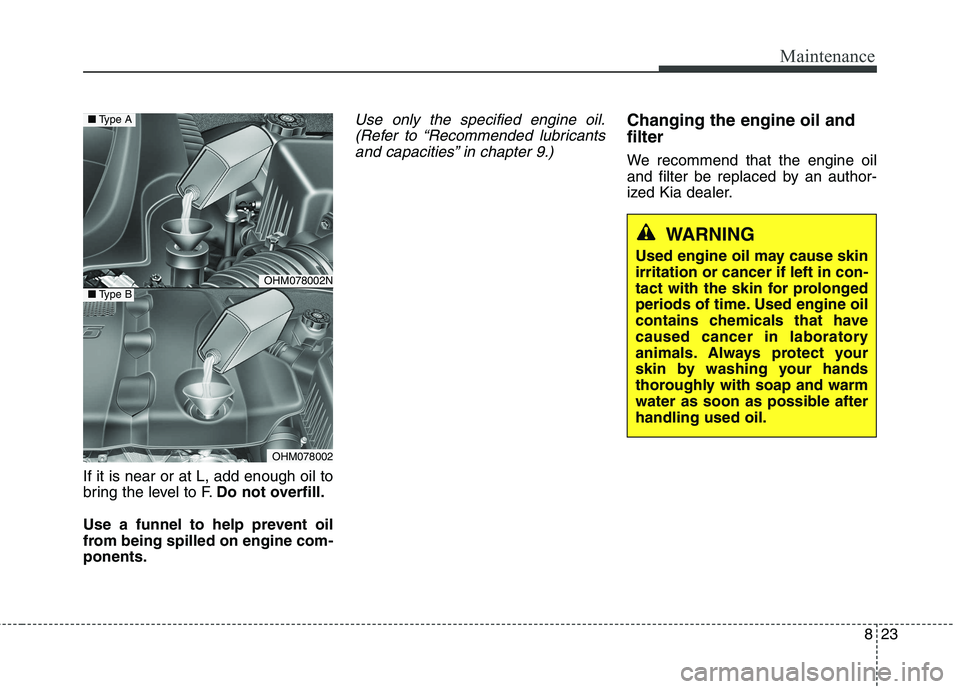
If it is near or at L, add enough oil to
bring the level to F.Do not overfill.
Use a funnel to help prevent oil
from being spilled on engine com-ponents.
Use only the specified engine oil. (Refer to “Recommended lubricantsand capacities” in chapter 9.)Changing the engine oil and filter
We recommend that the engine oil
and filter be replaced by an author-
ized Kia dealer.
WARNING
Used engine oil may cause skin irritation or cancer if left in con-
tact with the skin for prolonged
periods of time. Used engine oil
contains chemicals that have
caused cancer in laboratory
animals. Always protect your
skin by washing your hands
thoroughly with soap and warm
water as soon as possible afterhandling used oil.
OHM078002N
OHM078002
■ Type A
■Type B
Page 463 of 548
827
Maintenance
BRAKE FLUID
Checking the brake fluid level
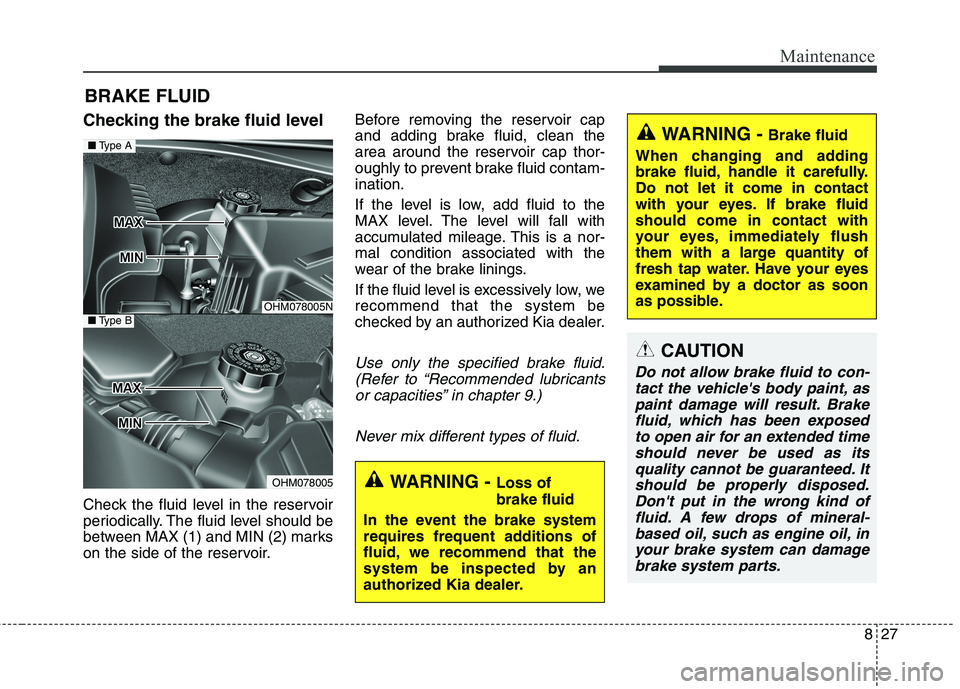
Check the fluid level in the reservoir
periodically. The fluid level should be
between MAX (1) and MIN (2) marks
on the side of the reservoir. Before removing the reservoir cap
and adding brake fluid, clean the
area around the reservoir cap thor-
oughly to prevent brake fluid contam-ination.
If the level is low, add fluid to the
MAX level. The level will fall with
accumulated mileage. This is a nor-mal condition associated with the
wear of the brake linings.
If the fluid level is excessively low, we recommend that the system be
checked by an authorized Kia dealer.
Use only the specified brake fluid.
(Refer to “Recommended lubricantsor capacities” in chapter 9.)
Never mix different types of fluid.
WARNING - Brake fluid
When changing and adding
brake fluid, handle it carefully.Do not let it come in contact
with your eyes. If brake fluidshould come in contact with
your eyes, immediately flush
them with a large quantity of
fresh tap water. Have your eyes
examined by a doctor as soon
as possible.
WARNING - Loss of brake fluid
In the event the brake system
requires frequent additions of
fluid, we recommend that the
system be inspected by an
authorized Kia dealer.
CAUTION
Do not allow brake fluid to con- tact the vehicle's body paint, aspaint damage will result. Brakefluid, which has been exposed to open air for an extended timeshould never be used as itsquality cannot be guaranteed. It should be properly disposed.Don't put in the wrong kind offluid. A few drops of mineral- based oil, such as engine oil, inyour brake system can damagebrake system parts.
OHM078005N
OHM078005
■ Type A
■Type B
Page 464 of 548
Maintenance
28
8
POWER STEERING FLUID
Checking the power steering
fluid level
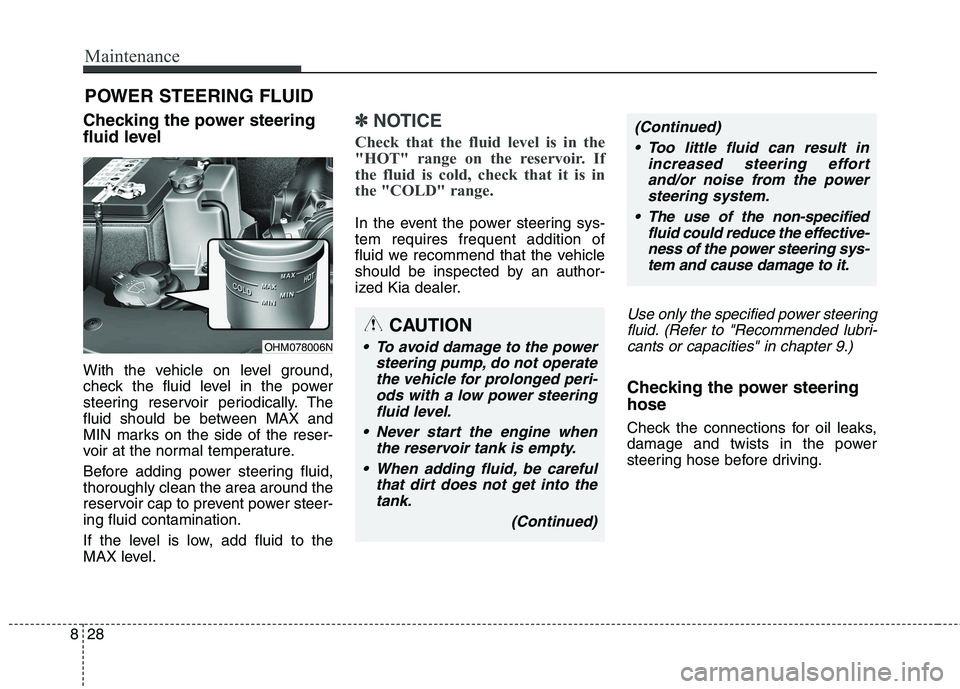
With the vehicle on level ground,
check the fluid level in the power
steering reservoir periodically. The
fluid should be between MAX and
MIN marks on the side of the reser-
voir at the normal temperature.
Before adding power steering fluid, thoroughly clean the area around the
reservoir cap to prevent power steer-ing fluid contamination.
If the level is low, add fluid to the
MAX level.
✽✽ NOTICE
Check that the fluid level is in the
"HOT" range on the reservoir. If
the fluid is cold, check that it is in
the "COLD" range.
In the event the power steering sys- tem requires frequent addition of
fluid we recommend that the vehicle
should be inspected by an author-
ized Kia dealer.
Use only the specified power steering fluid. (Refer to "Recommended lubri-cants or capacities" in chapter 9.)
Checking the power steering hose
Check the connections for oil leaks,
damage and twists in the power
steering hose before driving.
CAUTION
To avoid damage to the power steering pump, do not operatethe vehicle for prolonged peri-ods with a low power steeringfluid level.
Never start the engine when the reservoir tank is empty.
When adding fluid, be careful that dirt does not get into thetank.
(Continued)
(Continued) Too little fluid can result in increased steering effortand/or noise from the power steering system.
The use of the non-specified fluid could reduce the effective-ness of the power steering sys-tem and cause damage to it.
OHM078006N
Page 519 of 548
883
Maintenance
Interior care
Interior general precautions
Prevent chemicals such as perfume, cosmetic oil, sun cream, hand clean-
er, and air freshener from contacting
the interior parts because they may
cause damage or discoloration. If
they do contact the interior parts,
wipe them off immediately. If neces-
sary, use a vinyle cleaner, see
instructions for correct usage.
Cleaning the upholstery and inte-rior trim
Vinyl
Remove dust and loose dirt from
vinyl with a whisk broom or vacuum
cleaner. Clean vinyl surfaces with a
vinyl cleaner.
Fabric
Remove dust and loose dirt from fab-
ric with a whisk broom or vacuum
cleaner. Clean with a mild soap solu-
tion recommended for upholstery or
carpets. Remove fresh spots imme-
diately with a fabric spot cleaner. If
fresh spots do not receive immediate
attention, the fabric can be stained
and its color can be affected. Also, its
fire-resistant properties can be
reduced if the material is not proper-ly maintained.
CAUTION - Nappa leather
seat cover (If equipped)
Nappa leather retains the hide’s own soft texture with visiblepores, scars or blood vessels, etc. Pressure marks or wrinklesmay be made when used.Prolonged exposure to sunlight or heat may cause discol-oration. These things occur dueto the natural characteristics ofcowhides. If the leather is exposed to rain or gets wet,remove water with a dry clothand dry the leather in the shade to minimize damage. Make sureto keep sharp objects away fromthe leather as these can create scratches on the surface. Forlight-colored leather, be carefulof spots or color transfer, such as from jeans.
CAUTION
Using anything but recommend-ed cleaners and procedures mayaffect the fabric’s appearance and fire-resistant properties.
CAUTION
Never allow water or other liq-uids to come in contact withelectrical/electronic compo- nents inside the vehicle as thismay damage them.
CAUTION
When cleaning leather products(steering wheel, seats etc.), useneutral detergents or low alco- hol content solutions. If you usehigh alcohol content solutionsor acid/alkaline detergents, the color of the leather may fade orthe surface may get stripped off.
Page 520 of 548
Maintenance
84
8
Cleaning the lap/shoulder belt
webbing
Clean the belt webbing with any mild
soap solution recommended for
cleaning upholstery or carpet. Follow
the instructions provided with the
soap. Do not bleach or re-dye the
webbing because this may weaken it.
Cleaning the interior windowglass
If the interior glass surfaces of the
vehicle become fogged (that is, cov-
ered with an oily, greasy or waxy
film), they should be cleaned with a
glass cleaner. Follow the directions
on the glass cleaner container.
Leather seat cover using precau-tions (If equipped)
Natural leather has visible pores,
scars or blood vessels, etc. Pressure
marks or wrinkles may be made
when used. Prolonged exposure to
sunlight or heat may cause discol-
oration. These things occur due to
the natural characteristics of
cowhides. If the leather is exposed to
rain or gets wet, remove water with a
dry cloth and dry the leather in the
shade to minimize damage. Make
sure to keep sharp objects awayfrom the leather as these can create
scratches on the surface. For light-
colored leather, be careful of spots or
color transfer, such as from jeans.
Fabric seat cover using precau-tions (if equipped)
Please clean the fabric seats regu-
larly with a vacuum cleaner in con-
sideration of fabric material charac-
teristics. If they are heavily soiled
with beverage stains, etc., use a suit-
able interior cleaner. To prevent dam-
age to seat covers, wipe off the seat
covers down to the seams with a
large wiping motion and moderatepressure using a soft sponge ormicrofiber cloth.
Velcro closures on clothing or sharp
objects may cause snagging or
scratches on the surface of the
seats. Make sure not to rub such
objects against the surface.
CAUTION
Do not scrape or scratch theinside of the rear window. Thismay result in damage of the rear window defroster grid.
Page 530 of 548
Specifications & Consumer information
6
9
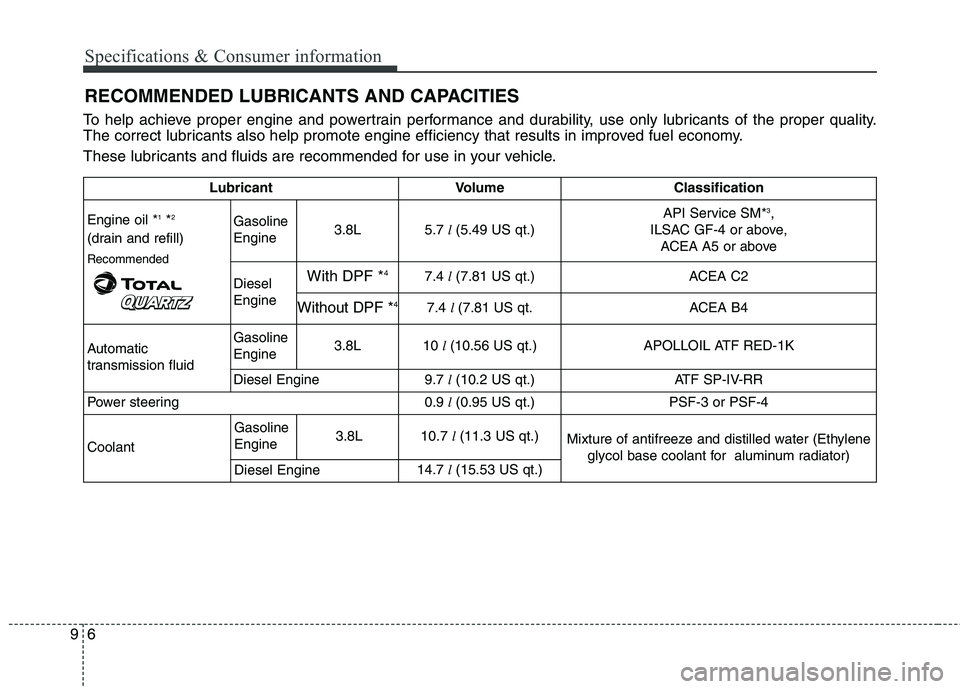
RECOMMENDED LUBRICANTS AND CAPACITIES
To help achieve proper engine and powertrain performance and durability, use only lubricants of the proper quality.
The correct lubricants also help promote engine efficiency that results in improved fuel economy.
These lubricants and fluids are recommended for use in your vehicle.
Lubricant Volume Classification
Engine oil * 1
*2
(drain and refill) Recommended Gasoline Engine
3.8L
5.7
l (5.49 US qt.) API Service SM*
3
,
ILSAC GF-4 or above, ACEA A5 or above
Diesel EngineWith DPF * 47.4
l (7.81 US qt.)ACEA C2
Without DPF * 47.4
l (7.81 US qt.ACEA B4
Automatic
transmission fluid GasolineEngine
3.8L
10
l (10.56 US qt.)
APOLLOIL ATF RED-1K
Diesel Engine 9.7
l (10.2 US qt.)
ATF SP-IV-RR
Power steering 0.9
l (0.95 US qt.)
PSF-3 or PSF-4
Coolant Gasoline Engine
3.8L
10.7
l (11.3 US qt.)
Mixture of antifreeze and distilled water (Ethylene
glycol base coolant for aluminum radiator)
Diesel Engine 14.7
l (15.53 US qt.)
Page 531 of 548
97
Specifications & Consumer information
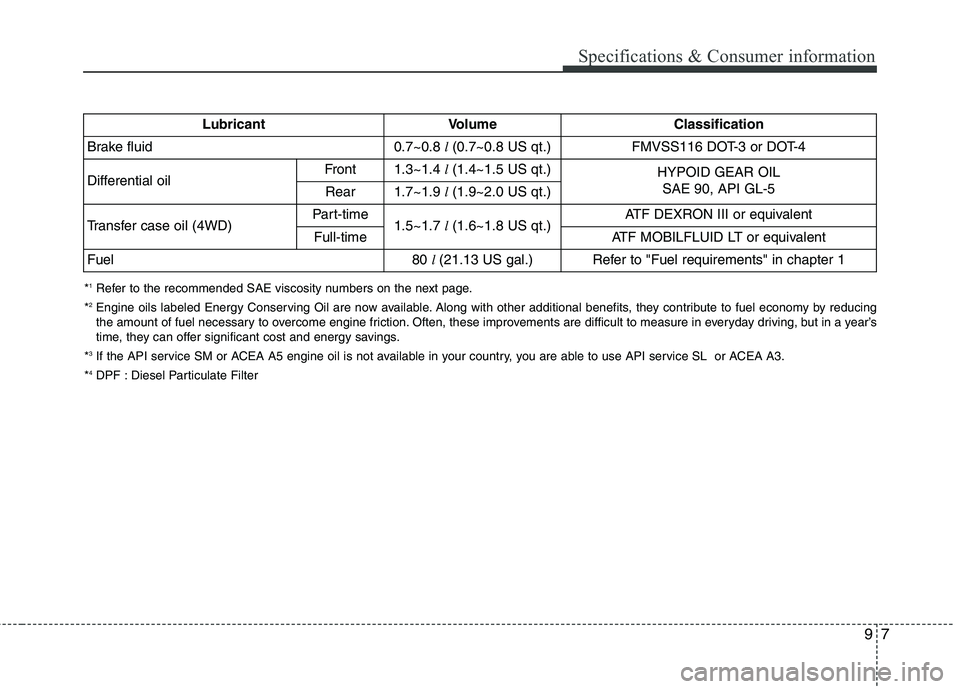
*1
Refer to the recommended SAE viscosity numbers on the next page.
* 2
Engine oils labeled Energy Conserving Oil are now available. Along with other additional benefits, they contribute to fuel econo my by reducing
the amount of fuel necessary to overcome engine friction. Often, these improvements are difficult to measure in everyday driving, but in a year’s
time, they can offer significant cost and energy savings.
* 3
If the API service SM or ACEA A5 engine oil is not available in your country, you are able to use API service SL or ACEA A3.
* 4
DPF : Diesel Particulate Filter Lubricant Volume Classification
Brake fluid 0.7~0.8
l (0.7~0.8 US qt.)
FMVSS116 DOT-3 or DOT-4
Differential oil
Front 1.3~1.4
l (1.4~1.5 US qt.)
HYPOID GEAR OIL
SAE 90, API GL-5
Rear 1.7~1.9
l (1.9~2.0 US qt.)
Transfer case oil (4WD)
Part-time 1.5~1.7 l (1.6~1.8 US qt.) ATF DEXRON III or equivalent
Full-time
ATF MOBILFLUID LT or equivalent
Fuel 80
l (21.13 US gal.)
Refer to "Fuel requirements" in chapter 1
Page 532 of 548
Specifications & Consumer information
8
9
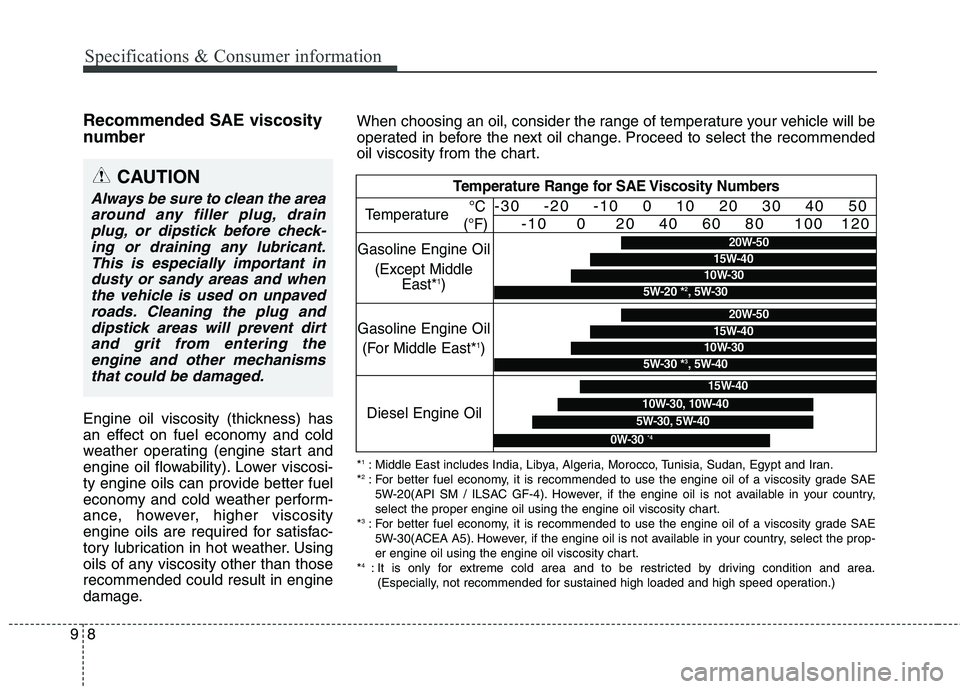
Recommended SAE viscosity
number
Engine oil viscosity (thickness) has
an effect on fuel economy and cold
weather operating (engine start and
engine oil flowability). Lower viscosi-
ty engine oils can provide better fuel
economy and cold weather perform-
ance, however, higher viscosity
engine oils are required for satisfac-
tory lubrication in hot weather. Using
oils of any viscosity other than thoserecommended could result in engine
damage.
CAUTION
Always be sure to clean the area
around any filler plug, drainplug, or dipstick before check- ing or draining any lubricant.This is especially important industy or sandy areas and when the vehicle is used on unpavedroads. Cleaning the plug anddipstick areas will prevent dirt and grit from entering theengine and other mechanismsthat could be damaged.
When choosing an oil, consider the range of temperature your vehicle will be
operated in before the next oil change. Proceed to select the recommended
oil viscosity from the chart.
Temperature Range for SAE Viscosity Numbers
Temperature
Gasoline Engine Oil (Except Middle East* 1
)
Gasoline Engine Oil (For Middle East* 1
)
°C
(°F)-30 -20 -10 0 10 20 30 40 50 -10 0 20 40 60 80 100 120
*1
: Middle East includes India, Libya, Algeria, Morocco, Tunisia, Sudan, Egypt and Iran.
* 2
: For better fuel economy, it is recommended to use the engine oil of a viscosity grade SAE
5W-20(API SM / ILSAC GF-4). However, if the engine oil is not available in your country,
select the proper engine oil using the engine oil viscosity chart.
* 3
: For better fuel economy, it is recommended to use the engine oil of a viscosity grade SAE
5W-30(ACEA A5). However, if the engine oil is not available in your country, select the prop-
er engine oil using the engine oil viscosity chart.
* 4
: It is only for extreme cold area and to be restricted by driving condition and area.
(Especially, not recommended for sustained high loaded and high speed operation.)
20W-50
10W-30
15W-40
5W-20 * 2
, 5W-30
20W-50
10W-30
15W-40
5W-30 * 3
, 5W-40
Diesel Engine Oil5W-30, 5W-40
15W-40
10W-30, 10W-40
0W-30 *4