power steering KIA CADENZA 2011 User Guide
[x] Cancel search | Manufacturer: KIA, Model Year: 2011, Model line: CADENZA, Model: KIA CADENZA 2011Pages: 352, PDF Size: 28.17 MB
Page 266 of 352
7
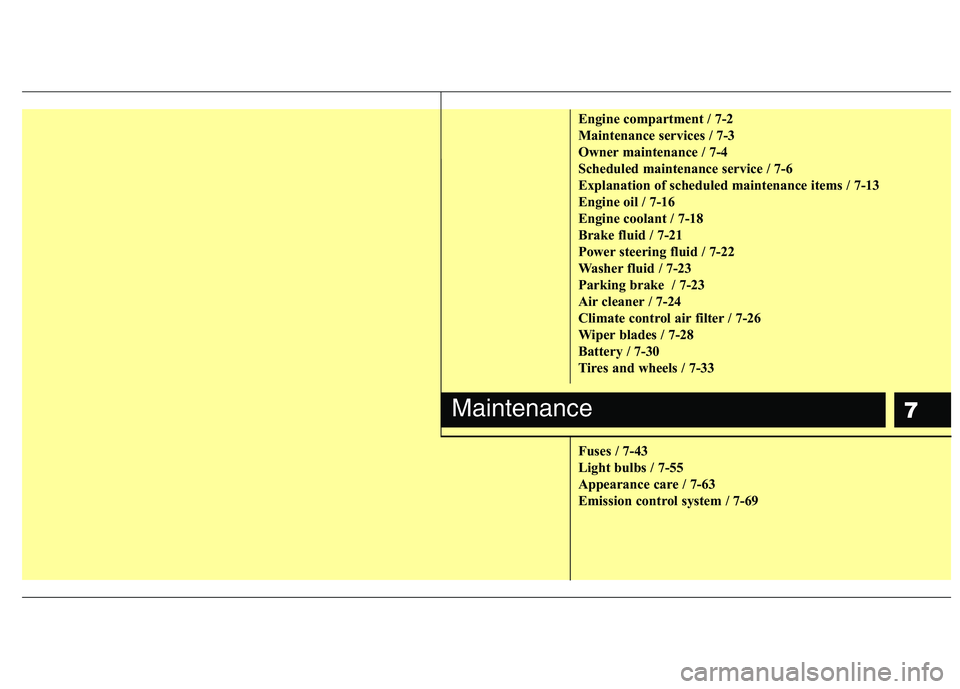
Engine compartment / 7-2
Maintenance services / 7-3
Owner maintenance / 7-4
Scheduled maintenance service / 7-6
Explanation of scheduled maintenance items / 7-13
Engine oil / 7-16
Engine coolant / 7-18
Brake fluid / 7-21
Power steering fluid / 7-22
Washer fluid / 7-23
Parking brake / 7-23
Air cleaner / 7-24
Climate control air filter / 7-26
Wiper blades / 7-28
Battery / 7-30
Tires and wheels / 7-33
Fuses / 7-43
Light bulbs / 7-55
Appearance care / 7-63
Emission control system / 7-69
Maintenance
Page 267 of 352
Maintenance
2
7
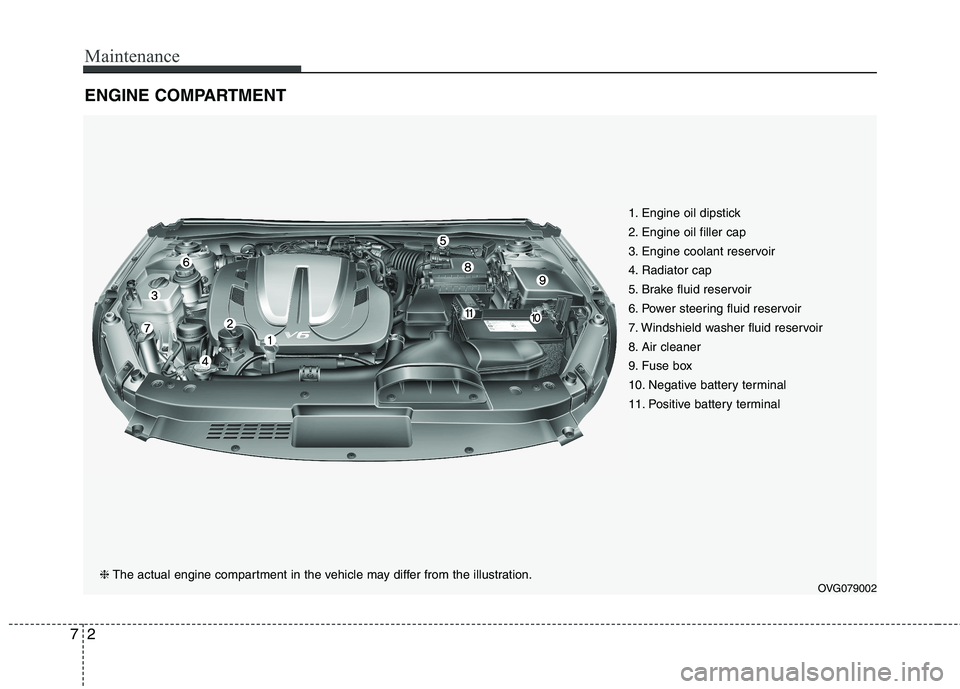
ENGINE COMPARTMENT
1. Engine oil dipstick
2. Engine oil filler cap
3. Engine coolant reservoir
4. Radiator cap
5. Brake fluid reservoir
6. Power steering fluid reservoir
7. Windshield washer fluid reservoir
8. Air cleaner
9. Fuse box
10. Negative battery terminal
11. Positive battery terminal
OVG079002
❈The actual engine compartment in the vehicle may differ from the illustration.
Page 271 of 352
Maintenance
6
7
SCHEDULED MAINTENANCE SERVICE
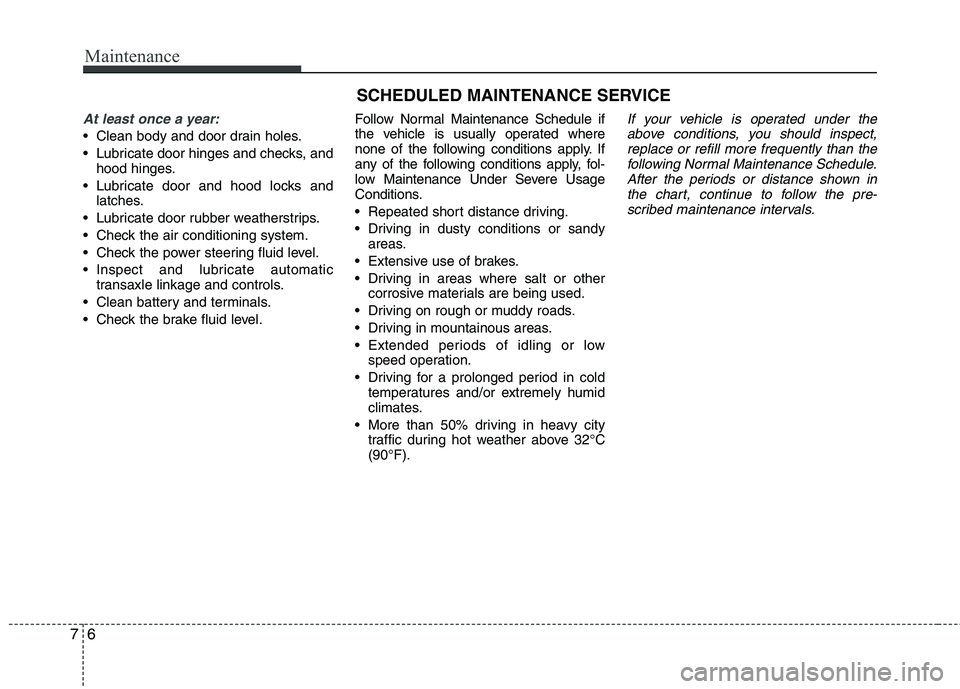
At least once a year:
Clean body and door drain holes.
Lubricate door hinges and checks, and
hood hinges.
Lubricate door and hood locks and latches.
Lubricate door rubber weatherstrips.
Check the air conditioning system.
Check the power steering fluid level.
Inspect and lubricate automatic transaxle linkage and controls.
Clean battery and terminals.
Check the brake fluid level. Follow Normal Maintenance Schedule if
the vehicle is usually operated where
none of the following conditions apply. If
any of the following conditions apply, fol-
low Maintenance Under Severe Usage
Conditions.
Repeated short distance driving.
Driving in dusty conditions or sandy
areas.
Extensive use of brakes.
Driving in areas where salt or other corrosive materials are being used.
Driving on rough or muddy roads.
Driving in mountainous areas.
Extended periods of idling or low speed operation.
Driving for a prolonged period in cold temperatures and/or extremely humid
climates.
More than 50% driving in heavy city traffic during hot weather above 32°C(90°F).
If your vehicle is operated under the
above conditions, you should inspect, replace or refill more frequently than thefollowing Normal Maintenance Schedule.
After the periods or distance shown inthe chart, continue to follow the pre-scribed maintenance intervals.
Page 272 of 352

77
Maintenance
I : Inspect and if necessary, adjust, correct, clean or replace.
R : Replace or change.*1
: Adjust alternator and power steering (and water pump drive belt) and air conditioner drive belt (if equipped).
Inspect and if necessary correct or replace.
* 2
: Check the engine oil level and leak every 500 km (350 miles) or before starting a long trip.
* 3
: Driving in summer season temperature over 40°C (104°F - SAUDI, UAE, OMAN, KUWAIT, BAHRAIN, QATAR, IRAN,YEMEN
ETC) or driving over 170 km/h (106 mile/h) must conform the severe driving condition.
* 4
: For your convenience, it can be replaced prior to it's interval when you do maintenance of other items.
NORMAL MAINTENANCE SCHEDULE
Number of months or driving distance, whichever comes first
Months1224364860728496
Miles×1,0001020304050607080
Km×1,000153045607590105120
Drive belts *
1IIII
Engine oil and engine oil filter *2
For ChinaReplace every 5,000 km or 6 months
For Middle EastReplace every 10,000 km or 12 months * 3
Except China, Middle EastRRRRRRRR
Air cleaner filter
For China, India, Middle EastRRRRRRRR
Except China, India, Middle EastIIRIIRII
Spark plugsExcept ChinaReplace every 150,000 km (100,000 miles) * 4
For ChinaReplace every 40,000 km (25,000 miles) *4
MAINTENANCE
INTERVALS
MAINTENANCE ITEM
Page 274 of 352
79
Maintenance
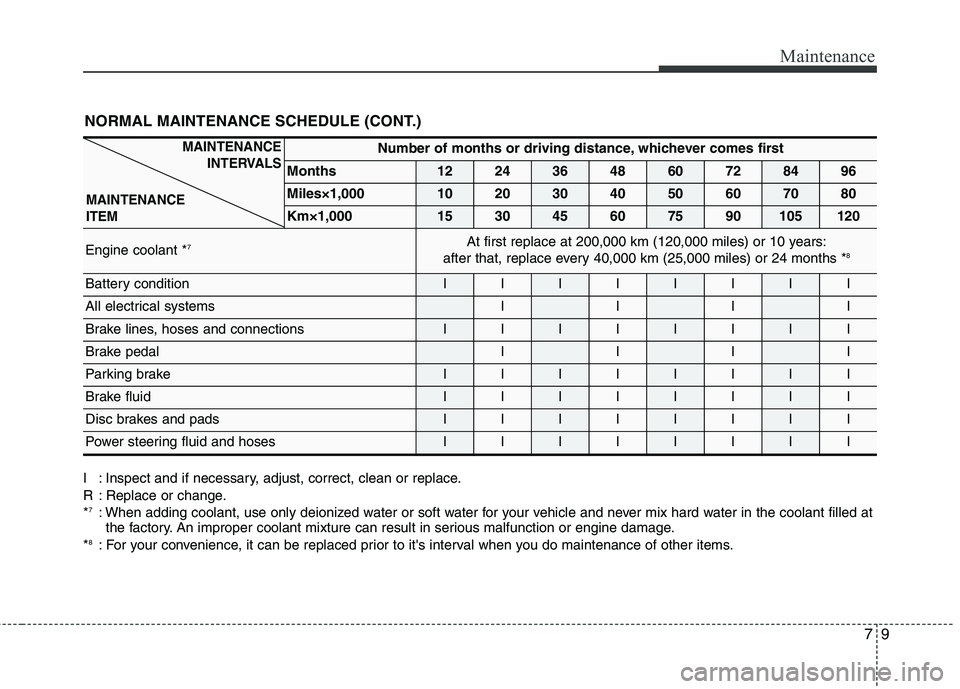
NORMAL MAINTENANCE SCHEDULE (CONT.)
I : Inspect and if necessary, adjust, correct, clean or replace.
R : Replace or change.*7
: When adding coolant, use only deionized water or soft water for your vehicle and never mix hard water in the coolant filled at
the factory. An improper coolant mixture can result in serious malfunction or engine damage.
* 8
: For your convenience, it can be replaced prior to it's interval when you do maintenance of other items.
Number of months or driving distance, whichever comes first
Months1224364860728496
Miles×1,0001020304050607080
Km×1,000153045607590105120
Engine coolant * 7At first replace at 200,000 km (120,000 miles) or 10 years:
after that, replace every 40,000 km (25,000 miles) or 24 months * 8
Battery conditionIIIIIIII
All electrical systemsIIII
Brake lines, hoses and connectionsIIIIIIII
Brake pedalIIII
Parking brakeIIIIIIII
Brake fluidIIIIIIII
Disc brakes and padsIIIIIIII
Power steering fluid and hosesIIIIIIII
MAINTENANCE
INTERVALS
MAINTENANCE ITEM
Page 280 of 352

715
Maintenance
Brake hoses and lines
Visually check for proper installation,
chafing, cracks, deterioration and any
leakage. Replace any deteriorated or
damaged parts immediately. Brake fluid
Check brake fluid level in the brake fluid
reservoir. The level should be between
“MIN” and “MAX” marks on the side of
the reservoir. Use only hydraulic brake
fluid conforming to DOT 3 or DOT 4specification.
Parking brake
Inspect the parking brake system includ-
ing the parking brake pedal and cables.Brake discs, pads, calipers and
rotors
Check the pads for excessive wear, discs
for run out and wear, and calipers for fluid
leakage. Suspension mounting bolts
Check the suspension connections for
looseness or damage. Retighten to the
specified torque.
Steering gear box, linkage &
boots/lower arm ball joint
With the vehicle stopped and engine off,
check for excessive free-play in the
steering wheel.
Check the linkage for bends or damage.
Check the dust boots and ball joints for
deterioration, cracks, or damage.
Replace any damaged parts.Power steering pump, belt and hoses
Check the power steering pump and
hoses for leakage and damage. Replace
any damaged or leaking parts immedi-
ately. Inspect the power steering belt (or
drive belt) for evidence of cuts, cracks,
excessive wear, oiliness and proper ten-
sion. Replace or adjust it if necessary. Drive shafts and boots
Check the drive shafts, boots and clamps
for cracks, deterioration, or damage.
Replace any damaged parts and, if nec-
essary, repack the grease.
Air conditioning refrigerant (if equipped)
Check the air conditioning lines and con-
nections for leakage and damage.
Page 287 of 352

Maintenance
22
7
POWER STEERING FLUID
Checking the power steering fluid
level
With the vehicle on level ground, check
the fluid level in the power steering reser-
voir periodically. The fluid should be
between MAX and MIN marks on the
side of the gauge at the normal tempera-
ture.
Before adding power steering fluid, thor- oughly clean the area around the reser-
voir cap to prevent power steering fluidcontamination.
If the level is low, add fluid to the MAX
level.
✽✽ NOTICE
Check that the fluid level is in the
"HOT" range on the gauge. If the fluid
is cold, check that it is in the "COLD"
range.
In the event the power steering system requires frequent addition of fluid, the
vehicle should be inspected by an
authorized KIA dealer.
Use only the specified power steering fluid. (Refer to "Recommended lubricants
or capacities" in section 8.)
Checking the power steering hose
Check the connections for oil leaks, dam-
age and twists in the power steering
hose before driving.
CAUTION
To avoid damage to the power steering pump, do not operate the
vehicle for prolonged periods with a low power steering fluidlevel.
Never start the engine when the reservoir tank is empty.
When adding fluid, be careful that dirt does not get into the tank.
Too little fluid can result in increased steering effort and/ornoise from the power steering
system.
The use of the non-specified fluid could reduce the effectiveness ofthe power steering system andcause damage to it.
OVG079008L
Page 314 of 352

749
Maintenance
DescriptionSymbolFuse ratingProtected component
MODULE 22
MODULE10A
ATM Shift Lever Illumination, Instrument Cluster, Multifunction Switch (Remote Control),
Tilt & Telescopic Module, Head Lamp Leveling Device Actuator LH/RH,
Auto Head Lamp Leveling Device Module, IMS Control Module,
Head Lamp Leveling Device Switch, Front CCS Switch, Front Seat Warmer Switch,
Driver/Passenger CCS Control Module, Driver/Passenger Seat Warmer Module
Rear Seat Warmer Module LH/RH, Rear Seat Warmer Switch,
Driver/Passenger Door Module, Electro Chromic Mirror, LDWS Camera Module,
Room Lamp (Deluxe Type)
A/BAG INDIND10AInstrument Cluster (Air Bag IND.)
MODULE 33
MODULE10AABS Control Module, ESP Control Module, ESP Off Switch, Yaw Rate Sensor,
Steering Angle Sensor
IG 1IG120AE/R Fuse & Relay Box (Fuse - F10, F11, F12)
SUNROOF20APanorama Sunroof
DR LOCK20ADriver Door Module
ECSECS15AICM Relay Box (Rear Fog Lamp Relay)
AUDIO 22 AUDIO10AAudio, Audio Monitor, Amp, Overhead Console Lamp Switch, PDM, Smart Key Control Module
POWER
OUTLET 22POWER
OUTLET15AConsole Power Outlet
POWER
OUTLET 11POWER
OUTLET15A(Not Used)
Page 315 of 352

Maintenance
50
7
DescriptionSymbolFuse ratingProtected component
C/LIGHTER15AFront Cigarette Lighter
AMPAMP25AAmp
TRUNK10ATrunk Lid Relay, Trunk Main Switch, Trunk Lid Motor, Fuel Filler Door Switch
S/HEATER
RRRR20ARear Seat Warmer Module LH/RH
MEMORYMEMORY10A
Driver/Passenger Foot Lamp, Data Link Connector, Auto Light & Photo Sensor,
Instrument Cluster (MICOM, IND.), Rear Curtain Module, Door Warning Switch,
Garnish Lamp LH/RH/Center, Tilt & Telescopic Module, A/C Control Module,
Loom Lamp (Deluxe Type), Driver/Passenger Door Scuff Lamp,
IMS Control Module, Driver/Passenger Door Lamp, Driver/Passenger Door Module,
RF Receiver, Trunk Room Lamp
AUDIO 1
1AUDIO15AAudio, Audio Monitor
MODULE 11
MODULE10APDM, Rear Curtain Module, Rain Sensor
Panorama Sunroof, ICM Relay Box (Head Lamp Washer Relay)
SPARESPARE10A-
WIPER 1125AFront Wiper Motor, Multifunction Switch (Wiper)
E/R Fuse & Relay Box (RLY. 11, RLY. 12)
HTD
HANDLEHTD
HANDLE15ASteering Wheel Heated
P/SEAT
PASSPASS20APassenger Manual Switch
POWER
CONNECTOR
POWER
CONNECTOR
Page 340 of 352
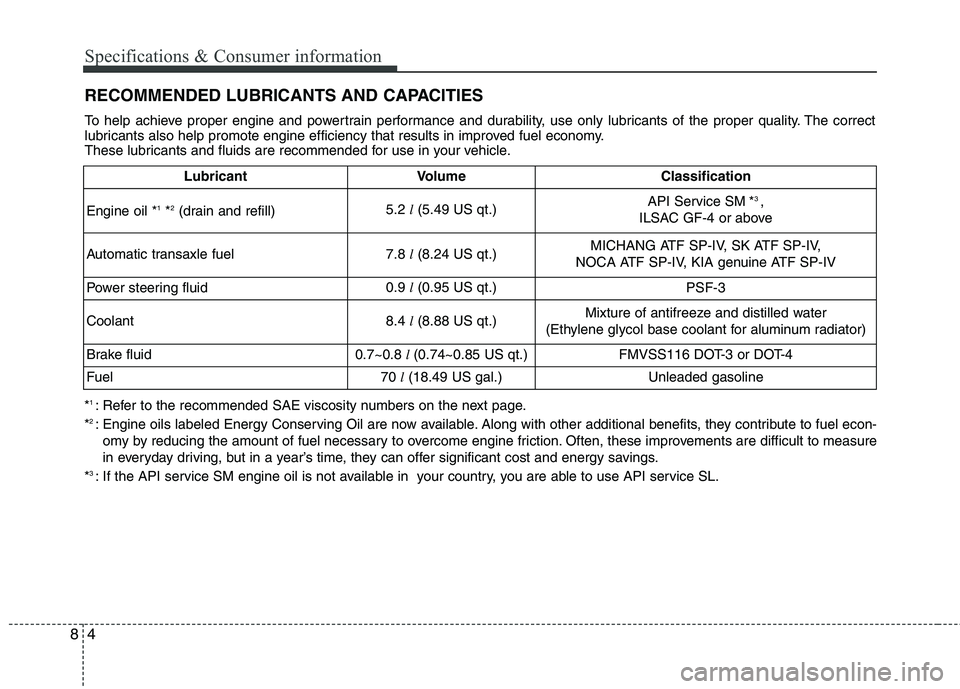
Specifications & Consumer information
4
8
RECOMMENDED LUBRICANTS AND CAPACITIES
* 1
: Refer to the recommended SAE viscosity numbers on the next page.
* 2
: Engine oils labeled Energy Conserving Oil are now available. Along with other additional benefits, they contribute to fuel econ -
omy by reducing the amount of fuel necessary to overcome engine friction. Often, these improvements are difficult to measure
in everyday driving, but in a year’s time, they can offer significant cost and energy savings.
* 3
: If the API service SM engine oil is not available in your country, you are able to use API service SL.
To help achieve proper engine and powertrain performance and durability, use only lubricants of the proper quality. The correct
lubricants also help promote engine efficiency that results in improved fuel economy.
These lubricants and fluids are recommended for use in your vehicle.
Lubricant Volume Classification
Engine oil * 1
*2
(drain and refill) 5.2
l(5.49 US qt.) API Service SM *
3
,
ILSAC GF-4 or above
Automatic transaxle fuel 7.8
l(8.24 US qt.) MICHANG ATF SP-IV, SK ATF SP-IV,
NOCA ATF SP-IV, KIA genuine ATF SP-IV
Power steering fluid 0.9
l(0.95 US qt.)
PSF-3
Coolant 8.4
l(8.88 US qt.) Mixture of antifreeze and distilled water
(Ethylene glycol base coolant for aluminum radiator)
Brake fluid 0.7~0.8
l (0.74~0.85 US qt.)
FMVSS116 DOT-3 or DOT-4
Fuel 70
l(18.49 US gal.)
Unleaded gasoline