Recommended engine oil KIA CADENZA 2011 Owners Manual
[x] Cancel search | Manufacturer: KIA, Model Year: 2011, Model line: CADENZA, Model: KIA CADENZA 2011Pages: 352, PDF Size: 28.17 MB
Page 281 of 352

Maintenance
16
7
ENGINE OIL
Checking the engine oil level
1. Be sure the vehicle is on level ground.
2. Start the engine and allow it to reach normal operating temperature. 3. Turn the engine off and wait for a few
minutes (about 5 minutes) for the oil to
return to the oil pan.
4. Pull the dipstick out, wipe it clean, and re-insert it fully.
5. Pull the dipstick out again and check the level. The level should be betweenF and L. If it is near or at L, add enough oil to bring
the level to F.
Do not overfill.
Use a funnel to help prevent oil frombeing spilled on engine components.
Use only the specified engine oil. (Refer to “Recommended lubricants and capaci- ties” in section 8.)
WARNING - Radiator hose
Be very careful not to touch the
radiator hose when checking or
adding the engine oil as it may be
hot enough to burn you.
OVG079003L
CAUTION
Do not overfill the engine oil. It may damage the engine.
OVG079004L
Page 286 of 352

721
Maintenance
BRAKE FLUID
Checking the brake fluid level
Check the fluid level in the reservoir peri-
odically. The fluid level should be
between MAX and MIN marks on the
side of the reservoir.
Before removing the reservoir cap and
adding brake fluid, clean the area around
the reservoir cap thoroughly to prevent
brake fluid contamination.
If the level is low, add fluid to the MAX
level. The level will fall with accumulated
mileage. This is a normal condition asso-
ciated with the wear of the brake linings.
If the fluid level is excessively low, have
the brake system checked by an author-
ized KIA dealer.
Use only the specified brake fluid. (Refer to “Recommended lubricants or capaci-ties” in section 8.)
Never mix different types of fluid.
WARNING - Brake fluid
When changing and adding brake
fluid, handle it carefully. Do not let it
come in contact with your eyes. Ifbrake fluid should come in contact
with your eyes, immediately flush
them with a large quantity of fresh
tap water. Have your eyes examined
by a doctor as soon as possible.
WARNING - Loss of brake fluid
In the event the brake system
requires frequent additions of fluid,
the vehicle should be inspected by
an authorized KIA dealer.
CAUTION
Do not allow brake fluid to contact the vehicle's body paint, as paintdamage will result. Brake fluid, which has been exposed to open air
for an extended time should never be used as its quality cannot beguaranteed. It should be disposedof properly. Don't put in the wrong
kind of fluid. A few drops of miner- al-based oil, such as engine oil, inyour brake system can damage brake system parts.
OVG079007L
Page 287 of 352

Maintenance
22
7
POWER STEERING FLUID
Checking the power steering fluid
level
With the vehicle on level ground, check
the fluid level in the power steering reser-
voir periodically. The fluid should be
between MAX and MIN marks on the
side of the gauge at the normal tempera-
ture.
Before adding power steering fluid, thor- oughly clean the area around the reser-
voir cap to prevent power steering fluidcontamination.
If the level is low, add fluid to the MAX
level.
✽✽ NOTICE
Check that the fluid level is in the
"HOT" range on the gauge. If the fluid
is cold, check that it is in the "COLD"
range.
In the event the power steering system requires frequent addition of fluid, the
vehicle should be inspected by an
authorized KIA dealer.
Use only the specified power steering fluid. (Refer to "Recommended lubricants
or capacities" in section 8.)
Checking the power steering hose
Check the connections for oil leaks, dam-
age and twists in the power steering
hose before driving.
CAUTION
To avoid damage to the power steering pump, do not operate the
vehicle for prolonged periods with a low power steering fluidlevel.
Never start the engine when the reservoir tank is empty.
When adding fluid, be careful that dirt does not get into the tank.
Too little fluid can result in increased steering effort and/ornoise from the power steering
system.
The use of the non-specified fluid could reduce the effectiveness ofthe power steering system andcause damage to it.
OVG079008L
Page 340 of 352
Specifications & Consumer information
4
8
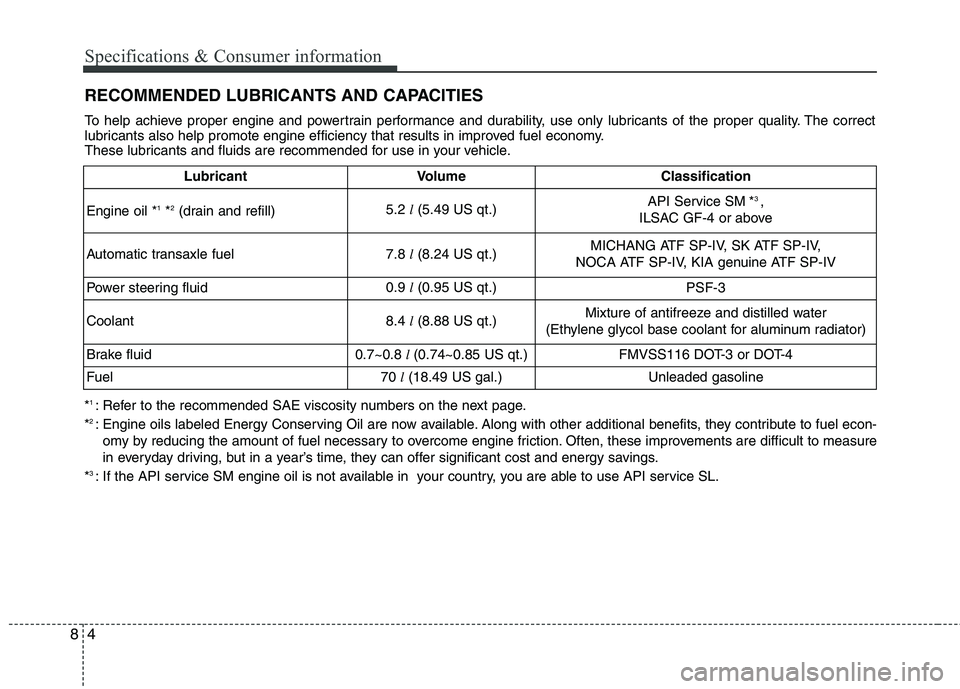
RECOMMENDED LUBRICANTS AND CAPACITIES
* 1
: Refer to the recommended SAE viscosity numbers on the next page.
* 2
: Engine oils labeled Energy Conserving Oil are now available. Along with other additional benefits, they contribute to fuel econ -
omy by reducing the amount of fuel necessary to overcome engine friction. Often, these improvements are difficult to measure
in everyday driving, but in a year’s time, they can offer significant cost and energy savings.
* 3
: If the API service SM engine oil is not available in your country, you are able to use API service SL.
To help achieve proper engine and powertrain performance and durability, use only lubricants of the proper quality. The correct
lubricants also help promote engine efficiency that results in improved fuel economy.
These lubricants and fluids are recommended for use in your vehicle.
Lubricant Volume Classification
Engine oil * 1
*2
(drain and refill) 5.2
l(5.49 US qt.) API Service SM *
3
,
ILSAC GF-4 or above
Automatic transaxle fuel 7.8
l(8.24 US qt.) MICHANG ATF SP-IV, SK ATF SP-IV,
NOCA ATF SP-IV, KIA genuine ATF SP-IV
Power steering fluid 0.9
l(0.95 US qt.)
PSF-3
Coolant 8.4
l(8.88 US qt.) Mixture of antifreeze and distilled water
(Ethylene glycol base coolant for aluminum radiator)
Brake fluid 0.7~0.8
l (0.74~0.85 US qt.)
FMVSS116 DOT-3 or DOT-4
Fuel 70
l(18.49 US gal.)
Unleaded gasoline
Page 341 of 352
85
Specifications & Consumer information
Recommended SAE viscosity
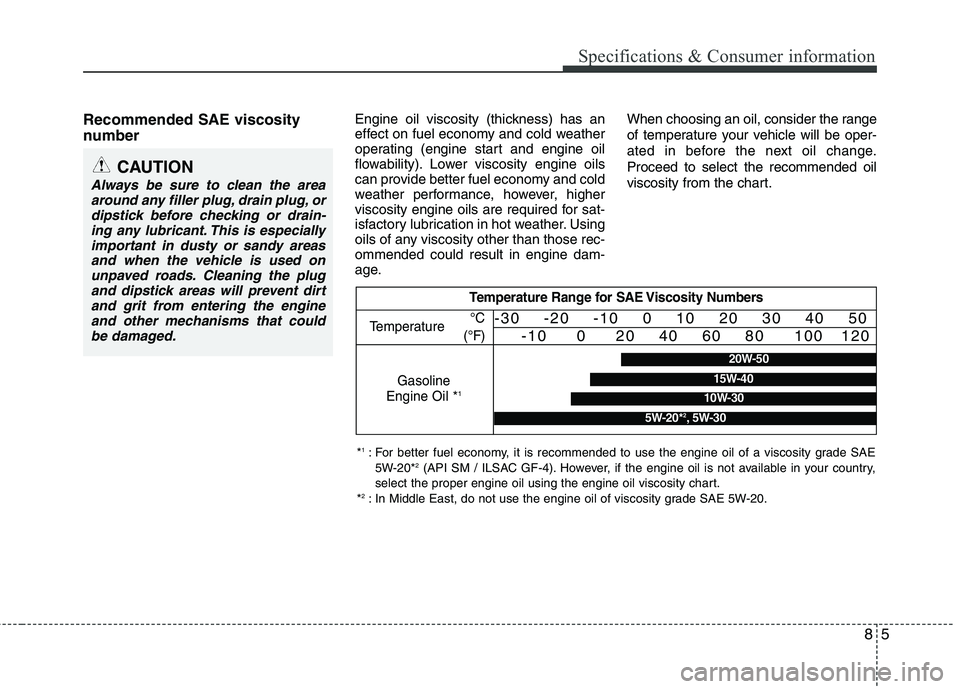
number Engine oil viscosity (thickness) has an
effect on fuel economy and cold weather
operating (engine start and engine oil
flowability). Lower viscosity engine oils
can provide better fuel economy and cold
weather performance, however, higher
viscosity engine oils are required for sat-
isfactory lubrication in hot weather. Using
oils of any viscosity other than those rec-ommended could result in engine dam-
age.When choosing an oil, consider the range
of temperature your vehicle will be oper-
ated in before the next oil change.Proceed to select the recommended oil
viscosity from the chart.
CAUTION
Always be sure to clean the area
around any filler plug, drain plug, ordipstick before checking or drain-ing any lubricant. This is especially
important in dusty or sandy areasand when the vehicle is used onunpaved roads. Cleaning the plugand dipstick areas will prevent dirt
and grit from entering the engine and other mechanisms that couldbe damaged.
Temperature Range for SAE Viscosity Numbers
Temperature
Gasoline
Engine Oil * 1°C
(°F)-30 -20 -10 0 10 20 30 40 50 -10 0 20 40 60 80 100 120
*1
: For better fuel economy, it is recommended to use the engine oil of a viscosity grade SAE
5W-20* 2
(API SM / ILSAC GF-4). However, if the engine oil is not available in your country,
select the proper engine oil using the engine oil viscosity chart.
* 2
: In Middle East, do not use the engine oil of viscosity grade SAE 5W-20.
20W-50
10W-30
15W-40
5W-20* 2
, 5W-30
Page 350 of 352
I7
Index
Neck restraints, see headrest ··································3-7, 3-11
Odometer ·······································································4-48
Oil (Engine) ···································································7-16
Outside rearview mirror·················································4-40
Control switch ···························································4-41
Folding switch ···························································4-42
Outside thermometer ···················································4-117
Overheats ·········································································6-7
Owner maintenance ·························································7-4
Panorama sunroof ··························································4-31
Parking assist system ·····················································4-71
Parking brake inspect·····················································7-23
Parking brake ·································································5-19
Passenger's front air bag ················································3-37
Power brakes ··································································5-18
Power outlet ·································································4-115
Power steering································································4-36
Power steering fluid ·······················································7-22
Power window lock button ············································4-24
Pre-tensioner seat belt····················································3-19
Push starting·····································································6-6 Rear seat·········································································3-11
Rear curtain··································································4-119
Rear parking assist system·············································4-68
Rearview camera····························································4-74
Recommended cold tire inflation pressures ··················7-33
Recommended lubricants and capacities ·························8-4
Recommended SAE viscosity number························8-5
Remote keyless entry ·······················································4-7
Battery replacement ····················································4-8
Road warning ···································································6-2
Rocking the vehicle ·······················································5-34
Scheduled maintenance service ·······································7-6 Normal maintenance schedule ····································7-7
Maintenance under severe usage conditions ·············7-11
Seat belts ········································································3-15
Height adjustment ·····················································3-17
Pre-tensioner seat belt ···············································3-19
Seat belt warning ·······················································3-16
Seat warmer ····························································3-9, 3-13
Seatback pocket ·····························································3-10
Seats ·················································································3-2 Armrest ······································································3-12
Cushion extension ·······················································3-6
Headrest ·····························································3-7, 3-11
O
P
NR
S