towing KIA CADENZA 2019 User Guide
[x] Cancel search | Manufacturer: KIA, Model Year: 2019, Model line: CADENZA, Model: KIA CADENZA 2019Pages: 518, PDF Size: 11.08 MB
Page 396 of 518
What to do in an emergency
24
6
TOWING
Towing service
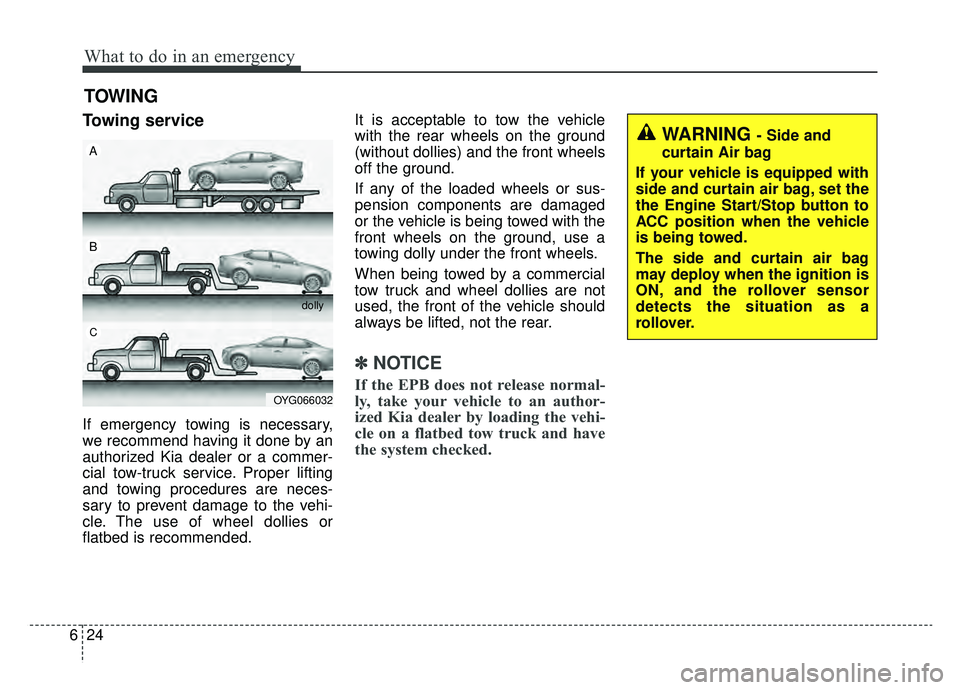
If emergency towing is necessary,
we recommend having it done by an
authorized Kia dealer or a commer-
cial tow-truck service. Proper lifting
and towing procedures are neces-
sary to prevent damage to the vehi-
cle. The use of wheel dollies or
flatbed is recommended. It is acceptable to tow the vehicle
with the rear wheels on the ground
(without dollies) and the front wheels
off the ground.
If any of the loaded wheels or sus-
pension components are damaged
or the vehicle is being towed with the
front wheels on the ground, use a
towing dolly under the front wheels.
When being towed by a commercial
tow truck and wheel dollies are not
used, the front of the vehicle should
always be lifted, not the rear.
✽ ✽
NOTICE
If the EPB does not release normal-
ly, take your vehicle to an author-
ized Kia dealer by loading the vehi-
cle on a flatbed tow truck and have
the system checked.
WARNING - Side and
curtain Air bag
If your vehicle is equipped with
side and curtain air bag, set the
the Engine Start/Stop button to
ACC position when the vehicle
is being towed.
The side and curtain air bag
may deploy when the ignition is
ON, and the rollover sensor
detects the situation as a
rollover.
OYG066032
A
B
C dolly
Page 397 of 518
625
What to do in an emergency
When towing your vehicle in an
emergency without wheel dollies :
1. Set the Engine Start/Stop buttonto ACC position.
2. Place the transaxle shift lever in N (Neutral).
3. Release the parking brake.Removable towing hook
(if equipped)
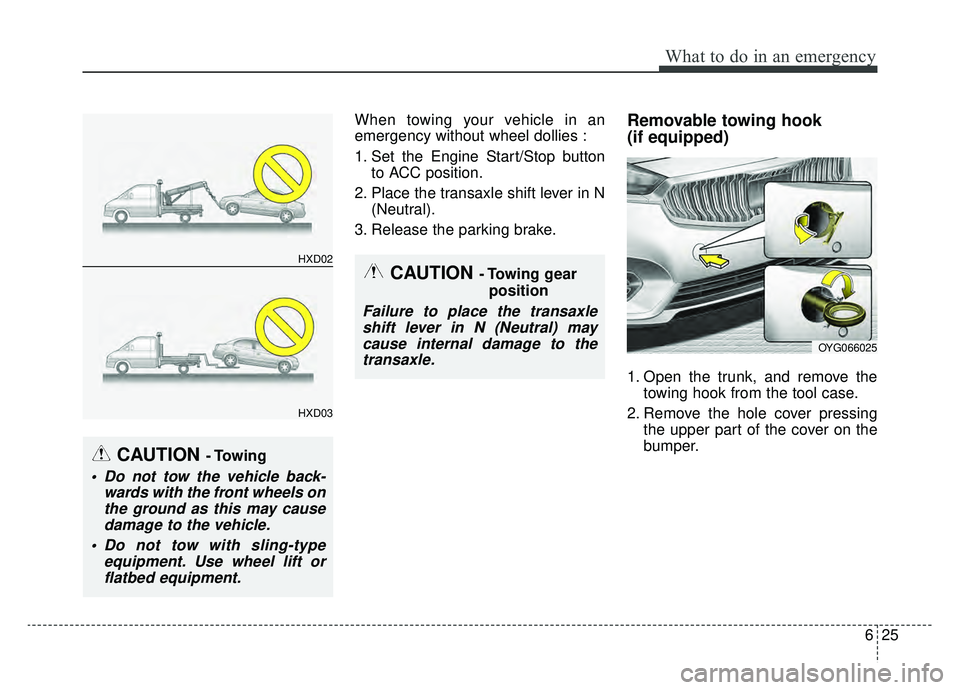
1. Open the trunk, and remove the towing hook from the tool case.
2. Remove the hole cover pressing the upper part of the cover on the
bumper.
CAUTION - Towing gear
position
Failure to place the transaxleshift lever in N (Neutral) maycause internal damage to thetransaxle.
CAUTION - Towing
Do not tow the vehicle back- wards with the front wheels onthe ground as this may causedamage to the vehicle.
Do not tow with sling-type equipment. Use wheel lift orflatbed equipment.
HXD02
HXD03
OYG066025
Page 398 of 518
What to do in an emergency
26
6
3. Install the towing hook by turning it
clockwise into the hole until it is
fully secured.
4. Remove the towing hook and install the cover after use.Emergency towing
If towing is necessary, we recom-
mend you to have it done by an
authorized Kia dealer or a com-
mercial tow truck service. If towing service is not available in an
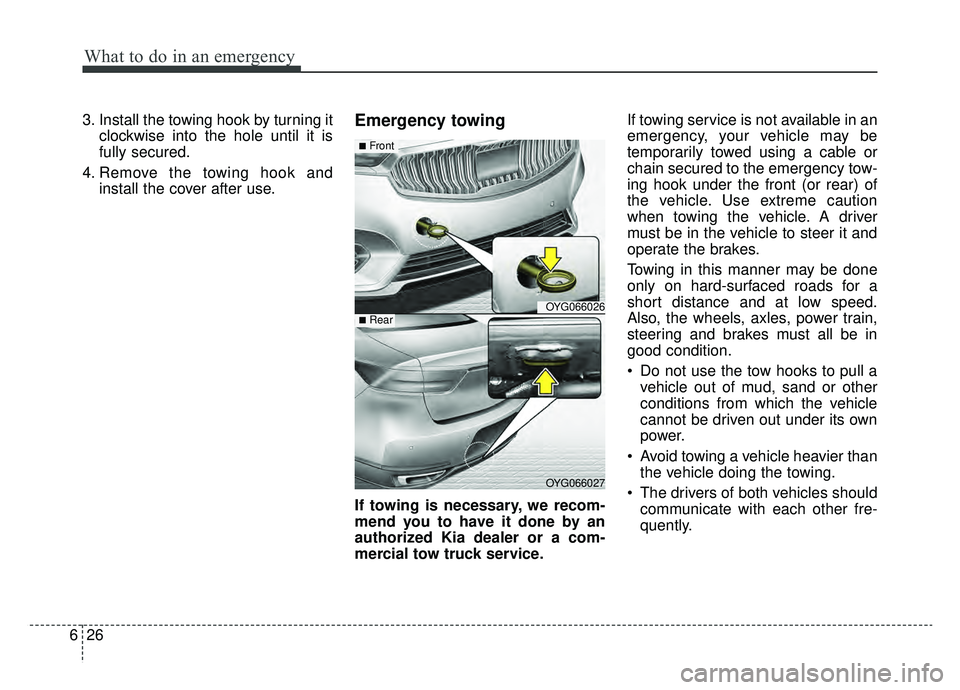
emergency, your vehicle may be
temporarily towed using a cable or
chain secured to the emergency tow-
ing hook under the front (or rear) of
the vehicle. Use extreme caution
when towing the vehicle. A driver
must be in the vehicle to steer it and
operate the brakes.
Towing in this manner may be done
only on hard-surfaced roads for a
short distance and at low speed.
Also, the wheels, axles, power train,
steering and brakes must all be in
good condition.
Do not use the tow hooks to pull a
vehicle out of mud, sand or other
conditions from which the vehicle
cannot be driven out under its own
power.
Avoid towing a vehicle heavier than the vehicle doing the towing.
The drivers of both vehicles should communicate with each other fre-
quently.
OYG066026
OYG066027
■Front
■Rear
Page 399 of 518
627
What to do in an emergency
Attach a towing strap to the towhook.
Use only a cable or chain specifical- ly intended for use in towing vehi-
cles. Securely fasten the cable or
chain to the towing hook provided.
Before emergency towing, check if the hook is not broken or damaged.
Fasten the towing cable or chain securely to the hook.
Do not jerk the hook. Apply it steadily and with even force.
To avoid damaging the hook, do not pull from the side or at a vertical
angle. Always pull straight ahead. Use a towing strap less than 16
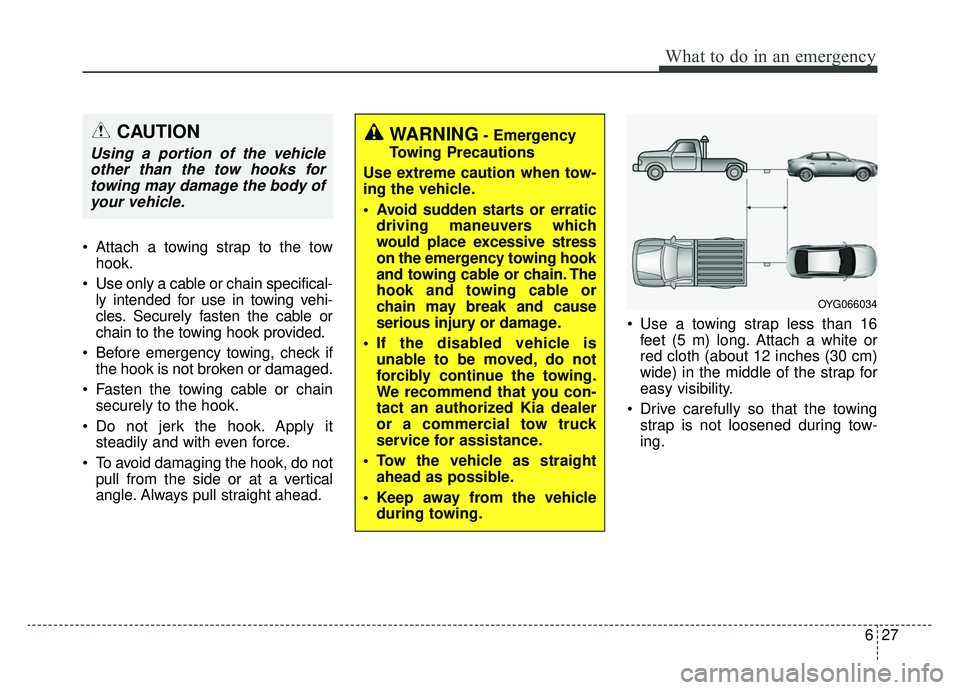
feet (5 m) long. Attach a white or
red cloth (about 12 inches (30 cm)
wide) in the middle of the strap for
easy visibility.
Drive carefully so that the towing strap is not loosened during tow-
ing.
CAUTION
Using a portion of the vehicleother than the tow hooks fortowing may damage the body ofyour vehicle.
WARNING- Emergency
Towing Precautions
Use extreme caution when tow-
ing the vehicle.
Avoid sudden starts or erratic driving maneuvers which
would place excessive stress
on the emergency towing hook
and towing cable or chain. The
hook and towing cable or
chain may break and cause
serious injury or damage.
If the disabled vehicle is unable to be moved, do not
forcibly continue the towing.
We recommend that you con-
tact an authorized Kia dealer
or a commercial tow truck
service for assistance.
Tow the vehicle as straight ahead as possible.
Keep away from the vehicle during towing.
OYG066034
Page 400 of 518
What to do in an emergency
28
6
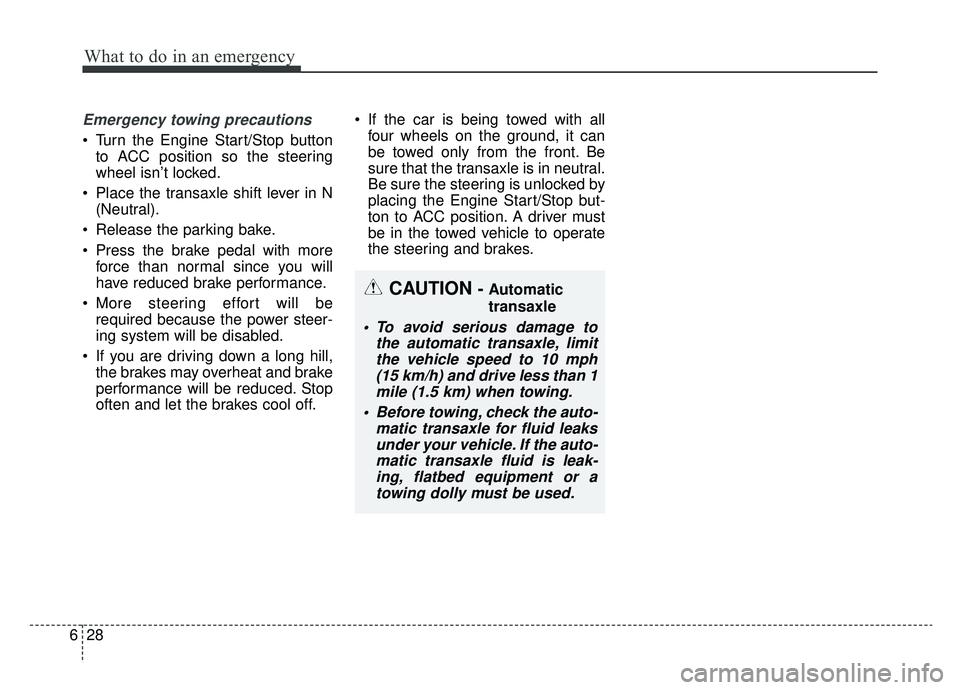
Emergency towing precautions
Turn the Engine Start/Stop button
to ACC position so the steering
wheel isn’t locked.
Place the transaxle shift lever in N (Neutral).
Release the parking bake.
Press the brake pedal with more force than normal since you will
have reduced brake performance.
More steering effort will be required because the power steer-
ing system will be disabled.
If you are driving down a long hill, the brakes may overheat and brake
performance will be reduced. Stop
often and let the brakes cool off. If the car is being towed with all
four wheels on the ground, it can
be towed only from the front. Be
sure that the transaxle is in neutral.
Be sure the steering is unlocked by
placing the Engine Start/Stop but-
ton to ACC position. A driver must
be in the towed vehicle to operate
the steering and brakes.
CAUTION - Automatic
transaxle
To avoid serious damage to the automatic transaxle, limitthe vehicle speed to 10 mph(15 km/h) and drive less than 1mile (1.5 km) when towing.
Before towing, check the auto- matic transaxle for fluid leaksunder your vehicle. If the auto-matic transaxle fluid is leak-ing, flatbed equipment or atowing dolly must be used.
Page 408 of 518
Maintenance
87
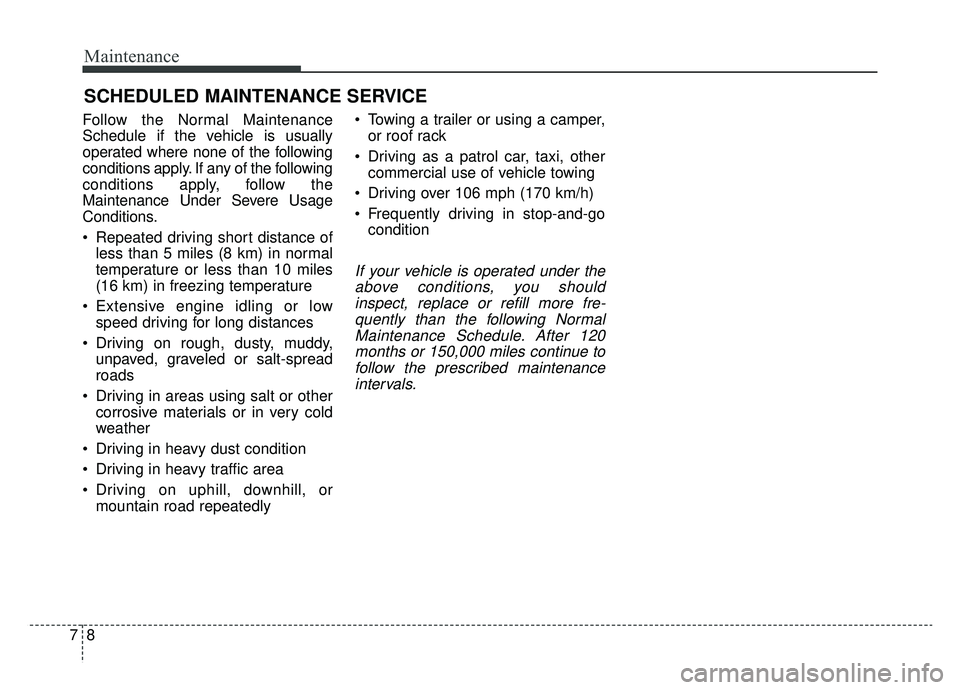
SCHEDULED MAINTENANCE SERVICE
Follow the Normal Maintenance
Schedule if the vehicle is usually
operated where none of the following
conditions apply. If any of the following
conditions apply, follow the
Maintenance Under Severe Usage
Conditions.
Repeated driving short distance ofless than 5 miles (8 km) in normal
temperature or less than 10 miles
(16 km) in freezing temperature
Extensive engine idling or low speed driving for long distances
Driving on rough, dusty, muddy, unpaved, graveled or salt-spread
roads
Driving in areas using salt or other corrosive materials or in very cold
weather
Driving in heavy dust condition
Driving in heavy traffic area
Driving on uphill, downhill, or mountain road repeatedly Towing a trailer or using a camper,
or roof rack
Driving as a patrol car, taxi, other commercial use of vehicle towing
Driving over 106 mph (170 km/h)
Frequently driving in stop-and-go condition
If your vehicle is operated under theabove conditions, you shouldinspect, replace or refill more fre-quently than the following NormalMaintenance Schedule. After 120months or 150,000 miles continue tofollow the prescribed maintenanceintervals.
Page 413 of 518
713
Maintenance
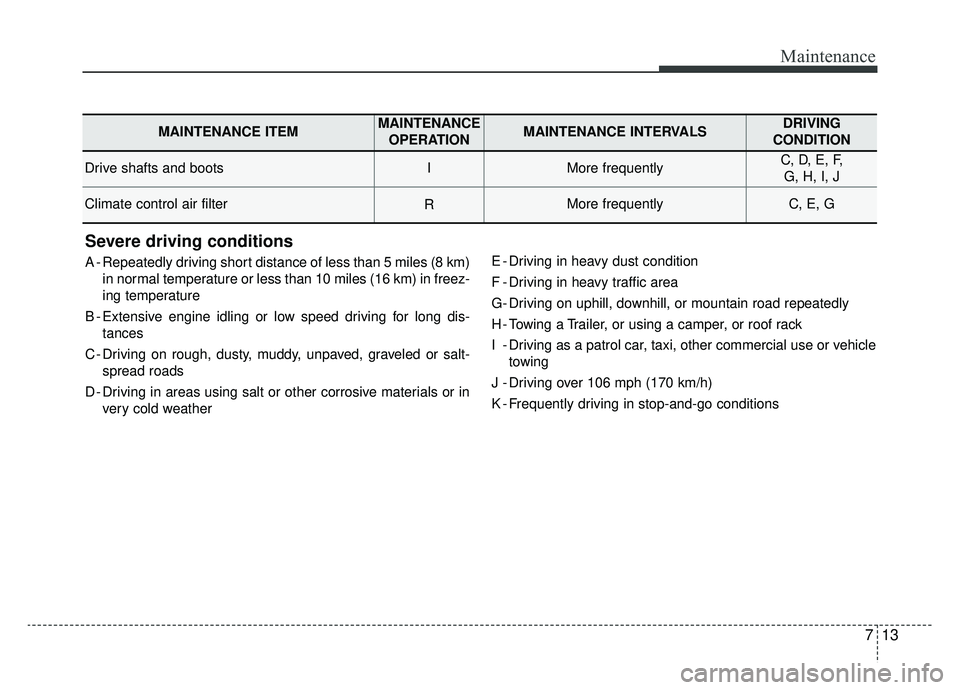
Severe driving conditions
A - Repeatedly driving short distance of less than 5 miles (8 km)in normal temperature or less than 10 miles (16 km) in freez-
ing temperature
B - Extensive engine idling or low speed driving for long dis- tances
C - Driving on rough, dusty, muddy, unpaved, graveled or salt- spread roads
D - Driving in areas using salt or other corrosive materials or in very cold weather E - Driving in heavy dust condition
F - Driving in heavy traffic area
G- Driving on uphill, downhill, or mountain road repeatedly
H - Towing a Trailer, or using a camper, or roof rack
I - Driving as a patrol car, taxi, other commercial use or vehicle
towing
J - Driving over 106 mph (170 km/h)
K - Frequently driving in stop-and-go conditions
MAINTENANCE ITEMMAINTENANCE OPERATIONMAINTENANCE INTERVALSDRIVING
CONDITION
Drive shafts and bootsIMore frequentlyC, D, E, F, G, H, I, J
Climate control air filterRMore frequentlyC, E, G
Page 516 of 518
I9
Index
Hazardous driving conditions . . . . . . . . . . . . . . . . 5-114
Highway driving . . . . . . . . . . . . . . . . . . . . . . . . . . . 5-117
Rocking the vehicle . . . . . . . . . . . . . . . . . . . . . . . . 5-114
Smooth cornering . . . . . . . . . . . . . . . . . . . . . . . . . . 5-115
Steering wheel . . . . . . . . . . . . . . . . . . . . . . . . . . . . . . . 4-49 Electric Power Steering (EPS) . . . . . . . . . . . . . . . . . 4-49
Heated steering wheel . . . . . . . . . . . . . . . . . . . . . . . 4-52
Horn . . . . . . . . . . . . . . . . . . . . . . . . . . . . . . . . . . . . \
. 4-53
Tilt and telescopic steering. . . . . . . . . . . . . . . . . . . . 4-50
Storage compartments . . . . . . . . . . . . . . . . . . . . . . . . 4-146 Center console storage . . . . . . . . . . . . . . . . . . . . . . 4-146
Glove box . . . . . . . . . . . . . . . . . . . . . . . . . . . . . . . . 4-146
Sunglass holder . . . . . . . . . . . . . . . . . . . . . . . . . . . 4-147
Surround view monitoring system (SVM) . . . . . . . . . 4-112
Theft-alarm system . . . . . . . . . . . . . . . . . . . . . . . . . . . . 4-14 Armed stage . . . . . . . . . . . . . . . . . . . . . . . . . . . . . . . 4-14
Disarmed stage . . . . . . . . . . . . . . . . . . . . . . . . . . . . . 4-15
Theft-alarm stage . . . . . . . . . . . . . . . . . . . . . . . . . . . 4-15
Tire Pressure Monitoring System (TPMS) . . . . . . . . . . . 6-8 Changing a tire with TPMS . . . . . . . . . . . . . . . . . . . 6-12
Check tire pressure . . . . . . . . . . . . . . . . . . . . . . . . . . . 6-8
Low tire pressure telltale . . . . . . . . . . . . . . . . . . . . . 6-10
This device complies with part 15 of the FCC rules . 6-14
Tire specification and pressure label . . . . . . . . . . . . . . . 8-9 Tires and wheels . . . . . . . . . . . . . . . . . . . . . . . . . . 7-36, 8-4
All season tires . . . . . . . . . . . . . . . . . . . . . . . . . . . . . 7-48
Checking tire inflation pressure . . . . . . . . . . . . . . . . 7-37
Low aspect ratio tire. . . . . . . . . . . . . . . . . . . . . . . . . 7-49
Radial-ply tires . . . . . . . . . . . . . . . . . . . . . . . . . . . . . 7-49
Recommended cold tire inflation pressures . . . . . . . 7-36
Snow tires . . . . . . . . . . . . . . . . . . . . . . . . . . . . . . . . . 7-48
Summer tires . . . . . . . . . . . . . . . . . . . . . . . . . . . . . . 7-48
Tire care . . . . . . . . . . . . . . . . . . . . . . . . . . . . . . . . . . 7-36\
Tire chains . . . . . . . . . . . . . . . . . . . . . . . . . . . . . . . . 7-48
Tire maintenance . . . . . . . . . . . . . . . . . . . . . . . . . . . 7-41
Tire pressure . . . . . . . . . . . . . . . . . . . . . . . . . . . . . . . 7-37
Tire replacement . . . . . . . . . . . . . . . . . . . . . . . . . . . . 7-40
Tire rotation . . . . . . . . . . . . . . . . . . . . . . . . . . . . . . . 7-38
Tire sidewall labeling . . . . . . . . . . . . . . . . . . . . . . . . 7-41
Tire traction . . . . . . . . . . . . . . . . . . . . . . . . . . . . . . . 7-41
Wheel alignment and tire balance . . . . . . . . . . . . . . 7-39
Wheel replacement . . . . . . . . . . . . . . . . . . . . . . . . . . 7-41
Towing . . . . . . . . . . . . . . . . . . . . . . . . . . . . . . . . . . . . \
. 6-24 Emergency towing . . . . . . . . . . . . . . . . . . . . . . . . . . 6-26
Removable towing hook. . . . . . . . . . . . . . . . . . . . . . 6-25
Towing service . . . . . . . . . . . . . . . . . . . . . . . . . . . . . 6-24
Trailer towing . . . . . . . . . . . . . . . . . . . . . . . . . . . . . . . 5-121
Trunk . . . . . . . . . . . . . . . . . . . . . . . . . . . . . . . . . . . . \
. . . 4-21 Emergency trunk safety release . . . . . . . . . . . . . . . . 4-26
Non-powered trunk . . . . . . . . . . . . . . . . . . . . . . . . . 4-21
Power trunk . . . . . . . . . . . . . . . . . . . . . . . . . . . . . . . 4-22
Trunk lid control button . . . . . . . . . . . . . . . . . . . . . . 4-25
T