brake KIA CARENS RHD 2017 Owners Manual
[x] Cancel search | Manufacturer: KIA, Model Year: 2017, Model line: CARENS RHD, Model: KIA CARENS RHD 2017Pages: 723, PDF Size: 40.8 MB
Page 537 of 723
Driving your vehicle
102
6
Hitches
It's important to have the correct hitch
equipment. Crosswinds, large trucks
going by, and rough roads are a few
reasons why you’ll need the right
hitch. Here are some rules to follow:
Do you have to make any holes in
the body of your vehicle when you
install a trailer hitch? If you do, thenbe sure to seal the holes later
when you remove the hitch.
The bumpers on your vehicle are not intended for hitches. Do notattach rental hitches or other
bumper-type hitches to them. Use
only a frame-mounted hitch that
does not attach to the bumper.
A Kia accessory trailer hitch is avail- able at an authorised Kia dealer. Safety chains
You should always attach chains
between your vehicle and your trail-
er. Cross the safety chains under the
tongue of the trailer so that thetongue will not drop to the road if it
becomes separated from the hitch.
Instructions about safety chains may
be provided by the hitch manufactur-
er or by the trailer manufacturer.
Follow the manufacturer’s recom-
mendation for attaching safety
chains. Always leave just enough
slack so you can turn with your trail-
er. And, never allow safety chains to
drag on the ground.
Trailer brakes
If your trailer is equipped with a brak-
ing system, make sure it conforms to
your country’s regulations and that it
is properly installed and operating
correctly.
If your trailer weight exceeds the
maximum allowed weight without
trailer brakes, then the trailer will also
require its own brakes as well. Be
sure to read and follow the instruc-
tions for the trailer brakes so you’ll be
able to install, adjust and maintain
them properly.
Do not tap into or modify your vehi-
cle's brake system.
WARNING - Trailer
brakes
Do not use a trailer with its own
brakes unless you are absolute-
ly certain that you have proper-
ly set up the brake system. This
is not a task for amateurs. Use
an experienced, competent
trailer shop for this work.
Page 538 of 723
6103
Driving your vehicle
Loading the trailer
The weight distribution between the
car and trailer should be balanced.
Make sure that the load in the trailer
is equally distributed and it is not
front-heavy or tail-heavy.
The heavy load in the trailer should
be placed above the axle or as close
as possible to the axle. And, secure
loads properly on the trailer.
Tyre pressure
Follow the trailer manufacturer’s tyre
pressure recommendations for the
trailer tyres.
When towing, inflate tyres in vehicle
to the maximum permissible pres-
sure referring to the tyre pressurelabel.Driving with a trailer
Towing a trailer requires a certain
amount of experience. Before setting
out for the open road, you must get to
know your trailer. Acquaint yourself
with the feel of handling and braking
with the added weight of the trailer.
And always keep in mind that the
vehicle you are driving is now a good
deal longer and not nearly so respon-
sive as your vehicle is by itself.
Before you start, check the trailer
hitch and platform, safety chains,
electrical connector(s), lights, tyres
and mirror adjustment. If the trailer
has electric brakes, start your vehicle
and trailer moving and then apply the
trailer brake controller by hand to be
sure the brakes are working. This lets
you check your electrical connection
at the same time.
During your trip, check occasionally
to be sure that the load is secure,
and that the lights and any trailer
brakes are still working.Following distance
Stay at least twice as far behind the
vehicle ahead as you would when
driving your vehicle without a trailer.
This can help you avoid situations
that require heavy braking and sud-
den turns.
Passing
You’ll need more passing distance
up ahead when you’re towing a trail-
er. And, because of the increased
vehicle length, you’ll need to go
much farther beyond the passed
vehicle before you can return to your
lane.
Page 540 of 723
6105
Driving your vehicle
Driving on grades
Reduce speed and shift to a lower
gear before you start down a long or
steep downgrade. If you don’t shift
down, you might have to use your
brakes so much that they would get
hot and no longer operate efficiently.
On a long uphill grade, shift down
and reduce your speed to around 70km/h (45 mph) to reduce the possi-
bility of engine and transaxle over-heating.
If your trailer weighs more than the
maximum trailer weight without trail-
er brakes and you have an automat-
ic transaxle / dual clutch transmis-
sion, you should drive in D (Drive)
when towing a trailer.
Operating your vehicle in D (Drive)
when towing a trailer will minimise
heat build up and extend the life of
your transaxle.CAUTION
When towing a trailer on steepgrades (in excess of 6%) payclose attention to the enginecoolant temperature gauge toensure the engine does not overheat.
If the needle of the coolanttemperature gauge movesacross the dial towards “130/H(HOT)”, pull over and stop as soon as it is safe to do so, andallow the engine to idle until itcools down. You may proceedonce the engine has cooled sufficiently.
You must decide driving speed depending on trailerweight and uphill grade toreduce the possibility of engine and transaxle over-heating.
CAUTION - Dual Clutch
Transmission
When towing a trailer on steepgrades, the clutch in the trans-mission could overheat.
When the clutch is overheated,the safe protection mode engages. If the safe protectionmode engages, the gear posi-tion indicator on the cluster blinks with a chime sound.
At this time, a warning messagewill appear on the LCD displayand driving may not be smooth.
If you ignore this warning, thedriving condition may become worse.
To return the normal drivingcondition, stop the vehicle onflat road and apply the footbrake for a few minutes before driving off.
Page 541 of 723
Driving your vehicle
106
6
Parking on hills
Generally, if you have a trailer
attached to your vehicle, you should
not park your vehicle on a hill. People
can be seriously or fatally injured,
and both your vehicle and the trailer
can be damaged if unexpectedly roll
down hill. However, if you ever have to park your
trailer on a hill, here is how to do it:
1. Pull the vehicle into the parking
space. Turn the steering wheel in
the direction of the kerb (left if head-
ed down hill, right if headed up hill).
2. If the vehicle has a manual transaxle, place the car in neutral.
If the vehicle has an automatic
transaxle / dual clutch transmis-
sion, place the car in P (Park).
3. Set the parking brake and shut off the vehicle.
4. Place chocks under the trailer wheels on the down hill side of the
wheels.
5. Start the vehicle, hold the brakes, shift to neutral, release the parking
brake and slowly release the
brakes until the trailer chocksabsorb the load.
6. Reapply the brakes, reapply the parking brake and shift the vehicle
to R (Reverse) for manual transaxle
or P (Park) for automatic transaxle /
dual clutch transmission.
7. Shut off the vehicle and release the vehicle brakes but leave the
parking brake set.
WARNING - Parking on
a hill
Parking your vehicle on a hill
with a trailer attached could
cause serious injury or death,
should the trailer break loose.
WARNING - Parking
brake
It can be dangerous to get out
of your vehicle if the parking
brake is not firmly set.
If you have left the engine run-
ning, the vehicle can move sud-
denly. You or others could be
seriously or fatally injured.
Page 542 of 723
6107
Driving your vehicle
When you are ready to leave after
parking on a hill
1.With the manual transaxle inNeutral or automatic transaxle /
dual clutch transmission in P
(Park), apply your brakes and hold
the brake pedal down whilst you:
and
2.Slowly remove your foot from the brake pedal.
3.Drive slowly until the trailer is clear of the chocks.
4.Stop and have someone pick up and store the chocks. Maintenance when trailer tow- ing
Your vehicle will need service more
often when you regularly pull a trail-
er. Important items to pay particularattention to include engine oil,
transaxle fluid, axle lubricant and
cooling system fluid. Brake condition
is another important item to frequent-
ly check. Each item is covered in this
manual, and the Index will help you
find them quickly. If you’re trailering, it
is a good idea to review these sec-
tions before you start your trip.
Do not forget to also maintain your
trailer and hitch. Follow the mainte-nance schedule that accompanied
your trailer and check it periodically.
Preferably, conduct the check at the
start of each day’s driving. Most
importantly, all hitch nuts and boltsshould be tight.CAUTION
Due to higher load during
trailer usage, overheatingmight occur in hot days or during uphill driving. If thecoolant gauge indicates over-heating, switch off the air con- ditioner and stop the vehiclein a safe area to cool down theengine.
When towing check transaxle fluid more frequently.
If your vehicle is not equipped with an air conditioner, youshould install a condenser fanto improve engine perform-ance when towing a trailer.
Page 543 of 723
Driving your vehicle
108
6
If you do decide to pull a trailer
Here are some important points if
you decide to pull a trailer:
Consider using a sway control. You
can ask a hitch dealer about sway control.
Do not do any towing with your car during its first 2,000 km (1,200
miles) in order to allow the engine
to properly break in. Failure to heed
this caution may result in serious
engine or transaxle damage.
When towing a trailer, we recom- mend that you consult an authorisedKia dealer on additional require-
ments such as a towing kit, etc.
Always drive your vehicle at a mod- erate speed (less than 100 km/h(60 mph)).
On a long uphill grade, do not exceed 70 km/h (45 mph) or the
posted towing speed limit,
whichever is lower.
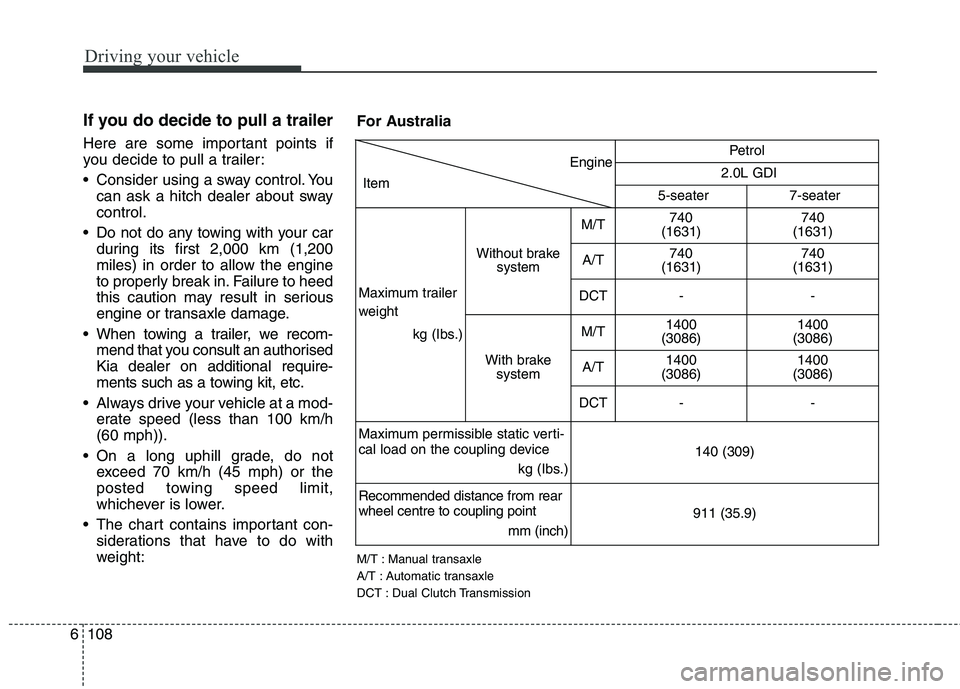
The chart contains important con- siderations that have to do with
weight:
Engine
ItemPetrol
2.0L GDI
5-seater 7-seater
Maximum trailer
weight kg (Ibs.)
Without brakesystem
M/T740
(1631) 740
(1631)
A/T740
(1631) 740
(1631)
DCT--
With brake system
M/T1400
(3086) 1400
(3086)
A/T1400
(3086) 1400
(3086)
DCT--
Maximum permissible static verti-
cal load on the coupling device kg (Ibs.)
140 (309)
Recommended distance from rear wheel centre to coupling point mm (inch)
911 (35.9)
For Australia
M/T : Manual transaxle
A/T : Automatic transaxle
DCT : Dual Clutch Transmission
Page 544 of 723
6109
Driving your vehicle
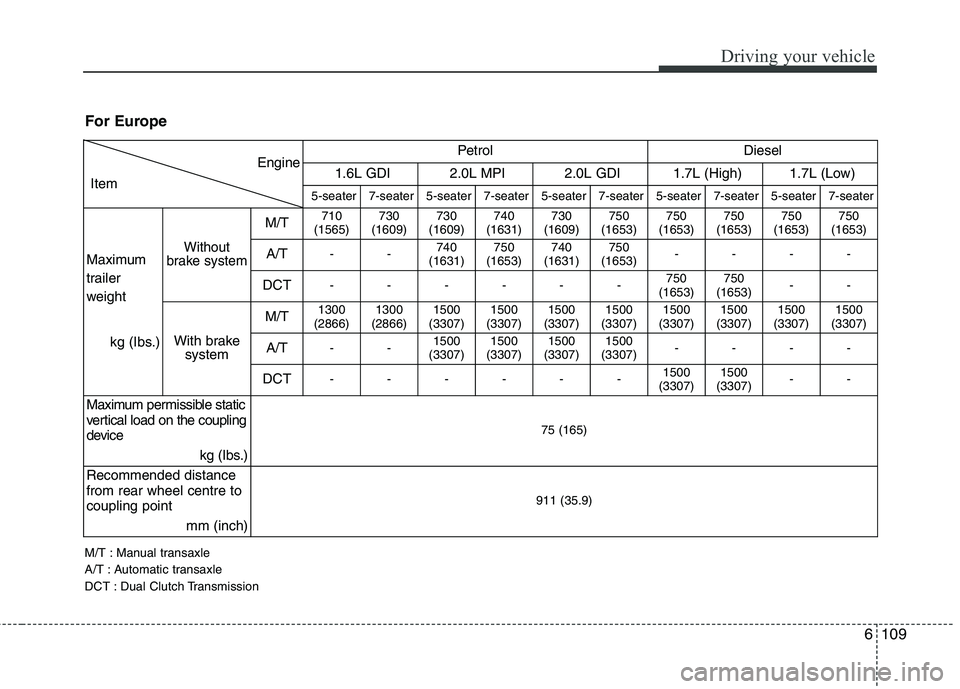
For Europe
M/T : Manual transaxle
A/T : Automatic transaxle
DCT : Dual Clutch Transmission
Engine
ItemPetrol Diesel
1.6L GDI2.0L MPI 2.0L GDI 1.7L (High) 1.7L (Low)
5-seater7-seater5-seater 7-seater 5-seater7-seater 5-seater 7-seater 5-seater 7-seater
Maximum
trailer
weight kg (Ibs.)
Without
brake system
M/T710
(1565)730
(1609)730
(1609) 740
(1631) 730
(1609)750
(1653) 750
(1653) 750
(1653) 750
(1653) 750
(1653)
A/T--740
(1631) 750
(1653) 740
(1631)750
(1653) ----
DCT------750
(1653) 750
(1653) --
With brake system
M/T1300
(2866)1300
(2866)1500
(3307) 1500
(3307) 1500
(3307)1500
(3307) 1500
(3307) 1500
(3307) 1500
(3307) 1500
(3307)
A/T--1500
(3307) 1500
(3307) 1500
(3307)1500
(3307) ----
DCT------1500
(3307) 1500
(3307) --
Maximum permissible static
vertical load on the coupling
device kg (Ibs.)
75 (165)
Recommended distance from rear wheel centre tocoupling point mm (inch)
911 (35.9)
Page 545 of 723
Driving your vehicle
110
6
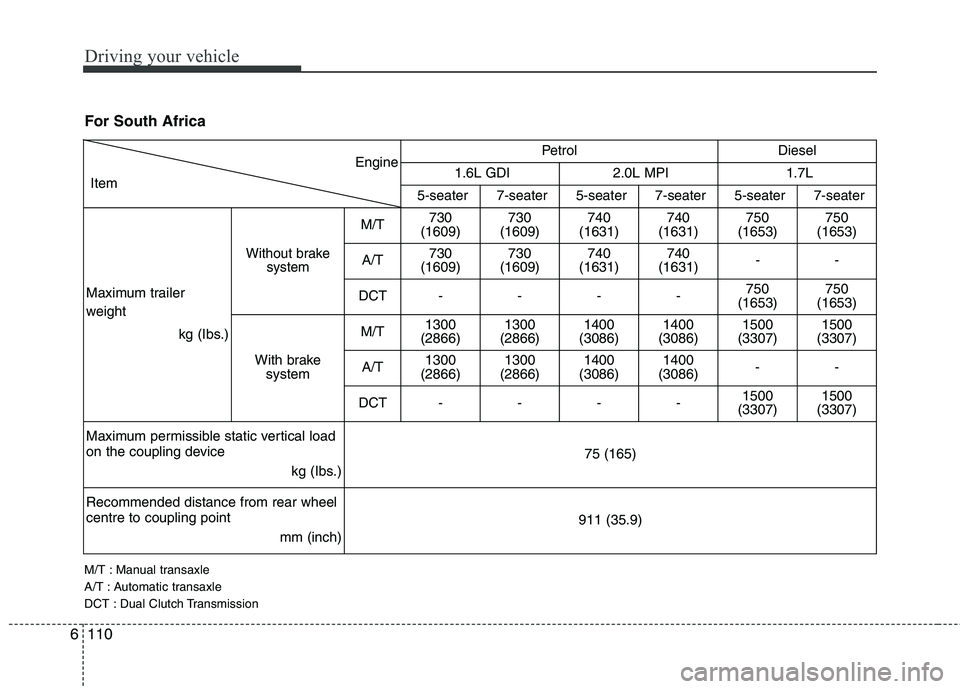
Engine
ItemPetrol Diesel
1.6L GDI2.0L MPI 1.7L
5-seater7-seater5-seater 7-seater 5-seater 7-seater
Maximum trailer
weight kg (Ibs.)
Without brake system
M/T730
(1609)730
(1609)740
(1631) 740
(1631) 750
(1653) 750
(1653)
A/T730
(1609)730
(1609)740
(1631) 740
(1631) --
DCT---- 750
(1653) 750
(1653)
With brake system
M/T1300
(2866)1300
(2866)1400
(3086) 1400
(3086) 1500
(3307) 1500
(3307)
A/T1300
(2866)1300
(2866)1400
(3086) 1400
(3086) --
DCT---- 1500
(3307) 1500
(3307)
Maximum permissible static vertical load
on the coupling device kg (Ibs.)
75 (165)
Recommended distance from rear wheel centre to coupling point mm (inch)
911 (35.9)
For South Africa
M/T : Manual transaxle
A/T : Automatic transaxle
DCT : Dual Clutch Transmission
Page 546 of 723
6111
Driving your vehicle
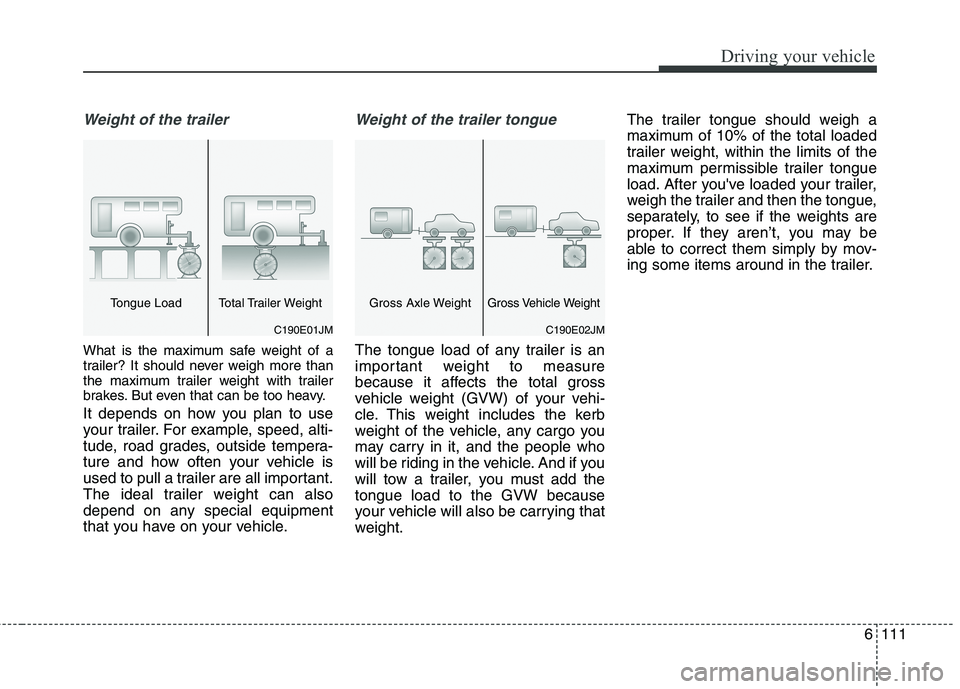
Weight of the trailer
What is the maximum safe weight of a
trailer? It should never weigh more than
the maximum trailer weight with trailer
brakes. But even that can be too heavy.
It depends on how you plan to use
your trailer. For example, speed, alti-
tude, road grades, outside tempera-
ture and how often your vehicle is
used to pull a trailer are all important.
The ideal trailer weight can also
depend on any special equipment
that you have on your vehicle.
Weight of the trailer tongue
The tongue load of any trailer is an
important weight to measure
because it affects the total gross
vehicle weight (GVW) of your vehi-
cle. This weight includes the kerb
weight of the vehicle, any cargo you
may carry in it, and the people who
will be riding in the vehicle. And if you
will tow a trailer, you must add thetongue load to the GVW because
your vehicle will also be carrying that
weight.The trailer tongue should weigh a
maximum of 10% of the total loaded
trailer weight, within the limits of the
maximum permissible trailer tongue
load. After you've loaded your trailer,
weigh the trailer and then the tongue,
separately, to see if the weights are
proper. If they aren’t, you may be
able to correct them simply by mov-
ing some items around in the trailer.
C190E02JM
Gross Axle WeightGross Vehicle Weight
C190E01JM
Tongue Load Total Trailer Weight
Page 553 of 723
73
What to do in an emergency
IN CASE OF AN EMERGENCY WHILST DRIVING
If the engine stalls at a cross-
road or crossing
If the engine stalls at a crossroad or crossing, set the shift lever in the
N (Neutral) position and then push
the vehicle to a safe place.
If your vehicle has a manual transaxle not equipped with a igni-
tion lock switch, the vehicle can
move forward by shifting to the2(Second) or 3(Third) gear and
then turning the starter withoutdepressing the clutch pedal. If you have a flat tyre whilst driving
If a tyre goes flat whilst you are driving:
1.Take your foot off the accelerator
pedal and let the vehicle slow down
whilst driving straight ahead. Do not
apply the brakes immediately orattempt to pull off the road as this
may cause a loss of control. When
the vehicle has slowed to such a
speed that it is safe to do so, brakecarefully and pull off the road.
Drive off the road as far as possible
and park on firm, level ground. If
you are on a divided highway, do
not park in the median area
between the two traffic lanes.
2.When the vehicle is stopped, turn on your emergency hazard flashers,
set the parking brake and put the
transaxle in P (automatic transaxle /
dual clutch transmission) or reverse
(manual transaxle). 3.Have all passengers get out of the
vehicle. Be sure they all get out on
the side of the vehicle that is away
from traffic.
4.When changing a flat tyre, follow the instruction provided later in this
chapter.
If engine stalls whilst driving
1.Reduce your speed gradually, keeping a straight line. Move cau-
tiously off the road to a safe place.
2.Turn on your emergency flashers.
3.Try to start the engine again. If your vehicle does not start, we recom-
mend that you consult an autho-
rised Kia dealer.