maintenance KIA CARENS RHD 2017 Owners Manual
[x] Cancel search | Manufacturer: KIA, Model Year: 2017, Model line: CARENS RHD, Model: KIA CARENS RHD 2017Pages: 723, PDF Size: 40.8 MB
Page 694 of 723
8107
Maintenance
Interior care
Interior general precautions
Prevent chemicals such as perfume, cosmetic oil, sun cream, hand clean-
er, and air freshener from contacting
the interior parts because they may
cause damage or discoloration. If
they do contact the interior parts,
wipe them off immediately.
See the instructions that follow for
the proper way to clean vinyl.
CAUTION
Never allow water or other liq-uids to come in contact withelectrical/electronic components inside the vehicle as this maydamage them.
CAUTION
When cleaning leather products(steering wheel, seats etc.), useneutral detergents or low alco- hol content solutions. If you usehigh alcohol content solutionsor acid/alkaline detergents, the colour of the leather may fade orthe surface may get stripped off.
CAUTION - Fabric seat cover (If equipped)
Please clean the fabric seats
regularly with a vacuum cleanerin consideration of fabric mate- rial characteristics. If they areheavily soiled with beveragestains, etc., use a suitable interi-or cleaner. To prevent damage to seat covers, wipe off the seatcovers down to the seams witha large wiping motion and mod- erate pressure using a softsponge or microfiber cloth.
Velcro closures on clothing orsharp objects may cause snag-ging or scratches on the surface of the seats. Make sure not torub such objects against thesurface.
Page 695 of 723
Maintenance
108
8
Cleaning the upholstery and inte-
rior trim
Vinyl
Remove dust and loose dirt from
vinyl with a whisk broom or vacuum
cleaner. Clean vinyl surfaces with a
vinyl cleaner.
Fabric
Remove dust and loose dirt from fab-
ric with a whisk broom or vacuum
cleaner. Clean with a mild soap solu-
tion recommended for upholstery or
carpets. Remove fresh spots imme-
diately with a fabric spot cleaner. If
fresh spots do not receive immediate
attention, the fabric can be stained
and its colour can be affected. Also,
its fire-resistant properties can be
reduced if the material is not proper-ly maintained.
Cleaning the lap/shoulder beltwebbing
Clean the belt webbing with any mild
soap solution recommended for
cleaning upholstery or carpet. Follow
the instructions provided with the
soap. Do not bleach or re-dye the
webbing because this may weaken it.
Cleaning the interior window glass
If the interior glass surfaces of the
vehicle become fogged (that is, cov-
ered with an oily, greasy or waxy
film), they should be cleaned with
glass cleaner. Follow the directions
on the glass cleaner container.
CAUTION
Do not scrape or scratch theinside of the rear window. Thismay result in damage to the rear window defroster grid.
CAUTION
Using anything but recommend-ed cleaners and procedures mayaffect the fabric’s appearance and fire-resistant properties.
CAUTION
- Natural leather seat cover
(If equipped)
Natural leather has visiblepores, scars or blood vessels,etc. Pressure marks or wrinkles may be made when used.Prolonged exposure to sunlightor heat may cause discol- oration. These things occur dueto the natural characteristics ofcowhides. If the leather is exposed to rain or gets wet,remove water with a dry clothand dry the leather in the shadeto minimise damage. Make sure to keep sharp objects away fromthe leather as these can createscratches on the surface. For light-coloured leather, be care-ful of spots or colour transfer,such as from jeans.
Page 696 of 723
8109
Maintenance
EMISSION CONTROL SYSTEM
The emission control system of your
vehicle is covered by a written limited
warranty. Please see the warranty
information contained in the Service
Passport in your vehicle.
Your vehicle is equipped with an emission control system to meet all
emission regulations. There are three emission control
systems which are as follows.
(1) Crankcase emission control sys- tem
(2) Evaporative emission control sys- tem
(3) Exhaust emission control systemIn order to assure the proper function
of the emission control systems, it is
recommended that you have your
car inspected and maintained by an
authorised Kia dealer in accordance
with the maintenance schedule. Caution for the Inspection and
Maintenance Test (With Electronic
Stability Control (ESC) system)
To prevent the vehicle from mis-
firing during dynamometer test-
ing, turn the Electronic Stability
Control (ESC) system off by
pressing the ESC switch.
After dynamometer testing is completed, turn the ESC system
back on by pressing the ESC
switch again.
1. Crankcase emission control system
The positive crankcase ventilation
system is employed to prevent air
pollution caused by blow-by gases
being emitted from the crankcase.This system supplies fresh filtered air
to the crankcase through the air
intake hose. Inside the crankcase,
the fresh air mixes with blow-by
gases, which then pass through the
PCV valve into the induction system. 2. Evaporative emission con-
trol System
The Evaporative Emission Control
System is designed to prevent fuel
vapours from escaping into the
atmosphere.
Canister
Fuel vapours generated inside the fuel tank are absorbed and stored in
the onboard canister. When the
engine is running, the fuel vapours
absorbed in the canister are drawninto the surge tank through the purge
control solenoid valve.
Purge Control Solenoid Valve (PCSV)
The purge control solenoid valve is
controlled by the Engine Control
Module (ECM); when the engine
coolant temperature is low during
idling, the PCSV closes so that evap-
orated fuel is not taken into the
engine. After the engine warms-up
during ordinary driving, the PCSV
opens to introduce evaporated fuel to
the engine.
Page 697 of 723
Maintenance
110
8
3. Exhaust emission control
system
The Exhaust Emission Control
System is a highly effective system
which controls exhaust emissions
whilst maintaining good vehicle per-
formance.
Vehicle modifications
This vehicle should not be modified.
Modification of your vehicle could
affect its performance, safety or
durability and may even violate gov-
ernmental safety and emissions reg-
ulations.
In addition, damage or performance
problems resulting from any modifi-
cation may not be covered under
warranty.
If you use unauthorised electronic devices, it may cause the vehicle to
operate abnormally, wire damage,
battery discharge or fire. For your
safety, do not use unauthorised
electric devices.
Engine exhaust gas precautions
(carbon monoxide)
Carbon monoxide can be present with other exhaust fumes.
Therefore, if you smell exhaust
fumes of any kind inside your vehi-
cle, have it inspected and repaired
immediately. If you ever suspect
exhaust fumes are coming into
your vehicle, drive it only with all
the windows fully open. Have your
vehicle checked and repaired
immediately. Do not operate the engine in con-
fined or closed areas (such as
garages) any more than what is
necessary to move the vehicle in orout of the area.
When the vehicle is stopped in an open area for more than a short
time with the engine running,
adjust the ventilation system (as
needed) to draw outside air into the
vehicle.
Never sit in a parked or stopped vehicle for any extended time with
the engine running.
When the engine stalls or fails to start, excessive attempts to restart
the engine may cause damage tothe emission control system.
WARNING - Exhaust
Engine exhaust gases contain
carbon monoxide (CO). Though
colourless and odourless, it is
dangerous and could be lethal if
inhaled. Follow the instructions
following to avoid CO poison-ing.
Page 698 of 723
8111
Maintenance
Operating precautions for catalyt-ic converters (if equipped)Your vehicle is equipped with a cat-
alytic converter emission control
device.
Therefore, the following precautions
must be observed:
Make sure to refuel your vehicle according to the "Fuel require- ments" suggested in chapter 1.
Do not operate the vehicle when there are signs of engine malfunc-
tion, such as misfire or a noticeable
loss of performance.
Do not misuse or abuse the engine. Examples of misuse arecoasting with the ignition off and
descending steep grades in gear
with the ignition off.
Do not operate the engine at high idle speed for extended periods (5
minutes or more).
Do not modify or tamper with any par t of the engine or emission con-
trol system. We recommend that the
system be inspected by an autho-
rised Kia dealer. Avoid driving with an extremely low
fuel level. Running out of fuel
cause the engine to misfire, dam-
aging the catalytic converter.
Failure to observe these precautionscould result in damage to the catalyt-
ic converter and to your vehicle.
Additionally, such actions could void
your warranties.
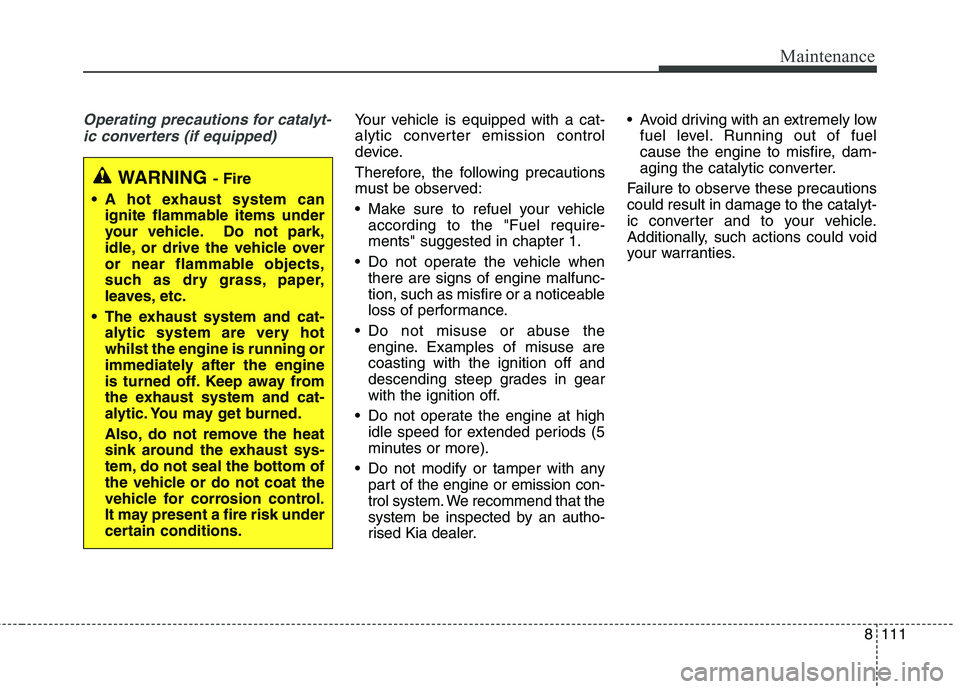
WARNING - Fire
A hot exhaust system can ignite flammable items under
your vehicle. Do not park,
idle, or drive the vehicle over
or near flammable objects,
such as dry grass, paper,
leaves, etc.
The exhaust system and cat- alytic system are very hotwhilst the engine is running or
immediately after the engine
is turned off. Keep away from
the exhaust system and cat-
alytic. You may get burned.
Also, do not remove the heat
sink around the exhaust sys-
tem, do not seal the bottom of
the vehicle or do not coat the
vehicle for corrosion control.
It may present a fire risk under
certain conditions.
Page 699 of 723
Diesel Particulate Filter (if equipped)
The Diesel Particulate Filter (DPF)
system removes the soot in the
exhaust gas.
Unlike a disposable air filter, the DPF
system automatically burns (oxidizes)
and removes the accumulated soot
according to the driving condition. In
other words, the active burning byengine control system and high
exhaust gas temperature caused by
normal/high driving condition burns
and removes the accumulated soot.
However, if the vehicle continues to
be driven at repeated short distance
or driven at low speed for a long
time, the accumulated soot may not
be automatically removed because
of low exhaust gas temperature.
More than a certain amount of sootdeposited, the malfunction indicator
light ( ) illuminates. When the malfunction indicator light
blinks, it may stop blinking by driving
the vehicle at more than 60 km/h (37mph) or at more than second gear
with 1500 ~ 2500 engine rpm for a
certain time (for about 25 minutes). If the malfunction indicator light ( )
continues to be blinked or the warn-
ing massage “Check exhaust system”
illuminates in spite of the procedure,
please visit an authorised Kia dealer
and the check the DPF system.
If you continue to drive with the mal-
function indicator light blinking for a
long time, the DPF system can bedamaged and fuel consumption can
be worsen.
Lean NOx Trap (if equipped)
The Lean NOx Trap (LNT) system
removes the nitrogen oxide in the
exhaust gas. The smell can occur in
the exhaust gas depending on the
quality of the fuel and it can degrade
NOx reduction performance, please
use the regulated automotive dieselfuel.
CAUTION -
Diesel Fuel
(if equipped with DPF)
It is recommended to use the regulated automotive diesel fuelfor diesel vehicle equipped with the DPF system.
If you use diesel fuel includinghigh sulfur (more than 50 ppmsulfur) and unspecified addi-tives, it can cause the DPF sys- tem to be damaged and whitesmoke can be emitted.
8112
Maintenance
Page 716 of 723
Index
4
I
To cancel cruise control ..............................................6-67
To decrease the cruising speed ..................................6-66
To increase cruise control set speed ..........................6-66
To resume cruising speed at more than approximately 30 km/h (20 mph) ............................6-68
To set cruise control speed..........................................6-65
To temporarily accelerate with the cruise control on ....6-67
To turn cruise control off ............................................6-68
Declaration of conformity ............................................9-13
Defroster ......................................................................4-138 Rear window defroster ..............................................4-138
Dimensions ......................................................................9-2
Door locks......................................................................4-23 Child-protector rear door lock ....................................4-29
Deadlocks....................................................................4-27
Door lock/unlock features ..........................................4-28
Operating door locks from inside the vehicle ............4-24
Operating door locks from outside the vehicle ........4-23
Dual Clutch Transmission (DCT) ................................6-34 Dual clutch transmission operation ..........................6-34
Good driving practices ................................................6-41
Economical operation ....................................................6-90 Emergency Commodity ................................................7-37
Fire extinguisher ........................................................7-37
Triangle reflector ......................................................7-37
Emergency starting ..........................................................7-5 Jump starting ..............................................................7-5
Push-starting ..............................................................7-7
Emission control system ..............................................8-109 Crankcase emission control system ..........................8-109
Evaporative emission control System ......................8-109
Exhaust emission control system ..............................8-110
Lean NOx Trap ........................................................8-112
Engine ..............................................................................9-2
Engine compartment ................................................2-6, 8-3
Engine coolant ..............................................................8-34 Changing the coolant ..................................................8-37
Checking the coolant level ....................................8-34
Engine number ..............................................................9-12
Engine oil ......................................................................8-32 Changing the engine oil and filter ..............................8-33
Checking the engine oil level ....................................8-32
ENGINE START/STOP button ....................................6-10 Engine start/stop button position ................................6-10
Illuminated engine start/stop button ..........................6-10
Starting the engine ......................................................6-13
Explanation of scheduled maintenance items ..............8-28
Exterior features ..........................................................4-186 Roof rack ..................................................................4-186
Exterior overview ............................................................2-2
D
E
Page 719 of 723
I7
Index
Interior light bulb replacement ................................8-100
License plate light bulb replacement ........................8-99
Rear combination light bulb replacement ................8-95
Side repeater light bulb replacement ..........................8-95
Lighting........................................................................4-117 Battery saver function ..............................................4-117
Daytime running light ..............................................4-118
Front fog light ..........................................................4-123
Headlamp delay function ..........................................4-117
Headlight (Headlamp) welcome function ................4-118
Headlight levelling device ........................................4-125
High - beam operation ............................................4-121
Lighting control ........................................................4-119
Rear fog light ............................................................4-124
Static bending light ..................................................4-118
Turn signals and lane change signals........................4-122
Luggage volume ..............................................................9-4
Maintenance services ......................................................8-6 Engine compartment precautions..................................8-7
Owner maintenance precautions ................................8-6
Owner’s responsibility ................................................8-6
Manual climate control system....................................4-140 Checking the amount of air conditioner refrigerant and compressor lubricant ..............................................4-149
Climate control air filter ..........................................4-148 Heating and air conditioning ....................................4-141
System operation ......................................................4-146
Manual Transaxle ..........................................................6-21 Good driving practices ................................................6-25
Manual transaxle operation ........................................6-21
Mirrors ..........................................................................4-52 Inside rearview mirror ................................................4-52
Outside rearview mirror ..............................................4-53
Owner maintenance ........................................................8-9 Owner maintenance schedule ......................................8-9
Panorama sunroof ..........................................................4-44 Closing the sunroof ....................................................4-46
Resetting the sunroof ..................................................4-47
Sliding the sunroof ....................................................4-45
Sunroof open warning ................................................4-44
Sunshade ....................................................................4-45
Tilting the sunroof ....................................................4-45
Parking assist system ..................................................4-100 Non-operational conditions of parking assist system ..............................................4-103
Operation of the parking assist system ....................4-101
Self-diagnosis............................................................4-105
P
M
O
Page 720 of 723
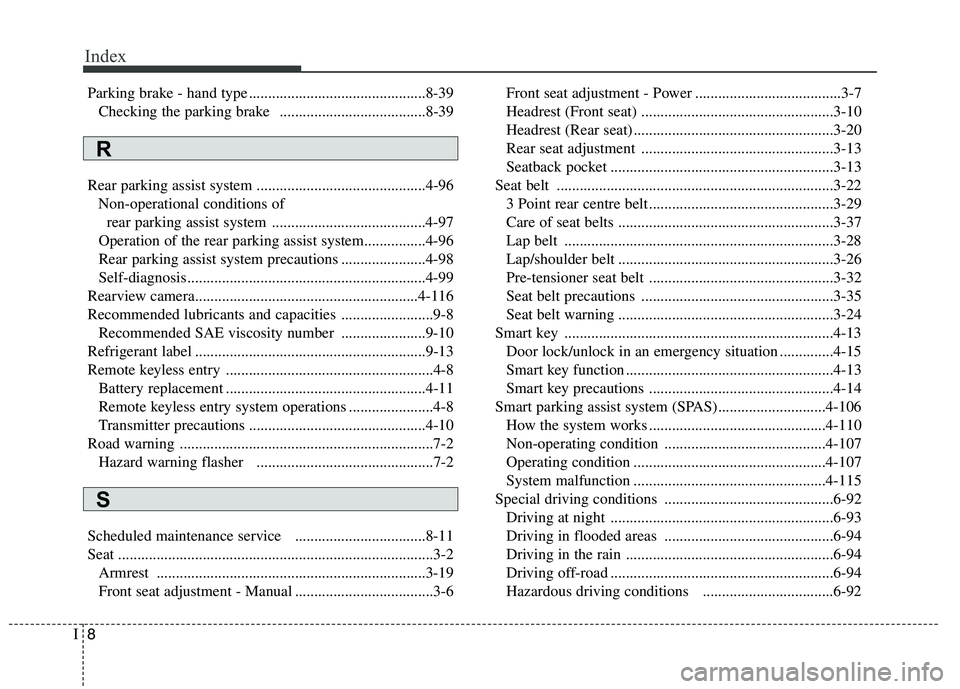
Index
8
I
Parking brake - hand type ..............................................8-39
Checking the parking brake ......................................8-39
Rear parking assist system ............................................4-96 Non-operational conditions of rear parking assist system ........................................4-97
Operation of the rear parking assist system................4-96
Rear parking assist system precautions ......................4-98
Self-diagnosis..............................................................4-99
Rearview camera..........................................................4-116
Recommended lubricants and capacities ........................9-8 Recommended SAE viscosity number ......................9-10
Refrigerant label ............................................................9-13
Remote keyless entry ......................................................4-8 Battery replacement ....................................................4-11
Remote keyless entry system operations ......................4-8
Transmitter precautions ..............................................4-10
Road warning ..................................................................7-2 Hazard warning flasher ..............................................7-2
Scheduled maintenance service ..................................8-11
Seat ..................................................................................3-2 Armrest ......................................................................3-19
Front seat adjustment - Manual ....................................3-6 Front seat adjustment - Power ......................................3-7
Headrest (Front seat) ..................................................3-10
Headrest (Rear seat) ....................................................3-20
Rear seat adjustment ..................................................3-13
Seatback pocket ..........................................................3-13
Seat belt ........................................................................3-22 3 Point rear centre belt ................................................3-29
Care of seat belts ........................................................3-37
Lap belt ......................................................................3-28
Lap/shoulder belt ........................................................3-26
Pre-tensioner seat belt ................................................3-32
Seat belt precautions ..................................................3-35
Seat belt warning ........................................................3-24
Smart key ......................................................................4-13 Door lock/unlock in an emergency situation ..............4-15
Smart key function ......................................................4-13
Smart key precautions ................................................4-14
Smart parking assist system (SPAS)............................4-106 How the system works ..............................................4-110
Non-operating condition ..........................................4-107
Operating condition ..................................................4-107
System malfunction ..................................................4-115
Special driving conditions ............................................6-92 Driving at night ..........................................................6-93
Driving in flooded areas ............................................6-94
Driving in the rain ......................................................6-94
Driving off-road ..........................................................6-94
Hazardous driving conditions ..................................6-92
S
R
Page 722 of 723
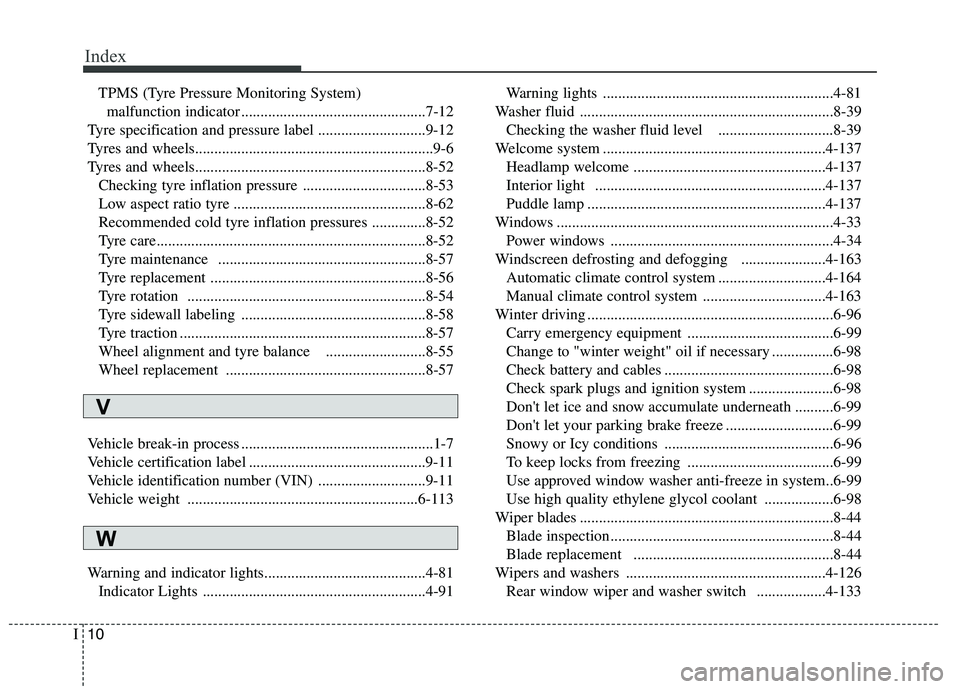
Index
10
I
TPMS (Tyre Pressure Monitoring System)
malfunction indicator ................................................7-12
Tyre specification and pressure label ............................9-12
Tyres and wheels..............................................................9-6
Tyres and wheels............................................................8-52 Checking tyre inflation pressure ................................8-53
Low aspect ratio tyre ..................................................8-62
Recommended cold tyre inflation pressures ..............8-52
Tyre care......................................................................8-52
Tyre maintenance ......................................................8-57
Tyre replacement ........................................................8-56
Tyre rotation ..............................................................8-54
Tyre sidewall labeling ................................................8-58
Tyre traction ................................................................8-57
Wheel alignment and tyre balance ..........................8-55
Wheel replacement ....................................................8-57
Vehicle break-in process ..................................................1-7
Vehicle certification label ..............................................9-11
Vehicle identification number (VIN) ............................9-11
Vehicle weight ............................................................6-113
Warning and indicator lights..........................................4-81 Indicator Lights ..........................................................4-91 Warning lights ............................................................4-81
Washer fluid ..................................................................8-39 Checking the washer fluid level ..............................8-39
Welcome system ..........................................................4-137 Headlamp welcome ..................................................4-137
Interior light ............................................................4-137
Puddle lamp ..............................................................4-137
Windows ........................................................................4-33 Power windows ..........................................................4-34
Windscreen defrosting and defogging ......................4-163 Automatic climate control system ............................4-164
Manual climate control system ................................4-163
Winter driving ................................................................6-96 Carry emergency equipment ......................................6-99
Change to "winter weight" oil if necessary ................6-98
Check battery and cables ............................................6-98
Check spark plugs and ignition system ......................6-98
Don't let ice and snow accumulate underneath ..........6-99
Don't let your parking brake freeze ............................6-99
Snowy or Icy conditions ............................................6-96
To keep locks from freezing ......................................6-99
Use approved window washer anti-freeze in system..6-99
Use high quality ethylene glycol coolant ..................6-98
Wiper blades ..................................................................8-44 Blade inspection ..........................................................8-44
Blade replacement ....................................................8-44
Wipers and washers ....................................................4-126 Rear window wiper and washer switch ..................4-133
V
W