radiator KIA CARENS RHD 2017 User Guide
[x] Cancel search | Manufacturer: KIA, Model Year: 2017, Model line: CARENS RHD, Model: KIA CARENS RHD 2017Pages: 723, PDF Size: 40.8 MB
Page 596 of 723
89
Maintenance
OWNER MAINTENANCE
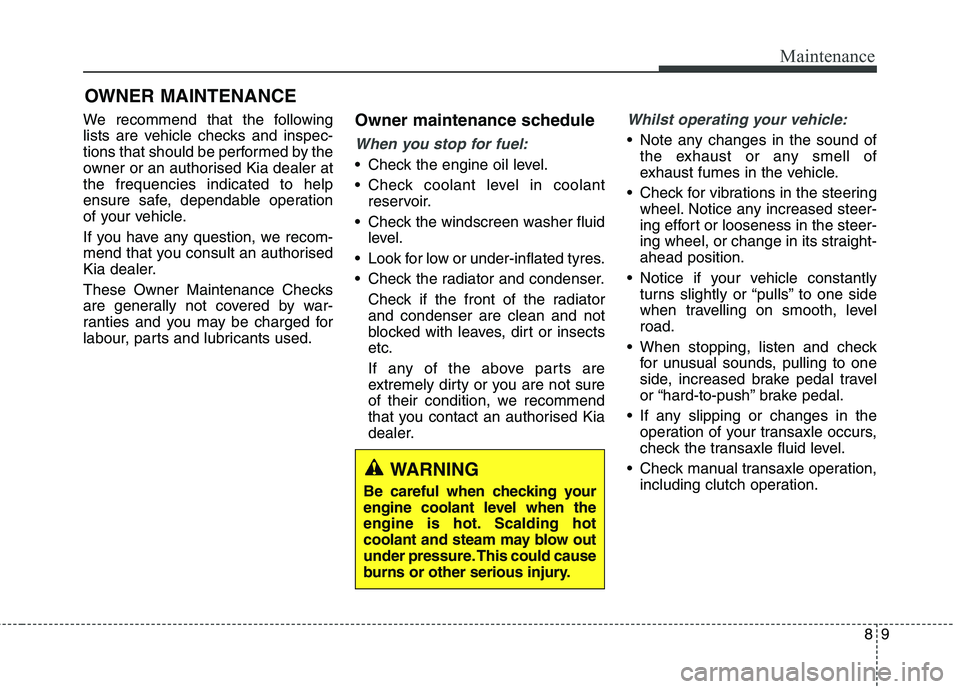
We recommend that the following
lists are vehicle checks and inspec-
tions that should be performed by the
owner or an authorised Kia dealer atthe frequencies indicated to help
ensure safe, dependable operation
of your vehicle.
If you have any question, we recom-
mend that you consult an authorised
Kia dealer.
These Owner Maintenance Checks
are generally not covered by war-
ranties and you may be charged for
labour, parts and lubricants used. Owner maintenance schedule
When you stop for fuel:
Check the engine oil level.
Check coolant level in coolant
reservoir.
Check the windscreen washer fluid level.
Look for low or under-inflated tyres.
Check the radiator and condenser. Check if the front of the radiator and condenser are clean and not
blocked with leaves, dirt or insectsetc.
If any of the above parts are
extremely dirty or you are not sure
of their condition, we recommend
that you contact an authorised Kia
dealer.
Whilst operating your vehicle:
Note any changes in the sound ofthe exhaust or any smell of
exhaust fumes in the vehicle.
Check for vibrations in the steering wheel. Notice any increased steer-
ing effort or looseness in the steer-
ing wheel, or change in its straight-ahead position.
Notice if your vehicle constantly turns slightly or “pulls” to one side
when travelling on smooth, levelroad.
When stopping, listen and check for unusual sounds, pulling to one
side, increased brake pedal travel
or “hard-to-push” brake pedal.
If any slipping or changes in the operation of your transaxle occurs,
check the transaxle fluid level.
Check manual transaxle operation, including clutch operation.
WARNING
Be careful when checking your
engine coolant level when the
engine is hot. Scalding hot
coolant and steam may blow out
under pressure. This could cause
burns or other serious injury.
Page 597 of 723
Maintenance
10
8
Check automatic transaxle / dual
clutch transmission P (Park) func- tion.
Check parking brake.
Check for fluid leaks under your vehicle (water dripping from the air
conditioning system during or after
use is normal).
At least monthly:
Check coolant level in the enginecoolant reservoir.
Check the operation of all exterior lights, including the stoplights, turn
signals and hazard warning flash-
ers.
Check the inflation pressures of all tyres including the spare.
At least twice a year
(i.e., every Spring and Fall) :
Check radiator, heater and air con- ditioning hoses for leaks or dam-
age.
Check windscreen washer spray and wiper operation. Clean wiper
blades with clean cloth dampened
with washer fluid.
Check headlight alignment.
Check muffler, exhaust pipes, shields and clamps.
Check the lap/shoulder belts for wear and function.
Check for worn tyres and loose wheel lug nuts.
At least once a year :
Clean body and door drain holes.
Lubricate door hinges and checks,and bonnet hinges.
Lubricate door and bonnet locks and latches.
Lubricate door rubber weather- strips.
Check the air conditioning system.
Inspect and lubricate automatic transaxle / dual clutch transmission
linkage and controls.
Clean battery and terminals.
Check the brake (and clutch) fluid level.
Page 617 of 723
Maintenance
30
8
Valve clearance
(for petrol engine)
(Except for Nu 2.0 Engine)
Inspect excessive valve noise and/or
engine vibration and adjust if neces-
sary. We recommend that the valve
clearance be serviced by an autho-
rised Kia dealer. Cooling system
Check the cooling system parts, such
as radiator, coolant reservoir, hoses
and connections for leakage and dam-
age. Replace any damaged parts. Coolant The coolant should be changed at
the intervals specified in the mainte-
nance schedule.
Manual transaxle fluid (if equipped)
Inspect the manual transaxle fluid according to the maintenance sched-
ule. Automatic transaxle fluid (if equipped)
Automatic transaxle fluid should not
be checked under normal usage
conditions.
But in severe conditions, we recom-
mend that the system be serviced by
an authorised Kia dealer in accor-
dance to the maintenance schedule.
✽✽
NOTICE
Automatic transaxle fluid colour is
basically red.
As the vehicle is driven, the auto-
matic transaxle fluid will begin to
look darker.
It is normal condition and you should
not judge the need to replace the fluid
based upon the changed colour.Dual clutch transmission fluid (if equipped)
Inspect the dual clutch transmission fluid according to the maintenance
schedule.
CAUTION
The use of a non-specified fluid could result in transaxle mal-function and failure.
Use only specified automatictransaxle fluid. (Refer to “Recommended lubricants andcapacities” in chapter 9.)
Page 619 of 723
Maintenance
32
8
ENGINE OIL
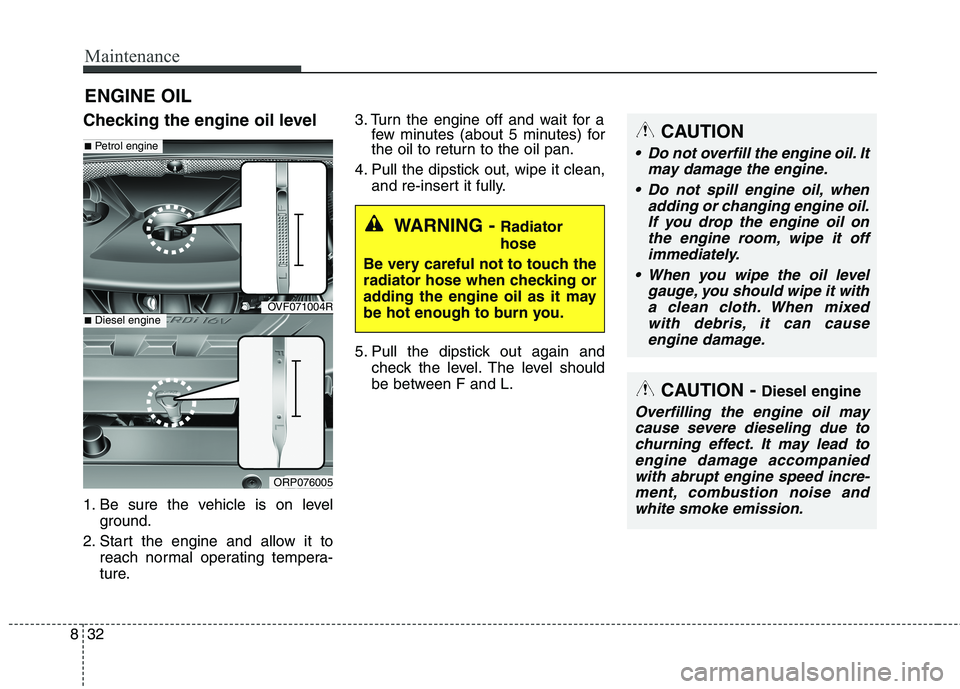
Checking the engine oil level
1. Be sure the vehicle is on level ground.
2. Start the engine and allow it to reach normal operating tempera-
ture. 3. Turn the engine off and wait for a
few minutes (about 5 minutes) for
the oil to return to the oil pan.
4. Pull the dipstick out, wipe it clean, and re-insert it fully.
5. Pull the dipstick out again and check the level. The level should
be between F and L.
WARNING - Radiator
hose
Be very careful not to touch the
radiator hose when checking or
adding the engine oil as it may
be hot enough to burn you.
CAUTION - Diesel engine
Overfilling the engine oil may
cause severe dieseling due tochurning effect. It may lead toengine damage accompanied with abrupt engine speed incre-ment, combustion noise andwhite smoke emission.
CAUTION
Do not overfill the engine oil. It may damage the engine.
Do not spill engine oil, when adding or changing engine oil.If you drop the engine oil on the engine room, wipe it offimmediately.
When you wipe the oil level gauge, you should wipe it witha clean cloth. When mixed with debris, it can causeengine damage.
OVF071004R
■ Petrol engine
ORP076005
■Diesel engine
Page 621 of 723
Maintenance
34
8
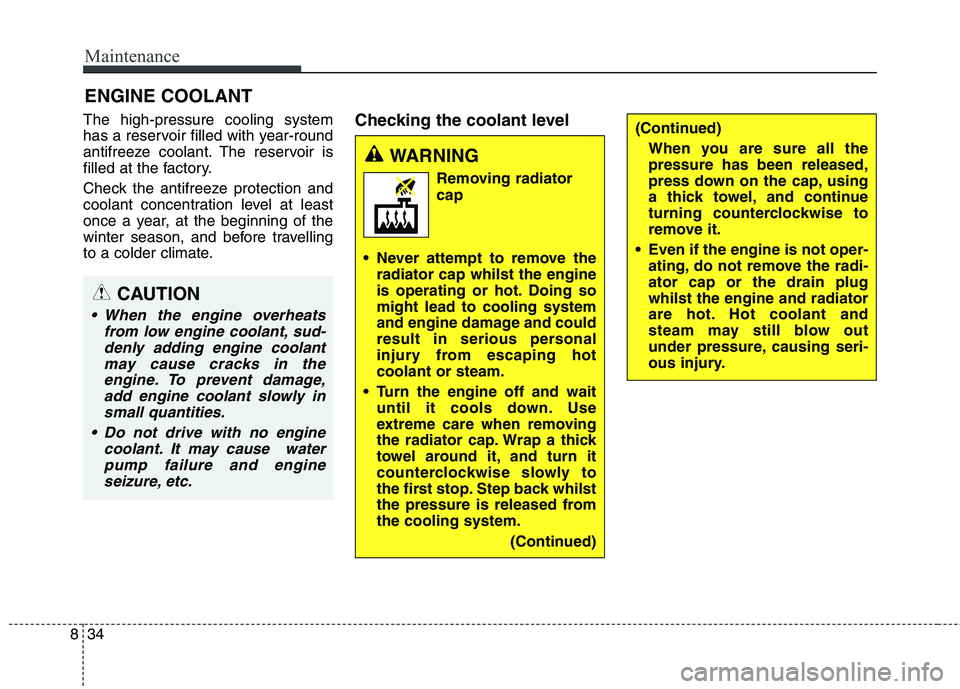
ENGINE COOLANT
The high-pressure cooling system
has a reservoir filled with year-round
antifreeze coolant. The reservoir is
filled at the factory.
Check the antifreeze protection and
coolant concentration level at least
once a year, at the beginning of the
winter season, and before travelling
to a colder climate. Checking the coolant level
(Continued)
When you are sure all the pressure has been released,
press down on the cap, using
a thick towel, and continue
turning counterclockwise to
remove it.
Even if the engine is not oper- ating, do not remove the radi-ator cap or the drain plugwhilst the engine and radiator
are hot. Hot coolant and
steam may still blow out
under pressure, causing seri-
ous injury.
WARNING
Removing radiatorcap
Never attempt to remove the radiator cap whilst the engine
is operating or hot. Doing somight lead to cooling system
and engine damage and could
result in serious personal
injury from escaping hotcoolant or steam.
Turn the engine off and wait until it cools down. Use
extreme care when removing
the radiator cap. Wrap a thick
towel around it, and turn it
counterclockwise slowly to
the first stop. Step back whilst
the pressure is released fromthe cooling system.
(Continued)
CAUTION
When the engine overheatsfrom low engine coolant, sud-denly adding engine coolantmay cause cracks in theengine. To prevent damage, add engine coolant slowly insmall quantities.
Do not drive with no engine coolant. It may cause waterpump failure and engine seizure, etc.
Page 623 of 723
Maintenance
36
8
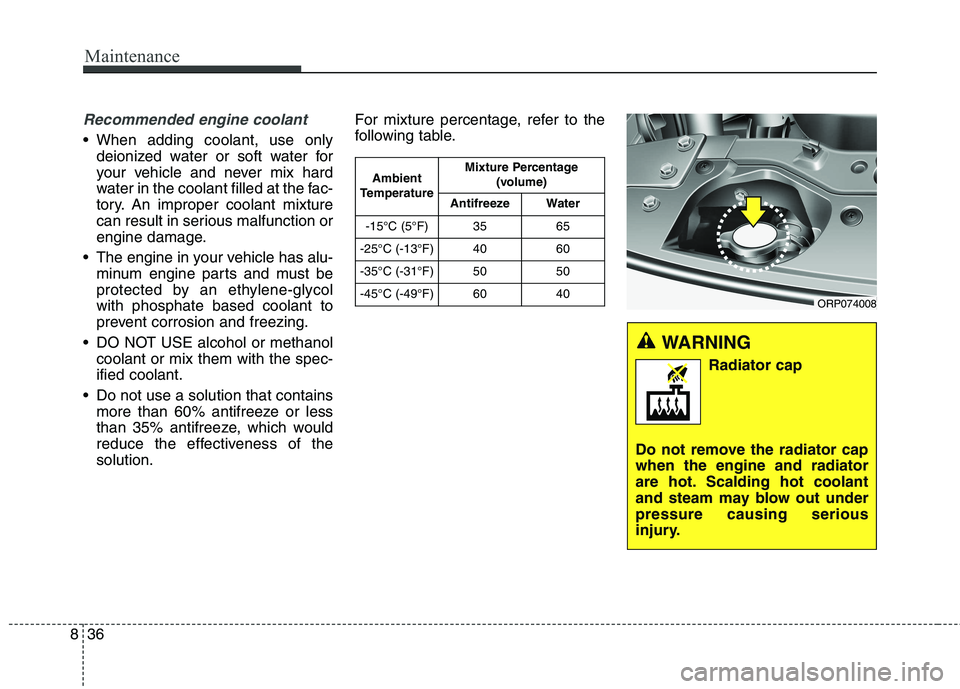
Recommended engine coolant
When adding coolant, use only
deionized water or soft water for
your vehicle and never mix hard
water in the coolant filled at the fac-
tory. An improper coolant mixture
can result in serious malfunction or
engine damage.
The engine in your vehicle has alu- minum engine parts and must be
protected by an ethylene-glycolwith phosphate based coolant to
prevent corrosion and freezing.
DO NOT USE alcohol or methanol coolant or mix them with the spec-ified coolant.
Do not use a solution that contains more than 60% antifreeze or less
than 35% antifreeze, which would
reduce the effectiveness of thesolution. For mixture percentage, refer to the
following table.
WARNING
Radiator cap
Do not remove the radiator cap when the engine and radiator
are hot. Scalding hot coolant
and steam may blow out underpressure causing serious
injury.
ORP074008
Ambient
Temperature Mixture Percentage
(volume)
Antifreeze Water
-15°C (5°F) 35 65
-25°C (-13°F) 40 60
-35°C (-31°F) 50 50
-45°C (-49°F) 60 40
Page 624 of 723
837
Maintenance
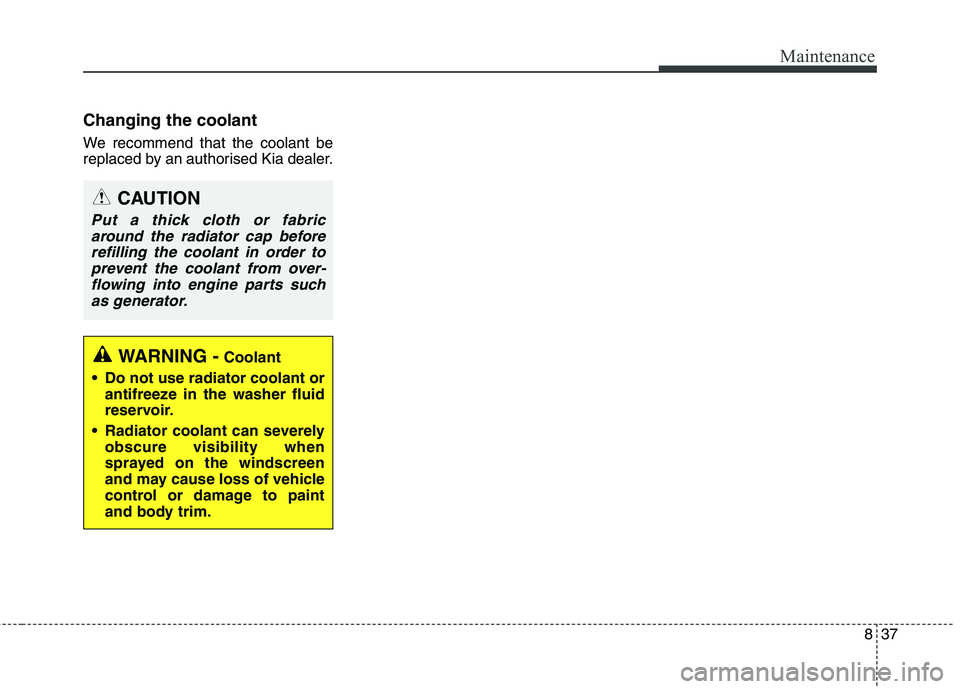
Changing the coolant
We recommend that the coolant be
replaced by an authorised Kia dealer.
CAUTION
Put a thick cloth or fabricaround the radiator cap beforerefilling the coolant in order to prevent the coolant from over-flowing into engine parts suchas generator.
WARNING - Coolant
Do not use radiator coolant or antifreeze in the washer fluid
reservoir.
Radiator coolant can severely obscure visibility when
sprayed on the windscreen
and may cause loss of vehicle
control or damage to paint
and body trim.
Page 626 of 723
839
Maintenance
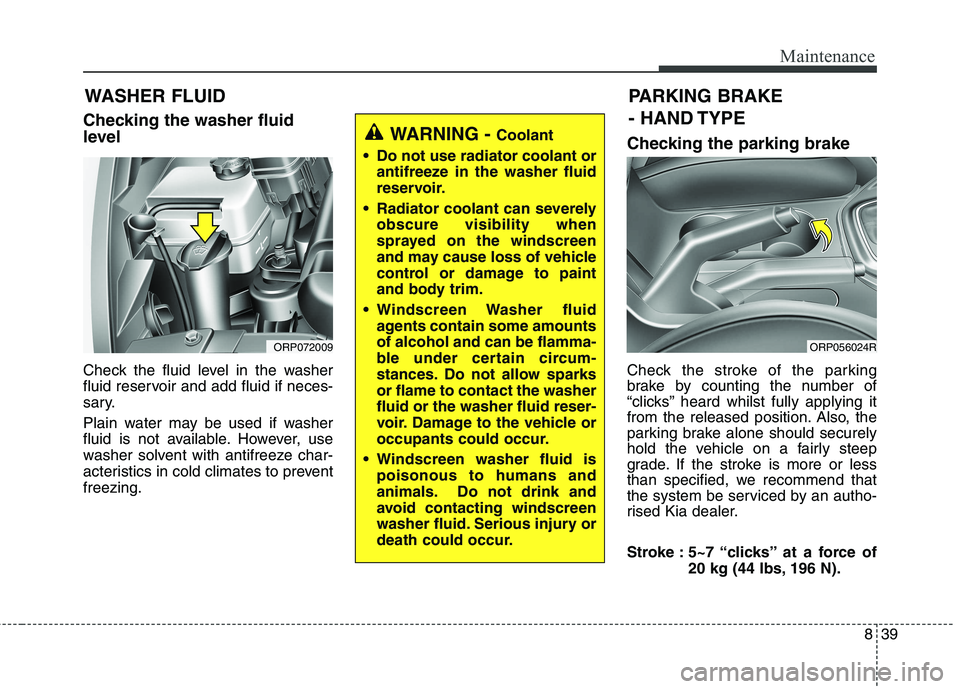
WASHER FLUID
Checking the washer fluid
level
Check the fluid level in the washer
fluid reservoir and add fluid if neces-
sary.
Plain water may be used if washer
fluid is not available. However, use
washer solvent with antifreeze char-
acteristics in cold climates to preventfreezing. Checking the parking brake
Check the stroke of the parking
brake by counting the number of
“clicks’’ heard whilst fully applying it
from the released position. Also, the
parking brake alone should securely
hold the vehicle on a fairly steep
grade. If the stroke is more or less
than specified, we recommend that
the system be serviced by an autho-
rised Kia dealer.
Stroke : 5~7 “clicks’’ at a force of
20 kg (44 lbs, 196 N).
ORP072009
WARNING - Coolant
Do not use radiator coolant or antifreeze in the washer fluid
reservoir.
Radiator coolant can severely obscure visibility when
sprayed on the windscreen
and may cause loss of vehicle
control or damage to paint
and body trim.
Windscreen Washer fluid agents contain some amountsof alcohol and can be flamma-
ble under certain circum-
stances. Do not allow sparksor flame to contact the washerfluid or the washer fluid reser-
voir. Damage to the vehicle or
occupants could occur.
Windscreen washer fluid is poisonous to humans and
animals. Do not drink and
avoid contacting windscreen
washer fluid. Serious injury or
death could occur.
PARKING BRAKE
- HAND TYPE
ORP056024R
Page 708 of 723
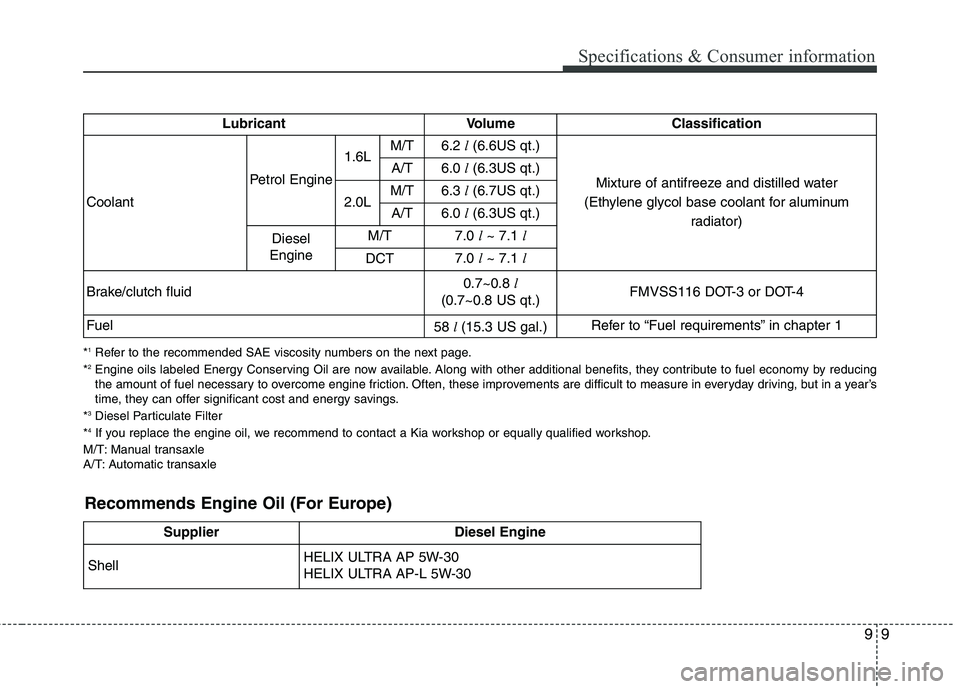
99
Specifications & Consumer information
Lubricant Volume Classification
Coolant
Petrol Engine
1.6LM/T6.2l(6.6US qt.)
Mixture of antifreeze and distilled water
(Ethylene glycol base coolant for aluminum radiator)A/T6.0l(6.3US qt.)
2.0LM/T6.3 l(6.7US qt.)
A/T6.0 l(6.3US qt.)
Diesel
EngineM/T7.0 l~ 7.1 l
DCT7.0l~ 7.1 l
Brake/clutch fluid0.7~0.8 l
(0.7~0.8 US qt.)FMVSS116 DOT-3 or DOT-4
Fuel 58 l (15.3 US gal.) Refer to “Fuel requirements” in chapter 1
*1
Refer to the recommended SAE viscosity numbers on the next page.
* 2
Engine oils labeled Energy Conserving Oil are now available. Along with other additional benefits, they contribute to fuel economy by reducing
the amount of fuel necessary to overcome engine friction. Often, these improvements are difficult to measure in everyday driving, but in a year’s
time, they can offer significant cost and energy savings.
* 3
Diesel Particulate Filter
* 4
If you replace the engine oil, we recommend to contact a Kia workshop or equally qualified workshop.
M/T: Manual transaxle
A/T: Automatic transaxle
Recommends Engine Oil (For Europe)
SupplierDiesel Engine
ShellHELIX ULTRA AP 5W-30
HELIX ULTRA AP-L 5W-30