bonnet KIA CARENS RHD 2017 Owner's Manual
[x] Cancel search | Manufacturer: KIA, Model Year: 2017, Model line: CARENS RHD, Model: KIA CARENS RHD 2017Pages: 723, PDF Size: 40.8 MB
Page 484 of 723
649
Driving your vehicle
To release EPB (Electronic parking
brake) automatically:
Manual transaxle vehicle1. Start the engine.
2. Fasten the driver's seat belt.
3. Close the driver's door, engine bonnet and tailgate.
4. Depress the clutch pedal with the gear engaged.
5. Depress the accelerator pedal whilst releasing the clutch pedal.
Automatic transaxle vehicle
1. Start the engine.
2. Fasten the driver's seat belt.
3. Close the driver's door, engine bonnet and tailgate.
4. Depress the accelerator pedal whilst the shift lever is in R
(Rear), D (Drive).
Shift lever in P (Park) With the engine running depress
the brake pedal and shift out of P
(Park) to R (Rear) or D (Drive). Shift lever in N (Neutral)
With the engine running depress
the brake pedal and shift out of N
(Neutral) to R (Rear) or D (Drive).
Make sure the brake warning light
goes off.
✽✽ NOTICE
For your safety, you can engage the EPB even though the ignition
switch or engine stop/start button
is in the OFF position, but you
cannot release it.
For your safety, depress the brake pedal and release the parking
brake manually with the EPB
switch when you drive downhill or
when backing up the vehicle. ✽
✽
NOTICE - Manual transaxle
A vehicle towing a trailer on a hill or
on an incline may slightly roll back-
wards when starting the vehicle. To
prevent the situation follow the
below instructions.
1. Depress the clutch pedal and select a gear.
2. Keep pulling up the EPB switch.
3. Depress the accelerator pedal and slowly release the clutch pedal.
4.If the vehicle starts off with enough driving power release the
EPB switch.
Do not follow the above procedure
when driving on a flat level ground.
The vehicle may suddenly move for-
ward.
Page 485 of 723
Driving your vehicle
50
6
EPB (Electronic parking brake) may
be automatically applied when:
The EPB is overheated
Requested by other systems
If you try to drive off depressing the
accelerator pedal with the EPB
applied, but doesn't release auto-
matically, a warning will sound and
a message ("Release parking
brake") will appear.
If the driver's seat belt is not fas- tened and any door, the enginebonnet or tailgate is opened, a
warning will sound and a message
will appear.
If there is a problem with the vehi- cle, a warning may sound and a
message may appear.
If the above situation occurs,
depress the brake pedal and release
EPB by pressing the EPB switch.
WARNING
To prevent unintentional movement when stopped and
leaving the vehicle, do not use
the shift lever in place of the
parking brake. Set the parkingbrake and make sure the shift
lever is securely positioned in
P (Park).
Never allow anyone who is unfamiliar with the vehicle to
touch the parking brake. If theparking brake is released
unintentionally, serious injury
may occur.
All vehicles should always have the parking brake fully
engaged when parking to
avoid inadvertent movement
of the car which can injureoccupants or pedestrians.CAUTION
If the parking brake warning
light is still on even thoughthe EPB has been released,we recommend that the sys-tem be checked by an autho- rised Kia dealer.
Do not drive your vehicle with the EPB applied. It may causeexcessive brake pad andbrake rotor wear.
Page 558 of 723
What to do in an emergency
8
7
IF THE ENGINE OVERHEATS
If your temperature gauge indicates
overheating, you will experience a
loss of power, or hear loud pinging or
knocking, the engine is probably too
hot. If this happens, you should:
1.Pull off the road and stop as soon as it is safe to do so.
2.Place the shift lever in P (automat- ic transaxle / dual clutch transmis-
sion) or neutral (manual transaxle)
and set the parking brake. If the air
conditioning is on, turn it off.
3.If engine coolant is running out under the vehicle or steam is com-ing out from the bonnet, stop the
engine. Do not open the bonnet until
the coolant has stopped running or
the steaming has stopped. If there is
no visible loss of engine coolant and
no steam, leave the engine running
and check to be sure the engine
cooling fan is operating. If the fan is
not running, turn the engine off.
4.Check to see if the water pump drive belt is missing. If it is not miss-
ing, check to see that it is tight. If the drive belt seems to be satis-
factory, check for coolant leaking
from the radiator, hoses or under
the vehicle. (If the air conditioning
had been in use, it is normal for
cold water to be draining from it
when you stop).
5.If the water pump drive belt is bro- ken or engine coolant is leakingout, stop the engine immediately
and we recommend that you call
an authorised Kia dealer. 6.If you cannot find the cause of the
overheating, wait until the engine
temperature has returned to nor-
mal. Then, if coolant has been lost,carefully add coolant to the reser-
voir to bring the fluid level in the
reservoir up to the halfway mark.
7.Proceed with caution, keeping alert for further signs of overheat-
ing. If overheating happens again,
we recommend that you call an
authorised Kia dealer.
CAUTION
Serious loss of coolant indi-
cates there is a leak in the cool-ing system and we recommend that the system be checked byan authorised Kia dealer.
When the engine overheats from low engine coolant, sud-denly adding engine coolant may cause cracks in theengine. To prevent damage,add engine coolant slowly in small quantities.
WARNING
Whilst the engine is running,
keep hair, hands and clothing
away from moving parts suchas the fan and drive belts to pre-
vent injury.
WARNING
Do not remove the radiator cap
when the engine is hot. This can
allow coolant to blow out of theopening and cause serious
burns.
Page 594 of 723
87
Maintenance
Engine compartment precau- tions (Diesel engine)
• The injector operates at high volt-age (maximum 200v). Therefore,
the following accidents may occur.
- Direct contact with the injector orinjector wiring may cause electric
shock or damage your muscle or
nerve system.
- The electromagnetic wave from the operating injector may cause
the artificial heart pacemaker tomalfunction.
Follow the safety tips provided below, when you are checking theengine room whilst the engine is
running.
- Do not touch the injector, injectorwirings, and the engine computer
whilst the engine is running.
- Do not remove the injector con- nector whilst the engine is run-ning.
- People using pacemakers must not go near the engine whilst the
engine is starting or running.WARNING - Maintenance
work
Performing maintenance work on a vehicle can be danger-
ous. You can be seriously
injured whilst performing
some maintenance proce-
dures. If you lack sufficient
knowledge and experience or
the proper tools and equip-
ment to do the work, we rec-ommend that the system be
serviced by an authorised Kia
dealer.
Working under the bonnet with the engine running is
dangerous. It becomes even
more dangerous when you
wear jewelry or loose cloth-
ing. These can become entan-
gled in moving parts and
result in injury.
(Continued)(Continued)
Therefore, if you must run the
engine whilst working under
the bonnet, make certain that
you remove all jewelry (espe-
cially rings, bracelets, watch-
es, and necklaces) and all
neckties, scarves, and similar
loose clothing before gettingnear the engine or coolingfans.
Page 597 of 723
Maintenance
10
8
Check automatic transaxle / dual
clutch transmission P (Park) func- tion.
Check parking brake.
Check for fluid leaks under your vehicle (water dripping from the air
conditioning system during or after
use is normal).
At least monthly:
Check coolant level in the enginecoolant reservoir.
Check the operation of all exterior lights, including the stoplights, turn
signals and hazard warning flash-
ers.
Check the inflation pressures of all tyres including the spare.
At least twice a year
(i.e., every Spring and Fall) :
Check radiator, heater and air con- ditioning hoses for leaks or dam-
age.
Check windscreen washer spray and wiper operation. Clean wiper
blades with clean cloth dampened
with washer fluid.
Check headlight alignment.
Check muffler, exhaust pipes, shields and clamps.
Check the lap/shoulder belts for wear and function.
Check for worn tyres and loose wheel lug nuts.
At least once a year :
Clean body and door drain holes.
Lubricate door hinges and checks,and bonnet hinges.
Lubricate door and bonnet locks and latches.
Lubricate door rubber weather- strips.
Check the air conditioning system.
Inspect and lubricate automatic transaxle / dual clutch transmission
linkage and controls.
Clean battery and terminals.
Check the brake (and clutch) fluid level.
Page 672 of 723
885
Maintenance
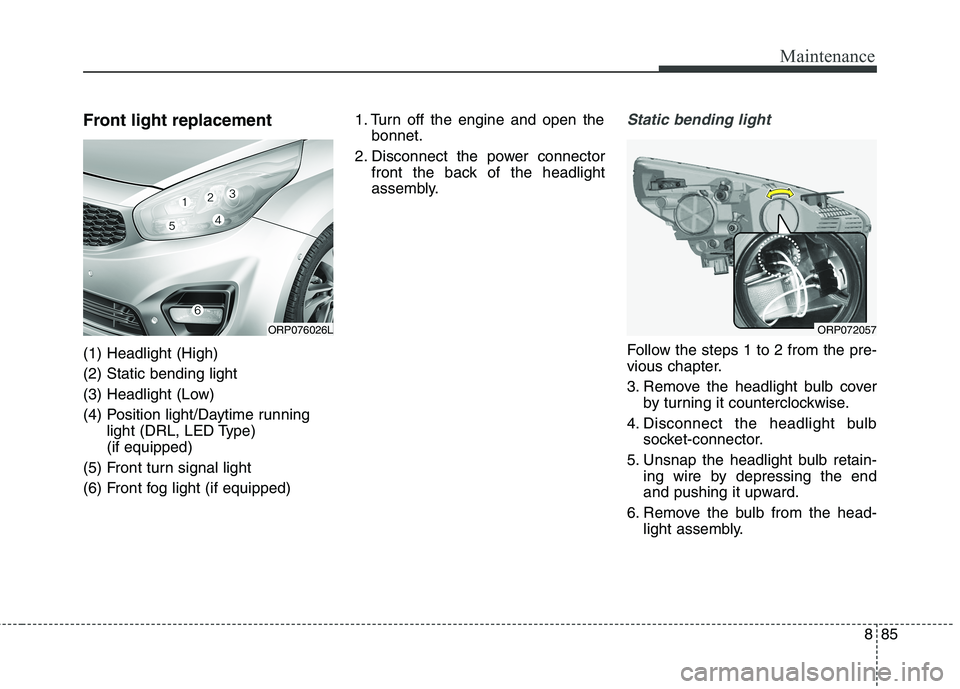
Front light replacement (1) Headlight (High) (2) Static bending light
(3) Headlight (Low)
(4) Position light/Daytime runninglight (DRL, LED Type) (if equipped)
(5) Front turn signal light
(6) Front fog light (if equipped) 1. Turn off the engine and open the
bonnet.
2. Disconnect the power connector front the back of the headlight
assembly.Static bending light
Follow the steps 1 to 2 from the pre-
vious chapter.
3. Remove the headlight bulb coverby turning it counterclockwise.
4. Disconnect the headlight bulb socket-connector.
5. Unsnap the headlight bulb retain- ing wire by depressing the end
and pushing it upward.
6. Remove the bulb from the head- light assembly.
ORP072057ORP076026L
Page 712 of 723
913
Specifications & Consumer information
REFRIGERANT LABEL
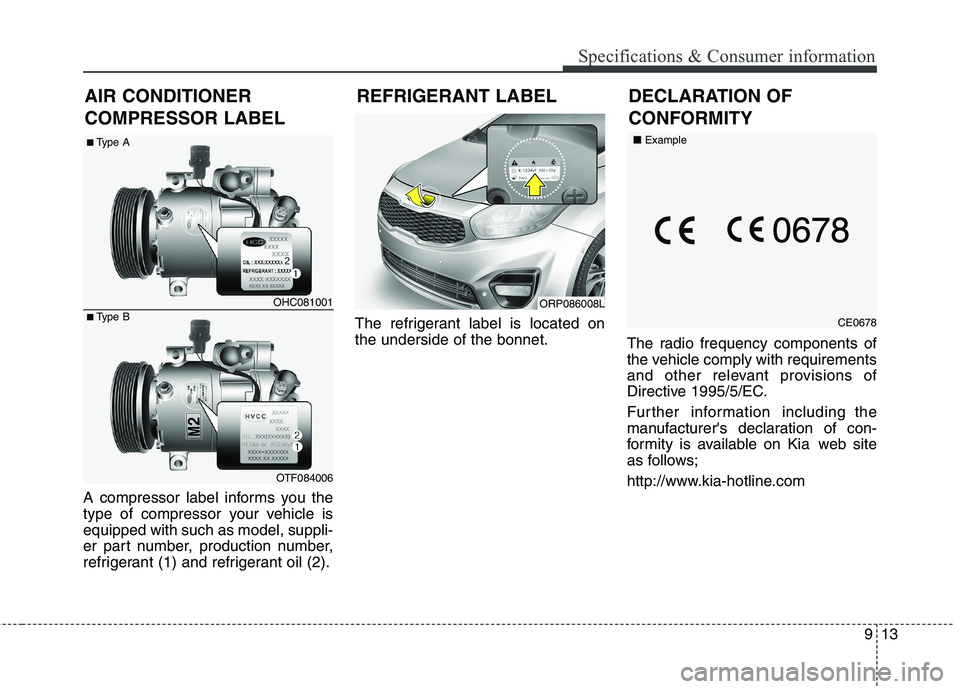
A compressor label informs you the
type of compressor your vehicle isequipped with such as model, suppli-
er part number, production number,
refrigerant (1) and refrigerant oil (2). The refrigerant label is located onthe underside of the bonnet.
The radio frequency components of
the vehicle comply with requirements
and other relevant provisions of
Directive 1995/5/EC.
Further information including the
manufacturer's declaration of con-
formity is available on Kia web site
as follows;
http://www.kia-hotline.com
AIR CONDITIONER COMPRESSOR LABEL
DECLARATION OF CONFORMITY
CE0678
■
Example
ORP086008LOHC081001
■Type A
■Type B
OTF084006
Page 715 of 723
I3
Index
Checking the amount of air conditioner refrigerant and
compressor lubricant ..............................................4-162
Climate control air filter ..........................................4-161
Manual heating and air conditioning ........................4-153
System operation ......................................................4-159
Automatic transaxle ......................................................6-26 Automatic transaxle operation ....................................6-26
Good driving practices ................................................6-32
Battery............................................................................8-48 Battery capacity label..................................................8-50
Battery recharging ....................................................8-50
For best battery service ..............................................8-48
Reset items ..................................................................8-51
Before driving ..................................................................6-4 Before entering vehicle ................................................6-4Before starting ..............................................................6-4
Necessary inspections ..................................................6-4
Blind spot detection system (BSD) ..............................6-82 BSD (Blind Spot Detection) / LCA (Lane Change Assist) ......................................6-83
Driver's Attention ........................................................6-88
RCTA (Rear cross traffic alert) ..................................6-86
Bonnet ............................................................................4-38 Closing the bonnet ......................................................4-39
Opening the bonnet ....................................................4-38 Brake system..................................................................6-44
Anti-lock brake system (ABS) ..................................6-53
Electronic parking brake (EPB) ..................................6-48
Electronic stability control (ESC) ..............................6-56
Emergency Stop Signal (ESS) ....................................6-62
Good braking practices ..............................................6-62
Hill-start assist control (HAC) ....................................6-61
Parking brake - Hand type ..........................................6-46
Power brakes ............................................................6-44
Vehicle stability management (VSM) ........................6-60
Brake/clutch fluid ..........................................................8-38 Checking the brake/clutch fluid level ........................8-38
Bulb wattage ....................................................................9-5
Child restraint system ....................................................3-39 Child restraint system ................................................3-41
Installing a child restraint system with a lap/shoulder belt........................................................3-42
ISOFIX and Top Tether Anchorage system ................3-48
Top Tether Anchor system ..........................................3-46
Clean air ......................................................................4-167
Climate control air filter ................................................8-42 Filter inspection ..........................................................8-42
Filter replacement ......................................................8-42
Cruise Control system ..................................................6-64 Cruise control switch ..................................................6-65
B
C