engine coolant KIA CARENS RHD 2017 Owner's Manual
[x] Cancel search | Manufacturer: KIA, Model Year: 2017, Model line: CARENS RHD, Model: KIA CARENS RHD 2017Pages: 723, PDF Size: 40.8 MB
Page 597 of 723
Maintenance
10
8
Check automatic transaxle / dual
clutch transmission P (Park) func- tion.
Check parking brake.
Check for fluid leaks under your vehicle (water dripping from the air
conditioning system during or after
use is normal).
At least monthly:
Check coolant level in the enginecoolant reservoir.
Check the operation of all exterior lights, including the stoplights, turn
signals and hazard warning flash-
ers.
Check the inflation pressures of all tyres including the spare.
At least twice a year
(i.e., every Spring and Fall) :
Check radiator, heater and air con- ditioning hoses for leaks or dam-
age.
Check windscreen washer spray and wiper operation. Clean wiper
blades with clean cloth dampened
with washer fluid.
Check headlight alignment.
Check muffler, exhaust pipes, shields and clamps.
Check the lap/shoulder belts for wear and function.
Check for worn tyres and loose wheel lug nuts.
At least once a year :
Clean body and door drain holes.
Lubricate door hinges and checks,and bonnet hinges.
Lubricate door and bonnet locks and latches.
Lubricate door rubber weather- strips.
Check the air conditioning system.
Inspect and lubricate automatic transaxle / dual clutch transmission
linkage and controls.
Clean battery and terminals.
Check the brake (and clutch) fluid level.
Page 599 of 723

Maintenance
12
8
Normal Maintenance Schedule - For Europe (Except Russia)
The following maintenance services must be performed to ensure good emission control and performance. Keep
receipts for all vehicle emission services to protect your warranty. Where both mileage and time are shown, the fre-
quency of service is deter mined by whichever occurs first.
NO.ITEMREMARK
*1Coolant (Engine)
When adding coolant, use only deionized water or soft water for your vehicle and never
mix hard water in the coolant filled at the factory. An improper coolant mixture can result
in serious malfunction or engine damage.
*2Drive belts (Engine)Inspect drive belt tensioner, idler and alternator pulley and if necessary correct or replace.
*3Transaxle fluidManual transaxle fluid and dual clutch transmission fluid should be changed anytime they
have been submerged in water.
*4Engine oil and engine oil filter
Check the engine oil level and leak every 500 km (350 miles) or before starting a long trip.
15,000 km or 12 months for GDI engine.
Operating with an insufficient amount of oil can damage the engine, and such damage is not cov-
ered by warranty.
*5Engine oil and engine oil filter (For Diesel Engine)
20,000 km or 12 months.
Operating with an insufficient amount of oi can damage the engine, and such damage is not cov-
ered by warranty.
It is applicable only when using a qualified fuel <"EN590 or equivalent">. If the diesel fuel specifications don't meet the
EN590, it must be replaced according to the severe maintenance schedule.
Page 601 of 723
Maintenance
14
8
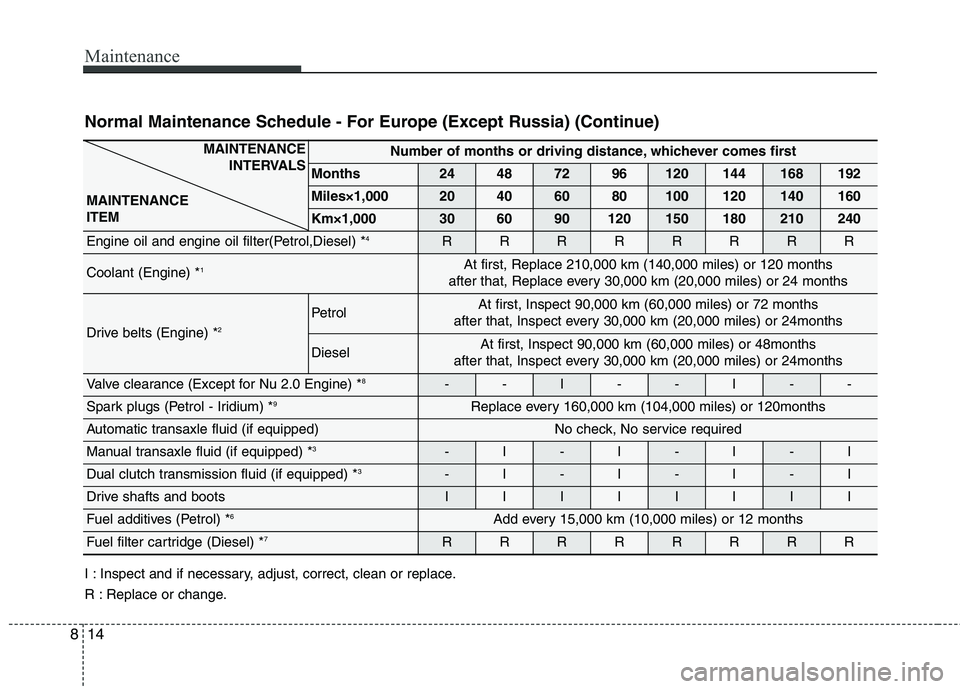
Normal Maintenance Schedule - For Europe (Except Russia) (Continue)
I : Inspect and if necessary, adjust, correct, clean or replace.
R : Replace or change.
MAINTENANCE
INTERVALS
MAINTENANCE ITEMNumber of months or driving distance, whichever comes first
Months24487296120144168192
Miles×1,00020406080100120140160
Km×1,000306090120150180210240
Engine oil and engine oil filter(Petrol,Diesel) * 4RRRRRRRR
Coolant (Engine) *1At first, Replace 210,000 km (140,000 miles) or 120 months
after that, Replace every 30,000 km (20,000 miles) or 24 months
Drive belts (Engine) * 2
PetrolAt first, Inspect 90,000 km (60,000 miles) or 72 months
after that, Inspect every 30,000 km (20,000 miles) or 24months
DieselAt first, Inspect 90,000 km (60,000 miles) or 48months
after that, Inspect every 30,000 km (20,000 miles) or 24months
Valve clearance (Except for Nu 2.0 Engine) * 8--I--I--
Spark plugs (Petrol - Iridium) *9Replace every 160,000 km (104,000 miles) or 120months
Automatic transaxle fluid (if equipped)No check, No service required
Manual transaxle fluid (if equipped) * 3-I-I-I-I
Dual clutch transmission fluid (if equipped) * 3-I-I-I-I
Drive shafts and bootsIIIIIIII
Fuel additives (Petrol) *6Add every 15,000 km (10,000 miles) or 12 months
Fuel filter cartridge (Diesel) * 7RRRRRRRR
Page 606 of 723

819
Maintenance
Normal Maintenance Schedule - Except Europe (Including Russia)
The following maintenance services must be performed to ensure good emission control and performance. Keep receipts for all
vehicle emission services to protect your warranty. Where both mileage and time are shown, the frequency of service is deter
mined by whichever occurs first.
NO.ITEMREMARK
*1Coolant (Engine)When adding coolant, use only deionized water or soft water for your vehicle and never mix
hard water in the coolant filled at the factory. An improper coolant mixture can result in seri-
ous malfunction or engine damage.
*2Drive belts (Engine)Inspect drive belt tensioner, idler and alternator pulley and if necessary correct or replace.
*3Transaxle fluidManual transaxle fluid and dual clutch transmission fluid should be changed anytime they
have been submerged in water.
*4Engine oil and engine oil filter
Operating withan insufficient amount of oil can damage the engine, and such damage is not covered
by warranty.
Page 609 of 723
Maintenance
22
8
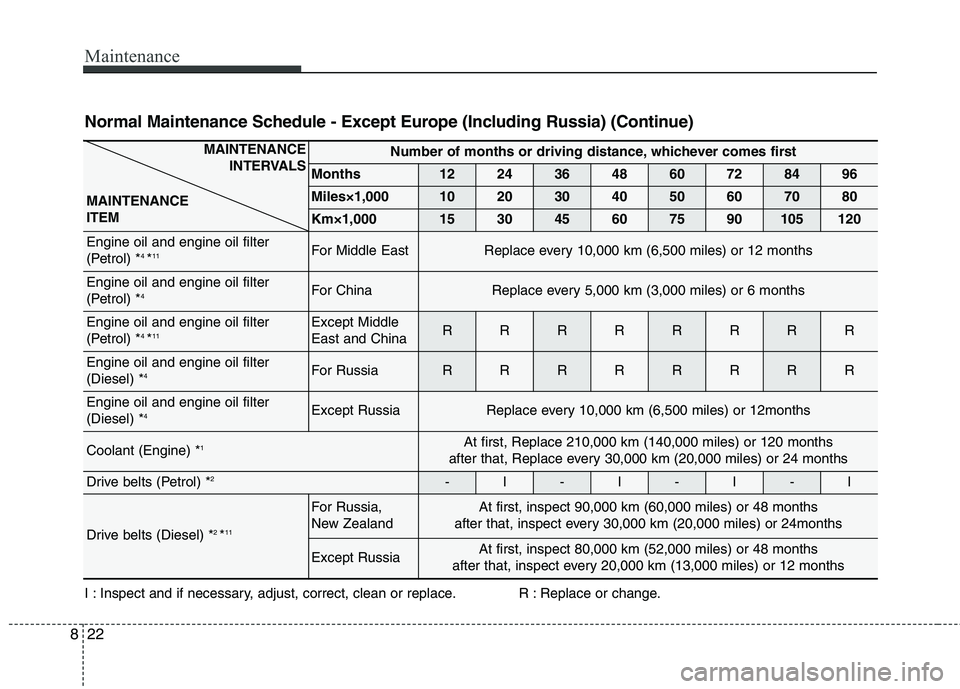
Normal Maintenance Schedule - Except Europe (Including Russia) (Continue)
I : Inspect and if necessary, adjust, correct, clean or replace. R : Replace or change.
MAINTENANCE
INTERVALS
MAINTENANCE ITEMNumber of months or driving distance, whichever comes first
Months1224364860728496
Miles×1,0001020304050607080
Km×1,000153045607590105120
Engine oil and engine oil filter
(Petrol) * 4
*11For Middle East Replace every 10,000 km (6,500 miles) or 12 months
Engine oil and engine oil filter
(Petrol) * 4For ChinaReplace every 5,000 km (3,000 miles) or 6 months
Engine oil and engine oil filter
(Petrol) *4
*11Except Middle East and ChinaRRRRRRRR
Engine oil and engine oil filter (Diesel) * 4For RussiaRRRRRRRR
Engine oil and engine oil filter (Diesel) *4Except RussiaReplace every 10,000 km (6,500 miles) or 12months
Coolant (Engine) * 1At first, Replace 210,000 km (140,000 miles) or 120 months
after that, Replace every 30,000 km (20,000 miles) or 24 months
Drive belts (Petrol) * 2-I-I-I-I
Drive belts (Diesel) * 2
*11
For Russia,
New ZealandAt first, inspect 90,000 km (60,000 miles) or 48 months
after that, inspect every 30,000 km (20,000 miles) or 24months
Except RussiaAt first, inspect 80,000 km (52,000 miles) or 48 months
after that, inspect every 20,000 km (13,000 miles) or 12 months
Page 617 of 723
Maintenance
30
8
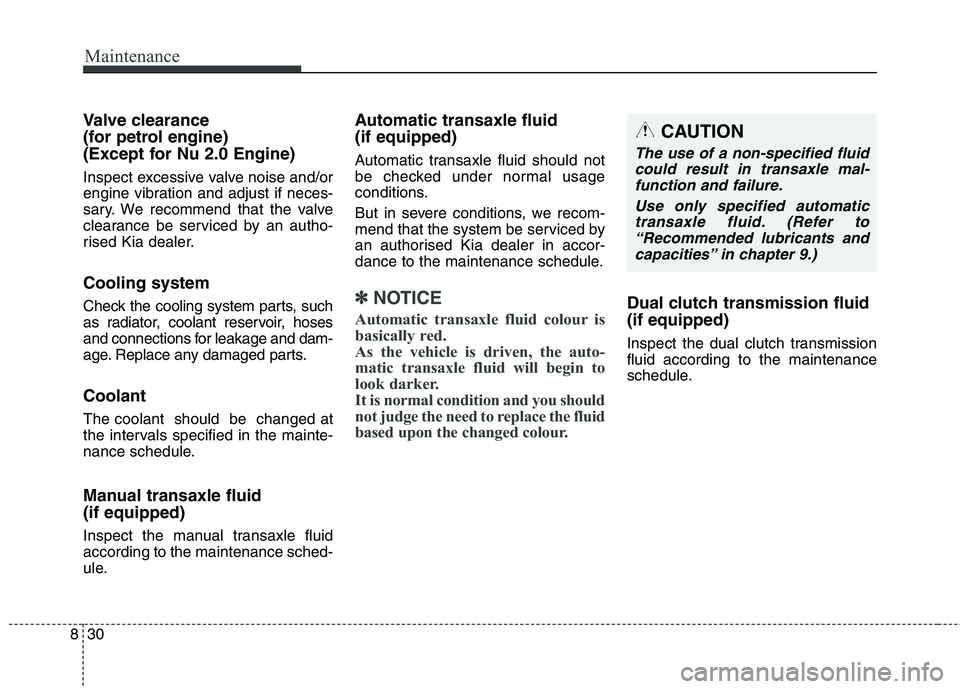
Valve clearance
(for petrol engine)
(Except for Nu 2.0 Engine)
Inspect excessive valve noise and/or
engine vibration and adjust if neces-
sary. We recommend that the valve
clearance be serviced by an autho-
rised Kia dealer. Cooling system
Check the cooling system parts, such
as radiator, coolant reservoir, hoses
and connections for leakage and dam-
age. Replace any damaged parts. Coolant The coolant should be changed at
the intervals specified in the mainte-
nance schedule.
Manual transaxle fluid (if equipped)
Inspect the manual transaxle fluid according to the maintenance sched-
ule. Automatic transaxle fluid (if equipped)
Automatic transaxle fluid should not
be checked under normal usage
conditions.
But in severe conditions, we recom-
mend that the system be serviced by
an authorised Kia dealer in accor-
dance to the maintenance schedule.
✽✽
NOTICE
Automatic transaxle fluid colour is
basically red.
As the vehicle is driven, the auto-
matic transaxle fluid will begin to
look darker.
It is normal condition and you should
not judge the need to replace the fluid
based upon the changed colour.Dual clutch transmission fluid (if equipped)
Inspect the dual clutch transmission fluid according to the maintenance
schedule.
CAUTION
The use of a non-specified fluid could result in transaxle mal-function and failure.
Use only specified automatictransaxle fluid. (Refer to “Recommended lubricants andcapacities” in chapter 9.)
Page 621 of 723
Maintenance
34
8
ENGINE COOLANT
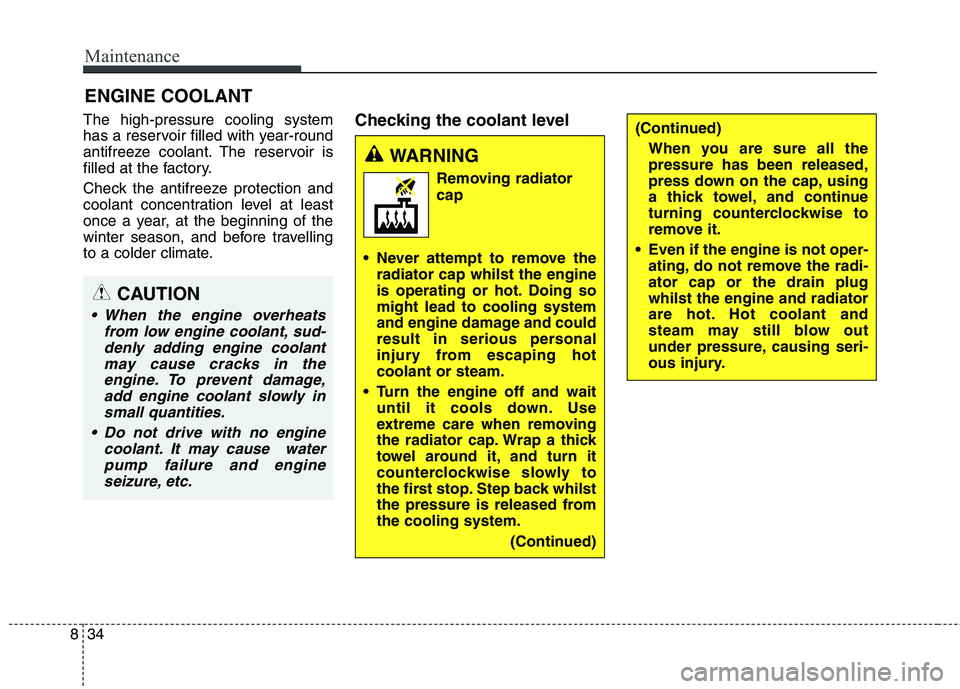
The high-pressure cooling system
has a reservoir filled with year-round
antifreeze coolant. The reservoir is
filled at the factory.
Check the antifreeze protection and
coolant concentration level at least
once a year, at the beginning of the
winter season, and before travelling
to a colder climate. Checking the coolant level
(Continued)
When you are sure all the pressure has been released,
press down on the cap, using
a thick towel, and continue
turning counterclockwise to
remove it.
Even if the engine is not oper- ating, do not remove the radi-ator cap or the drain plugwhilst the engine and radiator
are hot. Hot coolant and
steam may still blow out
under pressure, causing seri-
ous injury.
WARNING
Removing radiatorcap
Never attempt to remove the radiator cap whilst the engine
is operating or hot. Doing somight lead to cooling system
and engine damage and could
result in serious personal
injury from escaping hotcoolant or steam.
Turn the engine off and wait until it cools down. Use
extreme care when removing
the radiator cap. Wrap a thick
towel around it, and turn it
counterclockwise slowly to
the first stop. Step back whilst
the pressure is released fromthe cooling system.
(Continued)
CAUTION
When the engine overheatsfrom low engine coolant, sud-denly adding engine coolantmay cause cracks in theengine. To prevent damage, add engine coolant slowly insmall quantities.
Do not drive with no engine coolant. It may cause waterpump failure and engine seizure, etc.
Page 622 of 723
835
Maintenance
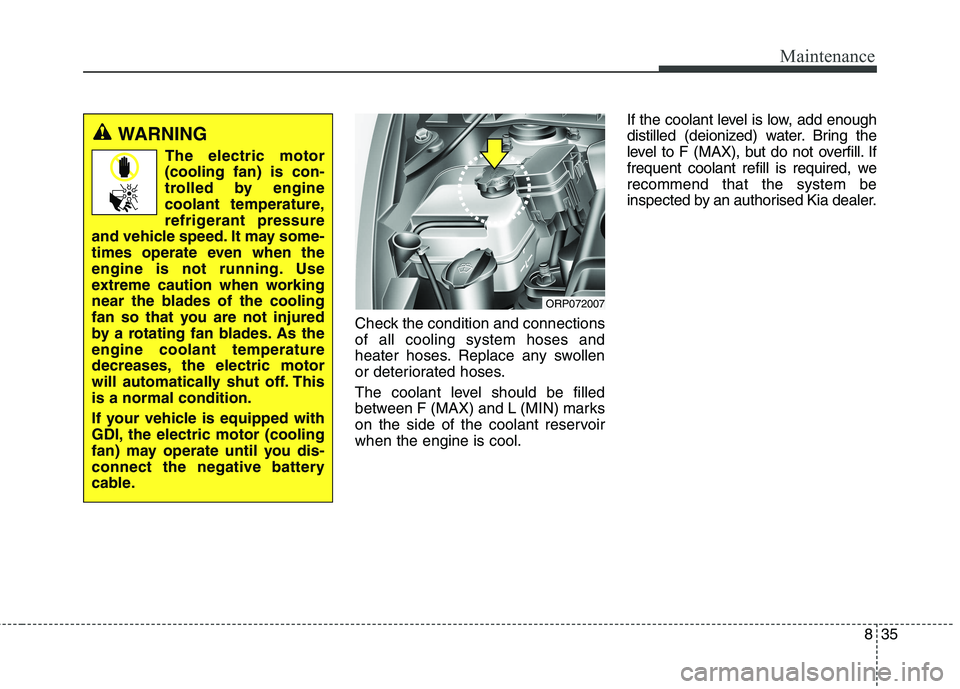
Check the condition and connections of all cooling system hoses and
heater hoses. Replace any swollen
or deteriorated hoses.
The coolant level should be filled
between F (MAX) and L (MIN) marks
on the side of the coolant reservoirwhen the engine is cool.If the coolant level is low, add enough
distilled (deionized) water. Bring the
level to F (MAX), but do not overfill. If
frequent coolant refill is required, werecommend that the system be
inspected by an authorised Kia dealer.
WARNING
The electric motor
(cooling fan) is con-
trolled by engine
coolant temperature,
refrigerant pressure
and vehicle speed. It may some-
times operate even when the
engine is not running. Use
extreme caution when working
near the blades of the cooling
fan so that you are not injured
by a rotating fan blades. As theengine coolant temperature
decreases, the electric motor
will automatically shut off. Thisis a normal condition.
If your vehicle is equipped with
GDI, the electric motor (cooling
fan) may operate until you dis-
connect the negative battery
cable.
ORP072007
Page 623 of 723
Maintenance
36
8
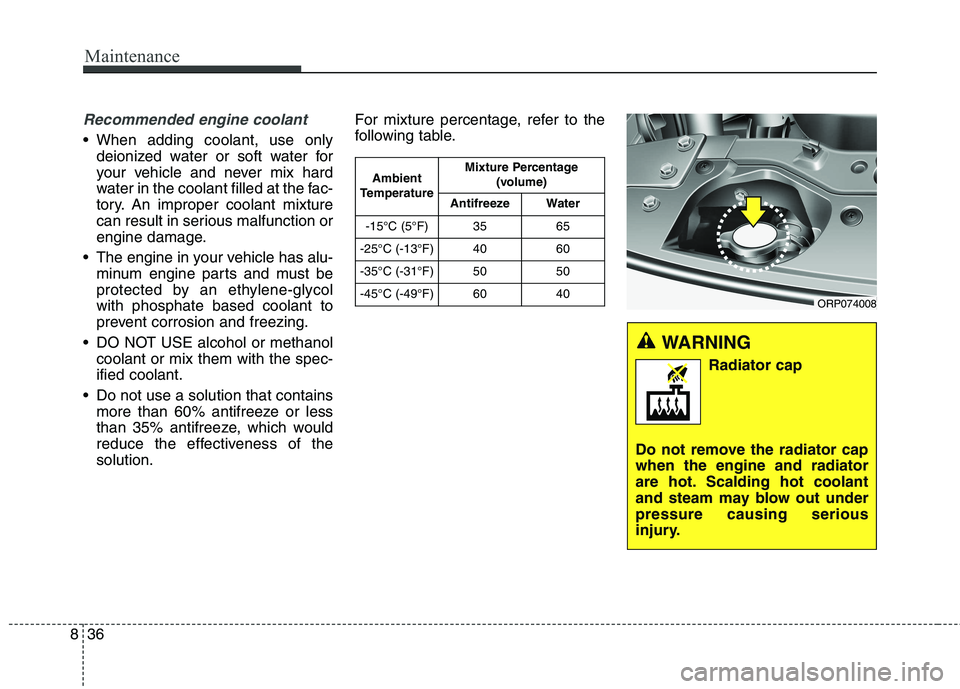
Recommended engine coolant
When adding coolant, use only
deionized water or soft water for
your vehicle and never mix hard
water in the coolant filled at the fac-
tory. An improper coolant mixture
can result in serious malfunction or
engine damage.
The engine in your vehicle has alu- minum engine parts and must be
protected by an ethylene-glycolwith phosphate based coolant to
prevent corrosion and freezing.
DO NOT USE alcohol or methanol coolant or mix them with the spec-ified coolant.
Do not use a solution that contains more than 60% antifreeze or less
than 35% antifreeze, which would
reduce the effectiveness of thesolution. For mixture percentage, refer to the
following table.
WARNING
Radiator cap
Do not remove the radiator cap when the engine and radiator
are hot. Scalding hot coolant
and steam may blow out underpressure causing serious
injury.
ORP074008
Ambient
Temperature Mixture Percentage
(volume)
Antifreeze Water
-15°C (5°F) 35 65
-25°C (-13°F) 40 60
-35°C (-31°F) 50 50
-45°C (-49°F) 60 40
Page 624 of 723
837
Maintenance
Changing the coolant
We recommend that the coolant be
replaced by an authorised Kia dealer.
CAUTION
Put a thick cloth or fabricaround the radiator cap beforerefilling the coolant in order to prevent the coolant from over-flowing into engine parts suchas generator.
WARNING - Coolant
Do not use radiator coolant or antifreeze in the washer fluid
reservoir.
Radiator coolant can severely obscure visibility when
sprayed on the windscreen
and may cause loss of vehicle
control or damage to paint
and body trim.