trailer KIA CARENS RHD 2017 Owner's Manual
[x] Cancel search | Manufacturer: KIA, Model Year: 2017, Model line: CARENS RHD, Model: KIA CARENS RHD 2017Pages: 723, PDF Size: 40.8 MB
Page 547 of 723
Driving your vehicle
112
6
✽✽
NOTICE
With increasing altitude the engine
performance decreases. From 1,000
m above sea level and for every
1,000 m thereafter 10% of
vehicle/trailer weight (trailer
weighter + gross vehicle weight)
must be deducted.WARNING - Trailer
Never load a trailer with more weight in the rear than in the
front. The front should be
loaded with approximately60% of the total trailer load;the rear should be loaded with
approximately 40% of the totaltrailer load.
Never exceed the maximum weight limits of the trailer or
trailer towing equipment.
Improper loading can result in
damage to your vehicle and/or
personal injury. Checkweights and loading at a com-
mercial scale or highway
patrol office equipped withscales.
An improperly loaded trailer can cause loss of vehicle con-
trol.
Page 548 of 723
6113
Driving your vehicle
This section will guide you in the
proper loading of your vehicle and/or
trailer, to keep your loaded vehicle
weight within its design rating capa-
bility, with or without a trailer.
Properly loading your vehicle will
provide maximum return of the vehi-
cle design performance. Before load-
ing your vehicle, familiarize yourself
with the following terms for determin-
ing your vehicle's weight ratings, with
or without a trailer, from the vehicle's
specifications and the certificationlabel:Base kerb weight
This is the weight of the vehicle including a full tank of fuel and all
standard equipment. It does not
include passengers, cargo, or option-al equipment.
Vehicle kerb weight
This is the weight of your new vehicle
when you picked it up from your deal-
er plus any aftermarket equipment.
Cargo weight
This figure includes all weight added
to the Base Kerb Weight, includingcargo and optional equipment.GAW (Gross axle weight)
This is the total weight placed on each axle (front and rear) - including
vehicle kerb weight and all payload.
GAWR
(Gross axle weight rating)
This is the maximum allowable
weight that can be carried by a single
axle (front or rear). These numbers
are shown on the certification label.
The total load on each axle must
never exceed its GAWR.
GVW (Gross vehicle weight)
This is the Base Kerb Weight plus
actual Cargo Weight plus passen-
gers.
VEHICLE WEIGHT
Page 573 of 723
723
What to do in an emergency
Do not take this vehicle through anautomatic car wash whilst the com- pact spare tyre is installed.
Do not use tyre chains on the com- pact spare tyre. Because of the
smaller size, a tyre chain will not fit
properly. This could damage the
vehicle and result in loss of thechain.
The compact spare tyre should not be installed on the front axle if the
vehicle must be driven in snow or
on ice.
Do not use the compact spare tyre on any other vehicle because thistyre has been designed especially
for your vehicle.
The compact spare tyre’s tread life is shorter than a regular tyre.
Inspect your compact spare tyre
regularly and replace worn com-
pact spare tyres with the same sizeand design, mounted on the samewheel. The compact spare tyre should not
be used on any other wheels, nor
should standard tyres, snow tyres,
wheel covers or trim rings be used
with the compact spare wheel. Ifsuch use is attempted, damage tothese items or other car compo-
nents may occur.
Do not use more than one compact spare tyre at a time.
Do not tow a trailer whilst the com- pact spare tyre is installed.
Page 577 of 723
727
What to do in an emergency
It is possible that some tyres, espe- cially with larger punctures or dam-
age to the sidewall, cannot be sealed
completely.
Air pressure loss in the tyre may
adversely affect tyre performance.
For this reason, you should avoid
abrupt steering or other driving
manoeuvres, especially if the vehicle
is heavily loaded or if a trailer is in use.
The TMK is not designed or intended
as a permanent tyre repair method
and is to be used for one tyre only.
This instruction shows you step by
step how to temporarily seal the
puncture simply and reliably.
Read the section "Notes on the safe
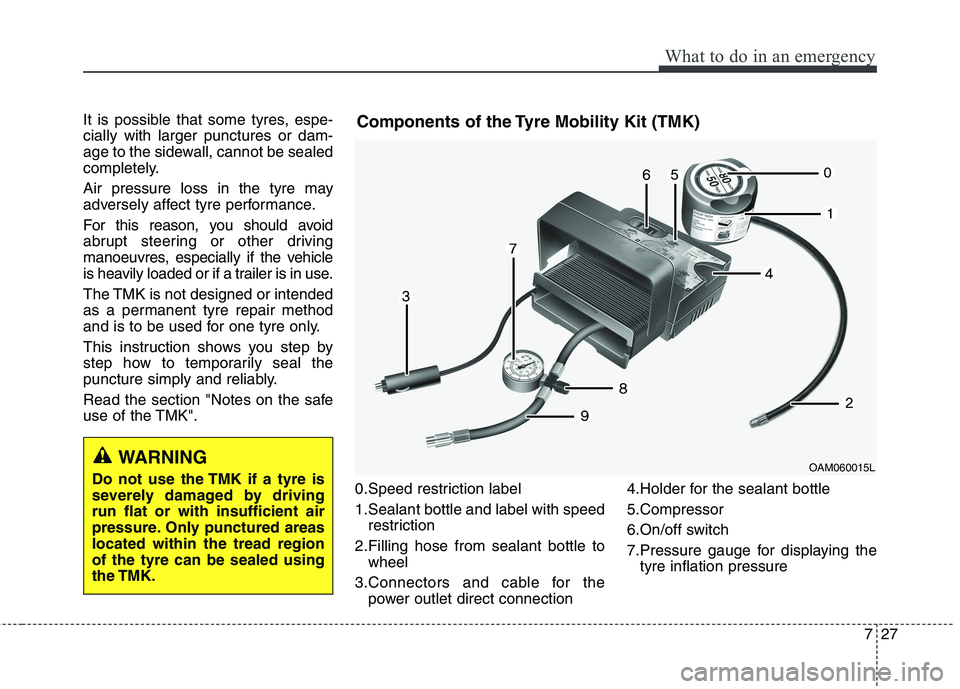
use of the TMK".0.Speed restriction label
1.Sealant bottle and label with speedrestriction
2.Filling hose from sealant bottle to wheel
3.Connectors and cable for the power outlet direct connection 4.Holder for the sealant bottle
5.Compressor
6.On/off switch
7.Pressure gauge for displaying the
tyre inflation pressure
OAM060015LWARNING
Do not use the TMK if a tyre is
severely damaged by drivingrun flat or with insufficient air
pressure. Only punctured areaslocated within the tread regionof the tyre can be sealed usingthe TMK.
Components of the Tyre Mobility Kit (TMK)
Page 582 of 723
What to do in an emergency
32
7
TOWING
Towing service
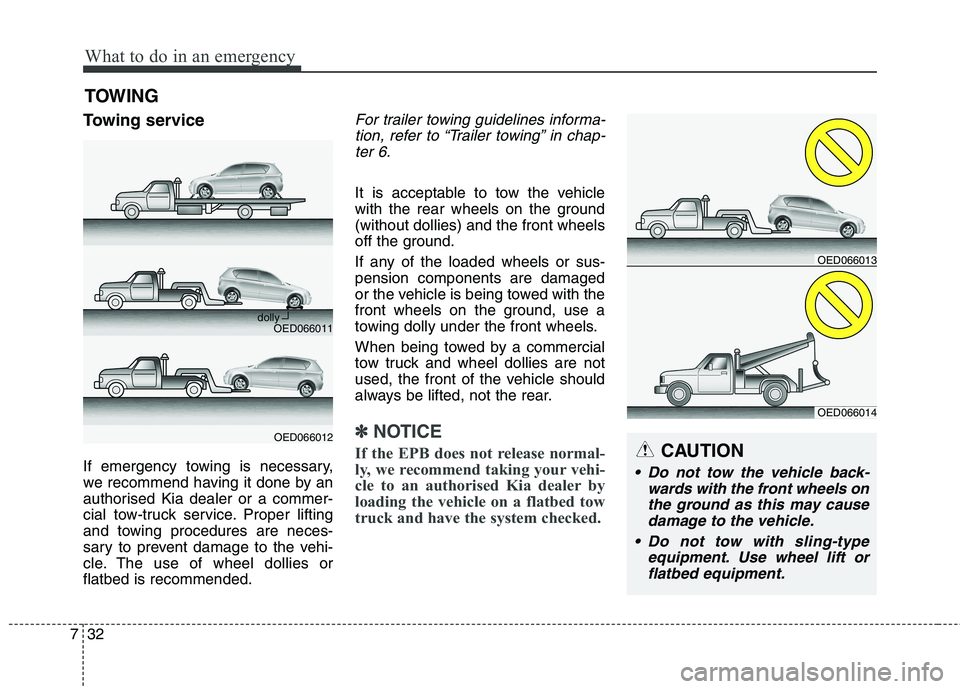
If emergency towing is necessary,
we recommend having it done by an
authorised Kia dealer or a commer-
cial tow-truck service. Proper lifting
and towing procedures are neces-
sary to prevent damage to the vehi-
cle. The use of wheel dollies orflatbed is recommended.
For trailer towing guidelines informa- tion, refer to “Trailer towing” in chap-ter 6.
It is acceptable to tow the vehicle
with the rear wheels on the ground(without dollies) and the front wheels
off the ground.
If any of the loaded wheels or sus- pension components are damaged
or the vehicle is being towed with the
front wheels on the ground, use a
towing dolly under the front wheels.
When being towed by a commercial
tow truck and wheel dollies are not
used, the front of the vehicle should
always be lifted, not the rear.
✽✽ NOTICE
If the EPB does not release normal-
ly, we recommend taking your vehi-
cle to an authorised Kia dealer by
loading the vehicle on a flatbed tow
truck and have the system checked.
CAUTION
Do not tow the vehicle back- wards with the front wheels onthe ground as this may causedamage to the vehicle.
Do not tow with sling-type equipment. Use wheel lift orflatbed equipment.
OED066011
OED066012
dolly
OED066014
OED066013
Page 598 of 723
811
Maintenance
SCHEDULED MAINTENANCE SERVICE
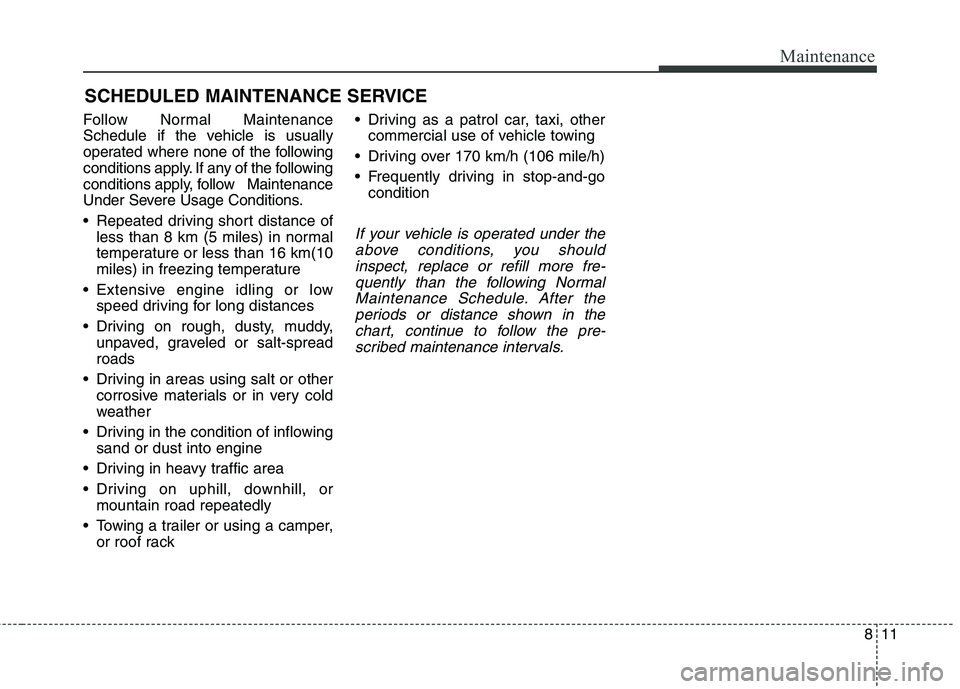
Follow Normal Maintenance
Schedule if the vehicle is usually
operated where none of the following
conditions apply. If any of the following
conditions apply, follow Maintenance
Under Severe Usage Conditions.
Repeated driving short distance of less than 8 km (5 miles) in normal
temperature or less than 16 km(10
miles) in freezing temperature
Extensive engine idling or low speed driving for long distances
Driving on rough, dusty, muddy, unpaved, graveled or salt-spreadroads
Driving in areas using salt or other corrosive materials or in very cold
weather
Driving in the condition of inflowing sand or dust into engine
Driving in heavy traffic area
Driving on uphill, downhill, or mountain road repeatedly
Towing a trailer or using a camper, or roof rack Driving as a patrol car, taxi, other
commercial use of vehicle towing
Driving over 170 km/h (106 mile/h)
Frequently driving in stop-and-go condition
If your vehicle is operated under the
above conditions, you shouldinspect, replace or refill more fre- quently than the following NormalMaintenance Schedule. After theperiods or distance shown in the chart, continue to follow the pre-scribed maintenance intervals.
Page 605 of 723
Maintenance
18
8
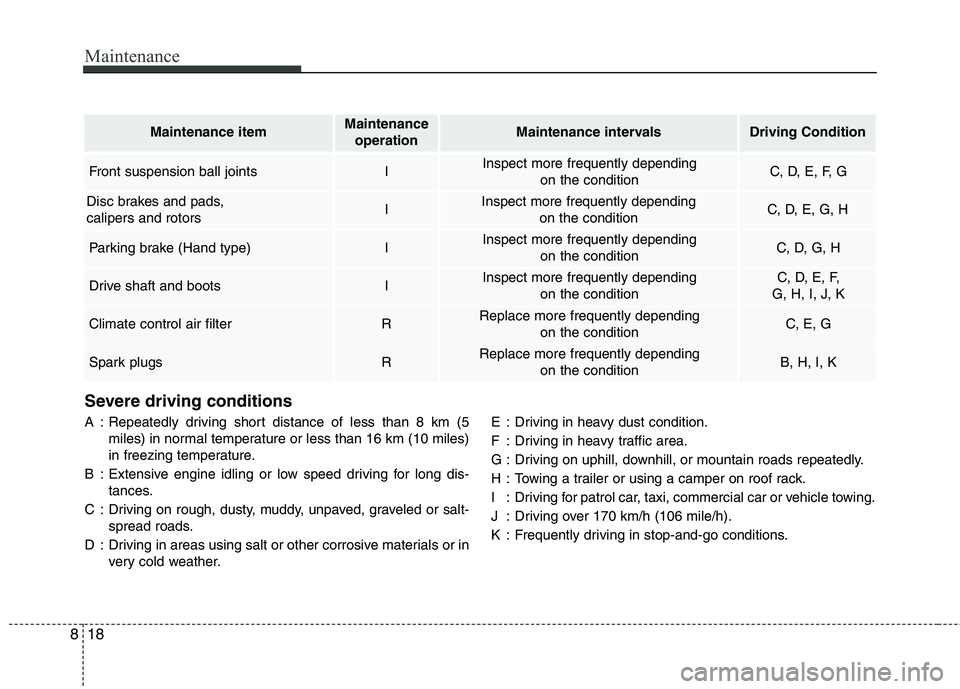
Severe driving conditions
A : Repeatedly driving short distance of less than 8 km (5
miles) in normal temperature or less than 16 km (10 miles)
in freezing temperature.
B : Extensive engine idling or low speed driving for long dis- tances.
C : Driving on rough, dusty, muddy, unpaved, graveled or salt- spread roads.
D : Driving in areas using salt or other corrosive materials or in very cold weather. E : Driving in heavy dust condition.
F : Driving in heavy traffic area.
G : Driving on uphill, downhill, or mountain roads repeatedly.
H : Towing a trailer or using a camper on roof rack.
I : Driving for patrol car, taxi, commercial car or vehicle towing.
J : Driving over 170 km/h (106 mile/h).
K : Frequently driving in stop-and-go conditions.
Maintenance itemMaintenance
operationMaintenance intervalsDriving Condition
Front suspension ball jointsIInspect more frequently depending on the conditionC, D, E, F, G
Disc brakes and pads, calipers and rotorsIInspect more frequently depending on the conditionC, D, E, G, H
Parking brake (Hand type)IInspect more frequently depending on the conditionC, D, G, H
Drive shaft and bootsIInspect more frequently depending on the conditionC, D, E, F,
G, H, I, J, K
Climate control air filter RReplace more frequently depending on the conditionC, E, G
Spark plugsRReplace more frequently depending on the conditionB, H, I, K
Page 614 of 723
827
Maintenance
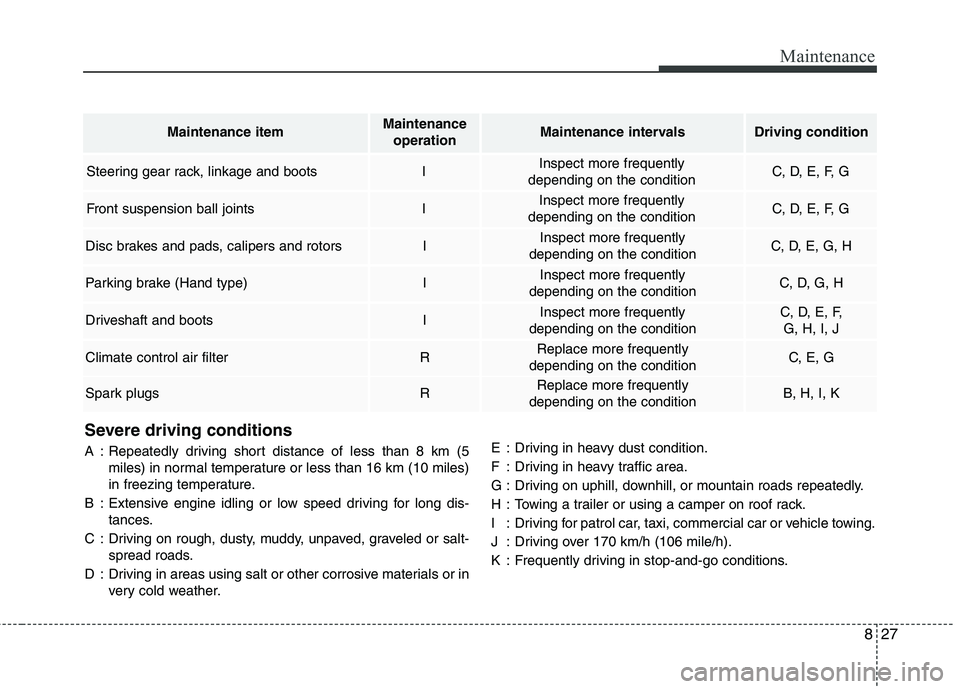
Severe driving conditions
A : Repeatedly driving short distance of less than 8 km (5miles) in normal temperature or less than 16 km (10 miles)
in freezing temperature.
B : Extensive engine idling or low speed driving for long dis- tances.
C : Driving on rough, dusty, muddy, unpaved, graveled or salt- spread roads.
D : Driving in areas using salt or other corrosive materials or in very cold weather. E : Driving in heavy dust condition.
F : Driving in heavy traffic area.
G : Driving on uphill, downhill, or mountain roads repeatedly.
H : Towing a trailer or using a camper on roof rack.
I : Driving for patrol car, taxi, commercial car or vehicle towing.
J : Driving over 170 km/h (106 mile/h).
K : Frequently driving in stop-and-go conditions.
Maintenance itemMaintenance
operationMaintenance intervalsDriving condition
Steering gear rack, linkage and bootsIInspect more frequently
depending on the conditionC, D, E, F, G
Front suspension ball jointsIInspect more frequently
depending on the conditionC, D, E, F, G
Disc brakes and pads, calipers and rotorsIInspect more frequently
depending on the conditionC, D, E, G, H
Parking brake (Hand type)IInspect more frequently
depending on the conditionC, D, G, H
Driveshaft and bootsIInspect more frequently
depending on the conditionC, D, E, F, G, H, I, J
Climate control air filterRReplace more frequently
depending on the conditionC, E, G
Spark plugsRReplace more frequently
depending on the conditionB, H, I, K
Page 721 of 723
I9
Index
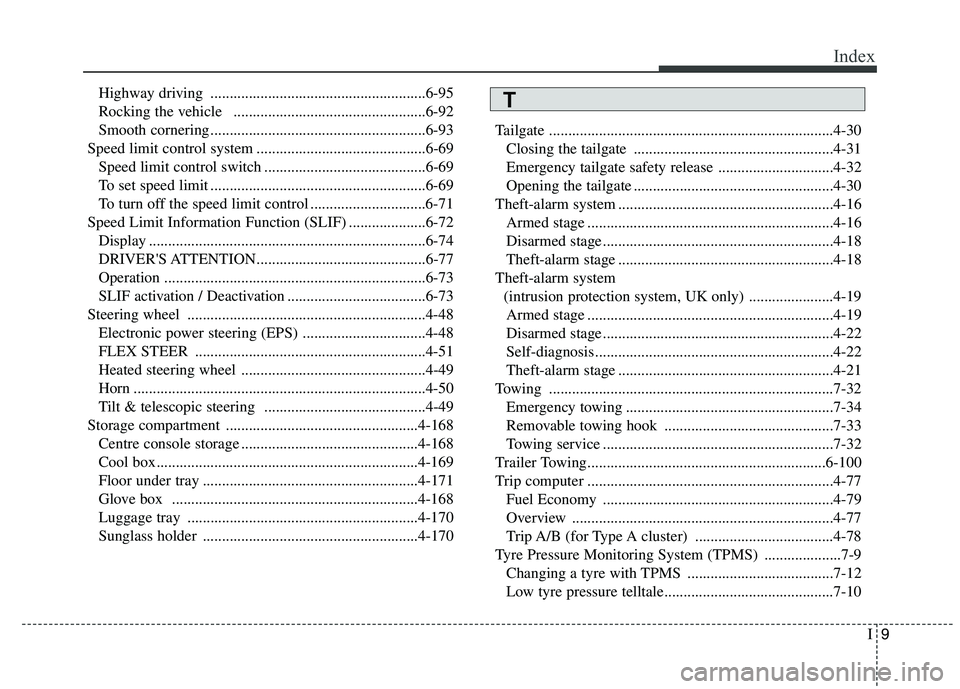
Highway driving ........................................................6-95
Rocking the vehicle ..................................................6-92
Smooth cornering ........................................................6-93
Speed limit control system ............................................6-69 Speed limit control switch ..........................................6-69
To set speed limit ........................................................6-69
To turn off the speed limit control ..............................6-71
Speed Limit Information Function (SLIF) ....................6-72 Display ........................................................................6-74
DRIVER'S ATTENTION............................................6-77
Operation ....................................................................6-73
SLIF activation / Deactivation ....................................6-73
Steering wheel ..............................................................4-48 Electronic power steering (EPS) ................................4-48
FLEX STEER ............................................................4-51
Heated steering wheel ................................................4-49
Horn ............................................................................4-50
Tilt & telescopic steering ..........................................4-49
Storage compartment ..................................................4-168 Centre console storage ..............................................4-168
Cool box....................................................................4-169
Floor under tray ........................................................4-171
Glove box ................................................................4-168
Luggage tray ............................................................4-170
Sunglass holder ........................................................4-170 Tailgate ..........................................................................4-30
Closing the tailgate ....................................................4-31
Emergency tailgate safety release ..............................4-32
Opening the tailgate ....................................................4-30
Theft-alarm system ........................................................4-16 Armed stage ................................................................4-16
Disarmed stage ............................................................4-18
Theft-alarm stage ........................................................4-18
Theft-alarm system (intrusion protection system, UK only) ......................4-19Armed stage ................................................................4-19
Disarmed stage ............................................................4-22
Self-diagnosis..............................................................4-22
Theft-alarm stage ........................................................4-21
Towing ..........................................................................7-32 Emergency towing ......................................................7-34
Removable towing hook ............................................7-33
Towing service ............................................................7-32
Trailer Towing..............................................................6-100
Trip computer ................................................................4-77 Fuel Economy ............................................................4-79
Overview ....................................................................4-77
Trip A/B (for Type A cluster) ....................................4-78
Tyre Pressure Monitoring System (TPMS) ....................7-9 Changing a tyre with TPMS ......................................7-12
Low tyre pressure telltale............................................7-10T