check engine light KIA CARENS RHD 2017 Owner's Guide
[x] Cancel search | Manufacturer: KIA, Model Year: 2017, Model line: CARENS RHD, Model: KIA CARENS RHD 2017Pages: 723, PDF Size: 40.8 MB
Page 534 of 723
699
Driving your vehicle
To keep locks from freezing
To keep the locks from freezing,
squirt an approved de-icer fluid or
glycerine into the key opening. If a
lock is covered with ice, squirt it with
an approved de-icing fluid to remove
the ice. If the lock is frozen internally,
you may be able to thaw it out by
using a heated key. Handle the heat-
ed key with care to avoid injury.
Use approved window washer
anti-freeze in system
To keep the water in the window
washer system from freezing, add an
approved window washer anti-freeze
solution in accordance with instruc-
tions on the container. Window wash-
er anti-freeze is available from an
authorised Kia dealer and most auto
parts outlets. Do not use engine
coolant or other types of anti-freeze
as these may damage the paint finish.Don't let your parking brake
freeze
Under some conditions your parking
brake can freeze in the engaged
position. This is most likely to hap-
pen when there is an accumulation
of snow or ice around or near the
rear brakes or if the brakes are wet.
If there is a risk the parking brake
may freeze, apply it only temporarily
whilst you put the shift lever in P
(automatic transaxle / dual clutch
transmission) or in first or reverse
gear (manual transaxle) and block
the rear wheels so the vehicle cannot
roll. Then release the parking brake.
Don't let ice and snow accu-
mulate underneath
Under some conditions, snow and
ice can build up under the fenders
and interfere with the steering. When
driving in severe winter conditions
where this may happen, you should
periodically check underneath the
vehicle to be sure the movement of
the front wheels and the steering
components is not obstructed.Carry emergency equipment
Depending on the severity of the
weather, you should carry appropri-
ate emergency equipment. Some of
the items you may want to carry
include tyre chains, tow straps or
chains, flashlight, emergency flares,
sand, shovel, jumper cables, window
scraper, gloves, ground cloth, cover-
alls, blanket, etc.
Page 554 of 723
What to do in an emergency
4
7
IF THE ENGINE DOES NOT START
If engine doesn't turn over or
turns over slowly
1.If your vehicle has an automatic transaxle / dual clutch transmis-
sion, be sure the shift lever is in N
(Neutral) or P (Park) and the emer-
gency brake is set.
2.Check the battery connections to be sure they are clean and tight.
3.Turn on the interior light. If the light dims or goes out when you operate
the starter, the battery is discharged.
4.Check the starter connections to be sure they are securely tightened.
5.Do not push or pull the vehicle to start it. See instructions for "Jump
starting". If engine turns over normally
but does not start
1.Check fuel level.
2.With the ignition switch in the
LOCK/ OFF position, check all connectors at ignition, coil and
spark plugs. Reconnect any that
may be disconnected or loose.
3.Check the fuel line in the engine compartment.
4.If the engine still does not start, we recommend that you call an autho-
rised Kia dealer.
WARNING
If the engine does not start, do
not push or pull the vehicle to
start it. This could result in a col-
lision or cause other damage. In
addition, push or pull starting
may cause the catalytic convert-
er (if equipped) to be overloaded
and create a fire hazard.
Page 596 of 723
89
Maintenance
OWNER MAINTENANCE
We recommend that the following
lists are vehicle checks and inspec-
tions that should be performed by the
owner or an authorised Kia dealer atthe frequencies indicated to help
ensure safe, dependable operation
of your vehicle.
If you have any question, we recom-
mend that you consult an authorised
Kia dealer.
These Owner Maintenance Checks
are generally not covered by war-
ranties and you may be charged for
labour, parts and lubricants used. Owner maintenance schedule
When you stop for fuel:
Check the engine oil level.
Check coolant level in coolant
reservoir.
Check the windscreen washer fluid level.
Look for low or under-inflated tyres.
Check the radiator and condenser. Check if the front of the radiator and condenser are clean and not
blocked with leaves, dirt or insectsetc.
If any of the above parts are
extremely dirty or you are not sure
of their condition, we recommend
that you contact an authorised Kia
dealer.
Whilst operating your vehicle:
Note any changes in the sound ofthe exhaust or any smell of
exhaust fumes in the vehicle.
Check for vibrations in the steering wheel. Notice any increased steer-
ing effort or looseness in the steer-
ing wheel, or change in its straight-ahead position.
Notice if your vehicle constantly turns slightly or “pulls” to one side
when travelling on smooth, levelroad.
When stopping, listen and check for unusual sounds, pulling to one
side, increased brake pedal travel
or “hard-to-push” brake pedal.
If any slipping or changes in the operation of your transaxle occurs,
check the transaxle fluid level.
Check manual transaxle operation, including clutch operation.
WARNING
Be careful when checking your
engine coolant level when the
engine is hot. Scalding hot
coolant and steam may blow out
under pressure. This could cause
burns or other serious injury.
Page 597 of 723
Maintenance
10
8
Check automatic transaxle / dual
clutch transmission P (Park) func- tion.
Check parking brake.
Check for fluid leaks under your vehicle (water dripping from the air
conditioning system during or after
use is normal).
At least monthly:
Check coolant level in the enginecoolant reservoir.
Check the operation of all exterior lights, including the stoplights, turn
signals and hazard warning flash-
ers.
Check the inflation pressures of all tyres including the spare.
At least twice a year
(i.e., every Spring and Fall) :
Check radiator, heater and air con- ditioning hoses for leaks or dam-
age.
Check windscreen washer spray and wiper operation. Clean wiper
blades with clean cloth dampened
with washer fluid.
Check headlight alignment.
Check muffler, exhaust pipes, shields and clamps.
Check the lap/shoulder belts for wear and function.
Check for worn tyres and loose wheel lug nuts.
At least once a year :
Clean body and door drain holes.
Lubricate door hinges and checks,and bonnet hinges.
Lubricate door and bonnet locks and latches.
Lubricate door rubber weather- strips.
Check the air conditioning system.
Inspect and lubricate automatic transaxle / dual clutch transmission
linkage and controls.
Clean battery and terminals.
Check the brake (and clutch) fluid level.
Page 650 of 723
863
Maintenance
FUSESA vehicle’s electrical system is pro-
tected from electrical overload dam-
age by fuses.
This vehicle has 3 (or 4) fuse panels,
one located in the driver’s side panel
bolster, others in the engine com-
partment near the battery.
If any of your vehicle’s lights, acces-
sories, or controls do not work, check
the appropriate circuit fuse. If a fuse
has blown, the element inside thefuse will be melted.
If the electrical system does not
work, first check the driver’s sidefuse panel.
Always replace a blown fuse with
one of the same rating.
Before replacing a blown fuse, dis-
connect the negative battery cable.
If the replacement fuse blows, this
indicates an electrical problem. Avoid
using the system involved and we
recommend that you consult an
authorised Kia dealer.
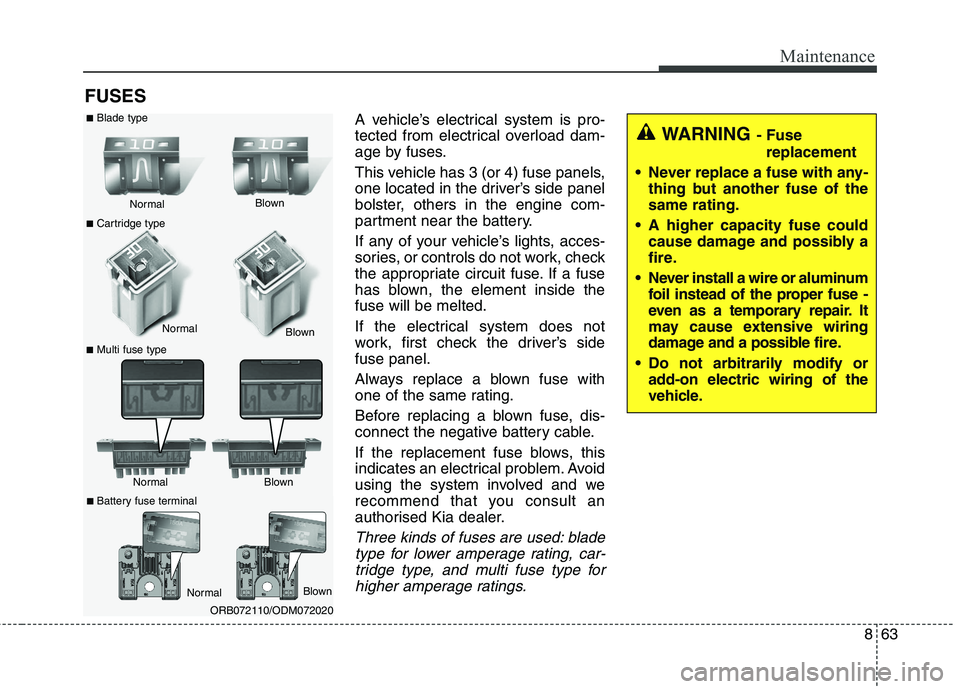
Three kinds of fuses are used: bladetype for lower amperage rating, car-tridge type, and multi fuse type for higher amperage ratings.
WARNING - Fuse
replacement
Never replace a fuse with any- thing but another fuse of the same rating.
A higher capacity fuse could cause damage and possibly a
fire.
Never install a wire or aluminum foil instead of the proper fuse -
even as a temporary repair. It
may cause extensive wiring
damage and a possible fire.
Do not arbitrarily modify or add-on electric wiring of the
vehicle.
Normal
Normal
■
Blade type
■ Cartridge type
■ Multi fuse type Blown
Blown
Normal Blown
ORB072110/ODM072020
Normal
Blown
■
Battery fuse terminal
Page 652 of 723
865
Maintenance
Inner panel fuse replacement
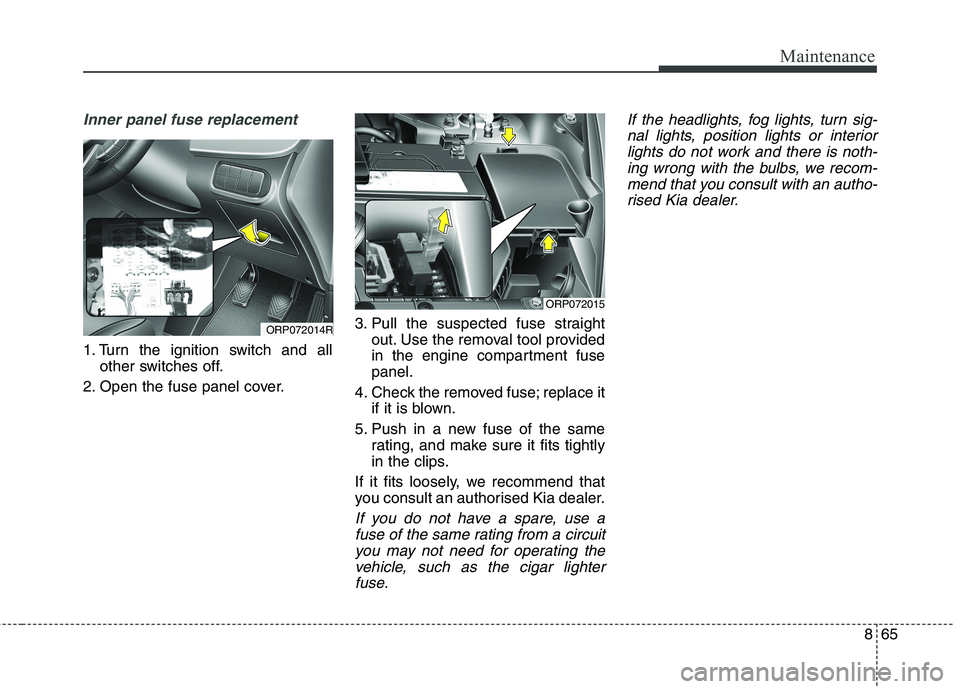
1. Turn the ignition switch and allother switches off.
2. Open the fuse panel cover. 3. Pull the suspected fuse straight
out. Use the removal tool provided
in the engine compartment fusepanel.
4. Check the removed fuse; replace it if it is blown.
5. Push in a new fuse of the same rating, and make sure it fits tightly
in the clips.
If it fits loosely, we recommend that
you consult an authorised Kia dealer.
If you do not have a spare, use a fuse of the same rating from a circuityou may not need for operating the vehicle, such as the cigar lighterfuse. If the headlights, fog lights, turn sig-
nal lights, position lights or interior lights do not work and there is noth-ing wrong with the bulbs, we recom-mend that you consult with an autho- rised Kia dealer.
ORP072014R
ORP072015
Page 671 of 723
Maintenance
84
8
LIGHT BULBS
Use only the bulbs of the specified
wattage.
✽✽ NOTICE
After driving in heavy rain or wash-
ing the vehicle, headlight and tail-
light lenses could appear foggy. This
condition is caused by the tempera-
ture difference between the lamp
inside and outside. This is similar to
the condensation on your windows
inside your vehicle during rain and
does not indicate a problem with
your vehicle. If the water leaks into
the lamp bulb circuitry, we recom-
mend that the system be checked by
an authorised Kia dealer.WARNING - Working on
the lights
Prior to working on the light,
firmly apply the parking brake,
ensure that the ignition switch
is turned to the “LOCK” position
(smart key: turn off the engine)
and turn off the lights to avoid
sudden movement of the vehi-
cle and burning your fingers or
getting an electric shock.
CAUTION
Be sure to replace the burned- out bulb with one of the samewattage rating. Otherwise, it may cause damage to the fuseor electric wiring system.
CAUTION
If you do not have necessarytools, the correct bulbs and theexpertise, we recommend that you consult an authorised Kiadealer. In many cases, it is diffi-cult to replace vehicle lightbulbs because other parts of the vehicle must be removed beforeyou can get to the bulb. This isespecially true if you have to remove the headlight assemblyto get to the bulb(s).
Removing/installing the head-light assembly can result indamage to the vehicle.
Page 683 of 723
Maintenance
96
8
Outside light
❈ The actual rear combination lamp shape
in the vehicle may differ from illustration.
Rear turn signal light and stop/tail light
1. Turn off the engine.
2. Open the tailgate.
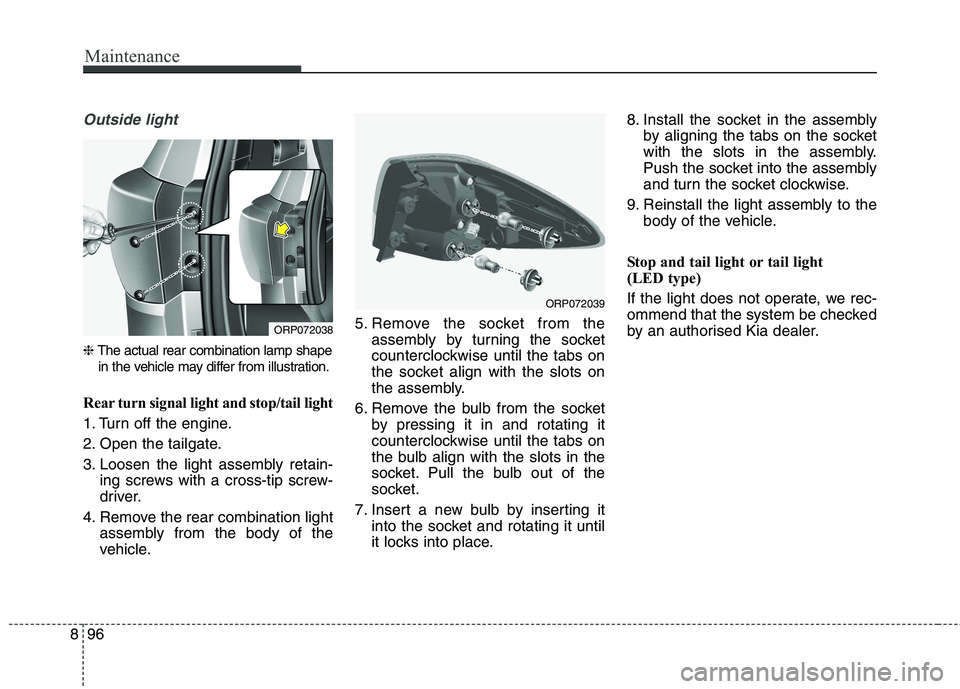
3. Loosen the light assembly retain- ing screws with a cross-tip screw-
driver.
4. Remove the rear combination light assembly from the body of the
vehicle. 5. Remove the socket from the
assembly by turning the socket
counterclockwise until the tabs on
the socket align with the slots on
the assembly.
6. Remove the bulb from the socket by pressing it in and rotating it
counterclockwise until the tabs on
the bulb align with the slots in the
socket. Pull the bulb out of the
socket.
7. Insert a new bulb by inserting it into the socket and rotating it until
it locks into place. 8. Install the socket in the assembly
by aligning the tabs on the socket
with the slots in the assembly.
Push the socket into the assembly
and turn the socket clockwise.
9. Reinstall the light assembly to the body of the vehicle.
Stop and tail light or tail light
(LED type)
If the light does not operate, we rec-
ommend that the system be checked
by an authorised Kia dealer.
ORP072039
ORP072038
Page 699 of 723
Diesel Particulate Filter (if equipped)
The Diesel Particulate Filter (DPF)
system removes the soot in the
exhaust gas.
Unlike a disposable air filter, the DPF
system automatically burns (oxidizes)
and removes the accumulated soot
according to the driving condition. In
other words, the active burning byengine control system and high
exhaust gas temperature caused by
normal/high driving condition burns
and removes the accumulated soot.
However, if the vehicle continues to
be driven at repeated short distance
or driven at low speed for a long
time, the accumulated soot may not
be automatically removed because
of low exhaust gas temperature.
More than a certain amount of sootdeposited, the malfunction indicator
light ( ) illuminates. When the malfunction indicator light
blinks, it may stop blinking by driving
the vehicle at more than 60 km/h (37mph) or at more than second gear
with 1500 ~ 2500 engine rpm for a
certain time (for about 25 minutes). If the malfunction indicator light ( )
continues to be blinked or the warn-
ing massage “Check exhaust system”
illuminates in spite of the procedure,
please visit an authorised Kia dealer
and the check the DPF system.
If you continue to drive with the mal-
function indicator light blinking for a
long time, the DPF system can bedamaged and fuel consumption can
be worsen.
Lean NOx Trap (if equipped)
The Lean NOx Trap (LNT) system
removes the nitrogen oxide in the
exhaust gas. The smell can occur in
the exhaust gas depending on the
quality of the fuel and it can degrade
NOx reduction performance, please
use the regulated automotive dieselfuel.
CAUTION -
Diesel Fuel
(if equipped with DPF)
It is recommended to use the regulated automotive diesel fuelfor diesel vehicle equipped with the DPF system.
If you use diesel fuel includinghigh sulfur (more than 50 ppmsulfur) and unspecified addi-tives, it can cause the DPF sys- tem to be damaged and whitesmoke can be emitted.
8112
Maintenance
Page 719 of 723
I7
Index
Interior light bulb replacement ................................8-100
License plate light bulb replacement ........................8-99
Rear combination light bulb replacement ................8-95
Side repeater light bulb replacement ..........................8-95
Lighting........................................................................4-117 Battery saver function ..............................................4-117
Daytime running light ..............................................4-118
Front fog light ..........................................................4-123
Headlamp delay function ..........................................4-117
Headlight (Headlamp) welcome function ................4-118
Headlight levelling device ........................................4-125
High - beam operation ............................................4-121
Lighting control ........................................................4-119
Rear fog light ............................................................4-124
Static bending light ..................................................4-118
Turn signals and lane change signals........................4-122
Luggage volume ..............................................................9-4
Maintenance services ......................................................8-6 Engine compartment precautions..................................8-7
Owner maintenance precautions ................................8-6
Owner’s responsibility ................................................8-6
Manual climate control system....................................4-140 Checking the amount of air conditioner refrigerant and compressor lubricant ..............................................4-149
Climate control air filter ..........................................4-148 Heating and air conditioning ....................................4-141
System operation ......................................................4-146
Manual Transaxle ..........................................................6-21 Good driving practices ................................................6-25
Manual transaxle operation ........................................6-21
Mirrors ..........................................................................4-52 Inside rearview mirror ................................................4-52
Outside rearview mirror ..............................................4-53
Owner maintenance ........................................................8-9 Owner maintenance schedule ......................................8-9
Panorama sunroof ..........................................................4-44 Closing the sunroof ....................................................4-46
Resetting the sunroof ..................................................4-47
Sliding the sunroof ....................................................4-45
Sunroof open warning ................................................4-44
Sunshade ....................................................................4-45
Tilting the sunroof ....................................................4-45
Parking assist system ..................................................4-100 Non-operational conditions of parking assist system ..............................................4-103
Operation of the parking assist system ....................4-101
Self-diagnosis............................................................4-105
P
M
O