ECU KIA CARENS RHD 2017 Owners Manual
[x] Cancel search | Manufacturer: KIA, Model Year: 2017, Model line: CARENS RHD, Model: KIA CARENS RHD 2017Pages: 723, PDF Size: 40.8 MB
Page 6 of 723
13
Introduction
Petrol engine
Unleaded
For Europe
For the optimal vehicle performance,
we recommend you use unleaded
petrol has an octane rating of RON(Research Octane Number) 95 / AKI
(Anti Knock Index) 91 or higher. (Do
not use methanol blended fuels.) You
may use unleaded petrol with an
octane rating of RON 91-94 / AKI 87-
90 but it may result in slight perform-
ance reduction of the vehicle.
Except Europe
Your new vehicle is designed to use
only unleaded fuel having an Octane
Rating of RON (Research Octane
Number) 91 / AKI (Anti-Knock Index)
87 or higher. (Do not use methanol
blended fuels.)
Your new vehicle is designed to
obtain maximum performance with
UNLEADED FUEL, as well as min-
imise exhaust emissions and spark
plug fouling.
Leaded (if equipped)
For some countries, your vehicle is
designed to use leaded petrol. When
you are going to use leaded petrol,
we recommend that you ask an
authorised Kia dealer whether lead-
ed petrol in your vehicle is availableor not. Octane Rating of leaded petrol is
same with unleaded one.
FUEL REQUIREMENTSCAUTION
NEVER USE LEADED FUEL. The
use of leaded fuel is detrimentalto the catalytic converter and will damage the engine controlsystem’s oxygen sensor andaffect emission control.
Never add any fuel systemcleaning agents to the fuel tank other than what has been speci-fied. (We recommend that youconsult an authorised Kia dealer for details.)
WARNING
Do not "top off" after the noz- zle automatically shuts off when refuelling.
Always check that the fuel cap is installed securely to pre-
vent fuel spillage in the eventof an accident.
Page 22 of 723

Safety features of your vehicle
4
3
(Continued)
In order to avoid unnecessary
and perhaps severe air bag
injuries, always sit as far back
as possible from the steeringwheel whilst maintaining
comfortable control of the
vehicle. It is recommended
that your chest is at least 250
mm (10 inches) away from thesteering wheel.WARNING - Driver’s seat
Never attempt to adjust seat whilst the vehicle is moving. This could result in loss of
control, and an accident caus-
ing death, serious injury, or
property damage.
Do not allow anything to inter- fere with the normal position of
the seatback. Storing items
against a seatback or in any
other way interfering with prop-
er locking of a seatback could
result in serious or fatal injury
in a sudden stop or collision.
Always drive and ride with your seatback upright and the lap
portion of the seat belt snug
and low across the hips. This
is the best position to protect
you in case of an accident.
(Continued)WARNING- Rear
seatbacks
The rear seatback must be securely latched. If not, passen-
gers and objects could be
thrown forward resulting in seri-
ous injury or death in the event
of a sudden stop or collision.
Luggage and other cargo should be laid flat in the cargo
area. If objects are large, heavy,
or must be piled, they must be
secured. Under no circum-
stances should cargo be piled
higher than the seatbacks.
Failure to follow these warnings
could result in serious injury or
death in the event of a sudden
stop, collision or rollover.
(Continued)
Page 23 of 723

35
Safety features of your vehicle
(Continued)
No passenger should ride inthe cargo area or sit or lie on
folded seatbacks whilst the
vehicle is moving. All passen-
gers must be properly seated
in seats and restrained prop-
erly whilst riding.
When resetting the seatback to the upright position, make sure
it is securely latched by push-
ing it forward and backwards.WARNING
After adjusting the seat, always
check that it is securely locked
into place by attempting to
move the seat forward or back-
ward without using the lock
release lever. Sudden or unex-
pected movement of the dri-
ver's seat could cause you to
lose control of the vehicleresulting in an accident.WARNING
Use extreme caution so that hands or other objects are not
caught in the seat mechanisms
whilst the seat is moving.
Do not put a cigarette lighter on the floor or seat. When you
operate the seat, gas may gush
out of the lighter and cause fire.
If there are occupants in the rear seats, be careful whilst
adjusting the front seat posi-tion.
Use extreme caution when picking small objects trappedunder the seats or between the
seat and the centre console.
Your hands might be cut or
injured by the sharp edges of
the seats mechanism.
Page 24 of 723

Safety features of your vehicle
6
3
Front seat adjustment - manual
Forward and backward
To move the seat forward or backward:
1. Pull the seat slide adjustment
lever up and hold it.
2. Slide the seat to the position you desire.
3. Release the lever and make sure the seat is locked in place.
Adjust the seat before driving, and
make sure the seat is locked securely
by trying to move forward and back-
ward without using the lever. If the seat
moves, it is not locked properly.
Seatback angle
To recline the seatback:
1. Lean forward slightly and lift up the seatback recline lever.
2. Carefully lean back on the seat and adjust the seatback of the
seat to the position you desire.
3. Release the lever and make sure the seatback is locked in place.
(The lever MUST return to its orig-
inal position for the seatback to
lock.)
Seatback folding (for front pas-
senger’s seat, if equipped)
The front passenger’s seatbacks can
be folded to facilitate carrying longitems or to increase the luggage
capacity of the vehicle.
To fold the seatback :
1. Lower the front passenger’s seat headrests to the lowest position.
And slide the seat rearward.
2. Pull on the seatback folding lever (recline lever), then fold the seat
toward the front of the vehicle.
When you return the seatback to
its upright position, always be sure
it has locked into position by push-
ing on the top of the seatback.
ORP036002R
ORP036003R
ORP036071R
Page 31 of 723
313
Safety features of your vehicle
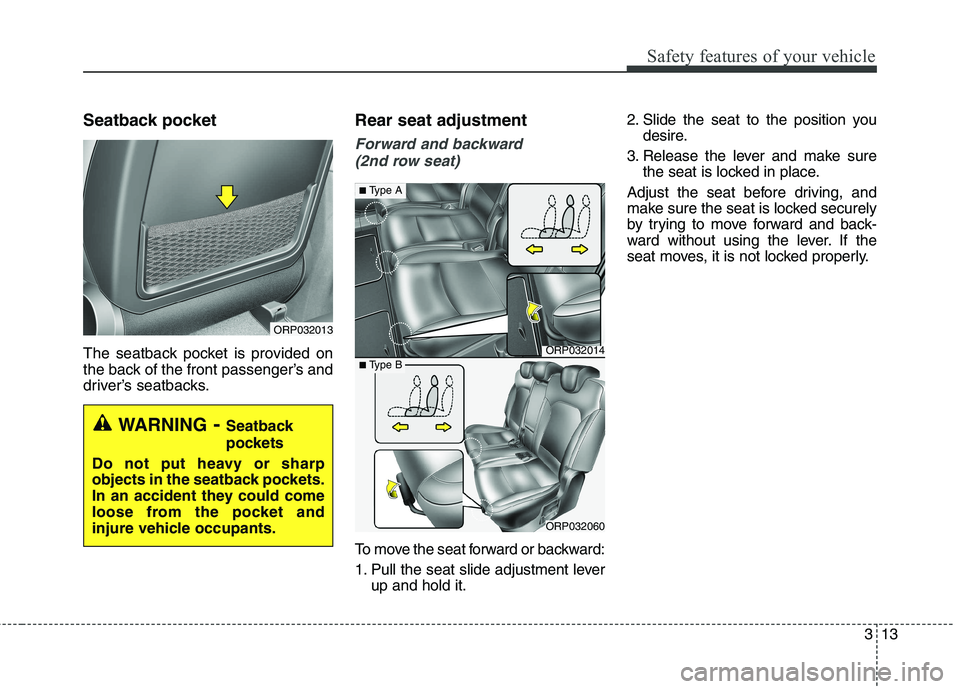
Seatback pocket
The seatback pocket is provided on
the back of the front passenger’s and
driver’s seatbacks.Rear seat adjustment
Forward and backward
(2nd row seat)
To move the seat forward or backward:
1. Pull the seat slide adjustment lever up and hold it. 2. Slide the seat to the position you
desire.
3. Release the lever and make sure the seat is locked in place.
Adjust the seat before driving, and
make sure the seat is locked securely
by trying to move forward and back-
ward without using the lever. If the
seat moves, it is not locked properly.
ORP032014
ORP032060
■ Type A
■Type B
ORP032013
WARNING - Seatback
pockets
Do not put heavy or sharp
objects in the seatback pockets.
In an accident they could come
loose from the pocket and
injure vehicle occupants.
Page 37 of 723
319
Safety features of your vehicle
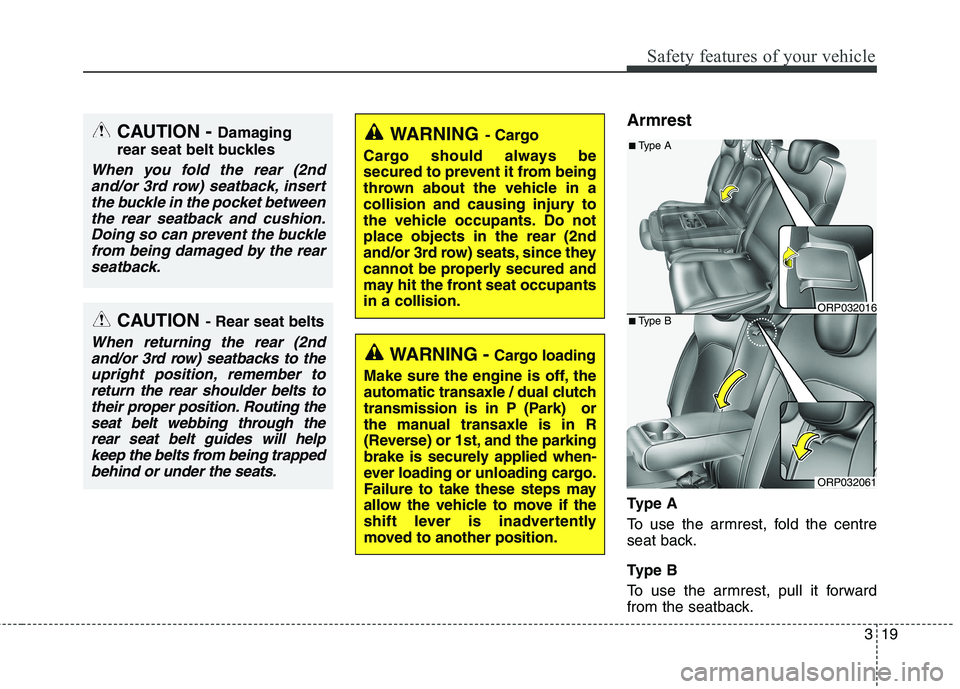
Armrest
Ty p e A
To use the armrest, fold the centre
seat back.
Ty p e B
To use the armrest, pull it forward
from the seatback.
CAUTION- Rear seat belts
When returning the rear (2nd
and/or 3rd row) seatbacks to theupright position, remember to return the rear shoulder belts totheir proper position. Routing theseat belt webbing through the rear seat belt guides will helpkeep the belts from being trappedbehind or under the seats.
CAUTION - Damaging
rear seat belt buckles
When you fold the rear (2nd and/or 3rd row) seatback, insertthe buckle in the pocket between the rear seatback and cushion.Doing so can prevent the bucklefrom being damaged by the rear seatback.
WARNING - Cargo
Cargo should always be
secured to prevent it from being
thrown about the vehicle in a
collision and causing injury to
the vehicle occupants. Do notplace objects in the rear (2nd
and/or 3rd row) seats, since they
cannot be properly secured and
may hit the front seat occupantsin a collision.
WARNING - Cargo loading
Make sure the engine is off, the
automatic transaxle / dual clutch
transmission is in P (Park) or
the manual transaxle is in R
(Reverse) or 1st, and the parking
brake is securely applied when-
ever loading or unloading cargo.
Failure to take these steps may
allow the vehicle to move if the
shift lever is inadvertently
moved to another position.
ORP032061
ORP032016
■ Type A
■Type B
Page 41 of 723
323
Safety features of your vehicle
(Continued)
Care should be taken to avoid contamination of the webbing
with polishes, oils and chemi-
cals, and particularly battery
acid. Cleaning may safely becarried out using mild soap and
water. The belt should bereplaced if webbing becomes
frayed, contaminated or dam-
aged. It is essential to replace
the entire assembly after it has
been worn in a severe impact
even if damage to the assembly
is not obvious. Belts should not
be worn with straps twisted.
Each belt assembly must only
be used by one occupant; it is
dangerous to put a belt around
a child being carried on theoccupant's lap.WARNING- Australian
design rules
No modifications or additions should be made by the user
which will either prevent the
seat belt adjusting devices
from operating to remove
slack, or prevent the seat belt
assembly from being adjusted
to remove slack.
When you fasten the seat belt, be careful not to latch the seat
belt in buckles of other seat.
It's very dangerous and you
may not be protected by the
seat belt properly.
Do not unfasten the seat belt and do not fasten and unfasten
the seat belt repeatedly whilst
driving. This could result in
loss of control, and an accident
causing death, serious injury,
or property damage.
(Continued)(Continued) When fastening the seat belt, make sure that the seat belt
does not pass over objects that
are hard or can break easily.
Make sure there is nothing in the buckle. The seat belt may
not be fastened securely.
Page 47 of 723
329
Safety features of your vehicle
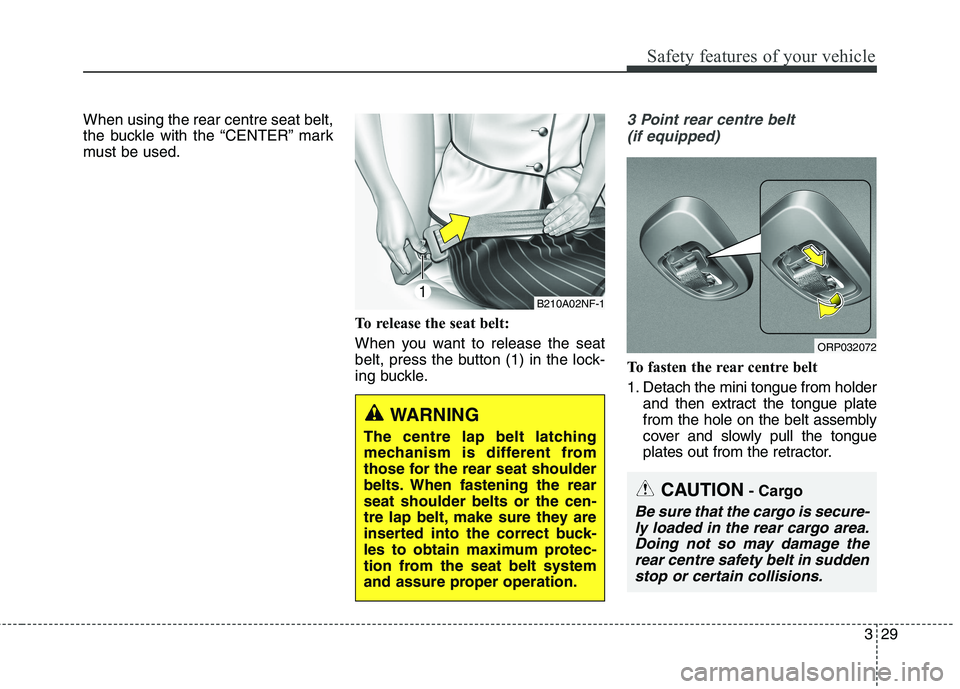
When using the rear centre seat belt,
the buckle with the “CENTER” mark
must be used.To release the seat belt:
When you want to release the seat
belt, press the button (1) in the lock-
ing buckle.3 Point rear centre belt (if equipped)
To fasten the rear centre belt
1. Detach the mini tongue from holder and then extract the tongue plate
from the hole on the belt assembly
cover and slowly pull the tongue
plates out from the retractor.
B210A02NF-1
WARNING
The centre lap belt latching
mechanism is different from
those for the rear seat shoulder
belts. When fastening the rearseat shoulder belts or the cen-
tre lap belt, make sure they are
inserted into the correct buck-
les to obtain maximum protec-
tion from the seat belt system
and assure proper operation.
ORP032072
CAUTION - Cargo
Be sure that the cargo is secure-
ly loaded in the rear cargo area.Doing not so may damage therear centre safety belt in sudden stop or certain collisions.
Page 54 of 723
Safety features of your vehicle
36
3
Larger children
Children who are too large for child
restraint systems should always
occupy the rear seat and use the
available lap/shoulder belts. The lap
portion should be fastened and
snugged on the hips and as low as
possible. Check if the belt fits period-
ically. A child's squirming could put
the belt out of position. Children are
afforded the most safety in the event
of an accident when they are
restrained by a proper restraint sys-
tem in the rear seat. If a larger child
(over age 12) must be seated in thefront seat, the child should be
securely restrained by the availablelap/shoulder belt and the seat should
be placed in the rearmost position.Children age 12 and under should be
restrained securely in the rear seat.NEVER place a child age 12 and
under in the front seat. NEVER place
a rear facing child seat in the front
seat of a vehicle. If the shoulder belt portion slightly
touches the child’s neck or face, tryplacing the child closer to the centre of
the vehicle. If the shoulder belt still
touches their face or neck they need to
be returned to a child restraint system.
Pregnant women
The use of a seat belt is recom-
mended for pregnant women to
lessen the chance of injury in an
accident. When a seat belt is used,
the lap belt portion should be placed
as low and snugly as possible on the
hips, not across the abdomen. For
specific recommendations, consult a
physician.
WARNING
- Shoulder
belts on small children
Never allow a shoulder belt to be in contact with a child’s
neck or face whilst the vehicleis in motion.
If seat belts are not properly worn and adjusted on chil-
dren, there is a risk of death or
serious injury.
WARNING - Pregnant
women
Pregnant women must never
place the lap portion of the
safety belt over the area of the
abdomen where the fetus is
located or above the abdomenwhere the belt could crush the
fetus during an impact.
Page 57 of 723
339
Safety features of your vehicle
CHILD RESTRAINT SYSTEM
Children riding in the vehicle should
sit in the rear seat and must always
be properly restrained to minimise
the risk of injury in an accident, sud-
den stop or sudden manoeuvre.
According to accident statistics, chil-
dren are safer when properly
restrained in the rear seats than in
the front seat. Larger children not in
a child restraint system should use
one of the seat belts provided.
You should be aware of the specific
requirements in your country. Child
restraint systems must be properly
placed and installed in the vehicle
seat. You must use a commercially
available child restraint system that
meets the requirements of the Safety
Standards of your country.
Child restraint systems are designed
to be secured in vehicle seats by lap
belts or the lap belt portion of a
lap/shoulder belt, or by a top tether
anchor and/or ISOFIX anchors. Children could be injured or killed in
a crash if their restraints are not
properly secured. For small children
and babies, Child restraint system
must be used. Before buying a par-
ticular child restraint system, make
sure it fits your vehicle seat and seat
belts, and fits your child. Follow all
the instructions provided by the man-
ufacturer when installing the child
restraint system.
WARNING
To ensure the safety of your child, we strongly recommend
a child restraint system to beinstalled in the rear seats.
When installing a child
restraint on the front passen-
ger's seat, the air bag must be
deactivated and set to the OFF
position. (if equipped passen-
ger's air bag ON/OFF switch)
(Continued)
(Continued)
A seat belt or child restraintsystem can become very hot
if it is left in a closed vehicle
on a sunny day, even if theoutside temperature does not
feel hot. Be sure to check the
seat cover and buckles before
placing a child there.
When the child restraint sys- tem is not in use, store it in the
luggage area or fasten it with a
seat belt or ISOFIX anchorage
so that it will not be thrown
forward in case of a suddenstop or an accident.
All children, even those too large for child restraints,should ride in the rear seats.