spare wheel KIA CARENS RHD 2017 Owners Manual
[x] Cancel search | Manufacturer: KIA, Model Year: 2017, Model line: CARENS RHD, Model: KIA CARENS RHD 2017Pages: 723, PDF Size: 40.8 MB
Page 203 of 723
4107
Features of your vehicle
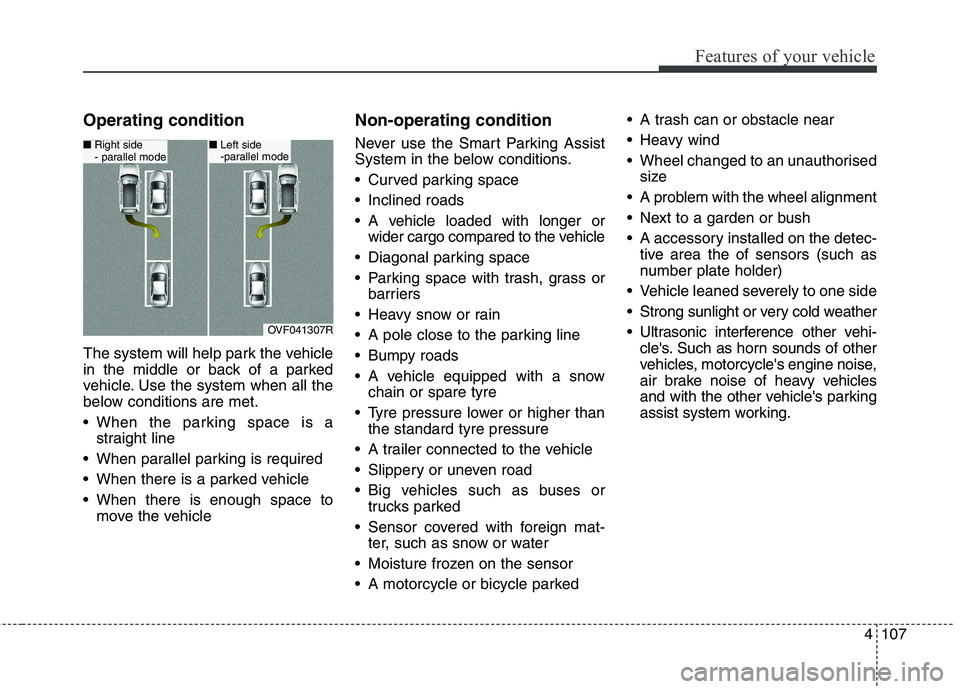
Operating condition
The system will help park the vehicle
in the middle or back of a parked
vehicle. Use the system when all the
below conditions are met.
When the parking space is astraight line
When parallel parking is required
When there is a parked vehicle
When there is enough space to move the vehicle Non-operating condition
Never use the Smart Parking Assist
System in the below conditions.
Curved parking space
Inclined roads
A vehicle loaded with longer or
wider cargo compared to the vehicle
Diagonal parking space
Parking space with trash, grass or barriers
Heavy snow or rain
A pole close to the parking line
Bumpy roads
A vehicle equipped with a snow chain or spare tyre
Tyre pressure lower or higher than the standard tyre pressure
A trailer connected to the vehicle
Slippery or uneven road
Big vehicles such as buses or trucks parked
Sensor covered with foreign mat- ter, such as snow or water
Moisture frozen on the sensor
A motorcycle or bicycle parked A trash can or obstacle near
Heavy wind
Wheel changed to an unauthorised
size
A problem with the wheel alignment
Next to a garden or bush
A accessory installed on the detec- tive area the of sensors (such as
number plate holder)
Vehicle leaned severely to one side
Strong sunlight or very cold weather
Ultrasonic interference other vehi- cle's. Such as horn sounds of other
vehicles, motorcycle's engine noise,
air brake noise of heavy vehicles
and with the other vehicle's parking
assist system working.
OVF041307R
■Right side
- parallel mode■ Left side
-parallel mode
Page 560 of 723
What to do in an emergency
10
7
Your vehicle has also been equipped
with a TPMS malfunction indicator toindicate when the system is not oper-
ating properly. The TPMS malfunction
indicator is combined with the low
tyre pressure telltale. When the sys-tem detects a malfunction, the telltale
will flash for approximately one
minute and then remain continuously
illuminated. This sequence will con-
tinue upon subsequent vehicle start-
ups as long as the malfunction exists.When the malfunction indicator is illu-
minated, the system may not be able
to detect or signal low tyre pressure
as intended. TPMS malfunctions may
occur for a variety of reasons, includ-ing the installation of replacement or
alternate tyres or wheels on the vehi-
cle that prevent the TPMS from func-
tioning properly. Always check theTPMS malfunction telltale afterreplacing one or more tyres or
wheels on your vehicle to ensure that
the replacement or alternate tyres
and wheels allow the TPMS to con-
tinue to function properly.✽✽
NOTICE
If the TPMS, Low Tyre Pressure
indicator do not illuminate for 3 sec-
onds when the ignition switch is
turned to the ON position or engine
is running, or if they remain illumi-
nated after coming on for approxi-
mately 3 seconds, we recommend
that the system be checked by an
authorised Kia dealer.Low tyre pressure telltale
When the tyre pressure monitoring
system warning indicators are illumi-
nated, one or more of your tyres issignificantly under-inflated.
If the telltale illuminates, immediately
reduce your speed, avoid hard cor-
nering and anticipate increased stop-
ping distances. You should stop and
check your tyres as soon as possi-
ble. Inflate the tyres to the proper
pressure as indicated on the vehi-
cle’s placard or tyre inflation pres-
sure label located on the driver’s side
centre pillar outer panel. If you can-
not reach a service station or if the
tyre cannot hold the newly added air,
replace the low pressure tyre with
the spare tyre.
Page 563 of 723
713
What to do in an emergency
Even if you replace the low pressure
tyre with the spare tyre, the Low TyrePressure telltale will remain on until
the low pressure tyre is repaired and
placed on the vehicle.
After you replace the low pressure
tyre with the spare tyre, the TPMS
malfunction indicator may illuminate
after a few minutes because theTPMS sensor mounted on the sparewheel is not initiated.
Once the low pressure tyre is rein- flated to the recommended pressure
and installed on the vehicle or theTPMS sensor mounted on the
replaced spare wheel is initiated by
an authorised Kia dealer, the TPMS
malfunction indicator and the low
tyre pressure telltale will extinguish
within a few minutes of driving.
If the indicator is not extinguished
after a few minutes of driving, werecommend that the system be
checked by an authorised Kia dealer.You may not be able identify a low
tyre by simply looking at it. Alwaysuse a good quality tyre pressuregauge to measure the tyre's inflation
pressure. Please note that a tyre that
is hot (from being driven) will have ahigher pressure measurement than atyre that is cold (from sitting station-
ary for at least 3 hours and driven
less than 1.6 km (1 mile) during that
3 hour period).
Allow the tyre to cool before measur-
ing the inflation pressure. Always be
sure the tyre is cold before inflating
to the recommended pressure.
A cold tyre means the vehicle has
been sitting for 3 hours and driven forless than 1.6 km (1 mile) in that 3
hour period.CAUTION
If a original mounted tyre is
replaced with the spare tyre, theTPMS sensor on the replaced spare wheel should be initiatedand the TPMS sensor on theoriginal mounted wheel shouldbe deactivated. If the TPMS sen- sor on the original mountedwheel located in the spare tyrecarrier still activates, the tyre pressure monitoring systemmay not operate properly. Werecommend that the system be serviced by an authorised Kiadealer.
CAUTION
We recommend that you use the sealant approved by Kia if yourvehicle is equipped with a TyrePressure Monitoring System. The liquid sealant can damagethe tyre pressure sensors.
Page 565 of 723
715
What to do in an emergency
IF YOU HAVE A FLAT TYRE (WITH SPARE TYRE, IF EQUIPPED)
Jack and tools
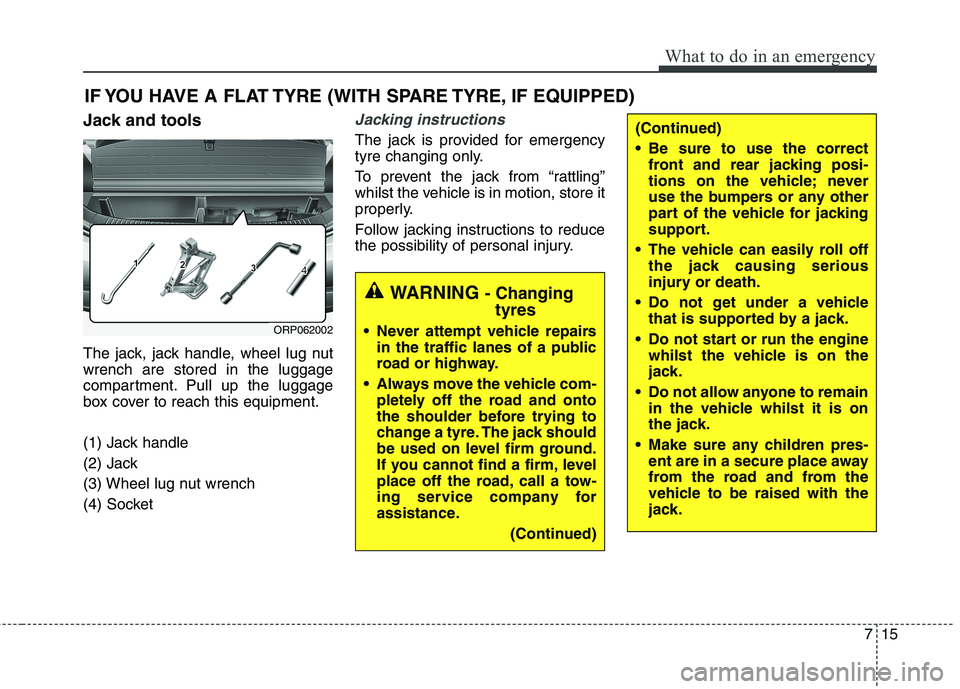
The jack, jack handle, wheel lug nut wrench are stored in the luggage
compartment. Pull up the luggage
box cover to reach this equipment.
(1) Jack handle
(2) Jack
(3) Wheel lug nut wrench
(4) Socket
Jacking instructions
The jack is provided for emergency
tyre changing only.
To prevent the jack from “rattling”
whilst the vehicle is in motion, store it
properly.
Follow jacking instructions to reduce
the possibility of personal injury.
WARNING - Changing
tyres
Never attempt vehicle repairs in the traffic lanes of a public
road or highway.
Always move the vehicle com- pletely off the road and onto
the shoulder before trying to
change a tyre. The jack should
be used on level firm ground.
If you cannot find a firm, level
place off the road, call a tow-
ing service company for
assistance.
(Continued)
ORP062002
(Continued)
Be sure to use the correctfront and rear jacking posi-
tions on the vehicle; never
use the bumpers or any other
part of the vehicle for jacking
support.
The vehicle can easily roll off the jack causing serious
injury or death.
Do not get under a vehicle that is supported by a jack.
Do not start or run the engine whilst the vehicle is on the
jack.
Do not allow anyone to remain in the vehicle whilst it is on
the jack.
Make sure any children pres- ent are in a secure place away
from the road and from the
vehicle to be raised with the
jack.
Page 566 of 723
What to do in an emergency
16
7
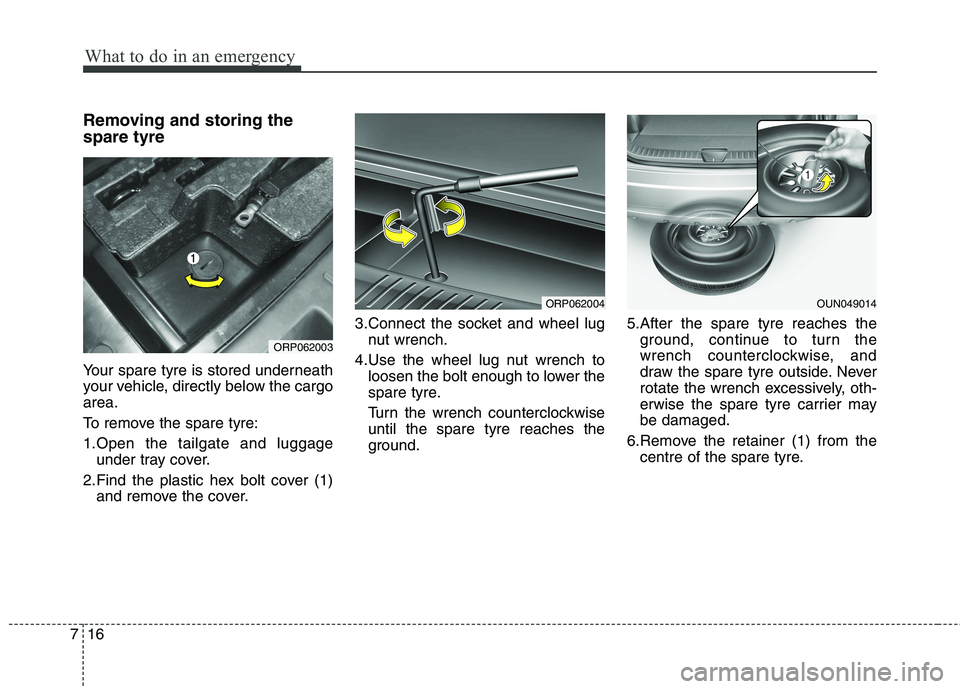
Removing and storing the spare tyre
Your spare tyre is stored underneath
your vehicle, directly below the cargoarea.
To remove the spare tyre:
1.Open the tailgate and luggage
under tray cover.
2.Find the plastic hex bolt cover (1) and remove the cover. 3.Connect the socket and wheel lug
nut wrench.
4.Use the wheel lug nut wrench to loosen the bolt enough to lower the
spare tyre.
Turn the wrench counterclockwise until the spare tyre reaches the
ground. 5.After the spare tyre reaches the
ground, continue to turn the
wrench counterclockwise, and
draw the spare tyre outside. Never
rotate the wrench excessively, oth-
erwise the spare tyre carrier maybe damaged.
6.Remove the retainer (1) from the centre of the spare tyre.
ORP062004
ORP062003
OUN049014
Page 567 of 723
717
What to do in an emergency
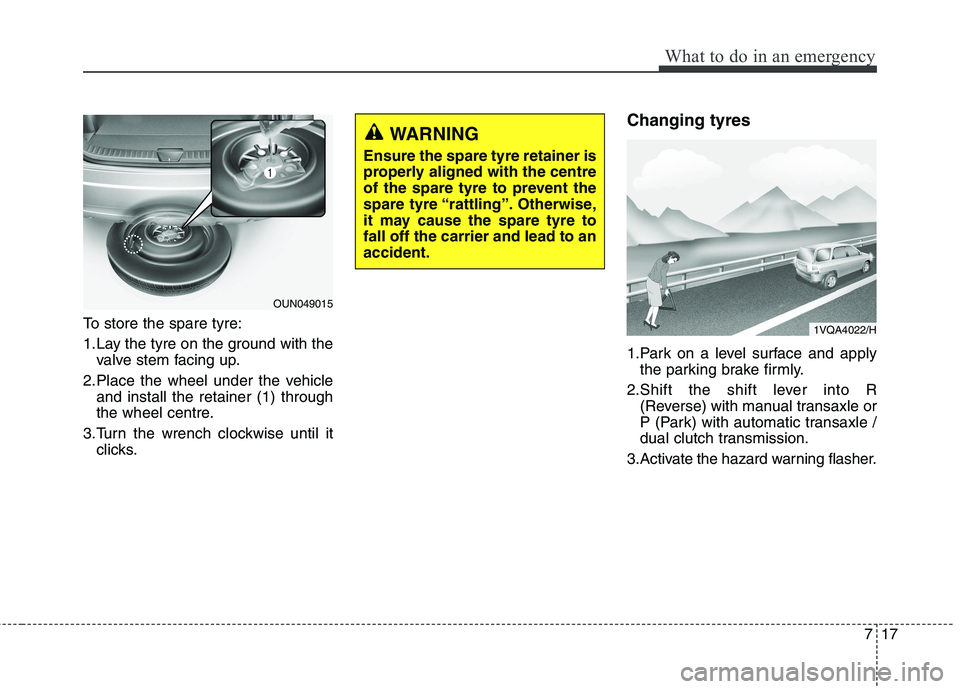
To store the spare tyre:
1.Lay the tyre on the ground with thevalve stem facing up.
2.Place the wheel under the vehicle and install the retainer (1) through
the wheel centre.
3.Turn the wrench clockwise until it clicks. Changing tyres
1.Park on a level surface and apply
the parking brake firmly.
2.Shift the shift lever into R (Reverse) with manual transaxle or
P (Park) with automatic transaxle /
dual clutch transmission.
3.Activate the hazard warning flasher.
OUN049015
WARNING
Ensure the spare tyre retainer is
properly aligned with the centre
of the spare tyre to prevent the
spare tyre “rattling”. Otherwise,
it may cause the spare tyre tofall off the carrier and lead to anaccident.
1VQA4022/H
Page 568 of 723
What to do in an emergency
18
7
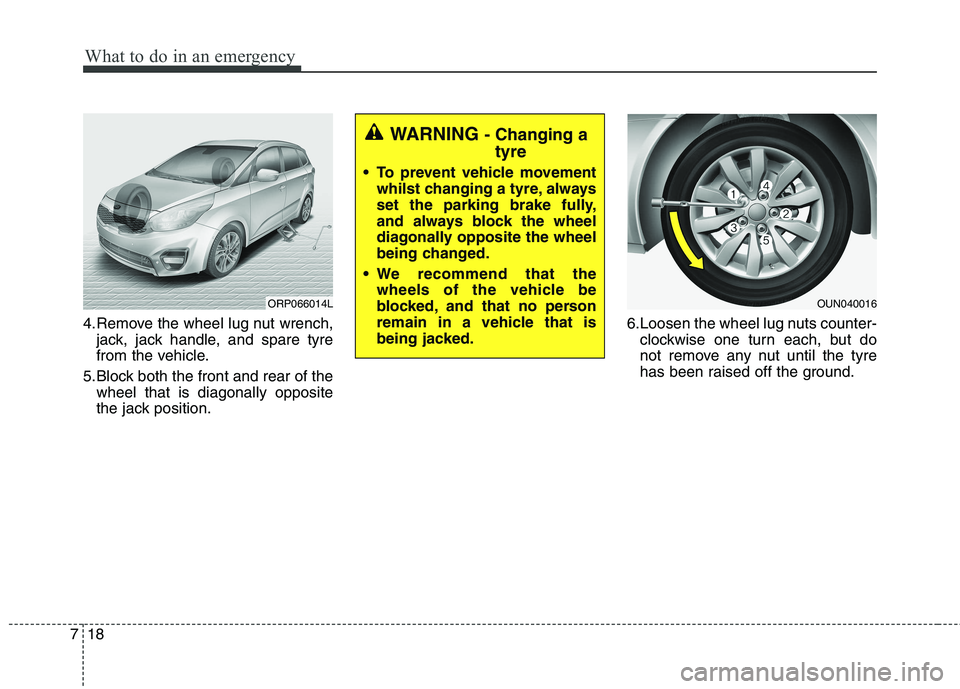
4.Remove the wheel lug nut wrench,
jack, jack handle, and spare tyre
from the vehicle.
5.Block both the front and rear of the wheel that is diagonally opposite
the jack position. 6.Loosen the wheel lug nuts counter-
clockwise one turn each, but do
not remove any nut until the tyre
has been raised off the ground.
ORP066014L
WARNING - Changing a
tyre
To prevent vehicle movement whilst changing a tyre, always
set the parking brake fully,
and always block the wheel
diagonally opposite the wheel
being changed.
We recommend that the wheels of the vehicle be
blocked, and that no person
remain in a vehicle that is
being jacked.
OUN040016
Page 569 of 723
719
What to do in an emergency
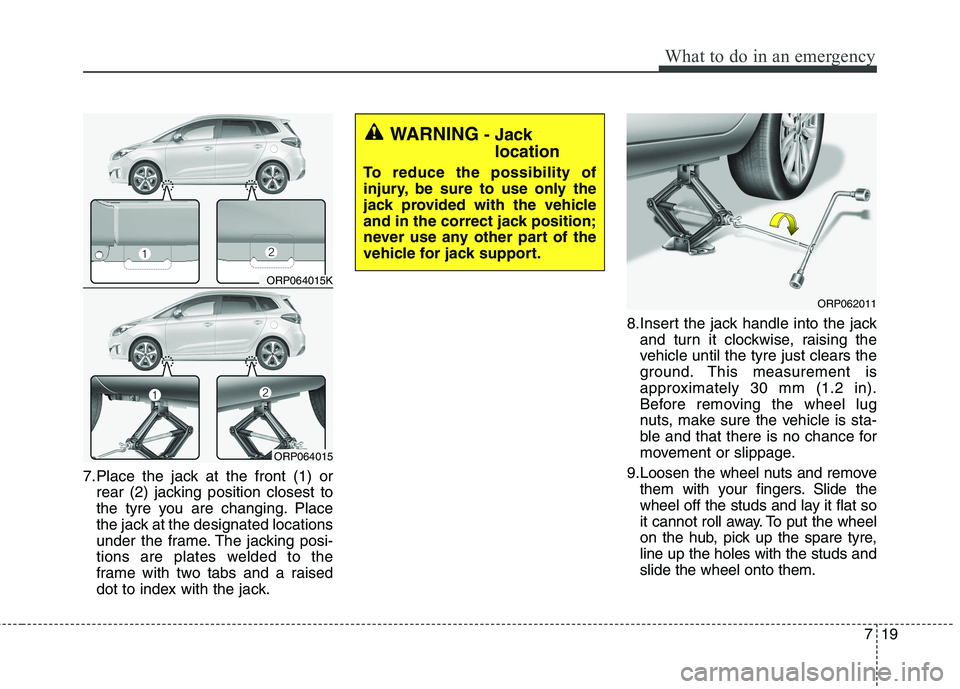
7.Place the jack at the front (1) orrear (2) jacking position closest to
the tyre you are changing. Place
the jack at the designated locations
under the frame. The jacking posi-
tions are plates welded to the
frame with two tabs and a raised
dot to index with the jack. 8.Insert the jack handle into the jack
and turn it clockwise, raising the
vehicle until the tyre just clears the
ground. This measurement is
approximately 30 mm (1.2 in).
Before removing the wheel lug
nuts, make sure the vehicle is sta-
ble and that there is no chance for
movement or slippage.
9.Loosen the wheel nuts and remove them with your fingers. Slide the
wheel off the studs and lay it flat so
it cannot roll away. To put the wheel
on the hub, pick up the spare tyre,line up the holes with the studs andslide the wheel onto them.
ORP064015K
ORP064015
WARNING - Jack
location
To reduce the possibility of
injury, be sure to use only the
jack provided with the vehicle
and in the correct jack position;
never use any other part of the
vehicle for jack support.
ORP062011
Page 571 of 723
721
What to do in an emergency
If you have a tyre gauge, remove the
valve cap and check the air pressure.
If the pressure is lower than recom-
mended, drive slowly to the nearest
service station and inflate to the cor-
rect pressure. If it is too high, adjust
it until it is correct. Always reinstall
the valve cap after checking or
adjusting tyre pressure. If the cap is
not replaced, air may leak from the
tyre. If you lose a valve cap, buyanother and install it as soon as pos-
sible.
After you have changed wheels,
always secure the flat tyre in its place
and return the jack and tools to their
proper storage locations.To prevent the jack, jack handle,
wheel lug nut wrench, socket and
spare tyre from rattling whilst the
vehicle is in motion, store them prop-
erly.CAUTION
Your vehicle has metric threads
on the wheel studs and nuts.Make certain during wheel removal that the same nuts thatwere removed are reinstalled -or, if replaced, that nuts with metric threads and the samechamfer configuration are used.Installation of a non-metricthread nut on a metric stud or vice-versa will not secure thewheel to the hub properly andwill damage the stud so that it must be replaced.
Note that most lug nuts do nothave metric threads. Be sure touse extreme care in checkingfor thread style before installing aftermarket lug nuts or wheels.If in doubt, we recommend thatyou consult an authorised Kia dealer.
WARNING - Wheel studs
If the studs are damaged, they
may lose their ability to retain
the wheel. This could lead to theloss of the wheel and a collisionresulting in serious injuries.
WARNING - Inadequate
spare tyre pressure
Check the inflation pressures
as soon as possible after
installing the spare tyre. Adjust
it to the specified pressure, if
necessary. Refer to “Tyres and
wheels” chapter 9.
Page 573 of 723
723
What to do in an emergency
Do not take this vehicle through anautomatic car wash whilst the com- pact spare tyre is installed.
Do not use tyre chains on the com- pact spare tyre. Because of the
smaller size, a tyre chain will not fit
properly. This could damage the
vehicle and result in loss of thechain.
The compact spare tyre should not be installed on the front axle if the
vehicle must be driven in snow or
on ice.
Do not use the compact spare tyre on any other vehicle because thistyre has been designed especially
for your vehicle.
The compact spare tyre’s tread life is shorter than a regular tyre.
Inspect your compact spare tyre
regularly and replace worn com-
pact spare tyres with the same sizeand design, mounted on the samewheel. The compact spare tyre should not
be used on any other wheels, nor
should standard tyres, snow tyres,
wheel covers or trim rings be used
with the compact spare wheel. Ifsuch use is attempted, damage tothese items or other car compo-
nents may occur.
Do not use more than one compact spare tyre at a time.
Do not tow a trailer whilst the com- pact spare tyre is installed.