weight KIA CARENS RHD 2017 Owners Manual
[x] Cancel search | Manufacturer: KIA, Model Year: 2017, Model line: CARENS RHD, Model: KIA CARENS RHD 2017Pages: 723, PDF Size: 40.8 MB
Page 8 of 723
15
Introduction
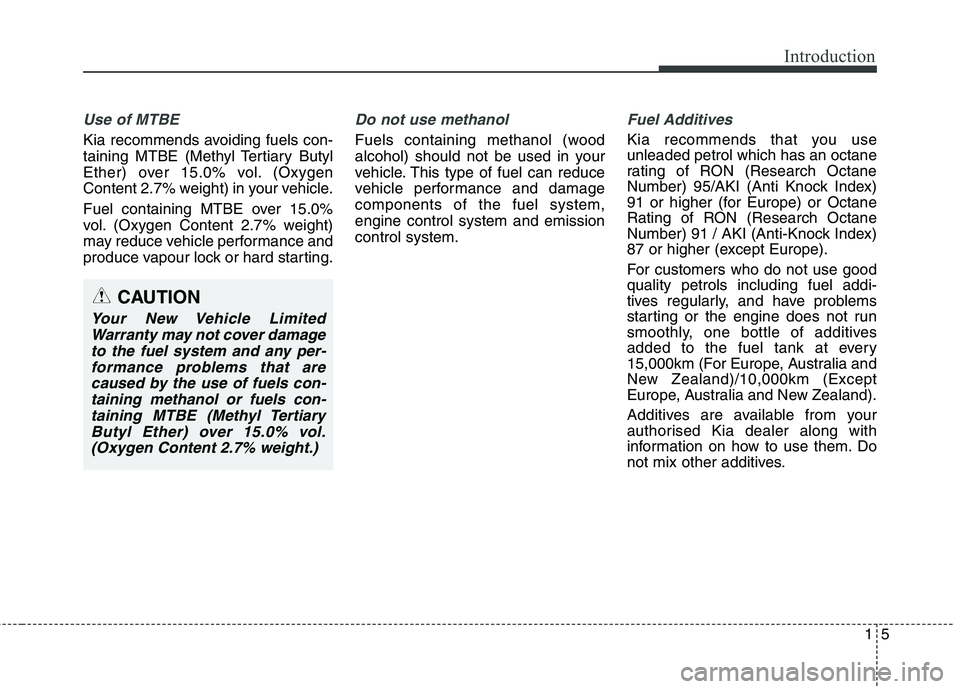
Use of MTBE
Kia recommends avoiding fuels con-
taining MTBE (Methyl Tertiary Butyl
Ether) over 15.0% vol. (Oxygen
Content 2.7% weight) in your vehicle.
Fuel containing MTBE over 15.0%
vol. (Oxygen Content 2.7% weight)
may reduce vehicle performance and
produce vapour lock or hard starting.
Do not use methanol
Fuels containing methanol (wood
alcohol) should not be used in your
vehicle. This type of fuel can reduce
vehicle performance and damagecomponents of the fuel system,engine control system and emissioncontrol system.
Fuel Additives
Kia recommends that you use unleaded petrol which has an octane
rating of RON (Research Octane
Number) 95/AKI (Anti Knock Index)
91 or higher (for Europe) or Octane
Rating of RON (Research Octane
Number) 91 / AKI (Anti-Knock Index)
87 or higher (except Europe).
For customers who do not use good quality petrols including fuel addi-
tives regularly, and have problems
starting or the engine does not run
smoothly, one bottle of additives
added to the fuel tank at every
15,000km (For Europe, Australia and
New Zealand)/10,000km (Except
Europe, Australia and New Zealand).
Additives are available from your
authorised Kia dealer along with
information on how to use them. Do
not mix other additives.
CAUTION
Your New Vehicle LimitedWarranty may not cover damageto the fuel system and any per- formance problems that arecaused by the use of fuels con-taining methanol or fuels con- taining MTBE (Methyl TertiaryButyl Ether) over 15.0% vol.(Oxygen Content 2.7% weight.)
Page 53 of 723
335
Safety features of your vehicle
Seat belt precautionsInfant or small child
You should be aware of the specific
requirements in your country. Child
and/or infant seats must be properlyplaced and installed in the rear seat.
For more information about the use
of these restraints, refer to “Child
restraint system” in this chapter.
✽✽NOTICE
Small children are best protected
from injury in an accident when
properly restrained in the rear seat
by a child restraint system that
meets the requirements of the Safety
Standards of your country. Before
buying any child restraint system,
make sure that it has a label certify-
ing that it meets Safety Standards of
your country. The restraint must be
appropriate for your child's height
and weight. Check the label on the
child restraint for this information.
Refer to “Child restraint system” in
this chapter.
WARNING
All occupants of the vehicle
must wear their seat belts at all
times. Seat belts and childrestraints reduce the risk of
serious or fatal injuries for all
occupants in the event of a col-
lision or sudden stop. Without a
seat belt, occupants could be
shifted too close to a deploying
air bag, strike the interior struc-
ture or be thrown from the vehi-
cle. Properly worn seat belts
greatly reduce these hazards.
Always follow the precautions
about seat belts, air bags andoccupant seat contained in this
manual.
WARNING
Every person in your vehicle
needs to be properly restrained
at all times, including infants
and children. Never hold a child
in your arms or lap when riding
in a vehicle. The violent forcescreated during a crash will tear
the child from your arms and
throw the child against the inte-
rior. Always use a child restraint
appropriate for your child'sheight and weight.
Page 221 of 723
4125
Features of your vehicle
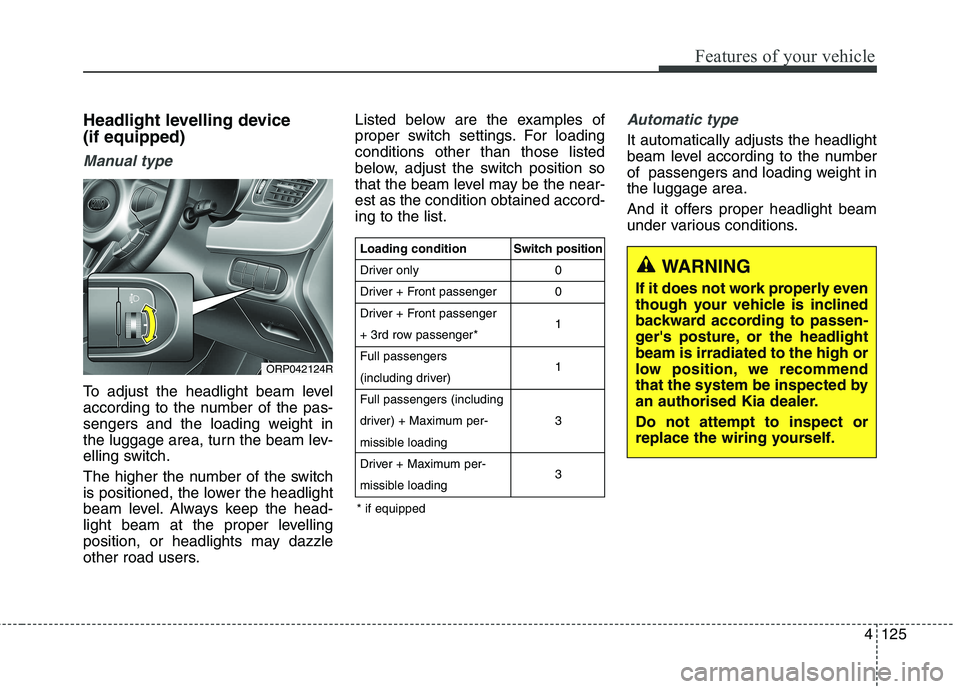
Headlight levelling device (if equipped)
Manual type
To adjust the headlight beam level
according to the number of the pas-
sengers and the loading weight in
the luggage area, turn the beam lev-
elling switch.
The higher the number of the switch
is positioned, the lower the headlight
beam level. Always keep the head-
light beam at the proper levelling
position, or headlights may dazzle
other road users.Listed below are the examples of
proper switch settings. For loadingconditions other than those listed
below, adjust the switch position so
that the beam level may be the near-est as the condition obtained accord-ing to the list.
Automatic type
It automatically adjusts the headlight
beam level according to the number
of passengers and loading weight inthe luggage area.
And it offers proper headlight beam
under various conditions.
ORP042124R
WARNING
If it does not work properly even
though your vehicle is inclined
backward according to passen-
ger's posture, or the headlightbeam is irradiated to the high or
low position, we recommend
that the system be inspected by
an authorised Kia dealer. Do not attempt to inspect or
replace the wiring yourself.
Loading condition
Driver only
Driver + Front passenger
Driver + Front passenger
+ 3rd row passenger*Full passengers
(including driver)Full passengers (including
driver) + Maximum per-
missible loading
Driver + Maximum per-
missible loading Switch position
00 1 1 3 3
* if equipped
Page 274 of 723
Features of your vehicle
178
4
✽✽
NOTICE
Close the vanity mirror cover
securely and return the sunvisor to
its original position after use.
❈ To learn how to use the vanity mir-
ror lamp, refer to "Interior light" in
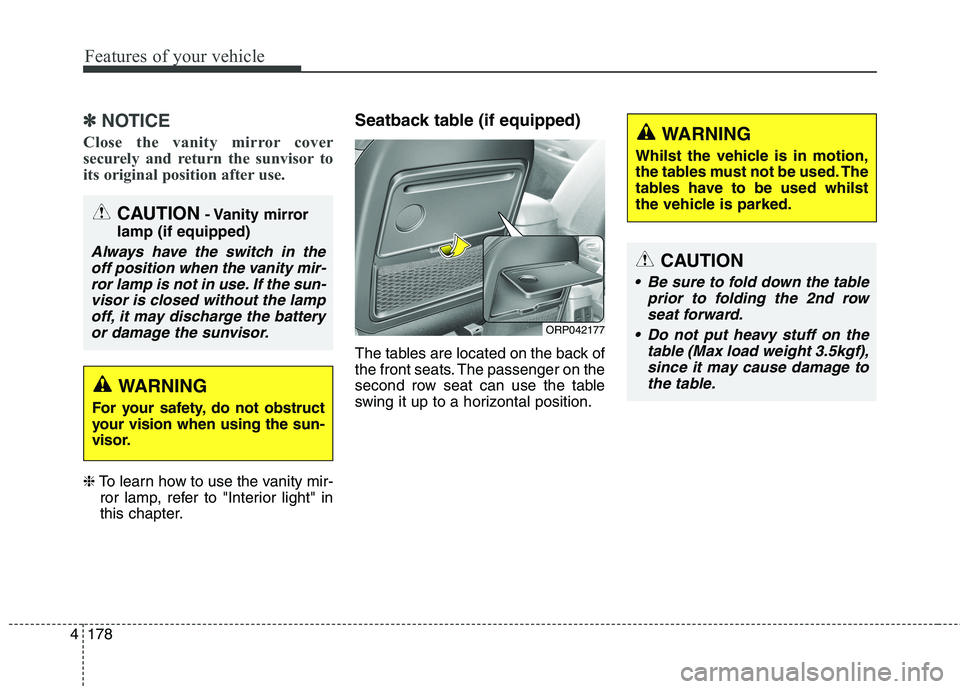
this chapter. Seatback table (if equipped)
The tables are located on the back of
the front seats. The passenger on the
second row seat can use the table
swing it up to a horizontal position.
CAUTION
Be sure to fold down the table
prior to folding the 2nd rowseat forward.
Do not put heavy stuff on the table (Max load weight 3.5kgf),since it may cause damage tothe table.
WARNING
Whilst the vehicle is in motion,
the tables must not be used. The
tables have to be used whilst
the vehicle is parked.
ORP042177
CAUTION - Vanity mirror
lamp (if equipped)
Always have the switch in the off position when the vanity mir-ror lamp is not in use. If the sun- visor is closed without the lampoff, it may discharge the batteryor damage the sunvisor.
WARNING
For your safety, do not obstruct
your vision when using the sun-
visor.
Page 280 of 723
Features of your vehicle
184
4
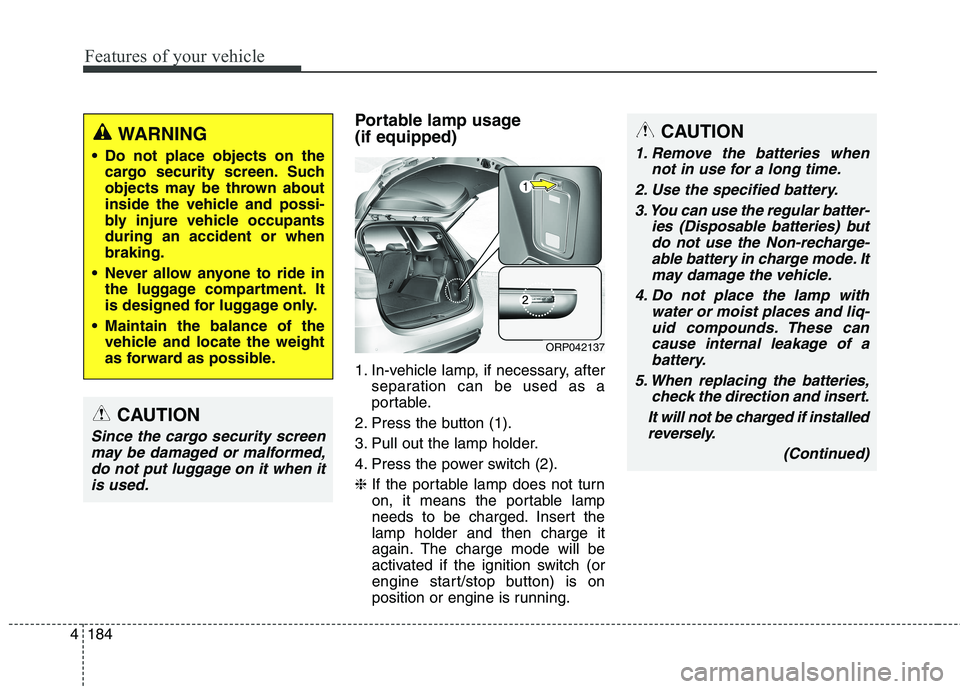
Portable lamp usage (if equipped)
1. In-vehicle lamp, if necessary, after
separation can be used as a
portable.
2. Press the button (1).
3. Pull out the lamp holder.
4. Press the power switch (2).❈ If the portable lamp does not turn
on, it means the portable lamp
needs to be charged. Insert thelamp holder and then charge it
again. The charge mode will be
activated if the ignition switch (or
engine start/stop button) is on
position or engine is running.CAUTION
1. Remove the batteries when
not in use for a long time.
2. Use the specified battery. 3. You can use the regular batter- ies (Disposable batteries) butdo not use the Non-recharge-able battery in charge mode. It may damage the vehicle.
4. Do not place the lamp with water or moist places and liq-uid compounds. These cancause internal leakage of a battery.
5. When replacing the batteries, check the direction and insert.
It will not be charged if installed reversely.
(Continued)
ORP042137
WARNING
Do not place objects on the cargo security screen. Such
objects may be thrown about
inside the vehicle and possi-
bly injure vehicle occupantsduring an accident or whenbraking.
Never allow anyone to ride in the luggage compartment. It
is designed for luggage only.
Maintain the balance of the vehicle and locate the weight
as forward as possible.
CAUTION
Since the cargo security screen
may be damaged or malformed,do not put luggage on it when it is used.
Page 283 of 723
4187
Features of your vehicle
WARNING
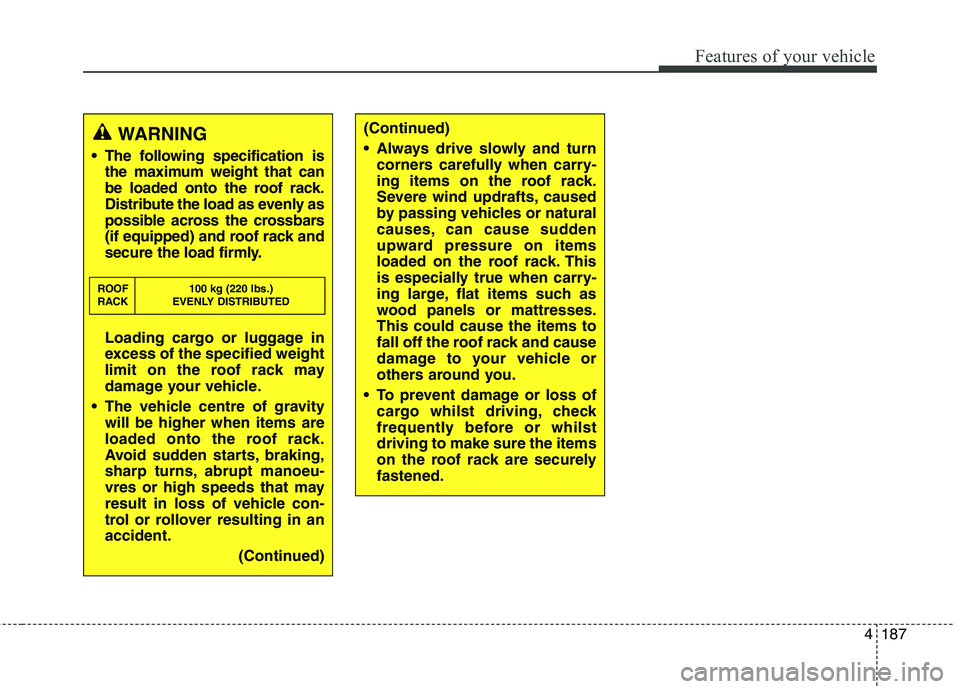
The following specification is the maximum weight that can
be loaded onto the roof rack.
Distribute the load as evenly as
possible across the crossbars
(if equipped) and roof rack and
secure the load firmly.
Loading cargo or luggage in
excess of the specified weight
limit on the roof rack may
damage your vehicle.
The vehicle centre of gravity will be higher when items are
loaded onto the roof rack.
Avoid sudden starts, braking,
sharp turns, abrupt manoeu-
vres or high speeds that may
result in loss of vehicle con-
trol or rollover resulting in anaccident.
(Continued)
ROOF 100 kg (220 lbs.)
RACK EVENLY DISTRIBUTED
(Continued)
Always drive slowly and turn
corners carefully when carry-
ing items on the roof rack.
Severe wind updrafts, caused
by passing vehicles or natural
causes, can cause sudden
upward pressure on items
loaded on the roof rack. This
is especially true when carry-
ing large, flat items such as
wood panels or mattresses.This could cause the items to
fall off the roof rack and cause
damage to your vehicle or
others around you.
To prevent damage or loss of cargo whilst driving, check
frequently before or whilstdriving to make sure the items
on the roof rack are securelyfastened.
Page 437 of 723
approximately 30 km/h (20 mph) . . . . . . . . . . . . . . 6-68
. . . . . . . . . . . . . . . . . . . . . . . 6-68
Speed limit control system. . . . . . . . . . . . . . . . . . . 6-69 . . . . . . . . . . . . . . . . . . . . . 6-69
. . . . . . . . . . . . . . . . . . . . . . . . . . . . . 6-69
. . . . . . . . . . . . . . . 6-71
Speed Limit Information Function (SLIF) . . . . . 6-72 . . . . . . . . . . . . . . . . . . 6-73
. . . . . . . . . . . . . . . . . . . . . . . . . . . . . . . . . . . 6-73
. . . . . . . . . . . . . . . . . . . . . . . . . . . . . . . . . . . . . 6-74
. . . . . . . . . . . . . . . . . . . . . . 6-77
Lane departure warning system (LDWS) . . . . . . 6-78 . . . . . . . . . . . . . . . . . . . . . . . . . . . 6-80
. . . . . . . . . . . . . . 6-81
vehicle leaves the lane, or may warn you even if the
vehicle does not leave the lane when . . . . . . . . . . . . 6-81
Blind spot detection system (BSD) . . . . . . . . . . . . 6-82 LCA (Lane Change Assist) . . . . . . . . . . . . . . . . . . . . 6-83
. . . . . . . . . . . . . . . . . 6-86
. . . . . . . . . . . . . . . . . . . . . . . . . . . . 6-88
Economical operation . . . . . . . . . . . . . . . . . . . . . . 6-90 Special driving conditions . . . . . . . . . . . . . . . . . . 6-92
. . . . . . . . . . . . . . . . . 6-92
. . . . . . . . . . . . . . . . . . . . . . . . . . 6-92
. . . . . . . . . . . . . . . . . . . . . . . . . . . . 6-93
. . . . . . . . . . . . . . . . . . . . . . . . . . . . . 6-93
. . . . . . . . . . . . . . . . . . . . . . 6-94
. . . . . . . . . . . . . . . . . . . . . . . . . . . . . . 6-94
. . . . . . . . . . . . . . . . . . . . . . . . . . . . . 6-95
Winter driving . . . . . . . . . . . . . . . . . . . . . . . . . . . . 6-96 . . . . . . . . . . . . . . . . . . . . . . . 6-96
. . . . . . . . . . 6-98
. . . . . . . . . . . . . . . . . . . . . . 6-98
. . . . . . . 6-98
. . . . . . . . . . . . . . . . . . . . 6-99
in system . . . . . . . . . . . . . . . . . . . . . . . . . . . . . . . . . . . 6-99
. . . . . . . . . . . . . 6-99
. . . . 6-99
. . . . . . . . . . . . . . . . . . . 6-99
Trailer Towing . . . . . . . . . . . . . . . . . . . . . . . . . . . 6-100
Vehicle weight . . . . . . . . . . . . . . . . . . . . . . . . . . . . 6-113
6
Page 457 of 723
Driving your vehicle
22
6
During cold weather, shifting may
be difficult until the transaxle lubri-
cant has warmed up. This is normal
and not harmful to the transaxle.
If you've come to a complete stop and it's hard to shift into 1 (First) or
R (Reverse), put the shift lever in
neutral position and release the
clutch. Press the clutch pedal back
down, and then shift into 1 (First)
or R (Reverse) gear position.CAUTION
To avoid premature clutch
wear and damage, do notdrive with your foot resting on the clutch pedal. Also, don’tuse the clutch to hold thevehicle stopped on an uphill grade, whilst waiting for a traf-fic light, etc.
Do not use the shift lever as a handrest during driving, asthis can result in premature wear of the transaxle shiftforks.
To prevent possible damage to the clutch system, do notstart with the 2nd (second) gear engaged except whenyou start on a slippery road.
Do not exceed the maximum weight limits of the loadingweight.
Improper loading can result indamage to clutch system.
WARNING
Before leaving the driver’s seat, always set the parking
brake fully and shut the
engine off. Then make sure thetransaxle is shifted into 1
(First) gear when the vehicle is
parked on a level or uphill
grade, and shifted into R
(Reverse) on a downhill grade.
Unexpected and sudden vehi-
cle movement can occur if
these precautions are not fol-
lowed in the order identified.
If your vehicle has a manual transaxle not equipped with a
ignition lock switch, it may
move and cause a serious
accident when starting theengine without depressing
the clutch pedal whilst theparking brake is released and
the shift lever not in the neu-tral position.
(Continued)
Page 477 of 723
Driving your vehicle
42
6
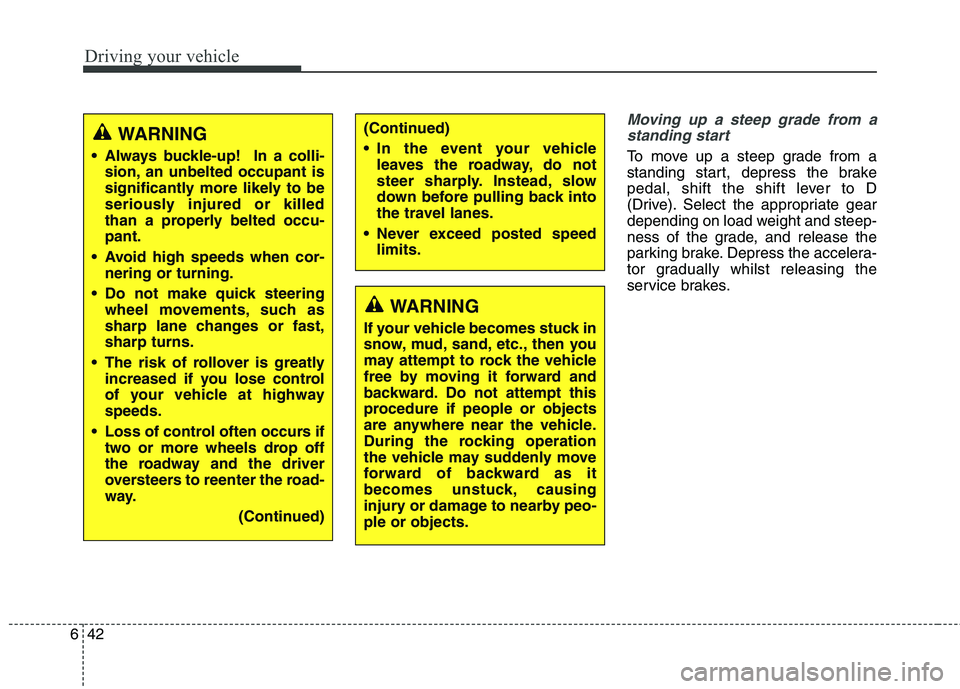
Moving up a steep grade from a
standing start
To move up a steep grade from a
standing start, depress the brake
pedal, shift the shift lever to D
(Drive). Select the appropriate gear
depending on load weight and steep-
ness of the grade, and release the
parking brake. Depress the accelera-
tor gradually whilst releasing the
service brakes.
WARNING
If your vehicle becomes stuck in
snow, mud, sand, etc., then you
may attempt to rock the vehicle
free by moving it forward and
backward. Do not attempt this
procedure if people or objects
are anywhere near the vehicle.
During the rocking operation
the vehicle may suddenly move
forward of backward as it
becomes unstuck, causing
injury or damage to nearby peo-ple or objects.
(Continued)
In the event your vehicle leaves the roadway, do not
steer sharply. Instead, slow
down before pulling back into
the travel lanes.
Never exceed posted speed limits.WARNING
Always buckle-up! In a colli- sion, an unbelted occupant is
significantly more likely to be
seriously injured or killed
than a properly belted occu-pant.
Avoid high speeds when cor- nering or turning.
Do not make quick steering wheel movements, such as
sharp lane changes or fast,sharp turns.
The risk of rollover is greatly increased if you lose control
of your vehicle at highwayspeeds.
Loss of control often occurs if two or more wheels drop off
the roadway and the driver
oversteers to reenter the road-
way.
(Continued)
Page 525 of 723
Driving your vehicle
90
6
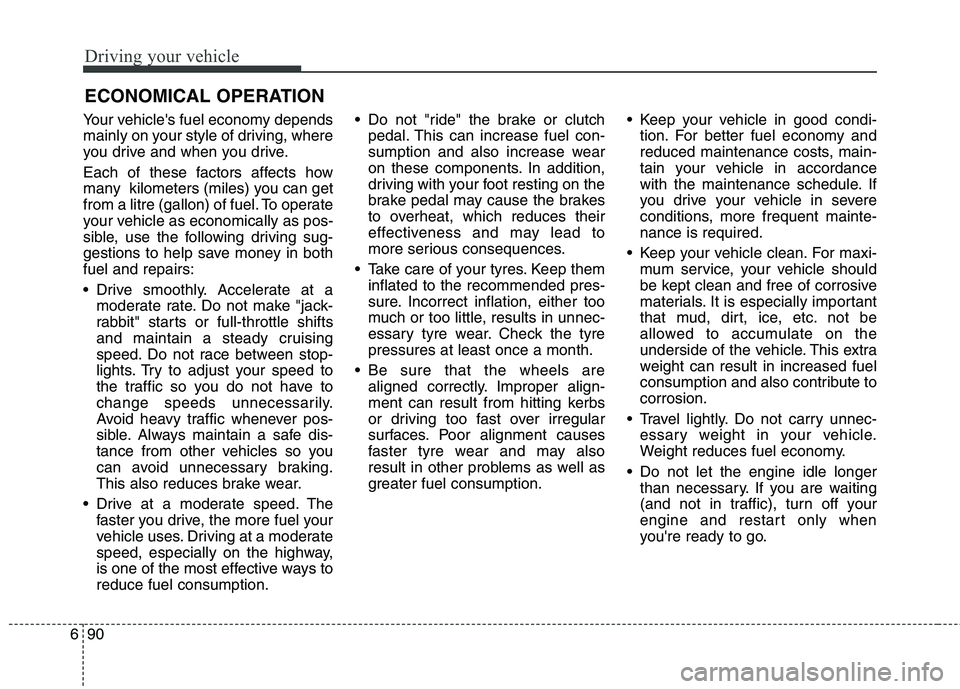
ECONOMICAL OPERATION
Your vehicle's fuel economy depends
mainly on your style of driving, where
you drive and when you drive.
Each of these factors affects how
many kilometers (miles) you can get
from a litre (gallon) of fuel. To operate
your vehicle as economically as pos-
sible, use the following driving sug-
gestions to help save money in bothfuel and repairs:
Drive smoothly. Accelerate at a moderate rate. Do not make "jack-
rabbit" starts or full-throttle shifts
and maintain a steady cruising
speed. Do not race between stop-
lights. Try to adjust your speed to
the traffic so you do not have to
change speeds unnecessarily.
Avoid heavy traffic whenever pos-
sible. Always maintain a safe dis-
tance from other vehicles so you
can avoid unnecessary braking.
This also reduces brake wear.
Drive at a moderate speed. The faster you drive, the more fuel your
vehicle uses. Driving at a moderate
speed, especially on the highway,
is one of the most effective ways toreduce fuel consumption. Do not "ride" the brake or clutch
pedal. This can increase fuel con-
sumption and also increase wear
on these components. In addition,
driving with your foot resting on the
brake pedal may cause the brakes
to overheat, which reduces their
effectiveness and may lead to
more serious consequences.
Take care of your tyres. Keep them inflated to the recommended pres-
sure. Incorrect inflation, either too
much or too little, results in unnec-
essary tyre wear. Check the tyrepressures at least once a month.
Be sure that the wheels are aligned correctly. Improper align-
ment can result from hitting kerbs
or driving too fast over irregular
surfaces. Poor alignment causes
faster tyre wear and may also
result in other problems as well as
greater fuel consumption. Keep your vehicle in good condi-
tion. For better fuel economy and
reduced maintenance costs, main-
tain your vehicle in accordance
with the maintenance schedule. If
you drive your vehicle in severe
conditions, more frequent mainte-nance is required.
Keep your vehicle clean. For maxi- mum service, your vehicle should
be kept clean and free of corrosive
materials. It is especially important
that mud, dirt, ice, etc. not be
allowed to accumulate on the
underside of the vehicle. This extra
weight can result in increased fuel
consumption and also contribute tocorrosion.
Travel lightly. Do not carry unnec- essary weight in your vehicle.
Weight reduces fuel economy.
Do not let the engine idle longer than necessary. If you are waiting
(and not in traffic), turn off your
engine and restart only when
you're ready to go.