ABS KIA CARENS RHD 2018 User Guide
[x] Cancel search | Manufacturer: KIA, Model Year: 2018, Model line: CARENS RHD, Model: KIA CARENS RHD 2018Pages: 723, PDF Size: 40.94 MB
Page 489 of 723
Driving your vehicle
54
6
The ABS continuously senses the
speed of the wheels. If the wheels
are going to lock, the ABS system
repeatedly modulates the hydraulic
brake pressure to the wheels.
When you apply your brakes under
conditions which may lock the
wheels, you may hear a “tik-tik’’
sound from the brakes, or feel a cor-
responding sensation in the brake
pedal. This is normal and it means
your ABS is active.
In order to obtain the maximum ben-
efit from your ABS in an emergencysituation, do not attempt to modulate
your brake pressure and do not try to
pump your brakes. Press your brake
pedal as hard as possible or as hard
as the situation warrants and allow
the ABS to control the force being
delivered to the brakes.✽✽
NOTICE
A click sound may be heard in the
engine compartment when the vehi-
cle begins to move after the engine is
started. These conditions are normal
and indicate that the anti-lock brake
system is functioning properly. Even with the anti-lock brake sys- tem, your vehicle still requires suf-
ficient stopping distance. Always
maintain a safe distance from the
vehicle in front of you.
Always slow down when cornering. The anti-lock brake system cannot
prevent accidents resulting from
excessive speeds.
On loose or uneven road surfaces, operation of the anti-lock brake
system may result in a longer stop-
ping distance than for vehicles
equipped with a conventional
brake system.
Page 490 of 723
655
Driving your vehicle
CAUTION
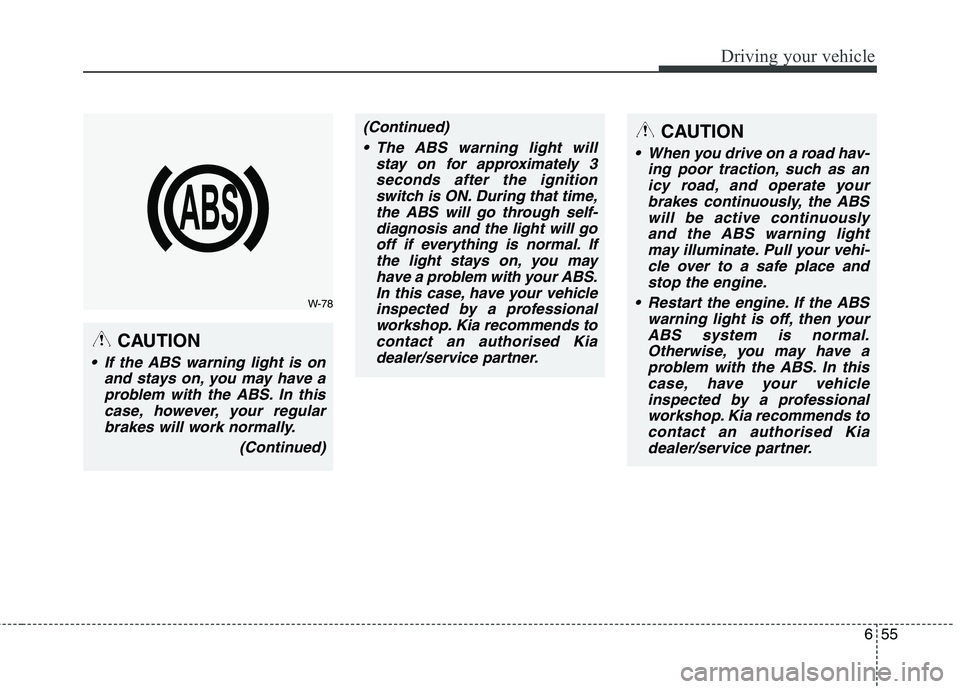
If the ABS warning light is onand stays on, you may have aproblem with the ABS. In thiscase, however, your regularbrakes will work normally.
(Continued)
(Continued) The ABS warning light will stay on for approximately 3seconds after the ignition switch is ON. During that time,the ABS will go through self-diagnosis and the light will gooff if everything is normal. If the light stays on, you mayhave a problem with your ABS.In this case, have your vehicle inspected by a professionalworkshop. Kia recommends tocontact an authorised Kia dealer/service partner.
W-78
CAUTION
When you drive on a road hav- ing poor traction, such as anicy road, and operate your brakes continuously, the ABSwill be active continuouslyand the ABS warning light may illuminate. Pull your vehi-cle over to a safe place andstop the engine.
Restart the engine. If the ABS warning light is off, then yourABS system is normal.Otherwise, you may have aproblem with the ABS. In this case, have your vehicleinspected by a professionalworkshop. Kia recommends tocontact an authorised Kia dealer/service partner.
Page 491 of 723
Driving your vehicle
56
6
✽✽
NOTICE
When you jump start your vehicle
because of a drained battery, the
engine may not run as smoothly and
the ABS warning light may turn on
at the same time. This happens
because of the low battery voltage. It
does not mean your ABS is malfunc-
tioning.
Do not pump your brakes!
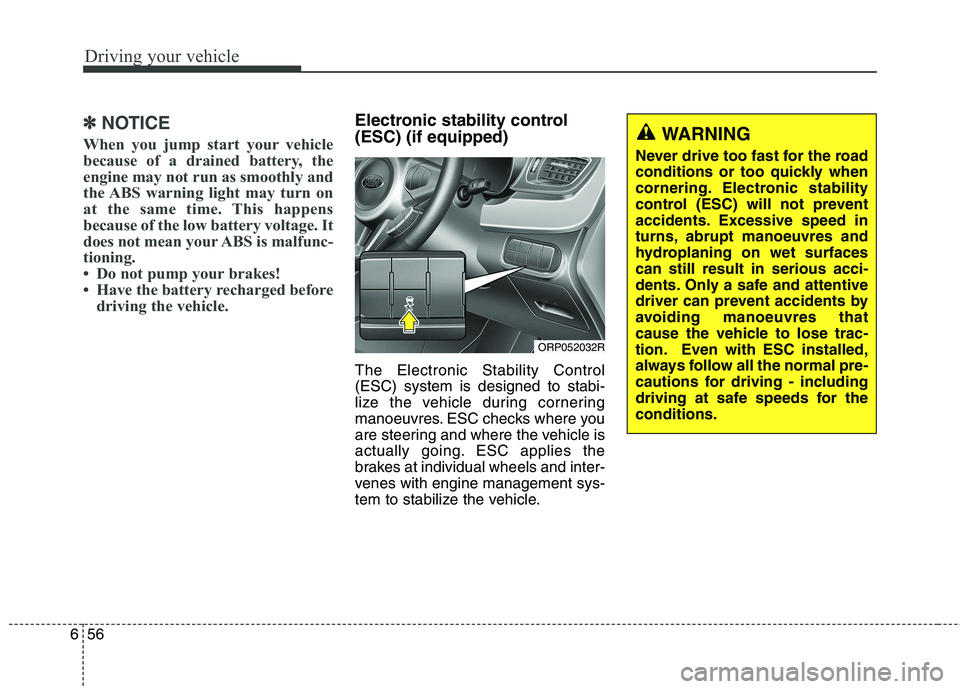
Have the battery recharged before driving the vehicle.Electronic stability control (ESC) (if equipped) The Electronic Stability Control (ESC) system is designed to stabi-
lize the vehicle during cornering
manoeuvres. ESC checks where you
are steering and where the vehicle is
actually going. ESC applies the
brakes at individual wheels and inter-
venes with engine management sys-
tem to stabilize the vehicle.
ORP052032R
WARNING
Never drive too fast for the road
conditions or too quickly when
cornering. Electronic stability
control (ESC) will not prevent
accidents. Excessive speed in
turns, abrupt manoeuvres and
hydroplaning on wet surfacescan still result in serious acci-
dents. Only a safe and attentive
driver can prevent accidents by
avoiding manoeuvres that
cause the vehicle to lose trac-
tion. Even with ESC installed,
always follow all the normal pre-
cautions for driving - including
driving at safe speeds for theconditions.
Page 494 of 723
659
Driving your vehicle
Indicator light
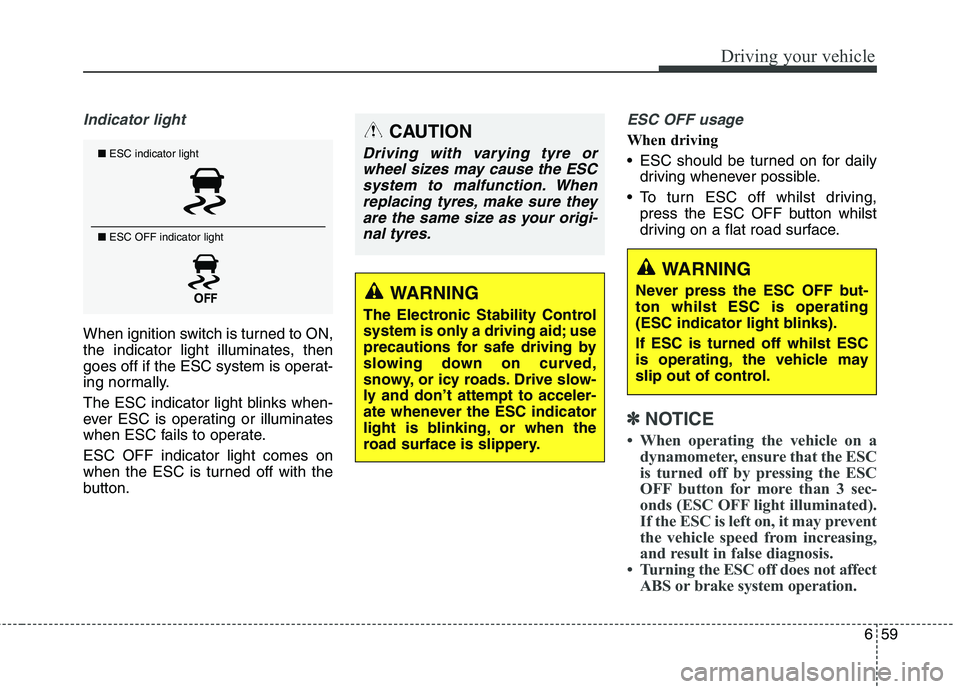
When ignition switch is turned to ON,
the indicator light illuminates, then
goes off if the ESC system is operat-
ing normally.
The ESC indicator light blinks when-
ever ESC is operating or illuminates
when ESC fails to operate. ESC OFF indicator light comes on
when the ESC is turned off with the
button.
ESC OFF usage
When driving
ESC should be turned on for dailydriving whenever possible.
To turn ESC off whilst driving, press the ESC OFF button whilst
driving on a flat road surface.
✽✽ NOTICE
When operating the vehicle on a dynamometer, ensure that the ESC
is turned off by pressing the ESC
OFF button for more than 3 sec-
onds (ESC OFF light illuminated).
If the ESC is left on, it may prevent
the vehicle speed from increasing,
and result in false diagnosis.
Turning the ESC off does not affect ABS or brake system operation.
■ESC indicator light
■ ESC OFF indicator light
CAUTION
Driving with varying tyre or
wheel sizes may cause the ESCsystem to malfunction. When replacing tyres, make sure theyare the same size as your origi-nal tyres.
WARNING
The Electronic Stability Control
system is only a driving aid; use
precautions for safe driving by
slowing down on curved,
snowy, or icy roads. Drive slow-
ly and don’t attempt to acceler-
ate whenever the ESC indicator
light is blinking, or when the
road surface is slippery.
WARNING
Never press the ESC OFF but- ton whilst ESC is operating
(ESC indicator light blinks). If ESC is turned off whilst ESC
is operating, the vehicle may
slip out of control.
Page 497 of 723
Driving your vehicle
62
6
Emergency Stop Signal (ESS) (if equipped) The Emergency Stop Signal system
alerts the driver behind by blinking
the stop light when the vehicle is
braked rapidly and severely.
The system is activated when:
The vehicle suddenly stops (vehi-
cle speed is over 55km/h and the
vehicle deceleration at greaterthan 7 m/s 2
)
The ABS is activating
When the vehicle speed is under 40
km/h and the ABS deactivates or the
sudden stop situation is over, the
stop light blinking will stop. Instead,
the hazard warning flasher will turn
on automatically.
The hazard warning flasher will turn
off when vehicle speed is over
10km/h after the vehicle has
stopped. Also, it will turn off when the
vehicle is driven at low speed for
some time. You can turn it off manu-
ally by pushing the hazard warning
flasher switch. Good braking practices
WARNING
Whenever you leave or park your vehicle, always set the parking brake as far as possi-
ble and fully engage the vehi-
cle's transaxle into the P
(Park) position. If the parking
brake is not fully engaged, the
vehicle may move inadver-
tently and injure yourself and
others.
All vehicles should always have the parking brake fully
engaged when parking to
avoid inadvertent movement
of the vehicle which can injureoccupants or pedestrians.
CAUTION
The Emergency Stop Signal
(ESS) system will not work if thehazard warning flasher is already on.
Page 522 of 723
687
Driving your vehicle
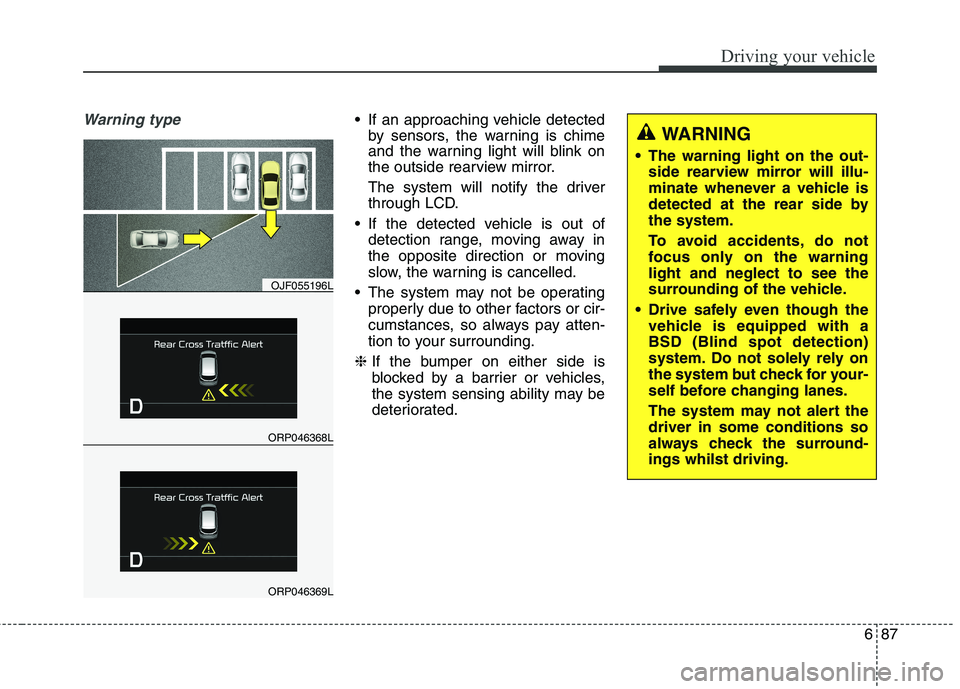
Warning type If an approaching vehicle detectedby sensors, the warning is chime
and the warning light will blink on
the outside rearview mirror.
The system will notify the driver
through LCD.
If the detected vehicle is out of detection range, moving away in
the opposite direction or moving
slow, the warning is cancelled.
The system may not be operating properly due to other factors or cir-
cumstances, so always pay atten-
tion to your surrounding.
❈ If the bumper on either side is
blocked by a barrier or vehicles,
the system sensing ability may be
deteriorated.
ORP046368L
OJF055196L
ORP046369L
WARNING
The warning light on the out- side rearview mirror will illu-
minate whenever a vehicle is
detected at the rear side bythe system.
To avoid accidents, do not
focus only on the warninglight and neglect to see the
surrounding of the vehicle.
Drive safely even though the vehicle is equipped with aBSD (Blind spot detection)
system. Do not solely rely on
the system but check for your-
self before changing lanes.
The system may not alert the driver in some conditions so
always check the surround-ings whilst driving.
Page 527 of 723
Driving your vehicle
92
6
Hazardous driving conditions
When hazardous driving conditions
are encountered such as water,
snow, ice, mud, sand, or similar haz-
ards, follow these suggestions:
Drive cautiously and allow extra
distance for braking.
Avoid sudden braking or steering.
When braking with non-ABS brakes pump the brake pedal with
a light up-and-down motion until
the vehicle is stopped.
If stalled in snow, mud, or sand, use second gear. Accelerate slowly to
avoid spinning the drive wheels.
Use sand, rock salt, tyre chains, or other non-slip material under the
drive wheels to provide traction
when stalled in ice, snow, or mud. Rocking the vehicle
If it is necessary to rock the vehicle to
free it from snow, sand, or mud, first
turn the steering wheel right and left
to clear the area around your front
wheels. Then, shift back and forth
between 1 (First) and R (Reverse) in
vehicles equipped with a manual
transaxle or R (Reverse) and any for-
ward gear in vehicles equipped with
an automatic transaxle / dual clutch
transmission. Do not race the engine,and spin the wheels as little as possi-
ble. If you are still stuck after a few
tries, have the vehicle pulled out by a
tow vehicle to avoid engine overheat-
ing and possible damage to the
transaxle.
SPECIAL DRIVING CONDITIONS WARNING
- Downshifting
Downshifting with an automatic
transaxle / dual clutch transmis-
sion, whilst driving on slipperysurfaces can cause an accident.
The sudden change in tyrespeed could cause the tyres to
skid. Be careful when down-
shifting on slippery surfaces.
WARNING - ABS
Do not pump the brake pedal on
a vehicle equipped with ABS.
CAUTION
Prolonged rocking may cause engine over-heating, transaxledamage or failure, and tyre dam- age.
Page 537 of 723
Driving your vehicle
102
6
Hitches
It's important to have the correct hitch
equipment. Crosswinds, large trucks
going by, and rough roads are a few
reasons why you’ll need the right
hitch. Here are some rules to follow:
Do you have to make any holes in
the body of your vehicle when you
install a trailer hitch? If you do, thenbe sure to seal the holes later
when you remove the hitch.
The bumpers on your vehicle are not intended for hitches. Do notattach rental hitches or other
bumper-type hitches to them. Use
only a frame-mounted hitch that
does not attach to the bumper.
Kia trailer hitch accessary is avail- able at an authorised Kia
dealer/service partner. Safety chains
You should always attach chains
between your vehicle and your trail-
er. Cross the safety chains under the
tongue of the trailer so that thetongue will not drop to the road if it
becomes separated from the hitch.
Instructions about safety chains may
be provided by the hitch manufactur-
er or by the trailer manufacturer.
Follow the manufacturer’s recom-
mendation for attaching safety
chains. Always leave just enough
slack so you can turn with your trail-
er. And, never allow safety chains to
drag on the ground.
Trailer brakes
If your trailer is equipped with a brak-
ing system, make sure it conforms to
your country’s regulations and that it
is properly installed and operating
correctly.
If your trailer weight exceeds the
maximum allowed weight without
trailer brakes, then the trailer will also
require its own brakes as well. Be
sure to read and follow the instruc-
tions for the trailer brakes so you’ll be
able to install, adjust and maintain
them properly.
Do not tap into or modify your vehi-
cle's brake system.
WARNING - Trailer brakes
Do not use a trailer with its own
brakes unless you are absolute-
ly certain that you have proper-
ly set up the brake system. This
is not a task for amateurs. Use
an experienced, competent
trailer shop for this work.
Page 541 of 723
Driving your vehicle
106
6
Parking on hills
Generally, if you have a trailer
attached to your vehicle, you should
not park your vehicle on a hill. People
can be seriously or fatally injured,
and both your vehicle and the trailer
can be damaged if unexpectedly roll
down hill. However, if you ever have to park your
trailer on a hill, here is how to do it:
1. Pull the vehicle into the parking
space. Turn the steering wheel in
the direction of the kerb (left if head-
ed down hill, right if headed up hill).
2. If the vehicle has a manual transaxle, place the car in neutral.
If the vehicle has an automatic
transaxle / dual clutch transmis-
sion, place the car in P (Park).
3. Set the parking brake and shut off the vehicle.
4. Place chocks under the trailer wheels on the down hill side of the
wheels.
5. Start the vehicle, hold the brakes, shift to neutral, release the parking
brake and slowly release the
brakes until the trailer chocksabsorb the load.
6. Reapply the brakes, reapply the parking brake and shift the vehicle
to R (Reverse) for manual transaxle
or P (Park) for automatic transaxle /
dual clutch transmission.
7. Shut off the vehicle and release the vehicle brakes but leave the
parking brake set.
WARNING - Parking on
a hill
Parking your vehicle on a hill
with a trailer attached could
cause serious injury or death,
should the trailer break loose.
WARNING - Parking
brake
It can be dangerous to get out
of your vehicle if the parking
brake is not firmly set.
If you have left the engine run-
ning, the vehicle can move sud-
denly. You or others could be
seriously or fatally injured.
Page 556 of 723
What to do in an emergency
6
7
Jump starting procedure
✽✽
NOTICE
If the battery is discharged, the
engine can be started using a battery
of another vehicle and two jumper
cables. Only use jumper cables with
fully insulated clamp handles.
To prevent personal injury or dam-
age to both vehicles, adhere strictly
to the following procedure.
1.Make sure the booster battery is 12-volt and that its negative termi-
nal is grounded.
2.If the booster battery is in another vehicle, do not allow the vehicles totouch.
3.Turn off all unnecessary electrical loads.
4.Connect the jumper cables in the exact sequence shown in the illus-
tration. First connect one end of a
jumper cable to the positive termi-
nal of the discharged battery (1),then connect the other end to the
positive terminal on the booster
battery (2). Proceed to connect
one end of the other jumper cable
to the negative terminal of the
booster battery (3), then the other
end to a solid, stationary, metallic
point (for example, the engine lift-
ing bracket) away from the battery
(4). Do not connect it to or near any
part that moves when the engine is
cranked. Make sure that there is no
contact between the bodywork of
the two vehicles; otherwise, there
is the danger of short circuits.(Continued)
The battery may rupture orexplode when you jump start
with a low or frozen battery.
CAUTION - AGM battery
(if equipped)
Absorbent Glass Matt (AGM) batteries are maintenance freeand have the AGM batteryserviced by a professionalworkshop. Kia recommends to visit an authorised Kia deal-er/service partner. For charg-ing your AGM battery, use only fully automatic battery charg-ers that are specially devel-oped for AGM batteries.
When replacing the AGM bat- tery, use parts for replacementfrom a professional workshop.Kia recommends to visit anauthorised Kia dealer/service partner.
(Continued)
(Continued)
Do not open or remove the cap on top of the battery. Thismay cause leaks of internal electrolyte that could result insevere injury.
If the AGM battery is reconnect- ed or replaced, ISG functionwill not operate immediately.
If you want to use the ISGfunction, the battery sensor needs to be calibrated forapproximately 4 hours withthe ignition off.