ECU KIA CARENS RHD 2018 User Guide
[x] Cancel search | Manufacturer: KIA, Model Year: 2018, Model line: CARENS RHD, Model: KIA CARENS RHD 2018Pages: 723, PDF Size: 40.94 MB
Page 61 of 723
343
Safety features of your vehicle
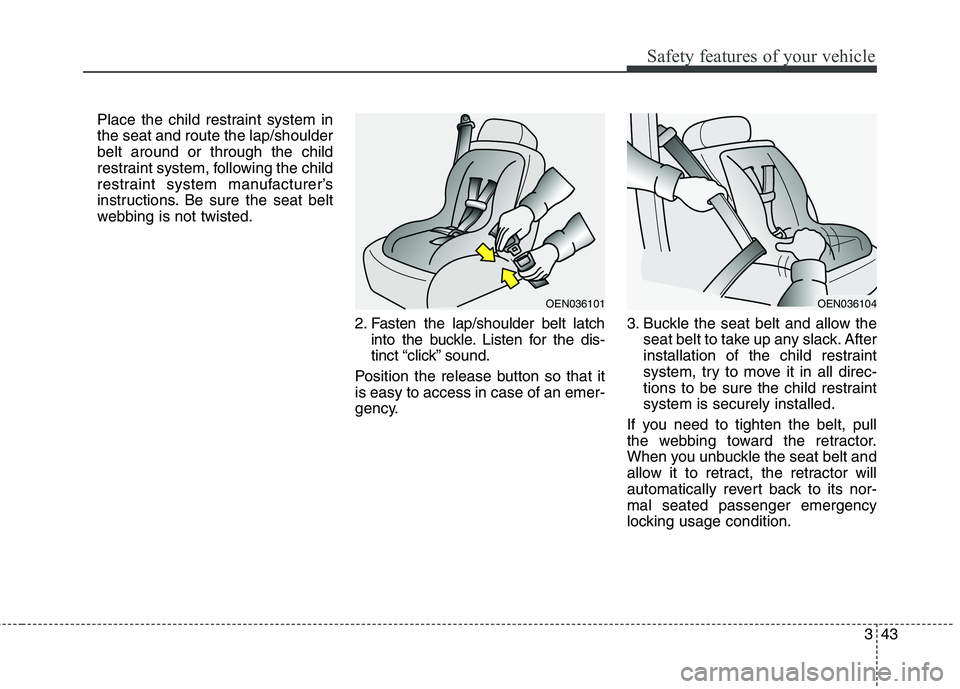
Place the child restraint system in the seat and route the lap/shoulderbelt around or through the child
restraint system, following the child
restraint system manufacturer’s
instructions. Be sure the seat belt
webbing is not twisted.2. Fasten the lap/shoulder belt latchinto the buckle. Listen for the dis-
tinct “click” sound.
Position the release button so that itis easy to access in case of an emer-
gency. 3. Buckle the seat belt and allow the
seat belt to take up any slack. After
installation of the child restraint
system, try to move it in all direc-
tions to be sure the child restraintsystem is securely installed.
If you need to tighten the belt, pull
the webbing toward the retractor.
When you unbuckle the seat belt and
allow it to retract, the retractor will
automatically revert back to its nor-mal seated passenger emergency
locking usage condition.
OEN036101OEN036104
Page 64 of 723
Safety features of your vehicle
46
3
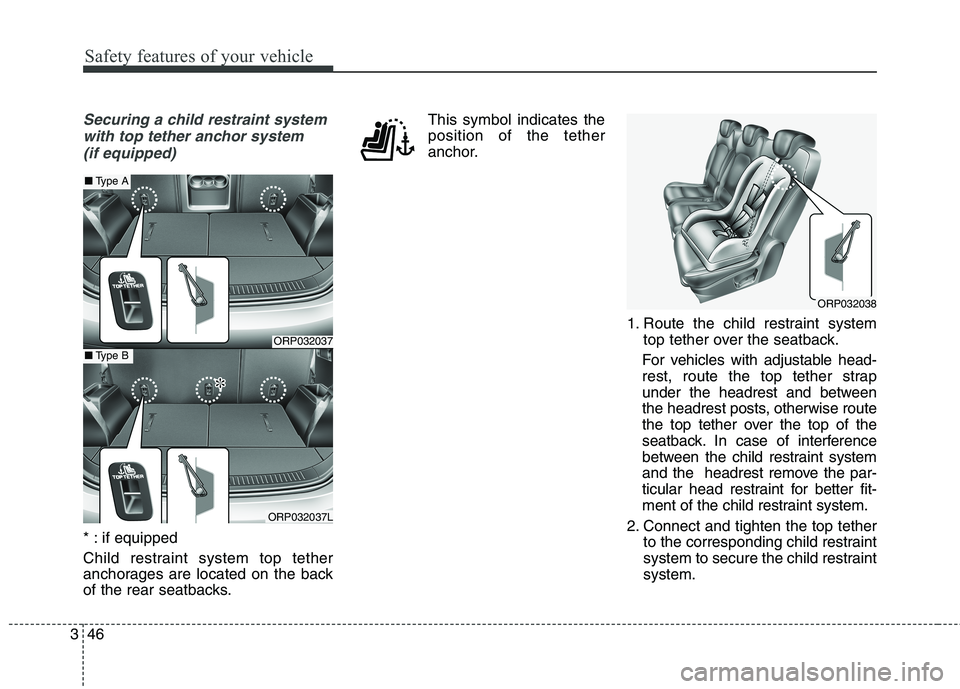
Securing a child restraint system
with top tether anchor system (if equipped)
* : if equipped
Child restraint system top tether
anchorages are located on the back
of the rear seatbacks. This symbol indicates the position of the tether
anchor.
1. Route the child restraint systemtop tether over the seatback.
For vehicles with adjustable head-
rest, route the top tether strap
under the headrest and between
the headrest posts, otherwise route
the top tether over the top of the
seatback. In case of interference
between the child restraint system
and the headrest remove the par-
ticular head restraint for better fit-
ment of the child restraint system.
2. Connect and tighten the top tether to the corresponding child restraint
system to secure the child restraintsystem.
ORP032038
ORP032037
ORP032037L
■Type A
■Type B
Page 65 of 723
347
Safety features of your vehicle
WARNING - Child
restraint system check
Check that the child restraint
system is secure by pushing
and pulling it in different direc-
tions. Incorrectly fitted child
restraint systems may swing,
twist, tip or separate causing
death or serious injury.
WARNING - Child
restraint system anchorage
Child restraint anchorages are designed to withstand only
those loads imposed by cor-
rectly fitted child restraints.
Under no circumstances are
they to be used for adult seat
belts, harnesses, or for attach-ing other items or equipment
to the vehicle.
The top tether may not work properly if attached some-where other than the correct
tether anchor.WARNING - Top tether
Never mount more than one
child restraint system to a sin-gle top tether or to a single top
tether anchorage point. The
increased load caused by multi-
ple child restraint system may
cause the top tethers or anchor-
age points to break, causing
serious injury or death.
WARNING
A child can be seriously injured
or killed in a collision if the child
restraint system is not properly
anchored to the car and the
child is not properly restrained
in the child restraint system.
Always follow the child restraint
system manufacturer’s instruc-
tions for installation and use.
WARNING - Australian
design rule
Child restraint anchorages are
designed to withstand only
those loads imposed by cor-
rectly fitted child restraints.
Under no circumstances are
they to be used for adult seat
belts, harnesses, or for attach-ing other items or equipment to
the vehicle.
Page 66 of 723
Safety features of your vehicle
48
3
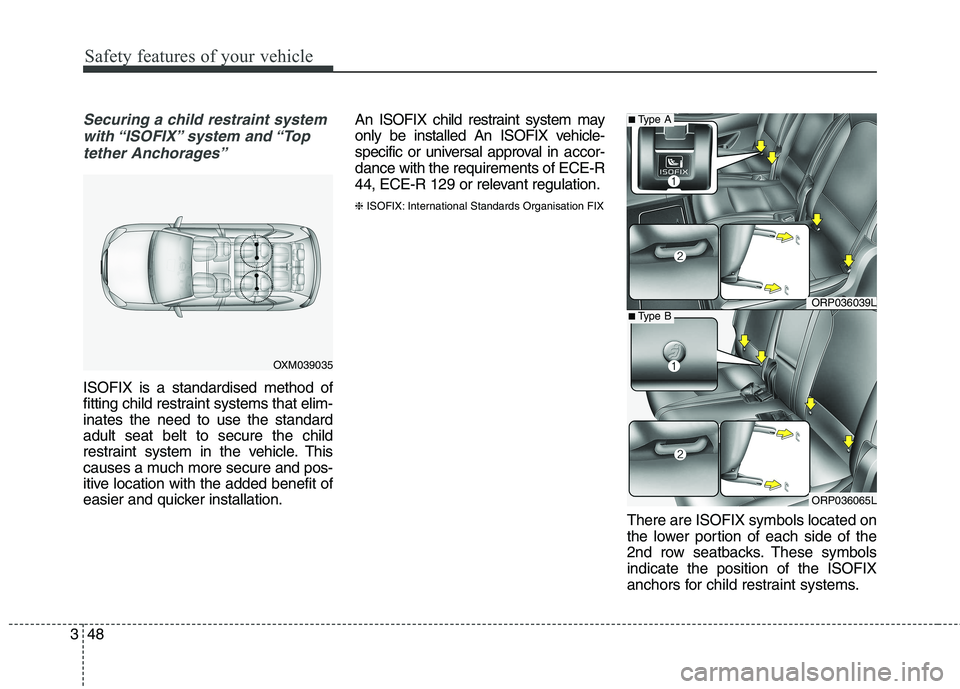
Securing a child restraint system
with “ISOFIX” system and “Top tether Anchorages”
ISOFIX is a standardised method of
fitting child restraint systems that elim-inates the need to use the standardadult seat belt to secure the child
restraint system in the vehicle. This
causes a much more secure and pos-
itive location with the added benefit of
easier and quicker installation. An ISOFIX child restraint system may
only be installed An ISOFIX vehicle-
specific or universal approval in
accor-
dance with the requirements of ECE-R
44, ECE-R 129 or relevant regulation. ❈ ISOFIX: International Standards Organisation FIX
There are ISOFIX symbols located on
the lower portion of each side of the
2nd row seatbacks. These symbolsindicate the position of the ISOFIX
anchors for child restraint systems.
ORP036039L
ORP036065L
■Type A
■Type B
OXM039035
Page 67 of 723
349
Safety features of your vehicle
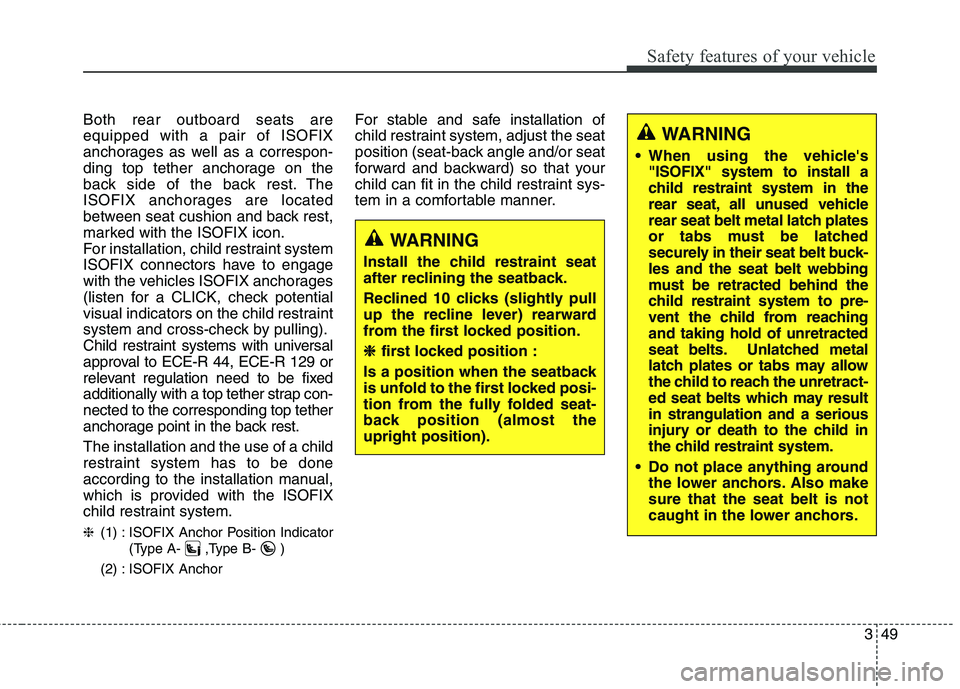
Both rear outboard seats are equipped with a pair of ISOFIX
anchorages as well as a correspon-
ding top tether anchorage on the
back side of the back rest. The
ISOFIX anchorages are located
between seat cushion and back rest,
marked with the ISOFIX icon.
For installation, child restraint system
ISOFIX connectors have to engage
with the vehicles ISOFIX anchorages
(listen for a CLICK, check potential
visual indicators on the child restraint
system and cross-check by pulling).
Child restraint systems with universal
approval to ECE-R 44, ECE-R 129 or
relevant regulation need to be fixed
additionally with a top tether strap con-nected to the corresponding top tether
anchorage point in the back rest. The installation and the use of a child
restraint system has to be done
according to the installation manual,
which is provided with the ISOFIX
child restraint system. ❈(1) : ISOFIX Anchor Position Indicator
(Type A- ,Type B- )
(2) : ISOFIX Anchor For stable and safe installation of
child restraint system, adjust the seat
position (seat-back angle and/or seat
forward and backward) so that your
child can fit in the child restraint sys-
tem in a comfortable manner.
WARNING
Install the child restraint seat
after reclining the seatback.
Reclined 10 clicks (slightly pull
up the recline lever) rearward
from the first locked position. ❈
❈ first locked position :
Is a position when the seatback
is unfold to the first locked posi-
tion from the fully folded seat-
back position (almost theupright position).
WARNING
When using the vehicle's "ISOFIX" system to install a
child restraint system in the
rear seat, all unused vehicle
rear seat belt metal latch plates
or tabs must be latched
securely in their seat belt buck-les and the seat belt webbing
must be retracted behind the
child restraint system to pre-
vent the child from reachingand taking hold of unretracted
seat belts. Unlatched metal
latch plates or tabs may allow
the child to reach the unretract-
ed seat belts which may resultin strangulation and a serious
injury or death to the child in
the child restraint system.
Do not place anything around the lower anchors. Also makesure that the seat belt is not
caught in the lower anchors.
Page 68 of 723
Safety features of your vehicle
50
3
To secure the child restraint system
1. To engage the child restraint sys-
tem to the ISOFIX anchor, insert
the child restraint system latch into
the ISOFIX anchor. Listen for the
audible “click” sound.
2. Connect the top tether strap to the corresponding top tether anchor-
age and tighten it. (Refer to the
previous page.)
CAUTION
Do not allow the rear seat belt
webbing to get scratched orpinched by the ISOFIX-seat latch and ISOFIX anchor duringinstallation.
WARNING
Do not install a child restraint system at the centre of the rear
seat using the vehicle's ISOFIX
anchors. The ISOFIX anchors
are only provided for the left
and right outboard rear seatingpositions. Do not misuse the ISOFIX
anchors by attempting to
attach a child restraint system
in the middle of the rear seat to
the ISOFIX anchors.
In a crash, the child restraint
system ISOFIX attachments
may not be strong enough to
secure the child restraint sys-
tem properly in the centre of the
rear seat and may break, caus-
ing serious injury or death.
(Continued)(Continued)
Do not mount more than onechild restraint system to an
ISOFIX anc horage point. The
improper increased load may
cause the anchorage points or
top tether anchor to break,
causing serious injury or death.
Attach the ISOFIX or ISOFIX- compatible child restraint sys-
tem only to the appropriate
locations shown in the illus-tration.
Always follow the installation and use instructions provided
by the manufacturer of the
child restraint system.
Page 75 of 723
357
Safety features of your vehicle
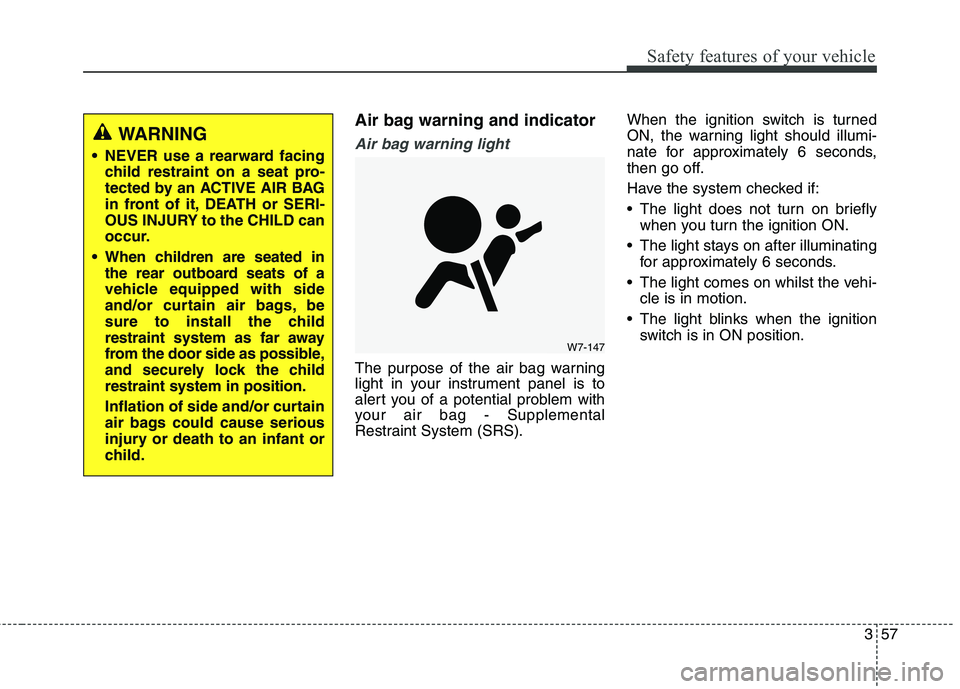
Air bag warning and indicator
Air bag warning light
The purpose of the air bag warning
light in your instrument panel is to
alert you of a potential problem with
your air bag - Supplemental
Restraint System (SRS).When the ignition switch is turned
ON, the warning light should illumi-
nate for approximately 6 seconds,
then go off.
Have the system checked if:
The light does not turn on briefly
when you turn the ignition ON.
The light stays on after illuminating for approximately 6 seconds.
The light comes on whilst the vehi- cle is in motion.
The light blinks when the ignition switch is in ON position.
W7-147
WARNING
NEVER use a rearward facing child restraint on a seat pro-
tected by an ACTIVE AIR BAG
in front of it, DEATH or SERI-
OUS INJURY to the CHILD can
occur.
When children are seated in the rear outboard seats of a
vehicle equipped with side
and/or curtain air bags, be
sure to install the child
restraint system as far away
from the door side as possible,
and securely lock the childrestraint system in position.
Inflation of side and/or curtain
air bags could cause serious
injury or death to an infant or
child.
Page 88 of 723
Safety features of your vehicle
70
3
(Continued)
Do not allow the passengers to
lean their heads or bodies onto
doors, put their arms on the
doors, stretch their arms out of
the window, or place objects
between the doors and pas-
sengers when they are seatedon seats equipped with side
and/or curtain air bags.
Never try to open or repair any components of the curtain air
bag system. If necessary,
have the system serviced by a
professional workshop. Kiarecommends to visit an
authorised Kia dealer/service
partner.
Failure to follow the above men-tioned instructions can result in
injury or death to the vehicleoccupants in an accident.WARNING
In order for side and curtain air bags to provide the best pro-
tection, both front seat occu-
pants and both outboard rearoccupants should sit in anupright position with the seat
belts properly fastened.
Importantly, children should
sit in a proper child restraintsystem in the rear seat.
When children are seated in the rear outboard seats, they
must be seated in the proper
child restraint system.
Make sure to put the child
restraint system as far away
from the door side as possible,
and secure the child restraint
system in a locked position.
(Continued)WARNING - No attaching objects
Do not place any objects over the air bag. Also, do not attach
any objects around the area
the air bag inflates such as the
door, side door glass, front
and rear pillar, roof side rail.
objects on the coat hook.
Do not hang heavy items on the coat hooks for safety rea-sons.
Page 112 of 723
Features of your vehicle
16
4
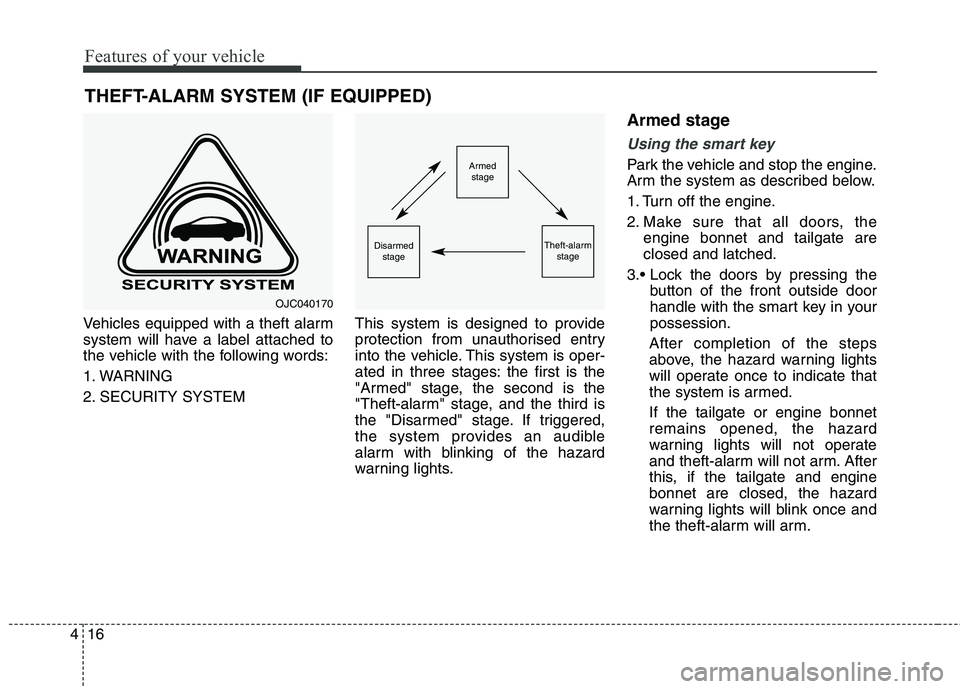
Vehicles equipped with a theft alarm
system will have a label attached to
the vehicle with the following words:
1. WARNING
2. SECURITY SYSTEM This system is designed to provide
protection from unauthorised entry
into the vehicle. This system is oper-
ated in three stages: the first is the
"Armed" stage, the second is the
"Theft-alarm" stage, and the third is
the "Disarmed" stage. If triggered,
the system provides an audible
alarm with blinking of the hazard
warning lights.Armed stage
Using the smart key
Park the vehicle and stop the engine.
Arm the system as described below.
1. Turn off the engine.
2. Make sure that all doors, the
engine bonnet and tailgate are closed and latched.
button of the front outside door
handle with the smart key in yourpossession.
After completion of the steps
above, the hazard warning lights
will operate once to indicate that
the system is armed. If the tailgate or engine bonnet remains opened, the hazard
warning lights will not operate
and theft-alarm will not arm. After
this, if the tailgate and enginebonnet are closed, the hazard
warning lights will blink once and
the theft-alarm will arm.
THEFT-ALARM SYSTEM (IF EQUIPPED)Armed
stage
Theft-alarm stageDisarmedstage
OJC040170
Page 115 of 723
419
Features of your vehicle
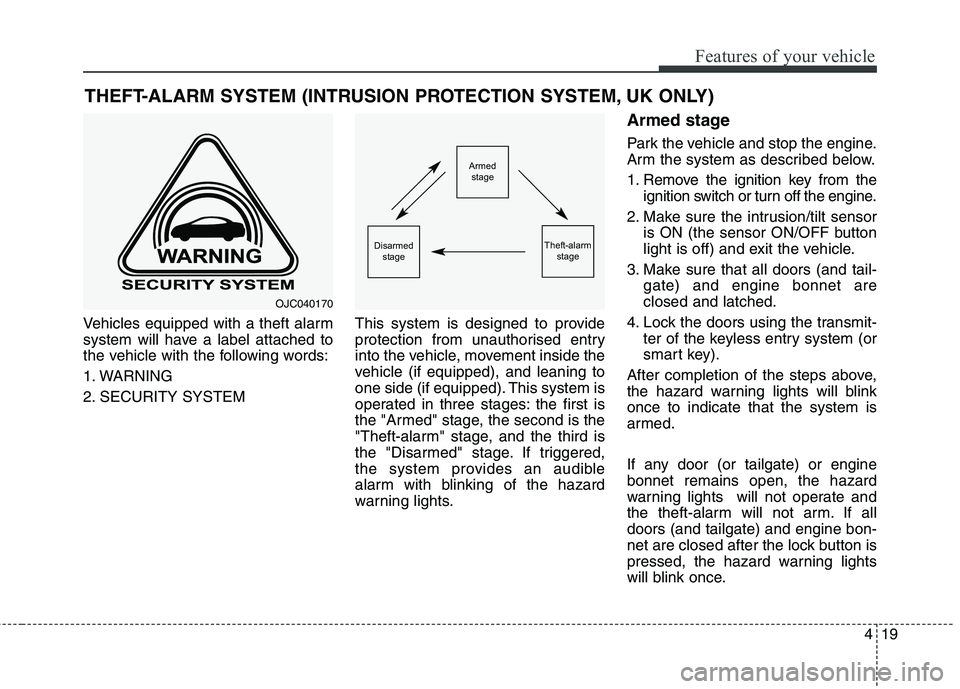
Vehicles equipped with a theft alarm
system will have a label attached to
the vehicle with the following words:
1. WARNING
2. SECURITY SYSTEMThis system is designed to provide
protection from unauthorised entry
into the vehicle, movement inside the
vehicle (if equipped), and leaning to
one side (if equipped). This system is
operated in three stages: the first is
the "Armed" stage, the second is the
"Theft-alarm" stage, and the third is
the "Disarmed" stage. If triggered,
the system provides an audible
alarm with blinking of the hazard
warning lights.Armed stage
Park the vehicle and stop the engine.
Arm the system as described below.
1. Remove the ignition key from the
ignition switch or turn off the engine.
2. Make sure the intrusion/tilt sensor is ON (the sensor ON/OFF button
light is off) and exit the vehicle.
3. Make sure that all doors (and tail- gate) and engine bonnet areclosed and latched.
4. Lock the doors using the transmit- ter of the keyless entry system (or
smart key).
After completion of the steps above,
the hazard warning lights will blinkonce to indicate that the system is
armed.
If any door (or tailgate) or engine bonnet remains open, the hazard
warning lights will not operate and
the theft-alarm will not arm. If alldoors (and tailgate) and engine bon-
net are closed after the lock button is
pressed, the hazard warning lights
will blink once.
THEFT-ALARM SYSTEM (INTRUSION PROTECTION SYSTEM, UK ONLY)
OJC040170
Armed
stage
Theft-alarm stageDisarmedstage