fuel filter KIA CARENS RHD 2018 User Guide
[x] Cancel search | Manufacturer: KIA, Model Year: 2018, Model line: CARENS RHD, Model: KIA CARENS RHD 2018Pages: 723, PDF Size: 40.94 MB
Page 610 of 723
823
Maintenance
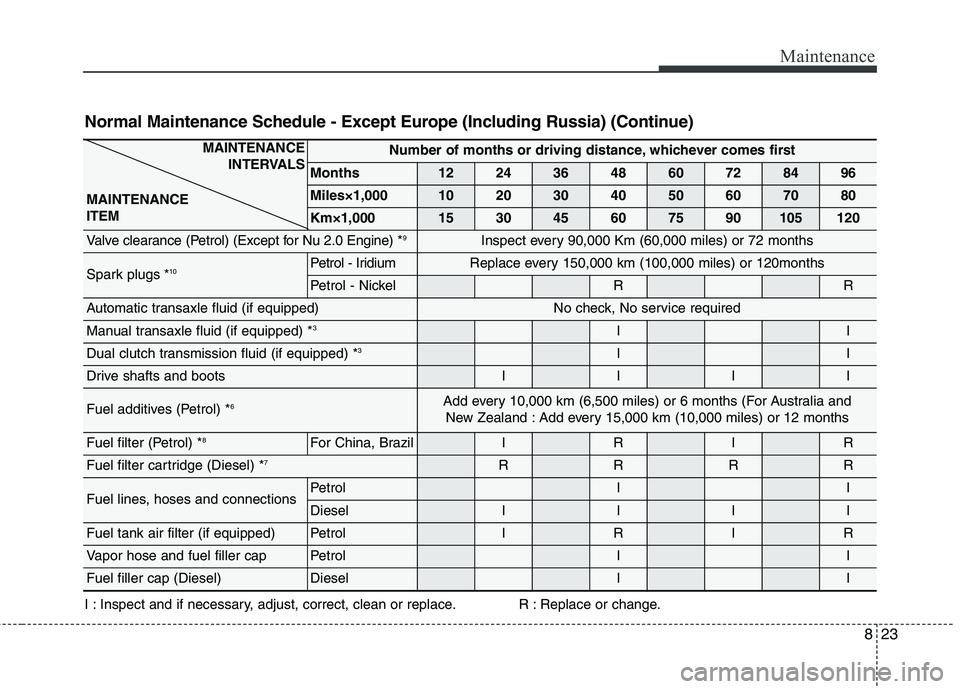
Normal Maintenance Schedule - Except Europe (Including Russia) (Continue)
MAINTENANCE INTERVALS
MAINTENANCE ITEMNumber of months or driving distance, whichever comes first
Months1224364860728496
Miles×1,0001020304050607080
Km×1,000153045607590105120
Valve clearance (Petrol) (Except for Nu 2.0 Engine) * 9Inspect every 90,000 Km (60,000 miles) or 72 months
Spark plugs *10Petrol - Iridium
Replace every 150,000 km (100,000 miles) or 120months
Petrol - NickelRR
Automatic transaxle fluid (if equipped)No check, No service required
Manual transaxle fluid (if equipped) * 3II
Dual clutch transmission fluid (if equipped) * 3II
Drive shafts and bootsIIII
Fuel additives (Petrol) *6Add every 10,000 km (6,500 miles) or 6 months (For Australia and
New Zealand : Add every 15,000 km (10,000 miles) or 12 months
Fuel filter (Petrol) * 8For China, BrazilIRIR
Fuel filter cartridge (Diesel) * 7RRRR
Fuel lines, hoses and connectionsPetrolII
DieselIIII
Fuel tank air filter (if equipped)PetrolIRIR
Vapor hose and fuel filler capPetrolII
Fuel filler cap (Diesel)DieselII
I : Inspect and if necessary, adjust, correct, clean or replace. R : Replace or change.
Page 615 of 723
Maintenance
28
8
EXPLANATION OF SCHEDULED MAINTENANCE ITEMS
Engine oil and filter The engine oil and filter should be
changed at the intervals specified in
the maintenance schedule. If the car
is being driven in severe conditions,more frequent oil and filter changesare required. Drive belts
Inspect all drive belts for evidence of
cuts, cracks, excessive wear or oil
saturation and replace if necessary.
Drive belts should be checked peri-
odically for proper tension and
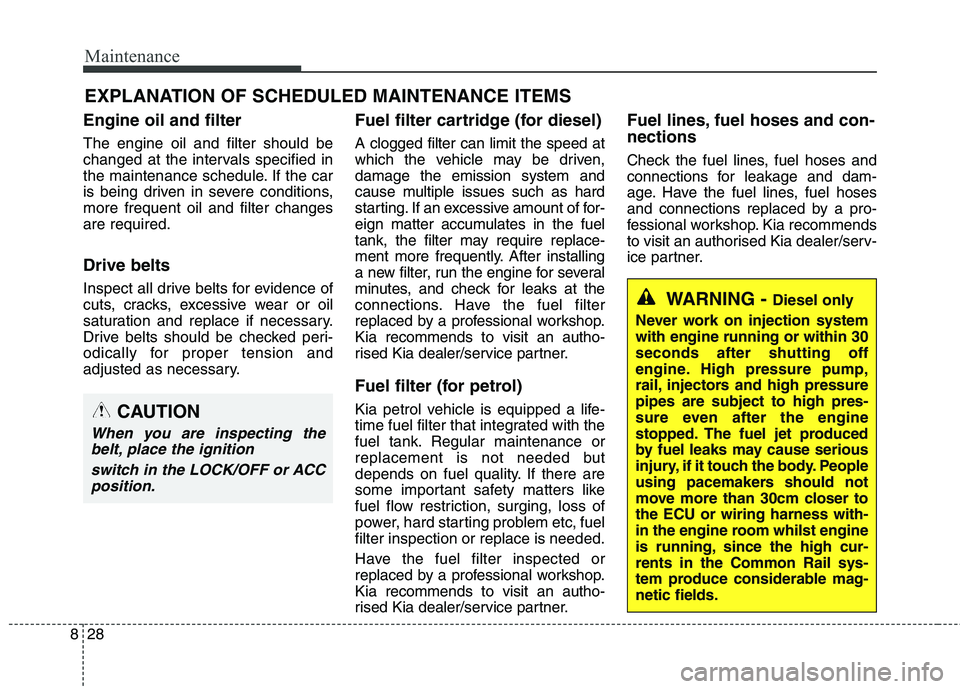
adjusted as necessary. Fuel filter cartridge (for diesel) A clogged filter can limit the speed at
which the vehicle may be driven,damage the emission system and
cause multiple issues such as hard
starting. If an excessive amount of for-
eign matter accumulates in the fuel
tank, the filter may require replace-
ment more frequently. After installing
a new filter, run the engine for several
minutes, and check for leaks at the
connections. Have the fuel filter
replaced by a professional workshop.Kia recommends to visit an autho-
rised Kia dealer/service partner.
Fuel filter (for petrol)
Kia petrol vehicle is equipped a life-
time fuel filter that integrated with the
fuel tank. Regular maintenance or
replacement is not needed but
depends on fuel quality. If there are
some important safety matters like
fuel flow restriction, surging, loss of
power, hard starting problem etc, fuelfilter inspection or replace is needed.
Have the fuel filter inspected or
replaced by a professional workshop.Kia recommends to visit an autho-
rised Kia dealer/service partner.Fuel lines, fuel hoses and con- nections
Check the fuel lines, fuel hoses and
connections for leakage and dam-
age. Have the fuel lines, fuel hoses
and connections replaced by a pro-
fessional workshop. Kia recommends
to visit an authorised Kia dealer/serv-
ice partner.
WARNING -
Diesel only
Never work on injection system with engine running or within 30seconds after shutting off
engine. High pressure pump,
rail, injectors and high pressurepipes are subject to high pres-
sure even after the engine
stopped. The fuel jet produced
by fuel leaks may cause serious
injury, if it touch the body. People
using pacemakers should not
move more than 30cm closer tothe ECU or wiring harness with-
in the engine room whilst engine
is running, since the high cur-rents in the Common Rail sys-
tem produce considerable mag-netic fields.
CAUTION
When you are inspecting the belt, place the ignition
switch in the LOCK/OFF or ACCposition.
Page 616 of 723
829
Maintenance
Vapour hose and fuel filler cap
The vapour hose and fuel filler cap should be inspected at those inter-
vals specified in the maintenance
schedule. Make sure that a new
vapour hose or fuel filler cap is cor-rectly replaced.Vacuum crankcase ventilation hoses (if equipped)
Inspect the surface of hoses for evi- dence of heat and/or mechanical
damage. Hard and brittle rubber,
cracking, tears, cuts, abrasions, and
excessive swelling indicate deterio-
ration. Particular attention should be
paid to examine those hose surfaces
nearest to high heat sources, such
as the exhaust manifold. Inspect the hose routing to assure that the hoses do not come in con-
tact with any heat source, sharp
edges or moving component whichmight cause heat damage or
mechanical wear. Inspect all hose
connections, such as clamps and
couplings, to make sure they are
secure, and that no leaks are pres-
ent. Hoses should be replaced
immediately if there is any evidence
of deterioration or damage.Air cleaner filter
Have the air cleaner filter replaced by
a professional workshop. Kia recom-
mends to visit an authorised Kia
dealer/service partner. Spark plugs
(for petrol engine)
Make sure to install new spark plugs
of the correct heat range.
WARNING
Do not disconnect and inspect spark plugs when the engine is
hot. You may burn yourself.
Page 627 of 723
Maintenance
40
8
FUEL FILTER (FOR DIESEL)
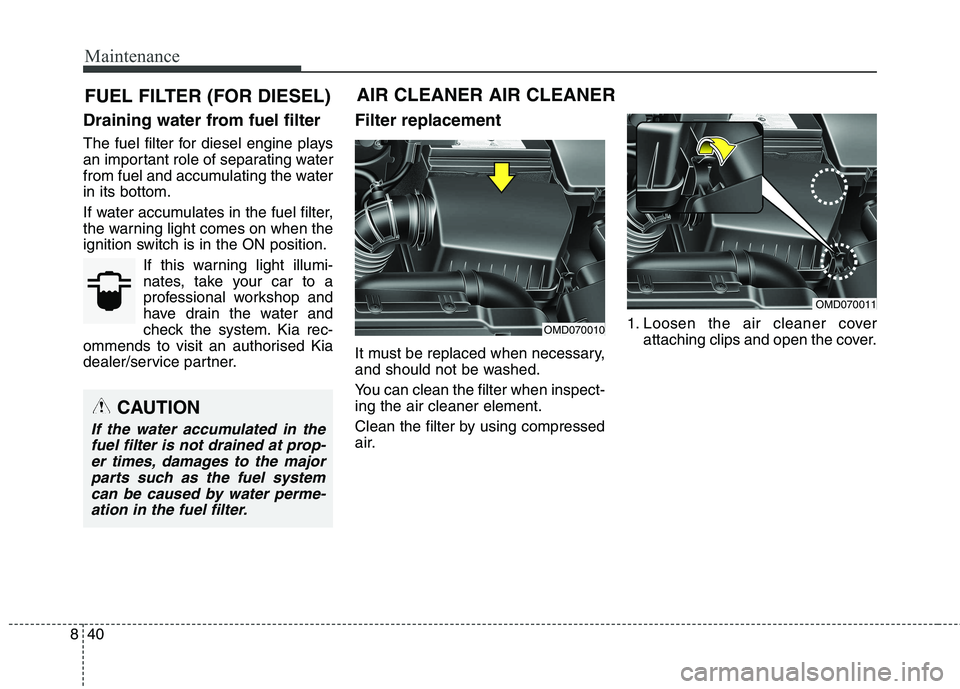
Draining water from fuel filter
The fuel filter for diesel engine plays
an important role of separating water
from fuel and accumulating the waterin its bottom.
If water accumulates in the fuel filter,
the warning light comes on when the
ignition switch is in the ON position. If this warning light illumi-
nates, take your car to a
professional workshop and
have drain the water and
check the system. Kia rec-
ommends to visit an authorised Kia
dealer/service partner. Filter replacement
It must be replaced when necessary,
and should not be washed.
You can clean the filter when inspect- ing the air cleaner element.
Clean the filter by using compressed
air.
1. Loosen the air cleaner cover
attaching clips and open the cover.
CAUTION
If the water accumulated in the
fuel filter is not drained at prop-er times, damages to the major parts such as the fuel systemcan be caused by water perme-ation in the fuel filter.
AIR CLEANER AIR CLEANER
OMD070011
OMD070010
Page 696 of 723
8109
Maintenance
EMISSION CONTROL SYSTEM
The emission control system of your
vehicle is covered by a written limited
warranty. Please see the warranty
information contained in the Service
Passport in your vehicle.
Your vehicle is equipped with an emission control system to meet all
emission regulations. There are three emission control
systems which are as follows.
(1) Crankcase emission control sys- tem
(2) Evaporative emission control sys- tem
(3) Exhaust emission control systemIn order to assure the proper function
of the emission control systems,
have your vehicle inspected and
maintained by a professional work-shop in accordance with the mainte-
nance schedule in this manual. Kia
recommends to visit an authorised
Kia dealer/service partner. Caution for the Inspection and
Maintenance Test (With Electronic
Stability Control (ESC) system)
To prevent the vehicle from mis-
firing during dynamometer test-
ing, turn the Electronic Stability
Control (ESC) system off by
pressing the ESC switch.
After dynamometer testing is completed, turn the ESC system
back on by pressing the ESC
switch again.
1. Crankcase emission control system
The positive crankcase ventilation
system is employed to prevent air
pollution caused by blow-by gases
being emitted from the crankcase.This system supplies fresh filtered air
to the crankcase through the air
intake hose. Inside the crankcase,
the fresh air mixes with blow-by
gases, which then pass through the
PCV valve into the induction system. 2. Evaporative emission con-
trol System
The Evaporative Emission Control
System is designed to prevent fuel
vapours from escaping into the
atmosphere.
Canister
Fuel vapours generated inside the fuel tank are absorbed and stored in
the onboard canister. When the
engine is running, the fuel vapours
absorbed in the canister are drawninto the surge tank through the purge
control solenoid valve.
Purge Control Solenoid Valve (PCSV)
The purge control solenoid valve is
controlled by the Engine Control
Module (ECM); when the engine
coolant temperature is low during
idling, the PCSV closes so that evap-
orated fuel is not taken into the
engine. After the engine warms-up
during ordinary driving, the PCSV
opens to introduce evaporated fuel to
the engine.
Page 699 of 723
Maintenance
112
8
Diesel Particulate Filter
(if equipped)
The Diesel Particulate Filter (DPF)
system removes the soot in the
exhaust gas.
Unlike a disposable air filter, the DPF
system automatically burns (oxidizes)
and removes the accumulated soot
according to the driving condition. In
other words, the active burning byengine control system and high
exhaust gas temperature caused by
normal/high driving condition burns
and removes the accumulated soot.
However, if the vehicle continues to
be driven at repeated short distance
or driven at low speed for a long
time, the accumulated soot may not
be automatically removed because
of low exhaust gas temperature.
More than a certain amount of sootdeposited, the malfunction indicator
light ( ) illuminates. When the malfunction indicator light
blinks, it may stop blinking by driving
the vehicle at more than 60 km/h (37mph) or at more than second gear
with 1500 ~ 2500 engine rpm for a
certain time (for about 25 minutes). If the malfunction indicator light ( )
continues to be blinked or the warn-
ing massage “Check exhaust system”
illuminates in spite of the procedure,
visit a professional workshop and
check the DPF system. Kia recom-
mends to visit an authorised Kia deal-
er/service partner.
If you continue to drive with the mal-
function indicator light blinking for a
long time, the DPF system can bedamaged and fuel consumption can
be worsen.
Lean NOx Trap (if equipped)
The Lean NOx Trap (LNT) system
removes the nitrogen oxide in the
exhaust gas. The smell can occur in
the exhaust gas depending on the
quality of the fuel and it can degrade
NOx reduction performance, please
use the regulated automotive dieselfuel.
CAUTION
- Diesel Fuel
(if equipped with DPF)
It is recommended to use the regulated automotive diesel fuelfor diesel vehicle equipped with the DPF system.
If you use diesel fuel includinghigh sulfur (more than 50 ppmsulfur) and unspecified addi-tives, it can cause the DPF sys- tem to be damaged and whitesmoke can be emitted.
Page 708 of 723
99
Specifications & Consumer information
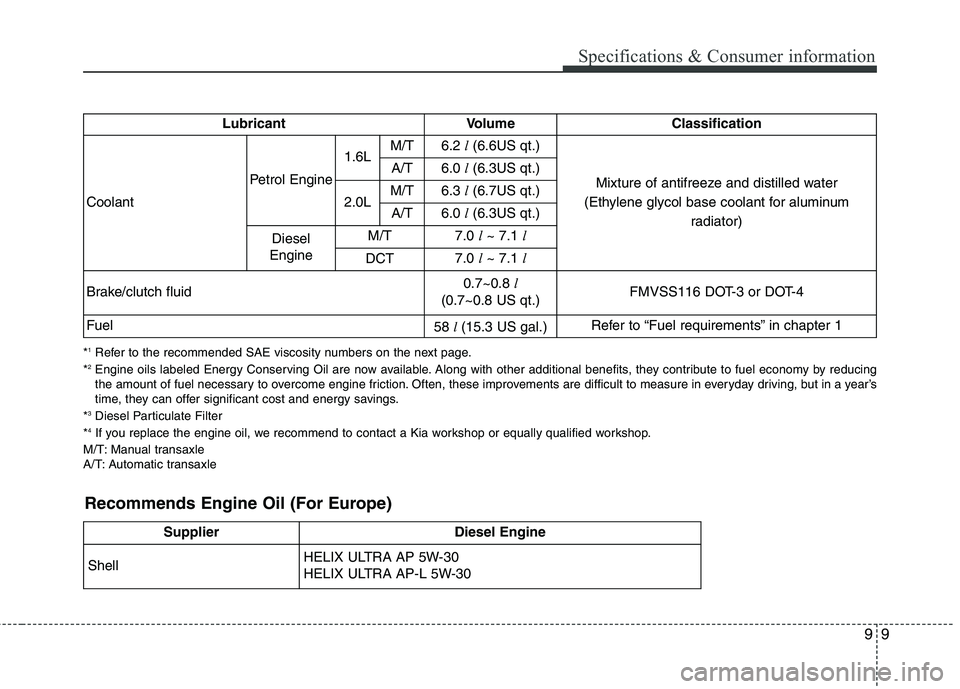
Lubricant Volume Classification
Coolant
Petrol Engine
1.6LM/T6.2l(6.6US qt.)
Mixture of antifreeze and distilled water
(Ethylene glycol base coolant for aluminum radiator)A/T6.0l(6.3US qt.)
2.0LM/T6.3 l(6.7US qt.)
A/T6.0 l(6.3US qt.)
Diesel
EngineM/T7.0 l~ 7.1 l
DCT7.0l~ 7.1 l
Brake/clutch fluid0.7~0.8 l
(0.7~0.8 US qt.)FMVSS116 DOT-3 or DOT-4
Fuel 58 l (15.3 US gal.) Refer to “Fuel requirements” in chapter 1
*1
Refer to the recommended SAE viscosity numbers on the next page.
* 2
Engine oils labeled Energy Conserving Oil are now available. Along with other additional benefits, they contribute to fuel economy by reducing
the amount of fuel necessary to overcome engine friction. Often, these improvements are difficult to measure in everyday driving, but in a year’s
time, they can offer significant cost and energy savings.
* 3
Diesel Particulate Filter
* 4
If you replace the engine oil, we recommend to contact a Kia workshop or equally qualified workshop.
M/T: Manual transaxle
A/T: Automatic transaxle
Recommends Engine Oil (For Europe)
SupplierDiesel Engine
ShellHELIX ULTRA AP 5W-30
HELIX ULTRA AP-L 5W-30
Page 717 of 723
I5
Index
Exterior features ..........................................................4-186
Roof rack ..................................................................4-186
Exterior overview ............................................................2-2
Fuel filler lid ..................................................................4-41 Closing the fuel filler lid ............................................4-41
Opening the fuel filler lid ..........................................4-41
Fuel Filter ......................................................................8-40 Draining water from fuel filter ..................................8-40
Fuel requirements ............................................................1-3 Diesel engine ................................................................1-6
Petrol engine ................................................................1-3
Fuses ..............................................................................8-63 Fuse/relay panel description ......................................8-69
Gross vehicle weight........................................................9-3
How to use this manual ..................................................1-2
If the engine does not start ..............................................7-4 If engine doesn't turn over or turns over slowly ..........7-4
If engine turns over normally but does not start ..........7-4
If the engine overheats ....................................................7-8
If you have a flat tyre (with spare tyre) ........................7-15 Changing tyres ..........................................................7-17
EC Declaration of Conformity for Jack......................7-25
Jack and tools ..............................................................7-15
Jack label ....................................................................7-24
Removing and storing the spare tyre ..........................7-16
If you have a flat tyre (with tyre mobility kit) ..............7-26 Checking the tyre inflation pressure ..........................7-30
Components of the Tyre Mobility Kit (TMK) ............7-27
Distributing the sealant ..............................................7-30
Introduction ................................................................7-26
Notes on the safe use of the Tyre Mobility Kit ..........7-31
Technical Data ............................................................7-31
Using the Tyre Mobility Kit (TMK) ..........................7-28
In case of an emergency whilst driving ..........................7-3 If engine stalls whilst driving ......................................7-3
If the engine stalls at a crossroad or crossing ..............7-3
If you have a flat tyre whilst driving ............................7-3
Instrument cluster ..........................................................4-57 Gauges ........................................................................4-60
Instrument Cluster Control ........................................4-58
LCD Display Control ..................................................4-59
Transaxle Shift Indicator ............................................4-64
Instrument panel overview ..............................................2-5
Interior features............................................................4-172
F
H
G
I