wheel KIA CARENS RHD 2018 Manual PDF
[x] Cancel search | Manufacturer: KIA, Model Year: 2018, Model line: CARENS RHD, Model: KIA CARENS RHD 2018Pages: 723, PDF Size: 40.94 MB
Page 536 of 723
6101
Driving your vehicle
Your vehicle can tow a trailer. To
identify what the vehicle trailering
capacity is for your vehicle, you
should read the information in
“Weight of the trailer” that appearslater in this section.
Remember that trailering is different
than just driving your vehicle by itself.
Trailering means changes in han-
dling, durability, and fuel economy.
Successful, safe trailering requirescorrect equipment, and it has to be
used properly.This section contains many time-test-
ed, important trailering tips and safe-
ty rules. Many of these are important
for your safety and that of your pas-
sengers. Please read this section
carefully before you pull a trailer. Load-pulling components such as
the engine, transaxle, wheel assem-
blies, and tyres are forced to workharder against the load of the added
weight. The engine is required to
operate at relatively higher speeds
and under greater loads. This addi-
tional burden generates extra heat.
The trailer also considerably adds
wind resistance, increasing the
pulling requirements.
✽✽
NOTICE - Location of trailer
mounting
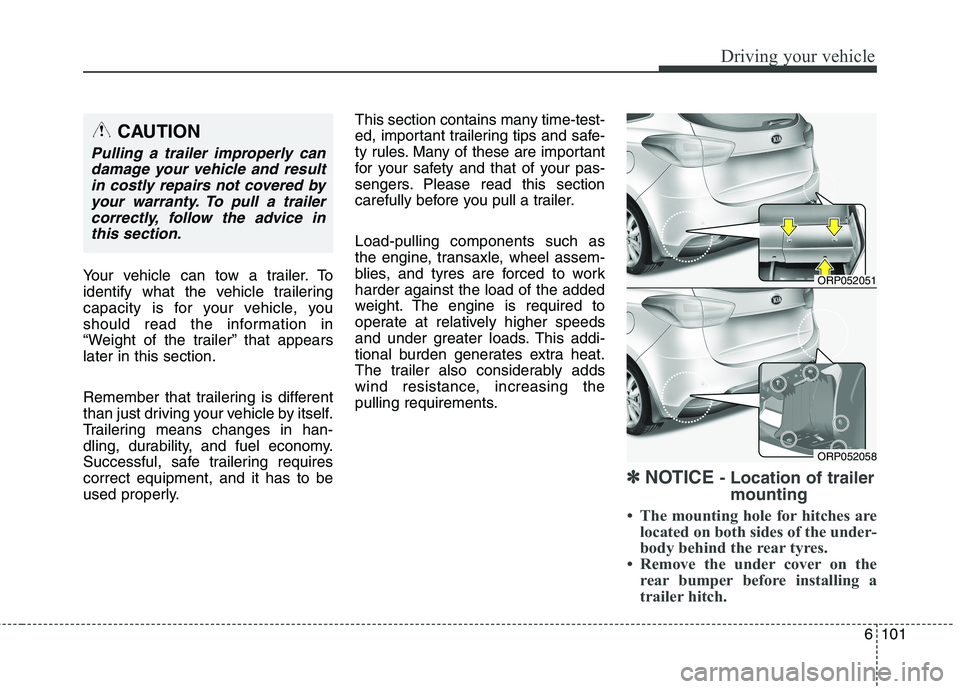
The mounting hole for hitches are located on both sides of the under-
body behind the rear tyres.
Remove the under cover on the rear bumper before installing a
trailer hitch.
CAUTION
Pulling a trailer improperly can
damage your vehicle and resultin costly repairs not covered by your warranty. To pull a trailercorrectly, follow the advice inthis section.
ORP052051
ORP052058
Page 539 of 723
Driving your vehicle
104
6
Backing up
Hold the bottom of the steering
wheel with one hand. Then, to move
the trailer to the left, just move your
hand to the left. To move the trailer to
the right, move your hand to the
right. Always back up slowly and, if
possible, have someone guide you.
Making turns
When you’re turning with a trailer,
make wider turns than normal. Do
this so your trailer won’t strike soft
shoulders, kerbs, road signs, trees,
or other objects. Avoid jerky or sud-
den manoeuvres. Signal well in
advance.
Turn signals when towing a trailer
When you tow a trailer, your vehicle
has to have a different turn signal
flasher and extra wiring. The green
arrows on your instrument panel will
flash whenever you signal a turn or
lane change. Properly connected,
the trailer lights will also flash to alert
other drivers you’re about to turn,
change lanes, or stop.
When towing a trailer, the green
arrows on your instrument panel will
flash for turns even if the bulbs on the
trailer are burned out. Thus, you may
think drivers behind you are seeing
your signals when, in fact, they are
not. It is important to check occasion-
ally to be sure the trailer bulbs are still
working. You must also check the
lights every time you disconnect and
then reconnect the wires.
Do not connect a trailer lighting sys-
tem directly to your vehicle’s lighting
system. Use only an approved trailer
wiring harness. Have yourself assist-
ed by a professional workshop in
installing the wiring harness. Kia recommends to visit an autho-
rised Kia dealer/service partner.WARNING
Failure to use an approved trail- er wiring harness could result
in damage to the vehicle electri-
cal system and/or personal
injury.
Page 541 of 723
Driving your vehicle
106
6
Parking on hills
Generally, if you have a trailer
attached to your vehicle, you should
not park your vehicle on a hill. People
can be seriously or fatally injured,
and both your vehicle and the trailer
can be damaged if unexpectedly roll
down hill. However, if you ever have to park your
trailer on a hill, here is how to do it:
1. Pull the vehicle into the parking
space. Turn the steering wheel in
the direction of the kerb (left if head-
ed down hill, right if headed up hill).
2. If the vehicle has a manual transaxle, place the car in neutral.
If the vehicle has an automatic
transaxle / dual clutch transmis-
sion, place the car in P (Park).
3. Set the parking brake and shut off the vehicle.
4. Place chocks under the trailer wheels on the down hill side of the
wheels.
5. Start the vehicle, hold the brakes, shift to neutral, release the parking
brake and slowly release the
brakes until the trailer chocksabsorb the load.
6. Reapply the brakes, reapply the parking brake and shift the vehicle
to R (Reverse) for manual transaxle
or P (Park) for automatic transaxle /
dual clutch transmission.
7. Shut off the vehicle and release the vehicle brakes but leave the
parking brake set.
WARNING - Parking on
a hill
Parking your vehicle on a hill
with a trailer attached could
cause serious injury or death,
should the trailer break loose.
WARNING - Parking
brake
It can be dangerous to get out
of your vehicle if the parking
brake is not firmly set.
If you have left the engine run-
ning, the vehicle can move sud-
denly. You or others could be
seriously or fatally injured.
Page 543 of 723
Driving your vehicle
108
6
If you do decide to pull a trailer
Here are some important points if
you decide to pull a trailer:
Consider using a sway control. You
can ask a hitch dealer about sway control.
Do not do any towing with your car during its first 2,000 km (1,200
miles) in order to allow the engine
to properly break in. Failure to heed
this caution may result in serious
engine or transaxle damage.
When towing a trailer, Kia recom- mends that you consult an autho-
rised Kia dealer/service partner onadditional requirements such as a
towing kit, etc.
Always drive your vehicle at a mod- erate speed (less than 100 km/h(60 mph)).
On a long uphill grade, do not exceed 70 km/h (45 mph) or the
posted towing speed limit,
whichever is lower.
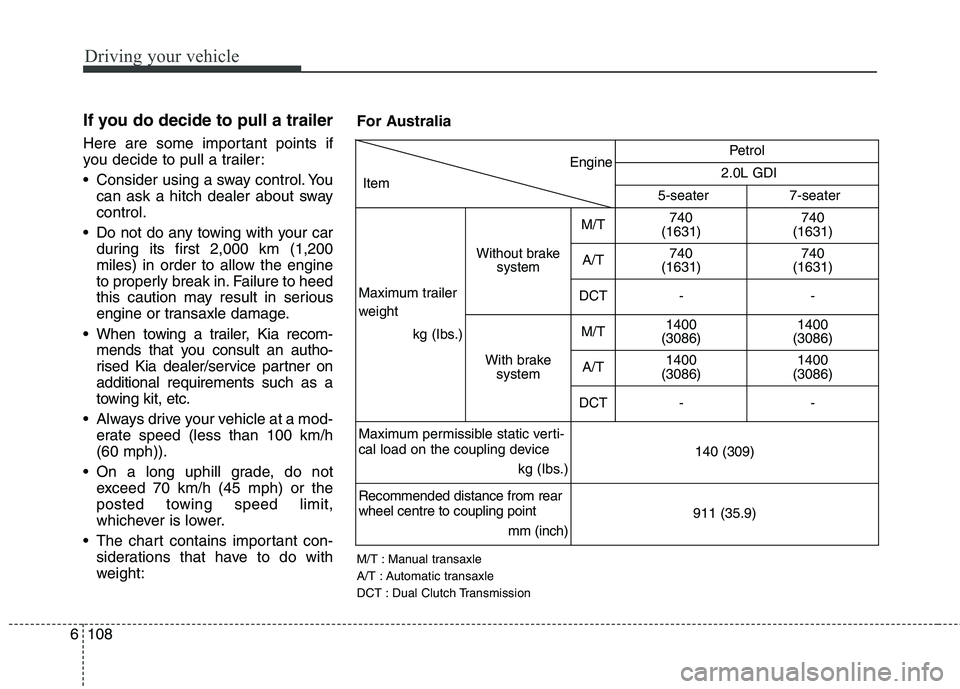
The chart contains important con- siderations that have to do with
weight:
Engine
ItemPetrol
2.0L GDI
5-seater 7-seater
Maximum trailer
weight kg (Ibs.)
Without brakesystem
M/T740
(1631) 740
(1631)
A/T740
(1631) 740
(1631)
DCT--
With brake system
M/T1400
(3086) 1400
(3086)
A/T1400
(3086) 1400
(3086)
DCT--
Maximum permissible static verti-
cal load on the coupling device kg (Ibs.)
140 (309)
Recommended distance from rear wheel centre to coupling point mm (inch)
911 (35.9)
For Australia
M/T : Manual transaxle
A/T : Automatic transaxle
DCT : Dual Clutch Transmission
Page 544 of 723
6109
Driving your vehicle
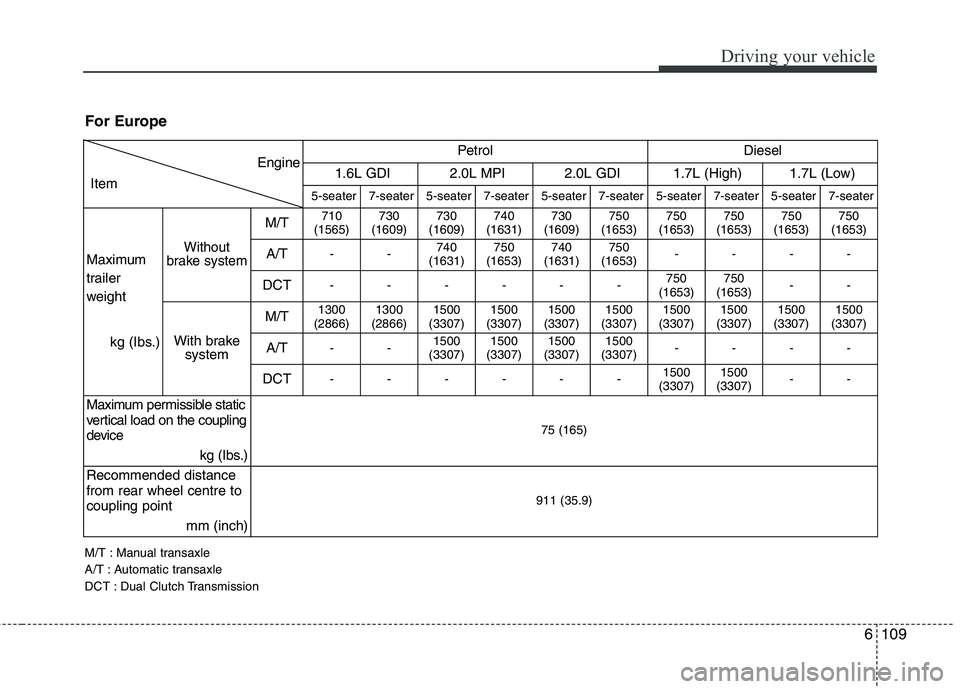
For Europe
M/T : Manual transaxle
A/T : Automatic transaxle
DCT : Dual Clutch Transmission
Engine
ItemPetrol Diesel
1.6L GDI2.0L MPI 2.0L GDI 1.7L (High) 1.7L (Low)
5-seater7-seater5-seater 7-seater 5-seater7-seater 5-seater 7-seater 5-seater 7-seater
Maximum
trailer
weight kg (Ibs.)
Without
brake system
M/T710
(1565)730
(1609)730
(1609) 740
(1631) 730
(1609)750
(1653) 750
(1653) 750
(1653) 750
(1653) 750
(1653)
A/T--740
(1631) 750
(1653) 740
(1631)750
(1653) ----
DCT------750
(1653) 750
(1653) --
With brake system
M/T1300
(2866)1300
(2866)1500
(3307) 1500
(3307) 1500
(3307)1500
(3307) 1500
(3307) 1500
(3307) 1500
(3307) 1500
(3307)
A/T--1500
(3307) 1500
(3307) 1500
(3307)1500
(3307) ----
DCT------1500
(3307) 1500
(3307) --
Maximum permissible static
vertical load on the coupling
device kg (Ibs.)
75 (165)
Recommended distance from rear wheel centre tocoupling point mm (inch)
911 (35.9)
Page 545 of 723
Driving your vehicle
110
6
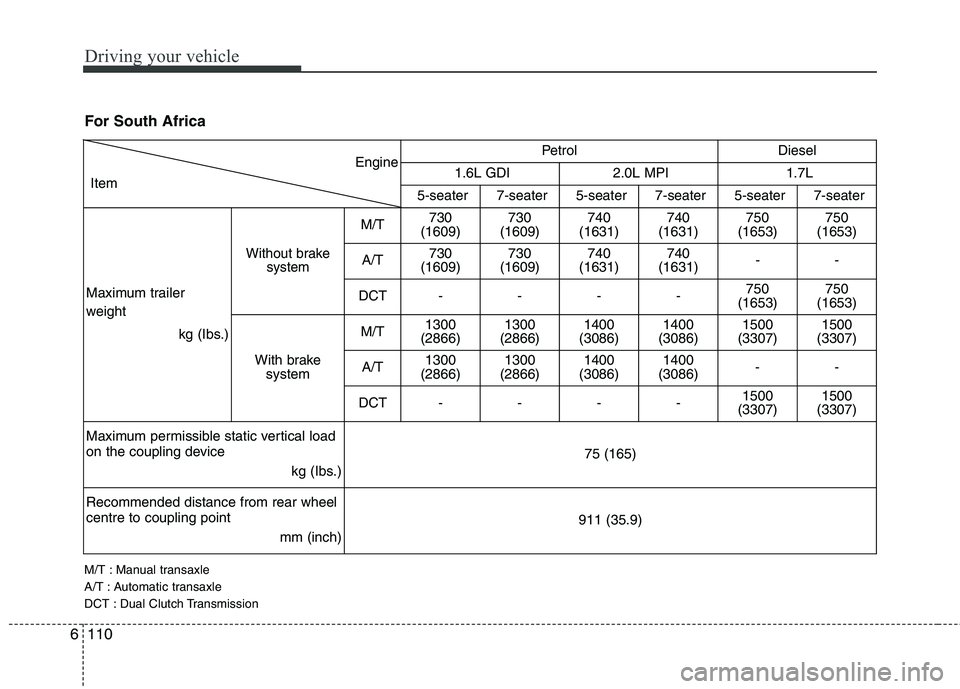
Engine
ItemPetrol Diesel
1.6L GDI2.0L MPI 1.7L
5-seater7-seater5-seater 7-seater 5-seater 7-seater
Maximum trailer
weight kg (Ibs.)
Without brake system
M/T730
(1609)730
(1609)740
(1631) 740
(1631) 750
(1653) 750
(1653)
A/T730
(1609)730
(1609)740
(1631) 740
(1631) --
DCT---- 750
(1653) 750
(1653)
With brake system
M/T1300
(2866)1300
(2866)1400
(3086) 1400
(3086) 1500
(3307) 1500
(3307)
A/T1300
(2866)1300
(2866)1400
(3086) 1400
(3086) --
DCT---- 1500
(3307) 1500
(3307)
Maximum permissible static vertical load
on the coupling device kg (Ibs.)
75 (165)
Recommended distance from rear wheel centre to coupling point mm (inch)
911 (35.9)
For South Africa
M/T : Manual transaxle
A/T : Automatic transaxle
DCT : Dual Clutch Transmission
Page 560 of 723
What to do in an emergency
10
7
Your vehicle has also been equipped
with a TPMS malfunction indicator toindicate when the system is not oper-
ating properly. The TPMS malfunction
indicator is combined with the low
tyre pressure telltale. When the sys-tem detects a malfunction, the telltale
will flash for approximately one
minute and then remain continuously
illuminated. This sequence will con-
tinue upon subsequent vehicle start-
ups as long as the malfunction exists.When the malfunction indicator is illu-
minated, the system may not be able
to detect or signal low tyre pressure
as intended. TPMS malfunctions may
occur for a variety of reasons, includ-ing the installation of replacement or
alternate tyres or wheels on the vehi-
cle that prevent the TPMS from func-
tioning properly. Always check theTPMS malfunction telltale afterreplacing one or more tyres or
wheels on your vehicle to ensure that
the replacement or alternate tyres
and wheels allow the TPMS to con-
tinue to function properly.✽✽
NOTICE
If the TPMS, Low Tyre Pressure
indicator do not illuminate for 3 sec-
onds when the ignition switch is
turned to the ON position or engine
is running, or if they remain illumi-
nated after coming on for approxi-
mately 3 seconds, have the system
checked by a professional workshop.
Kia recommends to visit an autho-
rised Kia dealer/service partner.Low tyre pressure telltale
When the tyre pressure monitoring
system warning indicators are illumi-
nated, one or more of your tyres issignificantly under-inflated.
If the telltale illuminates, immediately
reduce your speed, avoid hard cor-
nering and anticipate increased stop-
ping distances. You should stop and
check your tyres as soon as possi-
ble. Inflate the tyres to the proper
pressure as indicated on the vehi-
cle’s placard or tyre inflation pres-
sure label located on the driver’s side
centre pillar outer panel. If you can-
not reach a service station or if the
tyre cannot hold the newly added air,
replace the low pressure tyre with
the spare tyre.
Page 562 of 723
What to do in an emergency
12
7
TPMS (Tyre Pressure Monitoring System)malfunction indicator
The low tyre pressure telltale will illu-
minate after it blinks for approximate-
ly one minute when there is a prob-
lem with the Tyre Pressure
Monitoring System. If the system is
able to correctly detect an underinfla-
tion warning at the same time as sys-
tem failure then it will illuminate both
the TPMS malfunction and low tyre
pressure telltales e.g. if Front Left
sensor fails, the TPMS malfunction
indicator illuminates, but if the FrontRight, Rear Left, or Rear Right tyre is
under-inflated, the low tyre pressure
telltales may illuminate together with
the TPMS malfunction indicator.
In this case, have the system checked
by a professional workshop to deter-
mine the cause of the problem. Kia
recommends to visit an authorised
Kia dealer/service partner. Changing a tyre with TPMS
If you have a flat tyre, the low tyre
Pressure and Position telltales willcome on.
In this case, have the system
checked by a professional workshop.Kia recommends to visit an autho-
rised Kia dealer/service partner. Each wheel is equipped with a tyre pressure sensor mounted inside the
tyre behind the valve system. You
must use TPMS specific wheels.
Have your tyres serviced by a pro-
fessional workshop. Kia recom-
mends to visit an authorised Kia
dealer/service partner.CAUTION
The TPMS malfunction indica-
tor may be illuminated if thevehicle is moving around elec- tric power supply cables orradios transmitter such as atpolice stations, government and public offices, broadcast-ing stations, military installa-tions, airports, or transmitting towers, etc. This can interferewith normal operation of theTyre Pressure Monitoring System (TPMS).
The TPMS malfunction indica- tor may be illuminated if snowchains are used or some sep-arate electronic devices such as notebook computer, mobilecharger, remote starter ornavigation etc., are used in the vehicle. This can interfere withnormal operation of the TyrePressure Monitoring System(TPMS).
CAUTION
We recommend that you use the sealant approved by Kia.
The sealant on the tyre pressuresensor and wheel shall be elim-inated when you replace the tyre with a new one.
Page 563 of 723
713
What to do in an emergency
Even if you replace the low pressure
tyre with the spare tyre, the Low TyrePressure telltale will remain on until
the low pressure tyre is repaired and
placed on the vehicle.
After you replace the low pressure
tyre with the spare tyre, the TPMS
malfunction indicator may illuminate
after a few minutes because theTPMS sensor mounted on the sparewheel is not initiated.
Once the low pressure tyre is rein- flated to the recommended pressure
and installed on the vehicle or theTPMS sensor mounted on the
replaced spare wheel is initiated by
an authorised Kia dealer, the TPMS
malfunction indicator and the low
tyre pressure telltale will extinguish
within a few minutes of driving.
If the indicator is not extinguished after
a few minutes of driving, have the sys-
tem be checked by a professional
workshop. Kia recommends to visit an
authorised Kia dealer/service partner.You may not be able identify a low
tyre by simply looking at it. Alwaysuse a good quality tyre pressuregauge to measure the tyre's inflation
pressure. Please note that a tyre that
is hot (from being driven) will have ahigher pressure measurement than atyre that is cold (from sitting station-
ary for at least 3 hours and driven
less than 1.6 km (1 mile) during that
3 hour period).
Allow the tyre to cool before measur-
ing the inflation pressure. Always be
sure the tyre is cold before inflating
to the recommended pressure.
A cold tyre means the vehicle has
been sitting for 3 hours and driven forless than 1.6 km (1 mile) in that 3
hour period.CAUTION
If a original mounted tyre is
replaced with the spare tyre, theTPMS sensor on the replaced spare wheel should be initiatedand the TPMS sensor on theoriginal mounted wheel shouldbe deactivated. If the TPMS sen- sor on the original mountedwheel located in the spare tyrecarrier still activates, the tyre pressure monitoring systemmay not operate properly. In thiscase, have the system checked by a professional workshop. Kiarecommends to visit an autho-rised Kia dealer/service partner.
CAUTION
We recommend that you use the sealant approved by Kia if yourvehicle is equipped with a TyrePressure Monitoring System. The liquid sealant can damagethe tyre pressure sensors.
Page 564 of 723
What to do in an emergency
14
7
WARNING - Protecting TPMS
Tampering with, modifying, or
disabling the Tyre PressureMonitoring System (TPMS) com-
ponents may interfere with thesystem's ability to warn the driv-
er of low tyre pressure condi-
tions and/or TPMS malfunctions.
Tampering with, modifying, or
disabling the Tyre PressureMonitoring System (TPMS) com-
ponents may void the warranty
for that portion of the vehicle.WARNING - TPMS
The TPMS cannot alert you to severe and sudden tyre dam-
age caused by external factors
such as nails or road debris.
If you feel any vehicle instabil- ity, immediately take your foot
off the accelerator, apply the
brakes gradually and with
light force, and slowly move to
a safe position off the road.
WARNING - For EUROPE
Do not modify the vehicle, it may interfere with the TPMS function.
The wheels on the market do not have a TPMS sensor.
For your safety, use parts for
replacement from a profes-
sional workshop. Kia recom-mends to visit an authorised
Kia dealer/service partner.
(Continued)
(Continued)
If you use the wheels on themarket, use a TPMS sensor
approved by an authorised
Kia dealer.
If your vehicle is not equipped
with a TPMS sensor or TPMS
does not work properly, you
may fail the periodic vehicle
inspection conducted in your
country.
❈
❈ All vehicles sold in the
EUROPE market during
below period must be
equipped with TPMS.
- New model vehicle : Nov. 1, 2012 ~
- Current model vehicle : Nov. 1, 2014~ (Based on vehicleregistrations)