steering KIA CARENS RHD 2018 Owners Manual
[x] Cancel search | Manufacturer: KIA, Model Year: 2018, Model line: CARENS RHD, Model: KIA CARENS RHD 2018Pages: 723, PDF Size: 40.94 MB
Page 14 of 723
Your vehicle at a glance
4
2
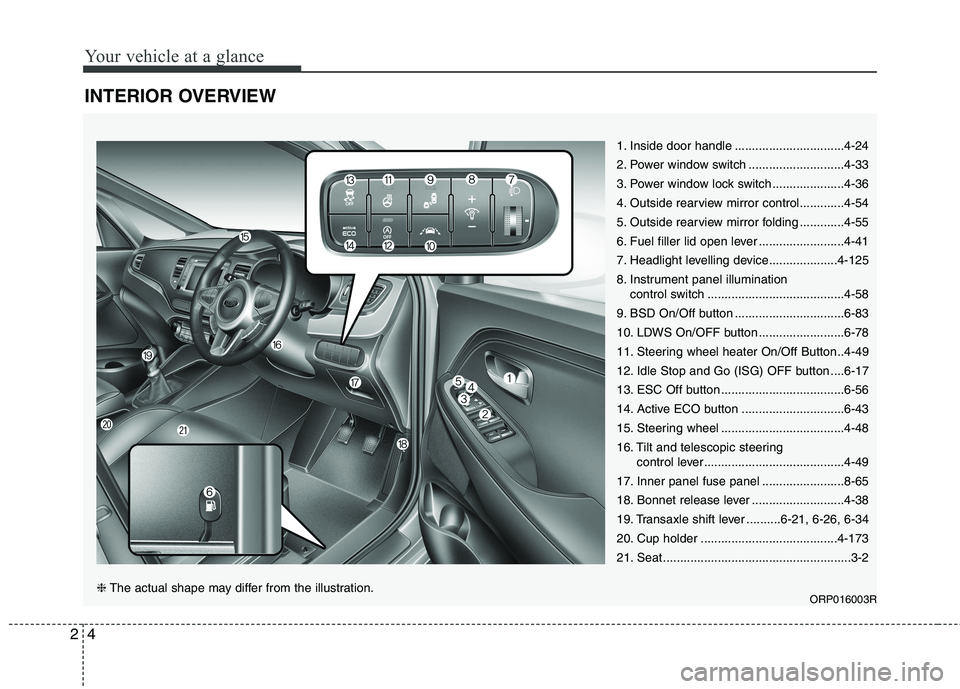
INTERIOR OVERVIEW
1. Inside door handle ................................4-24
2. Power window switch ............................4-33
3. Power window lock switch .....................4-36
4. Outside rearview mirror control.............4-54
5. Outside rearview mirror folding .............4-55
6. Fuel filler lid open lever .........................4-41
7. Headlight levelling device....................4-125
8. Instrument panel illumination
control switch ........................................4-58
9. BSD On/Off button ................................6-83
10. LDWS On/OFF button .........................6-78
11. Steering wheel heater On/Off Button..4-49
12. Idle Stop and Go (ISG) OFF button ....6-17
13. ESC Off button ....................................6-56
14. Active ECO button ..............................6-43
15. Steering wheel ....................................4-48
16. Tilt and telescopic steering control lever.........................................4-49
17. Inner panel fuse panel ........................8-65
18. Bonnet release lever ...........................4-38
19. Transaxle shift lever ..........6-21, 6-26, 6-34
20. Cup holder ........................................4-173
21. Seat .......................................................3-2
ORP016003R
❈The actual shape may differ from the illustration.
Page 22 of 723
Safety features of your vehicle
4
3
(Continued)
No passenger should ride in
the cargo area or sit or lie on
folded seatbacks whilst the
vehicle is moving. All passen-
gers must be properly seated
in seats and restrained prop-
erly whilst riding.
When resetting the seatback to the upright position, make
sure it is securely latched by
pushing it forward and back-
wards.
WARNING
After adjusting the seat, always
check that it is securely locked
into place by attempting to
move the seat forward or back-
ward without using the lock
release lever. Sudden or unex-
pected movement of the dri-
ver's seat could cause you to
lose control of the vehicleresulting in an accident.
(Continued)
Always drive and ride with your seatback upright and the lap
portion of the seat belt snug
and low across the hips. This
is the best position to protect
you in case of an accident.
In order to avoid unnecessary and perhaps severe air bag
injuries, always sit as far back
as possible from the steeringwheel whilst maintaining
comfortable control of the
vehicle. It is recommended
that your chest is at least 250
mm (10 inches) away from thesteering wheel.WARNING - Rear
seatbacks
The rear seatback must be securely latched. If not, pas-
sengers and objects could be
thrown forward resulting in
serious injury or death in the
event of a sudden stop or col-lision.
Luggage and other cargo should be laid flat in the cargo
area. If objects are large,
heavy, or must be piled, they
must be secured. Under no
circumstances should cargobe piled higher than the seat-
backs. Failure to follow thesewarnings could result in seri-
ous injury or death in the
event of a sudden stop, colli-
sion or rollover.
(Continued)
Page 25 of 723
37
Safety features of your vehicle
3. To use the front passenger’s seat,lift and pull the seatback backward
by pulling on the folding lever.
Pull the seatback firmly until it
clicks into place. Make sure the
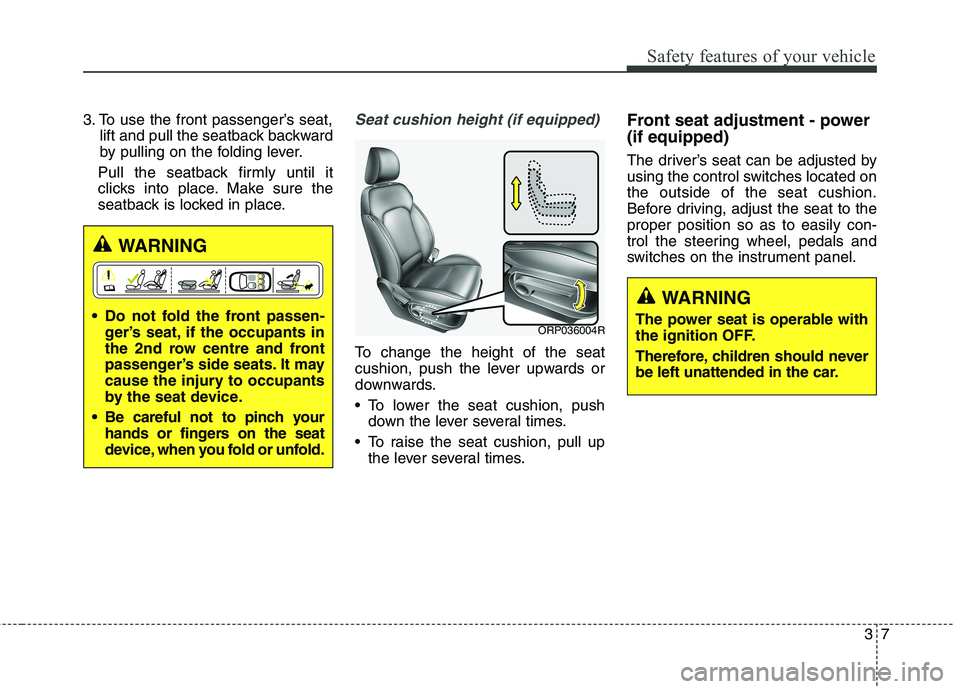
seatback is locked in place.Seat cushion height (if equipped)
To change the height of the seat
cushion, push the lever upwards or
downwards.
To lower the seat cushion, push down the lever several times.
To raise the seat cushion, pull up the lever several times. Front seat adjustment - power (if equipped)
The driver’s seat can be adjusted by
using the control switches located onthe outside of the seat cushion.
Before driving, adjust the seat to theproper position so as to easily con-
trol the steering wheel, pedals and
switches on the instrument panel.
WARNING
Do not fold the front passen- ger’s seat, if the occupants in
the 2nd row centre and front
passenger’s side seats. It may
cause the injury to occupants
by the seat device.
Be careful not to pinch your hands or fingers on the seat
device, when you fold or unfold.
ORP036004R
WARNING
The power seat is operable with
the ignition OFF.
Therefore, children should never
be left unattended in the car.
Page 73 of 723
355
Safety features of your vehicle
There are even circumstancesunder which contact with the
steering wheel air bag can cause
fatal injuries, especially if the
occupant is positioned exces-
sively close to the steering wheel.Noise and smoke
When the air bags inflate, they make
a loud noise and they leave smoke
and powder in the air inside of the
vehicle. This is normal and is a result
of the ignition of the air bag inflator.
After the air bag inflates, you may
feel substantial discomfort in breath-
ing due to the contact of your chestwith both the seat belt and the air
bag, as well as from breathing the
smoke and powder. Open your
doors and/or windows as soon as
possible after impact in order to
reduce discomfort and prevent
prolonged exposure to the smoke
and powder.
Though smoke and powder are non-
toxic, it may cause irritation to the
skin (eyes, nose and throat, etc.). If
this is the case, wash and rinse with
cold water immediately and consult
the doctor if the symptom persists.
WARNING
To avoid severe personal injury or death caused by
deploying air bags in a colli-
sion, the driver should sit as
far back from the ste ering
wheel air bag. The front pas-
senger should always move
their seat as far back as pos-
sible and sit back in their seat.
Air bag inflates instantly in an event of a collision, passen-
gers may be injured by the air
bag expansion force if they
are not in a proper position.
Air bag inflation may cause injuries including facial or
bodily abrasions, injuries from
broken glasses or burns.
WARNING
When the air bags deploy, the air bag related parts in the steering wheel and/or instru-ment panel and/or in both
sides of the roof rails above
the front and rear doors are
very hot. To prevent injury, do
not touch the air bag storageareas internal components
immediately after an air baghas inflated.
Do not install or place any accessories near air bag
deployment areas, such as
the instrument panel, win-
dows, pillars, and roof rails.
Page 78 of 723
Safety features of your vehicle
60
3
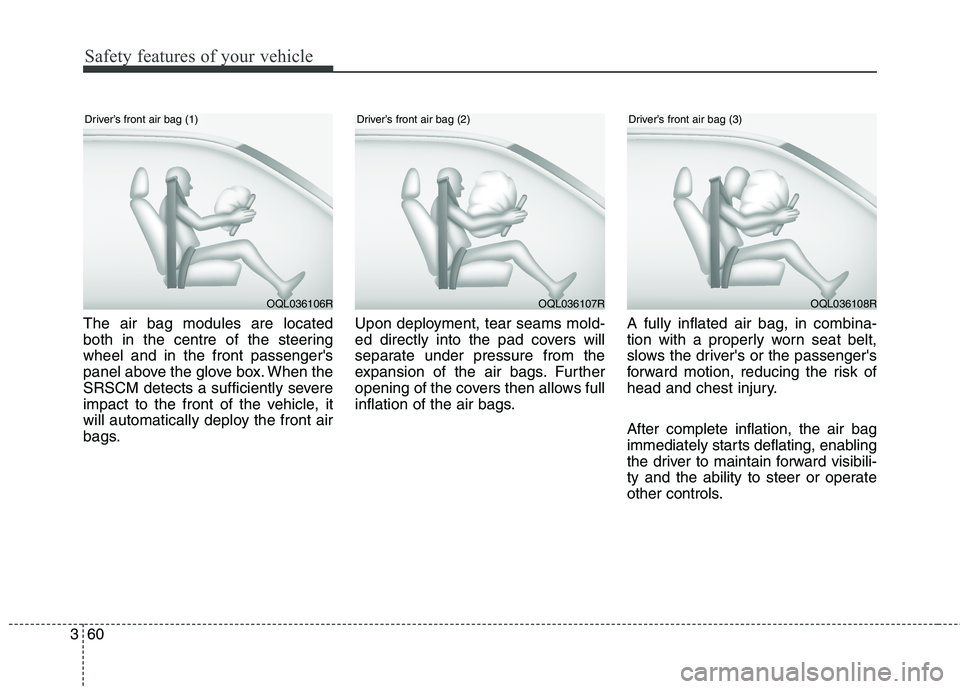
The air bag modules are located
both in the centre of the steeringwheel and in the front passenger's
panel above the glove box. When the
SRSCM detects a sufficiently severe
impact to the front of the vehicle, it
will automatically deploy the front air
bags. Upon deployment, tear seams mold-
ed directly into the pad covers will
separate under pressure from the
expansion of the air bags. Further
opening of the covers then allows full
inflation of the air bags.
A fully inflated air bag, in combina-
tion with a properly worn seat belt,
slows the driver's or the passenger's
forward motion, reducing the risk of
head and chest injury. After complete inflation, the air bag
immediately starts deflating, enabling
the driver to maintain forward visibili-
ty and the ability to steer or operate
other controls.
OQL036106R
Driver’s front air bag (1)
OQL036107R
Driver’s front air bag (2)
OQL036108R
Driver’s front air bag (3)
Page 80 of 723
Safety features of your vehicle
62
3
Driver's and passenger's front
air bag
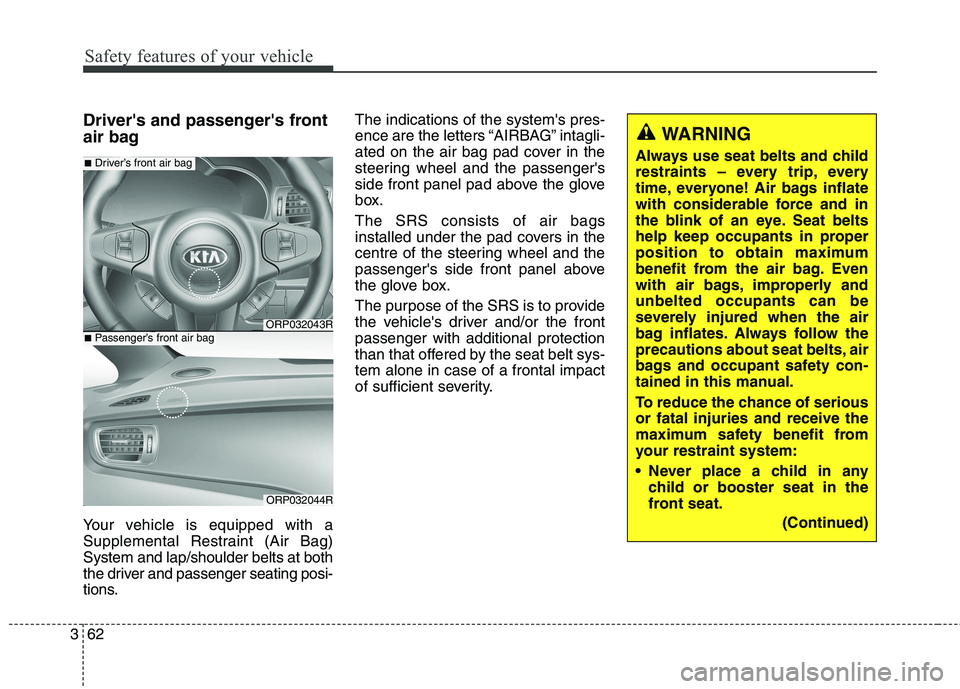
Your vehicle is equipped with a
Supplemental Restraint (Air Bag)System and lap/shoulder belts at both
the driver and passenger seating posi-
tions. The indications of the system's pres-
ence are the letters “AIRBAG” intagli-
ated on the air bag pad cover in the
steering wheel and the passenger's
side front panel pad above the glove
box. The SRS consists of air bags
installed under the pad covers in the
centre of the steering wheel and the
passenger's side front panel above
the glove box.
The purpose of the SRS is to provide
the vehicle's driver and/or the frontpassenger with additional protection
than that offered by the seat belt sys-tem alone in case of a frontal impact
of sufficient severity.
ORP032043R
■
Driver’s front air bag
ORP032044R
■Passenger’s front air bag
WARNING
Always use seat belts and child
restraints – every trip, every
time, everyone! Air bags inflate
with considerable force and in
the blink of an eye. Seat belts
help keep occupants in proper
position to obtain maximum
benefit from the air bag. Even
with air bags, improperly andunbelted occupants can be
severely injured when the air
bag inflates. Always follow the
precautions about seat belts, air
bags and occupant safety con-
tained in this manual.
To reduce the chance of serious or fatal injuries and receive the
maximum safety benefit from
your restraint system:
Never place a child in any child or booster seat in the
front seat.
(Continued)
Page 81 of 723
363
Safety features of your vehicle
(Continued)
ABC – Always Buckle Childrenin the back seat. It is the safest
place for children of any age
to ride.
Front and side air bags can injure occupants improperly
positioned in the front seats.
Move your seat as far back as practical from the front air
bags, whilst still maintaining
control of the vehicle.
You and your passengers should never sit or lean
unnecessarily close to the air
bags. Improperly positioned
drivers and passengers can
be severely injured by inflat-
ing air bags.
Never lean against the door or centre console – always sit inan upright position.
(Continued)(Continued)
No objects should be placedover or near the air bag mod- ules on the steering wheel,
instrument panel, and the front
passenger's panel above the
glove box, because any suchobject could cause harm if the
vehicle is in a crash severe
enough to cause the air bags
to deploy.
Do not tamper with or discon- nect SRS wiring or other com-ponents of the SRS system.
Doing so could result in injury,
due to accidental deployment
of the air bags or by rendering
the SRS inoperative.
If the SRS air bag warning light remains illuminated
whilst the vehicle is being
driven, have the system
inspected by a professional
workshop. Kia recommendsto visit an authorised Kia deal-
er/service partner.
(Continued)(Continued)
Air bags can only be used once– have the system replaced by a
professional workshop. Kia rec-ommends to visit an authorised
Kia dealer/service partner.
The SRS is designed to deploy the front air bags only when an
impact is sufficiently severeand when the impact angle is
less than 30° from the forwardlongitudinal axis of the vehi-
cle. Additionally, the air bags
will only deploy once. Seat
belts must be worn at all times.
Front air bags are not intended to deploy in side-impact, rear-
impact or rollover crashes. In
addition, front air bags will not
deploy in frontal crashes below
the deployment threshold.
A child restraint system must never be placed in the front
seat. The infant or child could
be severely injured or killed by
an air bag deployment in caseof an accident.
(Continued)
Page 85 of 723
367
Safety features of your vehicle
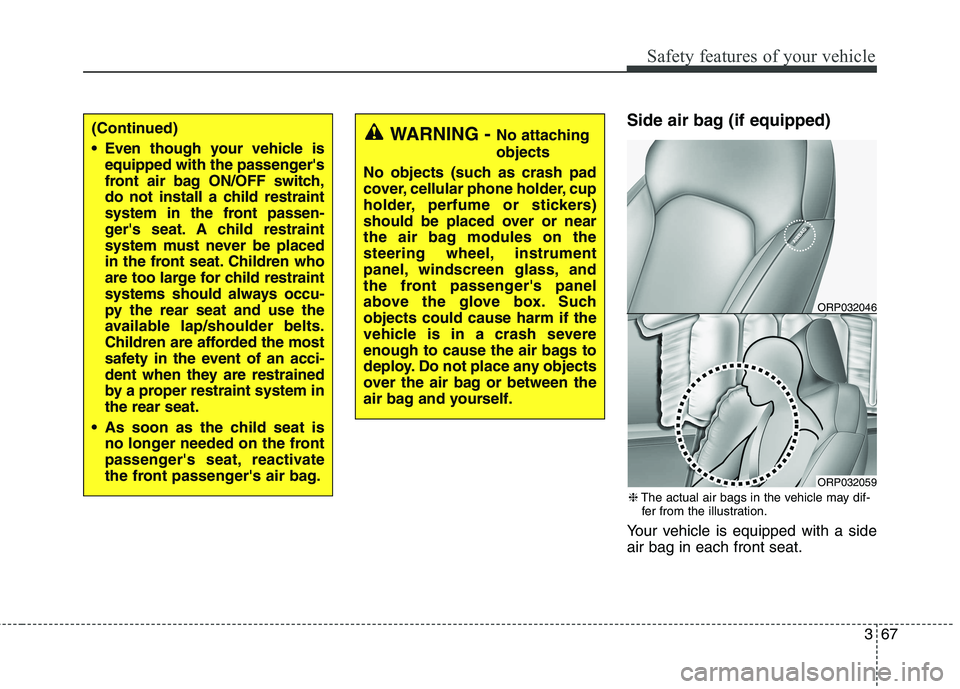
Side air bag (if equipped)
Your vehicle is equipped with a side air bag in each front seat.(Continued)
Even though your vehicle isequipped with the passenger's
front air bag ON/OFF switch,
do not install a child restraint
system in the front passen-
ger's seat. A child restraint
system must never be placed
in the front seat. Children who
are too large for child restraint
systems should always occu-
py the rear seat and use the
available lap/shoulder belts.
Children are afforded the most
safety in the event of an acci-
dent when they are restrained
by a proper restraint system inthe rear seat.
As soon as the child seat is no longer needed on the front
passenger's seat, reactivate
the front passenger's air bag.WARNING - No attaching objects
No objects (such as crash pad
cover, cellular phone holder, cup
holder, perfume or stickers)
should be placed over or near
the air bag modules on the
steering wheel, instrument
panel, windscreen glass, and
the front passenger's panel
above the glove box. Suchobjects could cause harm if the
vehicle is in a crash severe
enough to cause the air bags to
deploy. Do not place any objects
over the air bag or between the
air bag and yourself.
ORP032046
ORP032059
❈ The actual air bags in the vehicle may dif-
fer from the illustration.
Page 86 of 723
Safety features of your vehicle
68
3
The purpose of the air bag is to pro-
vide the vehicle's driver and/or thefront passenger with additional pro-
tection than that offered by the seat
belt alone. The side air bags are designed to
deploy only during certain side-
impact collisions, depending on the
crash severity, angle, speed and
point of impact. The side air bags are
not designed to deploy in all side
impact situations.
WARNING
Do not allow the passengers to lean their heads or bodies onto
doors, put their arms on the
doors, stretch their arms out of
the window, or place objects
between the doors and passen-
gers when they are seated onseats equipped with side and/or
curtain air bags.
WARNING
The side air bag is supplemen- tal to the driver's and the pas-
senger's seat belt systems and
is not a substitute for them.
Therefore your seat belts must
be worn at all times whilst the
vehicle is in motion. The air
bags deploy only in certain side
impact conditions severeenough to cause significant
injury to the vehicle occupants.
For best protection from the side air bag system and to
avoid being injured by the
deploying side air bag, both
front seat occupants should sitin an upright position with the
seat belt properly fastened. Thedriver's hands should beplaced on the steering wheel at
the 9:00 and 3:00 positions. The
passenger's arms and handsshould be placed on their laps.
(Continued)(Continued)
Do not use any accessory seatcovers.
Use of seat covers could reduce or prevent the effec- tiveness of the system.
To prevent unexpected deploy- ment of the side air bag that
may result in personal injury,
avoid impact to the sideimpact sensor when the igni-
tion key is on.
If the seat or seat cover is dam- aged, have the system serv-
iced by a professional work-shop. Kia recommends to visit an
authorised Kia dealer/service
partner.
Never place or insert any object into any small opening
near side airbag labels
attached to the vehicle seats.
When the air bag deploys, the
object may affect the deploy-
ment and result in unexpected
accident or bodily harm.
Page 94 of 723
Safety features of your vehicle
76
3
SRS Care
The SRS is virtually maintenance-
free and so there are no parts you
can safely service by yourself. If the
SRS air bag warning light does not
illuminate, or continuously remains
on, have the system inspected by a
professional workshop. Kia recommends to visit an autho-
rised Kia dealer/service partner.
WARNING
Modification to SRS compo- nents or wiring, including the
addition of any kind of badges
to the pad covers or modifica-
tions to the body structure,
can adversely affect SRS per-
formance and lead to possible
injury.
(Continued)
(Continued)
For cleaning the air bag padcovers, use only a soft, dry
cloth or one which has been
moistened with plain water.
Solvents or cleaners could
adversely affect the air bag
covers and proper deploy-ment of the system.
No objects should be placed over or near the air bag mod-ules on the steering wheel,
instrument panel, and the
front passenger's panel above
the glove box, because any
such object could cause harm
if the vehicle is in a crash
severe enough to cause the
air bags to inflate.
If the air bags inflate, have the system replaced by a profes-
sional workshop. Kia recommends to visit an
authorised Kia dealer/service
partner.
(Continued)(Continued)
Do not tamper with or discon-nect SRS wiring, or other components of the SRS sys-
tem. Doing so could result in
injury, due to accidental infla-
tion of the air bags or by ren-
dering the SRS inoperative.
If components of the air bag system must be discarded, or
if the vehicle must be
scrapped, certain safety pre-
cautions must be observed.An authorised Kia dealer
knows these precautions and
can give you the necessary
information. Failure to follow
these precautions and proce-dures could increase the risk
of personal injury.
If your car was flooded and has soaked carpeting or water
on flooring, you shouldn't try
to start the engine; in this
case, have your vehicle
inspected by a professional
workshop. Kia recommendsto contact an authorised Kia
dealer/service partner.