tires KIA CARNIVAL 2007 Workshop Manual
[x] Cancel search | Manufacturer: KIA, Model Year: 2007, Model line: CARNIVAL, Model: KIA CARNIVAL 2007Pages: 1575, PDF Size: 44.86 MB
Page 69 of 1575

The bottom side bolt(A) which can be seen after removing the under cover should be loosened for removal of
the radiator support upper member assembly.
18.Drain engine oil.
19. Remove the brake caliper.(Refer to DS group).
20. Disconnect the air conditioning compressor hoses.(Refer to HA group).
21. Remove the front wheels and tires.(Refer to DS group).
22. Remove the brake caliper hub nut.(Refer to DS group).
23. Remove the tie rod end ball joint from the knuckle.(Refer to DS group)
24. Remove the driver shaft and the stabilizer bar link(Refer to SS group).
25. Remove the front muffler(A).
26.Using a floor jack, support the engine and transaxle assembly.
After removing the sub frame mounting bolt , the engine and transaxle assembly may fall downward, and so
support them securely with floor jack.
Page 230 of 1575
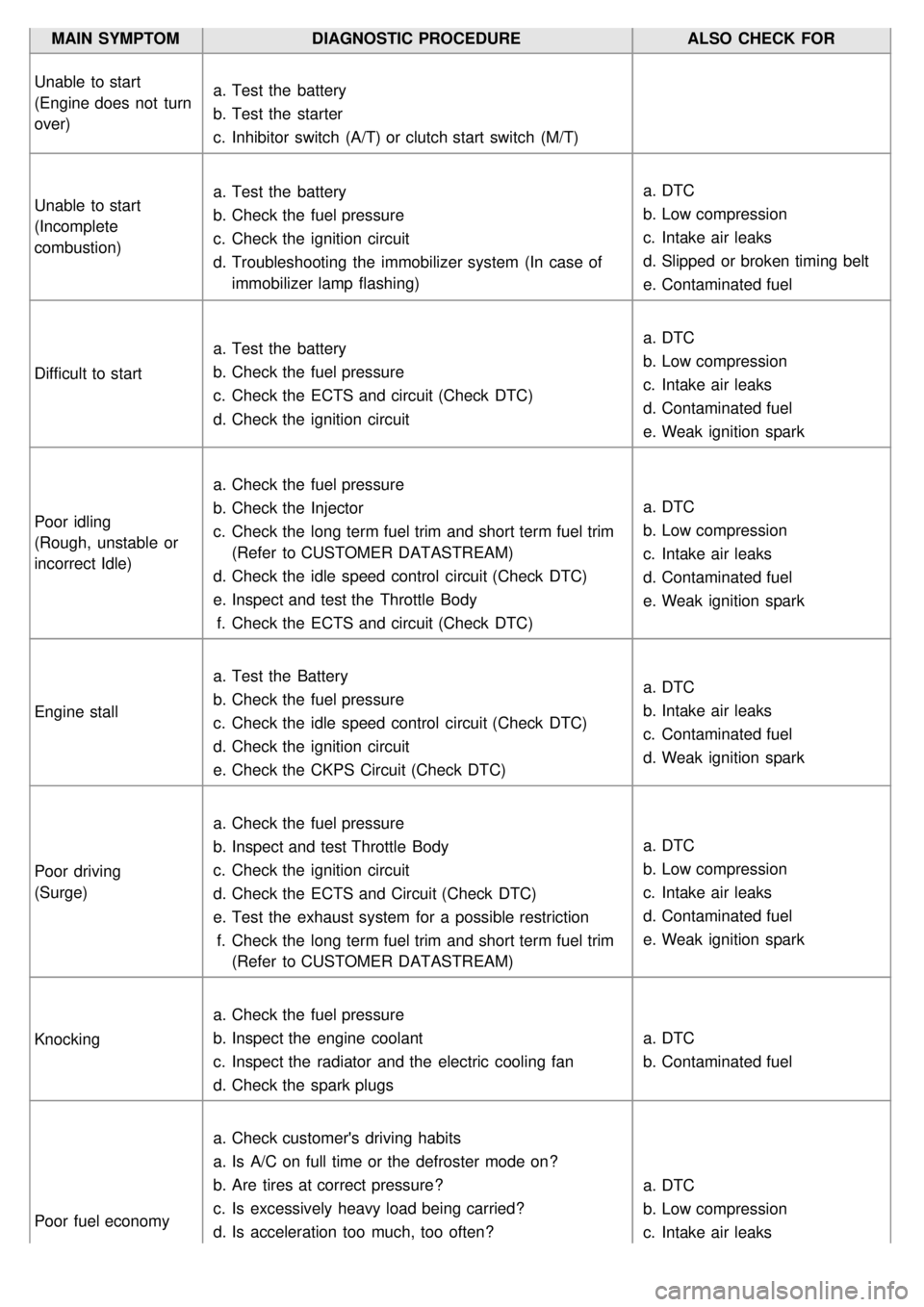
MAIN SYMPTOMDIAGNOSTIC PROCEDURE ALSO CHECK FOR
Unable to start
(Engine does not turn
over) a.
Test the battery
b. Test the starter
c. Inhibitor switch (A/T) or clutch start switch (M/T)
Unable to start
(Incomplete
combustion) a.
Test the battery
b. Check the fuel pressure
c. Check the ignition circuit
d. Troubleshooting the immobilizer system (In case of
immobilizer lamp flashing) a.
DTC
b. Low compression
c. Intake air leaks
d. Slipped or broken timing belt
e. Contaminated fuel
Difficult to start a.
Test the battery
b. Check the fuel pressure
c. Check the ECTS and circuit (Check DTC)
d. Check the ignition circuit a.
DTC
b. Low compression
c. Intake air leaks
d. Contaminated fuel
e. Weak ignition spark
Poor idling
(Rough, unstable or
incorrect Idle) a.
Check the fuel pressure
b. Check the Injector
c. Check the long term fuel trim and short term fuel trim
(Refer to CUSTOMER DATASTREAM)
d. Check the idle speed control circuit (Check DTC)
e. Inspect and test the Throttle Body
f. Check the ECTS and circuit (Check DTC) a.
DTC
b. Low compression
c. Intake air leaks
d. Contaminated fuel
e. Weak ignition spark
Engine stall a.
Test the Battery
b. Check the fuel pressure
c. Check the idle speed control circuit (Check DTC)
d. Check the ignition circuit
e. Check the CKPS Circuit (Check DTC) a.
DTC
b. Intake air leaks
c. Contaminated fuel
d. Weak ignition spark
Poor driving
(Surge) a.
Check the fuel pressure
b. Inspect and test Throttle Body
c. Check the ignition circuit
d. Check the ECTS and Circuit (Check DTC)
e. Test the exhaust system for a possible restriction
f. Check the long term fuel trim and short term fuel trim
(Refer to CUSTOMER DATASTREAM) a.
DTC
b. Low compression
c. Intake air leaks
d. Contaminated fuel
e. Weak ignition spark
Knocking a.
Check the fuel pressure
b. Inspect the engine coolant
c. Inspect the radiator and the electric cooling fan
d. Check the spark plugs a.
DTC
b. Contaminated fuel
Poor fuel economy a.
Check customer's driving habits
a. Is A/C on full time or the defroster mode on?
b. Are tires at correct pressure?
c. Is excessively heavy load being carried?
d. Is acceleration too much, too often? a.
DTC
b. Low compression
c. Intake air leaks
Page 386 of 1575

8.Install the under cover (A).
9.Install the steering column joint bolt and the VRS connector (A). (see ST group)
10. Connect the return tube(A) with a clamp. (see ST group)
11.Install the front wheels and tires.
12. Tighten the transaxle insulator mounting (B) bolt (A).
TORQUE:
90~110 Nm(9~11 kgf.m, 65.1~79.5 lb - ft)
Page 429 of 1575
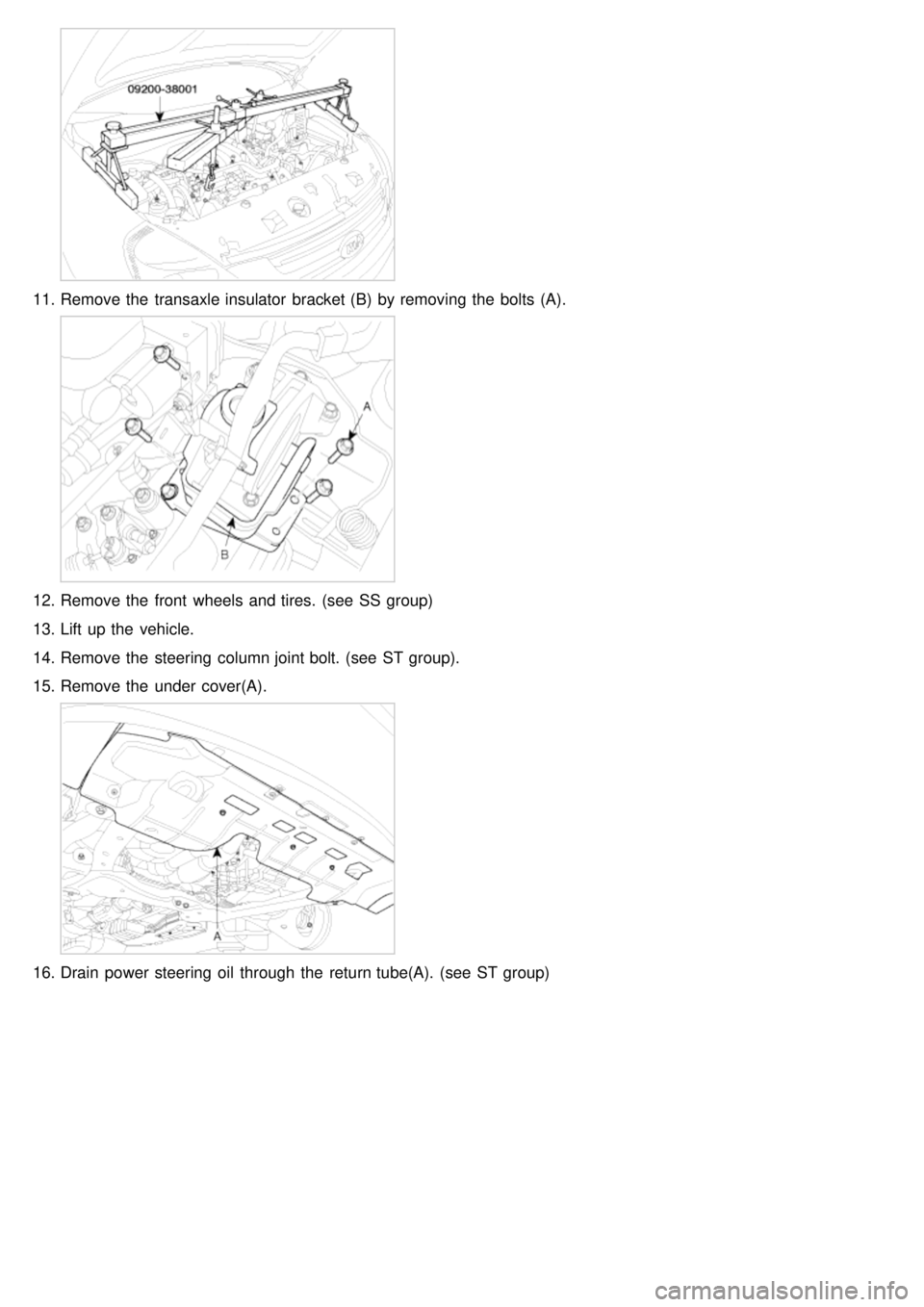
11.Remove the transaxle insulator bracket (B) by removing the bolts (A).
12.Remove the front wheels and tires. (see SS group)
13. Lift up the vehicle.
14. Remove the steering column joint bolt. (see ST group).
15. Remove the under cover(A).
16.Drain power steering oil through the return tube(A). (see ST group)
Page 438 of 1575

19.Install the under cover(A).
20.Install the steering column joint bolt.(See ST group).
21. Install the front wheels and tires. (see SS group)
22. Install the transaxle insulator and mounting bracket (B) by tightening the bolts (A).
TORQUE:
60~80 Nm (6~8 kgf.m, 43.6~58.2 lb - ft)
23.remove the SST (09200- 38001) holding the engine and transaxle assembly.
TORQUE:
65~85 Nm (6.5~8.5kgf.m, 47.0~61.5 lb - ft)
Page 489 of 1575
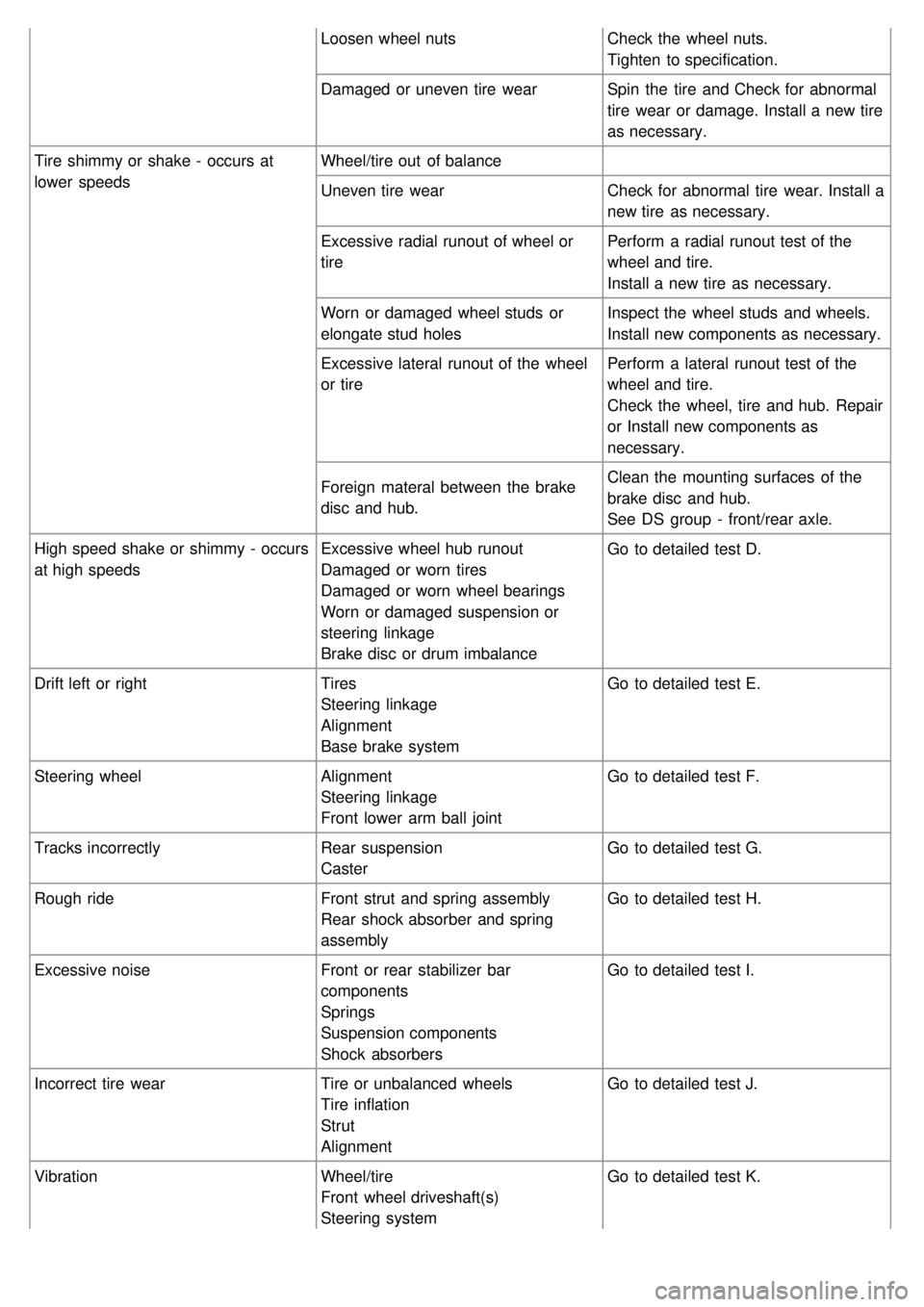
Loosen wheel nutsCheck the wheel nuts.
Tighten to specification.
Damaged or uneven tire wear Spin the tire and Check for abnormal
tire wear or damage. Install a new tire
as necessary.
Tire shimmy or shake - occurs at
lower speeds Wheel/tire out of balance
Uneven tire wear
Check for abnormal tire wear. Install a
new tire as necessary.
Excessive radial runout of wheel or
tire Perform a radial runout test of the
wheel and tire.
Install a new tire as necessary.
Worn or damaged wheel studs or
elongate stud holes Inspect the wheel studs and wheels.
Install new components as necessary.
Excessive lateral runout of the wheel
or tire Perform a lateral runout test of the
wheel and tire.
Check the wheel, tire and hub. Repair
or Install new components as
necessary.
Foreign materal between the brake
disc and hub. Clean the mounting surfaces of the
brake disc and hub.
See DS group - front/rear axle.
High speed shake or shimmy - occurs
at high speeds Excessive wheel hub runout
Damaged or worn tires
Damaged or worn wheel bearings
Worn or damaged suspension or
steering linkage
Brake disc or drum imbalanceGo to detailed test D.
Drift left or right Tires
Steering linkage
Alignment
Base brake systemGo to detailed test E.
Steering wheel Alignment
Steering linkage
Front lower arm ball jointGo to detailed test F.
Tracks incorrectly Rear suspension
CasterGo to detailed test G.
Rough ride Front strut and spring assembly
Rear shock absorber and spring
assemblyGo to detailed test H.
Excessive noise Front or rear stabilizer bar
components
Springs
Suspension components
Shock absorbersGo to detailed test I.
Incorrect tire wear Tire or unbalanced wheels
Tire inflation
Strut
AlignmentGo to detailed test J.
Vibration Wheel/tire
Front wheel driveshaft(s)
Steering system
Strut and spring assemblyGo to detailed test K.
Page 490 of 1575
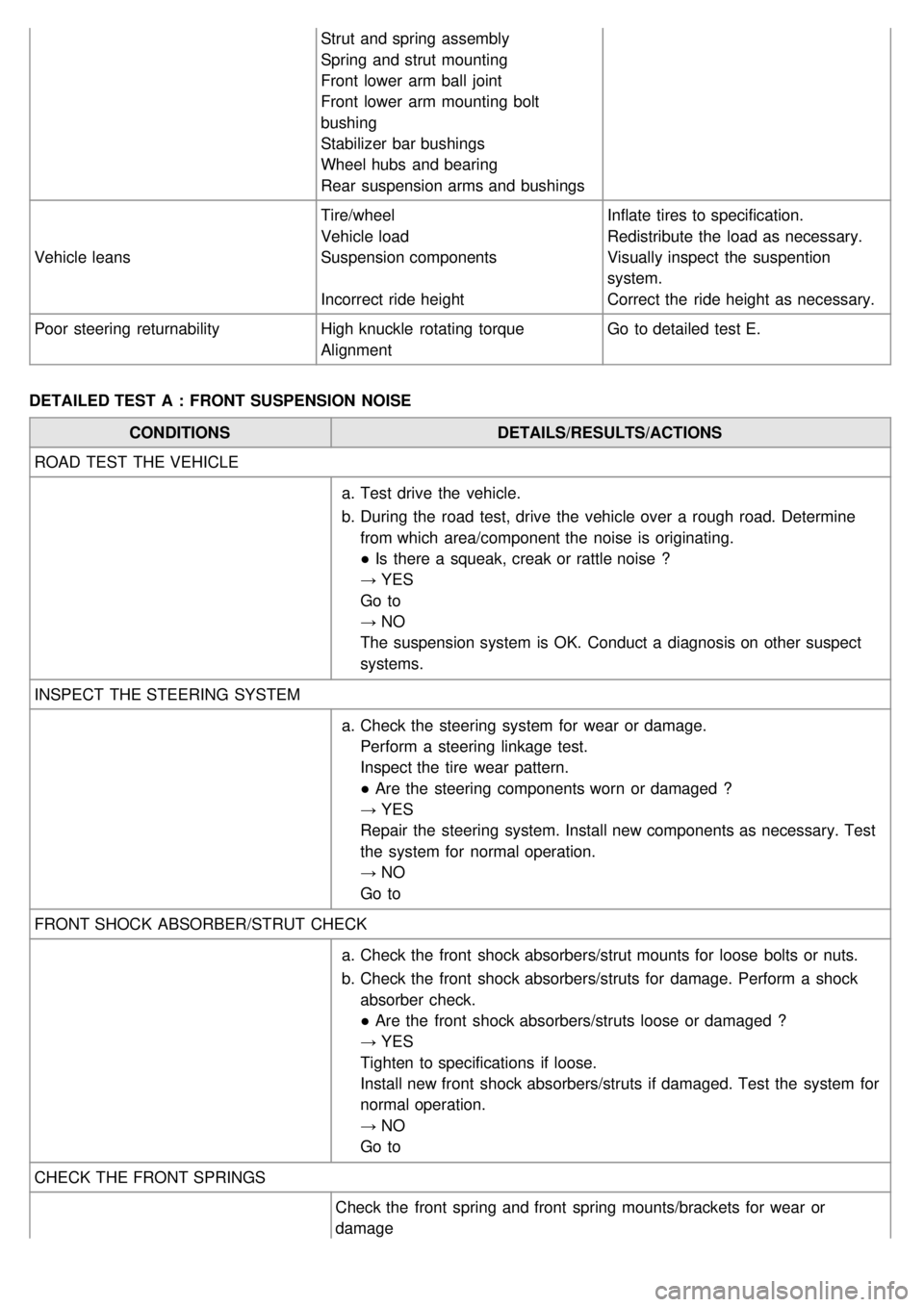
Strut and spring assembly
Spring and strut mounting
Front lower arm ball joint
Front lower arm mounting bolt
bushing
Stabilizer bar bushings
Wheel hubs and bearing
Rear suspension arms and bushings
Vehicle leans Tire/wheel
Vehicle load
Suspension components
Incorrect ride heightInflate tires to specification.
Redistribute the load as necessary.
Visually inspect the suspention
system.
Correct the ride height as necessary.
Poor steering returnability High knuckle rotating torque
AlignmentGo to detailed test E.
DETAILED TEST A : FRONT SUSPENSION NOISE CONDITIONS DETAILS/RESULTS/ACTIONS
ROAD TEST THE VEHICLE
a.Test drive the vehicle.
b. During the road test, drive the vehicle over a rough road. Determine
from which area/component the noise is originating.
● Is there a squeak, creak or rattle noise ?
→ YES
Go to
→ NO
The suspension system is OK. Conduct a diagnosis on other suspect
systems.
INSPECT THE STEERING SYSTEM a.Check the steering system for wear or damage.
Perform a steering linkage test.
Inspect the tire wear pattern.
● Are the steering components worn or damaged ?
→ YES
Repair the steering system. Install new components as necessary. Test
the system for normal operation.
→ NO
Go to
FRONT SHOCK ABSORBER/STRUT CHECK a.Check the front shock absorbers/strut mounts for loose bolts or nuts.
b. Check the front shock absorbers/struts for damage. Perform a shock
absorber check.
● Are the front shock absorbers/struts loose or damaged ?
→ YES
Tighten to specifications if loose.
Install new front shock absorbers/struts if damaged. Test the system for
normal operation.
→ NO
Go to
CHECK THE FRONT SPRINGS Check the front spring and front spring mounts/brackets for wear or
damage
Page 492 of 1575
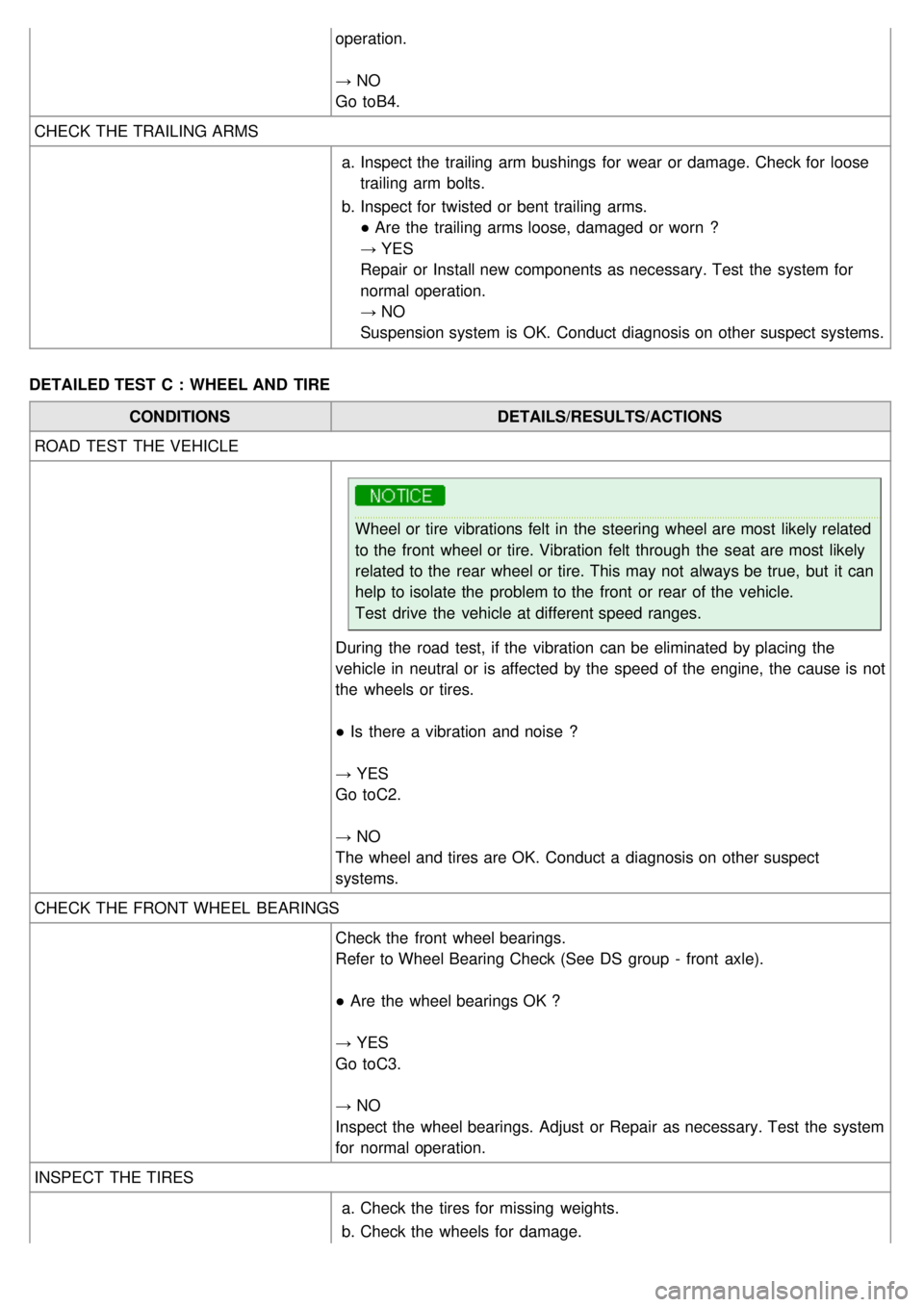
operation.
→ NO
Go toB4.
CHECK THE TRAILING ARMS
a.Inspect the trailing arm bushings for wear or damage. Check for loose
trailing arm bolts.
b. Inspect for twisted or bent trailing arms.
● Are the trailing arms loose, damaged or worn ?
→ YES
Repair or Install new components as necessary. Test the system for
normal operation.
→ NO
Suspension system is OK. Conduct diagnosis on other suspect systems.
DETAILED TEST C : WHEEL AND TIRE CONDITIONS DETAILS/RESULTS/ACTIONS
ROAD TEST THE VEHICLE
Wheel or tire vibrations felt in the steering wheel are most likely related
to the front wheel or tire. Vibration felt through the seat are most likely
related to the rear wheel or tire. This may not always be true, but it can
help to isolate the problem to the front or rear of the vehicle.
Test drive the vehicle at different speed ranges.
During the road test, if the vibration can be eliminated by placing the
vehicle in neutral or is affected by the speed of the engine, the cause is not
the wheels or tires.
● Is there a vibration and noise ?
→ YES
Go to C2.
→ NO
The wheel and tires are OK. Conduct a diagnosis on other suspect
systems.
CHECK THE FRONT WHEEL BEARINGS Check the front wheel bearings.
Refer to Wheel Bearing Check (See DS group - front axle).
● Are the wheel bearings OK ?
→ YES
Go to C3.
→ NO
Inspect the wheel bearings. Adjust or Repair as necessary. Test the system
for normal operation.
INSPECT THE TIRES
a.Check the tires for missing weights.
b. Check the wheels for damage.
Page 493 of 1575

c.Inspect the tire wear pattern.
● Do the tires have an abnormal wear pattern ?
→ YES
Correct the condition that caused the abnormal wear. Install new tire(s).
Test the system for normal operation.
→ NO
Go to
TIRE ROTATION DIAGNOSIS a.Spin the tires slowly and watch for signs of lateral runout.
b. Spin the tires slowly and watch for signs of radial runout.
● Are there signs of visual runout ?
→ YES
Go to
→ NO
Check the wheel and tire balance.
Correct as necessary. Test the system for normal operation.
RADIAL RUNOUT CHECK ON THE TIRE Measure the radial runout of the wheel and tire assembly. A typical
specification for total radial runout is 1.15mm (0.059 inch).
● Is the radial runout within specifications ?
→ YES
Go to C8.
→ NO
Go to C6.
RADIAL RUNOUT CHECK ON THE WHEEL Measure the radial runout of the wheel. A typical specification for total radial
runout is 1.14mm (0.045 inch.).
● Is the radial runout within specifications ?
→ YES
Install a new tire. Test the system for normal operation.
→ NO
Go to C7.
CHECK THE HUB/BRAKE DISC OR DRUM PILOT RUNOUT OR BOLT CIRCLE RUNOUT Measure the pilot or bolt circle runout. A typical specification for radial
runout is :
● pilot runout - less than 0.15mm (0.006 inch.)
● bolt circle runout - less than 0.38 mm (0.015 inch.)
● Is the radial runout within specification ?
→ YES
Install a new wheel. Test the system for normal operation.
→ NO
Repair or Install new components as necessary.
LATERAL RUNOUT CHECK ON THE TIRE Measure the lateral runout of the wheel and tire assembly. A typical
specification for total lateral runout is 2.5mm (0.098 inch).
Page 494 of 1575
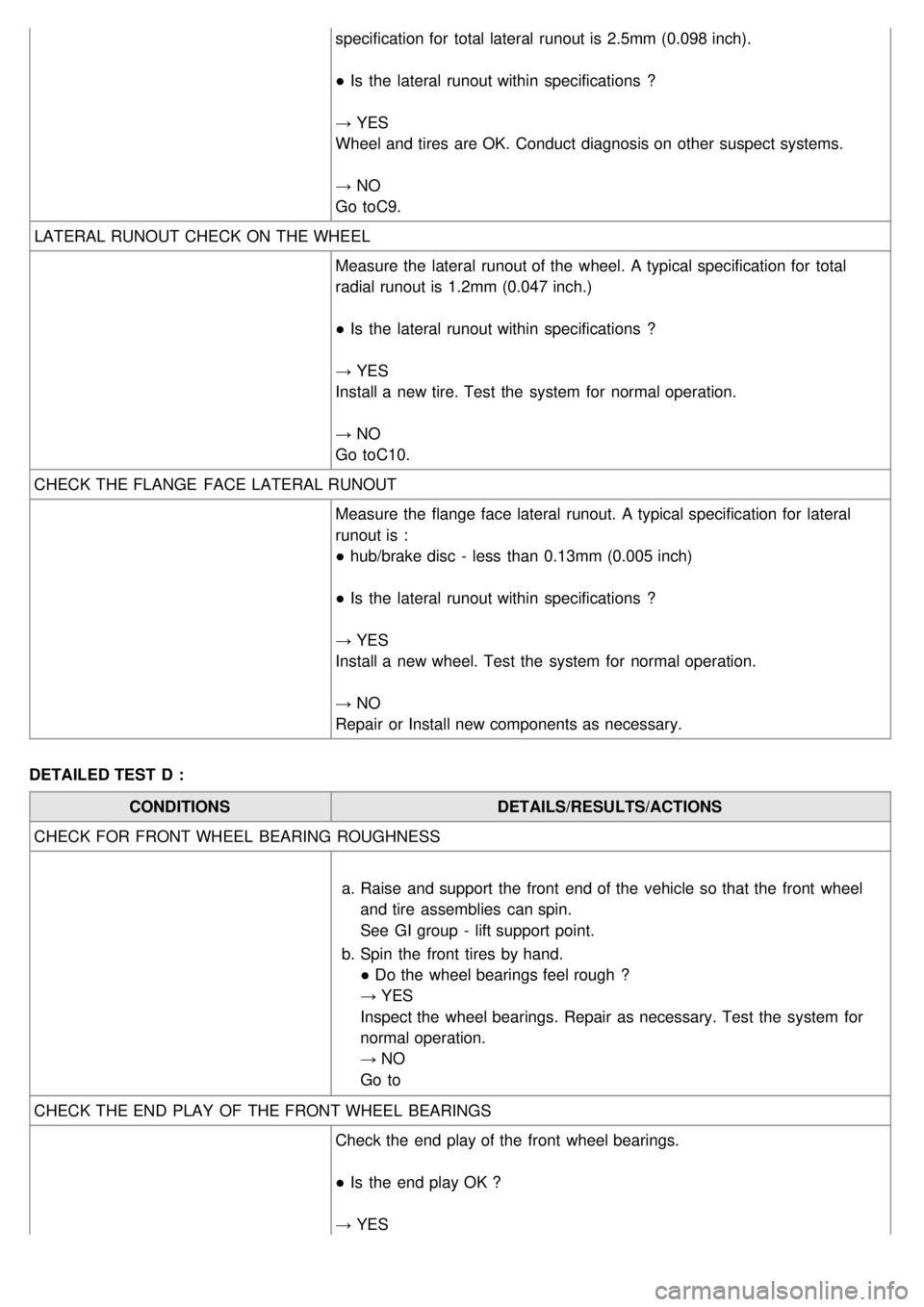
specification for total lateral runout is 2.5mm (0.098 inch).
● Is the lateral runout within specifications ?
→ YES
Wheel and tires are OK. Conduct diagnosis on other suspect systems.
→ NO
Go to C9.
LATERAL RUNOUT CHECK ON THE WHEEL Measure the lateral runout of the wheel. A typical specification for total
radial runout is 1.2mm (0.047 inch.)
● Is the lateral runout within specifications ?
→ YES
Install a new tire. Test the system for normal operation.
→ NO
Go to C10.
CHECK THE FLANGE FACE LATERAL RUNOUT Measure the flange face lateral runout. A typical specification for lateral
runout is :
● hub/brake disc - less than 0.13mm (0.005 inch)
● Is the lateral runout within specifications ?
→ YES
Install a new wheel. Test the system for normal operation.
→ NO
Repair or Install new components as necessary.
DETAILED TEST D : CONDITIONS DETAILS/RESULTS/ACTIONS
CHECK FOR FRONT WHEEL BEARING ROUGHNESS
a.Raise and support the front end of the vehicle so that the front wheel
and tire assemblies can spin.
See GI group - lift support point.
b. Spin the front tires by hand.
● Do the wheel bearings feel rough ?
→ YES
Inspect the wheel bearings. Repair as necessary. Test the system for
normal operation.
→ NO
Go to
CHECK THE END PLAY OF THE FRONT WHEEL BEARINGS Check the end play of the front wheel bearings.
● Is the end play OK ?
→ YES
Go to D3.