instrument cluster KIA CEED 2011 Owners Manual
[x] Cancel search | Manufacturer: KIA, Model Year: 2011, Model line: CEED, Model: KIA CEED 2011Pages: 390, PDF Size: 20.01 MB
Page 4 of 390
1
How to use this manual / 1-2
Fuel requirements / 1-3
Vehicle break-in process / 1-5
Indicator symbols on the instrument cluster / 1-6
Introduction
ED(FL) ENG 1.QXP 6/28/2010 10:25 AM Page 1
Page 9 of 390
Introduction
6
1
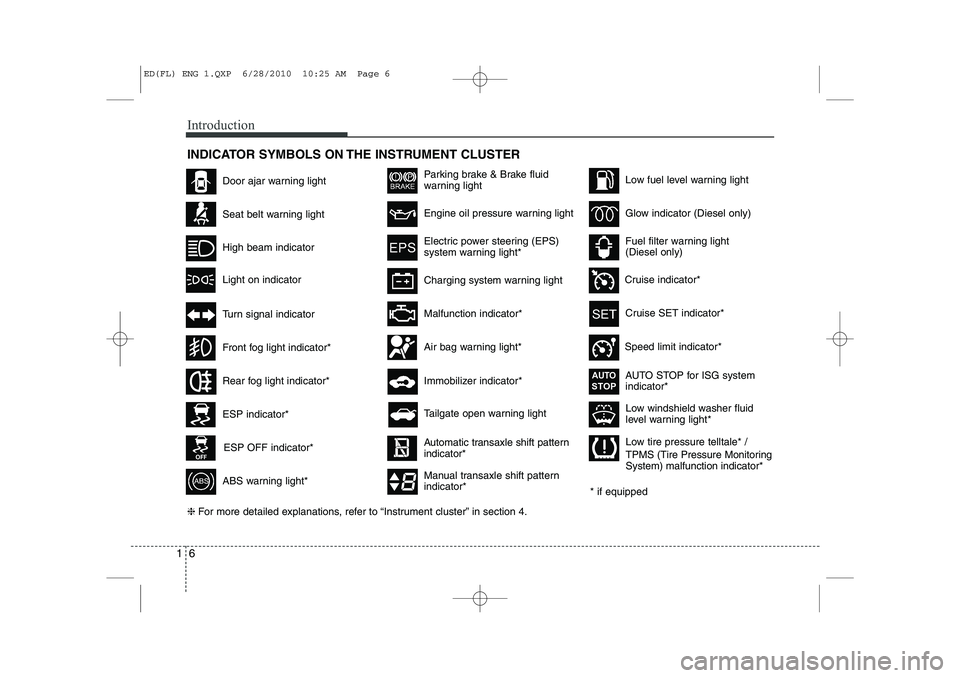
INDICATOR SYMBOLS ON THE INSTRUMENT CLUSTER
Seat belt warning light
High beam indicator
Turn signal indicator
ABS warning light*
Parking brake & Brake fluid
warning light
Malfunction indicator*
Immobilizer indicator*
Low fuel level warning light
Glow indicator (Diesel only)
Fuel filter warning light (Diesel only)
* if equipped
Tailgate open warning light
❈ For more detailed explanations, refer to “Instrument cluster” in section 4.
Charging system warning light
Door ajar warning light
ESP indicator*
ESP OFF indicator*
Front fog light indicator*
Engine oil pressure warning light
Electric power steering (EPS)
system warning light*
Air bag warning light*
Low tire pressure telltale* /
TPMS (Tire Pressure Monitoring System) malfunction indicator*
Rear fog light indicator*
Cruise SET indicator*
Speed limit indicator* AUTO STOP for ISG system indicator*
Cruise indicator*
AUTOSTOP
Low windshield washer fluid
level warning light*
Light on indicator
Automatic transaxle shift pattern indicator*
Manual transaxle shift pattern indicator*
ED(FL) ENG 1.QXP 6/28/2010 10:25 AM Page 6
Page 12 of 390

23
Your vehicle at a glance
INSTRUMENT PANEL OVERVIEW
1. Driver’s front air bag* .......................3-43
2. Light control / Turn signals ...............4-59
3. Instrument cluster.............................4-36
4. Wiper/Washer ...................................4-64
5. Steering wheel audio controls* ......4-129
6. Auto cruise controls* .........................5-29
Steering wheel audio controls* ......4-129
7. LCD display warning and indicator* .. 4-53
8. Audio controls * ................................4-111
9. Seat warmer* .....................................3-8
10. Central door lock/unlock button......4-11
11. Hazard warning flasher switch .. 4-57/6-2
12. Climate control system*..................4-70
13. Passenger’s front air bag* ..............3-43
14. Glove box .......................................4-90
15. Multi box* ...........................................4-91
16. Shift lever* ........................................5-9
17. Power outlet* ..................................4-95
18. Cigarette lighter* ............................4-93
19. Parking brake .................................5-19
20. Brake pedal ....................................5-18
21. Accelerator pedal .............................5-5
22. Vent controls...................................4-73
* : if equipped
OED029002
* The actual instrument panel in the vehicle may differ from the illustration.
ED(FL) ENG 2.QXP 6/28/2010 10:26 AM Page 3
Page 56 of 390

343
Safety features of your vehicle
Driver's and passenger's front air
bag (if equipped)
Your vehicle is equipped with a
Supplemental Restraint (Air Bag) System
and lap/shoulder belts at both the driver
and passenger seating positions.
WARNING
If an air bag deploys, there may be a loud noise followed by a fine
dust released in the vehicle.These conditions are normal and
are not hazardous - the air bags
are packed in this fine powder.
The dust generated during air
bag deployment may cause skin
or eye irritation as well as aggra-
vate asthma for some persons.
Always wash all exposed skin
areas thoroughly with lukewarmwater and a mild soap after an
accident in which the air bags
were deployed.
The SRS can function only when the ignition switch is in the ONposition.
Before you replace a fuse or dis- connect a battery terminal, turn
the ignition switch to the LOCK
position and remove the ignition
key. Never remove or replace the
air bag related fuse(s) when the
ignition switch is in the ON posi-
tion. Failure to heed this warning
will cause the SRS air bag warn-
ing light to illuminate.
OED030035
OED030036
Driver’s front air bag
Passenger’s front air bag
WARNING
Do not install or place any acces- sories (drink holder, cassette
holder, sticker, etc.) on the front
passenger's panel above the
glove box in a vehicle with a pas-
senger's air bag. Such objects
may become dangerous projec-
tiles and cause injury if the pas-
senger's air bag inflates.
When installing a container of liq- uid air freshener inside the vehi-
cle, do not place it near the
instrument cluster nor on the
instrument panel surface.
It may become a dangerous pro-
jectile and cause injury if the pas-
senger's air bag inflates.
B240B05L
Passenger’s front air bag
ED(FL) ENG 3.QXP 6/28/2010 10:31 AM Page 43
Page 72 of 390
4
Key / 4-2 Remote keyless entry / 4-5Theft-alarm system / 4-8
Door locks / 4-10
Tailgate / 4-14
Windows / 4-16Hood / 4-21
Fuel filler lid / 4-23
Sunroof / 4-26
Steering wheel / 4-30
Mirrors / 4-32
Instrument cluster / 4-36
Rear parking assist system /4-55Rearview camera / 4-58
Hazard warning flasher / 4-58Lighting / 4-59
Wipers and washers / 4-64
Interior light / 4-68
Defroster / 4-69
Manual climate control system / 4-70
Automatic climate control system / 4-79
Windshield defrosting and defogging / 4-87
Storage compartment / 4-90
Interior features / 4-93
Barrier net / 4-99
Tonneau cover / 4-101
Mounting bracket for roof carrier / 4-102
Exterior feature / 4-103Audio system / 4-104
Features of your vehicle
ED(FL) ENG 4(~103).QXP 10/28/2010 6:52 PM Page 1
Page 107 of 390
Features of your vehicle
36
4
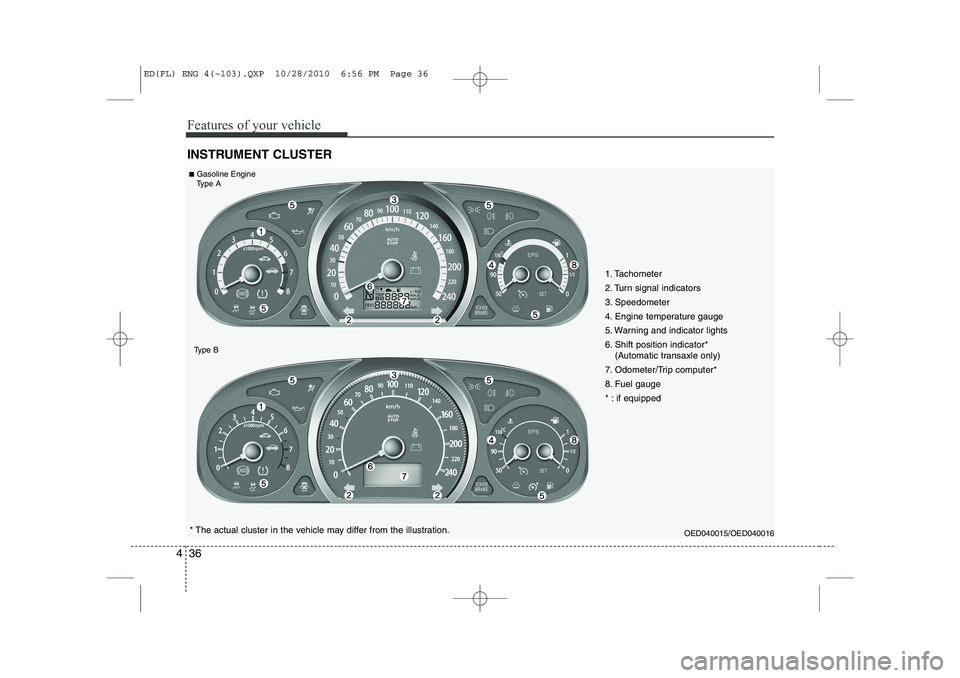
INSTRUMENT CLUSTER
1. Tachometer
2. Turn signal indicators
3. Speedometer
4. Engine temperature gauge
5. Warning and indicator lights
6. Shift position indicator*
(Automatic transaxle only)
7. Odometer/Trip computer*
8. Fuel gauge
* : if equipped
OED040015/OED040016
* The actual cluster in the vehicle may differ from the illustration.
■
Gasoline Engine
Type A
Type B
ED(FL) ENG 4(~103).QXP 10/28/2010 6:56 PM Page 36
Page 121 of 390

Features of your vehicle
50
4
ESP (Electronic Stability
Program) indicator(if equipped)
The ESP indicator will illuminate when
the ignition switch is turned ON, but
should go off after approximately 3 sec-
onds. When the ESP is on, it monitors the
driving conditions. Under normal driving
conditions, the ESP indicator will remain
off. When a slippery or low traction con-dition is encountered, the ESP will oper-
ate, and the ESP indicator will blink to
indicate the ESP is operating. But, if the ESP system malfunctions the
indicator illuminates and stays on. Take
your vehicle to an authorized KIA dealer
and have the system checked.
ESP OFF indicator (if equipped)
The ESP OFF indicator will illuminate
when the ignition switch is turned ON,
but should go off after approximately 3
seconds. To switch to ESP OFF mode,
press the ESP OFF button. The ESPOFF indicator will illuminate indicating
the ESP is deactivated.
Cruise indicator (if equipped)
CRUISE indicator
The indicator illuminates when the cruise
control system is enabled.
The cruise indicator in the instrument
cluster is illuminated when the cruise
control ON-OFF button on the steeringwheel is pushed.
The indicator goes off when the cruise
control ON-OFF button is pushed again.
For more information about the use of
cruise control, refer to “Cruise control
system” in section 5.
Cruise SET indicator
The indicator illuminates when the cruise
control switch (-/SET or RES/+) is ON.
The cruise SET indicator in the instru- ment cluster is illuminated when the
cruise control switch (-/SET or RES/+) ispushed.
The cruise SET indicator does not illumi-
nate when the cruise control switch(CANCEL) is pushed or the system isdisengaged.
Speed limit indicator (if equipped)
(1) Speed limit indicator (2) Set speed limit indicator The speed limit indicator illuminates when the speed limit control system is
enabled.
The speed limit indicator in the instru- ment cluster illuminates when the speed
limit ON.OFF button on the steeringwheel is pressed.
The set speed limit will display when the
speed limit control switch(SET-/RES+) isON.
If you drive over the speed limit, the set
speed limit will blink and chime willsound.
The set speed limit turns off when the
speed limit is cancelled by pressing the
CANCEL button. The speed limit indicator goes off when
the speed limit is deactivated.
For more information about the speed
limit control usage, refer to “Speed Limit
control System” in section 5.
SET
Limit 98
km/h
①
②
ED(FL) ENG 4(~103).QXP 10/28/2010 6:56 PM Page 50
Page 215 of 390

Driving your vehicle
8
5
ISG auto-starting
Before and after the engine enters the
idle stop mode, the ISG system will auto-
matically check all the necessary items
such as the safety of the vehicle and pas-
senger comfort.
The engine will start automatically with-
out the driver's action if any of the follow-ing occurs:
If the brake vacuum pressure is low
If the fan speed of the manual climate
control system is set above the 3rd position when the air conditioning is on
If the fan speed of the automatic cli- mate control system is set above the6th position when the air conditioningis on
When a certain amount of time has passed with the climate control systemon
When the defroster is ON
When the battery charge status is low
If the vehicle speed is over 5km/h by rolling down a hill
It could be different up to the vehicle con- dition.
When the automatic starting occurs, the
"AUTO STOP" indicator on the cluster
will blink for 5 seconds. ISG(Idle Stop and Go) system
deactivation
If you desire to deactivate the ISG sys-
tem, you can do it temporarily by press-
ing the ISG OFF button located on the
left side of the instrument panel.
After pressing the ISG OFF button, the
button light will illuminate.
The ISG system will activate by pressing
the ISG OFF button again and the button
light will turn off. ✽✽
NOTICE
Page 233 of 390
Driving your vehicle
26
5
Vehicle stability management (VSM) (if equipped)
This system provides further enhance-
ments to vehicle stability and steering
responses when a vehicle is driving on a
slippery road or a vehicle detected
changes in coefficient of friction between
right wheels and left wheels when brak-ing.
VSM operation
When the vehicle stability management
is operating properly, you can feel a slight
pulsation in the vehicle and/or abnormal
steering responses (EPS). This is only
the effect of brake and EPS control and
indicates nothing unusual.
The VSM does not operate when:
Driving on bank road such as gradient
or incline
Driving rearward
ESP OFF indicator light ( ) remains on the instrument cluster
EPS indicator light remains on the instrument cluster
VSM operation off
If you press the ESP OFF button to turn
off the ESP, the VSM will also cancel and
the ESP OFF indicator light ( ) illumi-
nates.
To turn on the VSM, press the button
again. The ESP OFF indicator light goesout.
Malfunction indicator
The VSM can be deactivated even if you
don’t cancel the VSM operation by press-
ing the ESP OFF button. It indicates thata malfunction has been detected some-
where in the Electric Power Steering sys-
tem or VSM system. If the ESP indicator
light ( ) or EPS warning light remains
on, take your vehicle to an authorized
KIA dealer and have the system
checked.
✽✽ NOTICE
Page 236 of 390
529
Driving your vehicle
The cruise control system allows you to
program the vehicle to maintain a con-stant speed without pressing the acceler-ator pedal. This system is designed to function
above approximately 40 km/h (25 mph).✽✽NOTICE
During normal cruise control operation,
when the SET switch is activated or
reactivated after applying the brakes,
the cruise control will energize after
approximately 3 seconds. This delay isnormal.
CRUISE CONTROL SYSTEM (IF EQUIPPED)
WARNING
If the cruise control is left on, (CRUISE indicator light in the
instrument cluster illuminated)
the cruise control can be
switched on accidentally. Keep
the cruise control system off
(CRUISE indicator light OFF)
when the cruise control is not in
use, to avoid inadvertently set-ting a speed.
Use the cruise control system only when traveling on open
highways in good weather.
(Continued)
(Continued)
Do not use the cruise controlwhen it may not be safe to keep
the car at a constant speed, for
instance, driving in heavy or
varying traffic, or on slippery
(rainy, icy or snow-covered) or
winding roads or over 6% up-hill
or down-hill roads.
Pay particular attention to the driving conditions whenever
using the cruise control system.
CAUTION
During cruise-speed driving of a
manual transaxle vehicle, do notshift into neutral without depress- ing the clutch pedal, since theengine will be overrevved. If this
happens, depress the clutch pedal or release the cruise control ON-OFF switch.
ED(FL) ENG 5.QXP 10/28/2010 6:23 PM Page 29