air filter KIA CEED 2013 Repair Manual
[x] Cancel search | Manufacturer: KIA, Model Year: 2013, Model line: CEED, Model: KIA CEED 2013Pages: 1168, PDF Size: 48.01 MB
Page 1066 of 1168
729
Maintenance
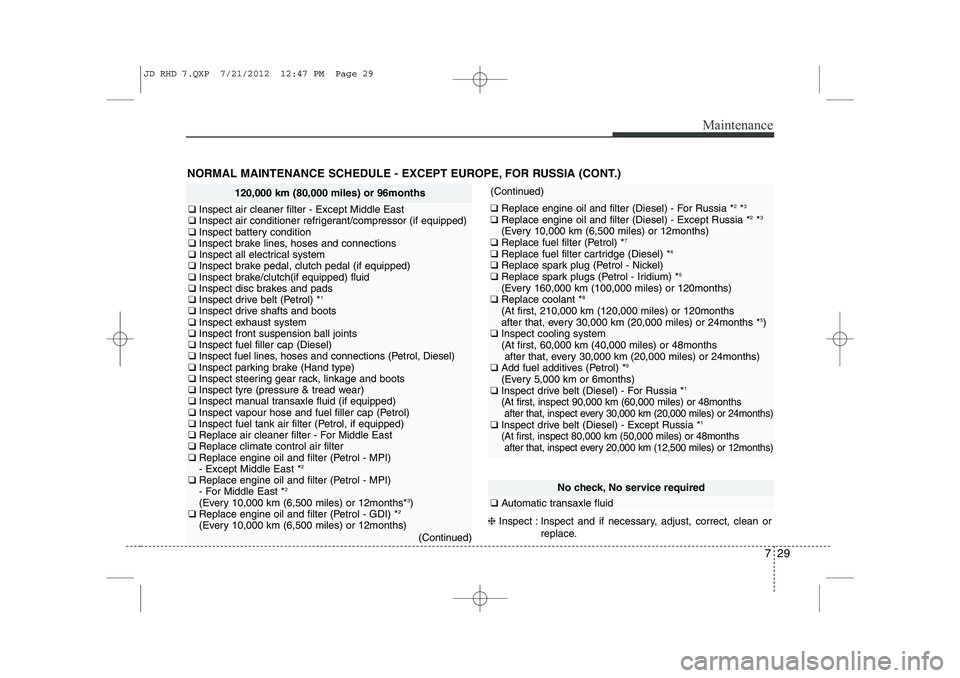
NORMAL MAINTENANCE SCHEDULE - EXCEPT EUROPE, FOR RUSSIA (CONT.)
120,000 km (80,000 miles) or 96months
❑ Inspect air cleaner filter - Except Middle East
❑ Inspect air conditioner refrigerant/compressor (if equipped)
❑ Inspect battery condition
❑ Inspect brake lines, hoses and connections
❑ Inspect all electrical system
❑ Inspect brake pedal, clutch pedal (if equipped)
❑ Inspect brake/clutch(if equipped) fluid
❑ Inspect disc brakes and pads
❑ Inspect drive belt (Petrol) * 1
❑ Inspect drive shafts and boots
❑ Inspect exhaust system
❑ Inspect front suspension ball joints
❑ Inspect fuel filler cap (Diesel)
❑ Inspect fuel lines, hoses and connections (Petrol, Diesel)
❑ Inspect parking brake (Hand type)
❑ Inspect steering gear rack, linkage and boots
❑ Inspect tyre (pressure & tread wear)
❑ Inspect manual transaxle fluid (if equipped)
❑ Inspect vapour hose and fuel filler cap (Petrol)
❑ Inspect fuel tank air filter (Petrol, if equipped)
❑ Replace air cleaner filter - For Middle East
❑ Replace climate control air filter
❑ Replace engine oil and filter (Petrol - MPI) - Except Middle East * 2
❑ Replace engine oil and filter (Petrol - MPI)
- For Middle East * 2
(Every 10,000 km (6,500 miles) or 12months* 3
)
❑ Replace engine oil and filter (Petrol - GDI) * 2
(Every 10,000 km (6,500 miles) or 12months)
(Continued)
(Continued)
❑ Replace engine oil and filter (Diesel) - For Russia * 2
*3
❑ Replace engine oil and filter (Diesel) - Except Russia * 2
*3
(Every 10,000 km (6,500 miles) or 12months)
❑ Replace fuel filter (Petrol) * 7
❑ Replace fuel filter cartridge (Diesel) * 4
❑ Replace spark plug (Petrol - Nickel)
❑ Replace spark plugs (Petrol - Iridium) * 5
(Every 160,000 km (100,000 miles) or 120months)
❑ Replace coolant * 8
(At first, 210,000 km (120,000 miles) or 120months
after that, every 30,000 km (20,000 miles) or 24months * 5
)
❑ Inspect cooling system
(At first, 60,000 km (40,000 miles) or 48months
after that, every 30,000 km (20,000 miles) or 24months)
❑ Add fuel additives (Petrol) * 9
(Every 5,000 km or 6months)
❑ Inspect drive belt (Diesel) - For Russia * 1
(At first, inspect 90,000 km (60,000 miles) or 48monthsafter that, inspect every 30,000 km (20,000 miles) or 24months)❑
Inspect drive belt (Diesel) - Except Russia * 1(At first, inspect 80,000 km (50,000 miles) or 48monthsafter that, inspect every 20,000 km (12,500 miles) or 12months)
No check, No service required
❑
Automatic transaxle fluid
❈ Inspect : Inspect and if necessary, adjust, correct, clean or
replace.
JD RHD 7.QXP 7/21/2012 12:47 PM Page 29
Page 1067 of 1168
Maintenance
30
7
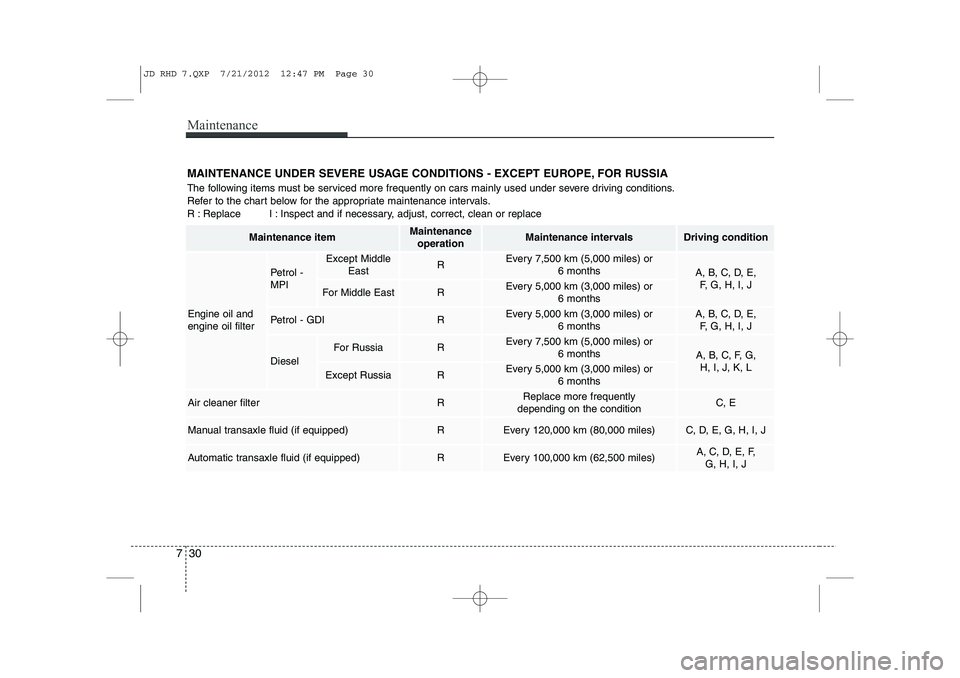
MAINTENANCE UNDER SEVERE USAGE CONDITIONS - EXCEPT EUROPE, FOR RUSSIA
The following items must be serviced more frequently on cars mainly used under severe driving conditions.
Refer to the chart below for the appropriate maintenance intervals.
R : Replace I : Inspect and if necessary, adjust, correct, clean or replace
Maintenance itemMaintenance
operationMaintenance intervalsDriving condition
Engine oil and engine oil filter
Petrol - MPI
Except Middle EastREvery 7,500 km (5,000 miles) or 6 months
A, B, C, D, E, F, G, H, I, J
For Middle EastREvery 5,000 km (3,000 miles) or 6 months
Petrol - GDIREvery 5,000 km (3,000 miles) or 6 monthsA, B, C, D, E, F, G, H, I, J
Diesel
For RussiaREvery 7,500 km (5,000 miles) or 6 months
A, B, C, F, G, H, I, J, K, L
Except RussiaREvery 5,000 km (3,000 miles) or 6 months
Air cleaner filterRReplace more frequently
depending on the conditionC, E
Manual transaxle fluid (if equipped)REvery 120,000 km (80,000 miles)C, D, E, G, H, I, J
Automatic transaxle fluid (if equipped)REvery 100,000 km (62,500 miles)A, C, D, E, F, G, H, I, J
JD RHD 7.QXP 7/21/2012 12:47 PM Page 30
Page 1068 of 1168
731
Maintenance
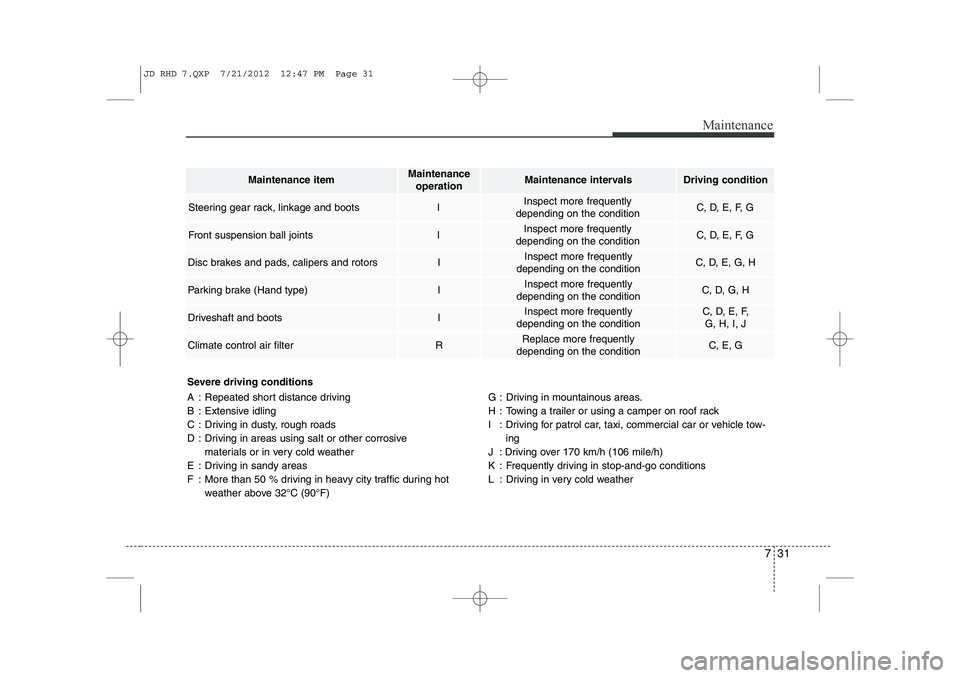
Severe driving conditions
A : Repeated short distance driving
B : Extensive idling
C : Driving in dusty, rough roads
D : Driving in areas using salt or other corrosive materials or in very cold weather
E : Driving in sandy areas
F : More than 50 % driving in heavy city traffic during hot weather above 32°C (90°F) G : Driving in mountainous areas.
H : Towing a trailer or using a camper on roof rack
I : Driving for patrol car, taxi, commercial car or vehicle tow-
ing
J : Driving over 170 km/h (106 mile/h)
K : Frequently driving in stop-and-go conditions
L : Driving in very cold weather
Maintenance itemMaintenance operationMaintenance intervalsDriving condition
Steering gear rack, linkage and bootsIInspect more frequently
depending on the conditionC, D, E, F, G
Front suspension ball jointsIInspect more frequently
depending on the conditionC, D, E, F, G
Disc brakes and pads, calipers and rotorsIInspect more frequently
depending on the conditionC, D, E, G, H
Parking brake (Hand type)IInspect more frequently
depending on the conditionC, D, G, H
Driveshaft and bootsIInspect more frequently
depending on the conditionC, D, E, F, G, H, I, J
Climate control air filterRReplace more frequently
depending on the conditionC, E, G
JD RHD 7.QXP 7/21/2012 12:47 PM Page 31
Page 1070 of 1168
733
Maintenance
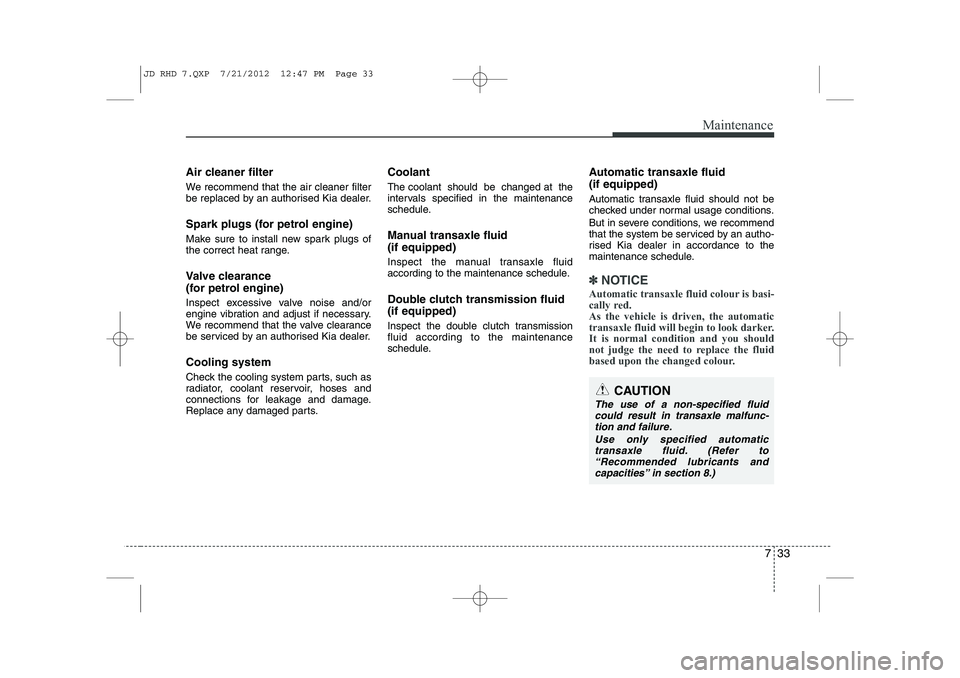
Air cleaner filter
We recommend that the air cleaner filter
be replaced by an authorised Kia dealer.
Spark plugs (for petrol engine)
Make sure to install new spark plugs of
the correct heat range.
Valve clearance
(for petrol engine)
Inspect excessive valve noise and/or
engine vibration and adjust if necessary.
We recommend that the valve clearance
be serviced by an authorised Kia dealer. Cooling system
Check the cooling system parts, such as
radiator, coolant reservoir, hoses and
connections for leakage and damage.
Replace any damaged parts.Coolant The coolant should be changed at the
intervals specified in the maintenance
schedule.
Manual transaxle fluid (if equipped)
Inspect the manual transaxle fluid
according to the maintenance schedule.
Double clutch transmission fluid (if equipped)
Inspect the double clutch transmission fluid according to the maintenance
schedule.
Automatic transaxle fluid (if equipped)
Automatic transaxle fluid should not be
checked under normal usage conditions.
But in severe conditions, we recommend
that the system be serviced by an autho-
rised Kia dealer in accordance to the
maintenance schedule.
✽✽
NOTICE
Automatic transaxle fluid colour is basi-
cally red. As the vehicle is driven, the automatic
transaxle fluid will begin to look darker.It is normal condition and you should
not judge the need to replace the fluid
based upon the changed colour.
CAUTION
The use of a non-specified fluid could result in transaxle malfunc-
tion and failure.
Use only specified automatictransaxle fluid. (Refer to“Recommended lubricants and capacities” in section 8.)
JD RHD 7.QXP 7/21/2012 12:47 PM Page 33
Page 1079 of 1168
Maintenance
42
7
FUEL FILTER (FOR DIESEL)
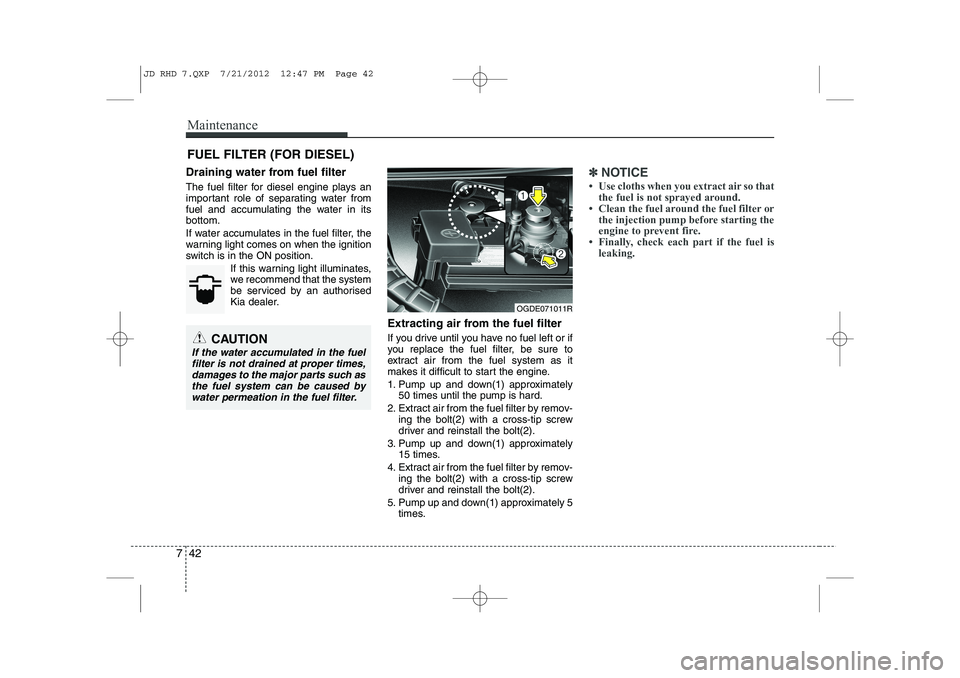
Draining water from fuel filter
The fuel filter for diesel engine plays an
important role of separating water from
fuel and accumulating the water in itsbottom.
If water accumulates in the fuel filter, the
warning light comes on when the ignition
switch is in the ON position. If this warning light illuminates,
we recommend that the system
be serviced by an authorised
Kia dealer.
Extracting air from the fuel filter
If you drive until you have no fuel left or if
you replace the fuel filter, be sure to
extract air from the fuel system as it
makes it difficult to start the engine.
1. Pump up and down(1) approximately50 times until the pump is hard.
2. Extract air from the fuel filter by remov- ing the bolt(2) with a cross-tip screw
driver and reinstall the bolt(2).
3. Pump up and down(1) approximately 15 times.
4. Extract air from the fuel filter by remov- ing the bolt(2) with a cross-tip screw
driver and reinstall the bolt(2).
5. Pump up and down(1) approximately 5 times.
✽✽ NOTICE
Page 1080 of 1168
743
Maintenance
AIR CLEANER
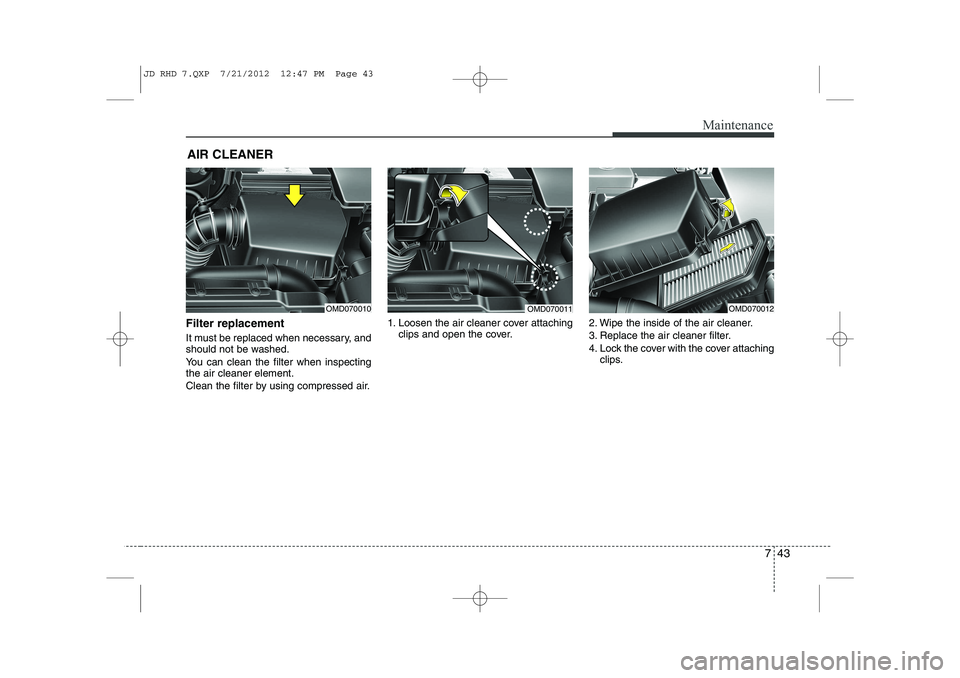
Filter replacement
It must be replaced when necessary, and
should not be washed.
You can clean the filter when inspecting the air cleaner element.
Clean the filter by using compressed air. 1. Loosen the air cleaner cover attaching
clips and open the cover. 2. Wipe the inside of the air cleaner.
3. Replace the air cleaner filter.
4. Lock the cover with the cover attaching
clips.
OMD070011OMD070010OMD070012
JD RHD 7.QXP 7/21/2012 12:47 PM Page 43
Page 1081 of 1168
Maintenance
44
7
Replace the filter according to the
Maintenance Schedule.
If the vehicle is operated in extremely
dusty or sandy areas, replace the ele-ment more often than the usual recom-
mended intervals. (Refer to “Maintenance under severe usage condi-tions” in this section.)
CAUTION
Do not drive with the air cleaner removed; this will result in exces-
sive engine wear.
When removing the air cleaner fil- ter, be careful that dust or dirtdoes not enter the air intake, or
damage may result.
We recommend that you use parts for replacement from anauthorised Kia dealer.
JD RHD 7.QXP 7/21/2012 12:47 PM Page 44
Page 1082 of 1168
745
Maintenance
CLIMATE CONTROL AIR FILTER
Filter inspection
If the vehicle is operated in the severely air-polluted cities or on dusty rough
roads for a long period, it should beinspected more frequently and replaced
earlier. When you, the owner, replace the
climate control air filter, replace it per-
forming the following procedure, and be
careful to avoid damaging other compo-
nents. Replace the filter according to the main-
tenance Schedule.
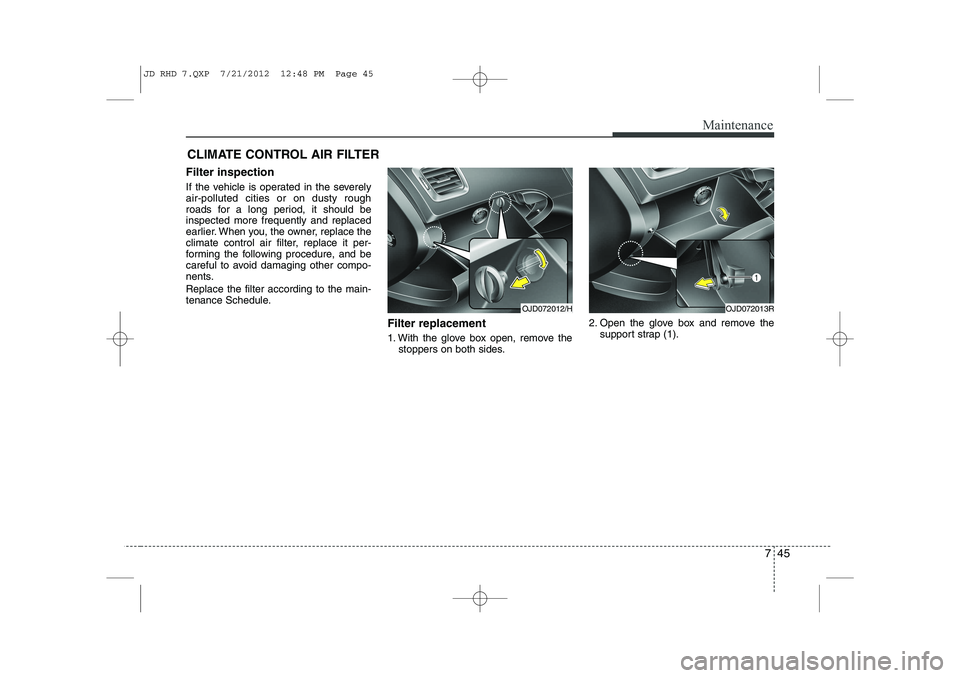
Filter replacement
1. With the glove box open, remove thestoppers on both sides. 2. Open the glove box and remove the
support strap (1).
OJD072013ROJD072012/H
JD RHD 7.QXP 7/21/2012 12:48 PM Page 45
Page 1083 of 1168
Maintenance
46
7
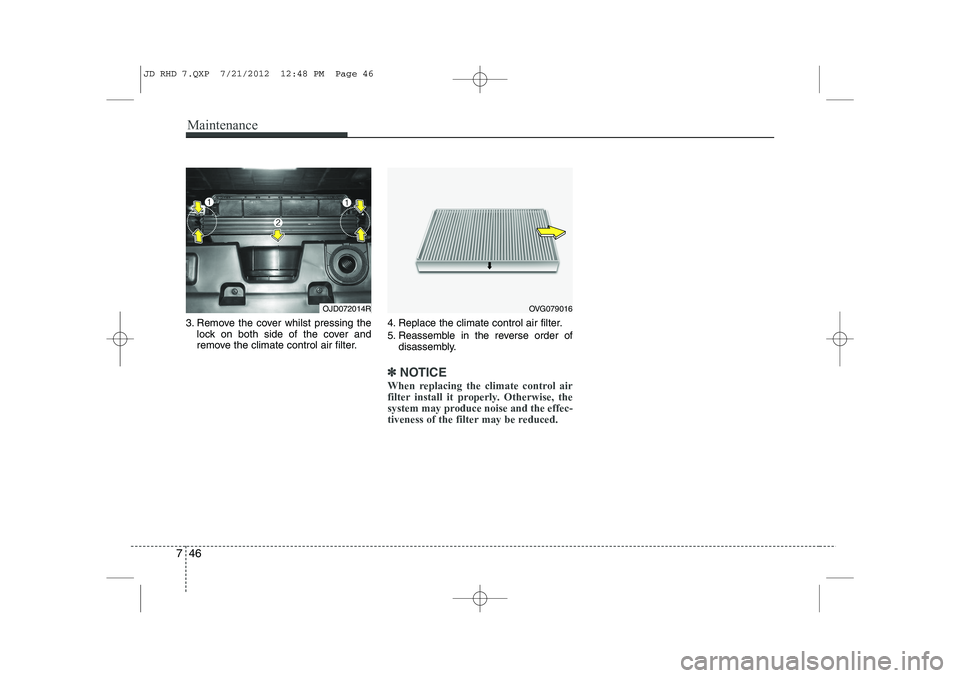
3. Remove the cover whilst pressing the
lock on both side of the cover and
remove the climate control air filter. 4. Replace the climate control air filter.
5. Reassemble in the reverse order of
disassembly.
✽✽ NOTICE
When replacing the climate control air
filter install it properly. Otherwise, the
system may produce noise and the effec-
tiveness of the filter may be reduced.
OVG079016OJD072014R
JD RHD 7.QXP 7/21/2012 12:48 PM Page 46
Page 1141 of 1168
Maintenance
104
7
EMISSION CONTROL SYSTEM
The emission control system of your
vehicle is covered by a written limited
warranty. Please see the warranty infor-
mation contained in the Service Passport
in your vehicle.
Your vehicle is equipped with an emis- sion control system to meet all emission
regulations. There are three emission control sys-
tems which are as follows.
(1) Crankcase emission control system
(2) Evaporative emission control system(3) Exhaust emission control system In order to assure the proper function of
the emission control systems, it is rec-
ommended that you have your car
inspected and maintained by an autho-
rised Kia dealer in accordance with the
maintenance schedule. Caution for the Inspection and
Maintenance Test (With Electronic
Stability Control (ESC) system)
To prevent the vehicle from misfir-
ing during dynamometer testing,
turn the Electronic Stability Control
(ESC) system off by pressing the
ESC switch.
After dynamometer testing is com- pleted, turn the ESC system back on
by pressing the ESC switch again.
1. Crankcase emission control system
The positive crankcase ventilation sys-
tem is employed to prevent air pollution
caused by blow-by gases being emitted
from the crankcase. This system supplies
fresh filtered air to the crankcase through
the air intake hose. Inside the crankcase,
the fresh air mixes with blow-by gases,
which then pass through the PCV valveinto the induction system. 2. Evaporative emission control
System
The Evaporative Emission Control
System is designed to prevent fuel
vapours from escaping into the atmos-
phere.
Canister
Fuel vapours generated inside the fuel tank are absorbed and stored in the
onboard canister. When the engine is
running, the fuel vapours absorbed in the
canister are drawn into the surge tank
through the purge control solenoid valve.
Purge Control Solenoid Valve (PCSV)
The purge control solenoid valve is con-
trolled by the Engine Control Module
(ECM); when the engine coolant temper-
ature is low during idling, the PCSV clos-
es so that evaporated fuel is not taken
into the engine. After the engine warms-
up during ordinary driving, the PCSV
opens to introduce evaporated fuel to the
engine.
JD RHD 7.QXP 7/21/2012 12:53 PM Page 104