engine overheat KIA CEED 2014 Owner's Manual
[x] Cancel search | Manufacturer: KIA, Model Year: 2014, Model line: CEED, Model: KIA CEED 2014Pages: 1206, PDF Size: 50.15 MB
Page 595 of 1206
I5
Index
Emergency Stop Signal (ESS) . . . . . . . . . . . . . . . . . . 5-48
Emergency while driving . . . . . . . . . . . . . . . . . . . . . . . 6-3
Emission control system . . . . . . . . . . . . . . . . . . . . . . 7-116
Crankcase emission control system . . . . . . . . . . . 7-116
Evaporative emission control System . . . . . . . . . . 7-116
Exhaust emission control system. . . . . . . . . . . . . . 7-117
Engine . . . . . . . . . . . . . . . . . . . . . . . . . . . . . . . . . . . . . . 8-3
Engine compartment . . . . . . . . . . . . . . . . . . . . . . . . . . 2-6
Engine compartment panel fuse . . . . . . . . . . . . . . . . 7-68
Engine coolant . . . . . . . . . . . . . . . . . . . . . . . . . . . . . . . 7-39
Engine coolant temperature gauge (Normal vision) . . 4-48
Engine coolant temperature gauge (Super vision) . . 4-63
Engine number . . . . . . . . . . . . . . . . . . . . . . . . . . . . . . 8-12
Engine oil . . . . . . . . . . . . . . . . . . . . . . . . . . . . . . . . . . . 7-37
Engine overheats . . . . . . . . . . . . . . . . . . . . . . . . . . . . . . 6-8
Engine start/stop button. . . . . . . . . . . . . . . . . . . . . . . . 5-9
Engine will not start . . . . . . . . . . . . . . . . . . . . . . . . . . . 6-4
Evaporative emission control System . . . . . . . . . . . 7-116
Exhaust emission control system . . . . . . . . . . . . . . . 7-117
Explanation of scheduled maintenance items . . . . . 7-34
Exterior care . . . . . . . . . . . . . . . . . . . . . . . . . . . . . . . 7-110
Exterior features
Mounting bracket for roof carrier . . . . . . . . . . . . 4-169
Roof rack . . . . . . . . . . . . . . . . . . . . . . . . . . . . . . . . . 4-170
Exterior overview(front) . . . . . . . . . . . . . . . . . . . . . . . 2-2
Exterior overview(rear) . . . . . . . . . . . . . . . . . . . . . . . . 2-3 Flat tire (with spare tire) . . . . . . . . . . . . . . . . . . . . . . . 6-9
Changing tires . . . . . . . . . . . . . . . . . . . . . . . . . . . . . . 6-10
Compact spare tire . . . . . . . . . . . . . . . . . . . . . . . . . . 6-15
Jack and tools . . . . . . . . . . . . . . . . . . . . . . . . . . . . . . . 6-9
Removing and storing the spare tire . . . . . . . . . . . 6-10
Flat tire (with Tire Mobility Kit). . . . . . . . . . . . . . . . 6-17
Flex steering wheel . . . . . . . . . . . . . . . . . . . . . . . . . . . 4-40
Floor mat anchor(s) . . . . . . . . . . . . . . . . . . . . . . . . . 4-161Fluid Brakes/clutch fluid . . . . . . . . . . . . . . . . . . . . . . . . . . 7-42
Washer fluid . . . . . . . . . . . . . . . . . . . . . . . . . . . . . . . 7-43
Fog light (front) . . . . . . . . . . . . . . . . . . . . . . . . . . . . . 4-116
Fog light (rear) . . . . . . . . . . . . . . . . . . . . . . . . . . . . . 4-116
Folding the rear seat . . . . . . . . . . . . . . . . . . . . . . . . . . 3-16
Front seat adjustment. . . . . . . . . . . . . . . . . . . . . . . . . . 3-4
Fuel filler lid . . . . . . . . . . . . . . . . . . . . . . . . . . . . . . . . 4-30
Fuel filter . . . . . . . . . . . . . . . . . . . . . . . . . . . . . . . . . . . 7-44
Fuel gauge (Normal vision) . . . . . . . . . . . . . . . . . . . . 4-48
Fuel gauge (Super vision) . . . . . . . . . . . . . . . . . . . . . . 4-62
Fuel requirements . . . . . . . . . . . . . . . . . . . . . . . . . . . . . 1-2 Gasoline engine . . . . . . . . . . . . . . . . . . . . . . . . . . . . . . 1-2
Diesel engine . . . . . . . . . . . . . . . . . . . . . . . . . . . . . . . . 1-4
Fuse switch . . . . . . . . . . . . . . . . . . . . . . . . . . . . . . . . . 7-68
Fuses . . . . . . . . . . . . . . . . . . . . . . . . . . . . . . . . . . . . . . . 7-66 Engine compartment panel fuse . . . . . . . . . . . . . . . 7-68F
JD eng Index.QXP 5/6/2013 10:37 AM Page 5
Page 599 of 1206
I9
Index
Main fuse . . . . . . . . . . . . . . . . . . . . . . . . . . . . . . . . . . . 7-69 Maintenance
Explanation of scheduled maintenance items . . . . 7-34
Maintenance services . . . . . . . . . . . . . . . . . . . . . . . . . 7-6
Maintenance under severe usage conditions (except Europe, for Russia) . . . . . . . . . . . . . . . . . . 7-32
Maintenance under severe usage conditions (for Europe, except Russia) . . . . . . . . . . . . . . . . . . 7-20
Normal maintenance schedule (except Europe, for Russia) . . . . . . . . . . . . . . . . . . 7-22
Normal maintenance schedule (for Europe, except Russia) . . . . . . . . . . . . . . . . . . 7-11
Owner maintenance . . . . . . . . . . . . . . . . . . . . . . . . . . 7-8
Scheduled maintenance service . . . . . . . . . . . . . . . . 7-10
Tire maintenance . . . . . . . . . . . . . . . . . . . . . . . . . . . 7-61
Maintenance schedule . . . . . . . . . . . . . . . . . . . . . . . . 7-10
Maintenance under severe usage conditions (except Europe, for Russia) . . . . . . . . . . . . . . . . . . 7-32
Maintenance under severe usage conditions (for Europe, except Russia) . . . . . . . . . . . . . . . . . . 7-20
Normal maintenance schedule (except Europe, for Russia) . . . . . . . . . . . . . . . . . . 7-22
Normal maintenance schedule (for Europe, except Russia) . . . . . . . . . . . . . . . . . . 7-11
Maintenance services . . . . . . . . . . . . . . . . . . . . . . . . . . 7-6 Manual climate control system . . . . . . . . . . . . . . . . 4-128
Air conditioning . . . . . . . . . . . . . . . . . . . . . . . . . . . 4-134
Climate control air filter . . . . . . . . . . . . . . . . . . . . 4-135
Heating and air conditioning. . . . . . . . . . . . . . . . . 4-129
Manual transaxle . . . . . . . . . . . . . . . . . . . . . . . . . . . . 5-20
Manual transaxle shift indicator (Normal vision) . . 4-49
Manual transaxle shift indicator (Super vision) . . . 4-64
Map lamp. . . . . . . . . . . . . . . . . . . . . . . . . . . . . . . . . . 4-123
Mirrors . . . . . . . . . . . . . . . . . . . . . . . . . . . . . . . . . . . . . 4-42 Day/night rearview mirror . . . . . . . . . . . . . . . . . . . 4-42
Electric chromic mirror (ECM) . . . . . . . . . . . . . . . 4-42
Inside rearview mirror . . . . . . . . . . . . . . . . . . . . . . . 4-42
Outside rearview mirror . . . . . . . . . . . . . . . . . . . . . 4-43
Moonroof, see panorama sunroof . . . . . . . . . . . . . . . 4-33
Mounting bracket for roof carrier . . . . . . . . . . . . . 4-169
Multi fuse . . . . . . . . . . . . . . . . . . . . . . . . . . . . . . . . . . . 7-69
Odometer (Normal vision) . . . . . . . . . . . . . . . . . . . . . 4-51
Odometer (Super vision) . . . . . . . . . . . . . . . . . . . . . . 4-66
Oil (Engine) . . . . . . . . . . . . . . . . . . . . . . . . . . . . . . . . . 7-37
Outside ambient Temperature . . . . . . . . . . . . . . . . . . 4-90
Outside rearview mirror . . . . . . . . . . . . . . . . . . . . . . 4-43
Overheats . . . . . . . . . . . . . . . . . . . . . . . . . . . . . . . . . . . . 6-8
Owner maintenance . . . . . . . . . . . . . . . . . . . . . . . . . . . 7-7
O
M
JD eng Index.QXP 5/6/2013 10:37 AM Page 9
Page 733 of 1206
449
Features of your vehicle
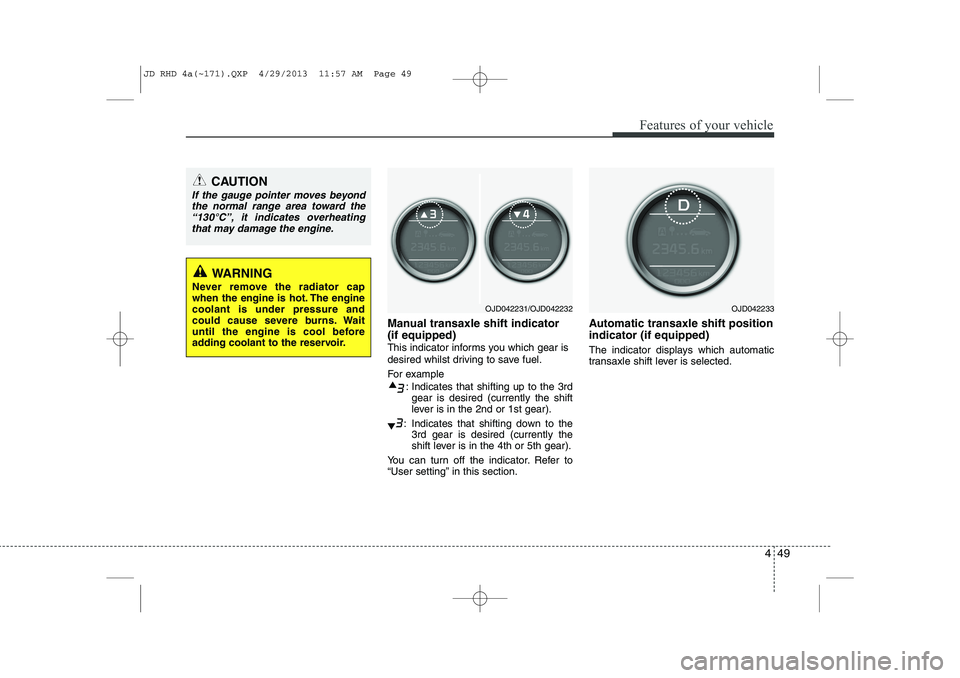
Manual transaxle shift indicator (if equipped)
This indicator informs you which gear is
desired whilst driving to save fuel.
For example: Indicates that shifting up to the 3rdgear is desired (currently the shift
lever is in the 2nd or 1st gear).
: Indicates that shifting down to the 3rd gear is desired (currently the
shift lever is in the 4th or 5th gear).
You can turn off the indicator. Refer to
“User setting” in this section. Automatic transaxle shift position indicator (if equipped)
The indicator displays which automatic
transaxle shift lever is selected.
OJD042233OJD042231/OJD042232
CAUTION
If the gauge pointer moves beyond
the normal range area toward the
“130°C”, it indicates overheatingthat may damage the engine.
WARNING
Never remove the radiator cap
when the engine is hot. The enginecoolant is under pressure and
could cause severe burns. Wait
until the engine is cool before
adding coolant to the reservoir.
JD RHD 4a(~171).QXP 4/29/2013 11:57 AM Page 49
Page 748 of 1206
Features of your vehicle
64
4
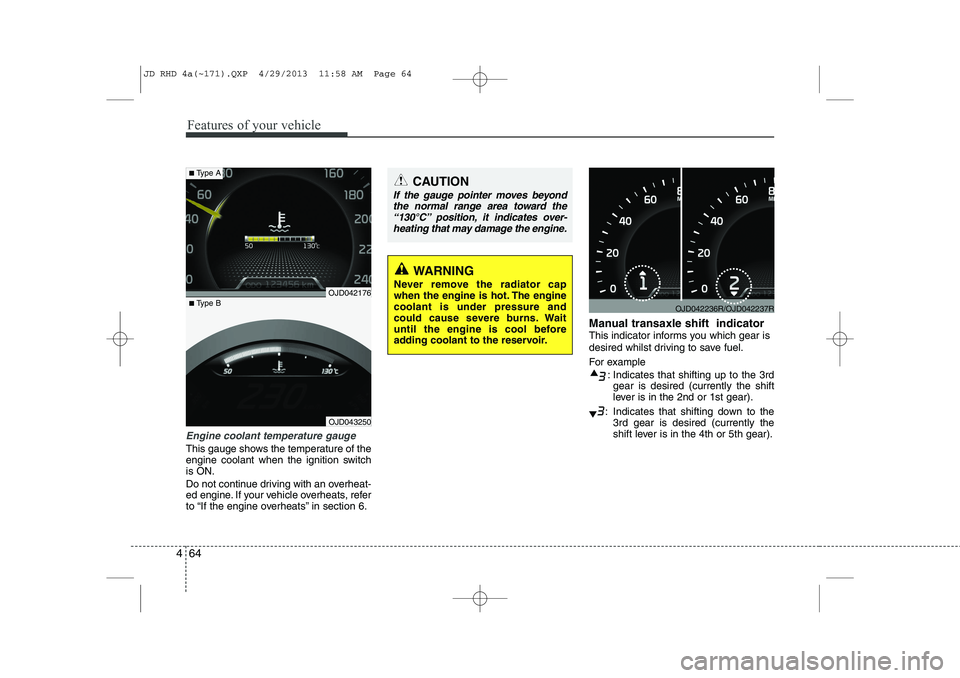
Engine coolant temperature gauge
This gauge shows the temperature of the
engine coolant when the ignition switchis ON.
Do not continue driving with an overheat-
ed engine. If your vehicle overheats, refer
to “If the engine overheats” in section 6. Manual transaxle shift indicator
This indicator informs you which gear is
desired whilst driving to save fuel.
For example
: Indicates that shifting up to the 3rdgear is desired (currently the shift
lever is in the 2nd or 1st gear).
: Indicates that shifting down to the 3rd gear is desired (currently the
shift lever is in the 4th or 5th gear).
OJD042236R/OJD042237R
CAUTION
If the gauge pointer moves beyond
the normal range area toward the
“130°C” position, it indicates over-heating that may damage the engine.
WARNING
Never remove the radiator cap
when the engine is hot. The enginecoolant is under pressure and
could cause severe burns. Wait
until the engine is cool before
adding coolant to the reservoir.
OJD043250
■ Type B
■Type A
OJD042176
JD RHD 4a(~171).QXP 4/29/2013 11:58 AM Page 64
Page 762 of 1206

Features of your vehicle
78
4
Check steering wheel lock system (if equipped)
If the steering wheel does not lock nor-
mally when the engine start/stop button
changes to the OFF position, the warning
illuminates for 10 seconds on the LCD
display. Also, the warning chime sounds
for 3 seconds and the engine start/stop
button light blinks for 10 seconds. Check "BRAKE SWITCH" fuse
When the brake switch fuse is discon-
nected, the warning illuminates for 10
seconds on the LCD display.
Replace the fuse with a new one. If that
is not possible you can start the engine
by pressing the engine start/stop button
for 10 seconds in ACC.
Torque reduced due to overheating(for T-GDI engine)
When the engine coolant temperature
exceeds 115°C, this message will be dis-
played and the torque will be reduced to
protect the engine.
OJD042069/OJD042201
■
Normal vision
■SupervisionOJD042076/OJD042208
■
Normal vision
■SupervisionOJD043509
JD RHD 4a(~171).QXP 4/29/2013 12:00 PM Page 78
Page 773 of 1206
489
Features of your vehicle
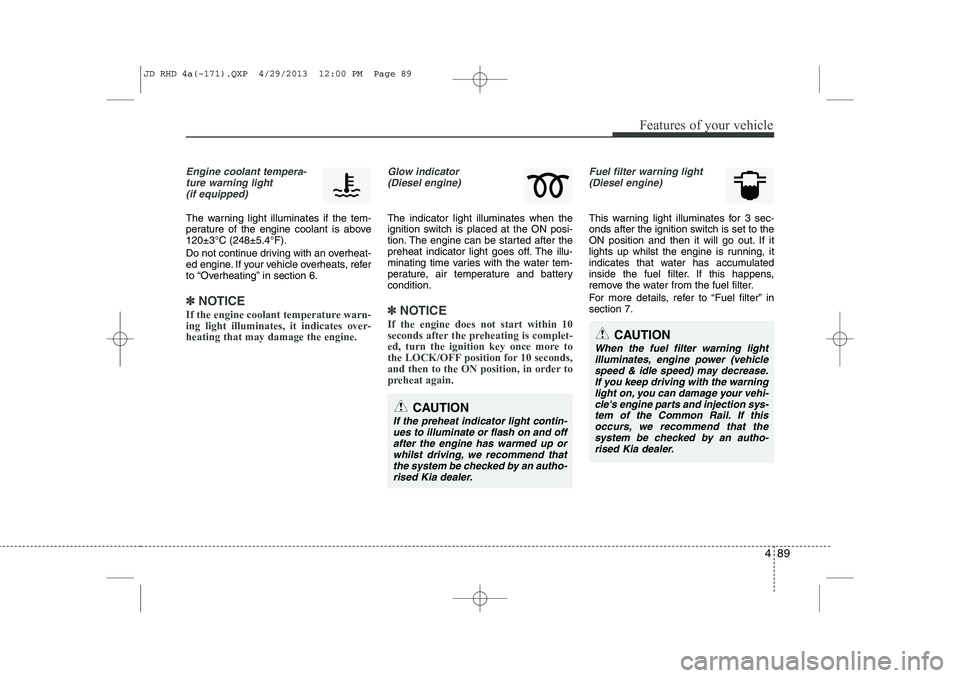
Engine coolant tempera-ture warning light(if equipped)
The warning light illuminates if the tem-
perature of the engine coolant is above120±3°C (248±5.4°F).
Do not continue driving with an overheat-
ed engine. If your vehicle overheats, refer
to “Overheating” in section 6.
✽✽ NOTICE
If the engine coolant temperature warn- ing light illuminates, it indicates over-heating that may damage the engine.
Glow indicator (Diesel engine)
The indicator light illuminates when the
ignition switch is placed at the ON posi-
tion. The engine can be started after the
preheat indicator light goes off. The illu-
minating time varies with the water tem-
perature, air temperature and batterycondition.
✽✽ NOTICE
If the engine does not start within 10
seconds after the preheating is complet-
ed, turn the ignition key once more to
the LOCK/OFF position for 10 seconds,
and then to the ON position, in order to
preheat again.
Fuel filter warning light (Diesel engine)
This warning light illuminates for 3 sec-
onds after the ignition switch is set to the
ON position and then it will go out. If it
lights up whilst the engine is running, it
indicates that water has accumulated
inside the fuel filter. If this happens,
remove the water from the fuel filter.
For more details, refer to “Fuel filter” in section 7.
CAUTION
If the preheat indicator light contin-ues to illuminate or flash on and off after the engine has warmed up orwhilst driving, we recommend that
the system be checked by an autho- rised Kia dealer.
CAUTION
When the fuel filter warning lightilluminates, engine power (vehiclespeed & idle speed) may decrease. If you keep driving with the warning
light on, you can damage your vehi-cle's engine parts and injection sys- tem of the Common Rail. If thisoccurs, we recommend that the
system be checked by an autho-rised Kia dealer.
JD RHD 4a(~171).QXP 4/29/2013 12:00 PM Page 89
Page 954 of 1206
55
Driving your vehicle
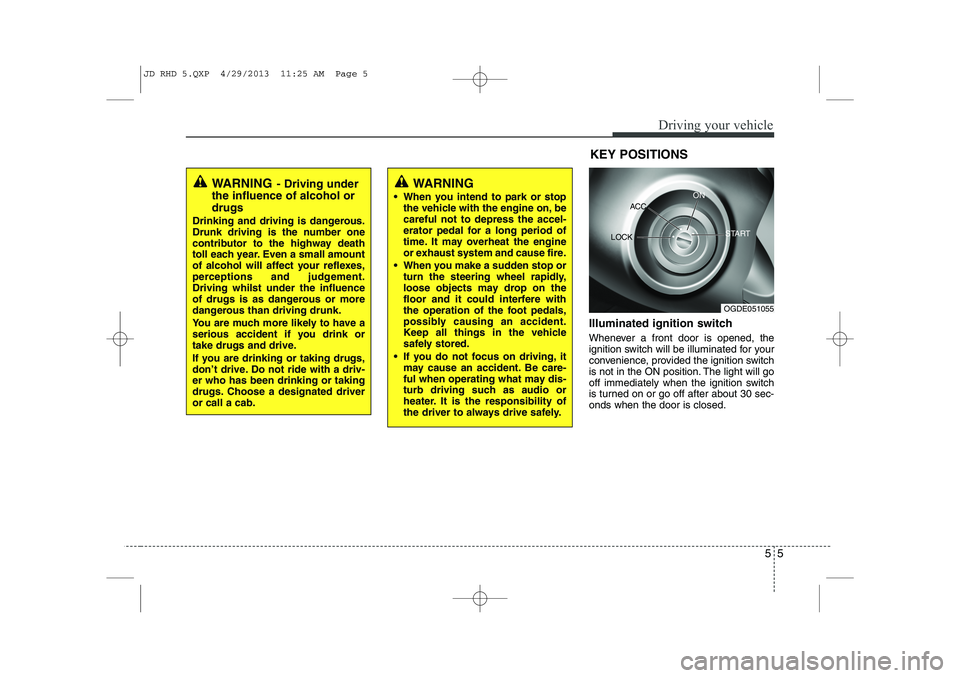
Illuminated ignition switch
Whenever a front door is opened, the
ignition switch will be illuminated for your
convenience, provided the ignition switch
is not in the ON position. The light will go
off immediately when the ignition switch
is turned on or go off after about 30 sec-onds when the door is closed.KEY POSITIONS
WARNING
- Driving under
the influence of alcohol or drugs
Drinking and driving is dangerous.
Drunk driving is the number one
contributor to the highway death
toll each year. Even a small amount
of alcohol will affect your reflexes,
perceptions and judgement.Driving whilst under the influence
of drugs is as dangerous or more
dangerous than driving drunk.
You are much more likely to have a
serious accident if you drink or
take drugs and drive.
If you are drinking or taking drugs,
don’t drive. Do not ride with a driv-er who has been drinking or taking
drugs. Choose a designated driveror call a cab.WARNING
When you intend to park or stop the vehicle with the engine on, be careful not to depress the accel-
erator pedal for a long period of
time. It may overheat the engine
or exhaust system and cause fire.
When you make a sudden stop or turn the steering wheel rapidly,
loose objects may drop on the
floor and it could interfere with
the operation of the foot pedals,
possibly causing an accident.
Keep all things in the vehicle
safely stored.
If you do not focus on driving, it may cause an accident. Be care-
ful when operating what may dis-
turb driving such as audio or
heater. It is the responsibility of
the driver to always drive safely.
OGDE051055
ACC
ON
START
LOCK
JD RHD 5.QXP 4/29/2013 11:25 AM Page 5
Page 971 of 1206
Driving your vehicle
22
5
Downshifting
When you must slow down in heavy traf-
fic or whilst driving up steep hills, down-
shift before the engine starts to labour.
Downshifting reduces the chance of
stalling and gives better acceleration
when you again need to increase your
speed. When the vehicle is travelling
down steep hills, downshifting helps
maintain safe speed and prolongs brake
life. Good driving practices
Never take the vehicle out of gear and
coast down a hill. This is extremely
hazardous. Always leave the vehicle in
gear.
Don't "ride" the brakes. This can cause them to overheat and malfunction.
Instead, when you are driving down a
long hill, slow down and shift to a lower
gear. When you do this, engine braking
will help slow down the vehicle.
Slow down before shifting to a lower gear. This will help avoid over-revving
the engine, which can cause damage.
Slow down when you encounter cross winds. This gives you much better con-
trol of your vehicle.
Be sure the vehicle is completely stopped before you attempt to shift into
R (Reverse). The transaxle can be
damaged if you do not. To shift into R
(Reverse), depress the clutch, move
the shift lever to neutral, wait three sec-
onds, then shift to the R (Reverse)position.
Exercise extreme caution when driving on a slippery surface. Be especially
careful when braking, accelerating or
shifting gears. On a slippery surface,
an abrupt change in vehicle speed can
cause the drive wheels to lose traction
and the vehicle to go out of control.WARNING
Always buckle-up! In a collision, an unbelted occupant is signifi-
cantly more likely to be seriously
injured or killed than a properlybelted occupant.
Avoid high speeds when corner- ing or turning.
Do not make quick steering wheel movements, such as sharp
lane changes or fast, sharp turns.
The risk of rollover is greatly increased if you lose control of
your vehicle at highway speeds.
Loss of control often occurs if two or more wheels drop off the
roadway and the driver over-
steers to reenter the roadway.
In the event your vehicle leaves the roadway, do not steer sharply.
Instead, slow down before pulling
back into the travel lanes.
Never exceed posted speed lim- its.
JD RHD 5.QXP 4/29/2013 11:26 AM Page 22
Page 974 of 1206
525
Driving your vehicle
CAUTION
To avoid damage to yourtransaxle, do not accelerate the
engine in R (Reverse) or any for- ward gear position with thebrakes on.
When stopped on an upgrade, do not hold the vehicle stationarywith engine power. Use the serv- ice brake or the parking brake.
Do not shift from N (Neutral) or P (Park) into D (Drive), or R
(Reverse) when the engine isabove idle speed.
CAUTION - DCT
If the vehicle is held by applying
accelerator pedal at the hill, the
transmission and clutch will be damaged. To hold at the hill, usethe parking brake or foot brake.
An overload of the clutch is indi- cated by a longitudinal judder anda blinking display. To exclude aclutch-damage, the clutch is opened and the torque flow inter-
rupted. If the clutch is opened, apply the foot brake and waitsome minutes before driving again.
Ignoring the warnings can lead to severe injuries and damage onthe car.
If the LCD warning is active, the foot brake has to be applied.
When the problem of gear system occurs, the transaxle indicatorwill blink. For your safety, we rec- ommend that you contact anauthorised Kia dealer and have
the system checked.
(Continued)
(Continued) When the clutch is overheated, the safe protection mode oper-ates. According to the safe pro-tection mode, the transaxle indi-
cator blinks with buzzer sound.The buzzer beeps 3 times.
In this time, the LCD warningabout safe protection mode also
displays. In this condition, thedriving may not be smoothly. Ifyou ignore this warning, the driv-ing condition is getting worse and
the system may have problem. Toreturn the normal driving condi- tion, apply the foot brake and
stop the vehicle for few minutes before driving off.
Whilst shifting the gear automati- cally, you may feel a correspon-ding shifting of gear. However, it
is not malfunction.
JD RHD 5.QXP 4/29/2013 11:27 AM Page 25
Page 979 of 1206
Driving your vehicle
30
5
Good driving practices
Never move the shift lever from P
(Park) or N (Neutral) to any other posi-
tion with the accelerator pedaldepressed.
Never move the shift lever into P (Park) when the vehicle is in motion.
Be sure the vehicle is completely stopped before you attempt to shift into
R (Reverse) or D (Drive).
Never take the vehicle out of gear and coast down a hill. This may be
extremely hazardous. Always leave the
vehicle in gear when moving.
Do not "ride" the brakes. This can cause them to overheat and malfunc-
tion. Instead, when you are driving
down a long hill, slow down and shift to
a lower gear. When you do this, engine
braking will help slow down the vehicle.
Slow down before shifting to a lower gear. Otherwise, the lower gear maynot be engaged.
Always use the parking brake. Do not depend on placing the transaxle in P
(Park) to keep the vehicle from moving. Exercise extreme caution when driving
on a slippery surface. Be especially
careful when braking, accelerating or
shifting gears. On a slippery surface,
an abrupt change in vehicle speed can
cause the drive wheels to lose traction
and the vehicle to go out of control.
Optimum vehicle performance and economy is obtained by smoothly
depressing and releasing the accelera-tor pedal.
WARNING
Always buckle-up! In a collision, an unbelted occupant is signifi-
cantly more likely to be seriously
injured or killed than a properlybelted occupant.
Avoid high speeds when corner- ing or turning.
Do not make quick steering wheel movements, such as sharp
lane changes or fast, sharp turns.
The risk of rollover is greatly increased if you lose control of
your vehicle at highway speeds.
Loss of control often occurs if two or more wheels drop off the
roadway and the driver over-
steers to reenter the roadway.
In the event your vehicle leaves the roadway, do not steer sharply.
Instead, slow down before pulling
back into the travel lanes.
Never exceed posted speed lim- its.
JD RHD 5.QXP 4/29/2013 11:27 AM Page 30