weight KIA CEED 2014 Owner's Manual
[x] Cancel search | Manufacturer: KIA, Model Year: 2014, Model line: CEED, Model: KIA CEED 2014Pages: 1206, PDF Size: 50.15 MB
Page 582 of 1206
85
Specifications & Consumer information
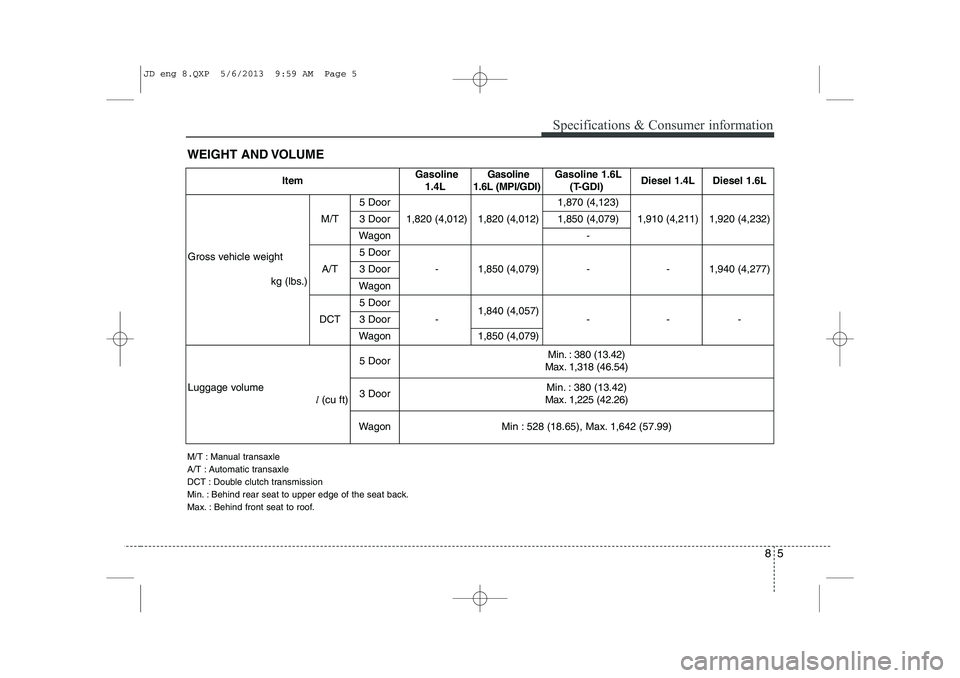
WEIGHT AND VOLUME
M/T : Manual transaxle
A/T : Automatic transaxle
DCT : Double clutch transmission
Min. : Behind rear seat to upper edge of the seat back.
Max. : Behind front seat to roof.Item
Gasoline
1.4L Gasoline
1.6L (MPI/GDI) Gasoline 1.6L
(T-GDI) Diesel 1.4L Diesel 1.6L
Gross vehicle weight kg (lbs.)M/T
5 Door
1,820 (4,012) 1,820 (4,012) 1,870 (4,123)
1,910 (4,211) 1,920 (4,232)
3 Door1,850 (4,079)
Wagon -
A/T 5 Door
- 1,850 (4,079) - - 1,940 (4,277)
3 Door
Wagon
DCT 5 Door
- 1,840 (4,057)
- - -
3 Door
Wagon 1,850 (4,079)
Luggage volume l(cu ft) 5 Door
Min. : 380 (13.42)
Max. 1,318 (46.54)
3 Door Min. : 380 (13.42)
Max. 1,225 (42.26)
Wagon Min : 528 (18.65), Max. 1,642 (57.99)
JD eng 8.QXP 5/6/2013 9:59 AM Page 5
Page 603 of 1206
I13
Index
User Settings (Normal vision) . . . . . . . . . . . . . . . . . . 4-56
User Settings (Super vision) . . . . . . . . . . . . . . . . . . . . 4-71
Vanity mirror lamp . . . . . . . . . . . . . . . . . . . . . . . . . . 4-124
Vehicle break-in process . . . . . . . . . . . . . . . . . . . . . . . . 1-5
Vehicle certification label . . . . . . . . . . . . . . . . . . . . . . 8-11
Vehicle identification number (VIN) . . . . . . . . . . . . . 8-11
Vehicle stability management (VSM) . . . . . . . . . . . . 5-47
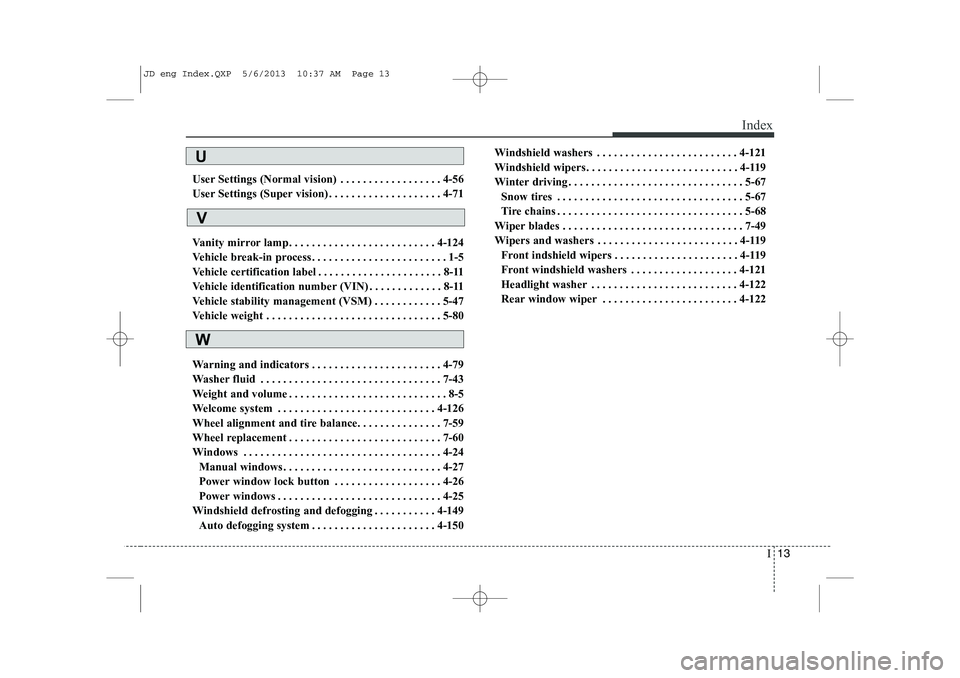
Vehicle weight . . . . . . . . . . . . . . . . . . . . . . . . . . . . . . . 5-80
Warning and indicators . . . . . . . . . . . . . . . . . . . . . . . 4-79
Washer fluid . . . . . . . . . . . . . . . . . . . . . . . . . . . . . . . . 7-43
Weight and volume . . . . . . . . . . . . . . . . . . . . . . . . . . . . 8-5
Welcome system . . . . . . . . . . . . . . . . . . . . . . . . . . . . 4-126
Wheel alignment and tire balance. . . . . . . . . . . . . . . 7-59
Wheel replacement . . . . . . . . . . . . . . . . . . . . . . . . . . . 7-60
Windows . . . . . . . . . . . . . . . . . . . . . . . . . . . . . . . . . . . 4-24
Manual windows . . . . . . . . . . . . . . . . . . . . . . . . . . . . 4-27
Power window lock button . . . . . . . . . . . . . . . . . . . 4-26
Power windows . . . . . . . . . . . . . . . . . . . . . . . . . . . . . 4-25
Windshield defrosting and defogging . . . . . . . . . . . 4-149
Auto defogging system . . . . . . . . . . . . . . . . . . . . . . 4-150 Windshield washers . . . . . . . . . . . . . . . . . . . . . . . . . 4-121
Windshield wipers . . . . . . . . . . . . . . . . . . . . . . . . . . . 4-119
Winter driving . . . . . . . . . . . . . . . . . . . . . . . . . . . . . . . 5-67
Snow tires . . . . . . . . . . . . . . . . . . . . . . . . . . . . . . . . . 5-67
Tire chains . . . . . . . . . . . . . . . . . . . . . . . . . . . . . . . . . 5-68
Wiper blades . . . . . . . . . . . . . . . . . . . . . . . . . . . . . . . . 7-49
Wipers and washers . . . . . . . . . . . . . . . . . . . . . . . . . 4-119 Front indshield wipers . . . . . . . . . . . . . . . . . . . . . . 4-119
Front windshield washers . . . . . . . . . . . . . . . . . . . 4-121
Headlight washer . . . . . . . . . . . . . . . . . . . . . . . . . . 4-122
Rear window wiper . . . . . . . . . . . . . . . . . . . . . . . . 4-122
W
U
V
JD eng Index.QXP 5/6/2013 10:37 AM Page 13
Page 609 of 1206
13
Introduction
Petrol containing alcohol andmethanol
Gasohol, a mixture of petrol and ethanol
(also known as grain alcohol), and petrolor gasohol containing methanol (also
known as wood alcohol) are being mar-
keted along with or instead of leaded orunleaded petrol. Do not use gasohol containing more than 10% ethanol, and do not use petrol or
gasohol containing any methanol. Either
of these fuels may cause drivability prob-lems and damage to the fuel system.
Discontinue using gasohol of any kind if
drivability problems occur.
Vehicle damage or driveability problems
may not be covered by the manufactur-
er’s warranty if they result from the useof:
1. Gasohol containing more than 10% ethanol.
2. Petrol or gasohol containing methanol.
3. Leaded fuel or leaded gasohol.
Use of MTBE
Kia recommends avoiding fuels contain-
ing MTBE (Methyl Tertiary Butyl Ether)
over 15.0% vol. (Oxygen Content 2.7%
weight) in your vehicle.
Fuel containing MTBE over 15.0% vol.
(Oxygen Content 2.7% weight) may
reduce vehicle performance and produce
vapour lock or hard starting.CAUTION
NEVER USE LEADED FUEL. The use of leaded fuel is detrimental to
the catalytic converter and willdamage the engine control sys-tem’s oxygen sensor and affect emission control.
Never add any fuel system cleaningagents to the fuel tank other thanwhat has been specified. We recom-mend that the system be checked
by an authorised Kia dealer.
WARNING
Do not "top off" after the nozzle automatically shuts off when refueling.
Always check that the fuel cap is installed securely to prevent fuel
spillage in the event of an acci-dent.
CAUTION
Never use gasohol which contains
methanol. Discontinue use of anygasohol product which impairs dri- vability.
CAUTION
Your New Vehicle Limited Warranty may not cover damage to the fuel
system and any performance prob- lems that are caused by the use offuels containing methanol or fuels
containing MTBE (Methyl TertiaryButyl Ether) over 15.0% vol.(Oxygen Content 2.7% weight.)
JD RHD 1.QXP 4/29/2013 11:16 AM Page 3
Page 647 of 1206
Safety system of your vehicle
28
3
Infant or small child
You should be aware of the specific
requirements in your country. Child
and/or infant seats must be properly
placed and installed in the rear seat. For
more information about the use of these
restraints, refer to “Child restraint sys-
tem” in this section.✽✽
NOTICE
Small children are best protected from
injury in an accident when properly
restrained in the rear seat by a child
restraint system that meets the require-
ments of the Safety Standards of your
country. Before buying any child
restraint system, make sure that it has alabel certifying that it meets Safety
Standards of your country. The restraint
must be appropriate for your child'sheight and weight. Check the label on
the child restraint for this information.
Refer to “Child restraint system” in thissection.Larger children
Children who are too large for child
restraint systems should always occupy
the rear seat and use the available
lap/shoulder belts. The lap portion should
be fastened and snugged on the hips
and as low as possible. Check if the belt
fits periodically. A child's squirming could
put the belt out of position. Children are
afforded the most safety in the event of
an accident when they are restrained by
a proper restraint system in the rear seat.
If a larger child (over age 12) must beseated in the front seat, the child should
be securely restrained by the availablelap/shoulder belt and the seat should be
placed in the rearmost position. Children
age 12 and under should be restrained
securely in the rear seat. NEVER place achild age 12 and under in the front seat.
NEVER place a rear facing child seat in
the front seat of a vehicle.
WARNING
Every person in your vehicle needs
to be properly restrained at all
times, including infants and chil-
dren. Never hold a child in yourarms or lap when riding in a vehi-
cle. The violent forces created dur-
ing a crash will tear the child from
your arms and throw the child
against the interior. Always use a
child restraint appropriate for your
child's height and weight.
JD RHD 3.QXP 4/29/2013 11:22 AM Page 28
Page 801 of 1206
4 117
Features of your vehicle
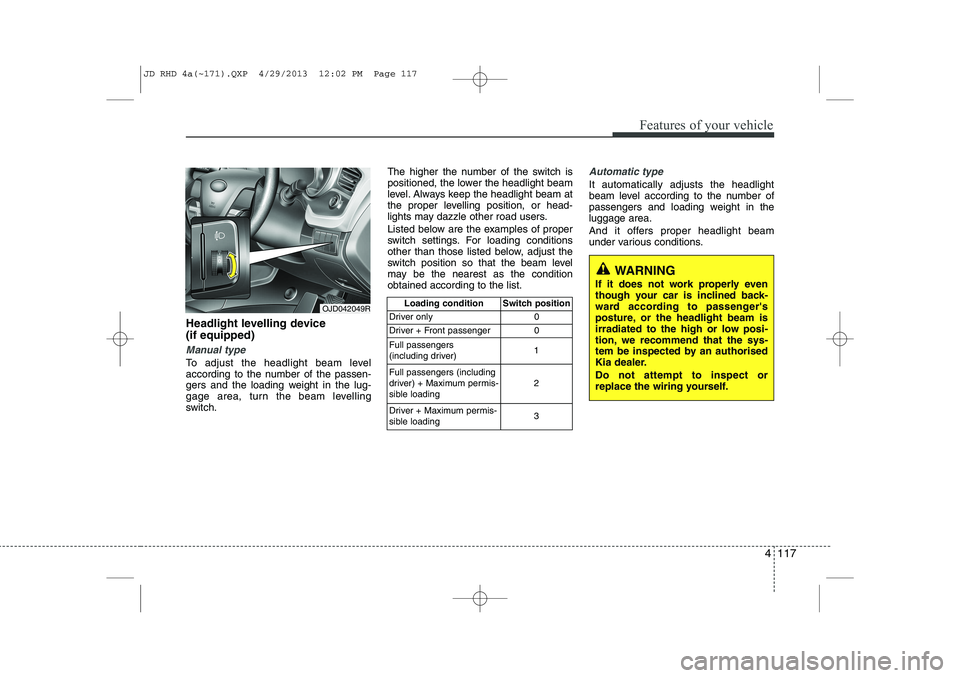
Headlight levelling device (if equipped)
Manual type
To adjust the headlight beam level
according to the number of the passen-
gers and the loading weight in the lug-
gage area, turn the beam levelling
switch.The higher the number of the switch is
positioned, the lower the headlight beam
level. Always keep the headlight beam at
the proper levelling position, or head-
lights may dazzle other road users.
Listed below are the examples of proper
switch settings. For loading conditions
other than those listed below, adjust the
switch position so that the beam level
may be the nearest as the conditionobtained according to the list.
Automatic type
It automatically adjusts the headlight
beam level according to the number of
passengers and loading weight in theluggage area.
And it offers proper headlight beam
under various conditions.
OJD042049R
Loading condition Switch position
Driver only 0
Driver + Front passenger 0 Full passengers
(including driver) 1
Full passengers (including
driver) + Maximum permis-
sible loading 2
Driver + Maximum permis-
sible loading 3
WARNING
If it does not work properly even
though your car is inclined back-
ward according to passenger's
posture, or the headlight beam is
irradiated to the high or low posi-
tion, we recommend that the sys-
tem be inspected by an authorised
Kia dealer. Do not attempt to inspect or
replace the wiring yourself.
JD RHD 4a(~171).QXP 4/29/2013 12:02 PM Page 117
Page 847 of 1206
4 163
Features of your vehicle
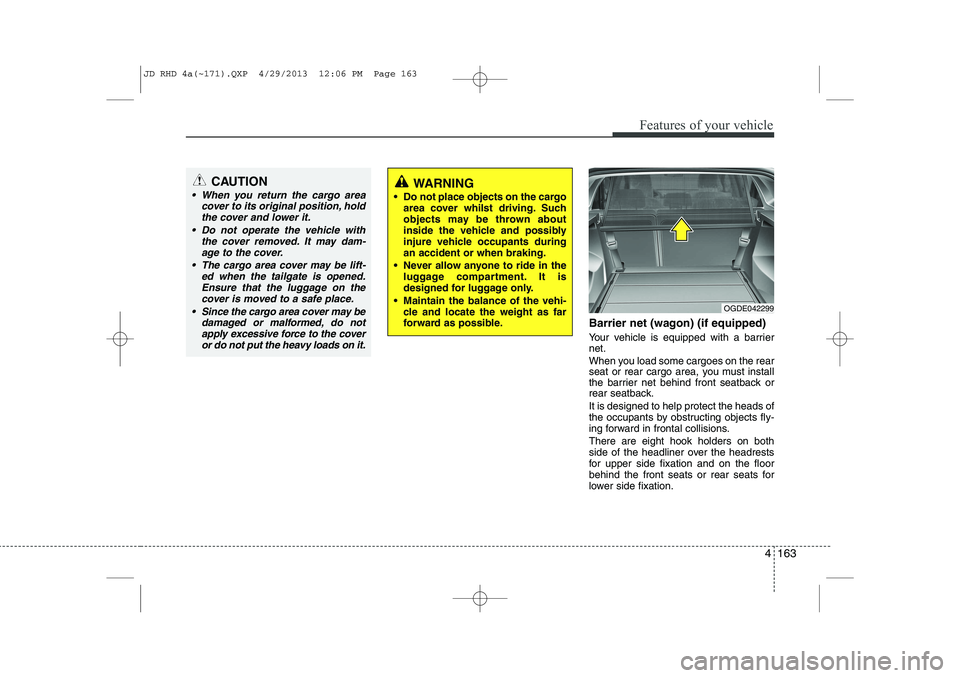
Barrier net (wagon) (if equipped)
Your vehicle is equipped with a barrier net.
When you load some cargoes on the rear
seat or rear cargo area, you must install
the barrier net behind front seatback or
rear seatback. It is designed to help protect the heads of
the occupants by obstructing objects fly-
ing forward in frontal collisions. There are eight hook holders on both
side of the headliner over the headrests
for upper side fixation and on the floor
behind the front seats or rear seats for
lower side fixation.
CAUTION
When you return the cargo areacover to its original position, hold
the cover and lower it.
Do not operate the vehicle with the cover removed. It may dam-age to the cover.
The cargo area cover may be lift- ed when the tailgate is opened.Ensure that the luggage on the cover is moved to a safe place.
Since the cargo area cover may be damaged or malformed, do not
apply excessive force to the cover or do not put the heavy loads on it.WARNING
Do not place objects on the cargo area cover whilst driving. Such
objects may be thrown about
inside the vehicle and possibly
injure vehicle occupants duringan accident or when braking.
Never allow anyone to ride in the luggage compartment. It is
designed for luggage only.
Maintain the balance of the vehi- cle and locate the weight as far
forward as possible.
OGDE042299
JD RHD 4a(~171).QXP 4/29/2013 12:06 PM Page 163
Page 851 of 1206
4 167
Features of your vehicle
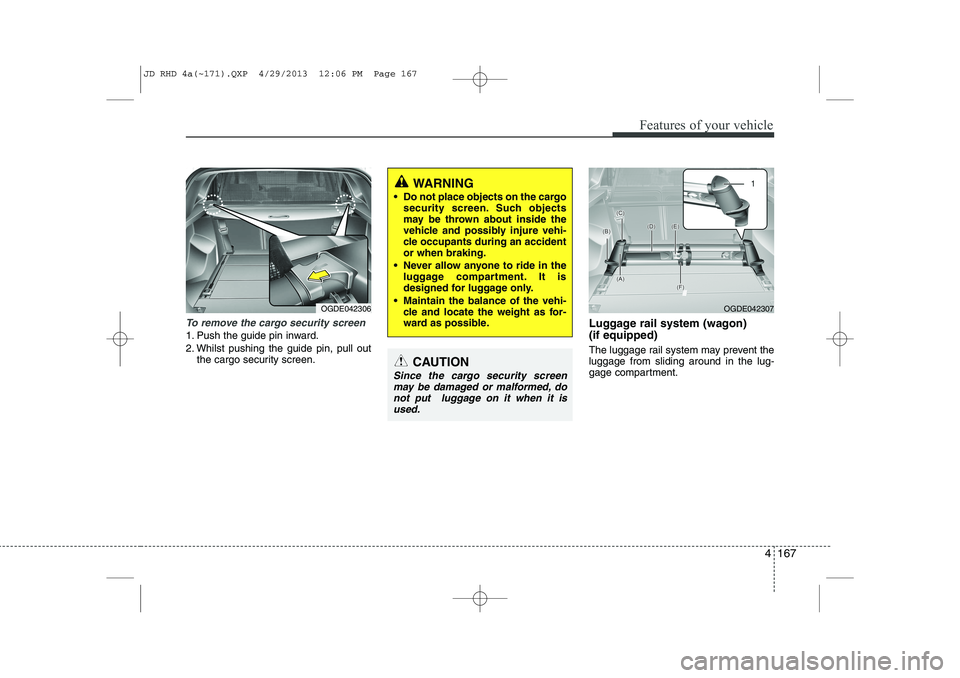
To remove the cargo security screen
1. Push the guide pin inward.
2. Whilst pushing the guide pin, pull outthe cargo security screen. Luggage rail system (wagon) (if equipped)
The luggage rail system may prevent the luggage from sliding around in the lug-
gage compartment.
WARNING
Do not place objects on the cargo security screen. Such objects
may be thrown about inside the
vehicle and possibly injure vehi-
cle occupants during an accidentor when braking.
Never allow anyone to ride in the luggage compartment. It is
designed for luggage only.
Maintain the balance of the vehi- cle and locate the weight as for-
ward as possible.
CAUTION
Since the cargo security screen
may be damaged or malformed, do
not put luggage on it when it isused.
OGDE042306OGDE042307
JD RHD 4a(~171).QXP 4/29/2013 12:06 PM Page 167
Page 855 of 1206
4 171
Features of your vehicle
(Continued)
Always drive slowly and turn cor-ners carefully when carrying
items on the roof rack. Severe
wind updrafts, caused by passing
vehicles or natural causes, can
cause sudden upward pressure
on items loaded on the roof rack.
This is especially true when car-
rying large, flat items such as
wood panels or mattresses. Thiscould cause the items to fall off
the roof rack and cause damage
to your vehicle or others around
you.
To prevent damage or loss of cargo whilst driving, check fre-
quently before or whilst driving to
make sure the items on the roof
rack are securely fastened.WARNING
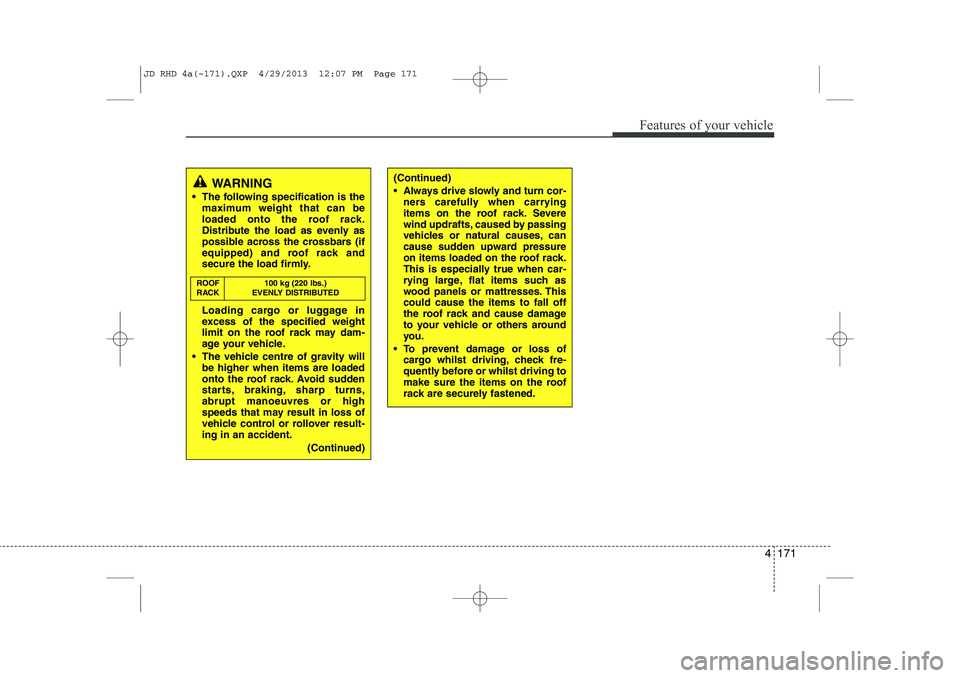
The following specification is the maximum weight that can be
loaded onto the roof rack.
Distribute the load as evenly as
possible across the crossbars (if
equipped) and roof rack and
secure the load firmly.
Loading cargo or luggage in
excess of the specified weight
limit on the roof rack may dam-
age your vehicle.
The vehicle centre of gravity will be higher when items are loaded
onto the roof rack. Avoid sudden
starts, braking, sharp turns,abrupt manoeuvres or high
speeds that may result in loss of
vehicle control or rollover result-ing in an accident.
(Continued)
ROOF 100 kg (220 lbs.)
RACK EVENLY DISTRIBUTED
JD RHD 4a(~171).QXP 4/29/2013 12:07 PM Page 171
Page 980 of 1206
531
Driving your vehicle
Moving up a steep grade from a stand-ing start
Auto transaxle and DCT
To move up a steep grade from a stand-
ing start, depress the brake pedal, shift
the shift lever to D (Drive). Select the
appropriate gear depending on load
weight and steepness of the grade, and
release the parking brake. Depress the
accelerator pedal gradually whilst releas-
ing the service brakes. Auto transaxle
When accelerating from a stop on a
steep hill, the vehicle may have a ten-
dency to roll backwards. Shifting the
shift lever into 2 (Second Gear) will
help prevent the vehicle from rolling
backwards.
WARNING
If your vehicle becomes stuck in
snow, mud, sand, etc., then you
may attempt to rock the vehicle free
by moving it forward and backward.
Do not attempt this procedure if
people or objects are anywhere
near the vehicle. During the rocking
operation the vehicle may suddenly
move forward of backward as it
becomes unstuck, causing injury
or damage to nearby people orobjects.
JD RHD 5.QXP 4/29/2013 11:27 AM Page 31
Page 1011 of 1206
Driving your vehicle
62
5
ECONOMICAL OPERATION
Your vehicle's fuel economy depends
mainly on your style of driving, where you
drive and when you drive.
Each of these factors affects how many
kilometers (miles) you can get from a
litre (gallon) of fuel. To operate your vehi-
cle as economically as possible, use the
following driving suggestions to help
save money in both fuel and repairs:
Drive smoothly. Accelerate at a moder- ate rate. Do not make "jack-rabbit"
starts or full-throttle shifts and maintain
a steady cruising speed. Do not race
between stoplights. Try to adjust your
speed to the traffic so you do not have
to change speeds unnecessarily. Avoid
heavy traffic whenever possible.
Always maintain a safe distance from
other vehicles so you can avoid unnec-
essary braking. This also reduces
brake wear.
Drive at a moderate speed. The faster you drive, the more fuel your vehicle
uses. Driving at a moderate speed,
especially on the highway, is one of the
most effective ways to reduce fuel con-sumption. Do not "ride" the brake or clutch pedal.
This can increase fuel consumption
and also increase wear on these com-
ponents. In addition, driving with your
foot resting on the brake pedal may
cause the brakes to overheat, which
reduces their effectiveness and may
lead to more serious consequences.
Take care of your tyres. Keep them inflated to the recommended pressure.
Incorrect inflation, either too much or
too little, results in unnecessary tyre
wear. Check the tyre pressures at leastonce a month.
Be sure that the wheels are aligned correctly. Improper alignment can
result from hitting curbs or driving too
fast over irregular surfaces. Poor align-
ment causes faster tyre wear and may
also result in other problems as well as
greater fuel consumption. Keep your vehicle in good condition.
For better fuel economy and reduced
maintenance costs, maintain your vehi-cle in accordance with the mainte-
nance schedule. If you drive your vehi-
cle in severe conditions, more frequentmaintenance is required.
Keep your vehicle clean. For maximum service, your vehicle should be kept
clean and free of corrosive materials. It
is especially important that mud, dirt,
ice, etc. not be allowed to accumulate
on the underside of the vehicle. This
extra weight can result in increased
fuel consumption and also contributeto corrosion.
Travel lightly. Do not carry unnecessary weight in your vehicle. Weight reduces
fuel economy.
Do not let the engine idle longer than necessary. If you are waiting (and not
in traffic), turn off your engine and
restart only when you're ready to go.
JD RHD 5.QXP 4/29/2013 11:28 AM Page 62