maintenance schedule KIA CERATO 2005 User Guide
[x] Cancel search | Manufacturer: KIA, Model Year: 2005, Model line: CERATO, Model: KIA CERATO 2005Pages: 318, PDF Size: 58.49 MB
Page 257 of 318
713
Maintenance
1 23456789
OWNER MAINTENANCE
Owner maintenance schedule
The following lists are vehicle checks and inspections that should be per-
formed by the owner or an
Authorized Kia Dealer at the fre-quencies indicated to help ensure
safe, dependable operation of your
vehicle.
Any adverse conditions should be
brought to the attention of your deal-
er as soon as possible.
These Owner Maintenance Checks
are generally not covered by war-
ranties and you may be charged for
labor, parts and lubricants used.
When you stop for fuel:
Check the engine oil level.
Check coolant level in coolant reservoir.
Check the windshield washer fluid level.
Look for low or under-inflated tyres.
While operating your vehicle:
Note any changes in the sound ofthe exhaust or any smell of
exhaust fumes in the vehicle.
Check for vibrations in the steering wheel. Notice any increased steer-
ing effort or looseness in the steer-
ing wheel, or change in its straight-ahead position.
Notice if your vehicle constantly turns slightly or “pulls” to one side
when traveling on smooth, levelroad.
When stopping, listen and check for strange sounds, pulling to one
side, increased brake pedal travel
or “hard-to-push” brake pedal.
If any slipping or changes in the operation of your transaxle occurs,
check the transaxle fluid level.
Check automatic transaxle P (Park) function.
Check parking brake.
Check for fluid leaks under your vehicle (water dripping from the air conditioning system after use is
normal).
WARNING
Be careful when checking your
engine coolant level when the
engine is hot. Scalding hot
coolant and steam may blow out
under pressure. This could
cause serious injury.
Page 263 of 318
719
Maintenance
1 23456789
ENGINE OIL AND OIL FILTER
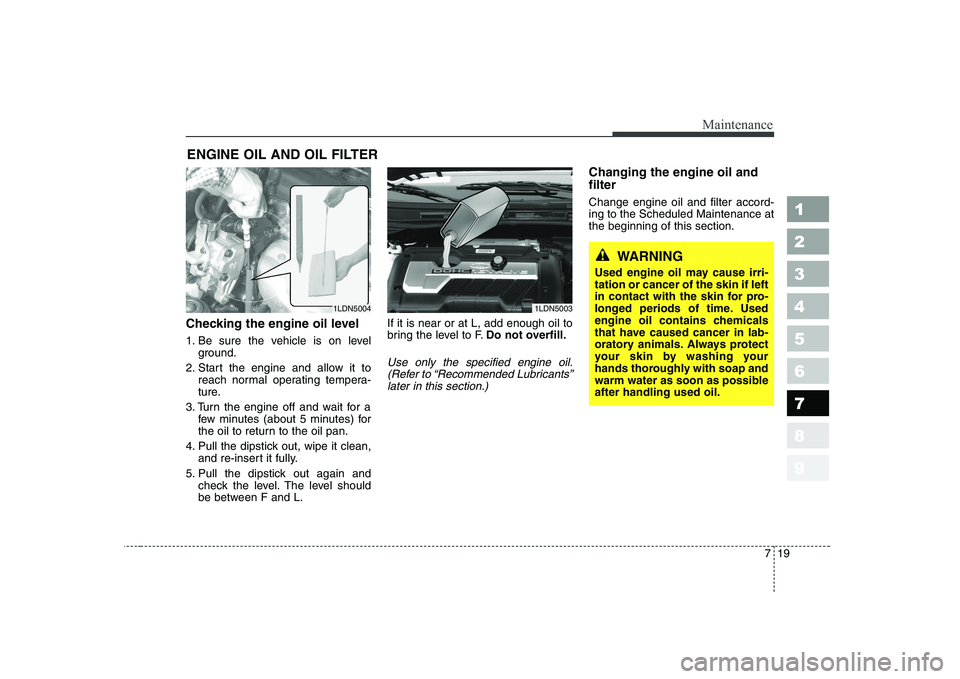
Checking the engine oil level
1. Be sure the vehicle is on level ground.
2. Start the engine and allow it to reach normal operating tempera-
ture.
3. Turn the engine off and wait for a few minutes (about 5 minutes) for
the oil to return to the oil pan.
4. Pull the dipstick out, wipe it clean, and re-insert it fully.
5. Pull the dipstick out again and check the level. The level should
be between F and L. If it is near or at L, add enough oil to
bring the level to F.
Do not overfill.
Use only the specified engine oil.
(Refer to “Recommended Lubricants” later in this section.)
Changing the engine oil and filter Change engine oil and filter accord- ing to the Scheduled Maintenance atthe beginning of this section.
1LDN50031LDN5004
WARNING
Used engine oil may cause irri- tation or cancer of the skin if left
in contact with the skin for pro-
longed periods of time. Used
engine oil contains chemicals
that have caused cancer in lab-
oratory animals. Always protect
your skin by washing your
hands thoroughly with soap and
warm water as soon as possibleafter handling used oil.
Page 267 of 318
723
Maintenance
1 23456789
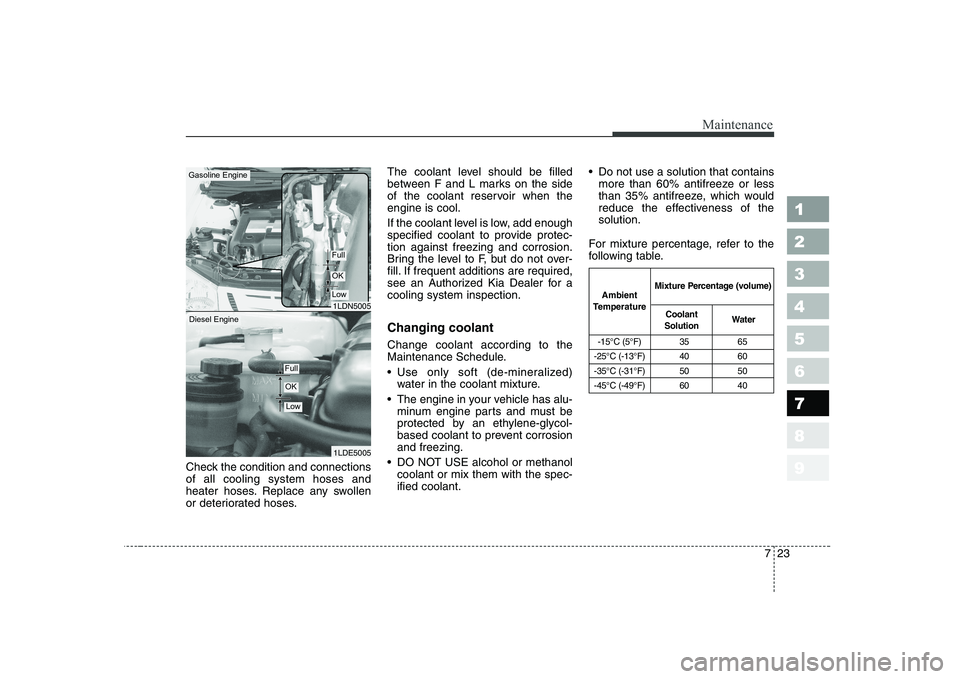
Check the condition and connections of all cooling system hoses and
heater hoses. Replace any swollen
or deteriorated hoses.The coolant level should be filled
between F and L marks on the side
of the coolant reservoir when theengine is cool.
If the coolant level is low, add enough
specified coolant to provide protec-tion against freezing and corrosion.
Bring the level to F, but do not over-
fill. If frequent additions are required,
see an Authorized Kia Dealer for acooling system inspection. Changing coolant Change coolant according to the
Maintenance Schedule.
Use only soft (de-mineralized)
water in the coolant mixture.
The engine in your vehicle has alu- minum engine parts and must be
protected by an ethylene-glycol-
based coolant to prevent corrosionand freezing.
DO NOT USE alcohol or methanol coolant or mix them with the spec-ified coolant. Do not use a solution that contains
more than 60% antifreeze or less
than 35% antifreeze, which would
reduce the effectiveness of thesolution.
For mixture percentage, refer to the
following table.
1LDN5005
-15°C (5°F) 35 65
-25°C (-13°F) 40 60
-35°C (-31°F) 50 50
-45°C (-49°F) 60 40
Ambient
Temperature Mixture Percentage (volume)
Coolant
Solution Water
Full
OK
Low
1LDE5005
Gasoline Engine
Diesel Engine
Full
OK
Low
Page 277 of 318
733
Maintenance
1 23456789
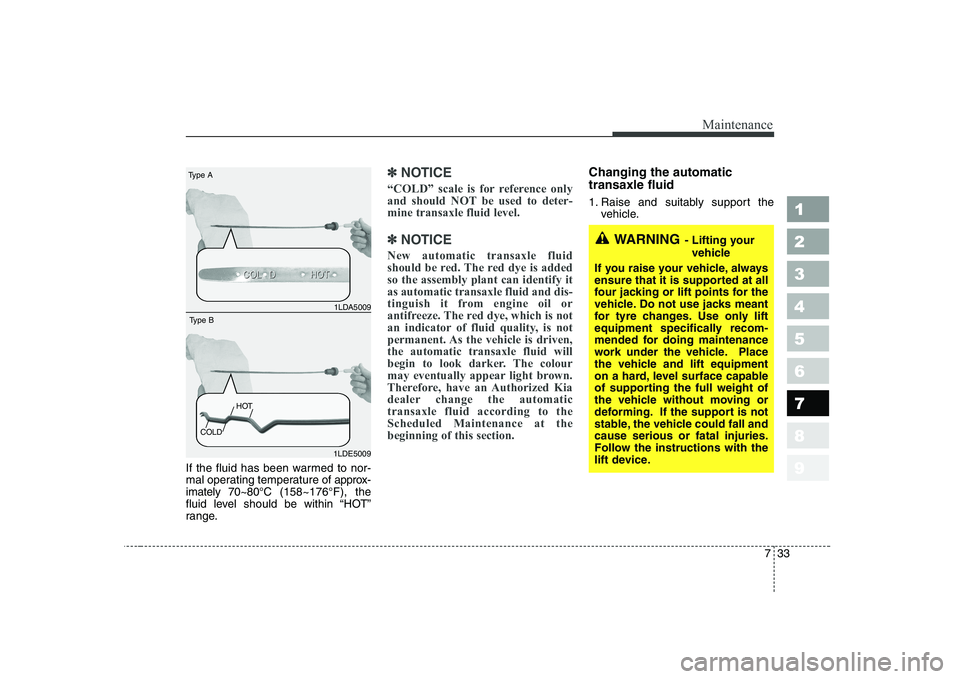
If the fluid has been warmed to nor-
mal operating temperature of approx-
imately 70~80°C (158~176°F), the
fluid level should be within “HOT”
range.
✽✽ NOTICE
“COLD” scale is for reference only
and should NOT be used to deter-mine transaxle fluid level.
✽
✽ NOTICE
New automatic transaxle fluid
should be red. The red dye is addedso the assembly plant can identify itas automatic transaxle fluid and dis-
tinguish it from engine oil or
antifreeze. The red dye, which is not
an indicator of fluid quality, is not
permanent. As the vehicle is driven,the automatic transaxle fluid will
begin to look darker. The colour
may eventually appear light brown.
Therefore, have an Authorized Kia
dealer change the automatictransaxle fluid according to theScheduled Maintenance at thebeginning of this section.
Changing the automatic transaxle fluid
1. Raise and suitably support the vehicle.
1LDA5009
Type A
1LDE5009
Type B
COLD HOT
WARNING
- Lifting your
vehicle
If you raise your vehicle, always
ensure that it is supported at all
four jacking or lift points for the
vehicle. Do not use jacks meant
for tyre changes. Use only lift
equipment specifically recom-
mended for doing maintenance
work under the vehicle. Place
the vehicle and lift equipment
on a hard, level surface capable
of supporting the full weight of
the vehicle without moving or
deforming. If the support is not
stable, the vehicle could fall andcause serious or fatal injuries.
Follow the instructions with the
lift device.
Page 282 of 318
Maintenance
38
7
1 23456789
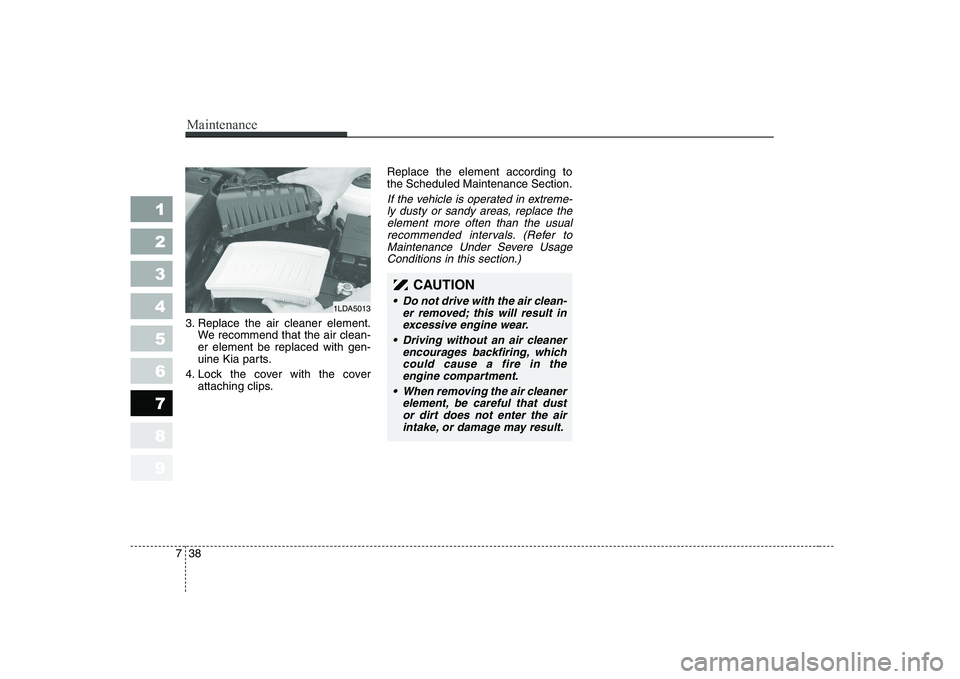
3. Replace the air cleaner element.
We recommend that the air clean- er element be replaced with gen-
uine Kia parts.
4. Lock the cover with the cover attaching clips. Replace the element according tothe Scheduled Maintenance Section.
If the vehicle is operated in extreme-
ly dusty or sandy areas, replace theelement more often than the usualrecommended intervals. (Refer to Maintenance Under Severe UsageConditions in this section.)
1LDA5013
CAUTION
Do not drive with the air clean- er removed; this will result inexcessive engine wear.
Driving without an air cleaner encourages backfiring, whichcould cause a fire in theengine compartment.
When removing the air cleaner element, be careful that dustor dirt does not enter the air intake, or damage may result.
Page 317 of 318
93
1 23456789
Index
Interior features ···························································3-91
Interior lights ·······························································3-86
Interior overview····························································2-4
Keys ·················································································3-2
Label information ························································5-23
Lighting ·········································································4-46
Loading your vehicle ···················································5-22
Lubricant specifications ··············································7-60
Lubricants and fluids ··················································7-35
Luggage net ··································································3-99
Maintenance services ·····················································7-3
Maintenance under severe usage conditions ·············7-11
Manual climate control system···································4-57
Manual transaxle ··················································4-7, 7-30
Mirrors ··········································································3-82
Normal maintenance schedule······································7-5Overheating ····································································6-3
Overloading ··································································5-21
Owner maintenance ·····················································7-13
Parking brake·······························································7-26
Power steering ······························································7-28
Remote keyless entry ·····················································3-4
Road warning ·································································6-2
Safety belts····································································3-30
Seats···············································································3-16
Special driving conditions ·············································5-7
Specifications ··································································8-2
Starting the engine ·························································4-4
Steering wheel ·····················································4-22, 7-29
Storage compartment ··················································3-88
Suggestions for economical operation··························5-6
Sunroof ··········································································3-96
K
L
M
N
O
P
R
S