oil KIA CERATO 2005 User Guide
[x] Cancel search | Manufacturer: KIA, Model Year: 2005, Model line: CERATO, Model: KIA CERATO 2005Pages: 318, PDF Size: 58.49 MB
Page 224 of 318
63
In case of an emergency
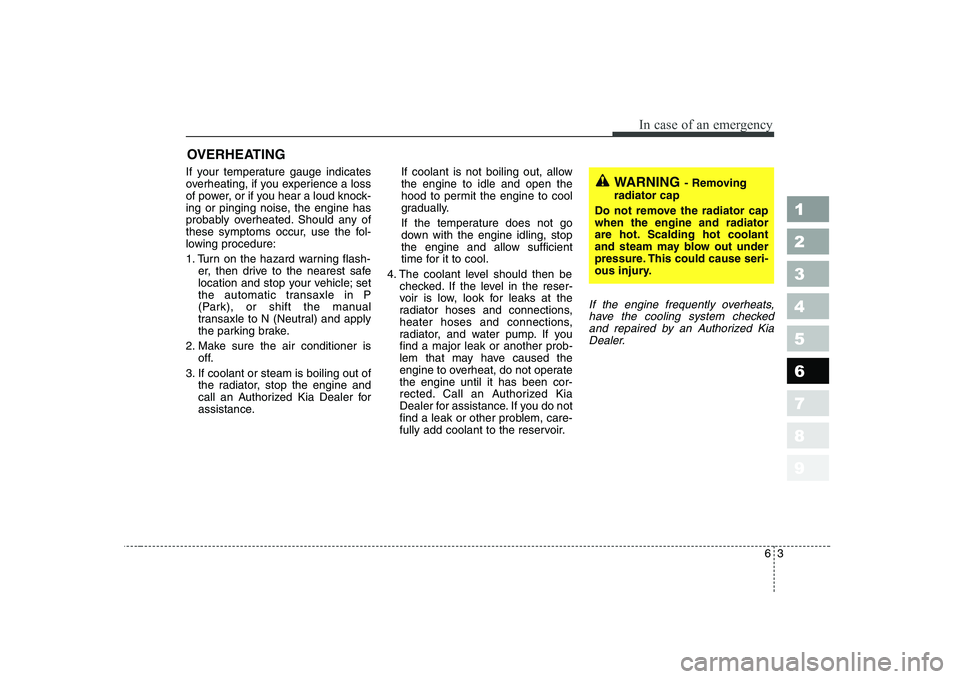
OVERHEATING
If your temperature gauge indicates
overheating, if you experience a loss
of power, or if you hear a loud knock-
ing or pinging noise, the engine has
probably overheated. Should any of
these symptoms occur, use the fol-
lowing procedure:
1. Turn on the hazard warning flash- er, then drive to the nearest safe
location and stop your vehicle; set
the automatic transaxle in P
(Park), or shift the manual
transaxle to N (Neutral) and apply
the parking brake.
2. Make sure the air conditioner is off.
3. If coolant or steam is boiling out of the radiator, stop the engine and
call an Authorized Kia Dealer for
assistance. If coolant is not boiling out, allowthe engine to idle and open the
hood to permit the engine to cool
gradually.
If the temperature does not go
down with the engine idling, stop
the engine and allow sufficient
time for it to cool.
4. The coolant level should then be checked. If the level in the reser-
voir is low, look for leaks at the
radiator hoses and connections,
heater hoses and connections,
radiator, and water pump. If youfind a major leak or another prob-
lem that may have caused the
engine to overheat, do not operatethe engine until it has been cor-
rected. Call an Authorized Kia
Dealer for assistance. If you do not
find a leak or other problem, care-
fully add coolant to the reservoir.
If the engine frequently overheats,
have the cooling system checkedand repaired by an Authorized Kia Dealer.
1 23456789
WARNING - Removing
radiator cap
Do not remove the radiator cap when the engine and radiator
are hot. Scalding hot coolant
and steam may blow out under
pressure. This could cause seri-
ous injury.
Page 239 of 318
In case of an emergency
18
6
1 23456789
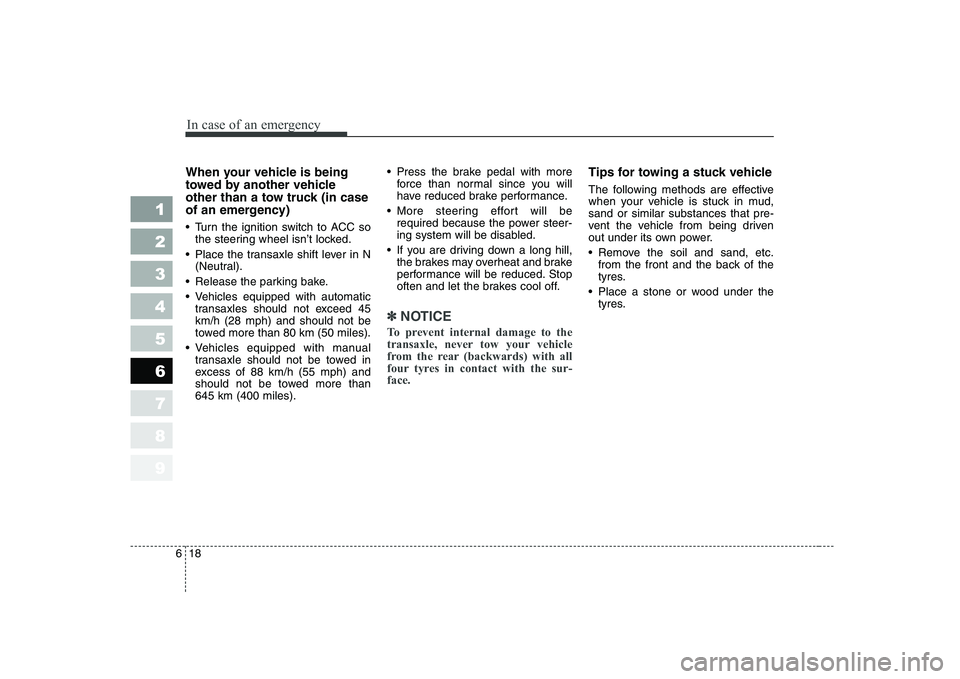
When your vehicle is being
towed by another vehicle
other than a tow truck (in case
of an emergency)
Turn the ignition switch to ACC so
the steering wheel isn’t locked.
Place the transaxle shift lever in N (Neutral).
Release the parking bake.
Vehicles equipped with automatic transaxles should not exceed 45 km/h (28 mph) and should not be
towed more than 80 km (50 miles).
Vehicles equipped with manual transaxle should not be towed in
excess of 88 km/h (55 mph) and
should not be towed more than645 km (400 miles). Press the brake pedal with more
force than normal since you will
have reduced brake performance.
More steering effort will be required because the power steer-
ing system will be disabled.
If you are driving down a long hill, the brakes may overheat and brake
performance will be reduced. Stop
often and let the brakes cool off.
✽✽ NOTICE
To prevent internal damage to the
transaxle, never tow your vehicle
from the rear (backwards) with all
four tyres in contact with the sur-face.
Tips for towing a stuck vehicle
The following methods are effective
when your vehicle is stuck in mud,sand or similar substances that pre-
vent the vehicle from being driven
out under its own power.
Remove the soil and sand, etc. from the front and the back of the
tyres.
Place a stone or wood under the tyres.
Page 245 of 318
1 234567891 23456789
10
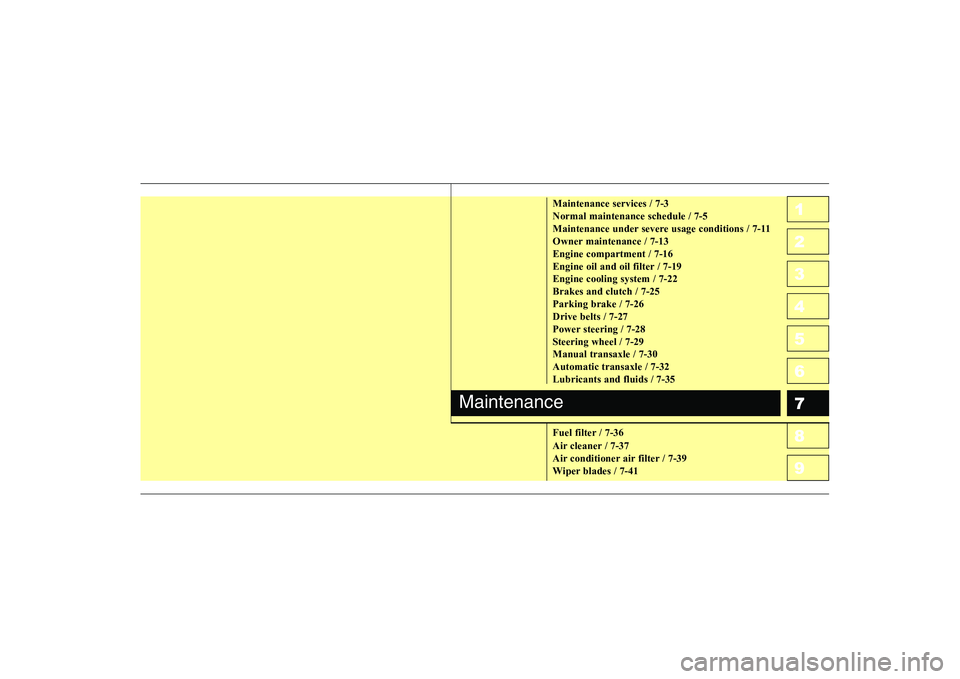
Maintenance services / 7-3 Normal maintenance schedule / 7-5
Maintenance under severe usage conditions / 7-11
Owner maintenance / 7-13Engine compartment / 7-16
Engine oil and oil filter / 7-19Engine cooling system / 7-22Brakes and clutch / 7-25Parking brake / 7-26Drive belts / 7-27
Power steering / 7-28
Steering wheel / 7-29Manual transaxle / 7-30Automatic transaxle / 7-32Lubricants and fluids / 7-35
Fuel filter / 7-36
Air cleaner / 7-37
Air conditioner air filter / 7-39
Wiper blades / 7-41
Maintenance
Page 249 of 318
75
Maintenance
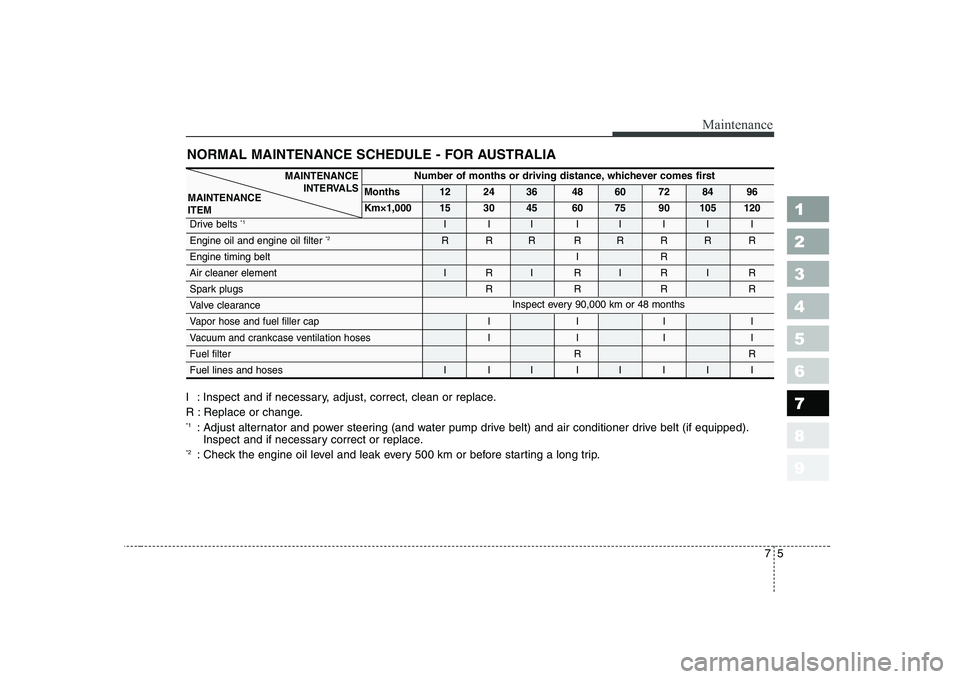
NORMAL MAINTENANCE SCHEDULE - FOR AUSTRALIA
1 23456789
I : Inspect and if necessary, adjust, correct, clean or replace.
R : Replace or change. *1: Adjust alternator and power steering (and water pump drive belt) and air conditioner drive belt (if equipped).
Inspect and if necessary correct or replace.
*2 : Check the engine oil level and leak every 500 km or before starting a long trip.
MAINTENANCE
INTERVALSNumber of months or driving distance, whichever comes first
Months 12 24 36 48 60 72 84 96
Km×1,000 15 30 45 60 75 90 105 120
Drive belts *1
III IIIII
Engine oil and engine oil filter *2
RRR RRRRR
Engine timing belt I R
Air cleaner element I R I R I R I R
Spark plugs R R R R
Valve clearance
Vapor hose and fuel filler cap I I I I
Vacuum and crankcase ventilation hoses I I I IFuel filter
RR
Fuel lines and hoses I I I I I I I I
Inspect every 90,000 km or 48 months
MAINTENANCE ITEM
Page 252 of 318
Maintenance
8
7
1 23456789
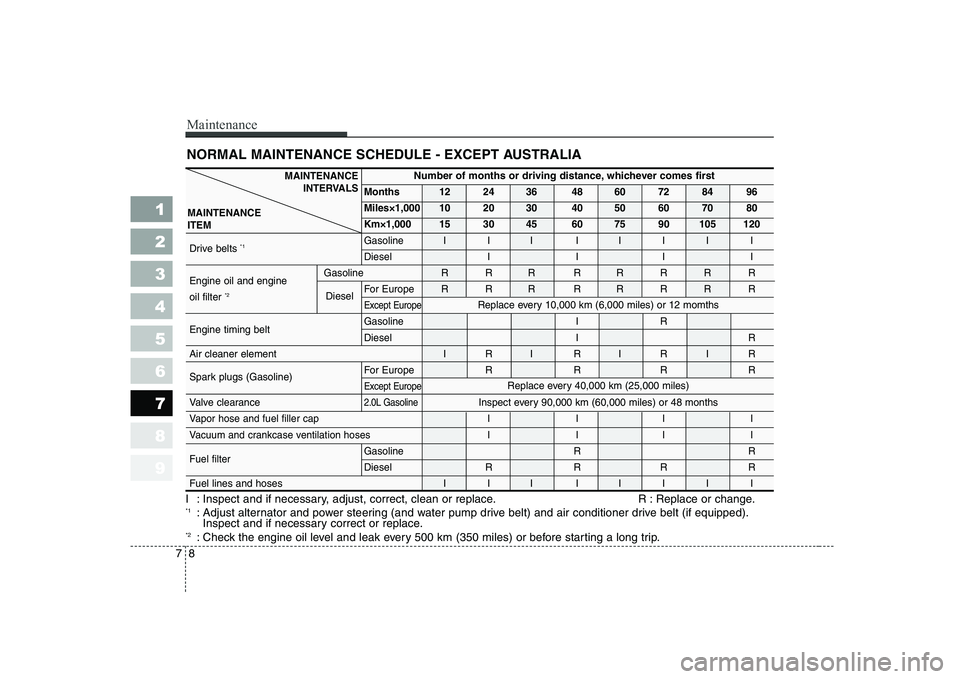
NORMAL MAINTENANCE SCHEDULE - EXCEPT AUSTRALIA
I : Inspect and if necessary, adjust, correct, clean or replace. R : Replace or change. *1
: Adjust alternator and power steering (and water pump drive belt) and air conditioner drive belt (if equipped).
Inspect and if necessary correct or replace.
*2 : Check the engine oil level and leak every 500 km (350 miles) or before starting a long trip.
MAINTENANCE
INTERVALS
MAINTENANCE ITEM
Replace every 40,000 km (25,000 miles)
Inspect every 90,000 km (60,000 miles) or 48 months
Diesel
Replace every 10,000 km (6,000 miles) or 12 momths
Number of months or driving distance, whichever comes first
Months 12 24 36 48 60 72 84 96
Miles×1,000 10 20 30 40 50 60 70 80
Km×1,000 15 30 45 60 75 90 105 120
Drive belts *1 Gasoline I I I I I I I I
Diesel I I I I
Engine oil and engine Gasoline R R R R R R R R
oil filter *2 For Europe R R R R R R R R
Except Europe
Engine timing belt Gasoline
I R
Diesel IR
Air cleaner element I R I R I R I R
Spark plugs (Gasoline) For Europe R R R R
Except Europe
Valve clearance 2.0L Gasoline
Vapor hose and fuel filler cap
I I I I
Vacuum and crankcase ventilation hoses I I I I Fuel filter
Gasoline RR
Diesel R R R R
Fuel lines and hoses I I I I I I I I
Page 255 of 318
711
Maintenance
1 23456789
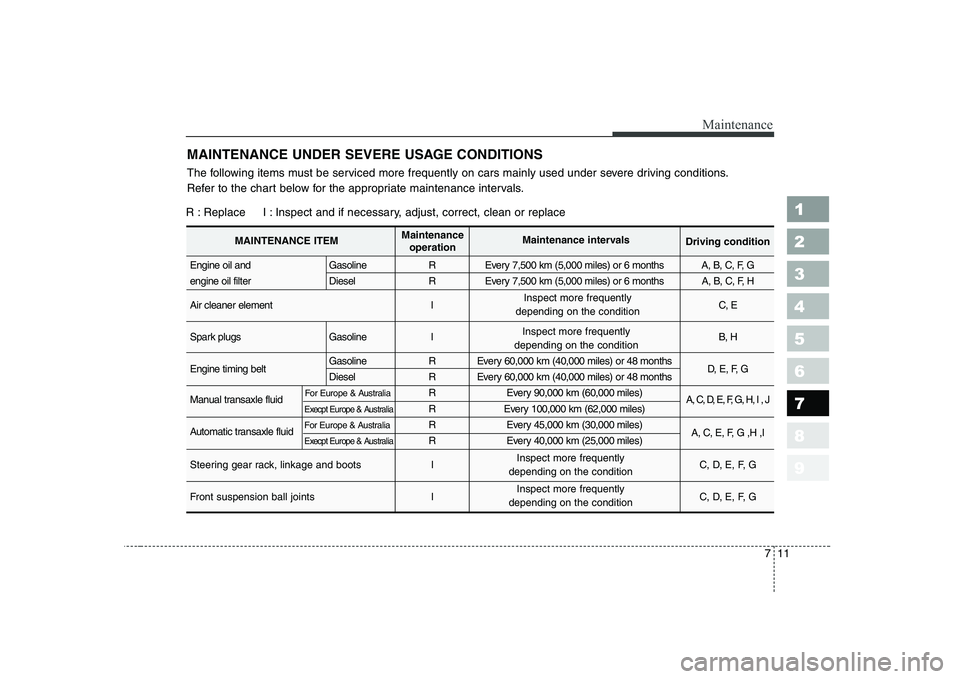
MAINTENANCE UNDER SEVERE USAGE CONDITIONS
The following items must be serviced more frequently on cars mainly used under severe driving conditions.
Refer to the chart below for the appropriate maintenance intervals.
R : Replace I : Inspect and if necessary, adjust, correct, clean or replace
Engine oil and Gasoline R Every 7,500 km (5,000 miles) or 6 months A, B, C, F, G
engine oil filter Diesel R Every 7,500 km (5,000 miles) or 6 months A, B, C, F, H
Air cleaner element IC, E
Spark plugs Gasoline I B, H
Engine timing belt Gasoline R Every 60,000 km (40,000 miles) or 48 months
D, E, F, G
Diesel R Every 60,000 km (40,000 miles) or 48 months
Manual transaxle fluid For Europe & Australia
R Every 90,000 km (60,000 miles)
A, C, D, E, F, G, H, I , J
Execpt Europe & AustraliaR Every 100,000 km (62,000 miles)
Automatic transaxle fluid For Europe & Australia
R Every 45,000 km (30,000 miles)
A, C, E, F, G ,H ,I
Execpt Europe & AustraliaR Every 40,000 km (25,000 miles)
Steering gear rack, linkage and boots I C, D, E, F, G
Front suspension ball joints I C, D, E, F, G
MAINTENANCE ITEMMaintenance
operation Maintenance intervals
Driving condition
Inspect more frequently
depending on the condition
Inspect more frequently
depending on the condition
Inspect more frequently
depending on the condition Inspect more frequently
depending on the condition
Page 257 of 318
713
Maintenance
1 23456789
OWNER MAINTENANCE
Owner maintenance schedule
The following lists are vehicle checks and inspections that should be per-
formed by the owner or an
Authorized Kia Dealer at the fre-quencies indicated to help ensure
safe, dependable operation of your
vehicle.
Any adverse conditions should be
brought to the attention of your deal-
er as soon as possible.
These Owner Maintenance Checks
are generally not covered by war-
ranties and you may be charged for
labor, parts and lubricants used.
When you stop for fuel:
Check the engine oil level.
Check coolant level in coolant reservoir.
Check the windshield washer fluid level.
Look for low or under-inflated tyres.
While operating your vehicle:
Note any changes in the sound ofthe exhaust or any smell of
exhaust fumes in the vehicle.
Check for vibrations in the steering wheel. Notice any increased steer-
ing effort or looseness in the steer-
ing wheel, or change in its straight-ahead position.
Notice if your vehicle constantly turns slightly or “pulls” to one side
when traveling on smooth, levelroad.
When stopping, listen and check for strange sounds, pulling to one
side, increased brake pedal travel
or “hard-to-push” brake pedal.
If any slipping or changes in the operation of your transaxle occurs,
check the transaxle fluid level.
Check automatic transaxle P (Park) function.
Check parking brake.
Check for fluid leaks under your vehicle (water dripping from the air conditioning system after use is
normal).
WARNING
Be careful when checking your
engine coolant level when the
engine is hot. Scalding hot
coolant and steam may blow out
under pressure. This could
cause serious injury.
Page 260 of 318
Maintenance
16
7
1 23456789
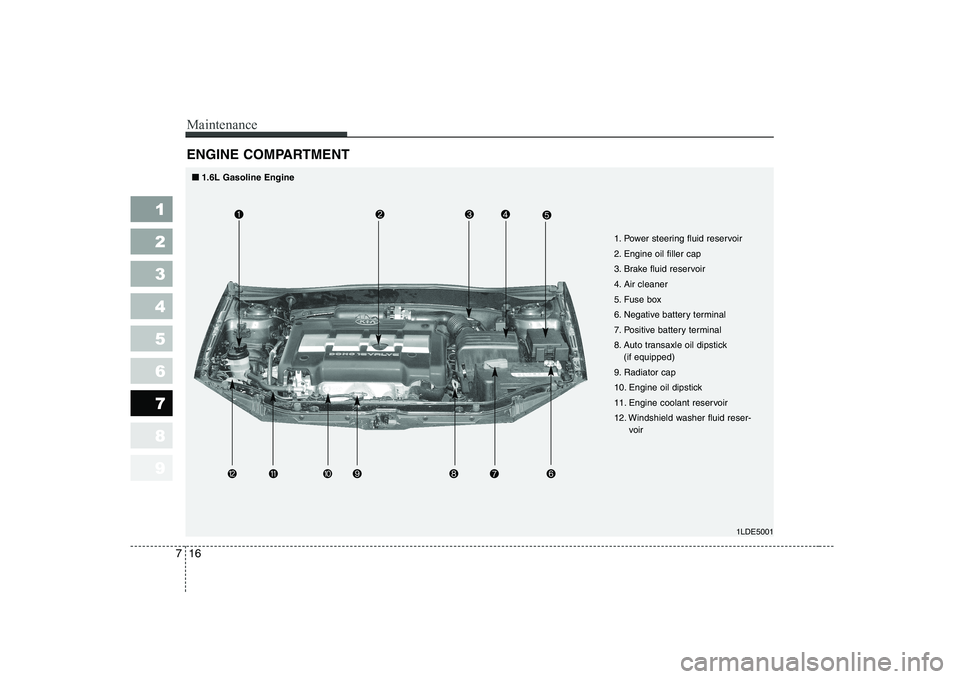
ENGINE COMPARTMENT
1LDE5001
1. Power steering fluid reservoir
2. Engine oil filler cap
3. Brake fluid reservoir
4. Air cleaner
5. Fuse box
6. Negative battery terminal
7. Positive battery terminal
8. Auto transaxle oil dipstick
(if equipped)
9. Radiator cap
10. Engine oil dipstick
11. Engine coolant reservoir
12. Windshield washer fluid reser- voir
■■1.6L Gasoline Engine
Page 261 of 318
717
Maintenance
1 23456789
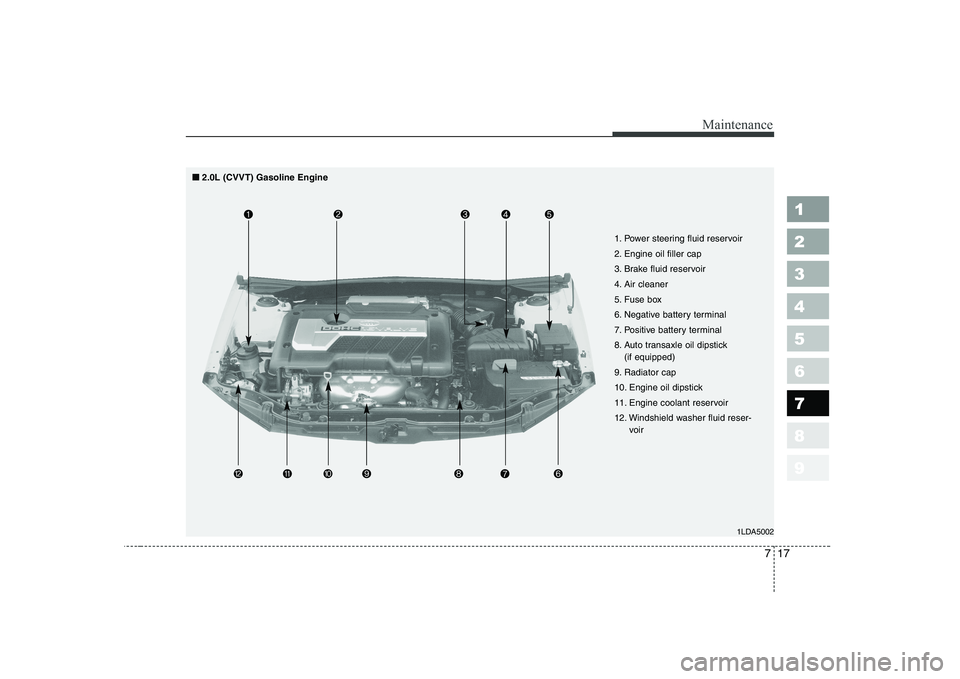
1LDA5002
1. Power steering fluid reservoir
2. Engine oil filler cap
3. Brake fluid reservoir
4. Air cleaner
5. Fuse box
6. Negative battery terminal
7. Positive battery terminal
8. Auto transaxle oil dipstick (if equipped)
9. Radiator cap
10. Engine oil dipstick
11. Engine coolant reservoir
12. Windshield washer fluid reser- voir
■
■
2.0L (CVVT) Gasoline Engine
Page 262 of 318
Maintenance
18
7
1 23456789
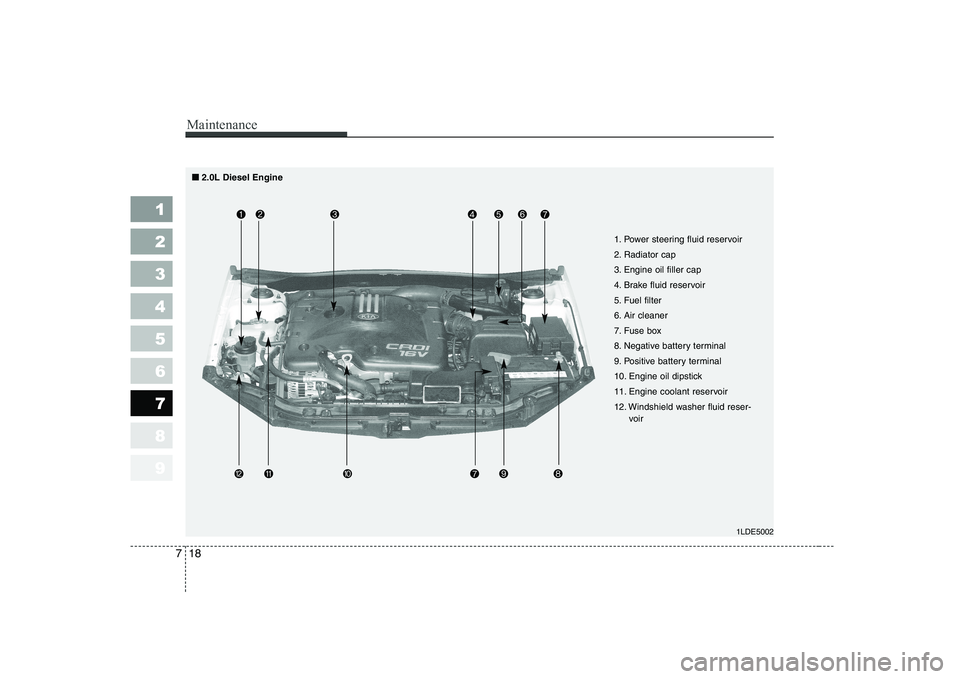
1LDE5002
1. Power steering fluid reservoir
2. Radiator cap
3. Engine oil filler cap
4. Brake fluid reservoir
5. Fuel filter
6. Air cleaner
7. Fuse box
8. Negative battery terminal
9. Positive battery terminal
10. Engine oil dipstick
11. Engine coolant reservoir
12. Windshield washer fluid reser-
voir
■
■
2.0L Diesel Engine