brakes KIA CERATO 2005 Owner's Manual
[x] Cancel search | Manufacturer: KIA, Model Year: 2005, Model line: CERATO, Model: KIA CERATO 2005Pages: 318, PDF Size: 58.49 MB
Page 248 of 318

Maintenance
4
7
Scheduled maintenance serv- ice
Follow Normal Maintenance
Schedule if the vehicle is usually
operated where none of the following
conditions apply. If any of the following
conditions apply, follow Maintenance
Under Severe Usage Conditions.
Repeated short distance driving.
Driving in dusty conditions or
sandy areas.
Extensive use of brakes.
Driving in areas where salt or other corrosive materials are being used.
Driving on rough or muddy roads.
Driving in mountainous areas.
Extended periods of idling or low speed operation.
Driving for a prolonged period in cold temperatures and/or extreme-
ly humid climates.
More than 50% driving in heavy city traffic during hot weather
above 32°C (90°F).If your vehicle is operated under the
above conditions, you shouldinspect, replace or refill more fre-quently than the following Normal
Maintenance Schedule. After 96month or 120,000 km (80,000 miles)continue to follow the prescribed maintenance intervals.
1 23456789
Page 250 of 318
Maintenance
6
7
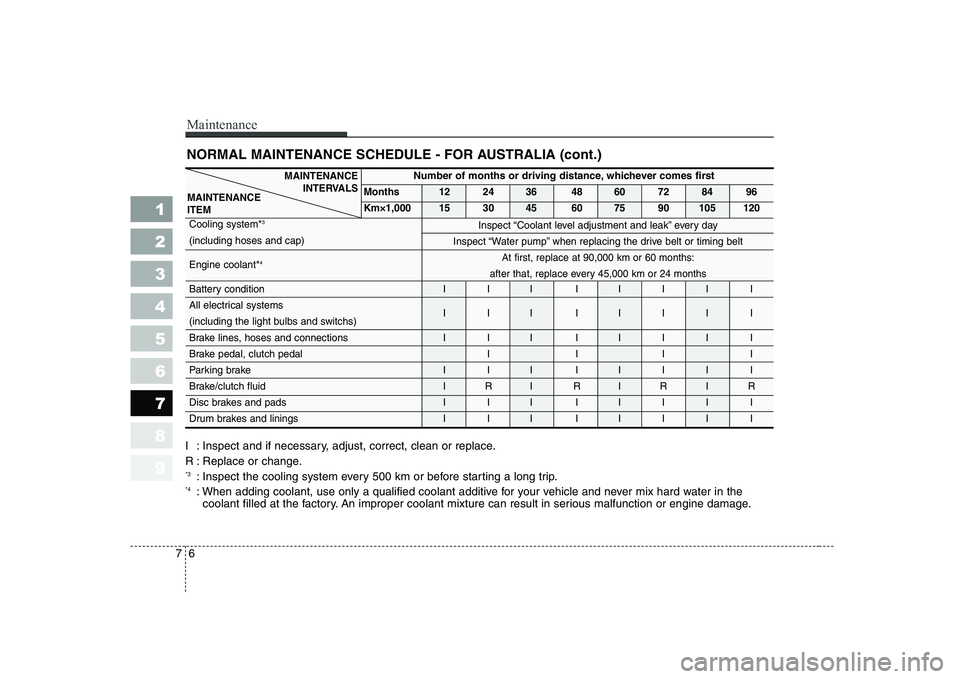
NORMAL MAINTENANCE SCHEDULE - FOR AUSTRALIA (cont.)
1 23456789
I : Inspect and if necessary, adjust, correct, clean or replace.
R : Replace or change. *3
: Inspect the cooling system every 500 km or before starting a long trip.
*4 : When adding coolant, use only a qualified coolant additive for your vehicle and never mix hard water in the
coolant filled at the factory. An improper coolant mixture can result in serious malfunction or engine damage.
MAINTENANCE
INTERVALSNumber of months or driving distance, whichever comes first
Months 12 24 36 48 60 72 84 96
Km×1,000 15 30 45 60 75 90 105 120
Cooling system* 3
(including hoses and cap) Engine coolant* 4
Battery condition I I I I I I I I
All electrical systems III IIIII
(including the light bulbs and switchs)
Brake lines, hoses and connections I I I I I I I I
Brake pedal, clutch pedal I I I I
Parking brake I I I I I I I I
Brake/clutch fluid I R I R I R I R
Disc brakes and pads I I I I I I I I
Drum brakes and linings I I I I I I I I
Inspect “Coolant level adjustment and leak” every day
Inspect “Water pump” when replacing the drive belt or timing belt
At first, replace at 90,000 km or 60 months:
after that, replace every 45,000 km or 24 months
MAINTENANCE ITEM
Page 253 of 318
79
Maintenance
1 23456789
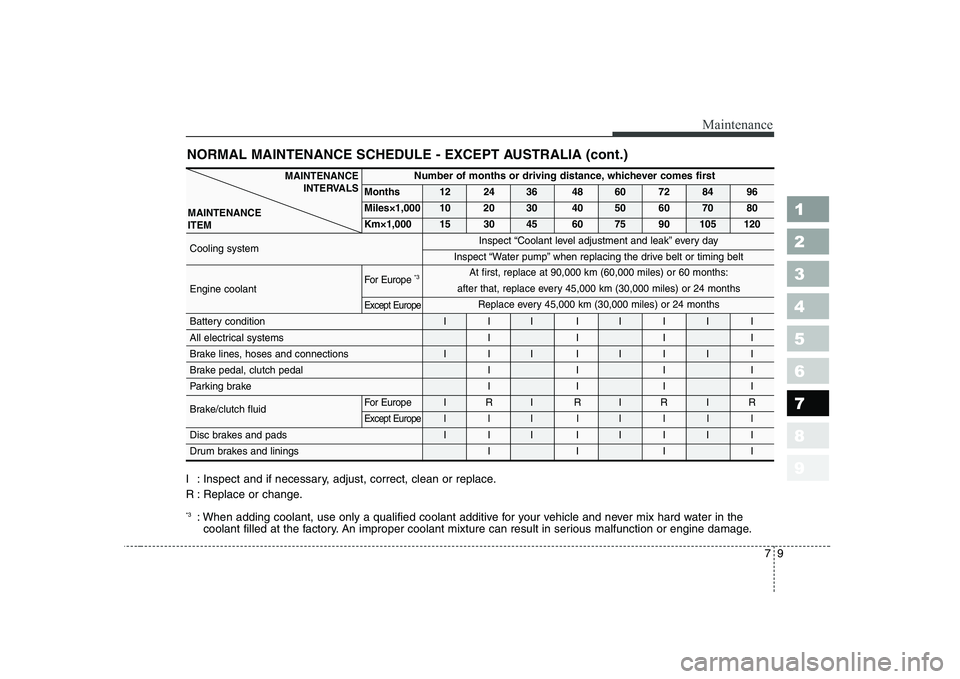
NORMAL MAINTENANCE SCHEDULE - EXCEPT AUSTRALIA (cont.)
I : Inspect and if necessary, adjust, correct, clean or replace.
R : Replace or change. *3: When adding coolant, use only a qualified coolant additive for your vehicle and never mix hard water in the
coolant filled at the factory. An improper coolant mixture can result in serious malfunction or engine damage.
MAINTENANCE
INTERVALS
MAINTENANCE ITEMNumber of months or driving distance, whichever comes first
Months 12 24 36 48 60 72 84 96
Miles×1,000 10 20 30 40 50 60 70 80
Km×1,000 15 30 45 60 75 90 105 120
Cooling system
For Europe *3
Engine coolant
Except Europe
Battery condition I I I I I I I I
All electrical systems I I I I
Brake lines, hoses and connections I I I I I I I I
Brake pedal, clutch pedal I I I I
Parking brake I I I I
Brake/clutch fluid
For EuropeIRI RIRIR
Except Europe I I I I I I I I
Disc brakes and pads I I I I I I I I
Drum brakes and linings I I I I
Inspect “Coolant level adjustment and leak” every day
Inspect “Water pump” when replacing the drive belt or timing belt
At first, replace at 90,000 km (60,000 miles) or 60 months:
after that, replace every 45,000 km (30,000 miles) or 24 months Replace every 45,000 km (30,000 miles) or 24 months
Page 256 of 318
Maintenance
12
7
1 23456789
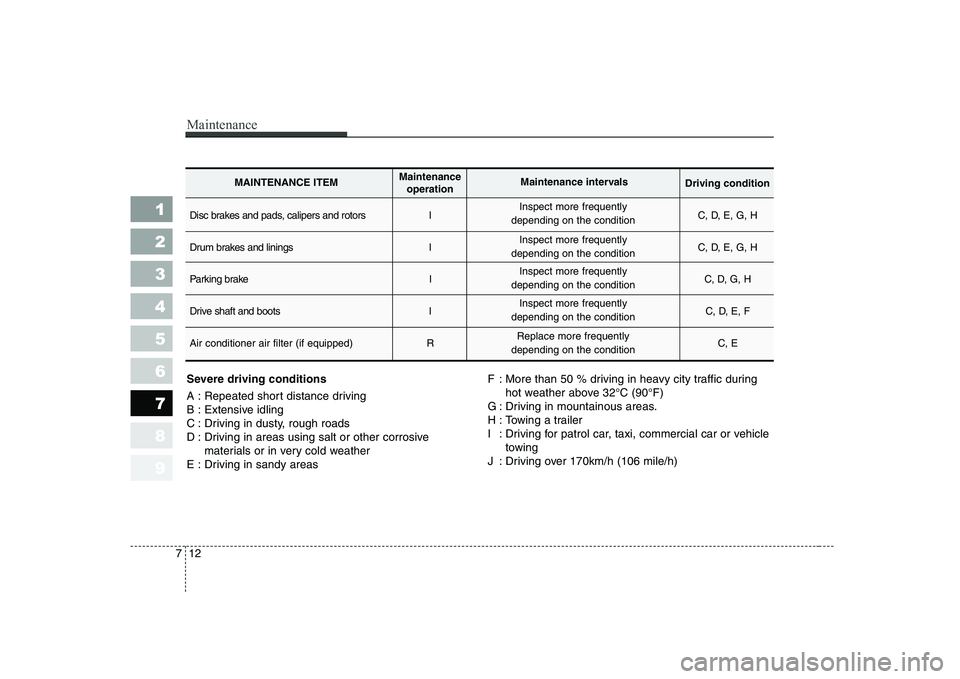
Severe driving conditions
A : Repeated short distance driving
B : Extensive idling
C : Driving in dusty, rough roads
D : Driving in areas using salt or other corrosive
materials or in very cold weather
E : Driving in sandy areas F : More than 50 % driving in heavy city traffic during
hot weather above 32°C (90°F)
G : Driving in mountainous areas.
H : Towing a trailer
I : Driving for patrol car, taxi, commercial car or vehicle towing
J : Driving over 170km/h (106 mile/h)
Disc brakes and pads, calipers and rotors I C, D, E, G, H
Drum brakes and linings I C, D, E, G, H
Parking brake I C, D, G, H
Drive shaft and boots I C, D, E, F
Air conditioner air filter (if equipped) R C, E
MAINTENANCE ITEMMaintenance
operation Maintenance intervals
Driving condition
Inspect more frequently
depending on the condition
Inspect more frequently
depending on the condition
Inspect more frequently
depending on the condition
Inspect more frequently
depending on the condition
Replace more frequently
depending on the condition
Page 269 of 318
725
Maintenance
1 23456789
BRAKES AND CLUTCH (IF EQUIPPED)
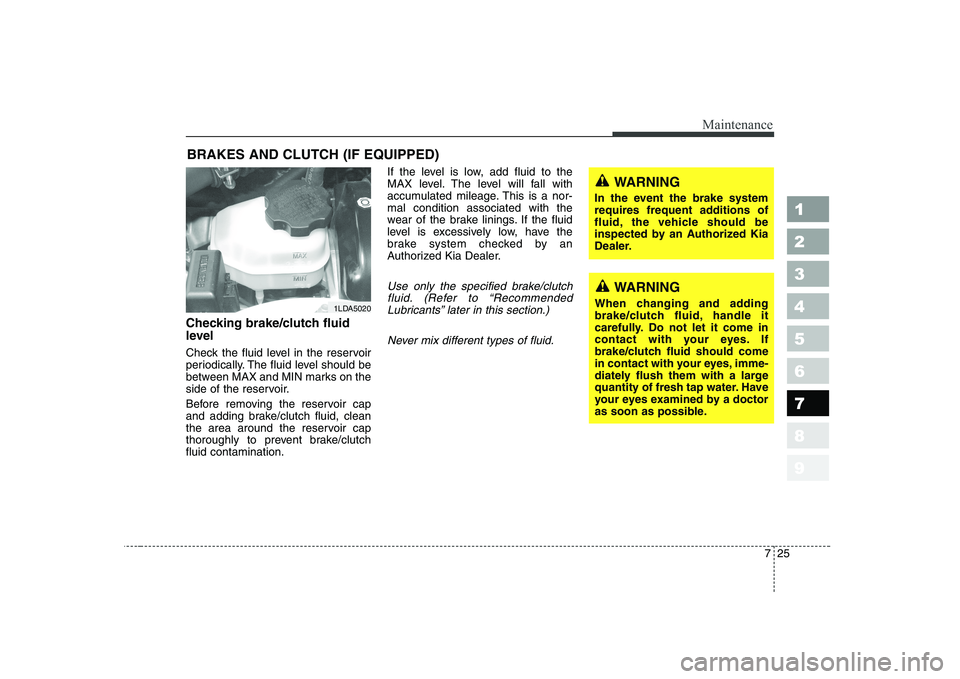
Checking brake/clutch fluid
level
Check the fluid level in the reservoir
periodically. The fluid level should be
between MAX and MIN marks on the
side of the reservoir.
Before removing the reservoir cap
and adding brake/clutch fluid, clean
the area around the reservoir cap
thoroughly to prevent brake/clutchfluid contamination. If the level is low, add fluid to the
MAX level. The level will fall with
accumulated mileage. This is a nor-mal condition associated with the
wear of the brake linings. If the fluid
level is excessively low, have the
brake system checked by an
Authorized Kia Dealer.
Use only the specified brake/clutch
fluid. (Refer to “Recommended Lubricants” later in this section.)
Never mix different types of fluid.WARNING
When changing and adding
brake/clutch fluid, handle it
carefully. Do not let it come in
contact with your eyes. If
brake/clutch fluid should come
in contact with your eyes, imme-
diately flush them with a large
quantity of fresh tap water. Have
your eyes examined by a doctor
as soon as possible.
WARNING
In the event the brake system
requires frequent additions of
fluid, the vehicle should be
inspected by an Authorized Kia
Dealer.
1LDA5020
Page 306 of 318
Maintenance
62
7
1 23456789
EXTERIOR CARE
Exterior general caution
It is very important to follow the label
directions when using any chemical
cleaner or polish. Read all warningand caution statements that appearon the label. Finish maintenance
Washing
To help protect your vehicle’s finish
from rust and deterioration, wash itthoroughly and frequently at least
once a month with lukewarm or cold
water.
If you use your vehicle for off-road
driving, you should wash it after each
off-road trip. Pay special attention to
the removal of any accumulation of
salt, dirt, mud, and other foreign
materials. Make sure the drain holes
in the lower edges of the doors and
rocker panels are kept clear andclean. Insects, tar, tree sap, bird droppings,
industrial pollution and similar
deposits can damage your vehicle’s
finish if not removed immediately.
Even prompt washing with plain
water may not completely remove all
these deposits. A mild soap, safe for
use on painted surfaces, may beused.
After washing, rinse the vehicle thor-
oughly with lukewarm or cold water.
Do not allow soap to dry on the fin-ish.
✽✽
NOTICE
Do not use strong soap, chemical
detergents or hot water, and do not
wash the vehicle in direct sunlight orwhen the body of the vehicle iswarm.
CAUTION
Water washing in the engine compartment may cause thefailure of electrical circuitslocated in the engine compart- ment.
Pay extreme attention to wash the engine compartment byusing water.
WARNING
After washing the vehicle, test
the brakes while driving slowly
to see if they have been affected
by water. If braking performance
is impaired, dry the brakes by
applying them lightly while
maintaining a slow forwardspeed.
Page 308 of 318
Maintenance
64
7
1 23456789
Bright-metal maintenance
To remove road tar and insects,
use a tar remover, not a scraper or
other sharp object.
To protect the surfaces of bright- metal parts from corrosion, apply a
coating of wax or chrome preser-
vative and rub to a high luster.
During winter weather or in coastal areas, cover the bright metal parts
with a heavier coating of wax or
preservative. If necessary, coat the
parts with non-corrosive petroleum
jelly or other protective compound. Underbody maintenance
Corrosive materials used for ice and
snow removal and dust control may
collect on the underbody. If these
materials are not removed, acceler-
ated rusting can occur on underbody
parts such as the fuel lines, frame,
floor pan and exhaust system, even
though they have been treated with
rust protection.
Thoroughly flush the vehicle under-
body and wheel openings with luke-
warm or cold water once a month,
after off-road driving and at the end
of each winter. Pay special attentionto these areas because it is difficult
to see all the mud and dirt. It will do
more harm than good to wet down
the road grime without removing it.
The lower edges of doors, rocker
panels, and frame members have
drain holes that should not be
allowed to clog with dirt; trapped
water in these areas can cause rust-ing.WARNING
After washing the vehicle, test
the brakes while driving slowly
to see if they have been affected
by water. If braking performance
is impaired, dry the brakes by
applying them lightly while
maintaining a slow forwardspeed.
Page 316 of 318
Index
2
9
1 23456789
Air cleaner ····································································7-37
Air conditioner air filter··············································7-39
Airbags-supplemental restraint system ·····················3-56
Antenna ·······································································3-100
Automatic climate control system ······························4-66
Automatic transaxle ·············································4-8, 7-32
Battery···········································································7-43
Before driving·································································5-5
Brake system ································································4-15
Brakes and clutch ························································7-25
Bulb replacement ·························································7-53
Cruise control system ··················································4-25
Defroster ·······································································4-55
Door locks ·······································································3-8
Drive belts ·····································································7-27
Electrical circuit protection ··········································6-7
Emergency starting························································6-4 Emission control system ················································5-3
Engine compartment ···················································7-16
Engine cooling system ·················································7-22
Engine oil and oil filter················································7-19
Exterior care·································································7-62
Exterior overview···························································2-2
Fuel filler lid ·································································3-79
Fuel filter ······································································7-36
Fuel requirements ··························································5-2
Gauges ···········································································4-34
Hazard warning flasher ··············································4-56
Hood ··············································································3-77
How to use this manual ·················································1-2
If you have a flat tyre ··················································6-19
Ignition switch ································································4-2
Immobilizer system ························································3-7
Instrument cluster ·······················································4-33
Instrument panel overview ···········································2-5
Interior care··································································7-66
A
B
C
D
E
F
G
H
I