battery KIA CERATO 2005 Owner's Guide
[x] Cancel search | Manufacturer: KIA, Model Year: 2005, Model line: CERATO, Model: KIA CERATO 2005Pages: 318, PDF Size: 58.49 MB
Page 287 of 318
743
Maintenance
1 23456789
BATTERY
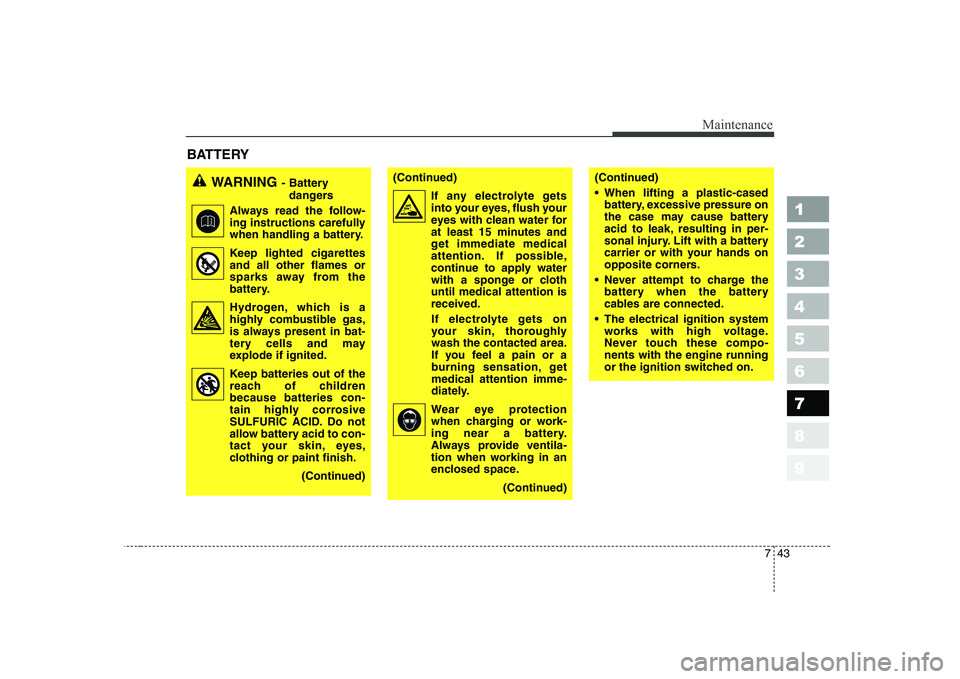
WARNING- Battery
dangers
Always read the follow-
ing instructions carefully
when handling a battery.
Keep lighted cigarettes and all other flames or
sparks away from the
battery.
Hydrogen, which is a highly combustible gas,
is always present in bat-
tery cells and may
explode if ignited.
Keep batteries out of the reach of children because batteries con-
tain highly corrosive
SULFURIC ACID. Do not
allow battery acid to con-
tact your skin, eyes,
clothing or paint finish.
(Continued)(Continued)If any electrolyte getsinto your eyes, flush your
eyes with clean water for
at least 15 minutes and
get immediate medical
attention. If possible,
continue to apply water
with a sponge or clothuntil medical attention isreceived.
If electrolyte gets on
your skin, thoroughlywash the contacted area.
If you feel a pain or a
burning sensation, getmedical attention imme-
diately.
Wear eye protection when charging or work-
ing near a battery.
Always provide ventila-
tion when working in an
enclosed space.
(Continued)(Continued)
When lifting a plastic-casedbattery, excessive pressure on
the case may cause battery
acid to leak, resulting in per-
sonal injury. Lift with a battery
carrier or with your hands on
opposite corners.
Never attempt to charge the battery when the battery
cables are connected.
The electrical ignition system works with high voltage.
Never touch these compo-nents with the engine running
or the ignition switched on.
Page 288 of 318
Maintenance
44
7
1 23456789
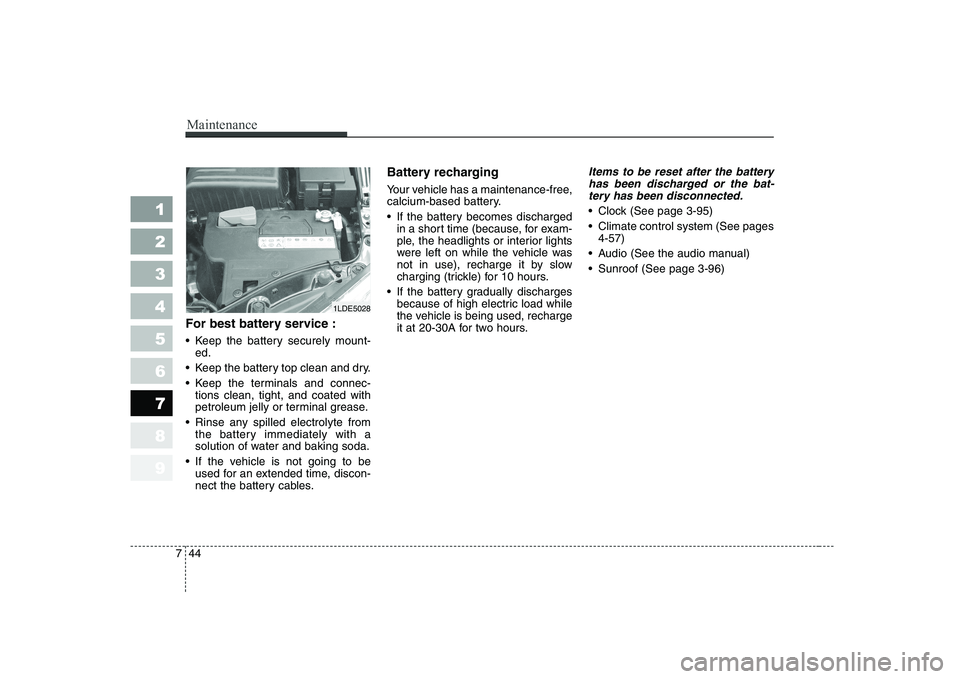
For best battery service :
Keep the battery securely mount-
ed.
Keep the battery top clean and dry.
Keep the terminals and connec- tions clean, tight, and coated with
petroleum jelly or terminal grease.
Rinse any spilled electrolyte from the battery immediately with a
solution of water and baking soda.
If the vehicle is not going to be used for an extended time, discon-
nect the battery cables. Battery recharging
Your vehicle has a maintenance-free,
calcium-based battery.
If the battery becomes discharged
in a short time (because, for exam-
ple, the headlights or interior lights
were left on while the vehicle was
not in use), recharge it by slow
charging (trickle) for 10 hours.
If the battery gradually discharges because of high electric load while
the vehicle is being used, recharge
it at 20-30A for two hours.
Items to be reset after the battery
has been discharged or the bat-tery has been disconnected.
Clock (See page 3-95)
Climate control system (See pages 4-57)
Audio (See the audio manual)
Sunroof (See page 3-96)
1LDE5028
Page 316 of 318
Index
2
9
1 23456789
Air cleaner ····································································7-37
Air conditioner air filter··············································7-39
Airbags-supplemental restraint system ·····················3-56
Antenna ·······································································3-100
Automatic climate control system ······························4-66
Automatic transaxle ·············································4-8, 7-32
Battery···········································································7-43
Before driving·································································5-5
Brake system ································································4-15
Brakes and clutch ························································7-25
Bulb replacement ·························································7-53
Cruise control system ··················································4-25
Defroster ·······································································4-55
Door locks ·······································································3-8
Drive belts ·····································································7-27
Electrical circuit protection ··········································6-7
Emergency starting························································6-4 Emission control system ················································5-3
Engine compartment ···················································7-16
Engine cooling system ·················································7-22
Engine oil and oil filter················································7-19
Exterior care·································································7-62
Exterior overview···························································2-2
Fuel filler lid ·································································3-79
Fuel filter ······································································7-36
Fuel requirements ··························································5-2
Gauges ···········································································4-34
Hazard warning flasher ··············································4-56
Hood ··············································································3-77
How to use this manual ·················································1-2
If you have a flat tyre ··················································6-19
Ignition switch ································································4-2
Immobilizer system ························································3-7
Instrument cluster ·······················································4-33
Instrument panel overview ···········································2-5
Interior care··································································7-66
A
B
C
D
E
F
G
H
I