steering KIA CERATO 2005 Owner's Guide
[x] Cancel search | Manufacturer: KIA, Model Year: 2005, Model line: CERATO, Model: KIA CERATO 2005Pages: 318, PDF Size: 58.49 MB
Page 257 of 318
713
Maintenance
1 23456789
OWNER MAINTENANCE
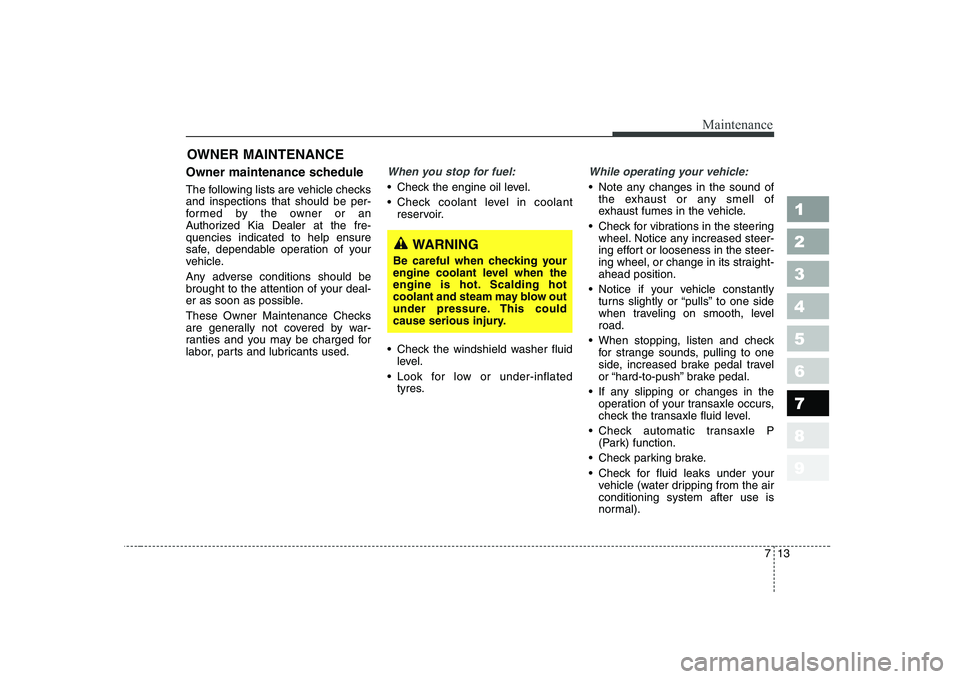
Owner maintenance schedule
The following lists are vehicle checks and inspections that should be per-
formed by the owner or an
Authorized Kia Dealer at the fre-quencies indicated to help ensure
safe, dependable operation of your
vehicle.
Any adverse conditions should be
brought to the attention of your deal-
er as soon as possible.
These Owner Maintenance Checks
are generally not covered by war-
ranties and you may be charged for
labor, parts and lubricants used.
When you stop for fuel:
Check the engine oil level.
Check coolant level in coolant reservoir.
Check the windshield washer fluid level.
Look for low or under-inflated tyres.
While operating your vehicle:
Note any changes in the sound ofthe exhaust or any smell of
exhaust fumes in the vehicle.
Check for vibrations in the steering wheel. Notice any increased steer-
ing effort or looseness in the steer-
ing wheel, or change in its straight-ahead position.
Notice if your vehicle constantly turns slightly or “pulls” to one side
when traveling on smooth, levelroad.
When stopping, listen and check for strange sounds, pulling to one
side, increased brake pedal travel
or “hard-to-push” brake pedal.
If any slipping or changes in the operation of your transaxle occurs,
check the transaxle fluid level.
Check automatic transaxle P (Park) function.
Check parking brake.
Check for fluid leaks under your vehicle (water dripping from the air conditioning system after use is
normal).
WARNING
Be careful when checking your
engine coolant level when the
engine is hot. Scalding hot
coolant and steam may blow out
under pressure. This could
cause serious injury.
Page 258 of 318
Maintenance
14
7
1 23456789
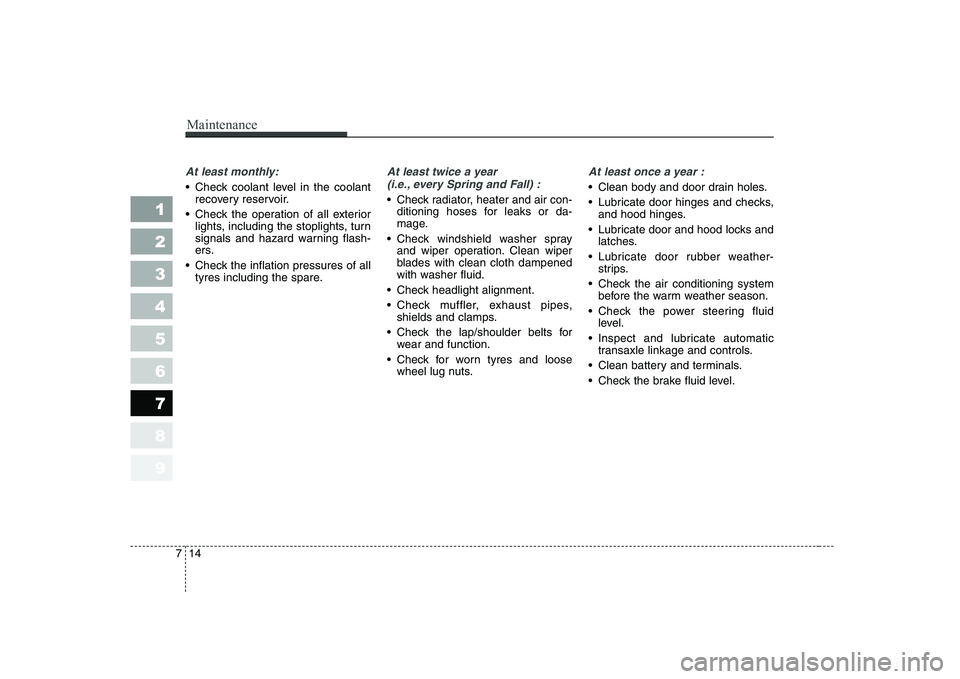
At least monthly:
Check coolant level in the coolant
recovery reservoir.
Check the operation of all exterior lights, including the stoplights, turn
signals and hazard warning flash-
ers.
Check the inflation pressures of all tyres including the spare.
At least twice a year
(i.e., every Spring and Fall) :
Check radiator, heater and air con- ditioning hoses for leaks or da-
mage.
Check windshield washer spray and wiper operation. Clean wiper
blades with clean cloth dampened
with washer fluid.
Check headlight alignment.
Check muffler, exhaust pipes, shields and clamps.
Check the lap/shoulder belts for wear and function.
Check for worn tyres and loose wheel lug nuts.
At least once a year :
Clean body and door drain holes.
Lubricate door hinges and checks,and hood hinges.
Lubricate door and hood locks and latches.
Lubricate door rubber weather- strips.
Check the air conditioning system before the warm weather season.
Check the power steering fluid level.
Inspect and lubricate automatic transaxle linkage and controls.
Clean battery and terminals.
Check the brake fluid level.
Page 260 of 318
Maintenance
16
7
1 23456789
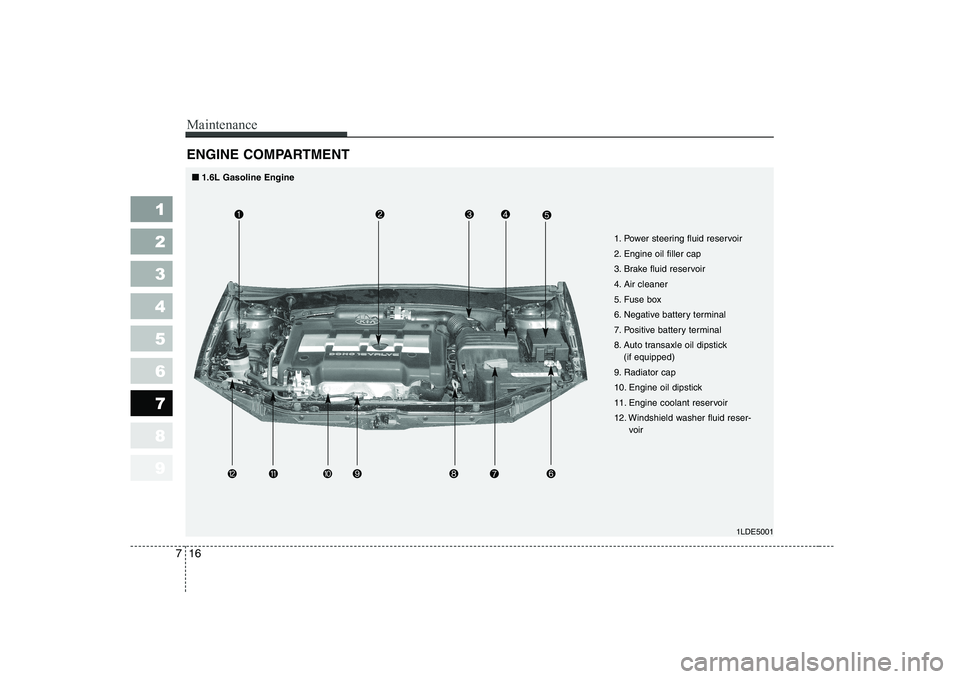
ENGINE COMPARTMENT
1LDE5001
1. Power steering fluid reservoir
2. Engine oil filler cap
3. Brake fluid reservoir
4. Air cleaner
5. Fuse box
6. Negative battery terminal
7. Positive battery terminal
8. Auto transaxle oil dipstick
(if equipped)
9. Radiator cap
10. Engine oil dipstick
11. Engine coolant reservoir
12. Windshield washer fluid reser- voir
■■1.6L Gasoline Engine
Page 261 of 318
717
Maintenance
1 23456789
1LDA5002
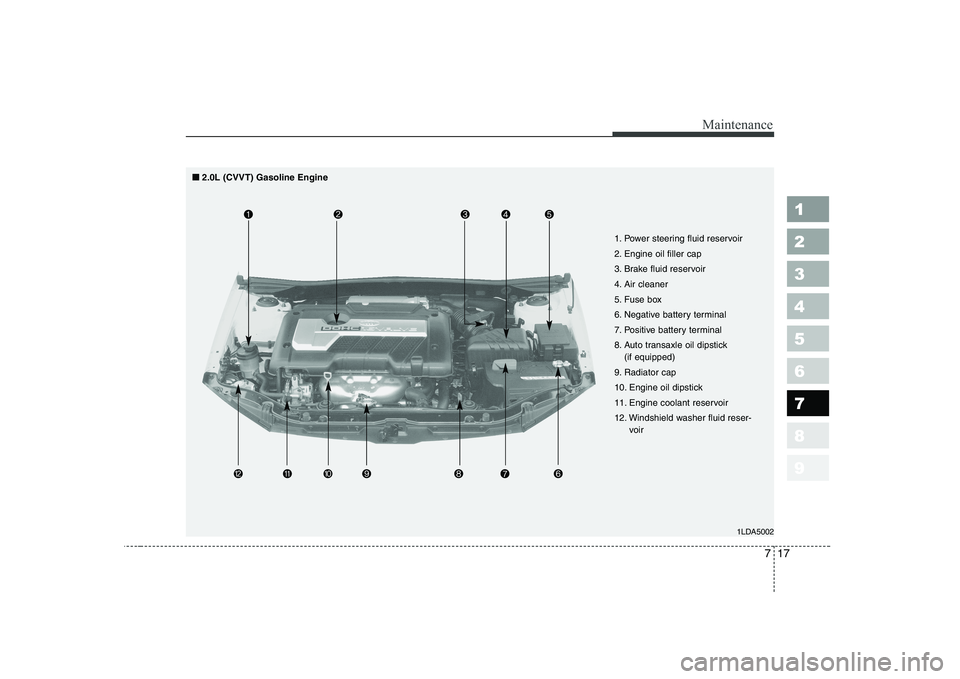
1. Power steering fluid reservoir
2. Engine oil filler cap
3. Brake fluid reservoir
4. Air cleaner
5. Fuse box
6. Negative battery terminal
7. Positive battery terminal
8. Auto transaxle oil dipstick (if equipped)
9. Radiator cap
10. Engine oil dipstick
11. Engine coolant reservoir
12. Windshield washer fluid reser- voir
■
■
2.0L (CVVT) Gasoline Engine
Page 262 of 318
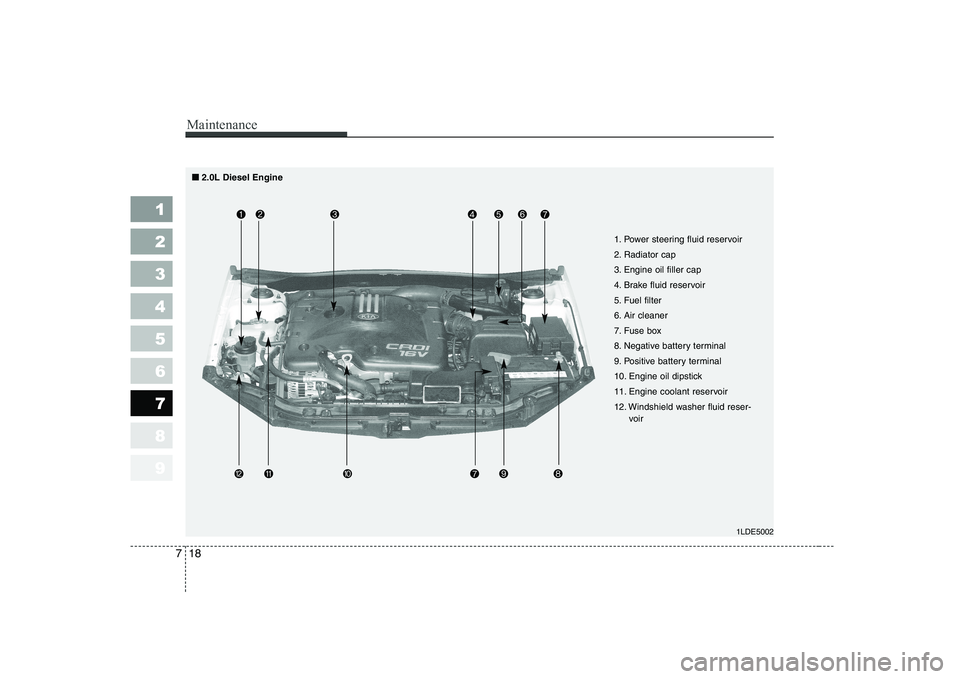
Maintenance
18
7
1 23456789
1LDE5002
1. Power steering fluid reservoir
2. Radiator cap
3. Engine oil filler cap
4. Brake fluid reservoir
5. Fuel filter
6. Air cleaner
7. Fuse box
8. Negative battery terminal
9. Positive battery terminal
10. Engine oil dipstick
11. Engine coolant reservoir
12. Windshield washer fluid reser-
voir
■
■
2.0L Diesel Engine
Page 272 of 318
Maintenance
28
7
1 23456789
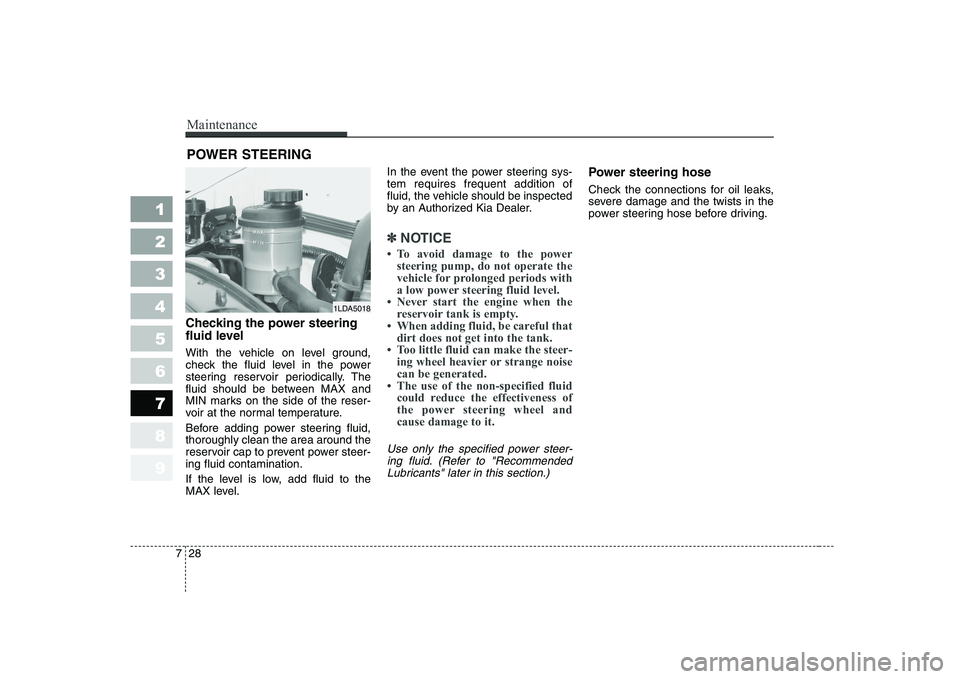
POWER STEERING
Checking the power steering
fluid level
With the vehicle on level ground,
check the fluid level in the power
steering reservoir periodically. The
fluid should be between MAX and
MIN marks on the side of the reser-
voir at the normal temperature.
Before adding power steering fluid, thoroughly clean the area around the
reservoir cap to prevent power steer-ing fluid contamination.
If the level is low, add fluid to the
MAX level. In the event the power steering sys-tem requires frequent addition of
fluid, the vehicle should be inspected
by an Authorized Kia Dealer.
✽✽
NOTICE
Page 273 of 318
729
Maintenance
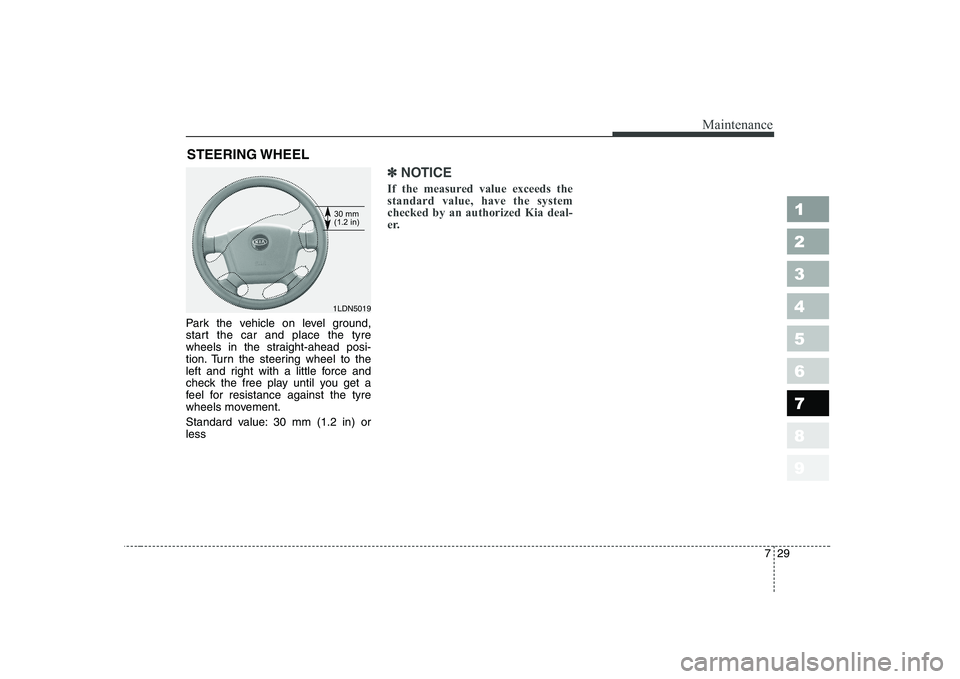
STEERING WHEEL
Park the vehicle on level ground,
start the car and place the tyre
wheels in the straight-ahead posi-
tion. Turn the steering wheel to the
left and right with a little force and
check the free play until you get a
feel for resistance against the tyre
wheels movement.
Standard value: 30 mm (1.2 in) or less
✽✽ NOTICE
If the measured value exceeds the standard value, have the systemchecked by an authorized Kia deal-
er.
1 23456789
1LDN5019
30 mm (1.2 in)
Page 293 of 318
749
Maintenance
1 23456789
Wheel replacement
When replacing the metal wheels for
any reason, make sure the new
wheels are equivalent to the original
factory units in diameter, rim widthand offset.WARNING
When replacing tyres, never mix radial, bias-belted, and
bias-type tyres. All four tyres
should be of the same size,
design and construction. Use
only the tyre sizes listed on
the Tyre Label found below the
door striker on the driver’s
side. Make sure that all tyres
and wheels are the same size
and have the same load-carry-
ing capacity. Use only tyre andwheel combinations recom-
mended on the Tyre Label or
by an Authorized Kia Dealer.
Failure to follow these precau-
tions can adversely affect the
safety and handling of your
vehicle.
(Continued)(Continued)
The use of any other tyre sizeor type may seriously affect
ride, handling, ground clear-
ance, tyre clearance, andspeedometer calibration.
Driving on worn-out tyres is very hazardous and will
reduce braking effectiveness,
steering accuracy, and trac-tion.
It is best to replace all four tyres at the same time. If that
is not possible, or necessary,
then replace the two front or
two rear tyres as a pair.Replacing just one tyre can
seriously affect your vehicle’shandling.
WARNING
A wheel that is not the correct
size may adversely affect wheel
and bearing life, braking and
stopping abilities, handling
characteristics, ground clear-
ance, body-to-tyre clearance,
snow chain clearance,
speedometer calibration, head-
light aim and bumper height.
Page 304 of 318
Maintenance
60
7
1 23456789
LUBRICANT SPECIFICATIONS
Recommended lubricants
To help achieve proper engine and
powertrain performance and durabil-
ity, use only lubricants of the proper
quality. The correct lubricants alsohelp promote engine efficiency that
results in improved fuel economy. Engine oils labeled Energy
Conserving Oil are now available.
Along with other additional benefits,
they contribute to fuel economy byreducing the amount of fuel neces-
sary to overcome engine friction.
Often, these improvements are diffi-
cult to measure in everyday driving,
but in a year’s time, they can offer
significant cost and energy savings.Recommended SAE viscosity
number
✽✽
NOTICE
Always be sure to clean the area
around any filler plug, drain plug,
or dipstick before checking or drain-
ing any lubricant. This is especially
important in dusty or sandy areasand when the vehicle is used on
unpaved roads. Cleaning the plug
and dipstick areas will prevent dirt
and grit from entering the engine
and other mechanisms that could bedamaged.
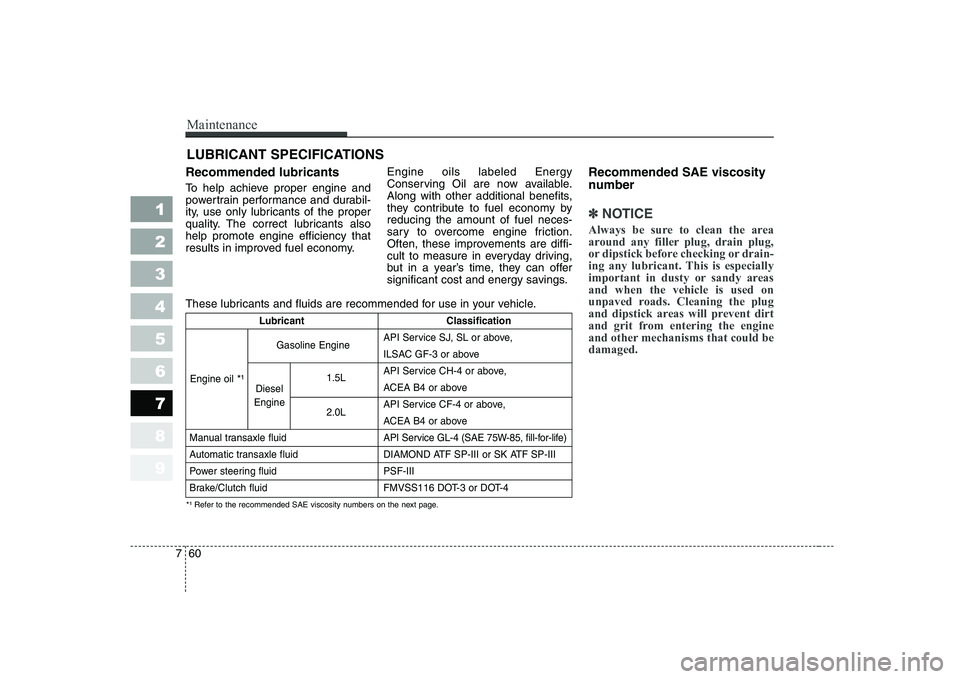
*¹ Refer to the recommended SAE viscosity numbers on the next page.
These lubricants and fluids are recommended for use in your vehicle.
Lubricant Classification
API Service SJ, SL or above,
ILSAC GF-3 or above
1.5L API Service CH-4 or above,
ACEA B4 or above
2.0L API Service CF-4 or above,
ACEA B4 or above
Manual transaxle fluid API Service GL-4 (SAE 75W-85, fill-for-life)
Automatic transaxle fluid DIAMOND ATF SP-III or SK ATF SP-III
Power steering fluid PSF-III
Brake/Clutch fluid FMVSS116 DOT-3 or DOT-4
Engine oil *¹
Gasoline Engine
Diesel
Engine
Page 313 of 318
83
1 23456789
Specifications
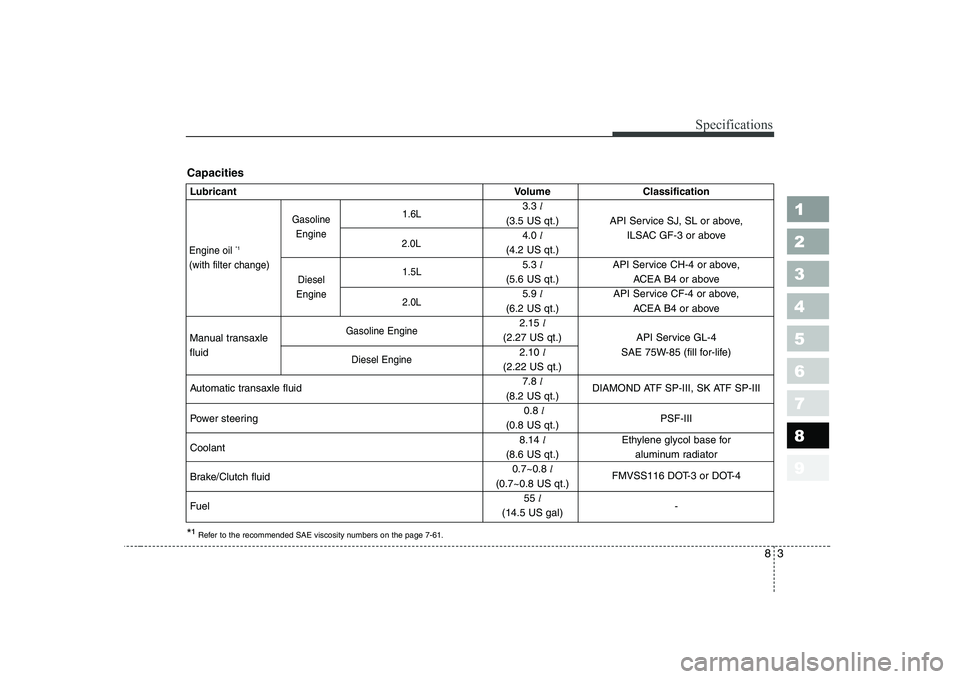
*¹Refer to the recommended SAE viscosity numbers on the page 7-61.
Lubricant Volume Classification
3.3 l
(3.5 US qt.) API Service SJ, SL or above,
4.0 l ILSAC GF-3 or above
(4.2 US qt.)
5.3 l API Service CH-4 or above,
(5.6 US qt.) ACEA B4 or above
5.9 l API Service CF-4 or above,
(6.2 US qt.) ACEA B4 or above
2.15 l
(2.27 US qt.) API Service GL-4
2.10 l SAE 75W-85 (fill for-life)
(2.22 US qt.)
Automatic transaxle fluid 7.8
l
DIAMOND ATF SP-III, SK ATF SP-III
(8.2 US qt.)
Power steering 0.8
l
PSF-III
(0.8 US qt.)
Coolant 8.14
l Ethylene glycol base for
(8.6 US qt.) aluminum radiator
Brake/Clutch fluid 0.7~0.8
l
FMVSS116 DOT-3 or DOT-4
(0.7~0.8 US qt.)
Fuel 55
l
-
(14.5 US gal)
Engine oil *1
(with filter change)
Manual transaxle fluid
Gasoline
Engine
Gasoline Engine
Diesel
Engine
Diesel Engine1.6L
2.0L
2.0L 1.5L
Capacities