oil change KIA CERATO 2006 User Guide
[x] Cancel search | Manufacturer: KIA, Model Year: 2006, Model line: CERATO, Model: KIA CERATO 2006Pages: 315, PDF Size: 11.29 MB
Page 274 of 315
729
Maintenance
1 23456789
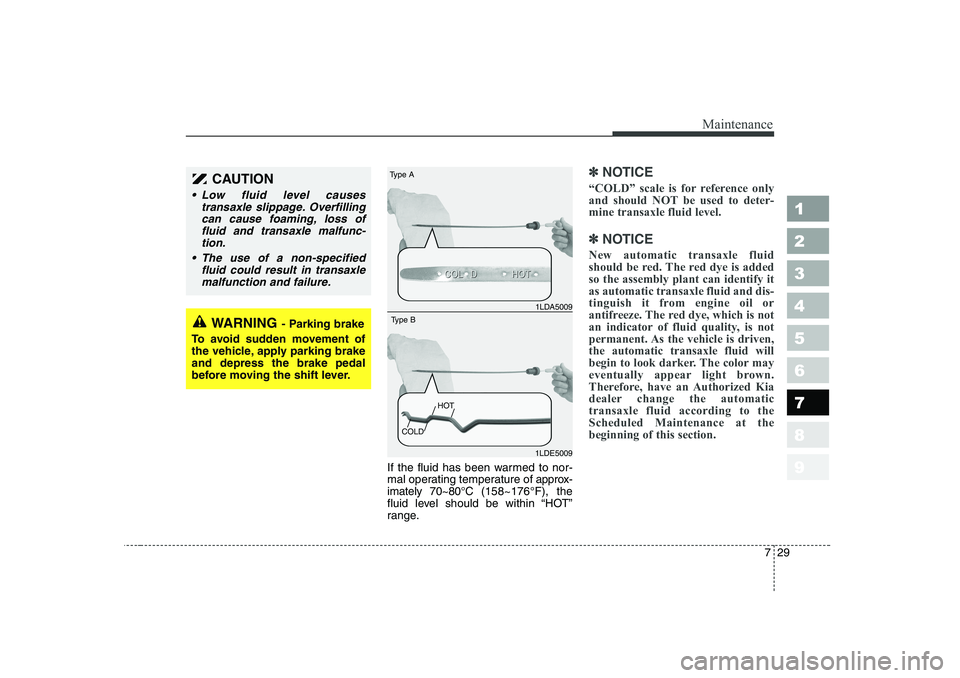
If the fluid has been warmed to nor-
mal operating temperature of approx-
imately 70~80°C (158~176°F), the
fluid level should be within “HOT”
range.
✽✽ NOTICE
“COLD” scale is for reference only
and should NOT be used to deter-mine transaxle fluid level.
✽
✽ NOTICE
New automatic transaxle fluid
should be red. The red dye is addedso the assembly plant can identify itas automatic transaxle fluid and dis-
tinguish it from engine oil or
antifreeze. The red dye, which is not
an indicator of fluid quality, is not
permanent. As the vehicle is driven,the automatic transaxle fluid will
begin to look darker. The color may
eventually appear light brown.
Therefore, have an Authorized Kia
dealer change the automatictransaxle fluid according to theScheduled Maintenance at thebeginning of this section.
CAUTION
Low fluid level causes transaxle slippage. Overfillingcan cause foaming, loss offluid and transaxle malfunc- tion.
The use of a non-specified fluid could result in transaxlemalfunction and failure.
WARNING - Parking brake
To avoid sudden movement of
the vehicle, apply parking brakeand depress the brake pedal
before moving the shift lever.
1LDA5009
Type A
1LDE5009
Type B
COLD HOT
Page 275 of 315
Maintenance
30
7
1 23456789
Changing the automatic transaxle fluid
1. Raise and suitably support the
vehicle.
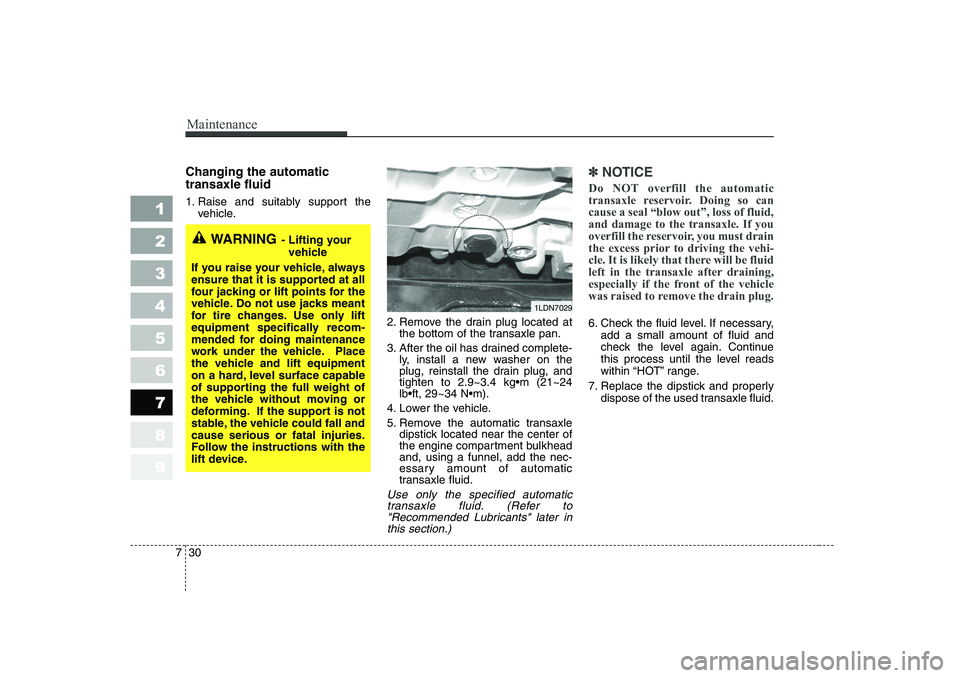
2. Remove the drain plug located atthe bottom of the transaxle pan.
3. After the oil has drained complete- ly, install a new washer on the
plug, reinstall the drain plug, andtighten to 2.9~3.4 kgm (21~24lbft, 29~34 Nm).
4. Lower the vehicle.
5. Remove the automatic transaxle dipstick located near the center of
the engine compartment bulkheadand, using a funnel, add the nec-
essary amount of automatic
transaxle fluid.
Use only the specified automatic
transaxle fluid. (Refer to"Recommended Lubricants" later in this section.)
✽✽ NOTICE
Do NOT overfill the automatic
transaxle reservoir. Doing so cancause a seal “blow out”, loss of fluid,and damage to the transaxle. If you
overfill the reservoir, you must drain
the excess prior to driving the vehi-
cle. It is likely that there will be fluid
left in the transaxle after draining,
especially if the front of the vehicle
was raised to remove the drain plug.
6. Check the fluid level. If necessary, add a small amount of fluid and
check the level again. Continue
this process until the level reads
within “HOT” range.
7. Replace the dipstick and properly dispose of the used transaxle fluid.
WARNING - Lifting your
vehicle
If you raise your vehicle, always
ensure that it is supported at all
four jacking or lift points for the
vehicle. Do not use jacks meant
for tire changes. Use only lift
equipment specifically recom-
mended for doing maintenance
work under the vehicle. Place
the vehicle and lift equipment
on a hard, level surface capable
of supporting the full weight of
the vehicle without moving or
deforming. If the support is not
stable, the vehicle could fall andcause serious or fatal injuries.
Follow the instructions with the
lift device.
1LDN7029
Page 276 of 315
731
Maintenance
1 23456789
LUBRICANTS AND FLUIDS
Checking the washer fluid
level
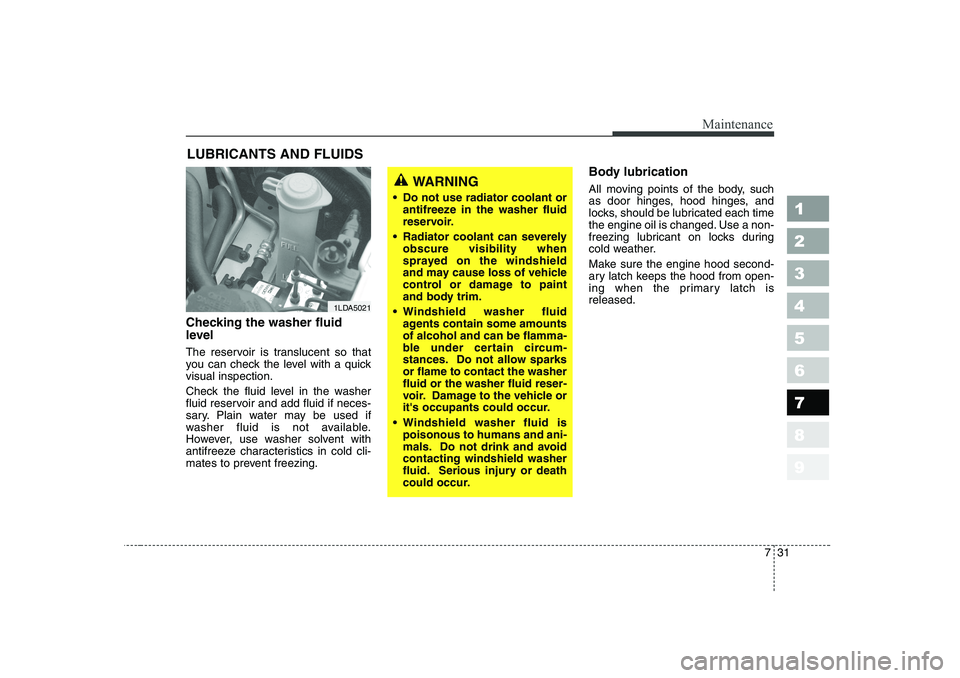
The reservoir is translucent so that
you can check the level with a quickvisual inspection.
Check the fluid level in the washer
fluid reservoir and add fluid if neces-
sary. Plain water may be used if
washer fluid is not available.
However, use washer solvent with
antifreeze characteristics in cold cli-
mates to prevent freezing. Body lubrication
All moving points of the body, such
as door hinges, hood hinges, and
locks, should be lubricated each time
the engine oil is changed. Use a non-
freezing lubricant on locks during
cold weather.
Make sure the engine hood second-
ary latch keeps the hood from open-
ing when the primary latch isreleased.
1LDA5021
WARNING
Do not use radiator coolant or antifreeze in the washer fluid
reservoir.
Radiator coolant can severely obscure visibility when
sprayed on the windshield
and may cause loss of vehicle
control or damage to paint
and body trim.
Windshield washer fluid agents contain some amountsof alcohol and can be flamma-
ble under certain circum-
stances. Do not allow sparksor flame to contact the washerfluid or the washer fluid reser-
voir. Damage to the vehicle or
it's occupants could occur.
Windshield washer fluid is poisonous to humans and ani-
mals. Do not drink and avoidcontacting windshield washer
fluid. Serious injury or death
could occur.
Page 302 of 315
757
Maintenance
1 23456789
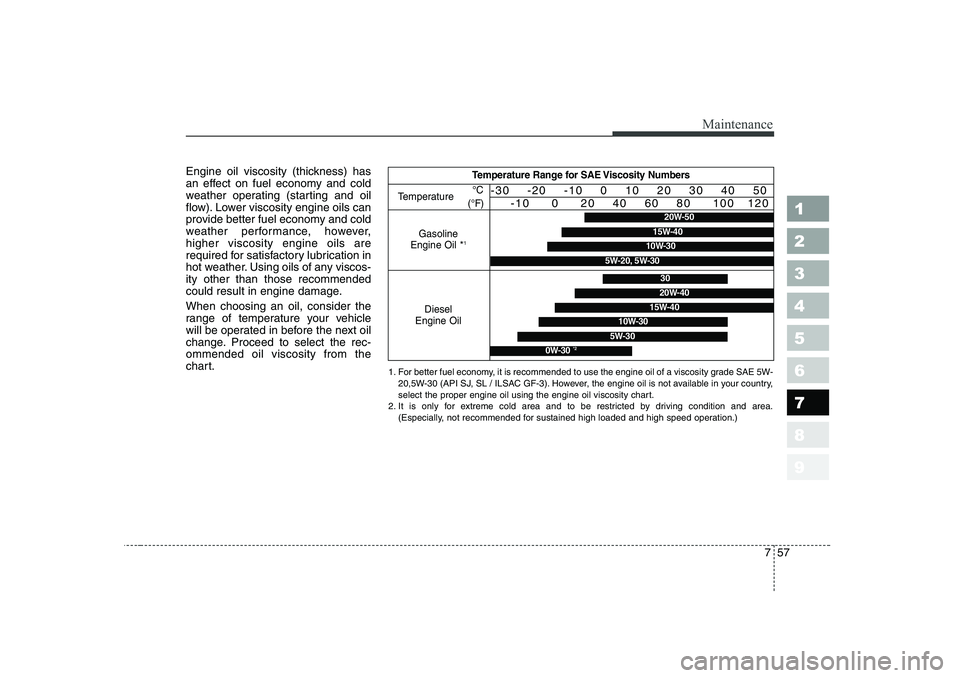
Engine oil viscosity (thickness) has
an effect on fuel economy and cold
weather operating (starting and oil
flow). Lower viscosity engine oils can
provide better fuel economy and cold
weather performance, however,higher viscosity engine oils are
required for satisfactory lubrication in
hot weather. Using oils of any viscos-ity other than those recommended
could result in engine damage. When choosing an oil, consider the
range of temperature your vehicle
will be operated in before the next oil
change. Proceed to select the rec-ommended oil viscosity from the
chart.Temperature Range for SAE Viscosity Numbers
TemperatureGasoline
Engine Oil *
1
°C
(°F)-30 -20 -10 0 10 20 30 40 50 -10 0 20 40 60 80 100 120
Diesel
Engine Oil
10W-30
30
20W-40
15W-40
0W-30 *2
5W-30
1. For better fuel economy, it is recommended to use the engine oil of a viscosity grade SAE 5W-
20,5W-30 (API SJ, SL / ILSAC GF-3). However, the engine oil is not available in your country,
select the proper engine oil using the engine oil viscosity chart.
2. It is only for extreme cold area and to be restricted by driving condition and area. (Especially, not recommended for sustained high loaded and high speed operation.)
20W-50
10W-30
15W-40
5W-20, 5W-30
Page 310 of 315
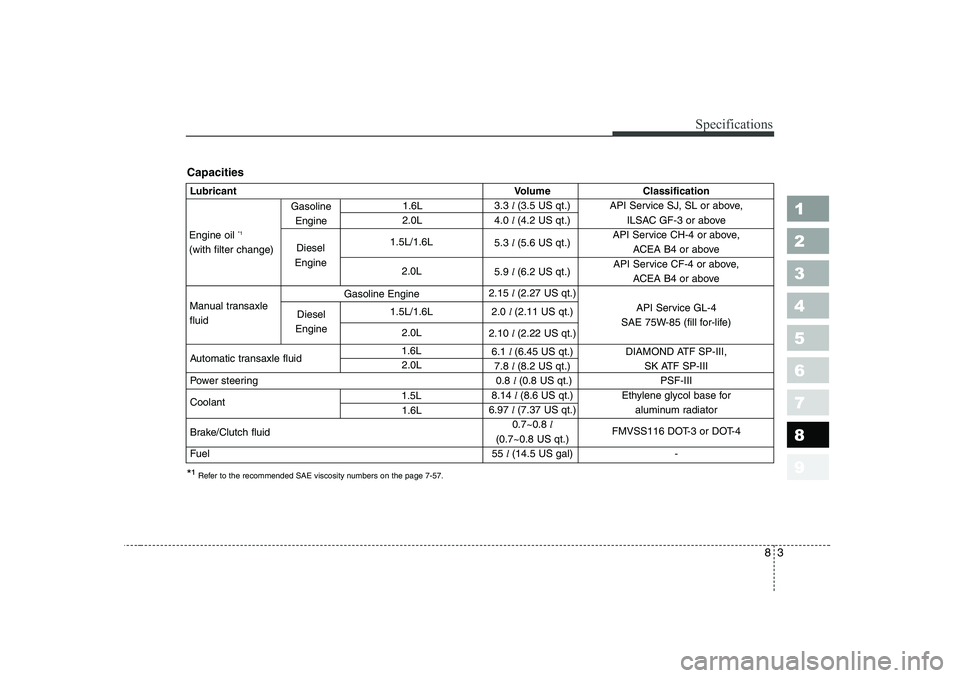
83
1 23456789
Specifications
*¹Refer to the recommended SAE viscosity numbers on the page 7-57.
Lubricant Volume Classification
3.3 l (3.5 US qt.) API Service SJ, SL or above,
4.0 l (4.2 US qt.) ILSAC GF-3 or above
5.3 l (5.6 US qt.) API Service CH-4 or above,
ACEA B4 or above
API Service CF-4 or above,
5.9 l (6.2 US qt.)
ACEA B4 or above
2.15 l (2.27 US qt.)
2.0 l (2.11 US qt.) API Service GL-4
2.10 l (2.22 US qt.) SAE 75W-85 (fill for-life)
Automatic transaxle fluid 6.1
l (6.45 US qt.) DIAMOND ATF SP-III,
7.8 l (8.2 US qt.) SK ATF SP-III
Power steering 0.8 l (0.8 US qt.) PSF-III
Coolant 8.14
l (8.6 US qt.) Ethylene glycol base for
6.97 l (7.37 US qt.) aluminum radiator
Brake/Clutch fluid 0.7~0.8
l
FMVSS116 DOT-3 or DOT-4
(0.7~0.8 US qt.)
Fuel 55 l (14.5 US gal) -
Engine oil *1
(with filter change)
Manual transaxle fluid Gasoline
Engine
Gasoline Engine
Diesel
Engine Diesel
Engine 1.6L
2.0L
2.0L
1.5L/1.6L
2.0L
1.5L/1.6L
2.0L
1.6L
1.6L
1.5L
Capacities