belt KIA CERATO 2006 Service Manual
[x] Cancel search | Manufacturer: KIA, Model Year: 2006, Model line: CERATO, Model: KIA CERATO 2006Pages: 315, PDF Size: 11.29 MB
Page 157 of 315
445
1 23456789
Driving your vehicle
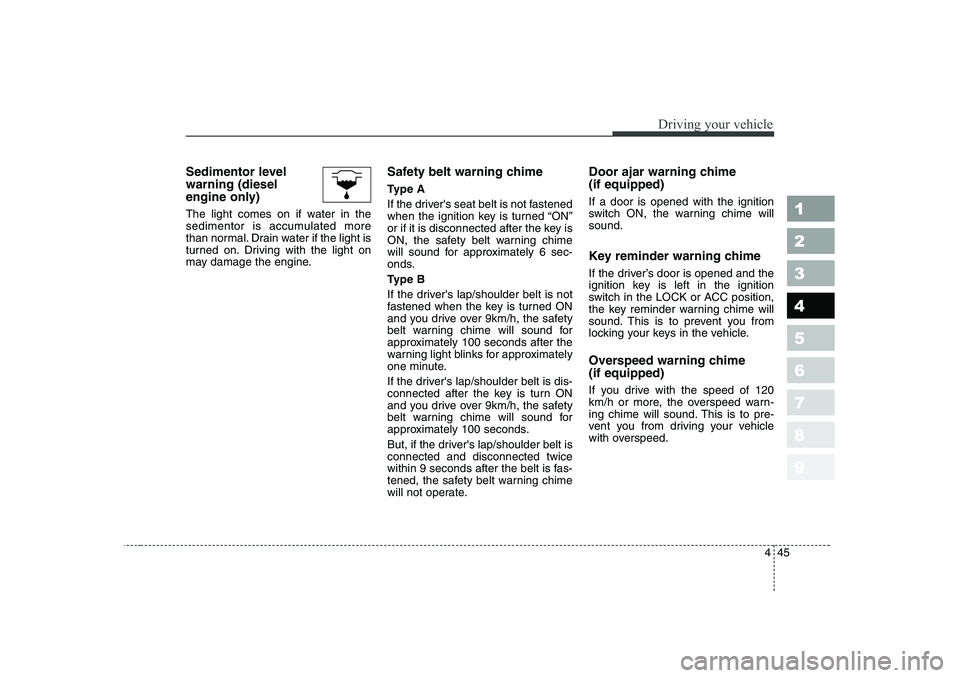
Sedimentor level warning (diesel
engine only)
The light comes on if water in the
sedimentor is accumulated more
than normal. Drain water if the light is
turned on. Driving with the light on
may damage the engine.Safety belt warning chime
Type A
If the driver's seat belt is not fastened
when the ignition key is turned
“ON ”
or if it is disconnected after the key is
ON, the safety belt warning chime
will sound for approximately 6 sec-
onds.
Type B
If the driver's lap/shoulder belt is not
fastened when the key is turned ON
and you drive over 9km/h, the safety
belt warning chime will sound for
approximately 100 seconds after the
warning light blinks for approximately
one minute.
If the driver's lap/shoulder belt is dis-
connected after the key is turn ON
and you drive over 9km/h, the safety
belt warning chime will sound for
approximately 100 seconds.
But, if the driver's lap/shoulder belt is connected and disconnected twice
within 9 seconds after the belt is fas-
tened, the safety belt warning chime
will not operate. Door ajar warning chime (if equipped) If a door is opened with the ignition
switch ON, the warning chime willsound.
Key reminder warning chime
If the driver
’s door is opened and the
ignition key is left in the ignition
switch in the LOCK or ACC position,
the key reminder warning chime will
sound. This is to prevent you from
locking your keys in the vehicle.
Overspeed warning chime (if equipped)
If you drive with the speed of 120
km/h or more, the overspeed warn-
ing chime will sound. This is to pre-
vent you from driving your vehicle
with overspeed.
Page 246 of 315
1 234567891 23456789
10
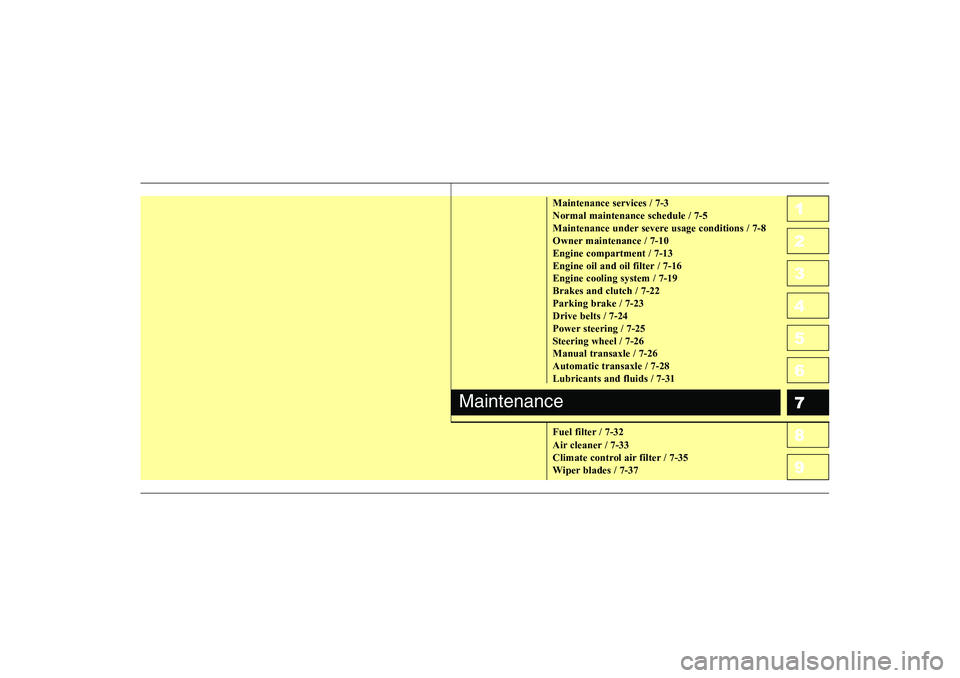
Maintenance services / 7-3 Normal maintenance schedule / 7-5
Maintenance under severe usage conditions / 7-8
Owner maintenance / 7-10Engine compartment / 7-13
Engine oil and oil filter / 7-16Engine cooling system / 7-19Brakes and clutch / 7-22Parking brake / 7-23Drive belts / 7-24
Power steering / 7-25
Steering wheel / 7-26Manual transaxle / 7-26Automatic transaxle / 7-28Lubricants and fluids / 7-31
Fuel filter / 7-32
Air cleaner / 7-33
Climate control air filter / 7-35
Wiper blades / 7-37
Maintenance
Page 250 of 315
1 23456789
75
Maintenance
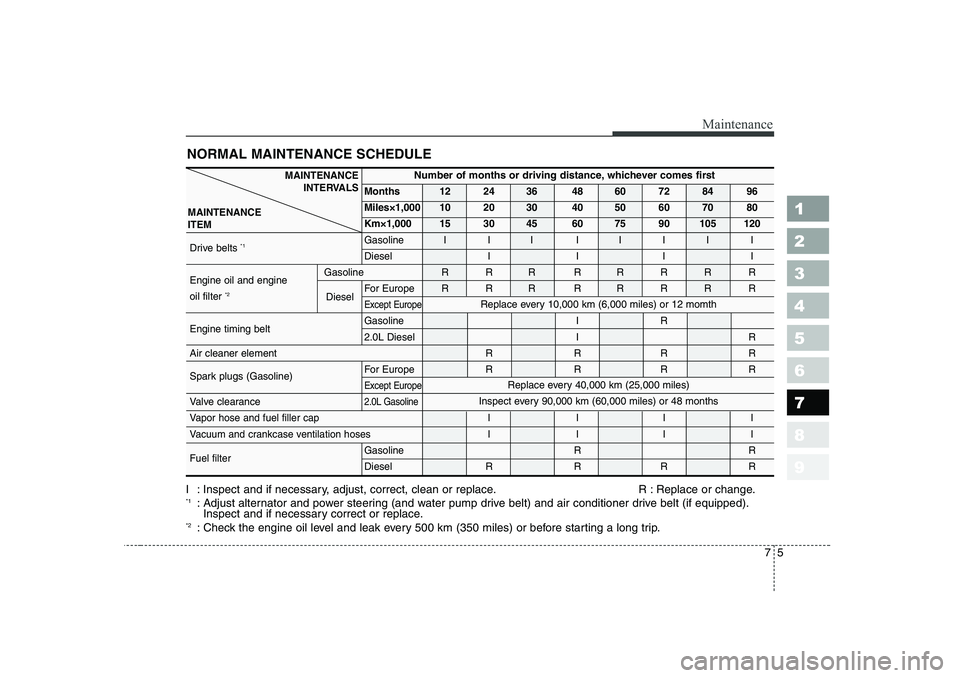
NORMAL MAINTENANCE SCHEDULE
I : Inspect and if necessary, adjust, correct, clean or replace. R : Replace or change. *1: Adjust alternator and power steering (and water pump drive belt) and air conditioner drive belt (if equipped).
Inspect and if necessary correct or replace.
*2 : Check the engine oil level and leak every 500 km (350 miles) or before starting a long trip.
MAINTENANCE
INTERVALS
MAINTENANCE ITEMNumber of months or driving distance, whichever comes first
Months 12 24 36 48 60 72 84 96
Miles×1,000 10 20 30 40 50 60 70 80
Km×1,000 15 30 45 60 75 90 105 120
Drive belts *1 Gasoline I I I I I I I I
Diesel I I I I
Engine oil and engine Gasoline R R R R R R R R
oil filter *2 For Europe R R R R R R R R
Except Europe
Engine timing belt Gasoline
I R
2.0L Diesel I R
Air cleaner element I R I R I R I R
Spark plugs (Gasoline) For Europe R R R R
Except Europe
Valve clearance 2.0L Gasoline
Vapor hose and fuel filler cap
I I I I
Vacuum and crankcase ventilation hoses I I I I Fuel filter
Gasoline RR
Diesel R R R R Replace every 40,000 km (25,000 miles)
Inspect every 90,000 km (60,000 miles) or 48 months
DieselReplace every 10,000 km (6,000 miles) or 12 momth
Page 251 of 315
1 23456789
Maintenance
6
7
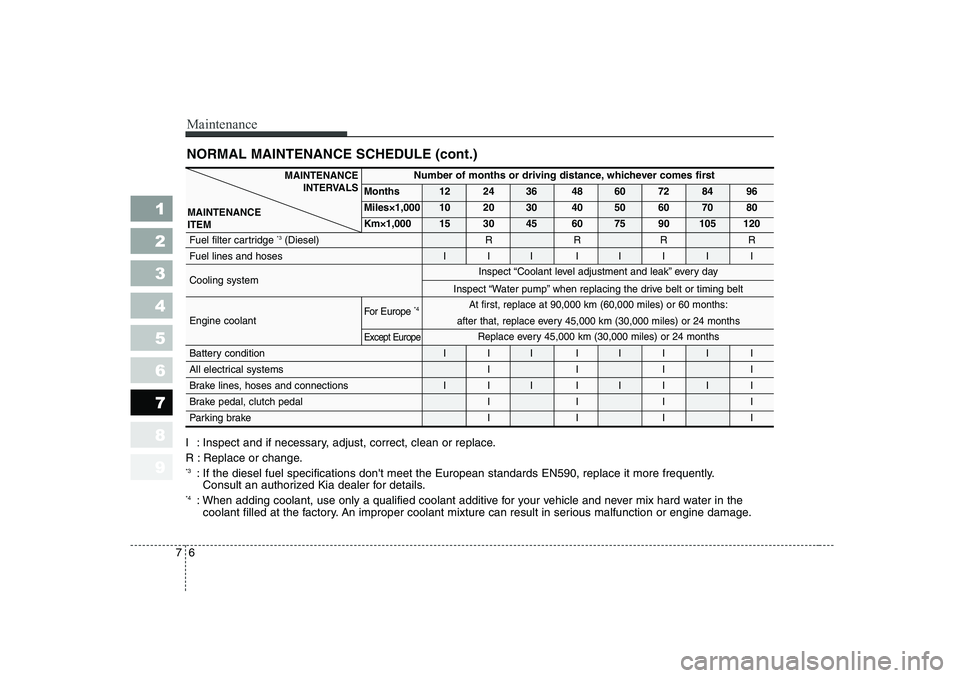
NORMAL MAINTENANCE SCHEDULE (cont.)
I : Inspect and if necessary, adjust, correct, clean or replace.
R : Replace or change. *3
: If the diesel fuel specifications don't meet the European standards EN590, replace it more frequently.
Consult an authorized Kia dealer for details.
*4 : When adding coolant, use only a qualified coolant additive for your vehicle and never mix hard water in the
coolant filled at the factory. An improper coolant mixture can result in serious malfunction or engine damage.
MAINTENANCE
INTERVALS
MAINTENANCE ITEMNumber of months or driving distance, whichever comes first
Months 12 24 36 48 60 72 84 96
Miles×1,000 10 20 30 40 50 60 70 80
Km×1,000 15 30 45 60 75 90 105 120
Fuel filter cartridge *3
(Diesel) R R R R
Fuel lines and hoses I I I I I I I I Cooling system
For Europe *4
Engine coolant
Except Europe
Battery condition I I I I I I I I
All electrical systems I I I I
Brake lines, hoses and connections I I I I I I I I
Brake pedal, clutch pedal I I I I
Parking brake I I I I
Inspect “Coolant level adjustment and leak” every day
Inspect “Water pump” when replacing the drive belt or timing belt
At first, replace at 90,000 km (60,000 miles) or 60 months:
after that, replace every 45,000 km (30,000 miles) or 24 months Replace every 45,000 km (30,000 miles) or 24 months
Page 253 of 315

Maintenance
8
7
MAINTENANCE UNDER SEVERE USAGE CONDITIONS
1 23456789
The following items must be serviced more frequently on cars mainly used under severe driving conditions.
Refer to the chart below for the appropriate maintenance intervals.
R : Replace I : Inspect and if necessary, adjust, correct, clean or replace
Engine oil and Gasoline R Every 7,500 km (5,000 miles) or 6 months A, B, C, F, G
engine oil filter Diesel R Every 7,500 km (5,000 miles) or 6 months A, B, C, F, H
Air cleaner element I C, E
Spark plugs Gasoline I B, H
Engine timing belt Gasoline R Every 60,000 km (40,000 miles) or 48 months
D, E, F, G
2.0L Diesel R Every 60,000 km (40,000 miles) or 48 months
Manual transaxle fluid For Europe R Every 90,000 km (60,000 miles)
A, C, D, E, F, G, H, I , J
Execpt Europe R Every 100,000 km (62,000 miles)
Automatic transaxle fluid For Europe R Every 45,000 km (30,000 miles)
A, C, E, F, G ,H ,I
Execpt Europe R Every 40,000 km (25,000 miles)
Steering gear rack, linkage and boots I C, D, E, F, G
Front suspension ball joints I C, D, E, F, G
MAINTENANCE ITEMMaintenance
operation Maintenance intervals
Driving condition
Inspect more frequently
depending on the condition
Inspect more frequently
depending on the condition
Inspect more frequently
depending on the condition Inspect more frequently
depending on the condition
Page 256 of 315
711
Maintenance
1 23456789
At least monthly:
Check coolant level in the coolantrecovery reservoir.
Check the operation of all exterior lights, including the stoplights, turn
signals and hazard warning flash-
ers.
Check the inflation pressures of all tires including the spare.
At least twice a year
(i.e., every Spring and Fall) :
Check radiator, heater and air con- ditioning hoses for leaks or da-
mage.
Check windshield washer spray and wiper operation. Clean wiper
blades with clean cloth dampened
with washer fluid.
Check headlight alignment.
Check muffler, exhaust pipes, shields and clamps.
Check the lap/shoulder belts for wear and function.
Check for worn tires and loose wheel lug nuts.
At least once a year :
Clean body and door drain holes.
Lubricate door hinges and checks,and hood hinges.
Lubricate door and hood locks and latches.
Lubricate door rubber weather- strips.
Check the air conditioning system before the warm weather season.
Check the power steering fluid level.
Inspect and lubricate automatic transaxle linkage and controls.
Clean battery and terminals.
Check the brake fluid level.
Page 269 of 315
Maintenance
24
7
1 23456789
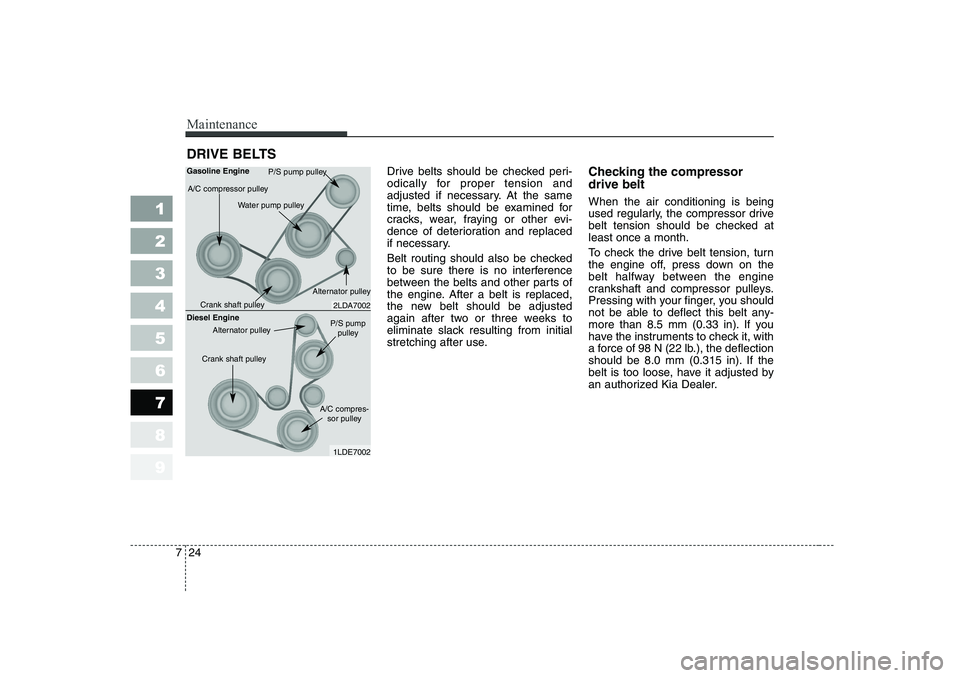
DRIVE BELTS
Drive belts should be checked peri-
odically for proper tension and
adjusted if necessary. At the same
time, belts should be examined for
cracks, wear, fraying or other evi-
dence of deterioration and replaced
if necessary.
Belt routing should also be checked
to be sure there is no interference
between the belts and other parts of
the engine. After a belt is replaced,
the new belt should be adjusted
again after two or three weeks to
eliminate slack resulting from initial
stretching after use. Checking the compressor drive belt When the air conditioning is being
used regularly, the compressor drive
belt tension should be checked atleast once a month.
To check the drive belt tension, turn
the engine off, press down on the
belt halfway between the engine
crankshaft and compressor pulleys.
Pressing with your finger, you should
not be able to deflect this belt any-
more than 8.5 mm (0.33 in). If you
have the instruments to check it, with
a force of 98 N (22 lb.), the deflection
should be 8.0 mm (0.315 in). If the
belt is too loose, have it adjusted by
an authorized Kia Dealer.
2LDA7002
A/C compressor pulley
P/S pump pulley
Water pump pulley
Crank shaft pulley Alternator pulley
Gasoline Engine
1LDE7002
Diesel Engine
Crank shaft pulley
Alternator pulleyP/S pumppulley
A/C compres- sor pulley
Page 290 of 315
745
Maintenance
1 23456789
Wheel replacement
When replacing the metal wheels for
any reason, make sure the new
wheels are equivalent to the original
factory units in diameter, rim widthand offset.WARNING
When replacing tires, never mix radial, bias-belted, and
bias-type tires. All four tires
should be of the same size,
design and construction. Use
only the tire sizes listed on the
Tire Label found below the
door striker on the driver’s
side. Make sure that all tires
and wheels are the same size
and have the same load-carry-
ing capacity. Use only tire andwheel combinations recom-
mended on the Tire Label or
by an Authorized Kia Dealer.
Failure to follow these precau-
tions can adversely affect the
safety and handling of your
vehicle.
(Continued)(Continued)
The use of any other tire sizeor type may seriously affect
ride, handling, ground clear-
ance, tire clearance, andspeedometer calibration.
Driving on worn-out tires is very hazardous and will
reduce braking effectiveness,
steering accuracy, and trac-tion.
It is best to replace all four tires at the same time. If that is
not possible, or necessary,
then replace the two front or
two rear tires as a pair.Replacing just one tire can
seriously affect your vehicle’shandling.
WARNING
A wheel that is not the correct
size may adversely affect wheel
and bearing life, braking and
stopping abilities, handling
characteristics, ground clear-
ance, body-to-tire clearance,
snow chain clearance,
speedometer calibration, head-
light aim and bumper height.
Page 307 of 315
Maintenance
62
7
1 23456789
INTERIOR CARE
Interior general precautions
Prevent caustic solutions such as perfume and cosmetic oil from con-
tacting the dashboard because they
may cause damage or discoloration.
If they do contact the dashboard,
wipe them off immediately. See the
instructions that follow for the proper
way to clean vinyl.
Cleaning the upholstery and interior trim
Vinyl
Remove dust and loose dirt from
vinyl with a whisk broom or vacuum
cleaner. Clean vinyl surfaces with a
vinyl cleaner.
Fabric
Remove dust and loose dirt from fab-
ric with a whisk broom or vacuum
cleaner. Clean with a mild soap solu-
tion recommended for upholstery or
carpets. Remove fresh spots imme-
diately with a fabric spot cleaner. If
fresh spots do not receive immediate
attention, the fabric can be stained
and its color can be affected. Also, its
fire-resistant properties can be
reduced if the material is not proper-ly maintained. Cleaning the lap/shoulder belt webbing
Clean the belt webbing with any mild
soap solution recommended for
cleaning upholstery or carpet. Follow
the instructions provided with the
soap. Do not bleach or re-dye the
webbing because this may weakenit.
Cleaning the interior window glass
If the interior glass surfaces of the
vehicle become fogged (that is, cov-
ered with an oily, greasy or waxy
film), they should be cleaned with
glass cleaner. Follow the directions
on the glass cleaner container.
✽✽
NOTICE
Do not scrape or scratch the inside
of the rear window. This may result
in damage to the rear window
defroster grid.
CAUTION
Using anything but recommend- ed cleaners and proceduresmay affect the fabric’s appear-ance and fire-resistant proper- ties.
Page 313 of 315
Index
2
9
1 23456789
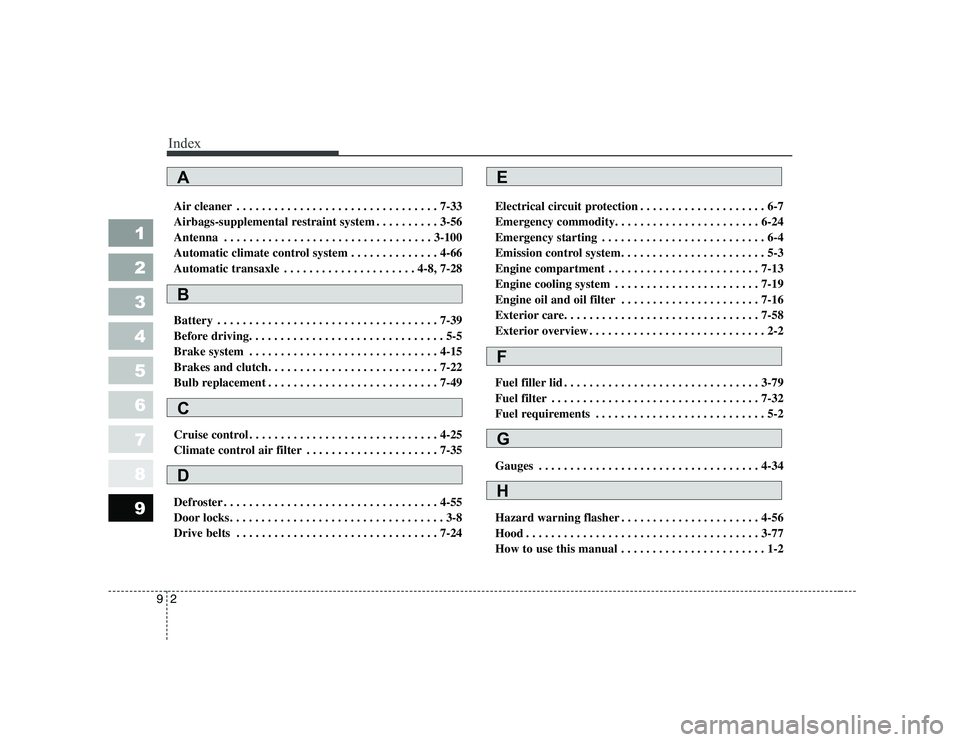
Air cleaner . . . . . . . . . . . . . . . . . . . . . . . . . . . . . . . . 7-33
Airbags-supplemental restraint system . . . . . . . . . . 3-56
Antenna . . . . . . . . . . . . . . . . . . . . . . . . . . . . . . . . . 3-100
Automatic climate control system . . . . . . . . . . . . . . 4-66
Automatic transaxle . . . . . . . . . . . . . . . . . . . . . 4-8, 7-28
Battery . . . . . . . . . . . . . . . . . . . . . . . . . . . . . . . . . . . 7-39
Before driving. . . . . . . . . . . . . . . . . . . . . . . . . . . . . . . 5-5
Brake system . . . . . . . . . . . . . . . . . . . . . . . . . . . . . . 4-15
Brakes and clutch. . . . . . . . . . . . . . . . . . . . . . . . . . . 7-22
Bulb replacement . . . . . . . . . . . . . . . . . . . . . . . . . . . 7-49
Cruise control . . . . . . . . . . . . . . . . . . . . . . . . . . . . . . 4-25
Climate control air filter . . . . . . . . . . . . . . . . . . . . . 7-35
Defroster . . . . . . . . . . . . . . . . . . . . . . . . . . . . . . . . . . 4-55
Door locks. . . . . . . . . . . . . . . . . . . . . . . . . . . . . . . . . . 3-8
Drive belts . . . . . . . . . . . . . . . . . . . . . . . . . . . . . . . . 7-24 Electrical circuit protection . . . . . . . . . . . . . . . . . . . . 6-7
Emergency commodity. . . . . . . . . . . . . . . . . . . . . . . 6-24
Emergency starting . . . . . . . . . . . . . . . . . . . . . . . . . . 6-4
Emission control system. . . . . . . . . . . . . . . . . . . . . . . 5-3
Engine compartment . . . . . . . . . . . . . . . . . . . . . . . . 7-13
Engine cooling system . . . . . . . . . . . . . . . . . . . . . . . 7-19
Engine oil and oil filter . . . . . . . . . . . . . . . . . . . . . . 7-16
Exterior care. . . . . . . . . . . . . . . . . . . . . . . . . . . . . . . 7-58
Exterior overview . . . . . . . . . . . . . . . . . . . . . . . . . . . . 2-2
Fuel filler lid . . . . . . . . . . . . . . . . . . . . . . . . . . . . . . . 3-79
Fuel filter . . . . . . . . . . . . . . . . . . . . . . . . . . . . . . . . . 7-32
Fuel requirements . . . . . . . . . . . . . . . . . . . . . . . . . . . 5-2
Gauges . . . . . . . . . . . . . . . . . . . . . . . . . . . . . . . . . . . 4-34
Hazard warning flasher . . . . . . . . . . . . . . . . . . . . . . 4-56
Hood . . . . . . . . . . . . . . . . . . . . . . . . . . . . . . . . . . . . . 3-77
How to use this manual . . . . . . . . . . . . . . . . . . . . . . . 1-2
A
B
C
D
F
E
G
H