engine KIA CERATO 2008 Owners Manual
[x] Cancel search | Manufacturer: KIA, Model Year: 2008, Model line: CERATO, Model: KIA CERATO 2008Pages: 327, PDF Size: 42.19 MB
Page 287 of 327
Maintenance
24
7
1 23456789
AUTOMATIC TRANSAXLE (IF EQUIPPED)
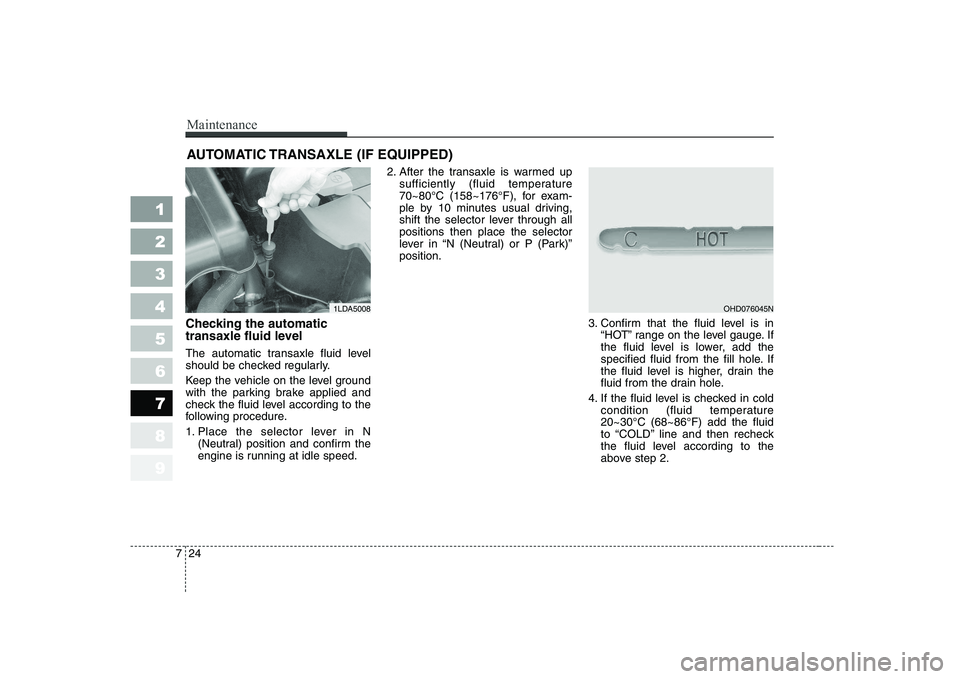
Checking the automatic
transaxle fluid level
The automatic transaxle fluid level
should be checked regularly.
Keep the vehicle on the level ground
with the parking brake applied and
check the fluid level according to the
following procedure.
1. Place the selector lever in N (Neutral) position and confirm the
engine is running at idle speed. 2. After the transaxle is warmed up
sufficiently (fluid temperature
70~80°C (158~176°F), for exam-
ple by 10 minutes usual driving,
shift the selector lever through allpositions then place the selector
lever in “N (Neutral) or P (Park)”position.
3. Confirm that the fluid level is in“HOT” range on the level gauge. If
the fluid level is lower, add the
specified fluid from the fill hole. If
the fluid level is higher, drain the
fluid from the drain hole.
4. If the fluid level is checked in cold condition (fluid temperature20~30°C (68~86°F) add the fluid
to “COLD” line and then recheck
the fluid level according to the
above step 2.
1LDA5008OHD076045N
Page 288 of 327
725
Maintenance
1 23456789
✽✽NOTICE
“COLD (C)” scale is for reference
only and should NOT be used todetermine transaxle fluid level. ✽
✽
NOTICE
New automatic transaxle fluid
should be red. The red dye is addedso the assembly plant can identify itas automatic transaxle fluid and dis-
tinguish it from engine oil or
antifreeze. The red dye, which is not
an indicator of fluid quality, is not
permanent. As the vehicle is driven,the automatic transaxle fluid will
begin to look darker. The color may
eventually appear light brown.
Therefore, have an Authorized Kia
dealer change the automatictransaxle fluid according to theScheduled Maintenance at thebeginning of this section.
Changing the automatic transaxle fluid
Have automatic transaxle fluid
changed by an authorized KIA deal-er according to the MaintenanceSchedule at the beginning of thissection.
CAUTION
Low fluid level causes transaxle slippage. Overfillingcan cause foaming, loss offluid and transaxle malfunc-tion.
The use of a non-specified fluid could result in transaxlemalfunction and failure.
WARNING - Parking brake
To avoid sudden movement of
the vehicle, apply parking brakeand depress the brake pedal
before moving the shift lever.
WARNING - Transaxle fluid
The transaxle fluid level should
be checked when the engine isat normal operating tempera-
ture. This means that the
engine, radiator, radiator hose
and exhaust system etc., are
very hot. Exercise great care not
to burn yourself during this pro-
cedure.
Page 289 of 327
Maintenance
26
7
1 23456789
LUBRICANTS AND FLUIDS
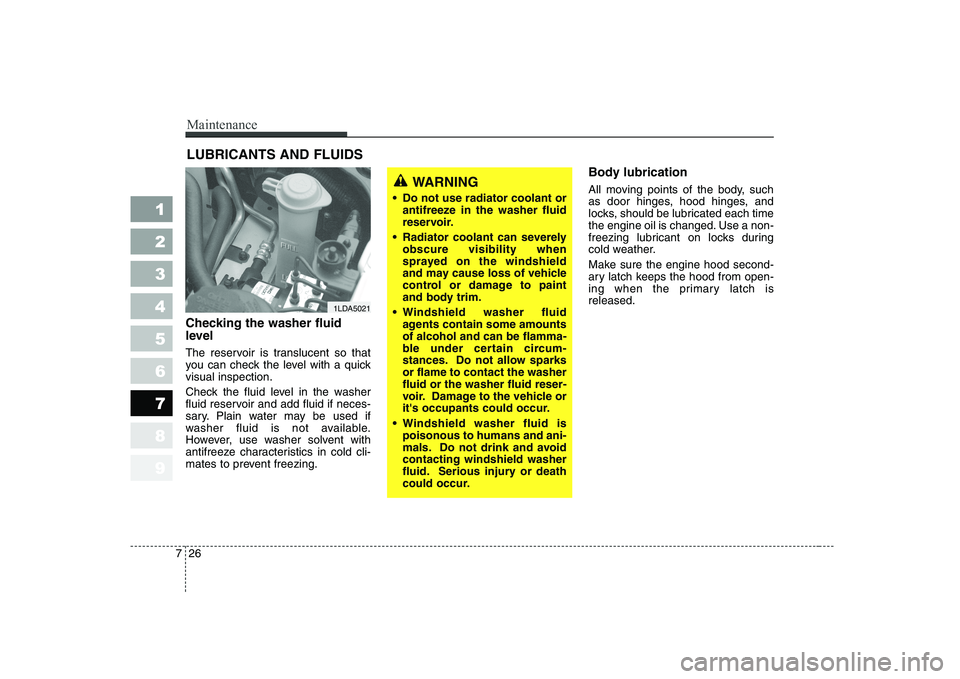
Checking the washer fluid
level
The reservoir is translucent so that
you can check the level with a quickvisual inspection.
Check the fluid level in the washer
fluid reservoir and add fluid if neces-
sary. Plain water may be used if
washer fluid is not available.
However, use washer solvent with
antifreeze characteristics in cold cli-
mates to prevent freezing. Body lubrication
All moving points of the body, such
as door hinges, hood hinges, and
locks, should be lubricated each time
the engine oil is changed. Use a non-
freezing lubricant on locks during
cold weather.
Make sure the engine hood second-
ary latch keeps the hood from open-
ing when the primary latch isreleased.
1LDA5021
WARNING
Do not use radiator coolant or antifreeze in the washer fluid
reservoir.
Radiator coolant can severely obscure visibility when
sprayed on the windshield
and may cause loss of vehicle
control or damage to paint
and body trim.
Windshield washer fluid agents contain some amountsof alcohol and can be flamma-
ble under certain circum-
stances. Do not allow sparksor flame to contact the washerfluid or the washer fluid reser-
voir. Damage to the vehicle or
it's occupants could occur.
Windshield washer fluid is poisonous to humans and ani-
mals. Do not drink and avoidcontacting windshield washer
fluid. Serious injury or death
could occur.
Page 290 of 327
727
Maintenance
1 23456789
FUEL FILTER (FOR DIESEL)
Draining water from the fuel filter
The fuel filter for diesel engine plays
an important role of separating water
from fuel and accumulating the waterin its bottom.
If water accumulates in the fuel filter,
the warning light comes on when the
ignition key is in the “ON” position.
Have water drained from fuel filter by
authorized KIA dealer when the
warning light comes on. Fuel filter cartridge replace- ment
Have fuel filter cartridge replaced by
an authorized KIA dealer accordingto the Maintenance Schedule at thebeginning of this section.
✽✽
NOTICE
When replacing the fuel filter cartridge,
use KIA genuine parts.
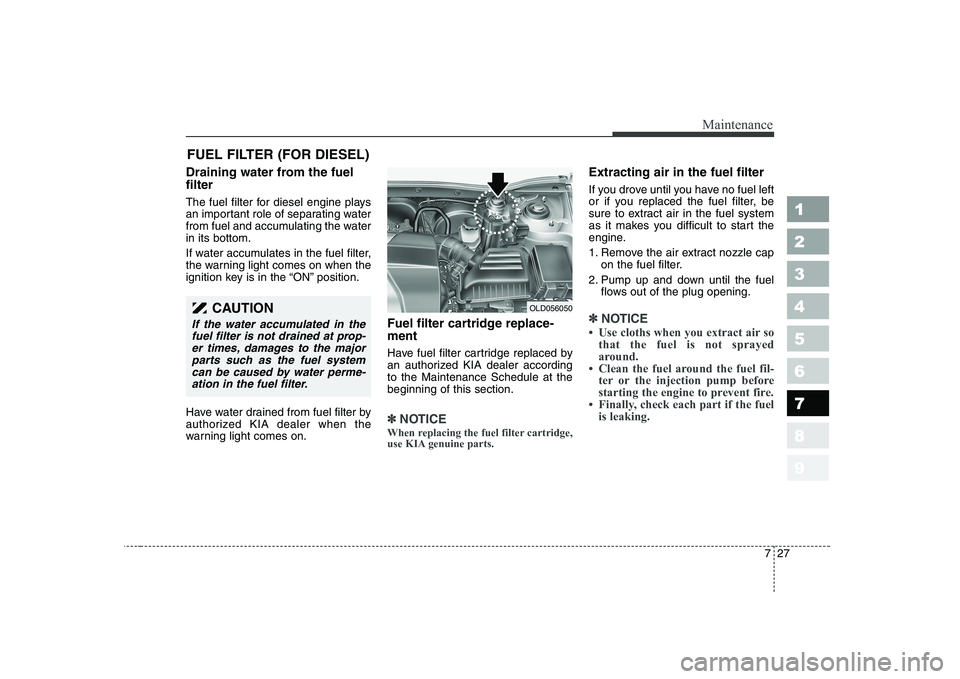
Extracting air in the fuel filter
If you drove until you have no fuel left
or if you replaced the fuel filter, be
sure to extract air in the fuel system
as it makes you difficult to start the
engine.
1. Remove the air extract nozzle cap on the fuel filter.
2. Pump up and down until the fuel flows out of the plug opening.
✽✽NOTICE
Page 292 of 327
729
Maintenance
1 23456789
Replace the filter according to the
Maintenance Schedule.
If the vehicle is operated in extreme-ly dusty or sandy areas, replace the element more often than the usualrecommended intervals. (Refer to“Maintenance under severe usage conditions” in this section.)
CAUTION
Do not drive with the air clean- er removed; this will result inexcessive engine wear.
When removing the air cleaner filter, be careful that dust ordirt does not enter the airintake, or damage may result.
Use a KIA genuine part. Use of non-genuine part could dam-age the air flow sensor or tur- bocharger.
Page 297 of 327
Maintenance
34
7
1 23456789
BATTERY
WARNING - Battery
dangers
Always read the follow-
ing instructions carefully
when handling a battery.
Keep lighted cigarettes and all other flames or
sparks away from the
battery.
Hydrogen, which is a highly combustible gas,
is always present in bat-
tery cells and may
explode if ignited.
Keep batteries out of the reach of children because batteries con-
tain highly corrosive
SULFURIC ACID. Do not
allow battery acid to con-
tact your skin, eyes,
clothing or paint finish.
(Continued)(Continued)If any electrolyte getsinto your eyes, flush your
eyes with clean water for
at least 15 minutes and
get immediate medical
attention. If possible,
continue to apply water
with a sponge or clothuntil medical attention isreceived.
If electrolyte gets on
your skin, thoroughlywash the contacted area.
If you feel a pain or a
burning sensation, getmedical attention imme-
diately.
Wear eye protection when charging or work-
ing near a battery.
Always provide ventila-
tion when working in an
enclosed space.
(Continued)(Continued)
When lifting a plastic-casedbattery, excessive pressure on
the case may cause battery
acid to leak, resulting in per-
sonal injury. Lift with a battery
carrier or with your hands on
opposite corners.
Never attempt to charge the battery when the battery
cables are connected.
The electrical ignition system works with high voltage.
Never touch these compo-nents with the engine running
or the ignition switched on.
Page 314 of 327
751
Maintenance
1 23456789
EXTERIOR CARE
Exterior general caution
It is very important to follow the label
directions when using any chemical
cleaner or polish. Read all warningand caution statements that appearon the label. Finish maintenance
Washing
To help protect your vehicle’s finish
from rust and deterioration, wash itthoroughly and frequently at least
once a month with lukewarm or cold
water.
If you use your vehicle for off-road
driving, you should wash it after each
off-road trip. Pay special attention to
the removal of any accumulation of
salt, dirt, mud, and other foreign
materials. Make sure the drain holes
in the lower edges of the doors and
rocker panels are kept clear andclean.
Insects, tar, tree sap, bird droppings,
industrial pollution and similar
deposits can damage your vehicle’s
finish if not removed immediately. Even prompt washing with plain
water may not completely remove all
these deposits. A mild soap, safe for
use on painted surfaces, may beused.
After washing, rinse the vehicle thor-
oughly with lukewarm or cold water.
Do not allow soap to dry on the fin-ish.✽✽
NOTICE
Do not use strong soap, chemical
detergents or hot water, and do not
wash the vehicle in direct sunlight orwhen the body of the vehicle iswarm.
CAUTION
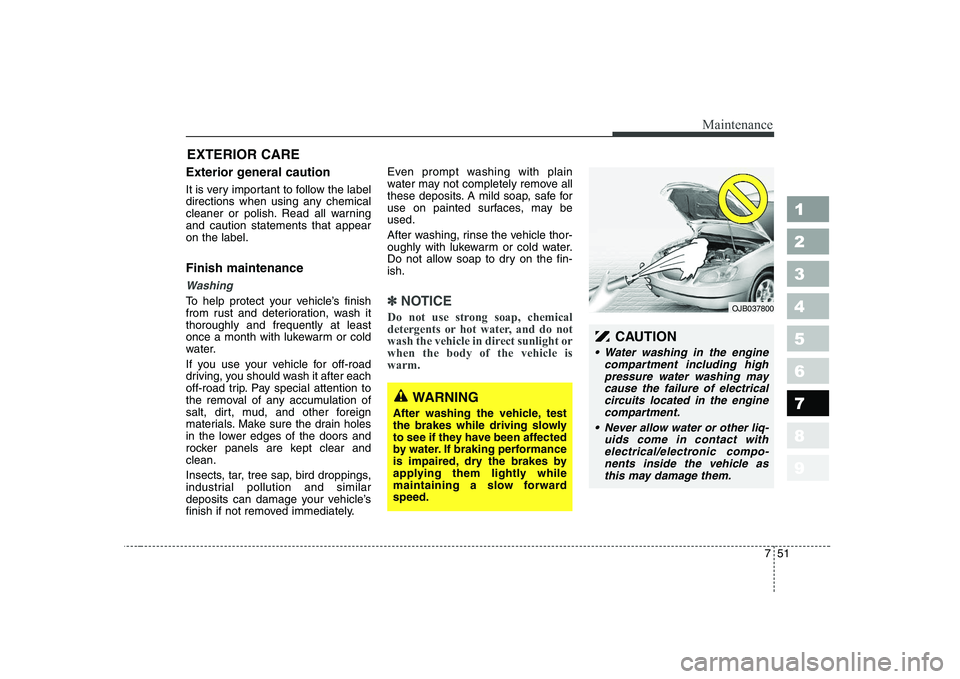
Water washing in the engine compartment including highpressure water washing maycause the failure of electricalcircuits located in the engine compartment.
Never allow water or other liq- uids come in contact withelectrical/electronic compo-nents inside the vehicle as this may damage them.
WARNING
After washing the vehicle, test
the brakes while driving slowly
to see if they have been affected
by water. If braking performance
is impaired, dry the brakes by
applying them lightly while
maintaining a slow forwardspeed.
OJB037800
Page 322 of 327
Specifications
4
8
1
2
3
4
5
6
7
8
9
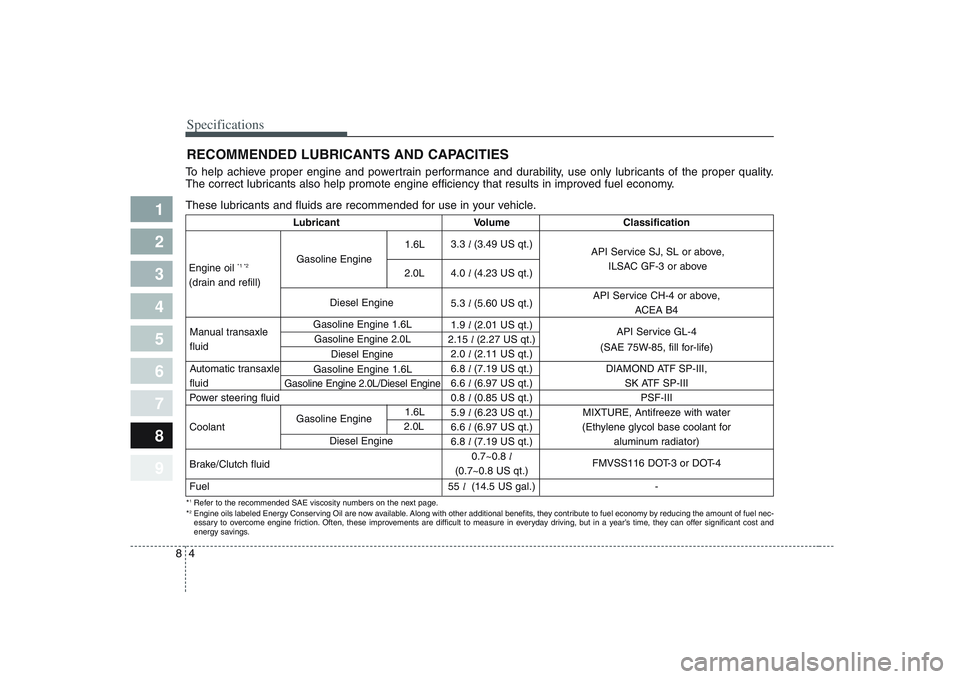
RECOMMENDED LUBRICANTS AND CAPACITIES
To help achieve proper engine and powertrain performance and durability, use only lubricants of the proper quality.
The correct lubricants also help promote engine efficiency that results in improved fuel economy.
These lubricants and fluids are recommended for use in your vehicle.
* 1
Refer to the recommended SAE viscosity numbers on the next page.
* 2
Engine oils labeled Energy Conserving Oil are now available. Along with other additional benefits, they contribute to fuel economy by reducing the amount of fuel nec-
essary to overcome engine friction. Often, these improvements are difficult to measure in everyday driving, but in a year’s time, they can offer significant cost and
energy savings.
Lubricant Volume Classification
3.3 l (3.49 US qt.)
4.0 l (4.23 US qt.)
API Service CH-4 or above,
5.3 l (5.60 US qt.)
ACEA B4
1.9 l (2.01 US qt.)
API Service GL-4
2.15 l (2.27 US qt.)
(SAE 75W-85, fill for-life)
2.0 l (2.11 US qt.)
6.8 l (7.19 US qt.) DIAMOND ATF SP-III,
6.6 l (6.97 US qt.) SK ATF SP-III
Power steering fluid 0.8 l (0.85 US qt.) PSF-III
5.9 l (6.23 US qt.) MIXTURE, Antifreeze with water
Coolant 6.6 l (6.97 US qt.) (Ethylene glycol base coolant for
6.8 l (7.19 US qt.) aluminum radiator)
Brake/Clutch fluid 0.7~0.8
l
FMVSS116 DOT-3 or DOT-4
(0.7~0.8 US qt.)
Fuel 55 l (14.5 US gal.) -
Engine oil *1 *2
(drain and refill)
Automatic transaxle fluidManual transaxlefluid Gasoline Engine
1.6L
2.0L
Gasoline Engine Diesel Engine
Diesel Engine API Service SJ, SL or above,
ILSAC GF-3 or above
1.6L
2.0L
Gasoline Engine 1.6L
Gasoline Engine 2.0L
Diesel Engine
Gasoline Engine 1.6L
Gasoline Engine 2.0L/Diesel Engine
Page 323 of 327
85
1
2
3
4
5
6
7
8
9
Specifications
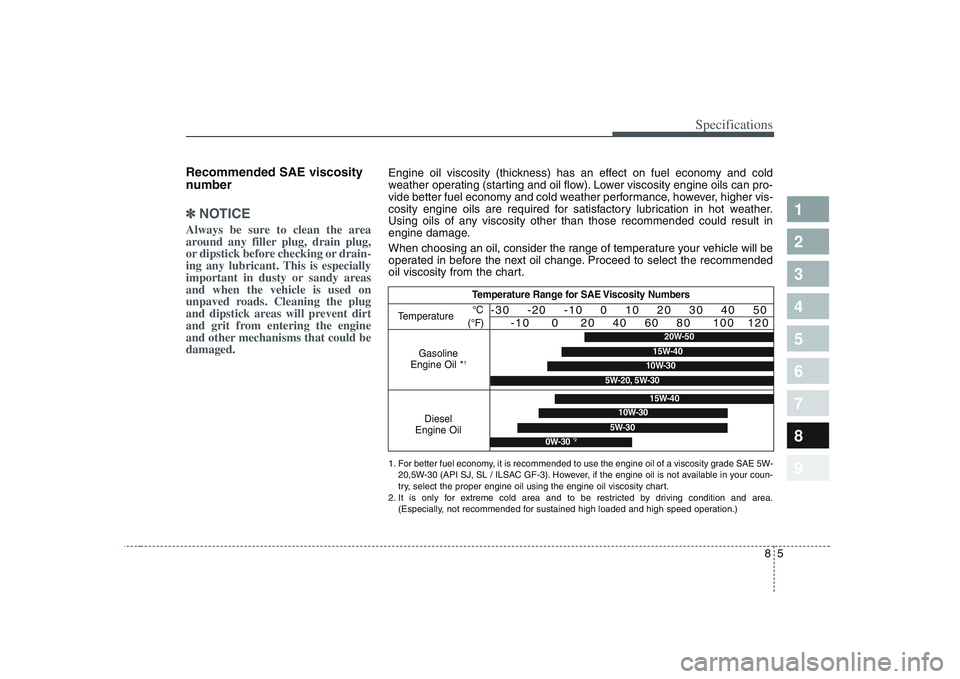
Recommended SAE viscosity
number
✽✽NOTICE
Always be sure to clean the area
around any filler plug, drain plug,
or dipstick before checking or drain-
ing any lubricant. This is especially
important in dusty or sandy areasand when the vehicle is used on
unpaved roads. Cleaning the plug
and dipstick areas will prevent dirt
and grit from entering the engine
and other mechanisms that could bedamaged.
Temperature Range for SAE Viscosity Numbers
Temperature
Gasoline
Engine Oil *
1
°C
(°F)-30 -20 -10 0 10 20 30 40 50 -10 0 20 40 60 80 100 120
Diesel
Engine Oil10W-30
15W-40
0W-30 *2
5W-30
1. For better fuel economy, it is recommended to use the engine oil of a viscosity grade SAE 5W-
20,5W-30 (API SJ, SL / ILSAC GF-3). However, if the engine oil is not available in your coun-
try, select the proper engine oil using the engine oil viscosity chart.
2. It is only for extreme cold area and to be restricted by driving condition and area. (Especially, not recommended for sustained high loaded and high speed operation.)
20W-50
10W-30
15W-40
5W-20, 5W-30
Engine oil viscosity (thickness) has an effect on fuel economy and cold
weather operating (starting and oil flow). Lower viscosity engine oils can pro-
vide better fuel economy and cold weather performance, however, higher vis-
cosity engine oils are required for satisfactory lubrication in hot weather.
Using oils of any viscosity other than those recommended could result in
engine damage.
When choosing an oil, consider the range of temperature your vehicle will be
operated in before the next oil change. Proceed to select the recommended
oil viscosity from the chart.
Page 325 of 327
Index
2
9
1
2
3
4
5
6
7
8
9
Air cleaner . . . . . . . . . . . . . . . . . . . . . . . . . . . . . . . . 7-28
Airbags-supplemental restraint system . . . . . . . . . . 3-54
Antenna . . . . . . . . . . . . . . . . . . . . . . . . . . . . . . . . . 3-100
Audio system . . . . . . . . . . . . . . . . . . . . . . . . . . . . . 3-102
Automatic climate control system . . . . . . . . . . . . . . 4-64
Automatic transaxle . . . . . . . . . . . . . . . . . . . . . 4-8, 7-24
Battery . . . . . . . . . . . . . . . . . . . . . . . . . . . . . . . . . . . 7-34
Before driving. . . . . . . . . . . . . . . . . . . . . . . . . . . . . . . 5-6
Brake system . . . . . . . . . . . . . . . . . . . . . . . . . . . . . . 4-14
Brakes and clutch. . . . . . . . . . . . . . . . . . . . . . . . . . . 7-21
Bulb replacement . . . . . . . . . . . . . . . . . . . . . . . . . . . 7-44
Climate control air filter . . . . . . . . . . . . . . . . . . . . . 7-30
Cruise control . . . . . . . . . . . . . . . . . . . . . . . . . . . . . . 4-23
Defroster . . . . . . . . . . . . . . . . . . . . . . . . . . . . . . . . . . 4-53
Door locks. . . . . . . . . . . . . . . . . . . . . . . . . . . . . . . . . . 3-7 Electrical circuit protection . . . . . . . . . . . . . . . . . . . . 6-7
Emergency commodity. . . . . . . . . . . . . . . . . . . . . . . 6-25
Emergency starting . . . . . . . . . . . . . . . . . . . . . . . . . . 6-4
Emission control system. . . . . . . . . . . . . . . . . . . . . . . 5-4
Engine compartment. . . . . . . . . . . . . . . . . . . . . 2-4, 7-14
Engine cooling system . . . . . . . . . . . . . . . . . . . . . . . 7-18
Engine oil and oil filter . . . . . . . . . . . . . . . . . . . . . . 7-17
Exterior care. . . . . . . . . . . . . . . . . . . . . . . . . . . . . . . 7-51
Fuel filler lid . . . . . . . . . . . . . . . . . . . . . . . . . . . . . . . 3-79
Fuel filter . . . . . . . . . . . . . . . . . . . . . . . . . . . . . . . . . 7-27
Fuel requirements . . . . . . . . . . . . . . . . . . . . . . . . . . . 5-2
Gauges . . . . . . . . . . . . . . . . . . . . . . . . . . . . . . . . . . . 4-31
Hazard warning flasher . . . . . . . . . . . . . . . . . . . . . . 4-54
Hood . . . . . . . . . . . . . . . . . . . . . . . . . . . . . . . . . . . . . 3-77
How to use this manual . . . . . . . . . . . . . . . . . . . . . . . 1-2
A
B
C
D
F
E
G
H