warning KIA CERATO 2008 User Guide
[x] Cancel search | Manufacturer: KIA, Model Year: 2008, Model line: CERATO, Model: KIA CERATO 2008Pages: 327, PDF Size: 42.19 MB
Page 31 of 327
321
1 23456789
Knowing your vehicle
Headrest adjustment
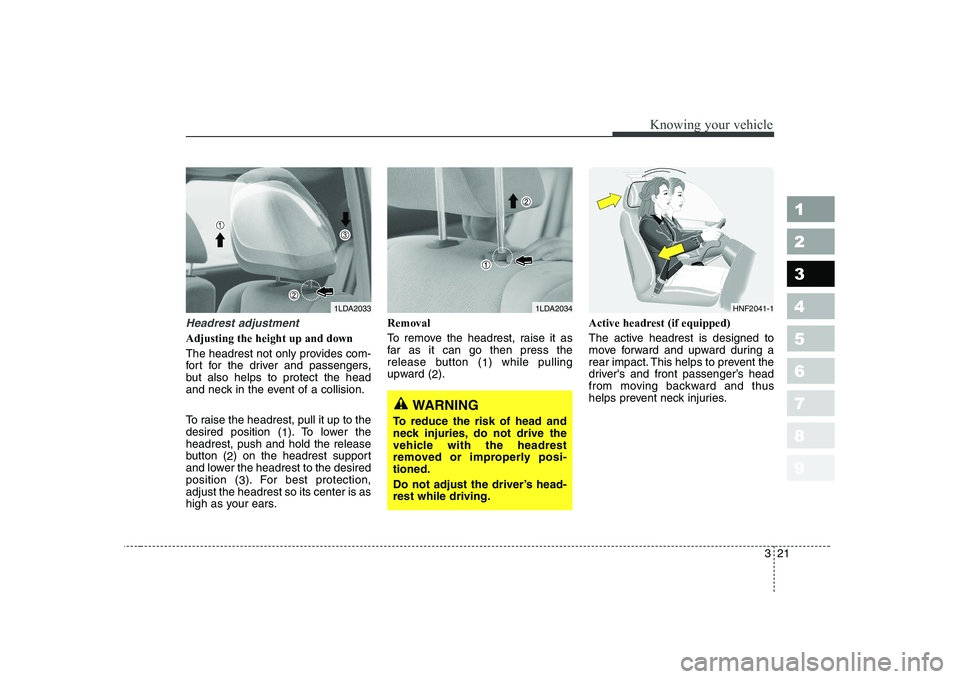
Adjusting the height up and down
The headrest not only provides com-
fort for the driver and passengers,
but also helps to protect the head
and neck in the event of a collision.
To raise the headrest, pull it up to the desired position (1). To lower the
headrest, push and hold the release
button ( 2) on the headrest support
and lower the headrest to the desiredposition ( 3). For best protection,
adjust the headrest so its center is as
high as your ears. Removal
To remove the headrest, raise it as
far as it can go then press the
release button (
1) while pulling
upward ( 2). Active headrest (if equipped)
The active headrest is designed to
move forward and upward during a
rear impact. This helps to prevent the
driver's and front passenger’s head
from moving backward and thus
helps prevent neck injuries.
1LDA20331LDA2034
WARNING
To reduce the risk of head and
neck injuries, do not drive the
vehicle with the headrest
removed or improperly posi-tioned.
Do not adjust the driver’s head- rest while driving.
HNF2041-1
Page 32 of 327
Knowing your vehicle
22
3
1 23456789
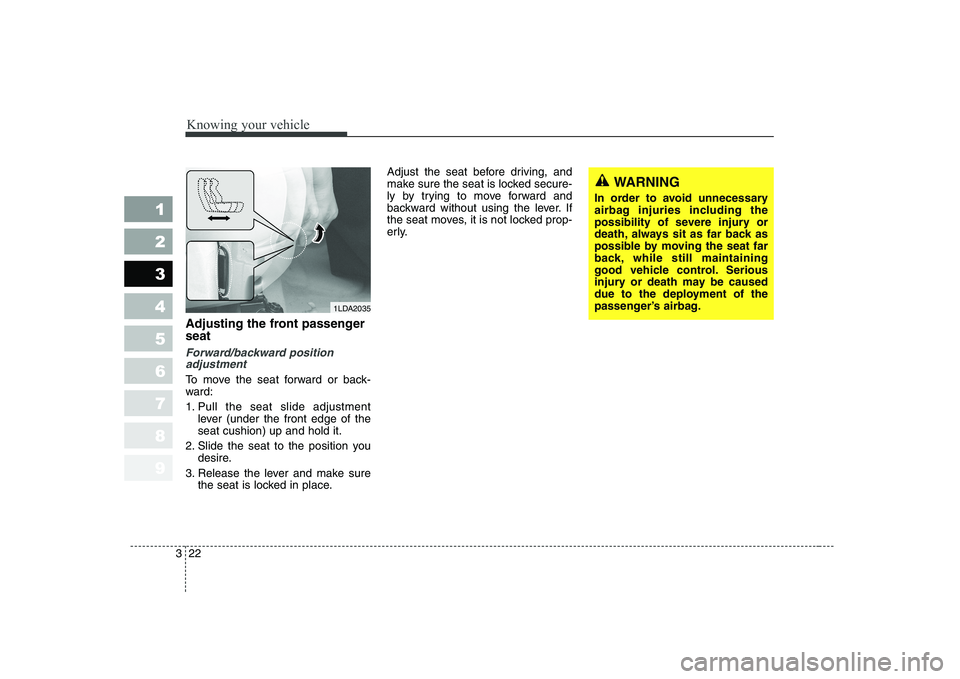
Adjusting the front passenger seat
Forward/backward position
adjustment
To move the seat forward or back-
ward:
1. Pull the seat slide adjustment
lever (under the front edge of the seat cushion) up and hold it.
2. Slide the seat to the position you desire.
3. Release the lever and make sure the seat is locked in place. Adjust the seat before driving, and
make sure the seat is locked secure-
ly by trying to move forward and
backward without using the lever. If
the seat moves, it is not locked prop-
erly.
1LDA2035
WARNING
In order to avoid unnecessary
airbag injuries including the
possibility of severe injury or
death, always sit as far back as
possible by moving the seat far
back, while still maintaining
good vehicle control. Serious
injury or death may be caused
due to the deployment of the
passenger’s airbag.
Page 33 of 327
323
1 23456789
Knowing your vehicle
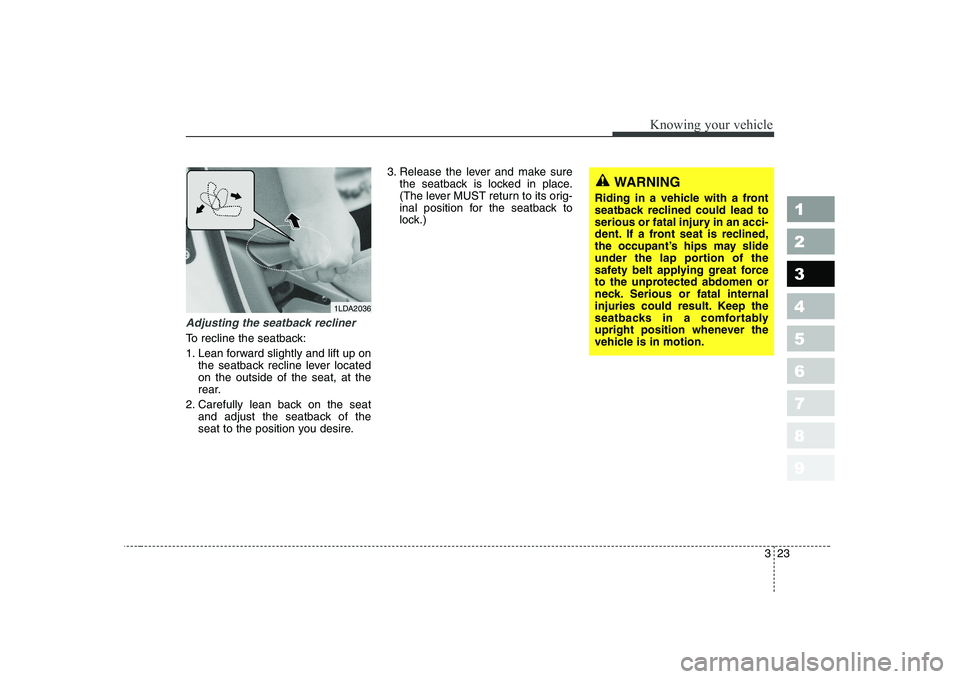
Adjusting the seatback recliner
To recline the seatback:
1. Lean forward slightly and lift up onthe seatback recline lever located on the outside of the seat, at the
rear.
2. Carefully lean back on the seat and adjust the seatback of the
seat to the position you desire. 3. Release the lever and make sure
the seatback is locked in place.
(The lever MUST return to its orig-
inal position for the seatback to
lock.)
WARNING
Riding in a vehicle with a front
seatback reclined could lead to
serious or fatal injury in an acci-
dent. If a front seat is reclined,
the occupant’s hips may slide
under the lap portion of the
safety belt applying great force
to the unprotected abdomen or
neck. Serious or fatal internal
injuries could result. Keep the
seatbacks in a comfortably
upright position whenever the
vehicle is in motion.
1LDA2036
Page 35 of 327
325
1 23456789
Knowing your vehicle
Headrest adjustment
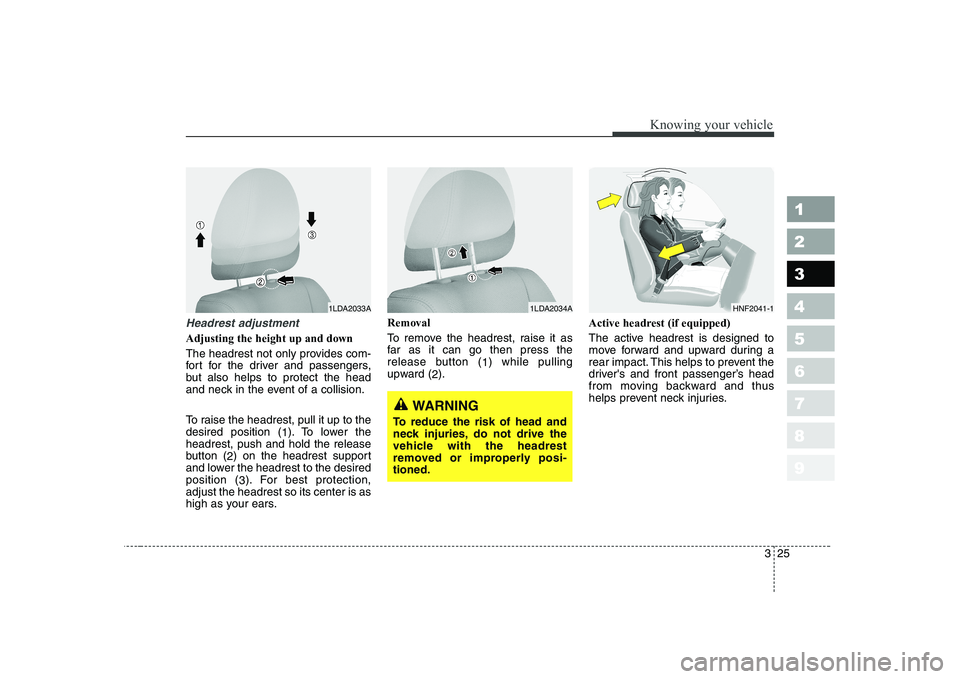
Adjusting the height up and down
The headrest not only provides com-
fort for the driver and passengers,
but also helps to protect the head
and neck in the event of a collision.
To raise the headrest, pull it up to the desired position (1). To lower the
headrest, push and hold the release
button ( 2) on the headrest support
and lower the headrest to the desiredposition ( 3). For best protection,
adjust the headrest so its center is as
high as your ears. Removal
To remove the headrest, raise it as
far as it can go then press the
release button (
1) while pulling
upward ( 2). Active headrest (if equipped)
The active headrest is designed to
move forward and upward during a
rear impact. This helps to prevent the
driver's and front passenger’s head
from moving backward and thus
helps prevent neck injuries.
1LDA2033A1LDA2034A
WARNING
To reduce the risk of head and
neck injuries, do not drive the
vehicle with the headrest
removed or improperly posi-tioned.
HNF2041-1
Page 38 of 327
Knowing your vehicle
28
3
1 23456789
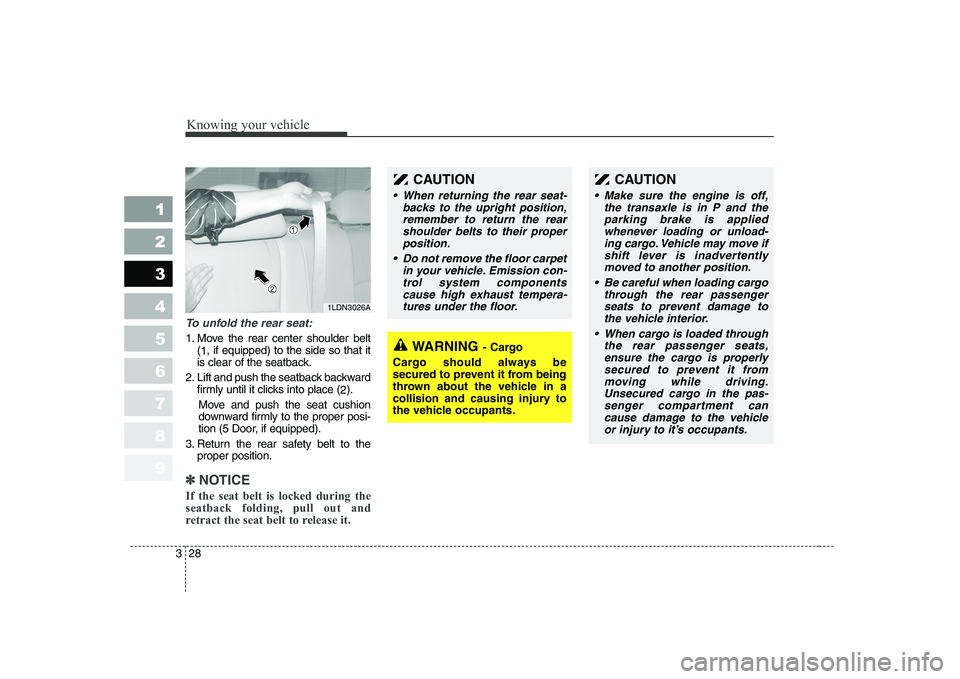
To unfold the rear seat:
1. Move the rear center shoulder belt
(1 , if equipped) to the side so that it
is clear of the seatback.
2. Lift and push the seatback backward firmly until it clicks into place ( 2).
Move and push the seat cushion
downward firmly to the proper posi-
tion (5 Door, if equipped).
3. Return the rear safety belt to the proper position.
✽✽ NOTICE
If the seat belt is locked during the seatback folding, pull out and
retract the seat belt to release it.
CAUTION
When returning the rear seat- backs to the upright position,remember to return the rear shoulder belts to their properposition.
Do not remove the floor carpet in your vehicle. Emission con-trol system components cause high exhaust tempera-tures under the floor.
WARNING - Cargo
Cargo should always be
secured to prevent it from being
thrown about the vehicle in a
collision and causing injury to
the vehicle occupants.
CAUTION
Make sure the engine is off, the transaxle is in P and theparking brake is appliedwhenever loading or unload- ing cargo. Vehicle may move ifshift lever is inadvertentlymoved to another position.
Be careful when loading cargo through the rear passengerseats to prevent damage tothe vehicle interior.
When cargo is loaded through the rear passenger seats,ensure the cargo is properly secured to prevent it frommoving while driving.Unsecured cargo in the pas- senger compartment cancause damage to the vehicleor injury to it’s occupants.
1LDN3026A
Page 39 of 327
329
1 23456789
Knowing your vehicle
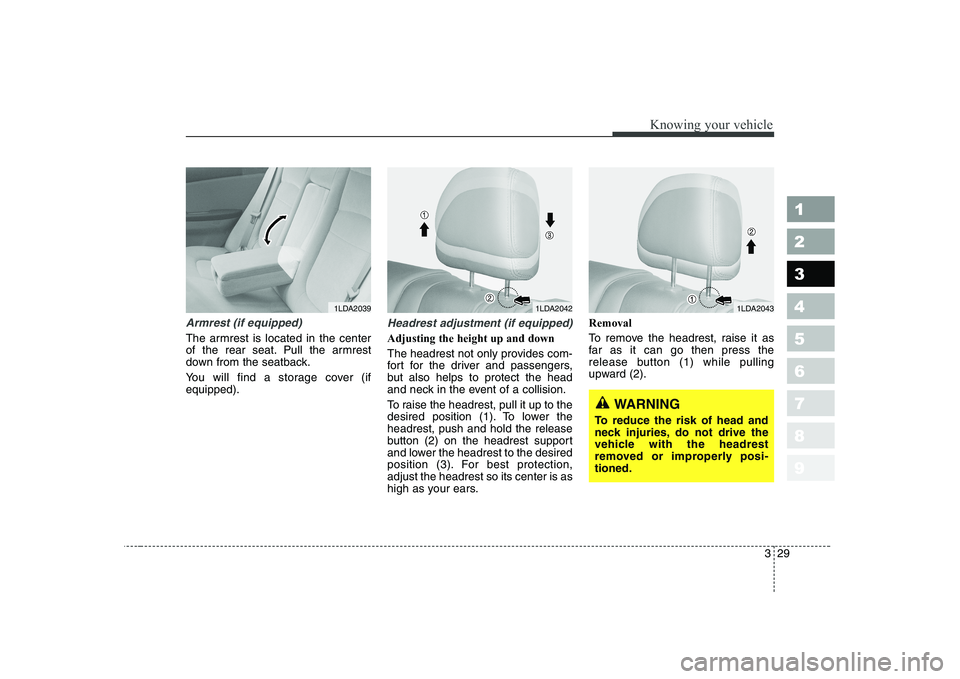
Armrest (if equipped)
The armrest is located in the center
of the rear seat. Pull the armrest
down from the seatback.
You will find a storage cover (if equipped).
Headrest adjustment (if equipped)
Adjusting the height up and down
The headrest not only provides com-
fort for the driver and passengers,
but also helps to protect the head
and neck in the event of a collision.
To raise the headrest, pull it up to the
desired position (1). To lower theheadrest, push and hold the release
button (2) on the headrest support
and lower the headrest to the desired
position (3). For best protection,adjust the headrest so its center is as
high as your ears.Removal
To remove the headrest, raise it as
far as it can go then press the
release button (1) while pulling
upward (2).
1LDA2042
WARNING
To reduce the risk of head and
neck injuries, do not drive the
vehicle with the headrest
removed or improperly posi-tioned.
1LDA20431LDA2039
Page 40 of 327
Knowing your vehicle
30
3
1 23456789
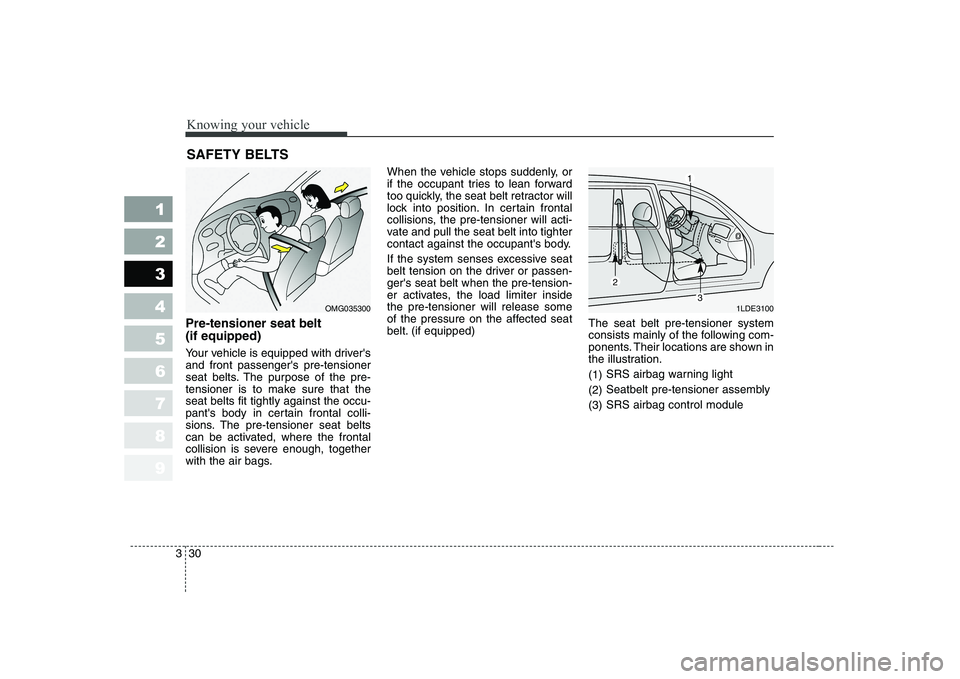
Pre-tensioner seat belt (if equipped)
Your vehicle is equipped with driver's and front passenger's pre-tensioner
seat belts. The purpose of the pre-
tensioner is to make sure that theseat belts fit tightly against the occu-
pant's body in certain frontal colli-
sions. The pre-tensioner seat belts
can be activated, where the frontal
collision is severe enough, together
with the air bags. When the vehicle stops suddenly, or
if the occupant tries to lean forward
too quickly, the seat belt retractor will
lock into position. In certain frontal
collisions, the pre-tensioner will acti-
vate and pull the seat belt into tighter
contact against the occupant's body.
If the system senses excessive seat
belt tension on the driver or passen-ger's seat belt when the pre-tension-
er activates, the load limiter insidethe pre-tensioner will release some
of the pressure on the affected seat
belt. (if equipped)
The seat belt pre-tensioner system
consists mainly of the following com-
ponents. Their locations are shown in
the illustration. (1)
SRS airbag warning light
(2) Seatbelt pre-tensioner assembly
(3) SRS airbag control module
SAFETY BELTS
1LDE3100OMG035300
1
2
3
Page 42 of 327
Knowing your vehicle
32
3
1 23456789
WARNING
Pre-tensioners are designed to operate once. After activa-
tion, pre-tensioner seat belts
must be replaced. All seat
belts, of any type, should
always be replaced after they
have been worn during a colli-sion.
Do not attempt to inspect or replace the pre-tensioner seat
belts yourself. This must be
done by an authorized Kia
dealer.CAUTION
The pre-tensioner seat belt
assembly mechanisms becomehot during activation. Do nottouch the pre-tensioner seat belt assembly for several min-utes after they have been acti-vated.
WARNING
Do not strike the pre-tensioner seat belt assemblies.
Do not attempt to service or repair the pre-tensioner seat
belt system in any manner.
Improper handling of the pre- tensioner seat belt assem-
blies, and failure to heed the
warnings not to strike, modify,
inspect, place, service orrepair the pre-tensioner seat
belt assemblies may lead to
improper operation or inad-
vertent activation causing
serious injury.
Always wear the seat belts when driving or riding in a
motor vehicle.
Page 43 of 327
333
1 23456789
Knowing your vehicle
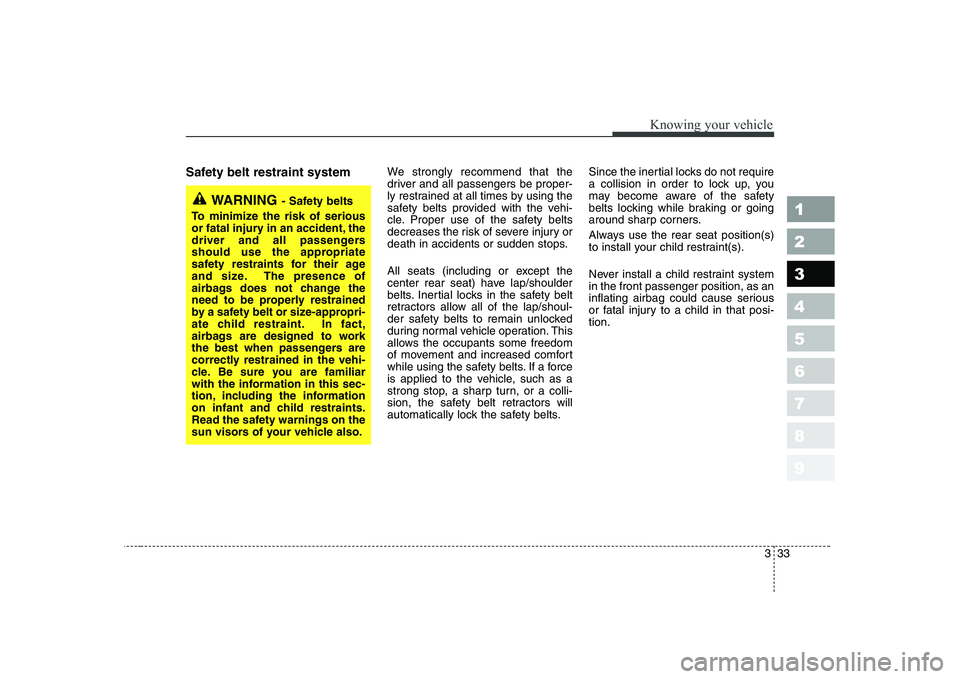
Safety belt restraint system We strongly recommend that the
driver and all passengers be proper-
ly restrained at all times by using the
safety belts provided with the vehi-
cle. Proper use of the safety belts
decreases the risk of severe injury or
death in accidents or sudden stops.
All seats (including or except the
center rear seat) have lap/shoulder
belts. Inertial locks in the safety belt
retractors allow all of the lap/shoul-
der safety belts to remain unlocked
during normal vehicle operation. This
allows the occupants some freedom
of movement and increased comfort
while using the safety belts. If a force
is applied to the vehicle, such as a
strong stop, a sharp turn, or a colli-
sion, the safety belt retractors will
automatically lock the safety belts.Since the inertial locks do not require
a collision in order to lock up, you
may become aware of the safety
belts locking while braking or going
around sharp corners.
Always use the rear seat position(s)
to install your child restraint(s).
Never install a child restraint system in the front passenger position, as an
inflating airbag could cause serious
or fatal injury to a child in that posi-tion.
WARNING
- Safety belts
To minimize the risk of serious
or fatal injury in an accident, the
driver and all passengers
should use the appropriate
safety restraints for their age
and size. The presence of
airbags does not change the
need to be properly restrained
by a safety belt or size-appropri-
ate child restraint. In fact,
airbags are designed to work
the best when passengers are
correctly restrained in the vehi-
cle. Be sure you are familiar
with the information in this sec-
tion, including the information
on infant and child restraints.
Read the safety warnings on the
sun visors of your vehicle also.
Page 44 of 327
Knowing your vehicle
34
3
1 23456789
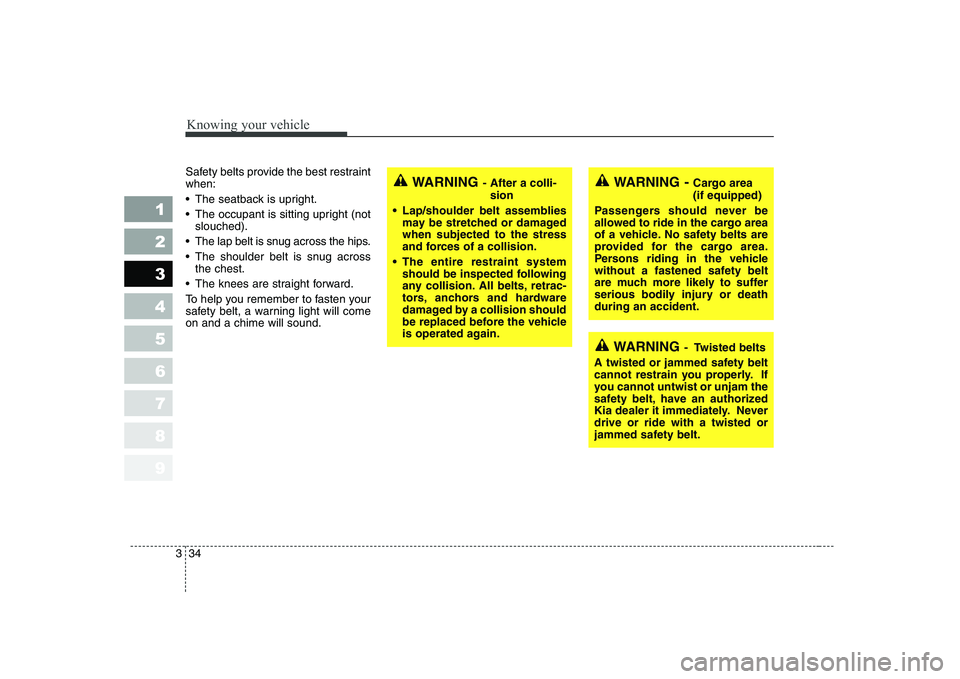
Safety belts provide the best restraint when:
The seatback is upright.
The occupant is sitting upright (not
slouched).
The lap belt is snug across the hips.
The shoulder belt is snug across the chest.
The knees are straight forward.
To help you remember to fasten your
safety belt, a warning light will comeon and a chime will sound.WARNING - After a colli-
sion
Lap/shoulder belt assemblies may be stretched or damaged when subjected to the stress
and forces of a collision.
The entire restraint system should be inspected following
any collision. All belts, retrac-
tors, anchors and hardware
damaged by a collision should
be replaced before the vehicle
is operated again.WARNING - Cargo area (if equipped)
Passengers should never be
allowed to ride in the cargo area
of a vehicle. No safety belts are
provided for the cargo area.
Persons riding in the vehicle
without a fastened safety belt
are much more likely to suffer
serious bodily injury or deathduring an accident.
WARNING - Twisted belts
A twisted or jammed safety belt
cannot restrain you properly. If
you cannot untwist or unjam the
safety belt, have an authorized
Kia dealer it immediately. Neverdrive or ride with a twisted or
jammed safety belt.