brake KIA CERATO 2008 Repair Manual
[x] Cancel search | Manufacturer: KIA, Model Year: 2008, Model line: CERATO, Model: KIA CERATO 2008Pages: 327, PDF Size: 42.19 MB
Page 287 of 327
Maintenance
24
7
1 23456789
AUTOMATIC TRANSAXLE (IF EQUIPPED)
Checking the automatic
transaxle fluid level
The automatic transaxle fluid level
should be checked regularly.
Keep the vehicle on the level ground
with the parking brake applied and
check the fluid level according to the
following procedure.
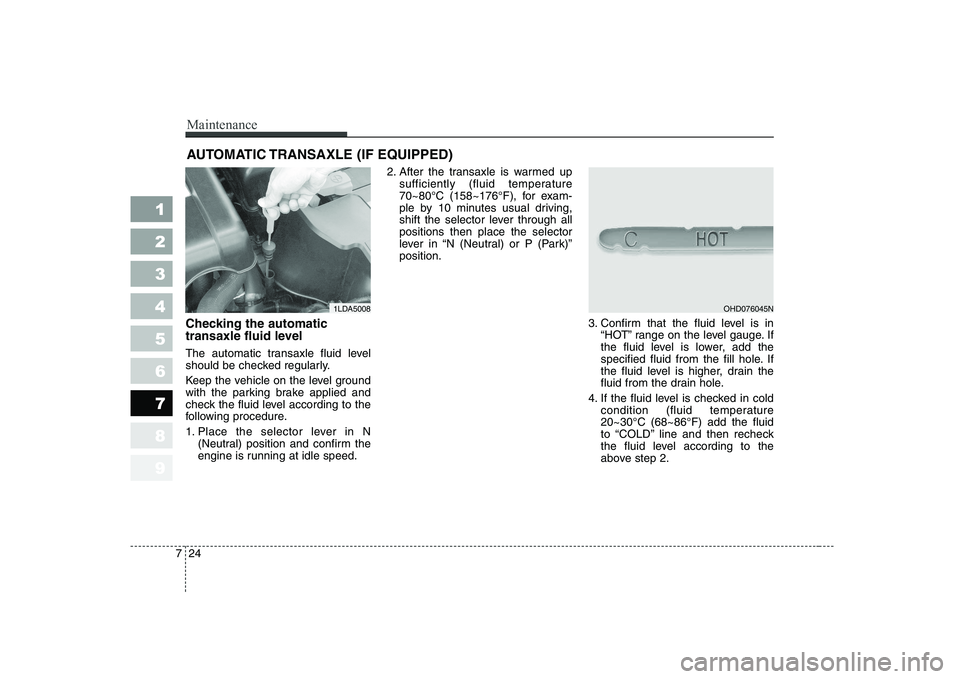
1. Place the selector lever in N (Neutral) position and confirm the
engine is running at idle speed. 2. After the transaxle is warmed up
sufficiently (fluid temperature
70~80°C (158~176°F), for exam-
ple by 10 minutes usual driving,
shift the selector lever through allpositions then place the selector
lever in “N (Neutral) or P (Park)”position.
3. Confirm that the fluid level is in“HOT” range on the level gauge. If
the fluid level is lower, add the
specified fluid from the fill hole. If
the fluid level is higher, drain the
fluid from the drain hole.
4. If the fluid level is checked in cold condition (fluid temperature20~30°C (68~86°F) add the fluid
to “COLD” line and then recheck
the fluid level according to the
above step 2.
1LDA5008OHD076045N
Page 288 of 327
725
Maintenance
1 23456789
✽✽NOTICE
“COLD (C)” scale is for reference
only and should NOT be used todetermine transaxle fluid level. ✽
✽
NOTICE
New automatic transaxle fluid
should be red. The red dye is addedso the assembly plant can identify itas automatic transaxle fluid and dis-
tinguish it from engine oil or
antifreeze. The red dye, which is not
an indicator of fluid quality, is not
permanent. As the vehicle is driven,the automatic transaxle fluid will
begin to look darker. The color may
eventually appear light brown.
Therefore, have an Authorized Kia
dealer change the automatictransaxle fluid according to theScheduled Maintenance at thebeginning of this section.
Changing the automatic transaxle fluid
Have automatic transaxle fluid
changed by an authorized KIA deal-er according to the MaintenanceSchedule at the beginning of thissection.
CAUTION
Low fluid level causes transaxle slippage. Overfillingcan cause foaming, loss offluid and transaxle malfunc-tion.
The use of a non-specified fluid could result in transaxlemalfunction and failure.
WARNING - Parking brake
To avoid sudden movement of
the vehicle, apply parking brakeand depress the brake pedal
before moving the shift lever.
WARNING - Transaxle fluid
The transaxle fluid level should
be checked when the engine isat normal operating tempera-
ture. This means that the
engine, radiator, radiator hose
and exhaust system etc., are
very hot. Exercise great care not
to burn yourself during this pro-
cedure.
Page 301 of 327
Maintenance
38
7
1 23456789
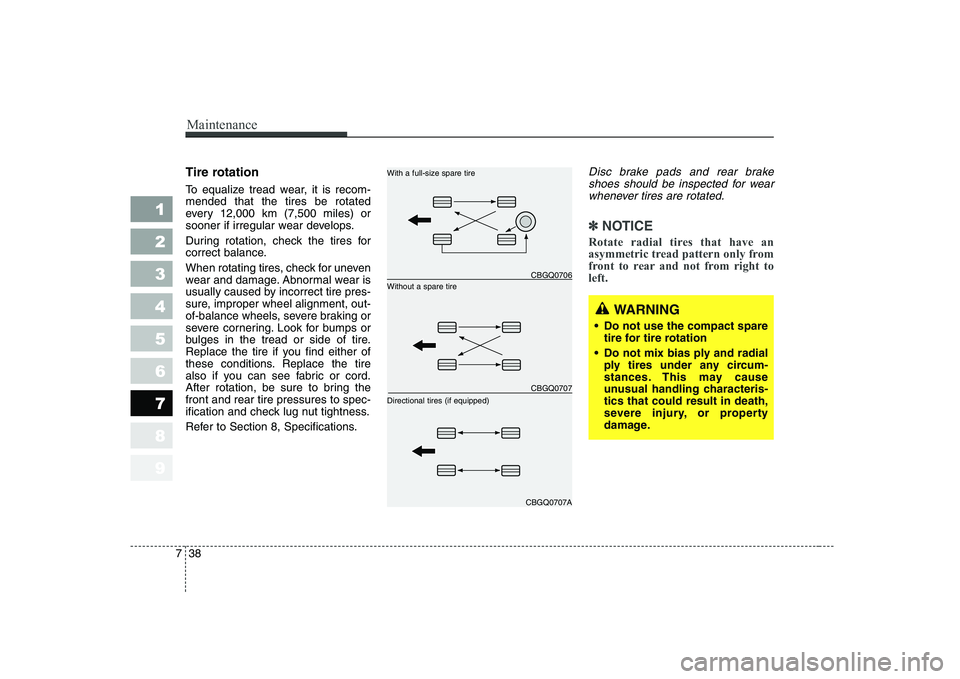
Tire rotation
To equalize tread wear, it is recom- mended that the tires be rotated
every 12,000 km (7,500 miles) or
sooner if irregular wear develops.
During rotation, check the tires for
correct balance.
When rotating tires, check for uneven
wear and damage. Abnormal wear is
usually caused by incorrect tire pres-
sure, improper wheel alignment, out-
of-balance wheels, severe braking or
severe cornering. Look for bumps or
bulges in the tread or side of tire.
Replace the tire if you find either of
these conditions. Replace the tire
also if you can see fabric or cord.
After rotation, be sure to bring thefront and rear tire pressures to spec-
ification and check lug nut tightness.
Refer to Section 8, Specifications.Disc brake pads and rear brake
shoes should be inspected for wearwhenever tires are rotated.
✽✽ NOTICE
Rotate radial tires that have an
asymmetric tread pattern only from
front to rear and not from right toleft.
CBGQ0706
CBGQ0707
CBGQ0707A
Without a spare tire
With a full-size spare tire Directional tires (if equipped)
WARNING
Do not use the compact spare tire for tire rotation
Do not mix bias ply and radial ply tires under any circum-
stances. This may cause
unusual handling characteris-tics that could result in death,
severe injury, or property
damage.
Page 307 of 327
Maintenance
44
7
1 23456789
BULB REPLACEMENT
Use only the bulbs of the specified
wattage.
✽✽ NOTICE
If you don’t have necessary tools,
the correct bulbs and the expertise,
consult an Authorized Kia Dealer. In
many cases, it is difficult to replacevehicle light bulbs because other
parts of the vehicle must be removed
before you can get to the bulb. Thisis especially true if you have to
remove the front bumper to get tothe bulb(s). Removing/installing the
front bumper or bumper hardware
can result in damage to the vehicle.
✽
✽ NOTICE
After heavy, driving rain or washing, headlight and taillight lenses could
appear frosty. This condition is
caused by the temperature differencebetween the lamp inside and outside.
This is similar to the condensation on
your windows inside your vehicleduring the rain and doesn’t indicate
a problem with your vehicle. If the
water leaks into the lamp bulb cir-
cuitry, have the vehicle checked by
an Authorized Kia Dealer.
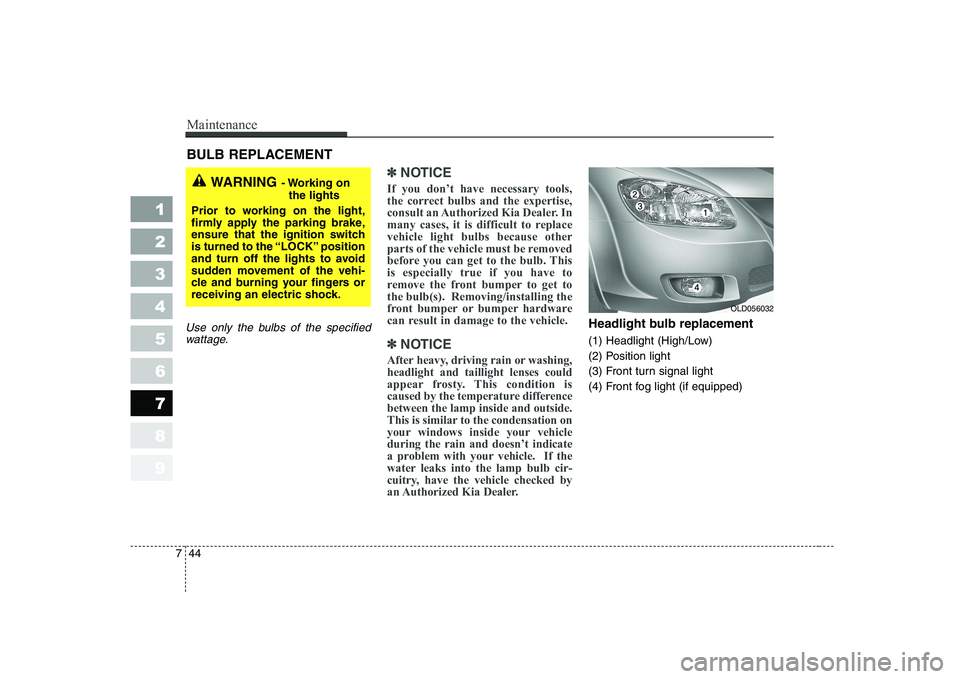
Headlight bulb replacement
(1) Headlight (High/Low)
(2) Position light
(3) Front turn signal light
(4) Front fog light (if equipped)
WARNING - Working on
the lights
Prior to working on the light,
firmly apply the parking brake,
ensure that the ignition switch
is turned to the “LOCK” position
and turn off the lights to avoid
sudden movement of the vehi-
cle and burning your fingers or
receiving an electric shock.
OLD056032
Page 314 of 327
751
Maintenance
1 23456789
EXTERIOR CARE
Exterior general caution
It is very important to follow the label
directions when using any chemical
cleaner or polish. Read all warningand caution statements that appearon the label. Finish maintenance
Washing
To help protect your vehicle’s finish
from rust and deterioration, wash itthoroughly and frequently at least
once a month with lukewarm or cold
water.
If you use your vehicle for off-road
driving, you should wash it after each
off-road trip. Pay special attention to
the removal of any accumulation of
salt, dirt, mud, and other foreign
materials. Make sure the drain holes
in the lower edges of the doors and
rocker panels are kept clear andclean.
Insects, tar, tree sap, bird droppings,
industrial pollution and similar
deposits can damage your vehicle’s
finish if not removed immediately. Even prompt washing with plain
water may not completely remove all
these deposits. A mild soap, safe for
use on painted surfaces, may beused.
After washing, rinse the vehicle thor-
oughly with lukewarm or cold water.
Do not allow soap to dry on the fin-ish.✽✽
NOTICE
Do not use strong soap, chemical
detergents or hot water, and do not
wash the vehicle in direct sunlight orwhen the body of the vehicle iswarm.
CAUTION
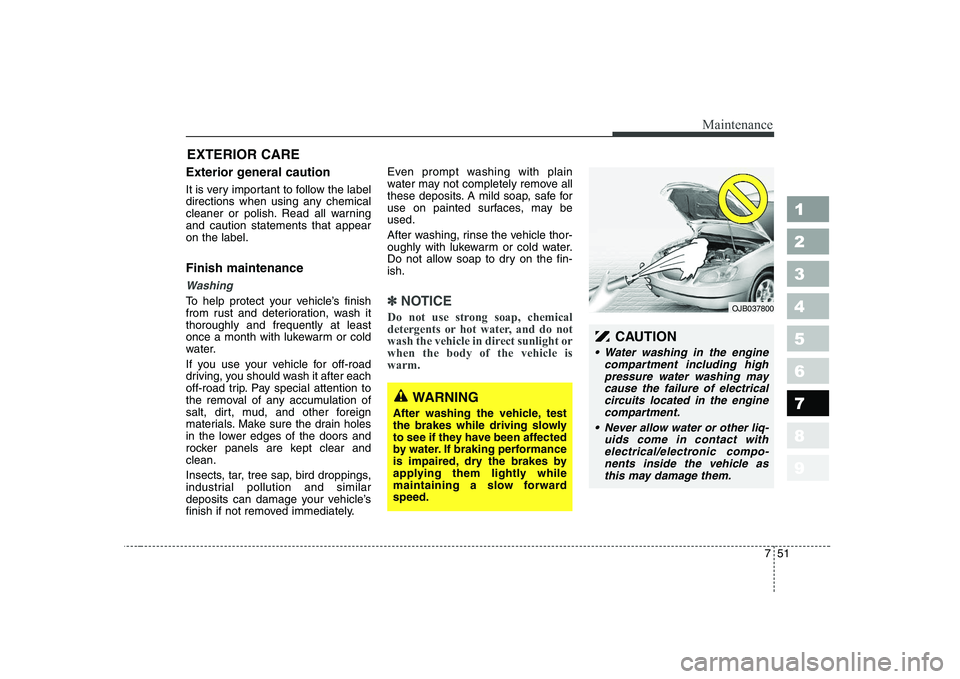
Water washing in the engine compartment including highpressure water washing maycause the failure of electricalcircuits located in the engine compartment.
Never allow water or other liq- uids come in contact withelectrical/electronic compo-nents inside the vehicle as this may damage them.
WARNING
After washing the vehicle, test
the brakes while driving slowly
to see if they have been affected
by water. If braking performance
is impaired, dry the brakes by
applying them lightly while
maintaining a slow forwardspeed.
OJB037800
Page 316 of 327
753
Maintenance
1 23456789
Bright-metal maintenance
To remove road tar and insects,use a tar remover, not a scraper or
other sharp object.
To protect the surfaces of bright- metal parts from corrosion, apply a
coating of wax or chrome preser-
vative and rub to a high luster.
During winter weather or in coastal areas, cover the bright metal parts
with a heavier coating of wax or
preservative. If necessary, coat the
parts with non-corrosive petroleum
jelly or other protective compound. Underbody maintenance
Corrosive materials used for ice and
snow removal and dust control may
collect on the underbody. If these
materials are not removed, acceler-
ated rusting can occur on underbody
parts such as the fuel lines, frame,
floor pan and exhaust system, even
though they have been treated with
rust protection.
Thoroughly flush the vehicle under-
body and wheel openings with luke-
warm or cold water once a month,
after off-road driving and at the end
of each winter. Pay special attentionto these areas because it is difficult
to see all the mud and dirt. It will do
more harm than good to wet down
the road grime without removing it.
The lower edges of doors, rocker
panels, and frame members have
drain holes that should not be
allowed to clog with dirt; trapped
water in these areas can cause rust-ing.WARNING
After washing the vehicle, test
the brakes while driving slowly
to see if they have been affected
by water. If braking performance
is impaired, dry the brakes by
applying them lightly while
maintaining a slow forwardspeed.
Page 322 of 327
Specifications
4
8
1
2
3
4
5
6
7
8
9
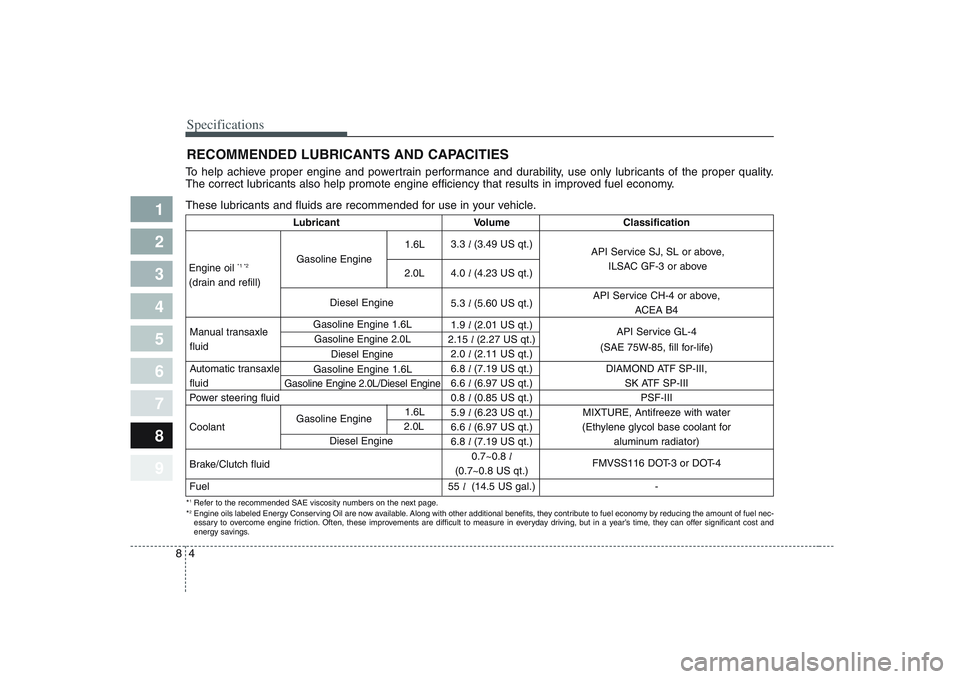
RECOMMENDED LUBRICANTS AND CAPACITIES
To help achieve proper engine and powertrain performance and durability, use only lubricants of the proper quality.
The correct lubricants also help promote engine efficiency that results in improved fuel economy.
These lubricants and fluids are recommended for use in your vehicle.
* 1
Refer to the recommended SAE viscosity numbers on the next page.
* 2
Engine oils labeled Energy Conserving Oil are now available. Along with other additional benefits, they contribute to fuel economy by reducing the amount of fuel nec-
essary to overcome engine friction. Often, these improvements are difficult to measure in everyday driving, but in a year’s time, they can offer significant cost and
energy savings.
Lubricant Volume Classification
3.3 l (3.49 US qt.)
4.0 l (4.23 US qt.)
API Service CH-4 or above,
5.3 l (5.60 US qt.)
ACEA B4
1.9 l (2.01 US qt.)
API Service GL-4
2.15 l (2.27 US qt.)
(SAE 75W-85, fill for-life)
2.0 l (2.11 US qt.)
6.8 l (7.19 US qt.) DIAMOND ATF SP-III,
6.6 l (6.97 US qt.) SK ATF SP-III
Power steering fluid 0.8 l (0.85 US qt.) PSF-III
5.9 l (6.23 US qt.) MIXTURE, Antifreeze with water
Coolant 6.6 l (6.97 US qt.) (Ethylene glycol base coolant for
6.8 l (7.19 US qt.) aluminum radiator)
Brake/Clutch fluid 0.7~0.8
l
FMVSS116 DOT-3 or DOT-4
(0.7~0.8 US qt.)
Fuel 55 l (14.5 US gal.) -
Engine oil *1 *2
(drain and refill)
Automatic transaxle fluidManual transaxlefluid Gasoline Engine
1.6L
2.0L
Gasoline Engine Diesel Engine
Diesel Engine API Service SJ, SL or above,
ILSAC GF-3 or above
1.6L
2.0L
Gasoline Engine 1.6L
Gasoline Engine 2.0L
Diesel Engine
Gasoline Engine 1.6L
Gasoline Engine 2.0L/Diesel Engine
Page 325 of 327
Index
2
9
1
2
3
4
5
6
7
8
9
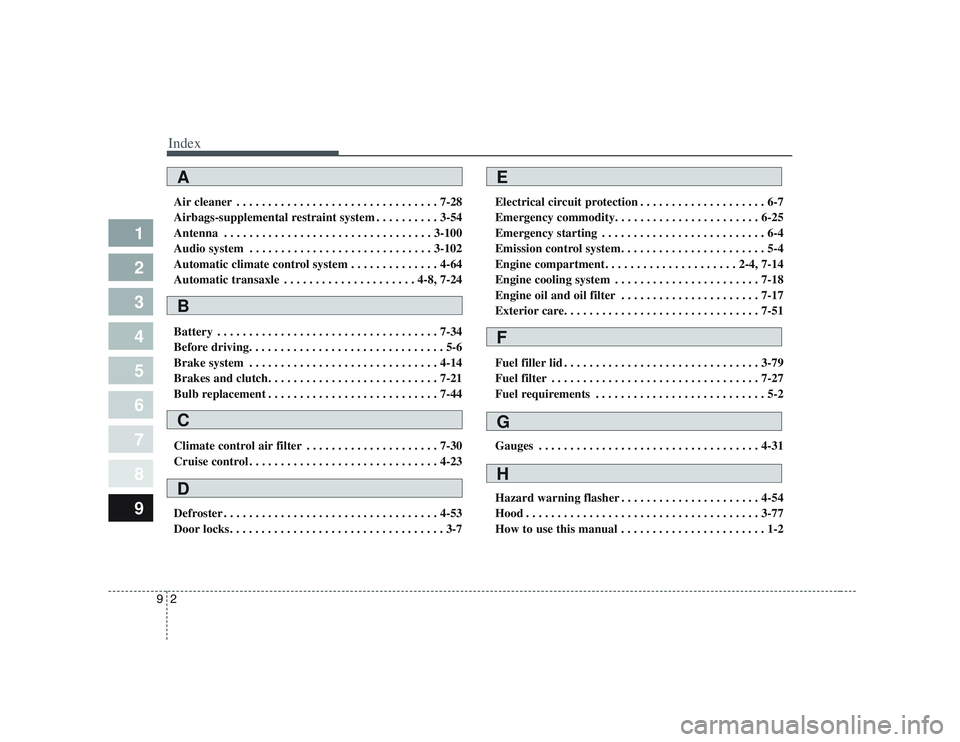
Air cleaner . . . . . . . . . . . . . . . . . . . . . . . . . . . . . . . . 7-28
Airbags-supplemental restraint system . . . . . . . . . . 3-54
Antenna . . . . . . . . . . . . . . . . . . . . . . . . . . . . . . . . . 3-100
Audio system . . . . . . . . . . . . . . . . . . . . . . . . . . . . . 3-102
Automatic climate control system . . . . . . . . . . . . . . 4-64
Automatic transaxle . . . . . . . . . . . . . . . . . . . . . 4-8, 7-24
Battery . . . . . . . . . . . . . . . . . . . . . . . . . . . . . . . . . . . 7-34
Before driving. . . . . . . . . . . . . . . . . . . . . . . . . . . . . . . 5-6
Brake system . . . . . . . . . . . . . . . . . . . . . . . . . . . . . . 4-14
Brakes and clutch. . . . . . . . . . . . . . . . . . . . . . . . . . . 7-21
Bulb replacement . . . . . . . . . . . . . . . . . . . . . . . . . . . 7-44
Climate control air filter . . . . . . . . . . . . . . . . . . . . . 7-30
Cruise control . . . . . . . . . . . . . . . . . . . . . . . . . . . . . . 4-23
Defroster . . . . . . . . . . . . . . . . . . . . . . . . . . . . . . . . . . 4-53
Door locks. . . . . . . . . . . . . . . . . . . . . . . . . . . . . . . . . . 3-7 Electrical circuit protection . . . . . . . . . . . . . . . . . . . . 6-7
Emergency commodity. . . . . . . . . . . . . . . . . . . . . . . 6-25
Emergency starting . . . . . . . . . . . . . . . . . . . . . . . . . . 6-4
Emission control system. . . . . . . . . . . . . . . . . . . . . . . 5-4
Engine compartment. . . . . . . . . . . . . . . . . . . . . 2-4, 7-14
Engine cooling system . . . . . . . . . . . . . . . . . . . . . . . 7-18
Engine oil and oil filter . . . . . . . . . . . . . . . . . . . . . . 7-17
Exterior care. . . . . . . . . . . . . . . . . . . . . . . . . . . . . . . 7-51
Fuel filler lid . . . . . . . . . . . . . . . . . . . . . . . . . . . . . . . 3-79
Fuel filter . . . . . . . . . . . . . . . . . . . . . . . . . . . . . . . . . 7-27
Fuel requirements . . . . . . . . . . . . . . . . . . . . . . . . . . . 5-2
Gauges . . . . . . . . . . . . . . . . . . . . . . . . . . . . . . . . . . . 4-31
Hazard warning flasher . . . . . . . . . . . . . . . . . . . . . . 4-54
Hood . . . . . . . . . . . . . . . . . . . . . . . . . . . . . . . . . . . . . 3-77
How to use this manual . . . . . . . . . . . . . . . . . . . . . . . 1-2
A
B
C
D
F
E
G
H
Page 326 of 327
93
1
2
3
4
5
6
7
8
9
Index
If you have a flat tire . . . . . . . . . . . . . . . . . . . . . . . . 6-19
Ignition switch . . . . . . . . . . . . . . . . . . . . . . . . . . . . . . 4-2
Immobilizer system . . . . . . . . . . . . . . . . . . . . . . . . . . 3-5
Instrument cluster . . . . . . . . . . . . . . . . . . . . . . . . . . 4-29
Instrument panel overview . . . . . . . . . . . . . . . . . . . . 2-3
Interior care . . . . . . . . . . . . . . . . . . . . . . . . . . . . . . . 7-55
Interior features . . . . . . . . . . . . . . . . . . . . . . . . . . . . 3-90
Interior lights . . . . . . . . . . . . . . . . . . . . . . . . . . . . . . 3-86
Interior overview . . . . . . . . . . . . . . . . . . . . . . . . . . . . 2-2
Keys . . . . . . . . . . . . . . . . . . . . . . . . . . . . . . . . . . . . . . 3-2
Label information . . . . . . . . . . . . . . . . . . . . . . . . . . 5-22
Lighting . . . . . . . . . . . . . . . . . . . . . . . . . . . . . . . . . . 4-45
Lubricants and fluids . . . . . . . . . . . . . . . . . . . . . . . . 7-26
Luggage net . . . . . . . . . . . . . . . . . . . . . . . . . . . . . . . 3-99
Maintenance services . . . . . . . . . . . . . . . . . . . . . . . . . 7-3
Maintenance under severe usage conditions . . . . . . . 7-9Manual climate control system . . . . . . . . . . . . . . . . 4-55
Manual transaxle . . . . . . . . . . . . . . . . . . . . . . . 4-7, 7-23
Mirrors . . . . . . . . . . . . . . . . . . . . . . . . . . . . . . . . . . . 3-82
Normal maintenance schedule . . . . . . . . . . . . . . . . . . 7-5
Overheating . . . . . . . . . . . . . . . . . . . . . . . . . . . . . . . . 6-3
Overloading . . . . . . . . . . . . . . . . . . . . . . . . . . . . . . . 5-21
Owner maintenance . . . . . . . . . . . . . . . . . . . . . . . . . 7-11
Parking brake. . . . . . . . . . . . . . . . . . . . . . . . . . . . . . 7-22
Power steering . . . . . . . . . . . . . . . . . . . . . . . . . . . . . 7-23
Remote keyless entry . . . . . . . . . . . . . . . . . . . . . . . . . 3-3
Road warning . . . . . . . . . . . . . . . . . . . . . . . . . . . . . . . 6-2
Safety belts . . . . . . . . . . . . . . . . . . . . . . . . . . . . . . . . 3-30
Seat . . . . . . . . . . . . . . . . . . . . . . . . . . . . . . . . . . . . . . 3-16
I
K
L
M
N
O
P
R
S