Battery KIA Forte 2014 2.G Repair Manual
[x] Cancel search | Manufacturer: KIA, Model Year: 2014, Model line: Forte, Model: KIA Forte 2014 2.GPages: 446, PDF Size: 7.32 MB
Page 390 of 446
Maintenance
42
7
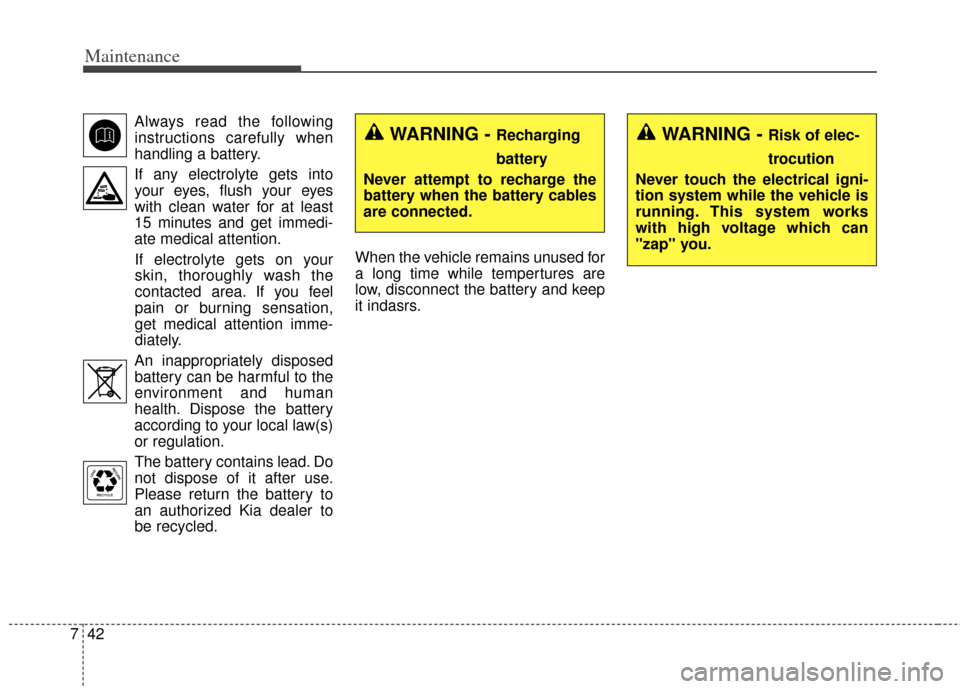
Always read the following
instructions carefully when
handling a battery.
If any electrolyte gets into your eyes, flush your eyes
with clean water for at least
15 minutes and get immedi-
ate medical attention.
If electrolyte gets on your
skin, thoroughly wash the
contacted area. If you feel
pain or burning sensation,
get medical attention imme-
diately.
An inappropriately disposed battery can be harmful to the
environment and human
health. Dispose the battery
according to your local law(s)
or regulation.
The battery contains lead. Do
not dispose of it after use.
Please return the battery to
an authorized Kia dealer to
be recycled. When the vehicle remains unused for
a long time while tempertures are
low, disconnect the battery and keep
it indasrs.WARNING - Recharging
battery
Never attempt to recharge the
battery when the battery cables
are connected.WARNING - Risk of elec-
trocution
Never touch the electrical igni-
tion system while the vehicle is
running. This system works
with high voltage which can
"zap" you.
Page 391 of 446
743
Maintenance
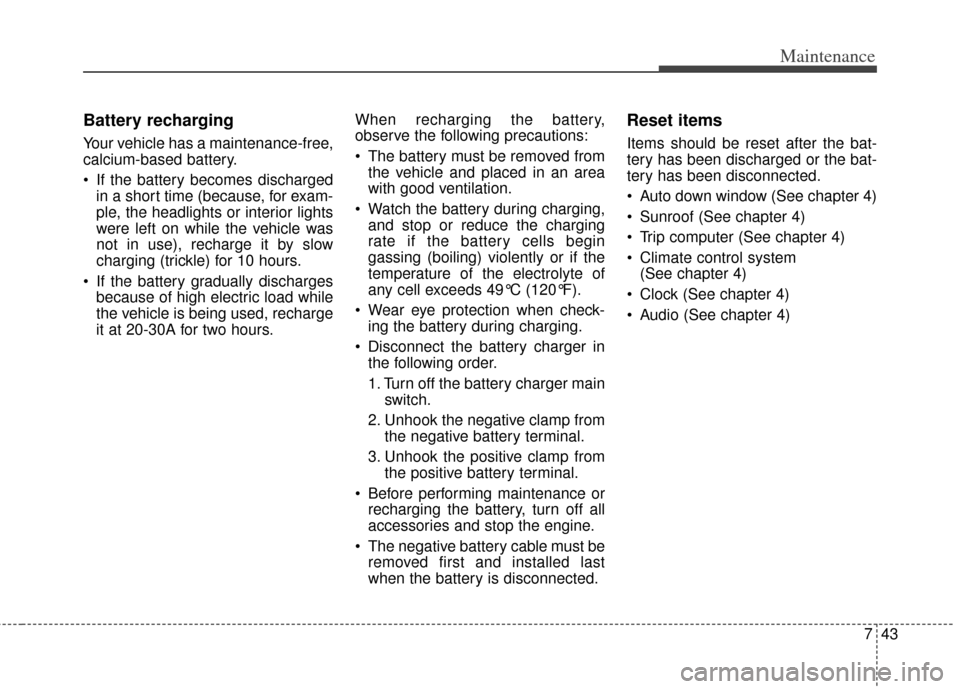
Battery recharging
Your vehicle has a maintenance-free,
calcium-based battery.
If the battery becomes dischargedin a short time (because, for exam-
ple, the headlights or interior lights
were left on while the vehicle was
not in use), recharge it by slow
charging (trickle) for 10 hours.
If the battery gradually discharges because of high electric load while
the vehicle is being used, recharge
it at 20-30A for two hours. When recharging the battery,
observe the following precautions:
The battery must be removed from
the vehicle and placed in an area
with good ventilation.
Watch the battery during charging, and stop or reduce the charging
rate if the battery cells begin
gassing (boiling) violently or if the
temperature of the electrolyte of
any cell exceeds 49°C (120°F).
Wear eye protection when check- ing the battery during charging.
Disconnect the battery charger in the following order.
1. Turn off the battery charger main switch.
2. Unhook the negative clamp from the negative battery terminal.
3. Unhook the positive clamp from the positive battery terminal.
Before performing maintenance or recharging the battery, turn off all
accessories and stop the engine.
The negative battery cable must be removed first and installed last
when the battery is disconnected.
Reset items
Items should be reset after the bat-
tery has been discharged or the bat-
tery has been disconnected.
Auto down window (See chapter 4)
Sunroof (See chapter 4)
Trip computer (See chapter 4)
Climate control system (See chapter 4)
Clock (See chapter 4)
Audio (See chapter 4)
Page 406 of 446
Maintenance
58
7
FUSES
A vehicle’s electrical system is pro-
tected from electrical overload dam-
age by fuses.
This vehicle has 2 fuse panels, one
located in the driver’s side panel bol-
ster, the other in the engine compart-
ment near the battery.
If any of your vehicle’s lights, acces-
sories, or controls do not work, check
the appropriate circuit fuse. If a fuse
has blown, the element inside the
fuse has melted.
If the electrical system does not
work, first check the driver’s side
fuse has melted.
Before replacing a blown fuse, dis-
connect the negative battery cable.
Always replace a blown fuse with
one of the same rating.
If the replacement fuse blows, this
indicates an electrical problem. Avoid
using the system involved and imme-
diately consult an authorized Kia
dealer.
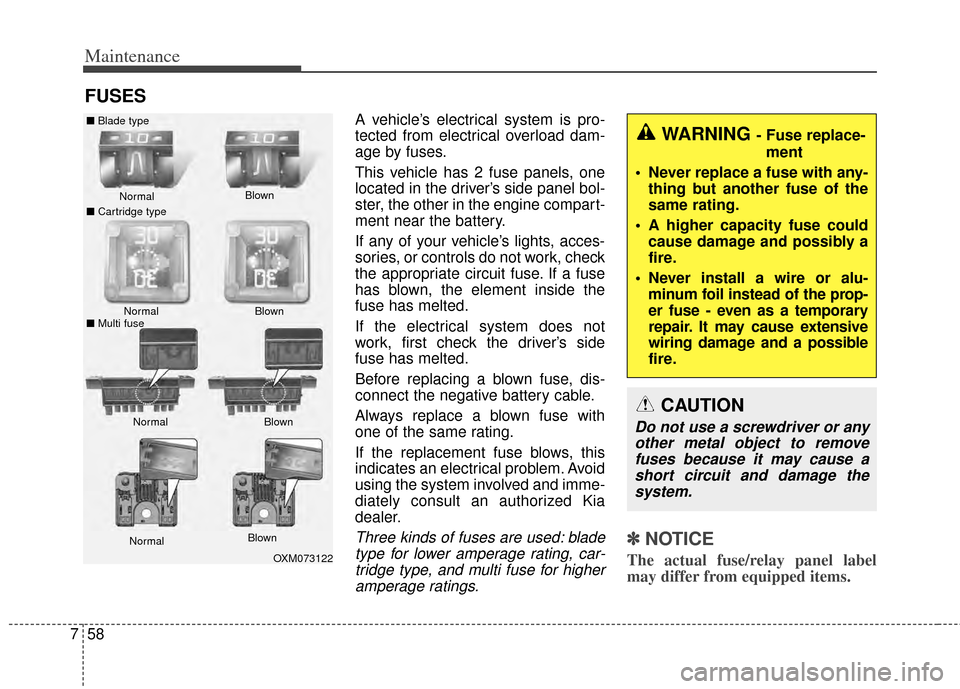
Three kinds of fuses are used: blade
type for lower amperage rating, car-tridge type, and multi fuse for higheramperage ratings.✽ ✽ NOTICE
The actual fuse/relay panel label
may differ from equipped items.
WARNING - Fuse replace-
ment
Never replace a fuse with any- thing but another fuse of the
same rating.
A higher capacity fuse could cause damage and possibly a
fire.
Never install a wire or alu- minum foil instead of the prop-
er fuse - even as a temporary
repair. It may cause extensive
wiring damage and a possible
fire.
CAUTION
Do not use a screwdriver or anyother metal object to removefuses because it may cause ashort circuit and damage thesystem.
OXM073122
Normal
Normal
■
Blade type
■ Cartridge type
■ Multi fuse Blown
Blown
Normal Blown
Normal Blown
Page 408 of 446
Maintenance
60
7
If the headlights or other electrical
components do not work and the
fuses are OK, check the fuse panel
in the engine compartment. If a fuse
is blown, it must be replaced.Fuse switch
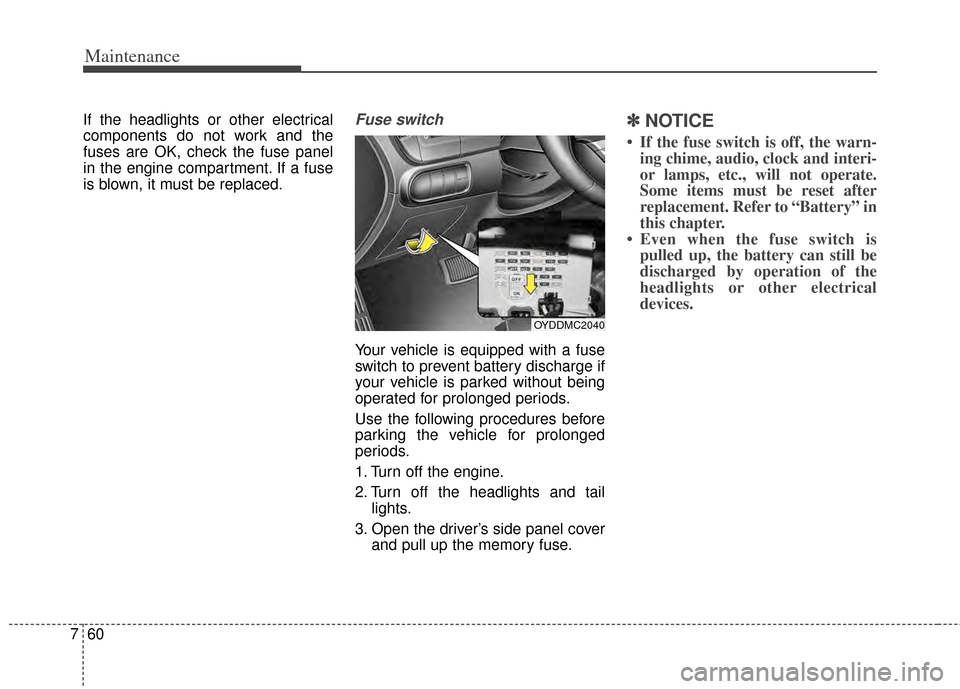
Your vehicle is equipped with a fuse
switch to prevent battery discharge if
your vehicle is parked without being
operated for prolonged periods.
Use the following procedures before
parking the vehicle for prolonged
periods.
1. Turn off the engine.
2. Turn off the headlights and tail
lights.
3. Open the driver’s side panel cover and pull up the memory fuse.
✽ ✽NOTICE
• If the fuse switch is off, the warn-
ing chime, audio, clock and interi-
or lamps, etc., will not operate.
Some items must be reset after
replacement. Refer to “Battery” in
this chapter.
• Even when the fuse switch is pulled up, the battery can still be
discharged by operation of the
headlights or other electrical
devices.
OYDDMC2040
Page 409 of 446
761
Maintenance
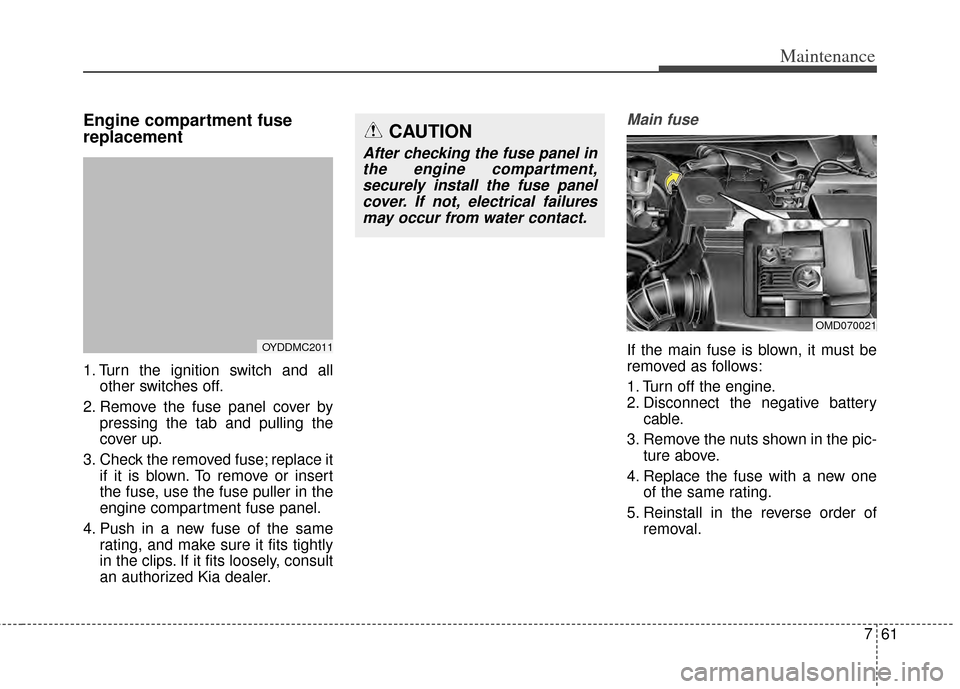
Engine compartment fuse
replacement
1. Turn the ignition switch and allother switches off.
2. Remove the fuse panel cover by pressing the tab and pulling the
cover up.
3. Check the removed fuse; replace it if it is blown. To remove or insert
the fuse, use the fuse puller in the
engine compartment fuse panel.
4. Push in a new fuse of the same rating, and make sure it fits tightly
in the clips. If it fits loosely, consult
an authorized Kia dealer.
Main fuse
If the main fuse is blown, it must be
removed as follows:
1. Turn off the engine.
2. Disconnect the negative batterycable.
3. Remove the nuts shown in the pic- ture above.
4. Replace the fuse with a new one of the same rating.
5. Reinstall in the reverse order of removal.
CAUTION
After checking the fuse panel inthe engine compartment,securely install the fuse panelcover. If not, electrical failuresmay occur from water contact.
OYDDMC2011
OMD070021
Page 413 of 446
765
Maintenance
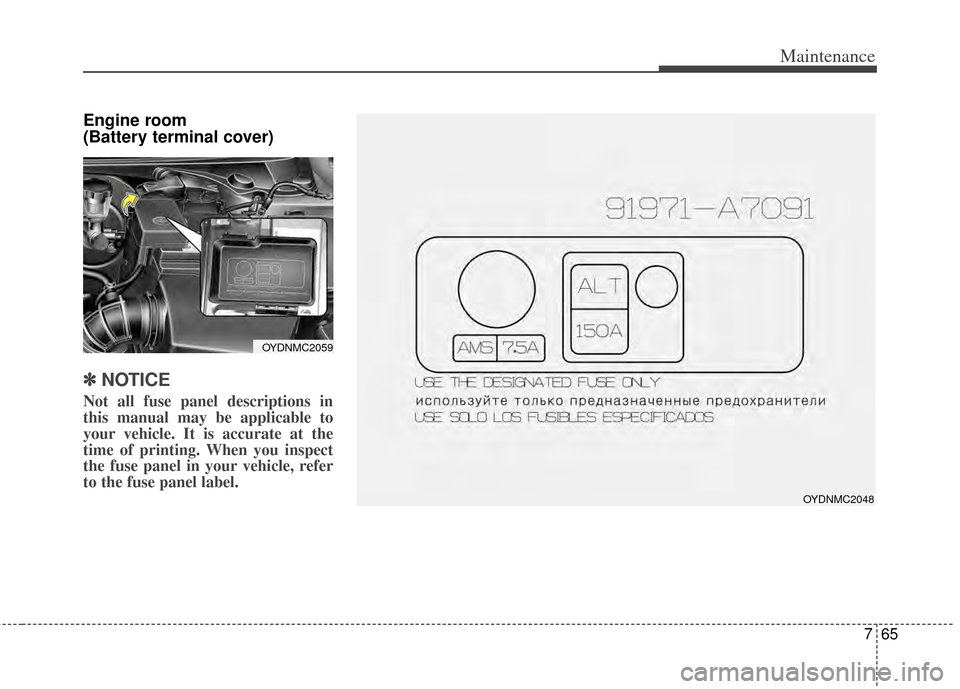
Engine room
(Battery terminal cover)
✽ ✽NOTICE
Not all fuse panel descriptions in
this manual may be applicable to
your vehicle. It is accurate at the
time of printing. When you inspect
the fuse panel in your vehicle, refer
to the fuse panel label.
OYDNMC2048
OYDNMC2059
Page 427 of 446
779
Maintenance
Canister
Fuel vapors generated inside the fuel
tank are absorbed and stored in the
onboard canister. When the engine is
running, the fuel vapors absorbed in
the canister are drawn into the surge
tank through the purge control sole-
noid valve.
Purge Control Solenoid Valve(PCSV)
The purge control solenoid valve is
controlled by the Engine Control
Module (ECM); when the engine
coolant temperature is low during
idling, the PCSV closes so that evap-
orated fuel is not taken into the
engine. After the engine warms up
during ordinary driving, the PCSV
opens to introduce evaporated fuel to
the engine.
3. Exhaust emission control system
The Exhaust Emission Control
System is a highly effective system
which controls exhaust emissions
while maintaining good vehicle per-
formance.
Vehicle modifications
This vehicle should not be modified.
Modification of your vehicle could
affect its performance, safety or
durability and may even violate gov-
ernmental safety and emissions reg-
ulations.
In addition, damage or performance
problems resulting from any modifi-
cation may not be covered under
warranty.
If you use unauthorized electronic
devices, it may cause the vehicle to
operate abnormally, wire damage,
battery discharge and fire. For your
safety, do not use unauthorized
electronic devices.
Engine exhaust gas precautions
(carbon monoxide)
Carbon monoxide can be present with other exhaust fumes.
Therefore, if you smell exhaust
fumes of any kind inside your vehi-
cle, have it inspected and repaired
immediately. If you ever suspect
exhaust fumes are coming into
your vehicle, drive it only with all
the windows fully open. Have your
vehicle checked and repaired
immediately.
WARNING - Exhaust
Engine exhaust gases contain
carbon monoxide (CO). Though
colorless and odorless, it is
dangerous and could be lethal if
inhaled. Follow the instructions
on this page to avoid CO poi-
soning.
Page 440 of 446
Index
2I
Active eco system . . . . . . . . . . . . . . . . . . . . . . . . . . . . . 5-40
Air bag-supplemental restraint system . . . . . . . . . . . . . 3-33Air bag warning label. . . . . . . . . . . . . . . . . . . . . . . . 3-55
Air bag warning light . . . . . . . . . . . . . . . . . . . . . . . . 3-36
Ari bag system operation . . . . . . . . . . . . . . . . . . . . . 3-34
Curtain air bag . . . . . . . . . . . . . . . . . . . . . . . . . . . . . 3-48
Do not install a child restraint on a front passenger’sseat . . . . . . . . . . . . . . . . . . . . . . . . . . . . . . . . . . . . \
. . . 3-35
Driver’s and passenger’s front air bag . . . . . . . . . . . 3-44
Inflation/non-inflation conditions of air bag . . . . . . 3-49
Occupant detection system. . . . . . . . . . . . . . . . . . . . 3-39
Side air bag. . . . . . . . . . . . . . . . . . . . . . . . . . . . . . . . 3-47
SRS Care . . . . . . . . . . . . . . . . . . . . . . . . . . . . . . . . . 3-54
SRS components and functions . . . . . . . . . . . . . . . . 3-37
Air cleaner . . . . . . . . . . . . . . . . . . . . . . . . . . . . . . . . . . 7-36\
Filter replacement . . . . . . . . . . . . . . . . . . . . . . . . . . 7-36
Appearance care . . . . . . . . . . . . . . . . . . . . . . . . . . . . . . 7-71 Exterior care . . . . . . . . . . . . . . . . . . . . . . . . . . . . . . . 7-71
Interior care . . . . . . . . . . . . . . . . . . . . . . . . . . . . . . . 7-76
Audio system . . . . . . . . . . . . . . . . . . . . . . . . . . . . . . . 4-144
Aux, USB and iPod
®port . . . . . . . . . . . . . . . . . . . 4-146
Glass antenna . . . . . . . . . . . . . . . . . . . . . . . . . . . . . 4-144
Steering wheel audio control . . . . . . . . . . . . . . . . . 4-145
Automatic climate control system . . . . . . . . . . . . . . . 4-117 Automatic heating and air conditioning. . . . . . . . . 4-118
Manual heating and air conditioning . . . . . . . . . . . 4-119 System operation . . . . . . . . . . . . . . . . . . . . . . . . . . 4-125
Automatic transaxle . . . . . . . . . . . . . . . . . . . . . . . . . . . 5-16 Automatic transaxle operation . . . . . . . . . . . . . . . . . 5-16
Battery. . . . . . . . . . . . . . . . . . . . . . . . . . . . . . . . . . . . \
. . 7-41 Battery recharging . . . . . . . . . . . . . . . . . . . . . . . . . . 7-43
For best battery service . . . . . . . . . . . . . . . . . . . . . . 7-41
Reset items . . . . . . . . . . . . . . . . . . . . . . . . . . . . . . . . 7-43
Before driving . . . . . . . . . . . . . . . . . . . . . . . . . . . . . . . . . 5-3
Brake system. . . . . . . . . . . . . . . . . . . . . . . . . . . . . . . . . 5-22 Anti-lock brake system (ABS) . . . . . . . . . . . . . . . . . 5-25
Electronic stability control (ESC) . . . . . . . . . . . . . . 5-27
Hill-start assist control (HAC) . . . . . . . . . . . . . . . . . 5-31
Parking brake . . . . . . . . . . . . . . . . . . . . . . . . . . . . . . 5-23
Power brakes . . . . . . . . . . . . . . . . . . . . . . . . . . . . . . 5-22
Vehicle stability management (VSM) . . . . . . . . . . . 5-31
Brake/clutch fluid . . . . . . . . . . . . . . . . . . . . . . . . . . . . . 7-34 Checking the brake/clutch fluid level . . . . . . . . . . . 7-34
Bulb wattage . . . . . . . . . . . . . . . . . . . . . . . . . . . . . . . . . . 8-3
Child restraint system . . . . . . . . . . . . . . . . . . . . . . . . . . 3-26 Lower anchor ststem . . . . . . . . . . . . . . . . . . . . . . . . 3-31
Tether Anchor system. . . . . . . . . . . . . . . . . . . . . . . . 3-30
Using a child restraint system . . . . . . . . . . . . . . . . . 3-27
A
B
C
Page 442 of 446

Index
4I
Fuses . . . . . . . . . . . . . . . . . . . . . . . . . . . . . . . . . . . . \
. . . 7-58Engine compartment fuse panel . . . . . . . . . . . . . . . . 7-64
Engine compartment fuse replacement . . . . . . . . . . 7-61
Engine room (Battery terminal cover) . . . . . . . . . . . 7-65
Fuse/relay panel description. . . . . . . . . . . . . . . . . . . 7-63
Instrument panel fuse replacement . . . . . . . . . . . . . 7-59
Hood . . . . . . . . . . . . . . . . . . . . . . . . . . . . . . . . . . . . \
. . . 4-29 Closing the hood . . . . . . . . . . . . . . . . . . . . . . . . . . . 4-30
Opening the hood . . . . . . . . . . . . . . . . . . . . . . . . . . . 4-29
How to use this manual . . . . . . . . . . . . . . . . . . . . . . . . . 1-2
If the engine will not start . . . . . . . . . . . . . . . . . . . . . . . 6-4 If engine doesn't turn over or turns over slowly . . . . 6-4
If engine turns over normally but does not start . . . . 6-4
If you have a flat tire (with spare tire) . . . . . . . . . . . . . 6-14 Changing tires . . . . . . . . . . . . . . . . . . . . . . . . . . . . . 6-15
Jack and tools . . . . . . . . . . . . . . . . . . . . . . . . . . . . . . 6-14
Removing and storing the spare tire . . . . . . . . . . . 6-15
If you have a flat tire (with tire mobility kit) . . . . . . . . . 6-8 Components of the TireMobilityKit. . . . . . . . . . . . . 6-10
Introduction . . . . . . . . . . . . . . . . . . . . . . . . . . . . . . . . 6-8
Notes on the safe use of the Tire Mobility Kit . . . . . 6-9
Using the Tire Mobility Kit . . . . . . . . . . . . . . . . . . . 6-11 In case of an emergency while driving . . . . . . . . . . . . . . 6-3
If engine stalls while driving . . . . . . . . . . . . . . . . . . . 6-3
If the engine stalls at a crossroad or crossing . . . . . . 6-3
If you have a flat tire while driving . . . . . . . . . . . . . . 6-3
Instrument cluster . . . . . . . . . . . . . . . . . . . . . . . . . . . . . 4-52 Gauges . . . . . . . . . . . . . . . . . . . . . . . . . . . . . . . . . . . 4-\
54
Instrument Cluster Control. . . . . . . . . . . . . . . . . . . . 4-53
LCD Display Control . . . . . . . . . . . . . . . . . . . . . . . . 4-54
Transaxle Shift Indicator . . . . . . . . . . . . . . . . . . . . . 4-57
Instrument panel overview . . . . . . . . . . . . . . . . . . . . . . . 2-5
Interior features. . . . . . . . . . . . . . . . . . . . . . . . . . . . . . 4-135 Ashtray . . . . . . . . . . . . . . . . . . . . . . . . . . . . . . . . . . 4-13\
5
Cigarette lighter . . . . . . . . . . . . . . . . . . . . . . . . . . . 4-135
Climate control seat . . . . . . . . . . . . . . . . . . . . . . . . 4-139
Clothes hanger . . . . . . . . . . . . . . . . . . . . . . . . . . . . 4-142
Cup holder . . . . . . . . . . . . . . . . . . . . . . . . . . . . . . . 4-136
Floor mat anchor(s) . . . . . . . . . . . . . . . . . . . . . . . . 4-142
LCD monitor . . . . . . . . . . . . . . . . . . . . . . . . . . . . . 4-141
Navigation system . . . . . . . . . . . . . . . . . . . . . . . . . 4-143
Power outlet . . . . . . . . . . . . . . . . . . . . . . . . . . . . . . 4-140
Seat warmer . . . . . . . . . . . . . . . . . . . . . . . . . . . . . . 4-137
Sliding armrest . . . . . . . . . . . . . . . . . . . . . . . . . . . . 4-136
Sunvisor . . . . . . . . . . . . . . . . . . . . . . . . . . . . . . . . . 4-137
Interior light . . . . . . . . . . . . . . . . . . . . . . . . . . . . . . . . 4-101 Automatict turn off function . . . . . . . . . . . . . . . . . 4-101
Glove box lamp . . . . . . . . . . . . . . . . . . . . . . . . . . . 4-103
Map lamp . . . . . . . . . . . . . . . . . . . . . . . . . . . . . . . . 4-101
Room lamp . . . . . . . . . . . . . . . . . . . . . . . . . . . . . . . 4-102
H
I
Page 443 of 446
I5
Index
Trunk room lamp . . . . . . . . . . . . . . . . . . . . . . . . . . 4-103
Vanity mirror lamp . . . . . . . . . . . . . . . . . . . . . . . . . 4-104
Interior overview. . . . . . . . . . . . . . . . . . . . . . . . . . . . . . . 2-4
Key positions . . . . . . . . . . . . . . . . . . . . . . . . . . . . . . . . . 5-5
Keys . . . . . . . . . . . . . . . . . . . . . . . . . . . . . . . . . . . . \
. . . . 4-4 Key operations . . . . . . . . . . . . . . . . . . . . . . . . . . . . . . 4-4
Record your key number . . . . . . . . . . . . . . . . . . . . . . 4-4
LCD display . . . . . . . . . . . . . . . . . . . . . . . . . . . . . . . . . 4-58 A/V Mode. . . . . . . . . . . . . . . . . . . . . . . . . . . . . . . . . 4-63
LCD Modes . . . . . . . . . . . . . . . . . . . . . . . . . . . . . . . 4-58
Service Mode . . . . . . . . . . . . . . . . . . . . . . . . . . . . . . 4-59
Turn By Turn Mode . . . . . . . . . . . . . . . . . . . . . . . . . 4-63
User Settings Mode . . . . . . . . . . . . . . . . . . . . . . . . . 4-60
Warning Messages . . . . . . . . . . . . . . . . . . . . . . . . . . 4-64
Lighting. . . . . . . . . . . . . . . . . . . . . . . . . . . . . . . . . . . . \
. 4-93 Battery saver function . . . . . . . . . . . . . . . . . . . . . . . 4-93
Daytime running light . . . . . . . . . . . . . . . . . . . . . . . 4-94
Front fog light . . . . . . . . . . . . . . . . . . . . . . . . . . . . . 4-98
Headlamp escort function . . . . . . . . . . . . . . . . . . . . 4-93
High - beam operation . . . . . . . . . . . . . . . . . . . . . . . 4-96
Lighting control . . . . . . . . . . . . . . . . . . . . . . . . . . . . 4-94
Turn signals and lane change signals . . . . . . . . . . . . 4-97 Maintenance services . . . . . . . . . . . . . . . . . . . . . . . . . . . 7-4
Owner maintenance precautions . . . . . . . . . . . . . . . . 7-5
Owner’s responsibility . . . . . . . . . . . . . . . . . . . . . . . . 7-4
Manual climate control system. . . . . . . . . . . . . . . . . . 4-107 Climate control air filter. . . . . . . . . . . . . . . . . . . . . 4-115
Heating and air conditioning . . . . . . . . . . . . . . . . . 4-108
Refrigerant and compressor lubricant . . . . . . . . . . 4-116
System operation . . . . . . . . . . . . . . . . . . . . . . . . . . 4-113
Manual transaxle. . . . . . . . . . . . . . . . . . . . . . . . . . . . . . 5-13 Manual transaxle operation . . . . . . . . . . . . . . . . . . . 5-13
Mirrors . . . . . . . . . . . . . . . . . . . . . . . . . . . . . . . . . . . . \
. 4-43 Inside rearview mirror . . . . . . . . . . . . . . . . . . . . . . . 4-43
Outside rearview mirror . . . . . . . . . . . . . . . . . . . . . . 4-48
Owner maintenance . . . . . . . . . . . . . . . . . . . . . . . . . . . . 7-6 Owner maintenance schedule. . . . . . . . . . . . . . . . . . . 7-6
Parking assist system . . . . . . . . . . . . . . . . . . . . . . . . . . 4-86 Non-operational conditions . . . . . . . . . . . . . . . . . . . 4-89
Operation . . . . . . . . . . . . . . . . . . . . . . . . . . . . . . . . . 4-87
Self-diagnosis . . . . . . . . . . . . . . . . . . . . . . . . . . . . . . 4-91
K
L
M
O
P