lane assist KIA FORTE 2017 User Guide
[x] Cancel search | Manufacturer: KIA, Model Year: 2017, Model line: FORTE, Model: KIA FORTE 2017Pages: 595, PDF Size: 11.5 MB
Page 416 of 595
573
Driving your vehicle
BSD (Blind Spot Detection) /
LCA (Lane Change Assist)
Operating conditions
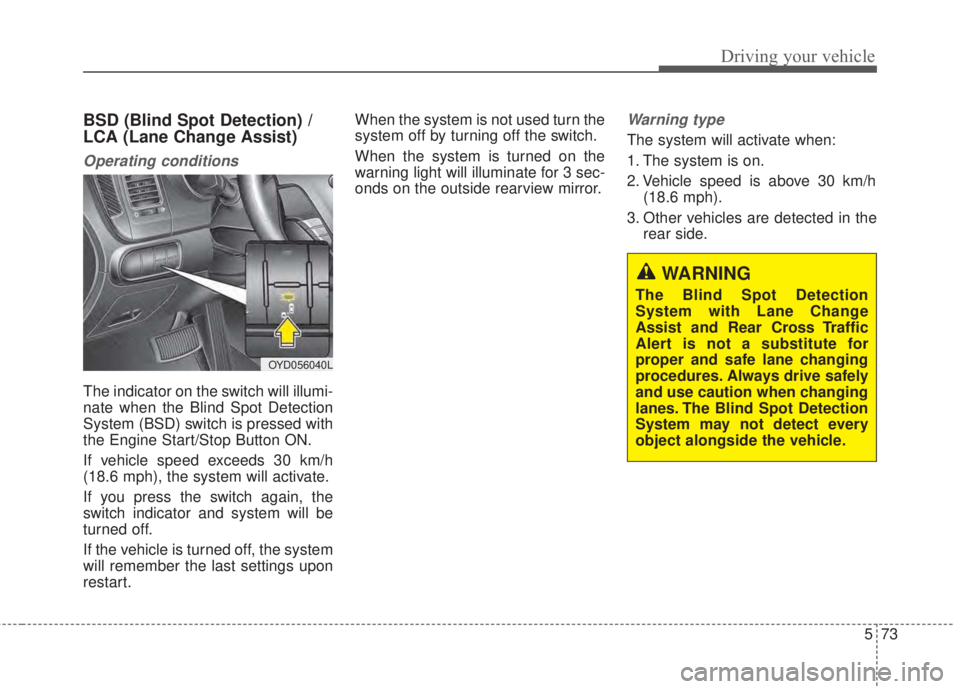
The indicator on the switch will illumi-
nate when the Blind Spot Detection
System (BSD) switch is pressed with
the Engine Start/Stop Button ON.
If vehicle speed exceeds 30 km/h
(18.6 mph), the system will activate.
If you press the switch again, the
switch indicator and system will be
turned off.
If the vehicle is turned off, the system
will remember the last settings upon
restart.When the system is not used turn the
system off by turning off the switch.
When the system is turned on the
warning light will illuminate for 3 sec-
onds on the outside rearview mirror.
Warning type
The system will activate when:
1. The system is on.
2. Vehicle speed is above 30 km/h
(18.6 mph).
3. Other vehicles are detected in the
rear side.
WARNING
The Blind Spot Detection
System with Lane Change
Assist and Rear Cross Traffic
Alert is not a substitute for
proper and safe lane changing
procedures. Always drive safely
and use caution when changing
lanes. The Blind Spot Detection
System may not detect every
object alongside the vehicle.
OYD056040L
Page 420 of 595
577
Driving your vehicle
• If the vehicle detected by sensors
approaches your vehicle, the warn-
ing chime will sound and the warn-
ing light will blink on the outside
rearview mirror.
• If the detected object is not in your
way, move the vehicle away from
the detected object slowly; and the
warning will cancel once the object
has been safely cleared.
• The system may not operate prop-
erly due to other factors or circum-
stances. Always pay attention to
your surroundings.
❈If your vehicle's left or right side
bumper is blinded by a barrier or
vehicles, the system sensing abili-
ty may be deteriorated.✽ NOTICE
• The system may not work proper-
ly if the bumper has been replaced
or if repair work has been done
near the sensor.
• The detection area differs accord-
ing to the road's width. If the road
is narrow the system may detect
other vehicles in the next lane.
• If the road is very wide the system
may not detect other vehicles.
• The system may turn off due to
strong electromagnetic interfer-
ence.WARNING
The Blind Spot Detection
System with Lane Change
Assist and Rear Cross Traffic
Alert is not a substitute for
proper and safe lane changing
procedures. Always drive safely
and use caution when changing
lanes. The Blind Spot Detection
System may not detect every
object alongside the vehicle.
Page 421 of 595
Driving your vehicle
78 5
Limitations condition
Driver's Attention
The driver must be cautious in the
below situations for the system may
not assist the driver and may not
work properly.
- Curved roads, tollgates, etc.
- The surrounding of the sensor cover
is dirty with rain, snow, mud, etc.
- The rear bumper near the sensor is
covered or obstructed with foreign
matter such as a sticker, bumper
guard, bicycle racks, etc.
- The rear bumper is damaged or the
sensor is out of place.
- The height of the vehicle has signif-
icantly changed such as when the
trunk is loaded with heavy objects,
abnormal tire pressure etc.
- Due to bad weather such as heavy
rain or snow.- A fixed object is near such as a
guardrail, etc.
- A substantial amount of metallic
objects such as a construction
area.
- A large vehicle is nearby such as a
bus or truck.
- A motorcycle or bicycle is near.
- A flat trailer is near.
- If two vehicles near each other
accelerate together.
- When another vehicle passes by at
a high rate of speed.
- When changing lanes.
- When going down or up a steep,
uneven road.
- When another vehicle drives very
close the back bumper/trunk.
- When a trailer or carrier is installed.- When the temperature of the rear
bumper is very high or low.
- When bike racks, etc. cover the
sensor.
- When reversing from a parking
space with pillars or metal struc-
tures.
- When you are reversing and if the
detected vehicle is simultaneously
reversing.
- If there are small objects like shop-
ping carts and baby carriages.
- If there is a vehicle with decreased
ride height (lowered).
- When the vehicle is close to anoth-
er vehicle.
- When driving through a narrow
road with many plants.
- When driving on wet surface.
Page 440 of 595
63
What to do in an emergency
In an emergency situation while the
vehicle is in motion, you are able to
turn the engine off and to the ACC
position by pressing the ENGINE
START/STOP button for more than 2
seconds or 3 times successively
within 3 seconds. If the vehicle is still
moving, you can restart the engine
without depressing the brake pedal
by pressing the ENGINE
START/STOP button with the shift
lever in the N (Neutral) position
(if smart key equipped).If the engine stalls at a cross-
road or crossing
If the engine stalls at a crossroad or
crossing, set the shift lever in the N
(Neutral) position and then push the
vehicle to a safe place.
If you have a flat tire while
driving
If a tire goes flat while you are driv-
ing:
1.Take your foot off the accelerator
pedal and let the vehicle slow
down while driving straight ahead.
Do not apply the brakes immedi-
ately or attempt to pull off the road
as this may cause a loss of control.
When the vehicle has slowed down
to such a speed that it is safe to do
so, brake carefully and pull off the
road. Drive off the road as far as
possible and park on a firm level
ground. If you are on a divided
highway, do not park in the median
area between the two traffic lanes.2.When the vehicle is stopped, turn
on your emergency hazard flash-
ers, set the parking brake and put
the transaxle in P (Automatic
transaxle / Dual Clutch Transaxle)
or reverse (manual transaxle).
3.Have all passengers get out of the
vehicle. Be sure they all get out on
the side of the vehicle that is away
from traffic.
4.When changing a flat tire, follow
the instruction provided later in this
section.
If engine stalls while driving
1.Reduce your speed gradually,
keeping a straight line. Move cau-
tiously off the road to a safe place.
2.Turn on your emergency flashers.
3.Try to start the engine again. If your
vehicle will not start, contact an
authorized Kia dealer or seek other
qualified assistance.
IN CASE OF AN EMERGENCY WHILE DRIVING
Page 450 of 595
613
What to do in an emergency
IF YOU HAVE A FLAT TIRE (IF EQUIPPED,4 DOOR)
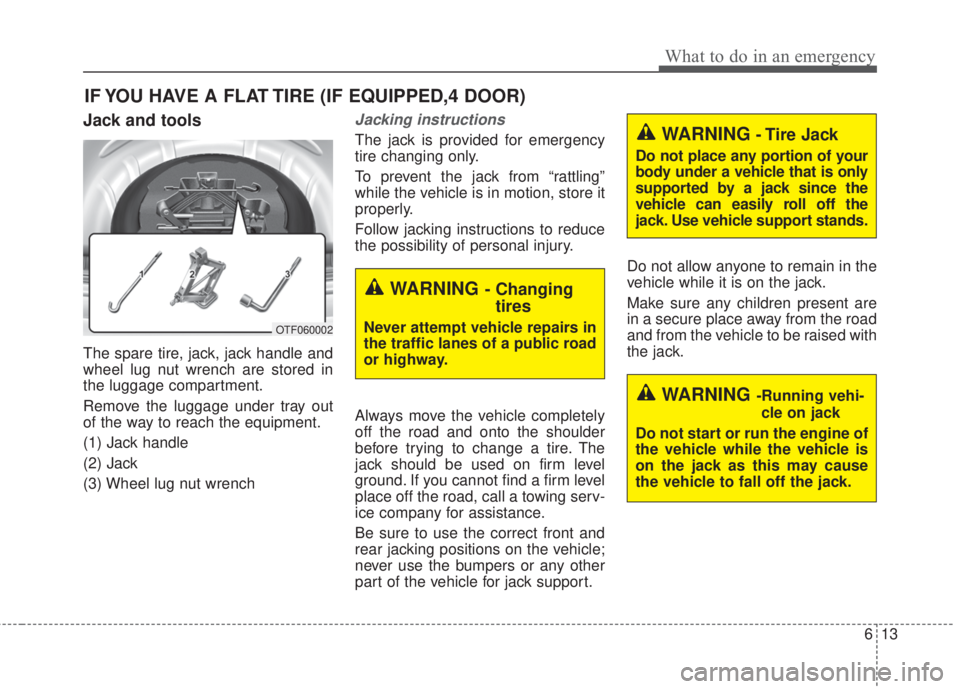
Jack and tools
The spare tire, jack, jack handle and
wheel lug nut wrench are stored in
the luggage compartment.
Remove the luggage under tray out
of the way to reach the equipment.
(1) Jack handle
(2) Jack
(3) Wheel lug nut wrench
Jacking instructions
The jack is provided for emergency
tire changing only.
To prevent the jack from “rattling”
while the vehicle is in motion, store it
properly.
Follow jacking instructions to reduce
the possibility of personal injury.
Always move the vehicle completely
off the road and onto the shoulder
before trying to change a tire. The
jack should be used on firm level
ground. If you cannot find a firm level
place off the road, call a towing serv-
ice company for assistance.
Be sure to use the correct front and
rear jacking positions on the vehicle;
never use the bumpers or any other
part of the vehicle for jack support.Do not allow anyone to remain in the
vehicle while it is on the jack.
Make sure any children present are
in a secure place away from the road
and from the vehicle to be raised with
the jack.WARNING- Tire Jack
Do not place any portion of your
body under a vehicle that is only
supported by a jack since the
vehicle can easily roll off the
jack. Use vehicle support stands.
WARNING - Changing
tires
Never attempt vehicle repairs in
the traffic lanes of a public road
or highway.OTF060002
WARNING -Running vehi-
cle on jack
Do not start or run the engine of
the vehicle while the vehicle is
on the jack as this may cause
the vehicle to fall off the jack.
Page 589 of 595
I3
Index
BSD (Blind Spot Detection) /
LCA (Lane Change Assist) . . . . . . . . . . . . . . . . . . 5-73
Limitations condition . . . . . . . . . . . . . . . . . . . . . . . . 5-78
RCTA (Rear Cross Traffic Alert) . . . . . . . . . . . . . . . 5-76
Brake system. . . . . . . . . . . . . . . . . . . . . . . . . . . . . . . . . 5-32
Anti-lock brake system (ABS) . . . . . . . . . . . . . . . . . 5-35
Electronic stability control (ESC) . . . . . . . . . . . . . . 5-37
Good braking practices . . . . . . . . . . . . . . . . . . . . . . 5-43
Hill-start assist control (HAC) . . . . . . . . . . . . . . . . . 5-41
Parking brake . . . . . . . . . . . . . . . . . . . . . . . . . . . . . . 5-33
Power brakes . . . . . . . . . . . . . . . . . . . . . . . . . . . . . . 5-32
Vehicle stability management (VSM) . . . . . . . . . . . 5-41
Brake/clutch fluid . . . . . . . . . . . . . . . . . . . . . . . . . . . . . 7-42
Checking the brake/clutch fluid level . . . . . . . . . . . 7-42
Bulb wattage . . . . . . . . . . . . . . . . . . . . . . . . . . . . . . . . . . 8-3
Child restraint system . . . . . . . . . . . . . . . . . . . . . . . . . . 3-27
Using a child restraint system . . . . . . . . . . . . . . . . . 3-28
Clean air . . . . . . . . . . . . . . . . . . . . . . . . . . . . . . . . . . . 4-138
Climate control air filter . . . . . . . . . . . . . . . . . . . . . . . . 7-46
Filter inspection . . . . . . . . . . . . . . . . . . . . . . . . . . . . 7-46
Filter replacement. . . . . . . . . . . . . . . . . . . . . . . . . . . 7-46
Cruise Control system . . . . . . . . . . . . . . . . . . . . . . . . . 5-56
Cruise control switch . . . . . . . . . . . . . . . . . . . . . . . . 5-56
To cancel cruise control . . . . . . . . . . . . . . . . . . . . . . 5-59
To decrease the cruising speed . . . . . . . . . . . . . . . . . 5-58To increase cruise control set speed . . . . . . . . . . . . . 5-58
To resume cruising speed at more than
approximately 40 km/h (25 mph) . . . . . . . . . . . . . 5-59
To set cruise control speed . . . . . . . . . . . . . . . . . . . . 5-57
To temporarily accelerate with the cruise control on . . 5-58
To turn cruise control off . . . . . . . . . . . . . . . . . . . . . 5-60
Defroster . . . . . . . . . . . . . . . . . . . . . . . . . . . . . . . . . . . 4-113
Front wiper deicer . . . . . . . . . . . . . . . . . . . . . . . . . 4-113
Rear window defroster . . . . . . . . . . . . . . . . . . . . . . 4-113
Dimensions . . . . . . . . . . . . . . . . . . . . . . . . . . . . . . . . . . . 8-2
Door locks. . . . . . . . . . . . . . . . . . . . . . . . . . . . . . . . . . . 4-17
Auto door lock/unlock feature . . . . . . . . . . . . . . . . . 4-19
Child-protector rear door lock . . . . . . . . . . . . . . . . . 4-20
Impact sensing door unlock system . . . . . . . . . . . . . 4-19
Operating door locks from inside the vehicle . . . . . 4-17
Operating door locks from outside the vehicle . . . . 4-17
Drive mode integrated control system . . . . . . . . . . . . . 5-61
DRIVE mode . . . . . . . . . . . . . . . . . . . . . . . . . . . . . . 5-61
Dual Clutch Transmission (DCT). . . . . . . . . . . . . . . . . 5-23
Dual clutch transmission operation . . . . . . . . . . . . . 5-23
Good driving practices . . . . . . . . . . . . . . . . . . . . . . . 5-31
Paddle shifter . . . . . . . . . . . . . . . . . . . . . . . . . . . . . . 5-29
C
D
Page 592 of 595
Index
6I
Lane Keeping Assist System (LKAS) . . . . . . . . . . . . . 5-64
LKAS function change . . . . . . . . . . . . . . . . . . . . . . 5-71
LKAS malfunction . . . . . . . . . . . . . . . . . . . . . . . . . . 5-70
LKAS operation . . . . . . . . . . . . . . . . . . . . . . . . . . . . 5-65
LCD windows . . . . . . . . . . . . . . . . . . . . . . . . . . . . . . . . 4-64
LCD modes (for Type B, C instrument cluster) . . . 4-69
Over view . . . . . . . . . . . . . . . . . . . . . . . . . . . . . . . . . 4-64
Liftgate (5 Door). . . . . . . . . . . . . . . . . . . . . . . . . . . . . . 4-27
Closing the liftgate . . . . . . . . . . . . . . . . . . . . . . . . . . 4-27
Emergency liftgate safety release. . . . . . . . . . . . . . . 4-28
Opening the liftgate . . . . . . . . . . . . . . . . . . . . . . . . . 4-27
Light bulbs . . . . . . . . . . . . . . . . . . . . . . . . . . . . . . . . . . 7-85
Front lights replacement. . . . . . . . . . . . . . . . . . . . . . 7-85
High mounted stop lamp replacement . . . . . . . . . . . 7-95
Interior lamp bulb replacement . . . . . . . . . . . . . . . . 7-98
License plate lamp bulb replacement . . . . . . . . . . . 7-97
Outside Mirrors with Turn Signal Indicators . . . . . . 7-89
Rear combination lamp bulb replacement . . . . . . . . 7-90
Lighting. . . . . . . . . . . . . . . . . . . . . . . . . . . . . . . . . . . . . 4-99
AFLS (Adaptive Front Lighting System) . . . . . . . 4-104
Battery saver function . . . . . . . . . . . . . . . . . . . . . . . 4-99
Daytime running light . . . . . . . . . . . . . . . . . . . . . . 4-104
Front fog light . . . . . . . . . . . . . . . . . . . . . . . . . . . . 4-103
Headlight escort function . . . . . . . . . . . . . . . . . . . . . 4-99High beam operation . . . . . . . . . . . . . . . . . . . . . . . 4-101
Lighting control . . . . . . . . . . . . . . . . . . . . . . . . . . . 4-100
Turn signals and lane change signals . . . . . . . . . . . 4-102
Maintenance services . . . . . . . . . . . . . . . . . . . . . . . . . . . 7-5
Owner maintenance precautions . . . . . . . . . . . . . . . . 7-6
Owner’s responsibility . . . . . . . . . . . . . . . . . . . . . . . . 7-5
Manual climate control system. . . . . . . . . . . . . . . . . . 4-114
Air conditioning refrigerant label . . . . . . . . . . . . . 4-123
Checking the amount of air conditioner
refrigerant and compressor lubricant . . . . . . . . . . 4-123
Climate control air filter. . . . . . . . . . . . . . . . . . . . . 4-122
Heating and air conditioning . . . . . . . . . . . . . . . . . 4-115
System operation . . . . . . . . . . . . . . . . . . . . . . . . . . 4-120
Manual transaxle. . . . . . . . . . . . . . . . . . . . . . . . . . . . . . 5-14
Good driving practices . . . . . . . . . . . . . . . . . . . . . . . 5-16
Manual transaxle operation . . . . . . . . . . . . . . . . . . . 5-14
Mirrors . . . . . . . . . . . . . . . . . . . . . . . . . . . . . . . . . . . . . 4-49
Inside rearview mirror . . . . . . . . . . . . . . . . . . . . . . . 4-49
Outside rearview mirror . . . . . . . . . . . . . . . . . . . . . . 4-54
Owner maintenance . . . . . . . . . . . . . . . . . . . . . . . . . . . . 7-7
Owner maintenance schedule. . . . . . . . . . . . . . . . . . . 7-7
L
M
O