park assist KIA FORTE 2017 User Guide
[x] Cancel search | Manufacturer: KIA, Model Year: 2017, Model line: FORTE, Model: KIA FORTE 2017Pages: 595, PDF Size: 11.5 MB
Page 345 of 595
• To resume cruising speed at more than
approximately 40 km/h (25 mph) . . . . . . . . . . . . . . 5-59
• To turn cruise control off . . . . . . . . . . . . . . . . . . . . . . . 5-60
Drive mode integrated control system . . . . . . . . . 5-61
• DRIVE mode . . . . . . . . . . . . . . . . . . . . . . . . . . . . . . . . 5-61
Lane Keeping Assist System (LKAS) . . . . . . . . . . 5-64
• LKAS operation. . . . . . . . . . . . . . . . . . . . . . . . . . . . . . 5-65
• LKAS malfunction . . . . . . . . . . . . . . . . . . . . . . . . . . . 5-70
• LKAS function change . . . . . . . . . . . . . . . . . . . . . . . . 5-71
Blind spot detection system (BSD) . . . . . . . . . . . . 5-72
• BSD (Blind Spot Detection) /
LCA (Lane Change Assist) . . . . . . . . . . . . . . . . . . . . 5-73
• RCTA (Rear Cross Traffic Alert). . . . . . . . . . . . . . . . 5-76
• Limitations condition . . . . . . . . . . . . . . . . . . . . . . . . . 5-78
Economical operation . . . . . . . . . . . . . . . . . . . . . . 5-80
Special driving conditions . . . . . . . . . . . . . . . . . . . 5-82
• Hazardous driving conditions . . . . . . . . . . . . . . . . . . 5-82
• Rocking the vehicle . . . . . . . . . . . . . . . . . . . . . . . . . . . 5-82
• Smooth cornering . . . . . . . . . . . . . . . . . . . . . . . . . . . . 5-83
• Driving at night . . . . . . . . . . . . . . . . . . . . . . . . . . . . . . 5-83
• Driving in the rain . . . . . . . . . . . . . . . . . . . . . . . . . . . . 5-84
• Driving in flooded areas . . . . . . . . . . . . . . . . . . . . . . . 5-84
• Driving off-road . . . . . . . . . . . . . . . . . . . . . . . . . . . . . . 5-85
• Highway driving . . . . . . . . . . . . . . . . . . . . . . . . . . . . . 5-85
Winter driving . . . . . . . . . . . . . . . . . . . . . . . . . . . . 5-86
• Snowy or Icy conditions . . . . . . . . . . . . . . . . . . . . . . . 5-86
• Use high quality ethylene glycol coolant . . . . . . . . . . 5-87
• Check battery and cables . . . . . . . . . . . . . . . . . . . . . . 5-87
• Change to "winter weight" oil if necessary . . . . . . . 5-87
• Check spark plugs and ignition system. . . . . . . . . . . 5-87
• To keep locks from freezing . . . . . . . . . . . . . . . . . . . . 5-87
• Use approved window washer anti-freeze in system . . 5-87
• Don't let your parking brake freeze . . . . . . . . . . . . . 5-88
• Don't let ice and snow accumulate underneath . . . . 5-88
• Carry emergency equipment . . . . . . . . . . . . . . . . . . . 5-88
Vehicle load limit . . . . . . . . . . . . . . . . . . . . . . . . . . 5-89
• Tire and loading information label . . . . . . . . . . . . . . 5-89
• Certification label . . . . . . . . . . . . . . . . . . . . . . . . . . . . 5-92
Vehicle weight . . . . . . . . . . . . . . . . . . . . . . . . . . . . . 5-94
• Base curb weight . . . . . . . . . . . . . . . . . . . . . . . . . . . . 5-94
• Vehicle curb weight . . . . . . . . . . . . . . . . . . . . . . . . . . . 5-94
• Cargo weight . . . . . . . . . . . . . . . . . . . . . . . . . . . . . . . . 5-94
• GAW (Gross axle weight) . . . . . . . . . . . . . . . . . . . . . . 5-94
• GAWR (Gross axle weight rating) . . . . . . . . . . . . . . . 5-94
• GVW (Gross vehicle weight) . . . . . . . . . . . . . . . . . . . 5-94
• GVWR (Gross vehicle weight rating) . . . . . . . . . . . . 5-94
5
Page 375 of 595
Driving your vehicle
32 5
Power brakes
Your vehicle has power-assisted
brakes that adjust automatically
through normal usage.
In the event that the power-assisted
brakes lose power because of a
stalled engine or some other reason,
you can still stop your vehicle by
applying greater force to the brake
pedal than you normally would. The
stopping distance, however, will be
longer.
When the engine is not running, the
reserve brake power is partially
depleted each time the brake pedal
is applied. Do not pump the brake
pedal when the power assist has
been interrupted.
Pump the brake pedal only when
necessary to maintain steering con-
trol on slippery surfaces.
Wet brakes may impair the vehicle’s
ability to safely slow down; the vehi-
cle may also pull to one side when
the brakes are applied. Applying the
brakes lightly will indicate whether
they have been affected in this way.To dry the brakes, apply them lightly
while maintaining a safe forward
speed until brake performance
returns to normal.
In the event of brake failure
If service brakes fail to operate while
the vehicle is in motion, you can
make an emergency stop with the
parking brake. The stopping dis-
tance, however, will be much greater
than normal.
BRAKE SYSTEM
WARNING- Parking brake
Avoid applying the parking
brake to stop the vehicle while it
is moving except in an emer-
gency situation. Applying the
parking brake while the vehicle
is moving at normal speeds can
cause a sudden loss of control
of the vehicle. If you must use
the parking brake to stop the
vehicle, use great caution in
applying the brake.
WARNING- Steep hill
braking
Avoid continuous application of
the brakes when descending a
long or steep hill by shifting to a
lower gear. Continuous brake
application will cause the
brakes to overheat and could
result in a temporary loss of
braking performance.
CAUTION- Brake pedal
Do not drive with your foot rest-
ing on the brake pedal. This will
create abnormally high brake
temperatures which can cause
excessive brake lining and pad
wear.
Page 384 of 595
541
Driving your vehicle
Hill-start assist control (HAC)
Hill start Assist Control is a comfort
function. The main intent is to pre-
vent the vehicle from rolling back-
wards while driving uphill on an
inclined surface. HAC holds the brak-
ing pressure builtup by driver during
stopping procedure for 2 seconds
after releasing brake pedal.
During the pressure-hold period, the
driver has enough time to press the
accelerator pedal to drive off.
The braking pressure is reduced as
soon as the system detects the dri-
ver’s intention to drive off.• The HAC does not operate when
the transaxle shift lever is in the P
(Park) or N (Neutral) position.
• The HAC activates even though
the ESP is off but it does not acti-
vate when the ESP has malfunc-
tioned.
Vehicle stability management
(VSM)
This system provides further
enhancements to vehicle stability
and steering responses when a vehi-
cle is driving on a slippery road or a
vehicle detected changes in coeffi-
cient of friction between right wheels
and left wheels when braking.
VSM operation
When the VSM is in operation, ESC
indicator light ( ) blinks.
When the vehicle stability manage-
ment is operating properly, you can
feel a slight pulsation in the vehicle
and/or abnormal steering responses
(EPS). This is only the effect of brake
and EPS control and indicates noth-
ing unusual.
WARNING- Maintaining
Brake Pressure on Incline
HAC does not replace the need
to apply brakes while stopped on
an incline. While stopped, make
sure you maintain brake pres-
sure sufficient to prevent your
vehicle from rolling backward
and causing an accident. Don’t
release the brake pedal until you
are ready to accelerate forward.
Page 394 of 595
551
Driving your vehicle
• The AEB may unnecessarily pro-
duce warning messages and warn-
ing alarms. Due to the sensing lim-
itation, the AEB may not produce
warning messages or warning
alarm at all.
• When there is a malfunction with
the AEB, the braking control does
not operate upon detecting a colli-
sion risk even with other braking
systems normally operating.
• The AEB operates only for the
vehicle / pedestrian in front, while
driving forward. It does not operate
for any animals or vehicles in the
opposite direction.
• The AEB can not recognize cross-
traffic or parked vehicles present-
ing a side-profile.Limitation of the system
The AEB is an assistant system for a
driver in a certain risky driving condi-
tion and it does not take every
responsibility for all risks from driving
condition.
The AEB monitors the driving situa-
tions through the radar and the cam-
era sensor. For any vehicle activity
occurring outside the sensor range,
the AEB may not function. The driver
should exercise caution in the follow-
ing situations, as the AEB operation
may be limited:
Recognizing vehicles
- The radar or the camera is con-
taminated with foreign substances.
- It heavily rains or snows.
- There is electromagnetic interfer-
ence.
- Something in the path of travel
deflects the radar waves.
- The vehicle in front has a narrow
body. (i.e. motorcycles and bicycles)
- The driver’s view is degraded by
driving towards sunlight, reflected
light, or darkness.
- The camera cannot see the full
profile of the vehicle in front.
- The vehicle in front is a special
vehicle, such as a heavily-loaded
truck or a trailer.
Page 419 of 595
Driving your vehicle
76 5
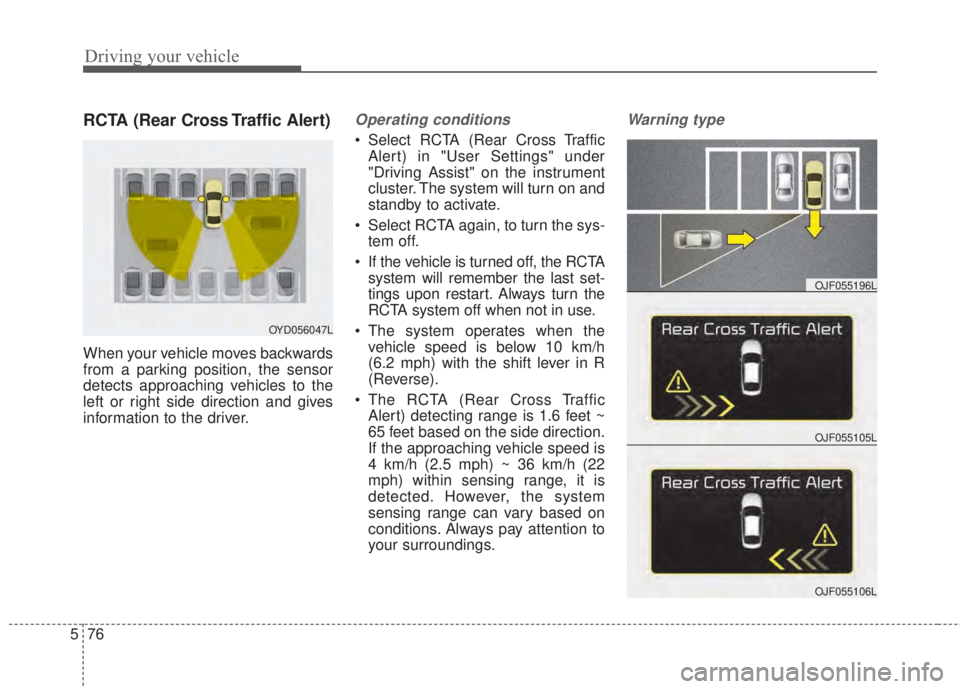
RCTA (Rear Cross Traffic Alert)
When your vehicle moves backwards
from a parking position, the sensor
detects approaching vehicles to the
left or right side direction and gives
information to the driver.
Operating conditions
• Select RCTA (Rear Cross Traffic
Alert) in "User Settings" under
"Driving Assist" on the instrument
cluster. The system will turn on and
standby to activate.
• Select RCTA again, to turn the sys-
tem off.
• If the vehicle is turned off, the RCTA
system will remember the last set-
tings upon restart. Always turn the
RCTA system off when not in use.
• The system operates when the
vehicle speed is below 10 km/h
(6.2 mph) with the shift lever in R
(Reverse).
• The RCTA (Rear Cross Traffic
Alert) detecting range is 1.6 feet ~
65 feet based on the side direction.
If the approaching vehicle speed is
4 km/h (2.5 mph) ~ 36 km/h (22
mph) within sensing range, it is
detected. However, the system
sensing range can vary based on
conditions. Always pay attention to
your surroundings.
Warning type
OYD056047L
OJF055105L
OJF055196L
OJF055106L
Page 421 of 595
Driving your vehicle
78 5
Limitations condition
Driver's Attention
The driver must be cautious in the
below situations for the system may
not assist the driver and may not
work properly.
- Curved roads, tollgates, etc.
- The surrounding of the sensor cover
is dirty with rain, snow, mud, etc.
- The rear bumper near the sensor is
covered or obstructed with foreign
matter such as a sticker, bumper
guard, bicycle racks, etc.
- The rear bumper is damaged or the
sensor is out of place.
- The height of the vehicle has signif-
icantly changed such as when the
trunk is loaded with heavy objects,
abnormal tire pressure etc.
- Due to bad weather such as heavy
rain or snow.- A fixed object is near such as a
guardrail, etc.
- A substantial amount of metallic
objects such as a construction
area.
- A large vehicle is nearby such as a
bus or truck.
- A motorcycle or bicycle is near.
- A flat trailer is near.
- If two vehicles near each other
accelerate together.
- When another vehicle passes by at
a high rate of speed.
- When changing lanes.
- When going down or up a steep,
uneven road.
- When another vehicle drives very
close the back bumper/trunk.
- When a trailer or carrier is installed.- When the temperature of the rear
bumper is very high or low.
- When bike racks, etc. cover the
sensor.
- When reversing from a parking
space with pillars or metal struc-
tures.
- When you are reversing and if the
detected vehicle is simultaneously
reversing.
- If there are small objects like shop-
ping carts and baby carriages.
- If there is a vehicle with decreased
ride height (lowered).
- When the vehicle is close to anoth-
er vehicle.
- When driving through a narrow
road with many plants.
- When driving on wet surface.
Page 440 of 595
63
What to do in an emergency
In an emergency situation while the
vehicle is in motion, you are able to
turn the engine off and to the ACC
position by pressing the ENGINE
START/STOP button for more than 2
seconds or 3 times successively
within 3 seconds. If the vehicle is still
moving, you can restart the engine
without depressing the brake pedal
by pressing the ENGINE
START/STOP button with the shift
lever in the N (Neutral) position
(if smart key equipped).If the engine stalls at a cross-
road or crossing
If the engine stalls at a crossroad or
crossing, set the shift lever in the N
(Neutral) position and then push the
vehicle to a safe place.
If you have a flat tire while
driving
If a tire goes flat while you are driv-
ing:
1.Take your foot off the accelerator
pedal and let the vehicle slow
down while driving straight ahead.
Do not apply the brakes immedi-
ately or attempt to pull off the road
as this may cause a loss of control.
When the vehicle has slowed down
to such a speed that it is safe to do
so, brake carefully and pull off the
road. Drive off the road as far as
possible and park on a firm level
ground. If you are on a divided
highway, do not park in the median
area between the two traffic lanes.2.When the vehicle is stopped, turn
on your emergency hazard flash-
ers, set the parking brake and put
the transaxle in P (Automatic
transaxle / Dual Clutch Transaxle)
or reverse (manual transaxle).
3.Have all passengers get out of the
vehicle. Be sure they all get out on
the side of the vehicle that is away
from traffic.
4.When changing a flat tire, follow
the instruction provided later in this
section.
If engine stalls while driving
1.Reduce your speed gradually,
keeping a straight line. Move cau-
tiously off the road to a safe place.
2.Turn on your emergency flashers.
3.Try to start the engine again. If your
vehicle will not start, contact an
authorized Kia dealer or seek other
qualified assistance.
IN CASE OF AN EMERGENCY WHILE DRIVING
Page 441 of 595
What to do in an emergency
4 6
IF THE ENGINE WILL NOT START
If the engine doesn't turn over
or turns over slowly
1.If your vehicle has an Automatic
transaxle/ Dual Clutch Transaxle,
be sure the shift lever is in N
(Neutral) or P (Park) and the emer-
gency brake is set.
2.Check the battery connections to
be sure they are clean and tight.
3.Turn on the interior light. If the light
dims or goes out when you operate
the starter, the battery is dis-
charged.
4.Check the starter connections to
be sure they are securely tight-
ened.
5.Do not push or pull the vehicle to
start it. See instructions for "Jump
starting".
If engine turns over normally
but does not start
1.Check fuel level.
2.With the ignition switch in the
LOCK position, check all connec-
tors at the ignition coil and spark
plugs. Reconnect any that may be
disconnected or loose.
3.Check the fuel line in the engine
compartment.
4.If the engine still does not start, call
an authorized Kia dealer or seek
other qualified assistance.
WARNING - Push/
pull start
Do not push or pull the vehicle
to start it. Push or pull starting
may cause the catalytic con-
verter to overload and create a
fire hazard.
Page 443 of 595
What to do in an emergency
6 6
IF THE ENGINE OVERHEATS
If your temperature gauge indicates
overheating, you will experience a
loss of power, or hear loud pinging or
knocking, the engine is probably too
hot. If this happens, you should:
1.Pull off the road and stop as soon
as it is safe to do so.
2.Place the shift lever in P
(Automatic transaxle/ Dual Clutch
Transaxle) or neutral (manual
transaxle) and set the parking
brake. If the air conditioning is on,
turn it off.
3.If engine coolant is running out
under the vehicle or steam is com-
ing out from underneath the hood,
stop the engine. Do not open the
hood until the coolant has stopped
running or the steaming has
stopped. If there is no visible loss
of engine coolant and no steam,
leave the engine running and
check to be sure the engine cool-
ing fan is operating. If the fan is not
running, turn the engine off.4.Check to see if the water pump
drive belt is missing. If it is not
missing, check to see that it is
tight. If the drive belt seems to be
satisfactory, check for coolant leak-
ing from the radiator, hoses or
under the vehicle. (If the air condi-
tioning had been in use, it is nor-
mal for cold water to be draining
from it when you stop).
5.If the water pump drive belt is bro-
ken or engine coolant leaks, stop
the engine immediately and call
the nearest authorized Kia dealer
for assistance.6.If you cannot find the cause of the
overheating, wait until the engine
temperature has returned to nor-
mal. Then, if coolant has been lost,
carefully add coolant to the reser-
voir to bring the fluid level in the
reservoir up to the halfway mark.
7.Proceed with caution, keeping
alert for further signs of overheat-
ing. If overheating happens again,
call an authorized Kia dealer for
assistance.
Serious loss of coolant indicates
there is a leak in the cooling system
and this should be checked as soon
as possible by an authorized Kia
dealer.
WARNING - Under the
hood
While the engine is running,
keep hair, hands and clothing
away from moving parts such
as the fan and drive belts.
WARNING- Radiator
cap
Do not remove the radiator cap
when the engine is hot. This can
allow coolant to be blown out of
the opening and cause serious
burns.
Page 589 of 595
I3
Index
BSD (Blind Spot Detection) /
LCA (Lane Change Assist) . . . . . . . . . . . . . . . . . . 5-73
Limitations condition . . . . . . . . . . . . . . . . . . . . . . . . 5-78
RCTA (Rear Cross Traffic Alert) . . . . . . . . . . . . . . . 5-76
Brake system. . . . . . . . . . . . . . . . . . . . . . . . . . . . . . . . . 5-32
Anti-lock brake system (ABS) . . . . . . . . . . . . . . . . . 5-35
Electronic stability control (ESC) . . . . . . . . . . . . . . 5-37
Good braking practices . . . . . . . . . . . . . . . . . . . . . . 5-43
Hill-start assist control (HAC) . . . . . . . . . . . . . . . . . 5-41
Parking brake . . . . . . . . . . . . . . . . . . . . . . . . . . . . . . 5-33
Power brakes . . . . . . . . . . . . . . . . . . . . . . . . . . . . . . 5-32
Vehicle stability management (VSM) . . . . . . . . . . . 5-41
Brake/clutch fluid . . . . . . . . . . . . . . . . . . . . . . . . . . . . . 7-42
Checking the brake/clutch fluid level . . . . . . . . . . . 7-42
Bulb wattage . . . . . . . . . . . . . . . . . . . . . . . . . . . . . . . . . . 8-3
Child restraint system . . . . . . . . . . . . . . . . . . . . . . . . . . 3-27
Using a child restraint system . . . . . . . . . . . . . . . . . 3-28
Clean air . . . . . . . . . . . . . . . . . . . . . . . . . . . . . . . . . . . 4-138
Climate control air filter . . . . . . . . . . . . . . . . . . . . . . . . 7-46
Filter inspection . . . . . . . . . . . . . . . . . . . . . . . . . . . . 7-46
Filter replacement. . . . . . . . . . . . . . . . . . . . . . . . . . . 7-46
Cruise Control system . . . . . . . . . . . . . . . . . . . . . . . . . 5-56
Cruise control switch . . . . . . . . . . . . . . . . . . . . . . . . 5-56
To cancel cruise control . . . . . . . . . . . . . . . . . . . . . . 5-59
To decrease the cruising speed . . . . . . . . . . . . . . . . . 5-58To increase cruise control set speed . . . . . . . . . . . . . 5-58
To resume cruising speed at more than
approximately 40 km/h (25 mph) . . . . . . . . . . . . . 5-59
To set cruise control speed . . . . . . . . . . . . . . . . . . . . 5-57
To temporarily accelerate with the cruise control on . . 5-58
To turn cruise control off . . . . . . . . . . . . . . . . . . . . . 5-60
Defroster . . . . . . . . . . . . . . . . . . . . . . . . . . . . . . . . . . . 4-113
Front wiper deicer . . . . . . . . . . . . . . . . . . . . . . . . . 4-113
Rear window defroster . . . . . . . . . . . . . . . . . . . . . . 4-113
Dimensions . . . . . . . . . . . . . . . . . . . . . . . . . . . . . . . . . . . 8-2
Door locks. . . . . . . . . . . . . . . . . . . . . . . . . . . . . . . . . . . 4-17
Auto door lock/unlock feature . . . . . . . . . . . . . . . . . 4-19
Child-protector rear door lock . . . . . . . . . . . . . . . . . 4-20
Impact sensing door unlock system . . . . . . . . . . . . . 4-19
Operating door locks from inside the vehicle . . . . . 4-17
Operating door locks from outside the vehicle . . . . 4-17
Drive mode integrated control system . . . . . . . . . . . . . 5-61
DRIVE mode . . . . . . . . . . . . . . . . . . . . . . . . . . . . . . 5-61
Dual Clutch Transmission (DCT). . . . . . . . . . . . . . . . . 5-23
Dual clutch transmission operation . . . . . . . . . . . . . 5-23
Good driving practices . . . . . . . . . . . . . . . . . . . . . . . 5-31
Paddle shifter . . . . . . . . . . . . . . . . . . . . . . . . . . . . . . 5-29
C
D