belt KIA FORTE 2018 Workshop Manual
[x] Cancel search | Manufacturer: KIA, Model Year: 2018, Model line: FORTE, Model: KIA FORTE 2018Pages: 584, PDF Size: 15.14 MB
Page 483 of 584
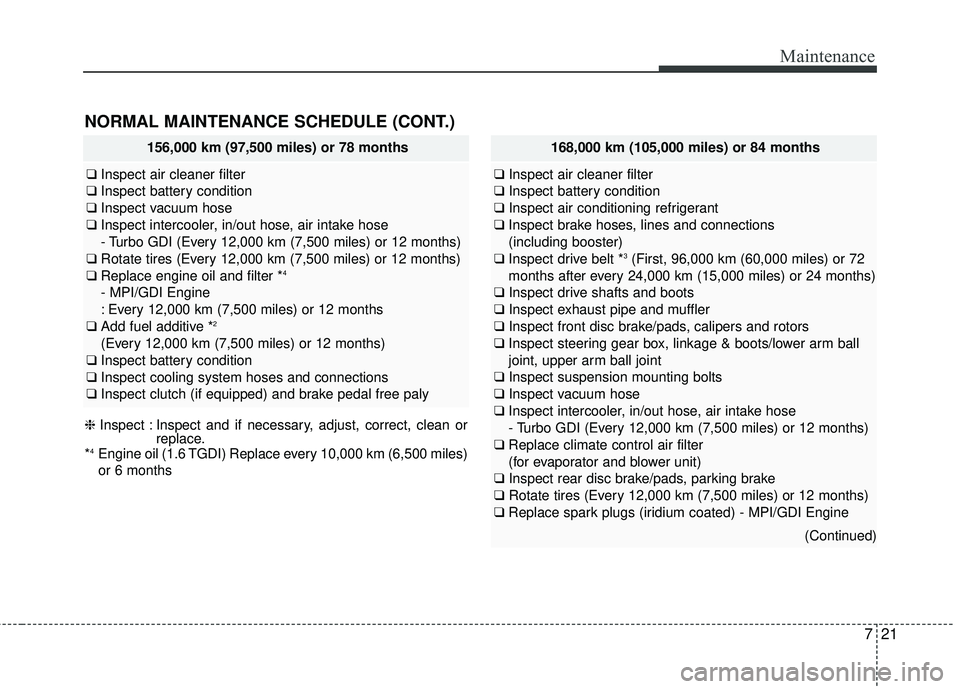
721
Maintenance
NORMAL MAINTENANCE SCHEDULE (CONT.)
❈Inspect : Inspect and if necessary, adjust, correct, clean or
replace.
*
4Engine oil (1.6 TGDI) Replace every 10,000 km (6,500 miles)
or 6 months
156,000 km (97,500 miles) or 78 months
❑ Inspect air cleaner filter
❑ Inspect battery condition
❑ Inspect vacuum hose
❑ Inspect intercooler, in/out hose, air intake hose
- Turbo GDI (Every 12,000 km (7,500 miles) or 12 months)
❑ Rotate tires (Every 12,000 km (7,500 miles) or 12 months)
❑ Replace engine oil and filter *
4
- MPI/GDI Engine
: Every 12,000 km (7,500 miles) or 12 months
❑ Add fuel additive *
2
(Every 12,000 km (7,500 miles) or 12 months)
❑ Inspect battery condition
❑ Inspect cooling system hoses and connections
❑ Inspect clutch (if equipped) and brake pedal free paly
168,000 km (105,000 miles) or 84 months
❑Inspect air cleaner filter
❑ Inspect battery condition
❑ Inspect air conditioning refrigerant
❑ Inspect brake hoses, lines and connections
(including booster)
❑ Inspect drive belt *
3 (First, 96,000 km (60,000 miles) or 72
months after every 24,000 km (15,000 miles) or 24 months)
❑ Inspect drive shafts and boots
❑ Inspect exhaust pipe and muffler
❑ Inspect front disc brake/pads, calipers and rotors
❑ Inspect steering gear box, linkage & boots/lower arm ball
joint, upper arm ball joint
❑ Inspect suspension mounting bolts
❑ Inspect vacuum hose
❑ Inspect intercooler, in/out hose, air intake hose
- Turbo GDI (Every 12,000 km (7,500 miles) or 12 months)
❑ Replace climate control air filter
(for evaporator and blower unit)
❑ Inspect rear disc brake/pads, parking brake
❑ Rotate tires (Every 12,000 km (7,500 miles) or 12 months)
❑ Replace spark plugs (iridium coated) - MPI/GDI Engine
(Continued)
Page 485 of 584
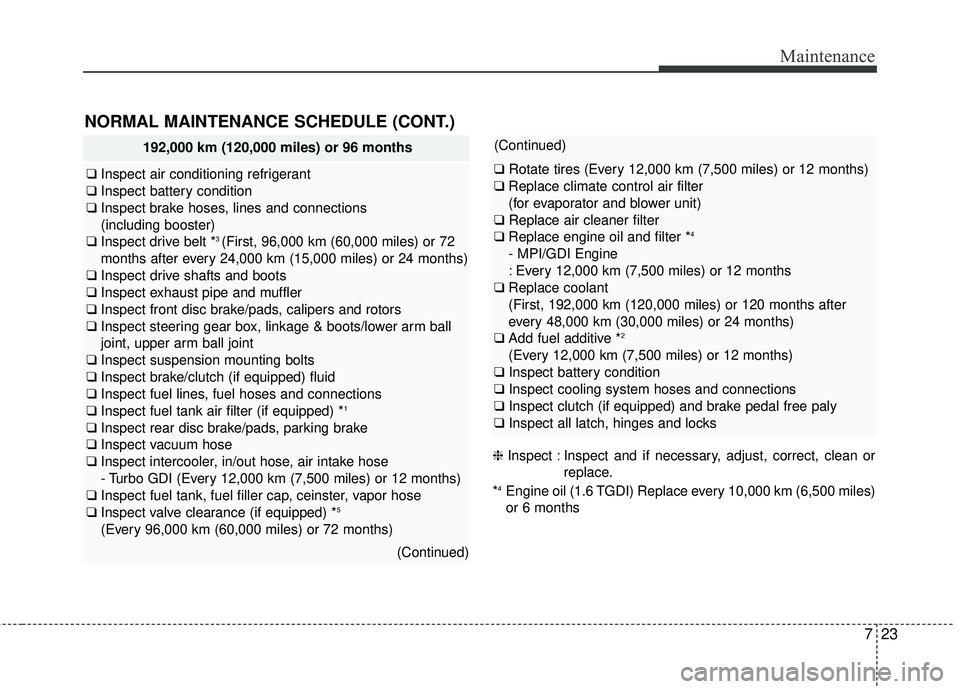
723
Maintenance
NORMAL MAINTENANCE SCHEDULE (CONT.)
192,000 km (120,000 miles) or 96 months
❑Inspect air conditioning refrigerant
❑ Inspect battery condition
❑ Inspect brake hoses, lines and connections
(including booster)
❑ Inspect drive belt *
3 (First, 96,000 km (60,000 miles) or 72
months after every 24,000 km (15,000 miles) or 24 months)
❑ Inspect drive shafts and boots
❑ Inspect exhaust pipe and muffler
❑ Inspect front disc brake/pads, calipers and rotors
❑ Inspect steering gear box, linkage & boots/lower arm ball
joint, upper arm ball joint
❑ Inspect suspension mounting bolts
❑ Inspect brake/clutch (if equipped) fluid
❑ Inspect fuel lines, fuel hoses and connections
❑ Inspect fuel tank air filter (if equipped) *
1
❑Inspect rear disc brake/pads, parking brake
❑ Inspect vacuum hose
❑ Inspect intercooler, in/out hose, air intake hose
- Turbo GDI (Every 12,000 km (7,500 miles) or 12 months)
❑ Inspect fuel tank, fuel filler cap, ceinster, vapor hose
❑ Inspect valve clearance (if equipped) *
5
(Every 96,000 km (60,000 miles) or 72 months)
(Continued)
(Continued)
❑ Rotate tires (Every 12,000 km (7,500 miles) or 12 months)
❑ Replace climate control air filter
(for evaporator and blower unit)
❑ Replace air cleaner filter
❑ Replace engine oil and filter *
4
- MPI/GDI Engine
: Every 12,000 km (7,500 miles) or 12 months
❑ Replace coolant
(First, 192,000 km (120,000 miles) or 120 months after
every 48,000 km (30,000 miles) or 24 months)
❑ Add fuel additive *
2
(Every 12,000 km (7,500 miles) or 12 months)
❑ Inspect battery condition
❑ Inspect cooling system hoses and connections
❑ Inspect clutch (if equipped) and brake pedal free paly
❑ Inspect all latch, hinges and locks
❈ Inspect : Inspect and if necessary, adjust, correct, clean or
replace.
*
4Engine oil (1.6 TGDI) Replace every 10,000 km (6,500 miles)
or 6 months
Page 486 of 584
Maintenance
24
7
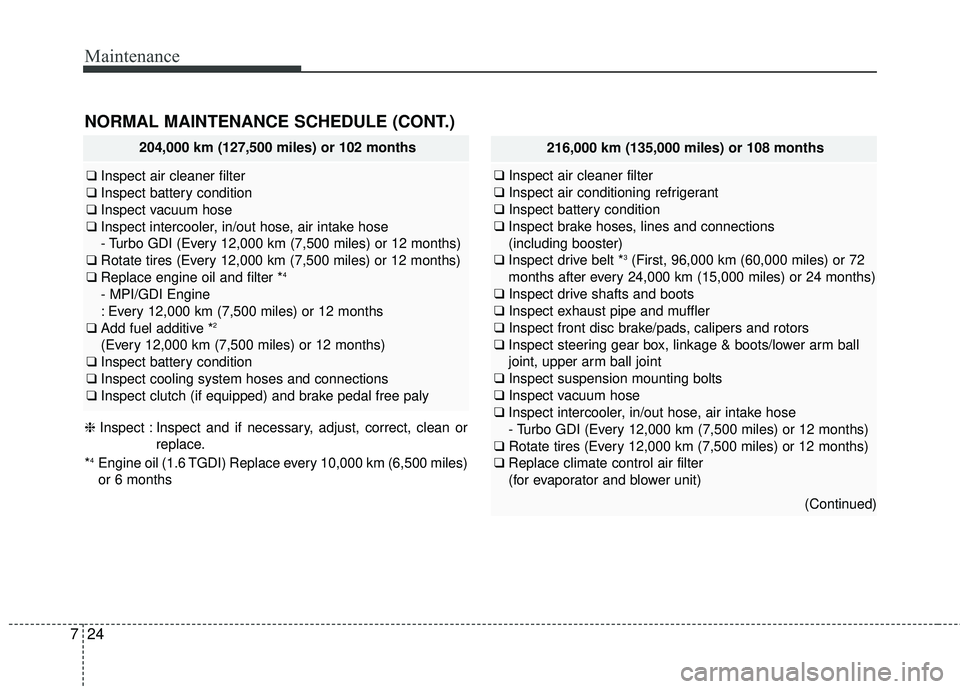
NORMAL MAINTENANCE SCHEDULE (CONT.)
204,000 km (127,500 miles) or 102 months
❑ Inspect air cleaner filter
❑ Inspect battery condition
❑ Inspect vacuum hose
❑ Inspect intercooler, in/out hose, air intake hose
- Turbo GDI (Every 12,000 km (7,500 miles) or 12 months)
❑ Rotate tires (Every 12,000 km (7,500 miles) or 12 months)
❑ Replace engine oil and filter *
4
- MPI/GDI Engine
: Every 12,000 km (7,500 miles) or 12 months
❑ Add fuel additive *
2
(Every 12,000 km (7,500 miles) or 12 months)
❑ Inspect battery condition
❑ Inspect cooling system hoses and connections
❑ Inspect clutch (if equipped) and brake pedal free paly
❈ Inspect : Inspect and if necessary, adjust, correct, clean or
replace.
*
4Engine oil (1.6 TGDI) Replace every 10,000 km (6,500 miles)
or 6 months
216,000 km (135,000 miles) or 108 months
❑ Inspect air cleaner filter
❑ Inspect air conditioning refrigerant
❑ Inspect battery condition
❑ Inspect brake hoses, lines and connections
(including booster)
❑ Inspect drive belt *
3 (First, 96,000 km (60,000 miles) or 72
months after every 24,000 km (15,000 miles) or 24 months)
❑ Inspect drive shafts and boots
❑ Inspect exhaust pipe and muffler
❑ Inspect front disc brake/pads, calipers and rotors
❑ Inspect steering gear box, linkage & boots/lower arm ball
joint, upper arm ball joint
❑ Inspect suspension mounting bolts
❑ Inspect vacuum hose
❑ Inspect intercooler, in/out hose, air intake hose
- Turbo GDI (Every 12,000 km (7,500 miles) or 12 months)
❑ Rotate tires (Every 12,000 km (7,500 miles) or 12 months)
❑ Replace climate control air filter
(for evaporator and blower unit)
(Continued)
Page 488 of 584
Maintenance
26
7
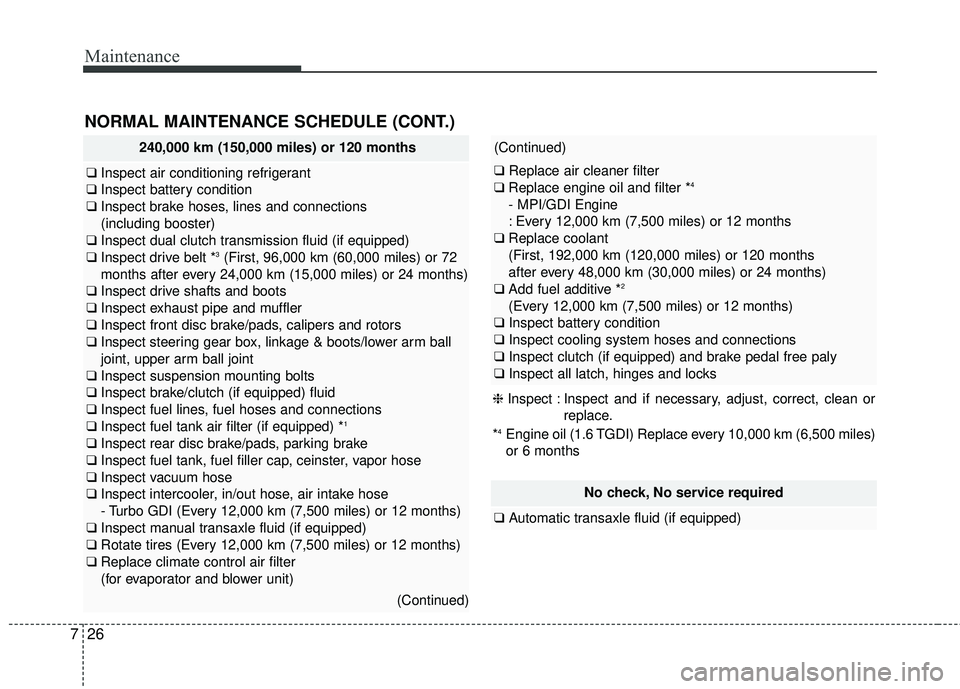
(Continued)
❑ Replace air cleaner filter
❑ Replace engine oil and filter *4
- MPI/GDI Engine
: Every 12,000 km (7,500 miles) or 12 months
❑ Replace coolant
(First, 192,000 km (120,000 miles) or 120 months
after every 48,000 km (30,000 miles) or 24 months)
❑ Add fuel additive *
2
(Every 12,000 km (7,500 miles) or 12 months)
❑ Inspect battery condition
❑ Inspect cooling system hoses and connections
❑ Inspect clutch (if equipped) and brake pedal free paly
❑ Inspect all latch, hinges and locks
❈ Inspect : Inspect and if necessary, adjust, correct, clean or
replace.
*
4Engine oil (1.6 TGDI) Replace every 10,000 km (6,500 miles)
or 6 months
NORMAL MAINTENANCE SCHEDULE (CONT.)
240,000 km (150,000 miles) or 120 months
❑ Inspect air conditioning refrigerant
❑ Inspect battery condition
❑ Inspect brake hoses, lines and connections
(including booster)
❑ Inspect dual clutch transmission fluid (if equipped)
❑ Inspect drive belt *
3 (First, 96,000 km (60,000 miles) or 72
months after every 24,000 km (15,000 miles) or 24 months)
❑ Inspect drive shafts and boots
❑ Inspect exhaust pipe and muffler
❑ Inspect front disc brake/pads, calipers and rotors
❑ Inspect steering gear box, linkage & boots/lower arm ball
joint, upper arm ball joint
❑ Inspect suspension mounting bolts
❑ Inspect brake/clutch (if equipped) fluid
❑ Inspect fuel lines, fuel hoses and connections
❑ Inspect fuel tank air filter (if equipped) *
1
❑Inspect rear disc brake/pads, parking brake
❑ Inspect fuel tank, fuel filler cap, ceinster, vapor hose
❑ Inspect vacuum hose
❑ Inspect intercooler, in/out hose, air intake hose
- Turbo GDI (Every 12,000 km (7,500 miles) or 12 months)
❑ Inspect manual transaxle fluid (if equipped)
❑ Rotate tires (Every 12,000 km (7,500 miles) or 12 months)
❑ Replace climate control air filter
(for evaporator and blower unit)
(Continued)
No check, No service required
❑ Automatic transaxle fluid (if equipped)
Page 491 of 584
729
Maintenance
EXPLANATION OF SCHEDULED MAINTENANCE ITEMS
Engine oil and filter
The engine oil and filter should be
changed at the intervals specified in
the maintenance schedule. If the car
is being driven in severe conditions,
more frequent oil and filter changes
are required.
Drive belts
Inspect all drive belts for evidence of
cuts, cracks, excessive wear or oil
saturation and replace if necessary.
Drive belts should be checked peri-
odically for proper tension and
adjusted as necessary.
Fuel filter
A clogged filter can limit the speed at
which the vehicle may be driven,
damage the emission system and
cause multiple issues such as hard
starting. If an excessive amount of
foreign matter accumulates in the
fuel tank, the filter may require
replacement more frequently.
After installing a new filter, run the
engine for several minutes, and
check for leaks at the connections.
Fuel filters should be installed by an
authorized Kia dealer.
Fuel filter (for gasoline)
Kia gasoline vehicle is equipped a
lifetime fuel filter that integrated with
the fuel tank. Regular maintenance
or replacement is not needed but
depends on fuel quality. If there are
some important safety matters like
fuel flow restriction, surging, loss of
power, hard starting problem etc, fuel
filter inspection or replace is needed.
The fuel filter be Inspected or
replaced by an authorized Kia dealer.
Fuel lines, fuel hoses and con-
nections
Check the fuel lines, fuel hoses and
connections for leakage and dam-
age. Have an authorized Kia dealer
replace any damaged or leaking
parts immediately.
Vapor hose and fuel filler cap
The vapor hose and fuel filler cap
should be inspected at those inter-
vals specified in the maintenance
schedule. Make sure that a new
vapor hose or fuel filler cap is cor-
rectly replaced.
Page 519 of 584
757
Maintenance
3. Checking tire life (TIN : TireIdentification Number)
Any tires that are over 6 years old,
based on the manufacturing date,
(including the spare tire) should be
replaced by new ones. You can find
the manufacturing date on the tire
sidewall (possibly on the inside of the
wheel), displaying the DOT Code.
The DOT Code is a series of num-
bers on a tire consisting of numbers
and English letters. The manufactur-
ing date is designated by the last four
digits (characters) of the DOT code.
DOT : XXXX XXXX OOOO
The front part of the DOT means a
plant code number, tire size and
tread pattern and the last four num-
bers indicate week and year manu-
factured.
For example:
DOT XXXX XXXX 1617 represents
that the tire was produced in the 16th
week of 2017.
4. Tire ply composition and mate-rial
The number of layers or plies of rub-
ber-coated fabric in the tire. Tire
manufacturers also must indicate the
materials in the tire, which include
steel, nylon, polyester, and others.
The letter "R" means radial ply con-
struction; the letter "D" means diago-
nal or bias ply construction; and the
letter "B" means belted-bias ply con-
struction.
5. Maximum permissible inflationpressure
This number is the greatest amount
of air pressure that should be put in
the tire. Do not exceed the maximum
permissible inflation pressure. Refer
to the Tire and Loading Information
label for recommended inflation
pressure.
6. Maximum load rating
This number indicates the maximum
load in kilograms and pounds that
can be carried by the tire. When
replacing the tires on the vehicle,
always use a tire that has the same
load rating as the factory installed
tire.
WARNING - Tire age
Replace tires within the recom-
mended time frame. Failure to
replace tires as recommended
can result in sudden tire failure,
which could lead to a loss of
control and an accident.
Page 521 of 584
759
Maintenance
Temperature -A, B & C
The temperature grades are A (the
highest), B and C representing the
tire’s resistance to the generation of
heat and its ability to dissipate heat
when tested under controlled condi-
tions on a specified indoor laboratory
test wheel.
Sustained high temperature can
cause the material of the tire to
degenerate and reduce tire life, and
excessive temperature can lead to
sudden tire failure. Grades B and A
represent higher levels of perform-
ance on the laboratory test wheel
than the minimum required by law.Tire terminology and definitions
Air Pressure:
The amount of air
inside the tire pressing outward on
the tire. Air pressure is expressed in
pounds per square inch (psi) or kilo-
pascal (kPa).
Accessory Weight: This means the
combined weight of optional acces-
sories. Some examples of optional
accessories are, automatic
transaxle, power seats, and air con-
ditioning.
Aspect Ratio: The relationship of a
tire's height to its width.
Belt: A rubber coated layer of cords
that is located between the plies and
the tread. Cords may be made from
steel or other reinforcing materials.
Bead: The tire bead contains steel
wires wrapped by steel cords that
hold the tire onto the rim.
Bias Ply Tire: A pneumatic tire in
which the plies are laid at alternate
angles less than 90 degrees to the
centerline of the tread. Cold Tire Pressure:
The amount of
air pressure in a tire, measured in
pounds per square inch (psi) or kilo-
pascals (kPa) before a tire has built
up heat from driving.
Curb Weight: This means the weight
of a motor vehicle with standard and
optional equipment including the
maximum capacity of fuel, oil and
coolant, but without passengers and
cargo.
DOT Markings: The DOT code
includes the Tire Identification
Number (TIN), an alphanumeric des-
ignator which can also identify the
tire manufacturer, production plant,
brand and date of production.
GVWR: Gross Vehicle Weight Rating
GAWR FRT: Gross Axle Weight
Rating for the Front Axle.
GAWR RR: Gross Axle Weight
Rating for the Rear axle.
Page 524 of 584
Maintenance
62
7
Snow tires
If you equip your car with snow tires,
they should be the same size and
have the same load capacity as the
original tires. Snow tires should be
installed on all four wheels; other-
wise, poor handling may result.
Snow tires should carry 28 kPa (4 psi
) more air pressure than the pressure
recommended for the standard tires
on the tire label on the driver's side of
the center pillar, or up to the maxi-
mum pressure shown on the tire
sidewall, whichever is less.
Do not drive faster than 120 km/h (75
mph) when your vehicle is equipped
with snow tires.
Radial-ply tires
Radial-ply tires provide improved
tread life, road hazard resistance and
smoother high speed ride. The radi-
al-ply tires used on this vehicle are of
belted construction and are selected
to complement the ride and handling
characteristics of your vehicle.
Radial-ply tires have the same load
carrying capacity as bias-ply or bias
belted tires of the same size and use
the same recommended inflation
pressure. Mixing of radial-ply tires
with bias-ply or bias belted tires is
not recommended. Any combina-
tions of radial-ply and bias-ply or bias
belted tires when used on the same
vehicle will seriously deteriorate
vehicle handling. The best rule to fol-
low is: identical radial-ply tires should
always be used as a set of four. Longer wearing tires can be more
susceptible to irregular tread wear. It
is very important to follow the tire
rotation interval shown in this section
to achieve the tread life potential of
these tires. Cuts and punctures in
radial-ply tires are repairable only in
the tread area, because of sidewall
flexing. Consult your tire dealer for
radial-ply tire repairs.
Low aspect ratio tire
(if equipped)
Low aspect ratio tires, whose aspect
ratio is lower than 50, are provided
for sporty looks.
Because the low aspect ratio tires
are optimized for handling and brak-
ing, it may be more uncomfortable to
ride in and there is more noise com-
pare with normal tires.
Page 561 of 584
799
Maintenance
Fabric seat cover (If equipped)
Please clean the fabric seats regu-
larly with a vacuum cleaner in con-
sideration of fabric material charac-
teristics. If they are heavily soiled
with beverage stains, etc., use a suit-
able interior cleaner. To prevent dam-
age to seat covers, wipe off the seat
covers down to the seams with a
large wiping motion and moderate
pressure using a soft sponge or
microfiber cloth.
Velcro closures on clothing or sharp
objects may cause snagging or
scratches on the surface of the
seats.
Make sure not to rub such objects
against the surface.
Cleaning the upholstery and inte-rior trim
Vinyl
Remove dust and loose dirt from
vinyl with a whisk broom or vacuum
cleaner. Clean vinyl surfaces with a
vinyl cleaner.
Fabric
Remove dust and loose dirt from fab-
ric with a whisk broom or vacuum
cleaner. Clean with a mild soap solu-
tion recommended for upholstery or
carpets. Remove fresh spots imme-
diately with a fabric spot cleaner. If
fresh spots do not receive immediate
attention, the fabric can be stained
and its color can be affected. Also, its
fire-resistant properties can be
reduced if the material is not proper-
ly maintained.
Using anything but recommended
cleaners and procedures may affect
the fabric’s appearance and fire-
resistant properties.
Cleaning the lap/shoulder beltwebbing
Clean the belt webbing with any mild
soap solution recommended for
cleaning upholstery or carpet. Follow
the instructions provided with the
soap. Do not bleach or re-dye the
webbing because this may weaken
it.
Cleaning the interior windowglass
If the interior glass surfaces of the
vehicle become fogged (that is, cov-
ered with an oily, greasy or waxy
film), they should be cleaned with
glass cleaner. Follow the directions
on the glass cleaner container.
CAUTION - Rear windows
Do not scrape or scratch theinside of the rear window. Thismay result in damage to the rearwindow defroster grid.
Page 582 of 584
I7
Index
Rearview camera . . . . . . . . . . . . . . . . . . . . . . . . . . . . . . 4-93
Recommended lubricants and capacities . . . . . . . . . . . . 8-7Recommended SAE viscosity number . . . . . . . . . . . . 8-9
Remote keyless entry . . . . . . . . . . . . . . . . . . . . . . . . . . . 4-9 Battery replacement . . . . . . . . . . . . . . . . . . . . . . . . . 4-11
Immobilizer system . . . . . . . . . . . . . . . . . . . . . . . . . 4-12
Remote keyless entry system operations . . . . . . . . . . 4-9
Transmitter precautions . . . . . . . . . . . . . . . . . . . . . . 4-10
Road warning . . . . . . . . . . . . . . . . . . . . . . . . . . . . . . . . . 6-2 Hazard warning flasher . . . . . . . . . . . . . . . . . . . . . . . . 6-2
Scheduled maintenance service. . . . . . . . . . . . . . . . . . . . 7-9
Seat . . . . . . . . . . . . . . . . . . . . . . . . . . . . . . . . . . . . \
. . . . . 3-2 Driver position memory system (for power seat). . . . 3-8
Front seat adjustment - manual . . . . . . . . . . . . . . . . . 3-4
Front seat adjustment - power . . . . . . . . . . . . . . . . . . 3-6
Headrest (for front seat) . . . . . . . . . . . . . . . . . . . . . . 3-10
Rear seat adjustment . . . . . . . . . . . . . . . . . . . . . . . . . 3-13
Seatback pocket . . . . . . . . . . . . . . . . . . . . . . . . . . . . 3-12
Seat belt . . . . . . . . . . . . . . . . . . . . . . . . . . . . . . . . . . . . \
. 3-17 Care of seat belts . . . . . . . . . . . . . . . . . . . . . . . . . . . 3-26
Pre-tensioner seat belt . . . . . . . . . . . . . . . . . . . . . . . 3-21
Seat belt precautions . . . . . . . . . . . . . . . . . . . . . . . . . 3-24
Seat belt restraint system . . . . . . . . . . . . . . . . . . . . . 3-17 Smart key. . . . . . . . . . . . . . . . . . . . . . . . . . . . . . . . . . . . \
. 4-6
Smart key functions . . . . . . . . . . . . . . . . . . . . . . . . . . 4-6
Smart key precautions . . . . . . . . . . . . . . . . . . . . . . . . 4-7
Smart trunk . . . . . . . . . . . . . . . . . . . . . . . . . . . . . . . . . . 4-24\
Special driving conditions . . . . . . . . . . . . . . . . . . . . . . . 5-84 Driving at night. . . . . . . . . . . . . . . . . . . . . . . . . . . . . 5-85
Driving in flooded areas . . . . . . . . . . . . . . . . . . . . . . 5-86
Driving in the rain . . . . . . . . . . . . . . . . . . . . . . . . . . 5-86
Driving off-road . . . . . . . . . . . . . . . . . . . . . . . . . . . . 5-87
Hazardous driving conditions . . . . . . . . . . . . . . . . . . 5-84
Highway driving . . . . . . . . . . . . . . . . . . . . . . . . . . . . 5-87
Rocking the vehicle . . . . . . . . . . . . . . . . . . . . . . . . . 5-84
Smooth cornering . . . . . . . . . . . . . . . . . . . . . . . . . . . 5-85
Starting the engine . . . . . . . . . . . . . . . . . . . . . . . . . . . . . 5-11 Starting the engine with a smart key . . . . . . . . . . . . 5-12
Starting the engine with an ignition key . . . . . . . . . . 5-11
Steering wheel . . . . . . . . . . . . . . . . . . . . . . . . . . . . . . . . 4-46 Electric power steering (EPS) . . . . . . . . . . . . . . . . . 4-46
FLEX STEER (5 Door) . . . . . . . . . . . . . . . . . . . . . . 4-49
Heated steering wheel . . . . . . . . . . . . . . . . . . . . . . . . 4-48
Horn . . . . . . . . . . . . . . . . . . . . . . . . . . . . . . . . . . . . \
. 4-47
Tilt and telescoping steering . . . . . . . . . . . . . . . . . . . 4-47
Storage compartment. . . . . . . . . . . . . . . . . . . . . . . . . . 4-134 Center console storage . . . . . . . . . . . . . . . . . . . . . . 4-134
Glove box . . . . . . . . . . . . . . . . . . . . . . . . . . . . . . . . 4-134
Luggage tray (5 Door) . . . . . . . . . . . . . . . . . . . . . . 4-135
Sunglass holder . . . . . . . . . . . . . . . . . . . . . . . . . . . . 4-135
Sunroof . . . . . . . . . . . . . . . . . . . . . . . . . . . . . . . . . . . . \
. 4-41
R
S
YDM CAN (ENG) Index.qxp 9/11/2017 12:44 PM Page 7