wheel KIA FORTE 2020 Owners Manual
[x] Cancel search | Manufacturer: KIA, Model Year: 2020, Model line: FORTE, Model: KIA FORTE 2020Pages: 568, PDF Size: 8.58 MB
Page 430 of 568

631
What to do in an emergency
Distributing the sealant
12. Immediately drive approximately7~10 km (4~6 miles) or about 10
minutes to evenly distribute the
sealant in the tire.
When you use the Tire Mobility Kit,
the tire pressure sensors and wheel
may be stained by sealant. Therefore,
remove the tire pressure sensors and
wheel stained by sealant and have
your vehicle inspected by an author-
ized Kia dealer.
Checking the tire inflation
pressure
1.After driving approximately 7~10 km (4~6 miles) or about 10 min-
utes, stop at a suitable location.
2.Connect the filling hose (3) of the compressor (clip mounted side)
directly and then connect the filling
hose (3) (opposite side) to the tire
valve.
3.Connect the compressor to the vehicle power outlet using the
cable and connectors.
4.Adjust the tire inflation pressure to 200 kPa (29 psi). With the ignition
switched on, proceed as follows.
- To increase the inflation pres-sure: Switch on the compressor,
position I. To check the current
inflation pressure setting, briefly
switch off the compressor. - To reduce the inflation pres-
sure: Press the button (9) on the
compressor.
CAUTION - Tire pressure
sensor
Do not use sealant notapproved by Kia as it may dam-age the tire pressure sensors.The sealant on the tire pressuresensor and wheel should beremoved when you replace thetire with a new one and inspectthe tire pressure sensors at anauthorized dealer.
WARNING
Do not let the compressor run
for more than 10 minutes, other-
wise the device will overheat
and may be damaged.
WARNING
The tire inflation pressure must
be at least 200 kPa, 2 bar (29
psi). If it is not, do not continue
driving. Call for road side serv-
ice or towing.
Page 432 of 568

633
What to do in an emergency
TOWING
Towing service
If emergency towing is necessary,
we recommend having it done by an
authorized Kia dealer or a commer-
cial tow-truck service. Proper lifting
and towing procedures are neces-
sary to prevent damage to the vehi-
cle. The use of wheel dollies or
flatbed is recommended.It is acceptable to tow the vehicle
with the rear wheels on the ground
(without dollies) and the front wheels
off the ground.
If any of the loaded wheels or sus-
pension components are damaged
or the vehicle is being towed with the
front wheels on the ground, use a
towing dolly under the front wheels.
When being towed by a commercial
tow truck and wheel dollies are not
used, the front of the vehicle should
always be lifted, not the rear.
✽ ✽
NOTICE
If the EPB does not release normal-
ly, take your vehicle to an author-
ized Kia dealer by loading the vehi-
cle on a flatbed tow truck and have
the system checked.
OBD068011 dollydolly
WARNING - Side and
curtain Air bag
If your vehicle is equipped with
side and curtain air bags, set
the ignition switch to the LOCK
or ACC position when the vehi-
cle is being towed.
The side and curtain air bag
may deploy when the ignition is
in the ON position, and the
rollover sensor detects a
rollover situation.
Page 433 of 568
What to do in an emergency
34
6
When towing your vehicle in an
emergency without wheel dollies :
1. Set the ignition switch in the ACC
position.
2. Place the transmission shift lever in N (Neutral).
3. Release the parking brake.
CAUTION - Towing gear position
Failure to place the transmis-sion shift lever in N (Neutral)may cause internal damage tothe transmission.
CAUTION - Towing
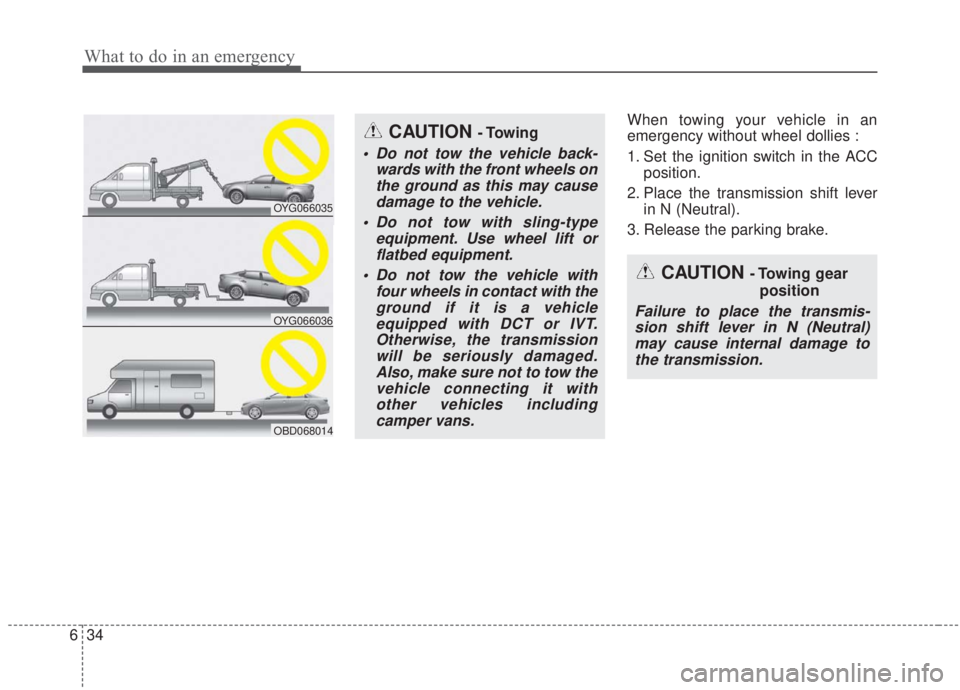
Do not tow the vehicle back- wards with the front wheels onthe ground as this may causedamage to the vehicle.
Do not tow with sling-type equipment. Use wheel lift orflatbed equipment.
Do not tow the vehicle with four wheels in contact with theground if it is a vehicleequipped with DCT or IVT.Otherwise, the transmissionwill be seriously damaged.Also, make sure not to tow thevehicle connecting it withother vehicles includingcamper vans.
OYG066035
OBD068014
OYG066036
Page 434 of 568
635
What to do in an emergency
Removable towing hook
(if equipped)
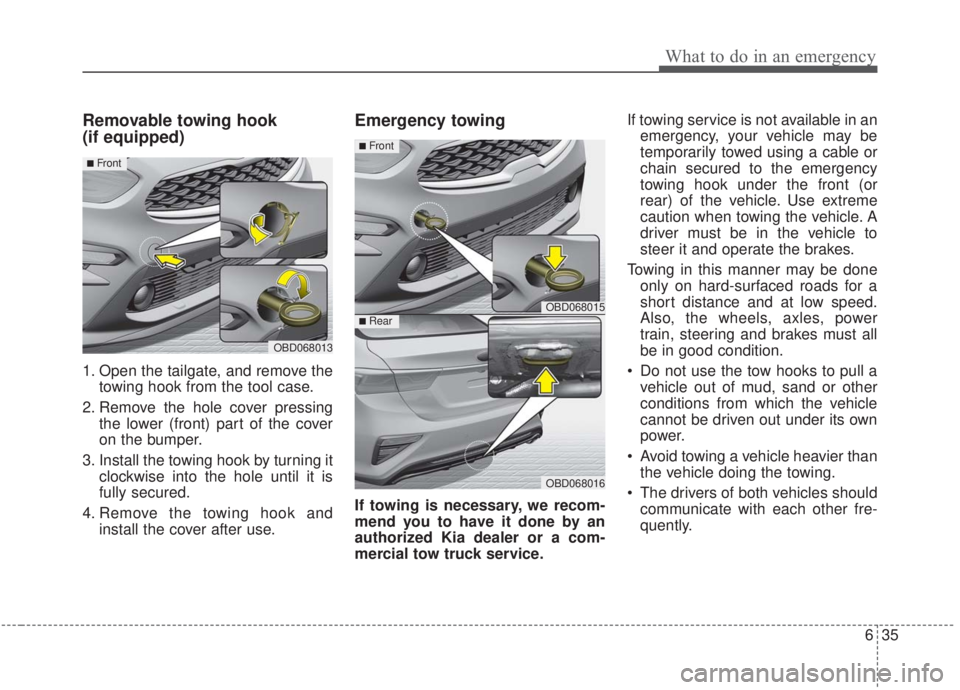
1. Open the tailgate, and remove thetowing hook from the tool case.
2. Remove the hole cover pressing the lower (front) part of the cover
on the bumper.
3. Install the towing hook by turning it clockwise into the hole until it is
fully secured.
4. Remove the towing hook and install the cover after use.
Emergency towing
If towing is necessary, we recom-
mend you to have it done by an
authorized Kia dealer or a com-
mercial tow truck service. If towing service is not available in an
emergency, your vehicle may be
temporarily towed using a cable or
chain secured to the emergency
towing hook under the front (or
rear) of the vehicle. Use extreme
caution when towing the vehicle. A
driver must be in the vehicle to
steer it and operate the brakes.
Towing in this manner may be done only on hard-surfaced roads for a
short distance and at low speed.
Also, the wheels, axles, power
train, steering and brakes must all
be in good condition.
Do not use the tow hooks to pull a vehicle out of mud, sand or other
conditions from which the vehicle
cannot be driven out under its own
power.
Avoid towing a vehicle heavier than the vehicle doing the towing.
The drivers of both vehicles should communicate with each other fre-
quently.
OBD068013
■ Front
OBD068015
OBD068016
■ Front
■ Rear
Page 436 of 568
637
What to do in an emergency
The driver must be in the vehicle forsteering and braking operations
when the vehicle is towed and pas-
sengers other than the driver must
not be allowed to be on board.Emergency towing precautions
Turn the ignition switch to ACC sothe steering wheel isn’t locked.
Place the transmission shift lever in N (Neutral).
Release the parking bake.
Press the brake pedal with more force than normal since you will
have reduced brake performance.
More steering effort will be required because the power steer-
ing system will be disabled.
If you are driving down a long hill, the brakes may overheat and brake
performance will be reduced. Stop
often and let the brakes cool off.
The vehicle should be towed at a speed of 25km/h (16 mph) or less
within a distance of 20km (12.4
miles).
If the car is being towed with all four wheels on the ground, it can
be towed only from the front. Be
sure that the transmission is in
neutral. Be sure the steering is
unlocked by placing the ignition
switch in the ACC position. A driver
must be in the towed vehicle to
operate the steering and brakes.CAUTION
- Dual clutch transmission
If the car is being towed with all four wheels on the ground, itcan be towed only from thefront. Be sure that the transmis-sion is in neutral. Be sure thesteering is unlocked by placingthe ignition switch in the ACCposition. A driver must be inthe towed vehicle to operatethe steering and brakes.
To avoid serious damage to the dual clutch transmission,limit the vehicle speed to 15km/h (10 mph) and drive lessthan 1.5 km (1 mile) when tow-ing.
Before towing, check the dual clutch transmission for fluidleaks under your vehicle. If thedual clutch transmission fluidis leaking, flatbed equipmentor a towing dolly must beused.
Page 437 of 568
What to do in an emergency
38
6
CAUTION
- Intelligent Variable
Transmission
If the car is being towed with all four wheels on the ground, itcan be towed only from thefront. Be sure that the transmis-sion is in neutral. Be sure thesteering is unlocked by placingthe ignition switch in the ACCposition. A driver must be inthe towed vehicle to operatethe steering and brakes.
To avoid serious damage to the Intelligent VariableTransmission, limit the vehiclespeed to 15 km/h (10 mph) anddrive less than 1.5 km (1 mile)when towing.
Before towing, check the Intelligent VariableTransmission for fluid leaksunder your vehicle. If theIntelligent VariableTransmission fluid is leaking,flatbed equipment or a towingdolly must be used.
CAUTION
- Intelligent Variable
Transmission (IVT)
Vehicles with Intelligent VariableTransmission (IVT) can only betowed to an ordinary vehiclewhen there is no IVT transmis-sion oil leakage. If towing to anordinary vehicle in the event ofoil leakage, the transmissionmay be damaged. If towing to anordinary vehicle in the event ofoil leakage, the transmissionmay be damaged.
Page 438 of 568
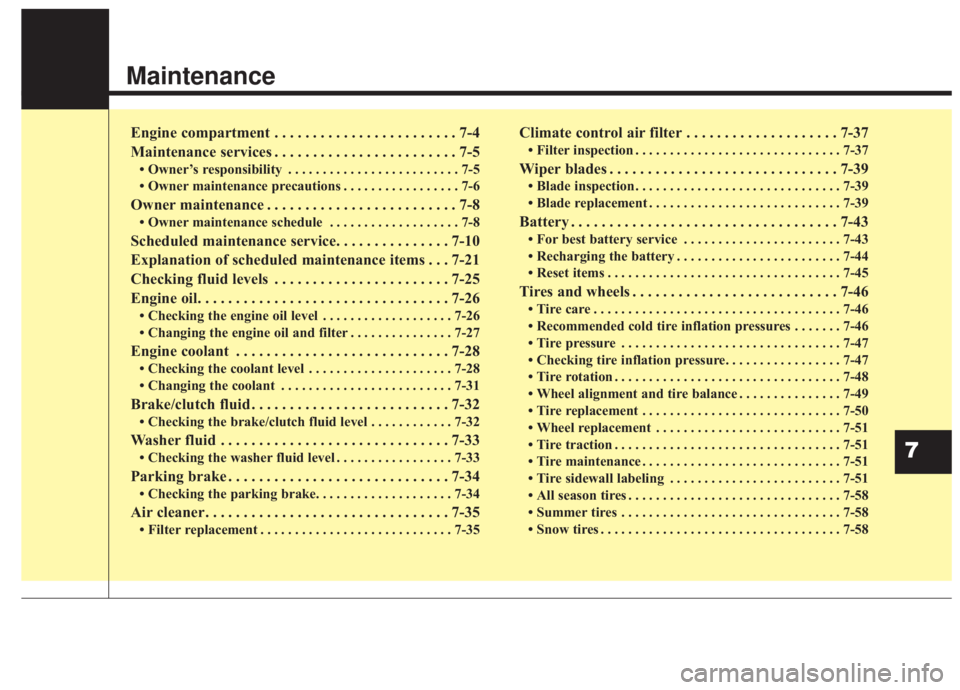
Maintenance
Engine compartment . . . . . . . . . . . . . . . . . . . . . . . . 7-4
Maintenance services . . . . . . . . . . . . . . . . . . . . . . . . 7-5
• Owner’s responsibility . . . . . . . . . . . . . . . . . . . . . . . . . 7-5
• Owner maintenance precautions . . . . . . . . . . . . . . . . . 7-6
Owner maintenance . . . . . . . . . . . . . . . . . . . . . . . . . 7-8
• Owner maintenance schedule . . . . . . . . . . . . . . . . . . . 7-8
Scheduled maintenance service. . . . . . . . . . . . . . . 7-10
Explanation of scheduled maintenance items . . . 7-21
Checking fluid levels . . . . . . . . . . . . . . . . . . . . . . . 7-25
Engine oil. . . . . . . . . . . . . . . . . . . . . . . . . . . . . . . . . 7-26
• Checking the engine oil level . . . . . . . . . . . . . . . . . . . 7-26
• Changing the engine oil and filter . . . . . . . . . . . . . . . 7-27
Engine coolant . . . . . . . . . . . . . . . . . . . . . . . . . . . . 7-28
• Checking the coolant level . . . . . . . . . . . . . . . . . . . . . 7-28
• Changing the coolant . . . . . . . . . . . . . . . . . . . . . . . . . 7-31
Brake/clutch fluid . . . . . . . . . . . . . . . . . . . . . . . . . . 7-32
• Checking the brake/clutch fluid level . . . . . . . . . . . . 7-32
Washer fluid . . . . . . . . . . . . . . . . . . . . . . . . . . . . . . 7-33
• Checking the washer fluid level . . . . . . . . . . . . . . . . . 7-33
Parking brake . . . . . . . . . . . . . . . . . . . . . . . . . . . . . 7-34
• Checking the parking brake. . . . . . . . . . . . . . . . . . . . 7-34
Air cleaner. . . . . . . . . . . . . . . . . . . . . . . . . . . . . . . . 7-35
• Filter replacement . . . . . . . . . . . . . . . . . . . . . . . . . . . . 7-35
Climate control air filter . . . . . . . . . . . . . . . . . . . . 7-37
• Filter inspection . . . . . . . . . . . . . . . . . . . . . . . . . . . . . . 7-37
Wiper blades . . . . . . . . . . . . . . . . . . . . . . . . . . . . . . 7-39
• Blade inspection . . . . . . . . . . . . . . . . . . . . . . . . . . . . . . 7-39
• Blade replacement . . . . . . . . . . . . . . . . . . . . . . . . . . . . 7-39
Battery . . . . . . . . . . . . . . . . . . . . . . . . . . . . . . . . . . . 7-\
43
• For best battery service . . . . . . . . . . . . . . . . . . . . . . . 7-43
• Recharging the battery . . . . . . . . . . . . . . . . . . . . . . . . 7-44
• Reset items . . . . . . . . . . . . . . . . . . . . . . . . . . . . . . . . . . 7-45\
Tires and wheels . . . . . . . . . . . . . . . . . . . . . . . . . . . 7-46
• Tire care . . . . . . . . . . . . . . . . . . . . . . . . . . . . . . . . . . . . \
7-46
• Recommended cold tire inflation pressures . . . . . . . 7-46
• Tire pressure . . . . . . . . . . . . . . . . . . . . . . . . . . . . . . . . 7-47
• Checking tire inflation pressure. . . . . . . . . . . . . . . . . 7-47
• Tire rotation . . . . . . . . . . . . . . . . . . . . . . . . . . . . . . . . . 7-48
• Wheel alignment and tire balance . . . . . . . . . . . . . . . 7-49
• Tire replacement . . . . . . . . . . . . . . . . . . . . . . . . . . . . . 7-50
• Wheel replacement . . . . . . . . . . . . . . . . . . . . . . . . . . . 7-51
• Tire traction . . . . . . . . . . . . . . . . . . . . . . . . . . . . . . . . . 7-51
• Tire maintenance . . . . . . . . . . . . . . . . . . . . . . . . . . . . . 7-51
• Tire sidewall labeling . . . . . . . . . . . . . . . . . . . . . . . . . 7-51
• All season tires . . . . . . . . . . . . . . . . . . . . . . . . . . . . . . . 7-58
• Summer tires . . . . . . . . . . . . . . . . . . . . . . . . . . . . . . . . 7-58
• Snow tires . . . . . . . . . . . . . . . . . . . . . . . . . . . . . . . . . . . 7-\
58
7
Page 445 of 568
Maintenance
87
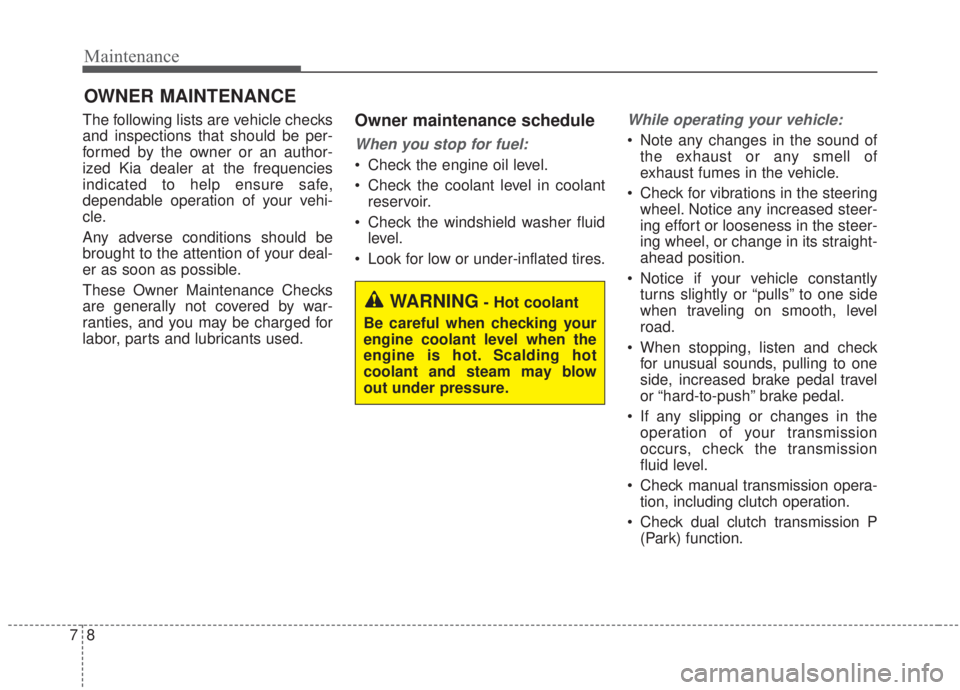
OWNER MAINTENANCE
The following lists are vehicle checks
and inspections that should be per-
formed by the owner or an author-
ized Kia dealer at the frequencies
indicated to help ensure safe,
dependable operation of your vehi-
cle.
Any adverse conditions should be
brought to the attention of your deal-
er as soon as possible.
These Owner Maintenance Checks
are generally not covered by war-
ranties, and you may be charged for
labor, parts and lubricants used.Owner maintenance schedule
When you stop for fuel:
Check the engine oil level.
Check the coolant level in coolantreservoir.
Check the windshield washer fluid level.
Look for low or under-inflated tires.
While operating your vehicle:
Note any changes in the sound of the exhaust or any smell of
exhaust fumes in the vehicle.
Check for vibrations in the steering wheel. Notice any increased steer-
ing effort or looseness in the steer-
ing wheel, or change in its straight-
ahead position.
Notice if your vehicle constantly turns slightly or “pulls” to one side
when traveling on smooth, level
road.
When stopping, listen and check for unusual sounds, pulling to one
side, increased brake pedal travel
or “hard-to-push” brake pedal.
If any slipping or changes in the operation of your transmission
occurs, check the transmission
fluid level.
Check manual transmission opera- tion, including clutch operation.
Check dual clutch transmission P (Park) function.
WARNING- Hot coolant
Be careful when checking your
engine coolant level when the
engine is hot. Scalding hot
coolant and steam may blow
out under pressure.
Page 446 of 568
79
Maintenance
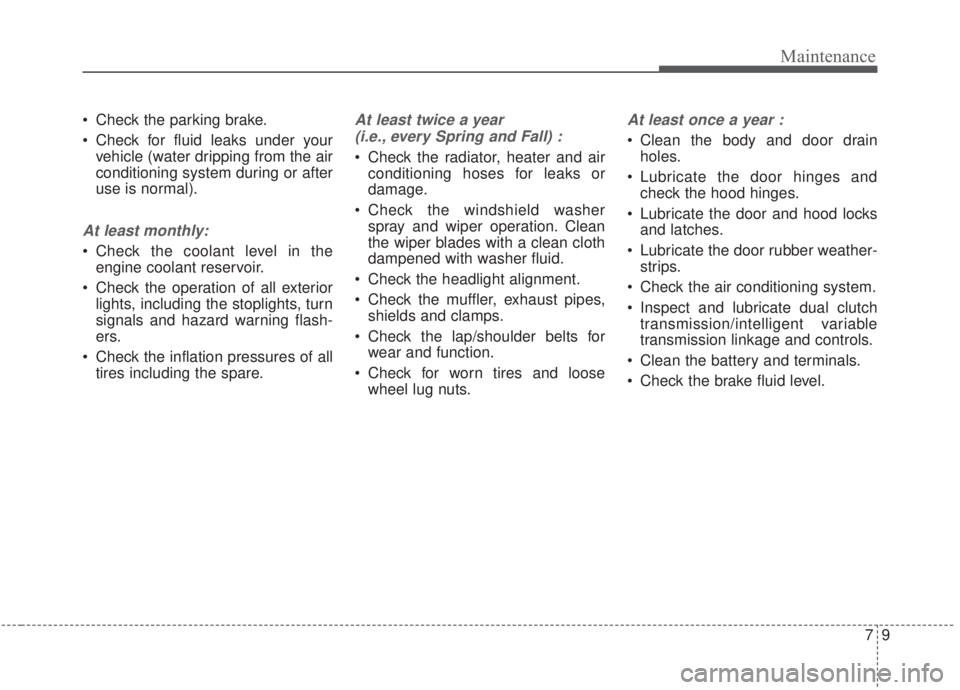
Check the parking brake.
Check for fluid leaks under yourvehicle (water dripping from the air
conditioning system during or after
use is normal).
At least monthly:
Check the coolant level in theengine coolant reservoir.
Check the operation of all exterior lights, including the stoplights, turn
signals and hazard warning flash-
ers.
Check the inflation pressures of all tires including the spare.
At least twice a year
(i.e., every Spring and Fall) :
Check the radiator, heater and air conditioning hoses for leaks or
damage.
Check the windshield washer spray and wiper operation. Clean
the wiper blades with a clean cloth
dampened with washer fluid.
Check the headlight alignment.
Check the muffler, exhaust pipes, shields and clamps.
Check the lap/shoulder belts for wear and function.
Check for worn tires and loose wheel lug nuts.
At least once a year :
Clean the body and door drainholes.
Lubricate the door hinges and check the hood hinges.
Lubricate the door and hood locks and latches.
Lubricate the door rubber weather- strips.
Check the air conditioning system.
Inspect and lubricate dual clutch transmission/intelligent variable
transmission linkage and controls.
Clean the battery and terminals.
Check the brake fluid level.
Page 462 of 568
725
Maintenance
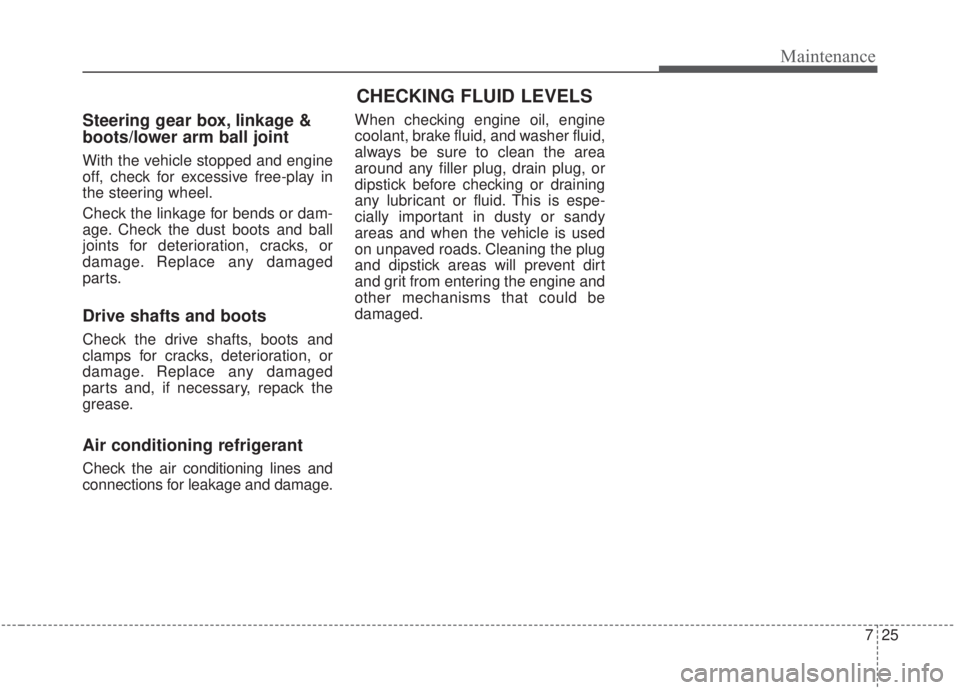
CHECKING FLUID LEVELS
Steering gear box, linkage &
boots/lower arm ball joint
With the vehicle stopped and engine
off, check for excessive free-play in
the steering wheel.
Check the linkage for bends or dam-
age. Check the dust boots and ball
joints for deterioration, cracks, or
damage. Replace any damaged
parts.
Drive shafts and boots
Check the drive shafts, boots and
clamps for cracks, deterioration, or
damage. Replace any damaged
parts and, if necessary, repack the
grease.
Air conditioning refrigerant
Check the air conditioning lines and
connections for leakage and damage.When checking engine oil, engine
coolant, brake fluid, and washer fluid,
always be sure to clean the area
around any filler plug, drain plug, or
dipstick before checking or draining
any lubricant or fluid. This is espe-
cially important in dusty or sandy
areas and when the vehicle is used
on unpaved roads. Cleaning the plug
and dipstick areas will prevent dirt
and grit from entering the engine and
other mechanisms that could be
damaged.