ignition KIA FORTE 2020 Owners Manual
[x] Cancel search | Manufacturer: KIA, Model Year: 2020, Model line: FORTE, Model: KIA FORTE 2020Pages: 568, PDF Size: 8.58 MB
Page 430 of 568

631
What to do in an emergency
Distributing the sealant
12. Immediately drive approximately7~10 km (4~6 miles) or about 10
minutes to evenly distribute the
sealant in the tire.
When you use the Tire Mobility Kit,
the tire pressure sensors and wheel
may be stained by sealant. Therefore,
remove the tire pressure sensors and
wheel stained by sealant and have
your vehicle inspected by an author-
ized Kia dealer.
Checking the tire inflation
pressure
1.After driving approximately 7~10 km (4~6 miles) or about 10 min-
utes, stop at a suitable location.
2.Connect the filling hose (3) of the compressor (clip mounted side)
directly and then connect the filling
hose (3) (opposite side) to the tire
valve.
3.Connect the compressor to the vehicle power outlet using the
cable and connectors.
4.Adjust the tire inflation pressure to 200 kPa (29 psi). With the ignition
switched on, proceed as follows.
- To increase the inflation pres-sure: Switch on the compressor,
position I. To check the current
inflation pressure setting, briefly
switch off the compressor. - To reduce the inflation pres-
sure: Press the button (9) on the
compressor.
CAUTION - Tire pressure
sensor
Do not use sealant notapproved by Kia as it may dam-age the tire pressure sensors.The sealant on the tire pressuresensor and wheel should beremoved when you replace thetire with a new one and inspectthe tire pressure sensors at anauthorized dealer.
WARNING
Do not let the compressor run
for more than 10 minutes, other-
wise the device will overheat
and may be damaged.
WARNING
The tire inflation pressure must
be at least 200 kPa, 2 bar (29
psi). If it is not, do not continue
driving. Call for road side serv-
ice or towing.
Page 432 of 568

633
What to do in an emergency
TOWING
Towing service
If emergency towing is necessary,
we recommend having it done by an
authorized Kia dealer or a commer-
cial tow-truck service. Proper lifting
and towing procedures are neces-
sary to prevent damage to the vehi-
cle. The use of wheel dollies or
flatbed is recommended.It is acceptable to tow the vehicle
with the rear wheels on the ground
(without dollies) and the front wheels
off the ground.
If any of the loaded wheels or sus-
pension components are damaged
or the vehicle is being towed with the
front wheels on the ground, use a
towing dolly under the front wheels.
When being towed by a commercial
tow truck and wheel dollies are not
used, the front of the vehicle should
always be lifted, not the rear.
✽ ✽
NOTICE
If the EPB does not release normal-
ly, take your vehicle to an author-
ized Kia dealer by loading the vehi-
cle on a flatbed tow truck and have
the system checked.
OBD068011 dollydolly
WARNING - Side and
curtain Air bag
If your vehicle is equipped with
side and curtain air bags, set
the ignition switch to the LOCK
or ACC position when the vehi-
cle is being towed.
The side and curtain air bag
may deploy when the ignition is
in the ON position, and the
rollover sensor detects a
rollover situation.
Page 433 of 568
What to do in an emergency
34
6
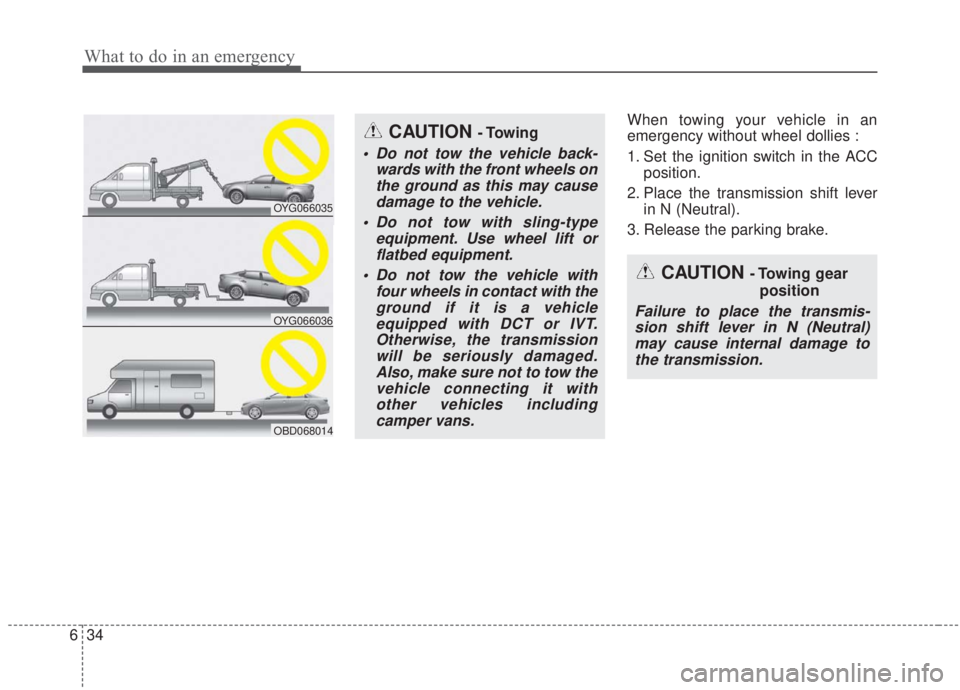
When towing your vehicle in an
emergency without wheel dollies :
1. Set the ignition switch in the ACC
position.
2. Place the transmission shift lever in N (Neutral).
3. Release the parking brake.
CAUTION - Towing gear position
Failure to place the transmis-sion shift lever in N (Neutral)may cause internal damage tothe transmission.
CAUTION - Towing
Do not tow the vehicle back- wards with the front wheels onthe ground as this may causedamage to the vehicle.
Do not tow with sling-type equipment. Use wheel lift orflatbed equipment.
Do not tow the vehicle with four wheels in contact with theground if it is a vehicleequipped with DCT or IVT.Otherwise, the transmissionwill be seriously damaged.Also, make sure not to tow thevehicle connecting it withother vehicles includingcamper vans.
OYG066035
OBD068014
OYG066036
Page 436 of 568
637
What to do in an emergency
The driver must be in the vehicle forsteering and braking operations
when the vehicle is towed and pas-
sengers other than the driver must
not be allowed to be on board.Emergency towing precautions
Turn the ignition switch to ACC sothe steering wheel isn’t locked.
Place the transmission shift lever in N (Neutral).
Release the parking bake.
Press the brake pedal with more force than normal since you will
have reduced brake performance.
More steering effort will be required because the power steer-
ing system will be disabled.
If you are driving down a long hill, the brakes may overheat and brake
performance will be reduced. Stop
often and let the brakes cool off.
The vehicle should be towed at a speed of 25km/h (16 mph) or less
within a distance of 20km (12.4
miles).
If the car is being towed with all four wheels on the ground, it can
be towed only from the front. Be
sure that the transmission is in
neutral. Be sure the steering is
unlocked by placing the ignition
switch in the ACC position. A driver
must be in the towed vehicle to
operate the steering and brakes.CAUTION
- Dual clutch transmission
If the car is being towed with all four wheels on the ground, itcan be towed only from thefront. Be sure that the transmis-sion is in neutral. Be sure thesteering is unlocked by placingthe ignition switch in the ACCposition. A driver must be inthe towed vehicle to operatethe steering and brakes.
To avoid serious damage to the dual clutch transmission,limit the vehicle speed to 15km/h (10 mph) and drive lessthan 1.5 km (1 mile) when tow-ing.
Before towing, check the dual clutch transmission for fluidleaks under your vehicle. If thedual clutch transmission fluidis leaking, flatbed equipmentor a towing dolly must beused.
Page 437 of 568
What to do in an emergency
38
6
CAUTION
- Intelligent Variable
Transmission
If the car is being towed with all four wheels on the ground, itcan be towed only from thefront. Be sure that the transmis-sion is in neutral. Be sure thesteering is unlocked by placingthe ignition switch in the ACCposition. A driver must be inthe towed vehicle to operatethe steering and brakes.
To avoid serious damage to the Intelligent VariableTransmission, limit the vehiclespeed to 15 km/h (10 mph) anddrive less than 1.5 km (1 mile)when towing.
Before towing, check the Intelligent VariableTransmission for fluid leaksunder your vehicle. If theIntelligent VariableTransmission fluid is leaking,flatbed equipment or a towingdolly must be used.
CAUTION
- Intelligent Variable
Transmission (IVT)
Vehicles with Intelligent VariableTransmission (IVT) can only betowed to an ordinary vehiclewhen there is no IVT transmis-sion oil leakage. If towing to anordinary vehicle in the event ofoil leakage, the transmissionmay be damaged. If towing to anordinary vehicle in the event ofoil leakage, the transmissionmay be damaged.
Page 478 of 568
741
Maintenance
4. Return the wiper arm on the wind-shield.
5. Turn ignition to the ON position and the wiper arms will return to
the normal operating position.
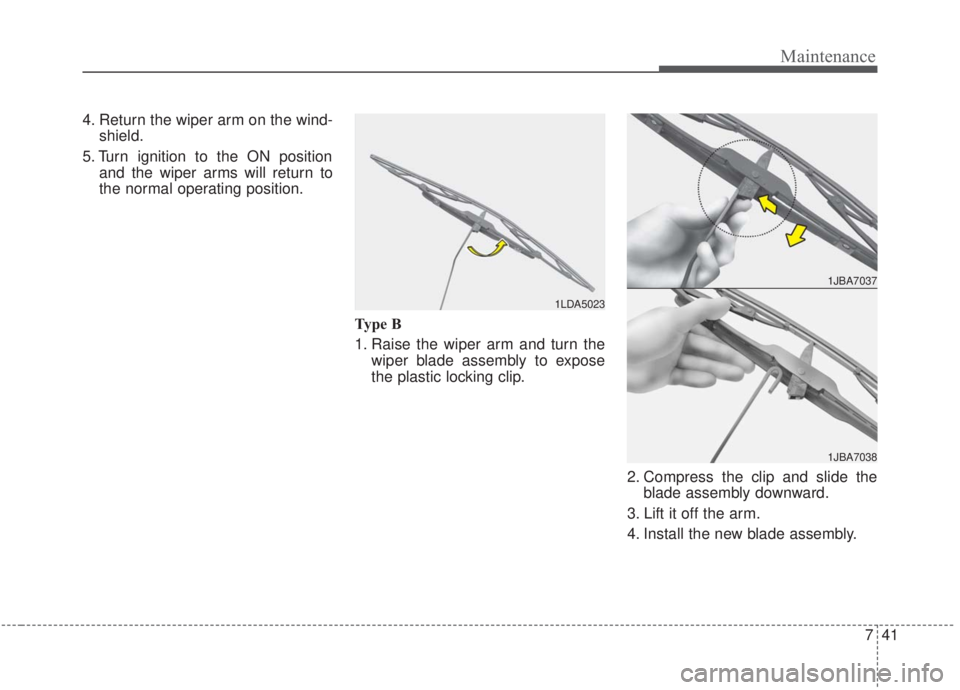
Type B
1. Raise the wiper arm and turn thewiper blade assembly to expose
the plastic locking clip.
2. Compress the clip and slide theblade assembly downward.
3. Lift it off the arm.
4. Install the new blade assembly.
1JBA7037
1JBA7038
1LDA5023
Page 479 of 568
Maintenance
42
7
5. Return the wiper arm on the wind-
shield.
6. Turn ignition to the ON position and the wiper arms will return to
the normal operating position.
Page 499 of 568

Maintenance
62
7
✽ ✽
NOTICE
• When replacing a fuse, turn the
ignition "OFF", turn off switches
of all electrical devices, and then
remove the battery (-) terminal.
• The actual fuse/relay panel label may differ from equipped items.
WARNING- Electrical Fire
Always ensure replacements
fuses and relays are securely
fastened when installed. Failure
to do so can result in a vehicle
fire.
CAUTION
When replacing a blown fuse or relay, make sure the newfuse or relay fits tightly intothe clips. Failure to tightlyinstall the fuse or relay maycause damage to the wiringand electric systems.
Do not remove fuses, relays and terminals fastened withbolts or nuts. The fuses, relaysand terminals may not be fas-tened correctly which maycause vehicle damage.
CAUTION
Do not input any other objects, such as a screwdriveror wiring, except fuses orrelays into the fuse/relay ter-minals.
Do not plug in screwdrivers or aftermarket wiring into the ter-minal originally designed forfuse and relays only. The elec-trical system and wiring of thevehicle interior may be dam-aged or burned due to contactfailure.
If you directly connect the wire on the taillight or replacethe bulb which is over the reg-ulated capacity to install trail-ers etc., the inner junctionblock can get burned.
Page 500 of 568
763
Maintenance
✽ ✽NOTICE- Remodeling
Prohibited
Do not rewire your vehicle in any
way as doing so may affect the per-
formance of several safety features
in your vehicle. Rewiring your vehi-
cle may also void your warranty and
cause you to be responsible for any
subsequent vehicle damage which
may result.
✽ ✽ NOTICE- Window tinting pre-
caution
Window tint (especially metallic
film) might cause communication
errors or poor radio reception, and a
malfunctioning automatic lighting
system due to reflections from the
mirror tint inside the vehicle. The
tint installation solution used might
also leak into the electronic compo-
nents, causing malfunctions or dam-
age.
Inner panel fuse replacement
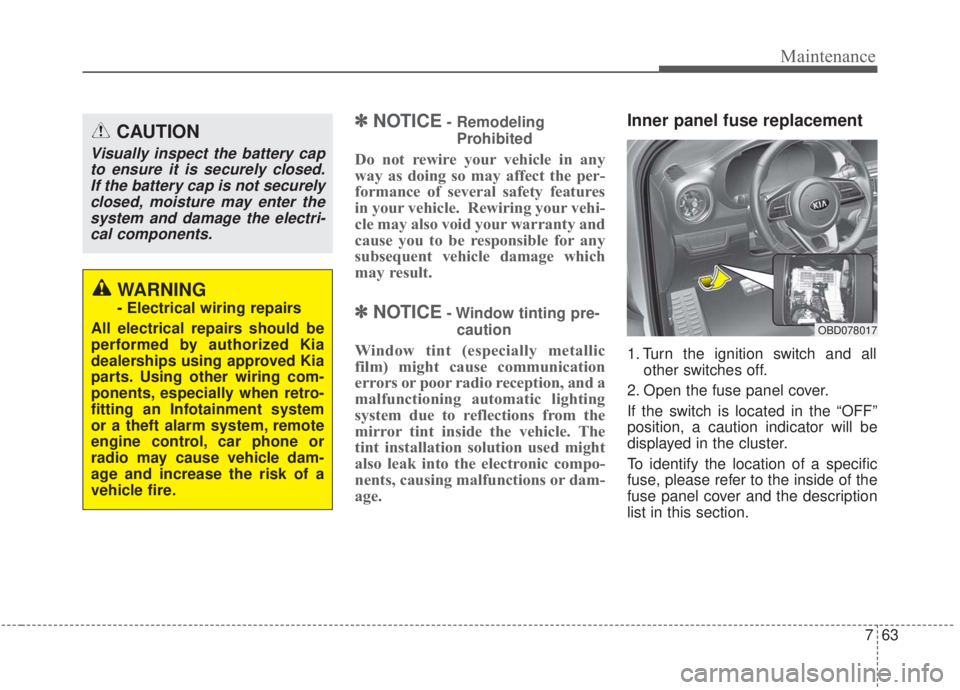
1. Turn the ignition switch and all other switches off.
2. Open the fuse panel cover.
If the switch is located in the “OFF”
position, a caution indicator will be
displayed in the cluster.
To identify the location of a specific
fuse, please refer to the inside of the
fuse panel cover and the description
list in this section.
CAUTION
Visually inspect the battery cap to ensure it is securely closed.If the battery cap is not securelyclosed, moisture may enter thesystem and damage the electri-cal components.
WARNING
- Electrical wiring repairs
All electrical repairs should be
performed by authorized Kia
dealerships using approved Kia
parts. Using other wiring com-
ponents, especially when retro-
fitting an Infotainment system
or a theft alarm system, remote
engine control, car phone or
radio may cause vehicle dam-
age and increase the risk of a
vehicle fire.
OBD078017
Page 501 of 568

Maintenance
64
7
3. Pull the suspected fuse straight
out. Use the removal tool provided
on the engine compartment fuse
panel cover.
4. Check the removed fuse; replace it if it is blown.
Spare fuses are provided in theengine compartment fuse panel.
5. Push in a new fuse of the same rating, and make sure it fits tightly
in the clips.
If it fits loosely, consult an authorized
Kia dealer.
If you do not have a spare, use a fuse of the same rating from a circuityou may not need for operating thevehicle, such as the power outletfuse.
If the head lamp, turn signal lamp,
stop signal lamp, fog lamp, Daytime
Running Lights (DRL), tail lamp,
High mounted stop lamp (HMSL) do
not work and the fuses are OK,
check the fuse panel in the engine
compartment. If a fuse is blown, it
must be replaced.
✽ ✽ NOTICE
If the headlamp, fog lamp, turn sig-
nal lamp, or tail lamp malfunction
even without any problem to the
lamps, have the vehicle checked by
an authorized Kia dealer for assis-
tance.
Engine compartment fuse
replacement
1. Turn the ignition switch and all
other switches off.
2. Remove the fuse panel cover by pressing the tab and pulling the
cover up.
OBD078018
OBD078019