air conditioning KIA FORTE 2020 Owner's Manual
[x] Cancel search | Manufacturer: KIA, Model Year: 2020, Model line: FORTE, Model: KIA FORTE 2020Pages: 568, PDF Size: 8.58 MB
Page 224 of 568

4139
Features of your vehicle
To defrost outside windshield
1. Set the fan speed to the highestposition.
2. Set the temperature to the highest (HI) position.
3. Press the defroster button ( ).
4. The outside (fresh) air position will be selected automatically and the
air conditioning will turn on
according to the detected ambient
temperature.
Defogging logic
To reduce the possibility of fogging
up the inside of the windshield, the
air intake or air conditioning is con-
trolled automatically according to
certain conditions such as or
position. To cancel automatic defog-
ging logic or to return to the auto-
matic defogging logic, do the follow-
ing.
Manual climate control system
1. Turn the ignition switch to the ONposition.
2. Press the defroster button ( ).
3. Within 3 seconds after pressing the defroster button, press the air
intake control button at least 5
times within 3 seconds.
If the battery has been discharged or
disconnected, it resets to the defog
logic status.
OBD048326OBDM048327
Page 225 of 568

Features of your vehicle
140
4
Automatic climate control system
1. Turn the ignition switch to the ON
position.
2. Press the defroster button ( ).
3. While pressing the air conditioning button (A/C), press the air intake
control button at least 5 times with-
in 3 seconds.
The recirculation indicator blinks 3
times with 0.5 second intervals. It
indicates that the defogging logic is
canceled or returned to the pro-
grammed status.
If the battery has been discharged or
disconnected, it resets to the defog
logic status.
Auto defogging system (if equipped)
Auto defogging reduces the probabil-
ity of fogging up the inside of the
windshield by automatically sensing
the moisture of inside the windshield.
The auto defogging system operates
when the heater or air conditioning is
on. This indicator illuminates
when the auto defogging
system senses moisture
on the inside of the wind-
shield and is activated.
The auto defogging system address-
es excess moisture on the inside of
the windshield in stages. For exam-
ple, if auto defogging does not defog
inside the windshield at step 1
Outside air position, it tries to defog
again at step 2 Operating the air con-
ditioning.
Step 1 : Outside air position
Step 2 : Operating the air condition- ing
Step 3 : Blowing air flow toward the windshield
Step 4 : Increasing air flow toward the windshield
OBD048015
OBD048334
Page 386 of 568
Driving your vehicle
140
5
Remember, your vehicle does not
require extended warm-up. After
the engine has started, allow the
engine to run for 10 to 20 seconds
prior to placing the vehicle in gear.
In very cold weather, however, give
your engine a slightly longer warm-
up period.
Don't "lug" or "over-rev" the engine. Lugging is driving too slowly in a
very high gear resulting in engine
bucking. If this happens, shift to a
lower gear. Over-revving is racing
the engine beyond its safe limit.
This can be avoided by shifting at
the recommended speed. Use your air conditioning sparingly.
The air conditioning system is
operated by engine power so your
fuel economy is reduced when you
use it.
Open windows at high speeds can reduce fuel economy.
Fuel economy decreases in cross- winds and headwinds. To help off-
set some of this loss, slow down
when driving in these conditions.
Keeping a vehicle in good operating
condition is important both for econ-
omy and safety. Therefore, have an
authorized Kia dealer perform
scheduled inspections and mainte-
nance.
WARNING - Engine off
during motion
Never turn the engine off to
coast down hills or anytime the
vehicle is in motion. The power
steering and power brakes will
not function properly without
the engine running. In addition,
turning off the ignition while
driving could engage the steer-
ing wheel lock resulting in loss
of vehicle steering. Keep the
engine on and downshift to an
appropriate gear for an engine
braking effect.
Page 446 of 568
79
Maintenance
Check the parking brake.
Check for fluid leaks under yourvehicle (water dripping from the air
conditioning system during or after
use is normal).
At least monthly:
Check the coolant level in theengine coolant reservoir.
Check the operation of all exterior lights, including the stoplights, turn
signals and hazard warning flash-
ers.
Check the inflation pressures of all tires including the spare.
At least twice a year
(i.e., every Spring and Fall) :
Check the radiator, heater and air conditioning hoses for leaks or
damage.
Check the windshield washer spray and wiper operation. Clean
the wiper blades with a clean cloth
dampened with washer fluid.
Check the headlight alignment.
Check the muffler, exhaust pipes, shields and clamps.
Check the lap/shoulder belts for wear and function.
Check for worn tires and loose wheel lug nuts.
At least once a year :
Clean the body and door drainholes.
Lubricate the door hinges and check the hood hinges.
Lubricate the door and hood locks and latches.
Lubricate the door rubber weather- strips.
Check the air conditioning system.
Inspect and lubricate dual clutch transmission/intelligent variable
transmission linkage and controls.
Clean the battery and terminals.
Check the brake fluid level.
Page 462 of 568
725
Maintenance
CHECKING FLUID LEVELS
Steering gear box, linkage &
boots/lower arm ball joint
With the vehicle stopped and engine
off, check for excessive free-play in
the steering wheel.
Check the linkage for bends or dam-
age. Check the dust boots and ball
joints for deterioration, cracks, or
damage. Replace any damaged
parts.
Drive shafts and boots
Check the drive shafts, boots and
clamps for cracks, deterioration, or
damage. Replace any damaged
parts and, if necessary, repack the
grease.
Air conditioning refrigerant
Check the air conditioning lines and
connections for leakage and damage.When checking engine oil, engine
coolant, brake fluid, and washer fluid,
always be sure to clean the area
around any filler plug, drain plug, or
dipstick before checking or draining
any lubricant or fluid. This is espe-
cially important in dusty or sandy
areas and when the vehicle is used
on unpaved roads. Cleaning the plug
and dipstick areas will prevent dirt
and grit from entering the engine and
other mechanisms that could be
damaged.
Page 492 of 568

755
Maintenance
Temperature -A, B & C
The temperature grades are A (the
highest), B and C, and represent the
tire's resistance to the generation of
heat and its ability to dissipate heat
when tested under controlled condi-
tions on a specified indoor laboratory
test wheel.
Sustained high temperature can
cause the material of the tire to
degenerate and reduce tire life, and
excessive temperature can lead to
sudden tire failure. Grades B and A
represent higher levels of perform-
ance on the laboratory test wheel
than the minimum required by law.Tire terminology and definitions
Air Pressure:
The amount of air
inside the tire pressing outward on
the tire. Air pressure is expressed in
kilopascal (kPa) or pounds per
square inch (psi).
Accessory Weight: This means the
combined weight of optional acces-
sories. Some examples of optional
accessories are, intelligent variable
transmission, power seats, and air
conditioning.
Aspect Ratio: The relationship of a
tire's height to its width.
Belt: A rubber coated layer of cords
that is located between the plies and
the tread. Cords may be made from
steel or other reinforcing materials.
Bead: The tire bead contains steel
wires wrapped by steel cords that
hold the tire onto the rim.
Bias Ply Tire: A pneumatic tire in
which the plies are laid at alternate
angles less than 90 degrees to the
centerline of the tread. Cold Tire Pressure:
The amount of
air pressure in a tire, measured in
kilopascals (kPa) or pounds per
square inch (psi), before a tire has
built up heat from driving.
Curb Weight: This means the weight
of a motor vehicle with standard and
optional equipment, including the
maximum capacity of fuel, oil and
coolant, but without passengers and
cargo.
DOT Markings: The DOT code
includes the Tire Identification
Number (TIN), an alphanumeric des-
ignator which can also identify the
tire manufacturer, production plant,
brand and date of production.
Page 546 of 568

Specifications & Consumer information
Dimensions . . . . . . . . . . . . . . . . . . . . . . . . . . . . . . . . 8-2
Engine . . . . . . . . . . . . . . . . . . . . . . . . . . . . . . . . . . . . \
8-3
Bulb wattage . . . . . . . . . . . . . . . . . . . . . . . . . . . . . . . 8-4
Tires and wheels . . . . . . . . . . . . . . . . . . . . . . . . . . . . 8-5
Gross vehicle weight. . . . . . . . . . . . . . . . . . . . . . . . . 8-7
Luggage volume . . . . . . . . . . . . . . . . . . . . . . . . . . . . 8-7
Air conditioning system . . . . . . . . . . . . . . . . . . . . . . 8-7
Recommended lubricants and capacities . . . . . . . . 8-8
• Recommended SAE viscosity number. . . . . . . . . . . . 8-10
Vehicle identification number (VIN) . . . . . . . . . . 8-11
Vehicle certification label. . . . . . . . . . . . . . . . . . . . 8-11
Tire specification and pressure label . . . . . . . . . . 8-11
Engine number . . . . . . . . . . . . . . . . . . . . . . . . . . . . 8-12
8
Page 552 of 568
87
Specifications & Consumer information
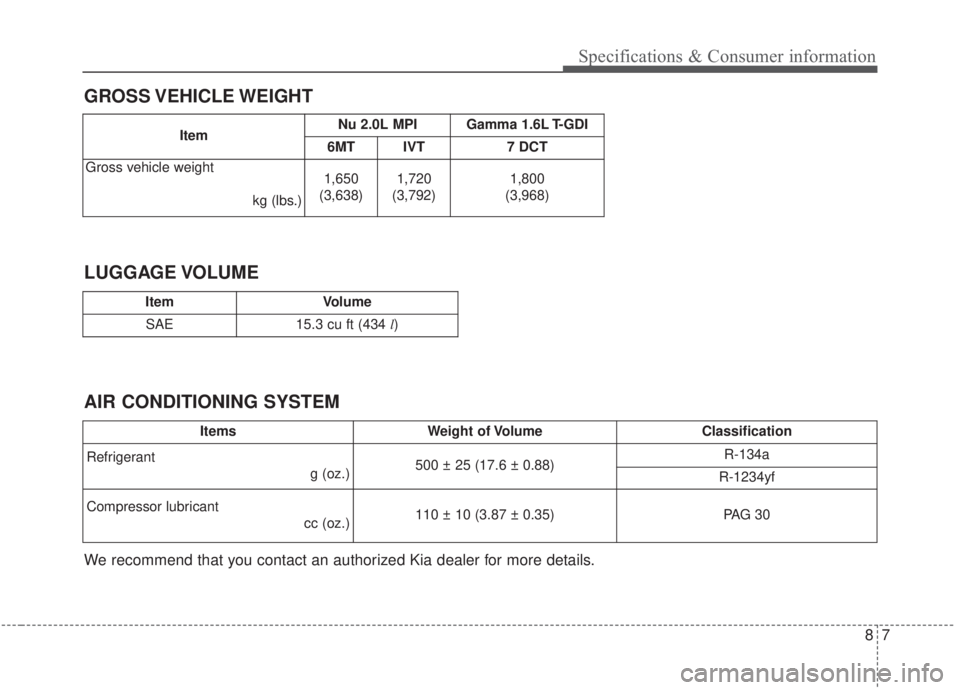
GROSS VEHICLE WEIGHT
AIR CONDITIONING SYSTEM LUGGAGE VOLUME
We recommend that you contact an authorized Kia dealer for more details.
ItemVolume
SAE15.3 cu ft (434 l)
ItemsWeight of VolumeClassification
Refrigerant g (oz.) 500 ± 25 (17.6 ± 0.88)R-134a
R-1234yf
Compressor lubricantcc (oz.) 110 ± 10 (3.87 ± 0.35)PAG 30
ItemNu 2.0L MPI Gamma 1.6L T-GDI
6MT IVT 7 DCT
Gross vehicle weight
kg (lbs.)
1,650
(3,638)1,720
(3,792)1,800
(3,968)
Page 559 of 568
Index
2I
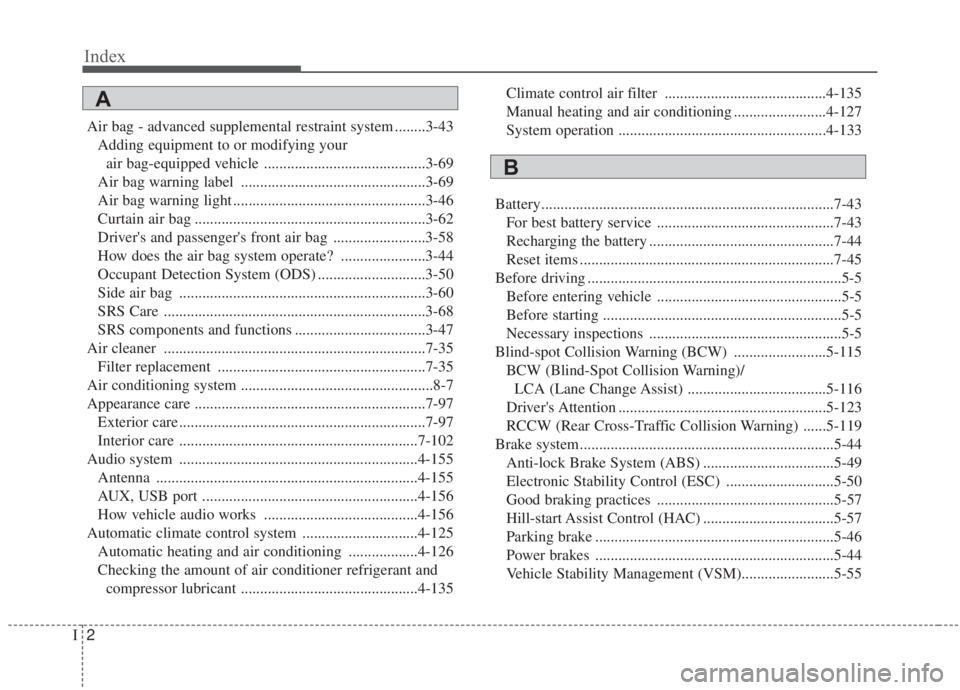
Air bag - advanced supplemental restraint system ........3-43Adding equipment to or modifying your air bag-equipped vehicle ..........................................3-69
Air bag warning label ................................................3-69
Air bag warning light ..................................................3-46
Curtain air bag ............................................................3-62
Driver's and passenger's front air bag ........................3-58
How does the air bag system operate? ......................3-44
Occupant Detection System (ODS) ............................3-50
Side air bag ................................................................3-60
SRS Care ....................................................................3-68\
SRS components and functions ..................................3-47
Air cleaner ....................................................................7-35\
Filter replacement ......................................................7-35
Air conditioning system ..................................................8-7
Appearance care ............................................................7-97 Exterior care ................................................................7-97
Interior care ..............................................................7-102
Audio system ..............................................................4-155 Antenna ....................................................................4-15\
5
AUX, USB port ........................................................4-156
How vehicle audio works ........................................4-156
Automatic climate control system ..............................4-125 Automatic heating and air conditioning ..................4-126
Checking the amount of air conditioner refrigerant and compressor lubricant ..............................................4-135 Climate control air filter ..........................................4-135
Manual heating and air conditioning ........................4-127
System operation ......................................................4-133
Battery........................................................................\
....7-43 For best battery service ..............................................7-43
Recharging the battery ................................................7-44
Reset items ..................................................................7-45
Before driving ..................................................................5-5 Before entering vehicle ................................................5-5
Before starting ..............................................................5-5
Necessary inspections ..................................................5-5
Blind-spot Collision Warning (BCW) ........................5-115 BCW (Blind-Spot Collision Warning)/LCA (Lane Change Assist) ....................................5-116
Driver's Attention ......................................................5-123
RCCW (Rear Cross-Traffic Collision Warning) ......5-119
Brake system..................................................................5-44 Anti-lock Brake System (ABS) ..................................5-49
Electronic Stability Control (ESC) ............................5-50
Good braking practices ..............................................5-57
Hill-start Assist Control (HAC) ..................................5-57
Parking brake ..............................................................5-46
Power brakes ..............................................................5-44
Vehicle Stability Management (VSM)........................5-55
A
B
Page 564 of 568
I7
Index
High mounted stop lamp (bulb type) bulb replacement ..............................................................7-91
High mounted stop lamp (LED type) bulb replacement ..............................................................7-91
License plate lamp bulb replacement ........................7-92
Light bulb position (Front) ........................................7-79
Light bulb position (Rear) ..........................................7-80
Light bulb position (Side) ..........................................7-81
Map lamp (Bulb type) bulb replacement ....................7-92
Map lamp (LED type) bulb replacement ....................7-93
Position lamp/Day time running lamp (LED type) replacement (Headlamp Type B) ..............................7-85
Rear turn signal lamp bulb replacement ....................7-90
Room lamp (Bulb type) bulb replacement ................7-93
Room lamp (LED type) bulb replacement ................7-94
Side marker (LED type) bulb replacement (Rear combination lamp Type B) ............................7-90
Side marker bulb replacement (Headlamp Type A,B)..7-84
Side repeater lamp (Bulb type) bulb replacement ......7-87
Side repeater lamp (LED type) bulb replacement ......7-86
Stop and tail lamp (LED type) bulb replacement (Rear combination lamp Type B) ............................7-89
Stop and tail lamp/side marker (Bulb type) bulb replacement (Rear combination lamp Type A) ........7-87
Tail lamp (inside) (Bulb type) bulb replacement (Rear combination lamp Type A) ............................7-88
Trunk room lamp replacement....................................7-96
Vanity mirror lamp bulb replacement ........................7-94 Lighting........................................................................\
4-100
Battery saver function ..............................................4-100
Daytime running light ..............................................4-100
Front fog light ..........................................................4-107
High beam assist ......................................................4-103
High beam operation ................................................4-102
Lighting control ........................................................4-100
Turn signals and lane change signals........................4-106
Luggage volume ..............................................................8-7
Maintenance services ......................................................7-5 Owner maintenance precautions ..................................7-6
Owner’s responsibility ..................................................7-5
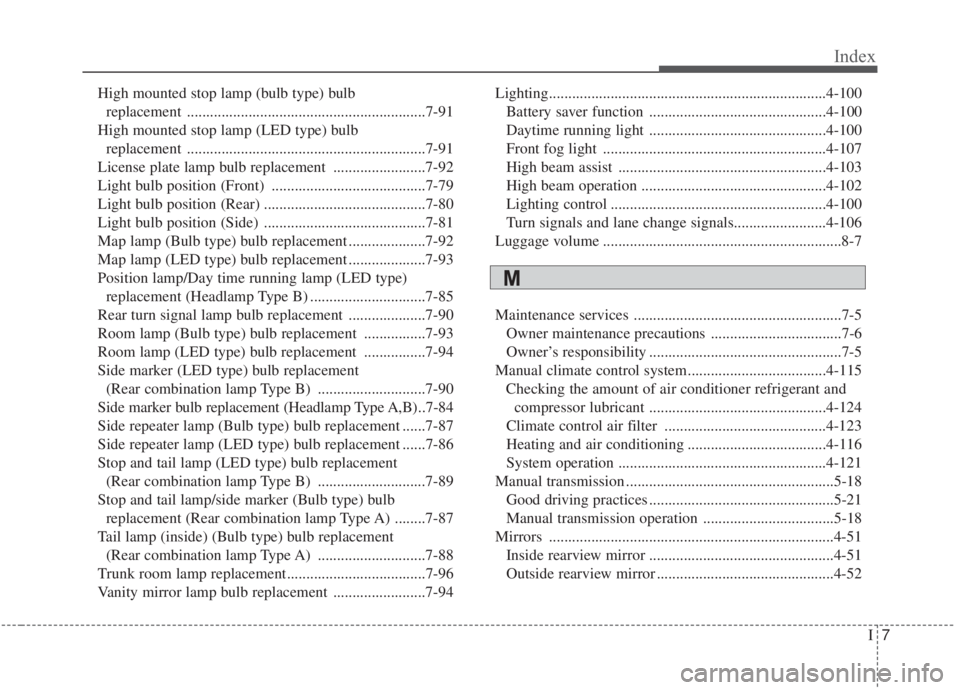
Manual climate control system....................................4-115 Checking the amount of air conditioner refrigerant and compressor lubricant ..............................................4-124
Climate control air filter ..........................................4-123
Heating and air conditioning ....................................4-116
System operation ......................................................4-121
Manual transmission ......................................................5-18 Good driving practices ................................................5-21
Manual transmission operation ..................................5-18
Mirrors ........................................................................\
..4-51 Inside rearview mirror ................................................4-51
Outside rearview mirror ..............................................4-52
M