brake fluid KIA FORTE 5 2018 Owner's Manual
[x] Cancel search | Manufacturer: KIA, Model Year: 2018, Model line: FORTE 5, Model: KIA FORTE 5 2018Pages: 584, PDF Size: 15.16 MB
Page 488 of 584
Maintenance
26
7
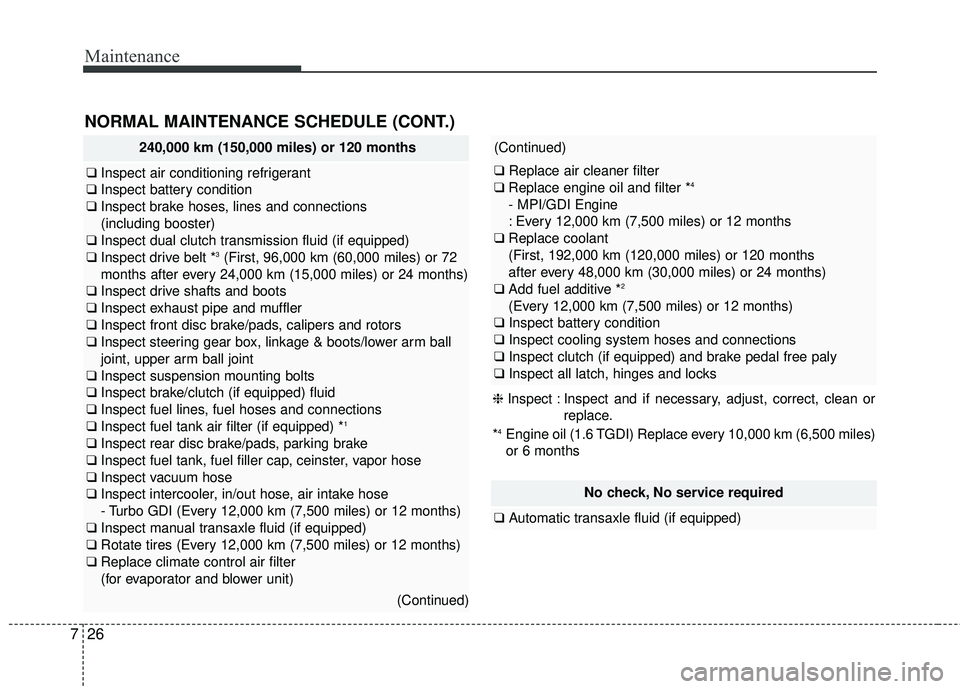
(Continued)
❑ Replace air cleaner filter
❑ Replace engine oil and filter *4
- MPI/GDI Engine
: Every 12,000 km (7,500 miles) or 12 months
❑ Replace coolant
(First, 192,000 km (120,000 miles) or 120 months
after every 48,000 km (30,000 miles) or 24 months)
❑ Add fuel additive *
2
(Every 12,000 km (7,500 miles) or 12 months)
❑ Inspect battery condition
❑ Inspect cooling system hoses and connections
❑ Inspect clutch (if equipped) and brake pedal free paly
❑ Inspect all latch, hinges and locks
❈ Inspect : Inspect and if necessary, adjust, correct, clean or
replace.
*
4Engine oil (1.6 TGDI) Replace every 10,000 km (6,500 miles)
or 6 months
NORMAL MAINTENANCE SCHEDULE (CONT.)
240,000 km (150,000 miles) or 120 months
❑ Inspect air conditioning refrigerant
❑ Inspect battery condition
❑ Inspect brake hoses, lines and connections
(including booster)
❑ Inspect dual clutch transmission fluid (if equipped)
❑ Inspect drive belt *
3 (First, 96,000 km (60,000 miles) or 72
months after every 24,000 km (15,000 miles) or 24 months)
❑ Inspect drive shafts and boots
❑ Inspect exhaust pipe and muffler
❑ Inspect front disc brake/pads, calipers and rotors
❑ Inspect steering gear box, linkage & boots/lower arm ball
joint, upper arm ball joint
❑ Inspect suspension mounting bolts
❑ Inspect brake/clutch (if equipped) fluid
❑ Inspect fuel lines, fuel hoses and connections
❑ Inspect fuel tank air filter (if equipped) *
1
❑Inspect rear disc brake/pads, parking brake
❑ Inspect fuel tank, fuel filler cap, ceinster, vapor hose
❑ Inspect vacuum hose
❑ Inspect intercooler, in/out hose, air intake hose
- Turbo GDI (Every 12,000 km (7,500 miles) or 12 months)
❑ Inspect manual transaxle fluid (if equipped)
❑ Rotate tires (Every 12,000 km (7,500 miles) or 12 months)
❑ Replace climate control air filter
(for evaporator and blower unit)
(Continued)
No check, No service required
❑ Automatic transaxle fluid (if equipped)
Page 493 of 584
731
Maintenance
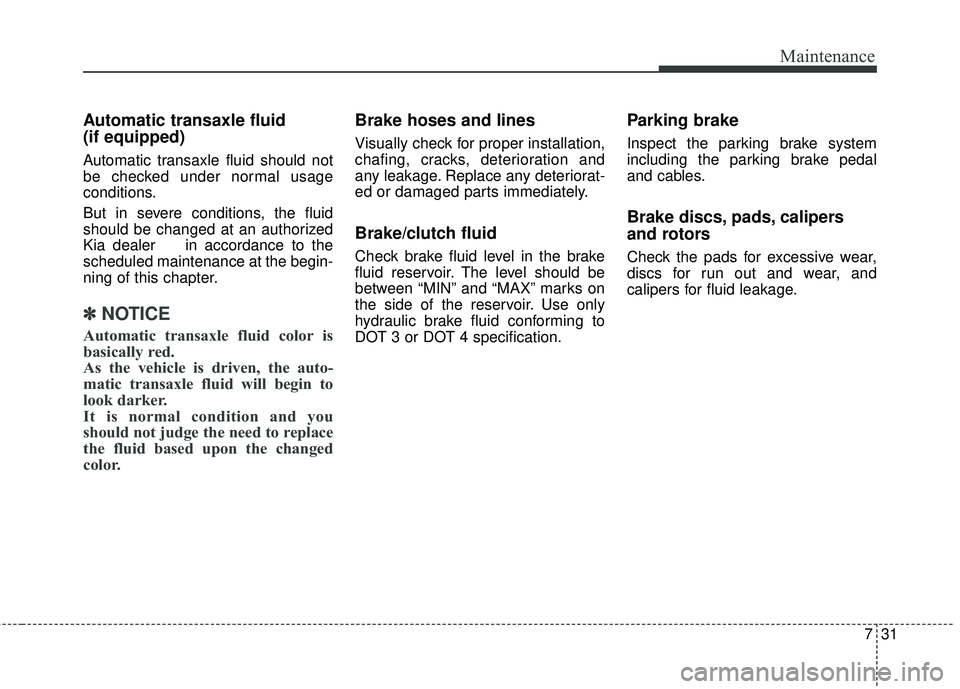
Automatic transaxle fluid
(if equipped)
Automatic transaxle fluid should not
be checked under normal usage
conditions.
But in severe conditions, the fluid
should be changed at an authorized
Kia dealer in accordance to the
scheduled maintenance at the begin-
ning of this chapter.
✽ ✽NOTICE
Automatic transaxle fluid color is
basically red.
As the vehicle is driven, the auto-
matic transaxle fluid will begin to
look darker.
It is normal condition and you
should not judge the need to replace
the fluid based upon the changed
color.
Brake hoses and lines
Visually check for proper installation,
chafing, cracks, deterioration and
any leakage. Replace any deteriorat-
ed or damaged parts immediately.
Brake/clutch fluid
Check brake fluid level in the brake
fluid reservoir. The level should be
between “MIN” and “MAX” marks on
the side of the reservoir. Use only
hydraulic brake fluid conforming to
DOT 3 or DOT 4 specification.
Parking brake
Inspect the parking brake system
including the parking brake pedal
and cables.
Brake discs, pads, calipers
and rotors
Check the pads for excessive wear,
discs for run out and wear, and
calipers for fluid leakage.
Page 494 of 584
Maintenance
32
7
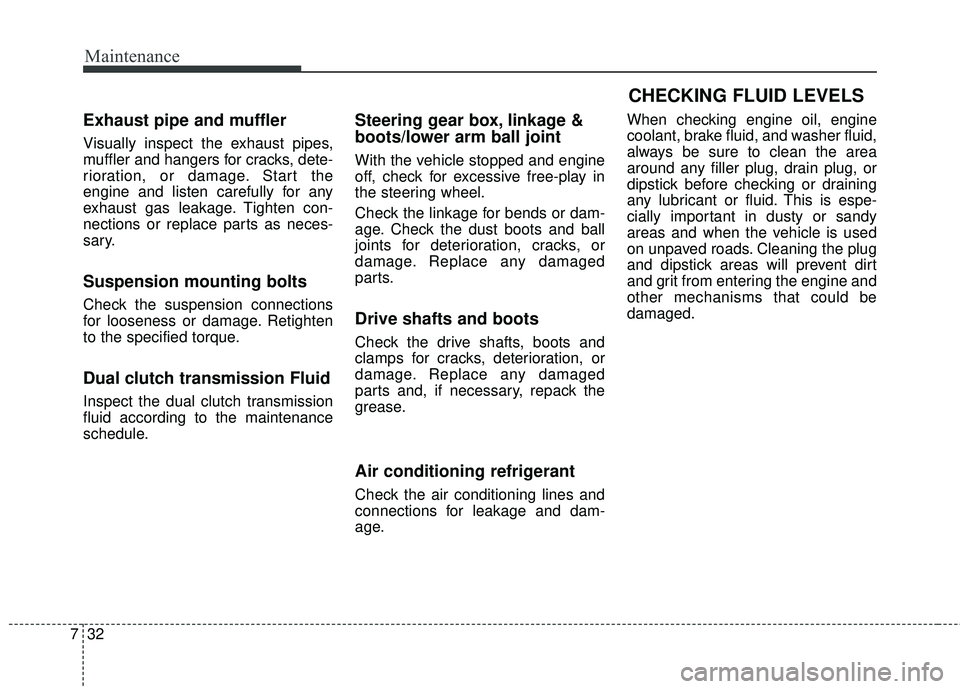
Exhaust pipe and muffler
Visually inspect the exhaust pipes,
muffler and hangers for cracks, dete-
rioration, or damage. Start the
engine and listen carefully for any
exhaust gas leakage. Tighten con-
nections or replace parts as neces-
sary.
Suspension mounting bolts
Check the suspension connections
for looseness or damage. Retighten
to the specified torque.
Dual clutch transmission Fluid
Inspect the dual clutch transmission
fluid according to the maintenance
schedule.
Steering gear box, linkage &
boots/lower arm ball joint
With the vehicle stopped and engine
off, check for excessive free-play in
the steering wheel.
Check the linkage for bends or dam-
age. Check the dust boots and ball
joints for deterioration, cracks, or
damage. Replace any damaged
parts.
Drive shafts and boots
Check the drive shafts, boots and
clamps for cracks, deterioration, or
damage. Replace any damaged
parts and, if necessary, repack the
grease.
Air conditioning refrigerant
Check the air conditioning lines and
connections for leakage and dam-
age. When checking engine oil, engine
coolant, brake fluid, and washer fluid,
always be sure to clean the area
around any filler plug, drain plug, or
dipstick before checking or draining
any lubricant or fluid. This is espe-
cially important in dusty or sandy
areas and when the vehicle is used
on unpaved roads. Cleaning the plug
and dipstick areas will prevent dirt
and grit from entering the engine and
other mechanisms that could be
damaged.
CHECKING FLUID LEVELS
Page 500 of 584
Maintenance
38
7
BRAKE/CLUTCH (IF EQUIPPED) FLUID
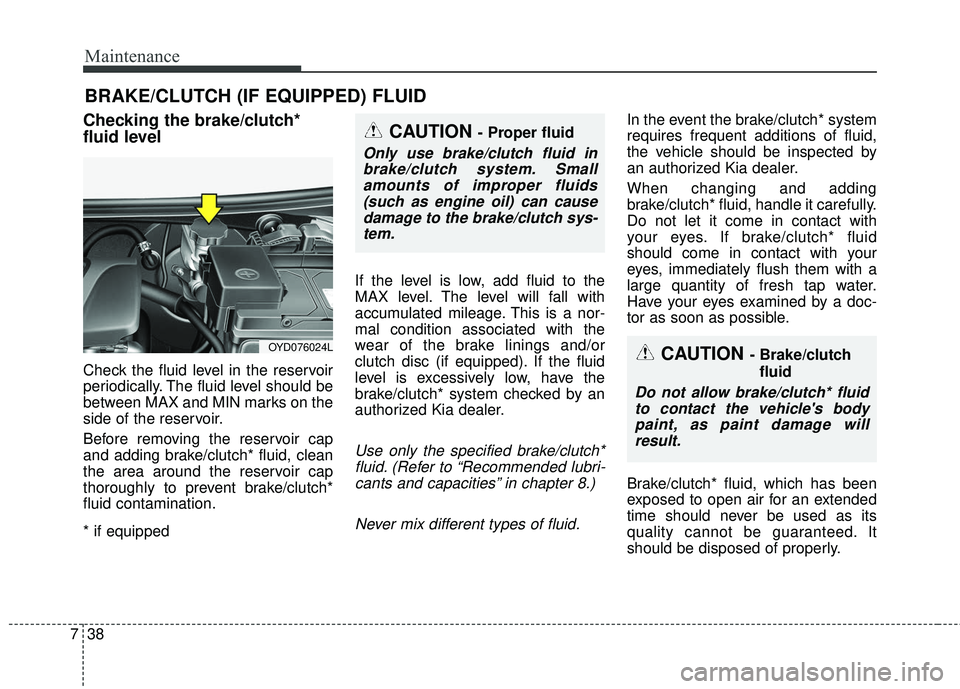
Checking the brake/clutch*
fluid level
Check the fluid level in the reservoir
periodically. The fluid level should be
between MAX and MIN marks on the
side of the reservoir.
Before removing the reservoir cap
and adding brake/clutch* fluid, clean
the area around the reservoir cap
thoroughly to prevent brake/clutch*
fluid contamination.
* if equipped If the level is low, add fluid to the
MAX level. The level will fall with
accumulated mileage. This is a nor-
mal condition associated with the
wear of the brake linings and/or
clutch disc (if equipped). If the fluid
level is excessively low, have the
brake/clutch* system checked by an
authorized Kia dealer.
Use only the specified brake/clutch*
fluid. (Refer to “Recommended lubri-cants and capacities” in chapter 8.)
Never mix different types of fluid.
In the event the brake/clutch* system
requires frequent additions of fluid,
the vehicle should be inspected by
an authorized Kia dealer.
When changing and adding
brake/clutch* fluid, handle it carefully.
Do not let it come in contact with
your eyes. If brake/clutch* fluid
should come in contact with your
eyes, immediately flush them with a
large quantity of fresh tap water.
Have your eyes examined by a doc-
tor as soon as possible.
Brake/clutch* fluid, which has been
exposed to open air for an extended
time should never be used as its
quality cannot be guaranteed. It
should be disposed of properly.
CAUTION - Brake/clutch fluid
Do not allow brake/clutch* fluidto contact the vehicle's bodypaint, as paint damage willresult.
CAUTION - Proper fluid
Only use brake/clutch fluid inbrake/clutch system. Smallamounts of improper fluids(such as engine oil) can causedamage to the brake/clutch sys-tem.
OYD076024L
Page 501 of 584
739
Maintenance
WASHER FLUID
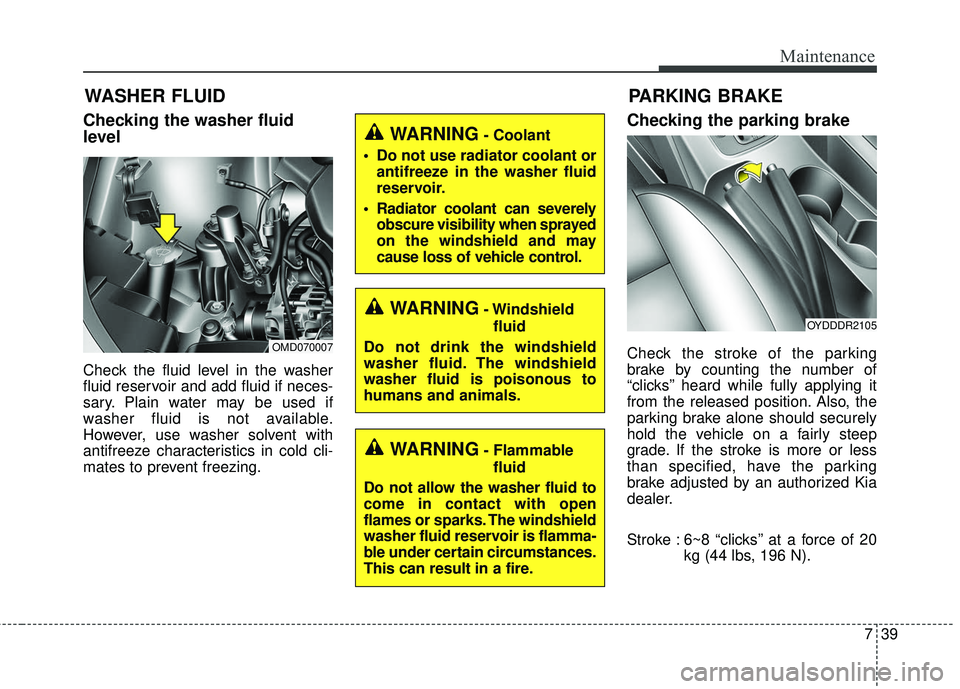
Checking the washer fluid
level
Check the fluid level in the washer
fluid reservoir and add fluid if neces-
sary. Plain water may be used if
washer fluid is not available.
However, use washer solvent with
antifreeze characteristics in cold cli-
mates to prevent freezing.
Checking the parking brake
Check the stroke of the parking
brake by counting the number of
“clicks’’ heard while fully applying it
from the released position. Also, the
parking brake alone should securely
hold the vehicle on a fairly steep
grade. If the stroke is more or less
than specified, have the parking
brake adjusted by an authorized Kia
dealer.
Stroke : 6~8 “clicks’’ at a force of 20kg (44 lbs, 196 N).
WARNING- Windshield
fluid
Do not drink the windshield
washer fluid. The windshield
washer fluid is poisonous to
humans and animals.
WARNING- Coolant
Do not use radiator coolant or antifreeze in the washer fluid
reservoir.
Radiator coolant can severely obscure visibility when sprayed
on the windshield and may
cause loss of vehicle control.
WARNING- Flammable
fluid
Do not allow the washer fluid to
come in contact with open
flames or sparks. The windshield
washer fluid reservoir is flamma-
ble under certain circumstances.
This can result in a fire.
OMD070007
OYDDDR2105
PARKING BRAKE
Page 522 of 584
Maintenance
60
7
Intended Outboard Sidewall: The
side of an asymmetrical tire, that
must always face outward when
mounted on a vehicle.
Kilopascal (kPa): The metric unit for
air pressure.
Light truck (LT) tire: A tire designat-
ed by its manufacturer as primarily
intended for use on lightweight trucks
or multipurpose passenger vehicles.
Load ratings: The maximum load
that a tire is rated to carry for a given
inflation pressure.
Load Index: An assigned number
ranging from 1 to 279 that corre-
sponds to the load carrying capacity
of a tire.
Maximum Inflation Pressure: The
maximum air pressure to which a
cold tire may be inflated. The maxi-
mum air pressure is molded onto the
sidewall.
Maximum Load Rating: The load
rating for a tire at the maximum per-
missible inflation pressure for that tire. Maximum Loaded Vehicle Weight:
The sum of curb weight; accessory
weight; vehicle capacity weight; and
production options weight.
Normal Occupant Weight:
The
number of occupants a vehicle is
designed to seat multiplied by 68 kg
(150 pounds).
Occupant Distribution: Designated
seating positions.
Outward Facing Sidewall: The side
of a asymmetrical tire that has a par-
ticular side that faces outward when
mounted on a vehicle. The outward
facing sidewall bears white lettering
or bears manufacturer, brand, and/or
model name molding that is higher or
deeper than the same moldings on
the inner facing sidewall.
Passenger (P-Metric) Tire: A tire
used on passenger cars and some
light duty trucks and multipurpose
vehicles.
Ply: A layer of rubber-coated parallel
cords. Pneumatic tire:
A mechanical
device made of rubber, chemicals,
fabric and steel or other materials,
that, when mounted on an automo-
tive wheel, provides the traction and
contains the gas or fluid that sustains
the load.
Production options weight: The
combined weight of installed regular
production options weighing over 2.3
kg (5 lb.) in excess of the standard
items which they replace, not previ-
ously considered in curb weight or
accessory weight, including heavy
duty brakes, ride levelers, roof rack,
heavy duty battery, and special trim.
Recommended Inflation Pressure:
Vehicle manufacturer's recommend-
ed tire inflation pressure and shown
on the tire placard.
Radial Ply Tire: A pneumatic tire in
which the ply cords that extend to the
beads are laid at 90 degrees to the
centerline of the tread.
Rim: A metal support for a tire and
upon which the tire beads are seated.
Page 557 of 584
795
Maintenance
Finish damage repair
Deep scratches or stone chips in the
painted surface must be repaired
promptly. Exposed metal will quickly
rust and may develop into a major
repair expense.
✽ ✽NOTICE
If your vehicle is damaged and
requires any metal repair or
replacement, be sure the body shop
applies anti-corrosion materials to
the parts repaired or replaced.
Bright-metal maintenance
To remove road tar and insects,
use a tar remover, not a scraper or
other sharp object.
To protect the surfaces of bright- metal parts from corrosion, apply a
coating of wax or chrome preser-
vative and rub to a high luster.
During winter weather or in coastal areas, cover the bright metal parts
with a heavier coating of wax or
preservative. If necessary, coat the
parts with non-corrosive petroleum
jelly or other protective compound.
Underbody maintenance
Road salt and other corrosive chemi-
cals are used in cold weather states to
melt snow and prevent ice accumula-
tion. If these chemicals are not regu-
larly removed, they will corrode the
vehicle underbody and over time dam-
age fuel lines, the fuel tank retention
system, the vehicle suspension, the
exhaust system, and even the body
frame. The National Highway Traffic
Safety Administration has warned all
vehicle owners of all brands of the
need to take the following steps:
Wash the undercarriage of yourvehicle regularly during the winter
and whenever your vehicle has
been exposed to such salts or
chemicals.
Do a thorough washing of the undercarriage at the end of the
winter.
Use professional service techni- cians or governmental inspection
stations to annually inspect for cor-
rosion. Immediately seek an inspection of
your vehicle if you become visually
aware of corrosion flaking or scal-
ing or if you become aware of a
change in vehicle performance,
such as soft or spongey brakes,
fluids leaking, impairment of direc-
tional control, suspension noises
or rattling metal straps.
Aluminum wheel maintenance
The aluminum wheels are coated with
a clear protective finish.
Do not use any abrasive cleaner, pol-ishing compound, solvent, or wire
brushes on aluminum wheels. They
may scratch or damage the finish.
Clean the wheel when it has cooled.
Use only a mild soap or neutral deter- gent, and rinse thoroughly with water.
Also, be sure to clean the wheels
after driving on salted roads. This
helps prevent corrosion.
Avoid washing the wheels with high- speed car wash brushes.
Do not use any alkaline or acid deter- gent. It may damage and corrode the
aluminum wheels coated with a clear
protective finish.
Page 572 of 584
88
Specifications & Consumer information
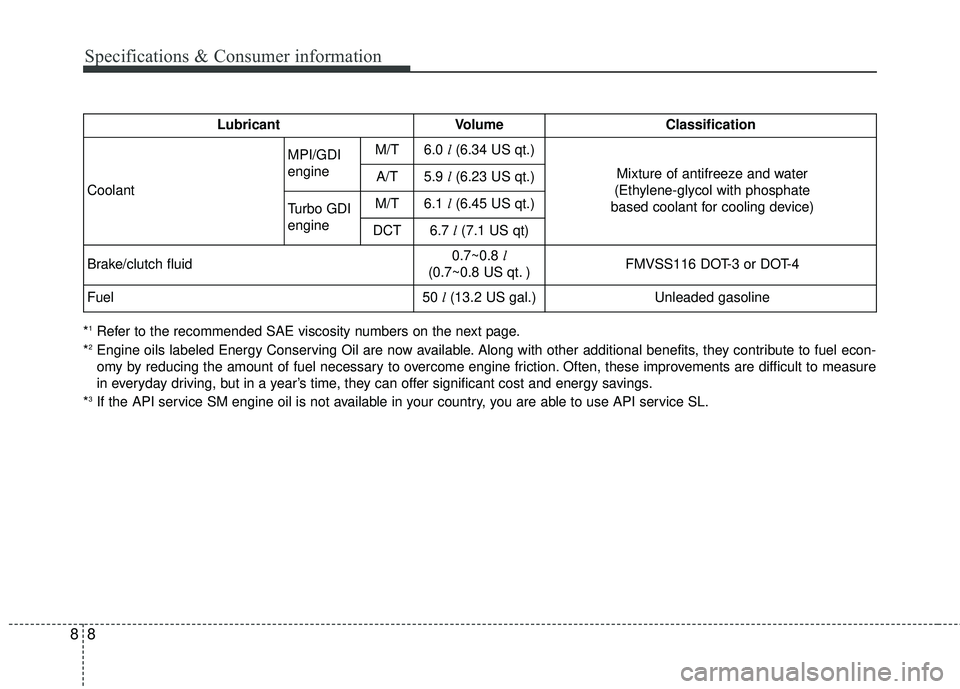
*1Refer to the recommended SAE viscosity numbers on the next page.
*2Engine oils labeled Energy Conserving Oil are now available. Along with other additional benefits, they contribute to fuel econ-
omy by reducing the amount of fuel necessary to overcome engine friction. Often, these improvements are difficult to measure
in everyday driving, but in a year’s time, they can offer significant cost and energy savings.
*
3If the API service SM engine oil is not available in your country, you are able to use API service SL.
LubricantVolumeClassification
Coolant
MPI/GDI
engineM/T6.0 l(6.34 US qt.)
Mixture of antifreeze and water
(Ethylene-glycol with phosphate
based coolant for cooling device)A/T5.9 l(6.23 US qt.)
Turbo GDI
engineM/T6.1 l(6.45 US qt.)
DCT6.7 l(7.1 US qt)
Brake/clutch fluid0.7~0.8 l
(0.7~0.8 US qt. )FMVSS116 DOT-3 or DOT-4
Fuel50 l(13.2 US gal.)Unleaded gasoline
Page 578 of 584
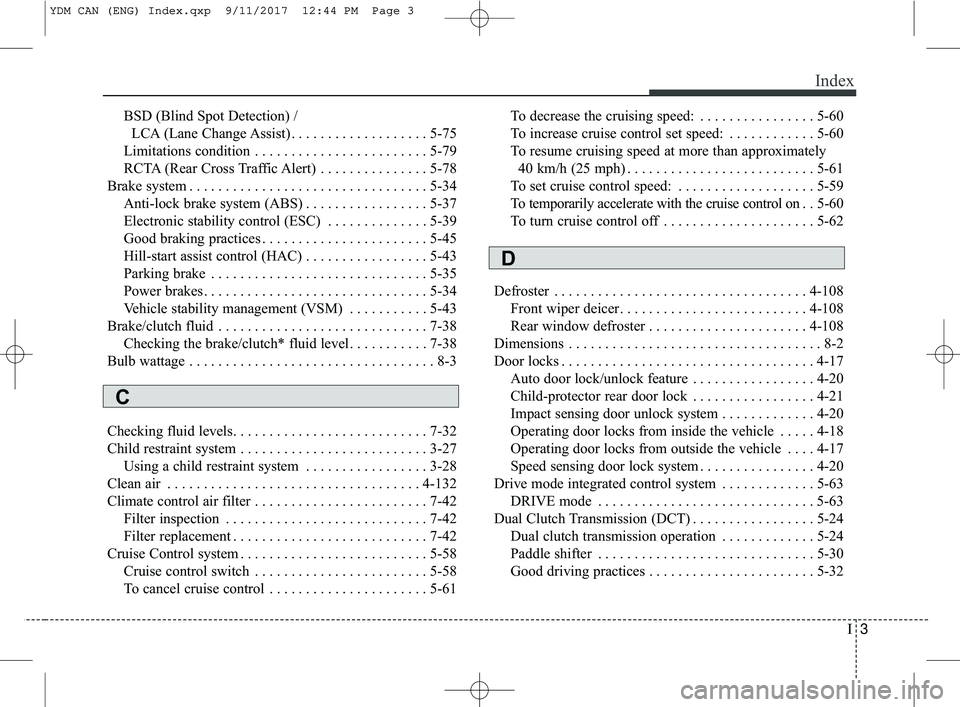
I3
Index
BSD (Blind Spot Detection) /LCA (Lane Change Assist) . . . . . . . . . . . . . . . . . . . 5-75
Limitations condition . . . . . . . . . . . . . . . . . . . . . . . . 5-79
RCTA (Rear Cross Traffic Alert) . . . . . . . . . . . . . . . 5-78
Brake system . . . . . . . . . . . . . . . . . . . . . . . . . . . . . . . . . 5-34 Anti-lock brake system (ABS) . . . . . . . . . . . . . . . . . 5-37
Electronic stability control (ESC) . . . . . . . . . . . . . . 5-39
Good braking practices . . . . . . . . . . . . . . . . . . . . . . . 5-45
Hill-start assist control (HAC) . . . . . . . . . . . . . . . . . 5-43
Parking brake . . . . . . . . . . . . . . . . . . . . . . . . . . . . . . 5-35
Power brakes. . . . . . . . . . . . . . . . . . . . . . . . . . . . . . . 5-34
Vehicle stability management (VSM) . . . . . . . . . . . 5-43
Brake/clutch fluid . . . . . . . . . . . . . . . . . . . . . . . . . . . . . 7-38 Checking the brake/clutch* fluid level . . . . . . . . . . . 7-38
Bulb wattage . . . . . . . . . . . . . . . . . . . . . . . . . . . . . . . . . . 8-3
Checking fluid levels. . . . . . . . . . . . . . . . . . . . . . . . . . . 7-32
Child restraint system . . . . . . . . . . . . . . . . . . . . . . . . . . 3-27 Using a child restraint system . . . . . . . . . . . . . . . . . 3-28
Clean air . . . . . . . . . . . . . . . . . . . . . . . . . . . . . . . . . . . 4-\
132
Climate control air filter . . . . . . . . . . . . . . . . . . . . . . . . 7-42 Filter inspection . . . . . . . . . . . . . . . . . . . . . . . . . . . . 7-42
Filter replacement . . . . . . . . . . . . . . . . . . . . . . . . . . . 7-42
Cruise Control system . . . . . . . . . . . . . . . . . . . . . . . . . . 5-58 Cruise control switch . . . . . . . . . . . . . . . . . . . . . . . . 5-58
To cancel cruise control . . . . . . . . . . . . . . . . . . . . . . 5-61 To decrease the cruising speed: . . . . . . . . . . . . . . . . 5-60
To increase cruise control set speed: . . . . . . . . . . . . 5-60
To resume cruising speed at more than approximately 40 km/h (25 mph) . . . . . . . . . . . . . . . . . . . . . . . . . . 5-61
To set cruise control speed: . . . . . . . . . . . . . . . . . . . 5-59
To temporarily accelerate with the cruise control on . . 5-60
To turn cruise control off . . . . . . . . . . . . . . . . . . . . . 5-62
Defroster . . . . . . . . . . . . . . . . . . . . . . . . . . . . . . . . . . . 4-\
108 Front wiper deicer. . . . . . . . . . . . . . . . . . . . . . . . . . 4-108
Rear window defroster . . . . . . . . . . . . . . . . . . . . . . 4-108
Dimensions . . . . . . . . . . . . . . . . . . . . . . . . . . . . . . . . . . . 8-\
2
Door locks . . . . . . . . . . . . . . . . . . . . . . . . . . . . . . . . . . . 4-\
17 Auto door lock/unlock feature . . . . . . . . . . . . . . . . . 4-20
Child-protector rear door lock . . . . . . . . . . . . . . . . . 4-21
Impact sensing door unlock system . . . . . . . . . . . . . 4-20
Operating door locks from inside the vehicle . . . . . 4-18
Operating door locks from outside the vehicle . . . . 4-17
Speed sensing door lock system . . . . . . . . . . . . . . . . 4-20
Drive mode integrated control system . . . . . . . . . . . . . 5-63 DRIVE mode . . . . . . . . . . . . . . . . . . . . . . . . . . . . . . 5-63
Dual Clutch Transmission (DCT) . . . . . . . . . . . . . . . . . 5-24 Dual clutch transmission operation . . . . . . . . . . . . . 5-24
Paddle shifter . . . . . . . . . . . . . . . . . . . . . . . . . . . . . . 5-30
Good driving practices . . . . . . . . . . . . . . . . . . . . . . . 5-32
C
D
YDM CAN (ENG) Index.qxp 9/11/2017 12:44 PM Page 3
Page 584 of 584
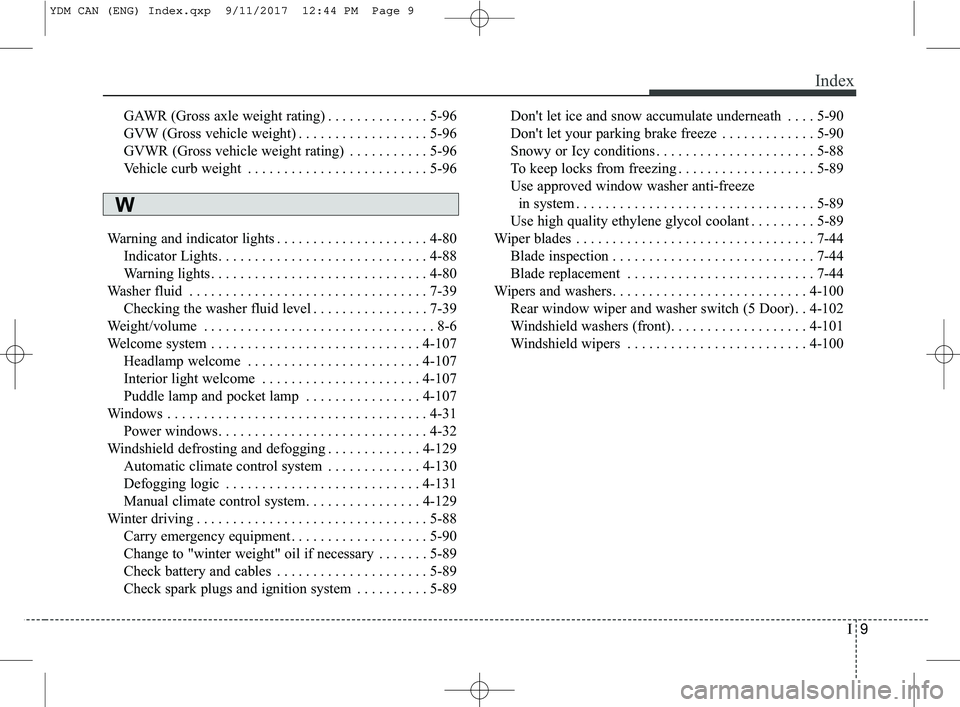
I9
Index
GAWR (Gross axle weight rating) . . . . . . . . . . . . . . 5-96
GVW (Gross vehicle weight) . . . . . . . . . . . . . . . . . . 5-96
GVWR (Gross vehicle weight rating) . . . . . . . . . . . 5-96
Vehicle curb weight . . . . . . . . . . . . . . . . . . . . . . . . . 5-96
Warning and indicator lights . . . . . . . . . . . . . . . . . . . . . 4-80 Indicator Lights. . . . . . . . . . . . . . . . . . . . . . . . . . . . . 4-88
Warning lights . . . . . . . . . . . . . . . . . . . . . . . . . . . . . . 4-80
Washer fluid . . . . . . . . . . . . . . . . . . . . . . . . . . . . . . . . . 7-39 Checking the washer fluid level . . . . . . . . . . . . . . . . 7-39
Weight/volume . . . . . . . . . . . . . . . . . . . . . . . . . . . . . . . . 8-6
Welcome system . . . . . . . . . . . . . . . . . . . . . . . . . . . . . 4-107 Headlamp welcome . . . . . . . . . . . . . . . . . . . . . . . . 4-107
Interior light welcome . . . . . . . . . . . . . . . . . . . . . . 4-107
Puddle lamp and pocket lamp . . . . . . . . . . . . . . . . 4-107
Windows . . . . . . . . . . . . . . . . . . . . . . . . . . . . . . . . . . . . \
4-31 Power windows. . . . . . . . . . . . . . . . . . . . . . . . . . . . . 4-32
Windshield defrosting and defogging . . . . . . . . . . . . . 4-129 Automatic climate control system . . . . . . . . . . . . . 4-130
Defogging logic . . . . . . . . . . . . . . . . . . . . . . . . . . . 4-131
Manual climate control system . . . . . . . . . . . . . . . . 4-129
Winter driving . . . . . . . . . . . . . . . . . . . . . . . . . . . . . . . . 5-88 Carry emergency equipment . . . . . . . . . . . . . . . . . . . 5-90
Change to "winter weight" oil if necessary . . . . . . . 5-89
Check battery and cables . . . . . . . . . . . . . . . . . . . . . 5-89
Check spark plugs and ignition system . . . . . . . . . . 5-89 Don't let ice and snow accumulate underneath . . . . 5-90
Don't let your parking brake freeze . . . . . . . . . . . . . 5-90
Snowy or Icy conditions . . . . . . . . . . . . . . . . . . . . . . 5-88
To keep locks from freezing . . . . . . . . . . . . . . . . . . . 5-89
Use approved window washer anti-freeze in system . . . . . . . . . . . . . . . . . . . . . . . . . . . . . . . . . 5-89
Use high quality ethylene glycol coolant . . . . . . . . . 5-89
Wiper blades . . . . . . . . . . . . . . . . . . . . . . . . . . . . . . . . . 7-44 Blade inspection . . . . . . . . . . . . . . . . . . . . . . . . . . . . 7-44
Blade replacement . . . . . . . . . . . . . . . . . . . . . . . . . . 7-44
Wipers and washers . . . . . . . . . . . . . . . . . . . . . . . . . . . 4-100 Rear window wiper and washer switch (5 Door) . . 4-102
Windshield washers (front). . . . . . . . . . . . . . . . . . . 4-101
Windshield wipers . . . . . . . . . . . . . . . . . . . . . . . . . 4-100
W
YDM CAN (ENG) Index.qxp 9/11/2017 12:44 PM Page 9