Eco KIA K900 2017 Owners Manual
[x] Cancel search | Manufacturer: KIA, Model Year: 2017, Model line: K900, Model: KIA K900 2017Pages: 542, PDF Size: 14.89 MB
Page 367 of 542
5-104
Driving your vehicle
Carry emergency equipment
Depending on the severity of the
weather you should carry appropri-
ate emergency equipment. Some of
the items you may want to carry
include tire chains, tow straps or
chains, flashlight, emergency flares,
sand, a shovel, jumper cables, a win-
dow scraper, gloves, ground cloth,
coveralls, a blanket, etc.We do not recommend using this
vehicle for trailer towing.
TRAILER TOWING
KH USA 5:2016 12/1/2016 10:57 PM Page 104
Page 368 of 542
Driving your vehicle
5
5-105
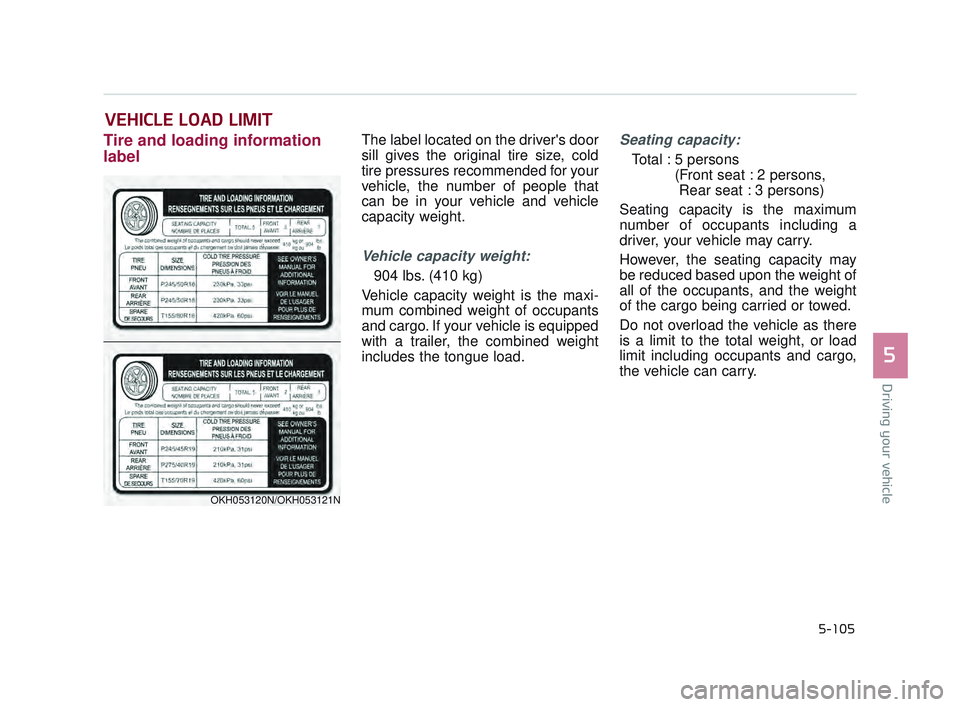
Tire and loading information
labelThe label located on the driver's door
sill gives the original tire size, cold
tire pressures recommended for your
vehicle, the number of people that
can be in your vehicle and vehicle
capacity weight.
Vehicle capacity weight:
904 lbs. (410 kg)
Vehicle capacity weight is the maxi-
mum combined weight of occupants
and cargo. If your vehicle is equipped
with a trailer, the combined weight
includes the tongue load.
Seating capacity:
Total : 5 persons (Front seat : 2 persons, Rear seat : 3 persons)
Seating capacity is the maximum
number of occupants including a
driver, your vehicle may carry.
However, the seating capacity may
be reduced based upon the weight of
all of the occupants, and the weight
of the cargo being carried or towed.
Do not overload the vehicle as there
is a limit to the total weight, or load
limit including occupants and cargo,
the vehicle can carry.
VEHICLE LOAD LIMIT
OKH053120N/OKH053121N
KH USA 5:2016 12/1/2016 10:57 PM Page 105
Page 369 of 542
5-106
Driving your vehicle
Towing capacity:
We do not recommend using this
vehicle for trailer towing.
Cargo capacity:
The cargo capacity of your vehicle
will increase or decrease depending
on the weight and the number of
occupants and the tongue load, if
your vehicle is equipped with a trailer.
Steps For Determining CorrectLoad Limit -
1.Locate the statement "The com- bined weight of occupants and
cargo should never exceed XXX kg
or XXX lbs.'' on your vehicle's plac-
ard.
2.Determine the combined weight of the driver and passengers that will
be riding in your vehicle.
3.Subtract the combined weight of the driver and passengers from
XXX kg or XXX lbs.
4.The resulting figure equals the available amount of cargo and lug-
gage load capacity. For example, if
the "XXX" amount equals 1400 lbs.
and there will be five 150 lbs. pas-
sengers in your vehicle, the
amount of available cargo and lug-
gage load capacity is 650 lbs.
(1400-750 (5 x 150) = 650 lbs.) 5.Determine the combined weight of
luggage and cargo being loaded
on the vehicle. That weight may not
safely exceed the available cargo
and luggage load capacity calcu-
lated in Step 4.
6.If your vehicle will be towing a trail- er, load from your trailer will be
transferred to your vehicle. Consult
this manual to determine how this
reduces the available cargo and
luggage load capacity of your vehi-
cle.
KH USA 5:2016 12/1/2016 10:57 PM Page 106
Page 377 of 542
IF THE ENGINE WILL NOT START
If engine doesn't turn over or
turns over slowly
1.Be sure the shift lever is in N(Neutral) or P (Park) and the emer-
gency brake is set.
2.Check the battery connections to be sure they are clean and tight.
3.Turn on the interior light. If the light dims or goes out when you operate
the starter, the battery is dis-
charged.
4.Check the starter connections to be sure they are securely tight-
ened.
5.Do not push or pull the vehicle to start it. See instructions for "Jump
starting".
If engine turns over normally
but does not start
1.Check fuel level.
2.With the Engine Start/Stop Buttonin the OFF position, check all con-
nectors at ignition coils and spark
plugs. Reconnect any that may be
disconnected or loose.
3.If the engine still does not start, call an authorized K900 Kia dealer or
Kia Roadside Assistance.
6-4
What to do in an emergency
Push/Pull start
Do not push or pull the vehicle
to start it. Push or pull starting
may cause the catalytic con-
verter to overload and create a
fire hazard.
WARNING
KH USA 6:2016 12/1/2016 11:08 PM Page 4
Page 378 of 542
EMERGENCY STARTING
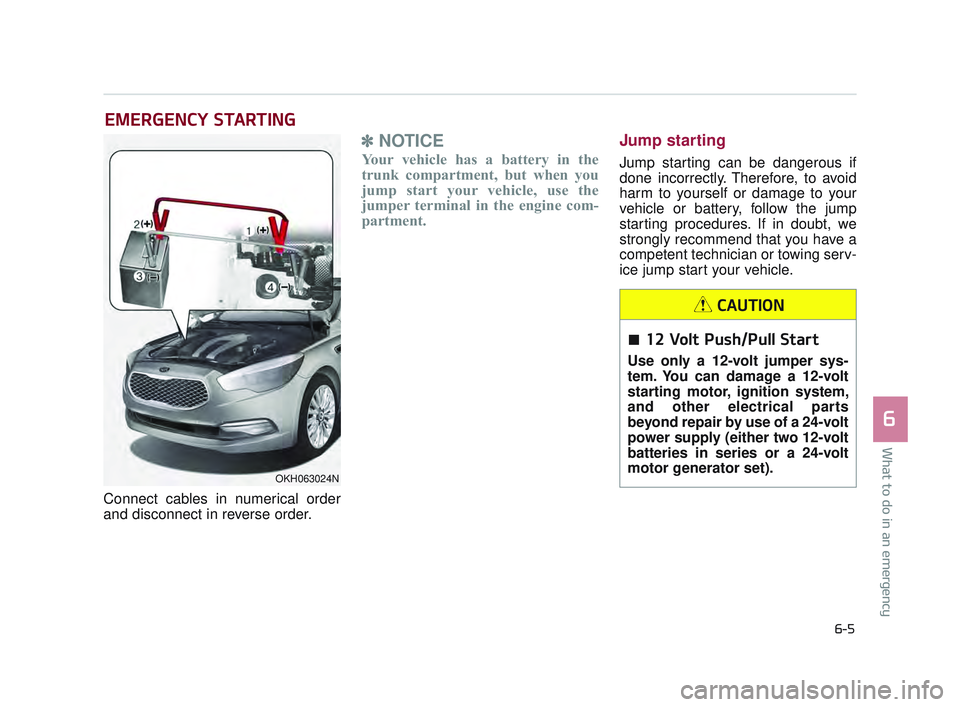
Connect cables in numerical order
and disconnect in reverse order.
✽ NOTICE
Your vehicle has a battery in the
trunk compartment, but when you
jump start your vehicle, use the
jumper terminal in the engine com-
partment.
Jump starting
Jump starting can be dangerous if
done incorrectly. Therefore, to avoid
harm to yourself or damage to your
vehicle or battery, follow the jump
starting procedures. If in doubt, we
strongly recommend that you have a
competent technician or towing serv-
ice jump start your vehicle.
What to do in an emergency
6
6-5
OKH063024N
12 Volt Push/Pull Start
Use only a 12-volt jumper sys-
tem. You can damage a 12-volt
starting motor, ignition system,
and other electrical parts
beyond repair by use of a 24-volt
power supply (either two 12-volt
batteries in series or a 24-volt
motor generator set).
CAUTION
KH USA 6:2016 12/1/2016 11:08 PM Page 5
Page 384 of 542
What to do in an emergency
6
6-11
TIRE PRESSURE MONITORING SYSTEM (TPMS)
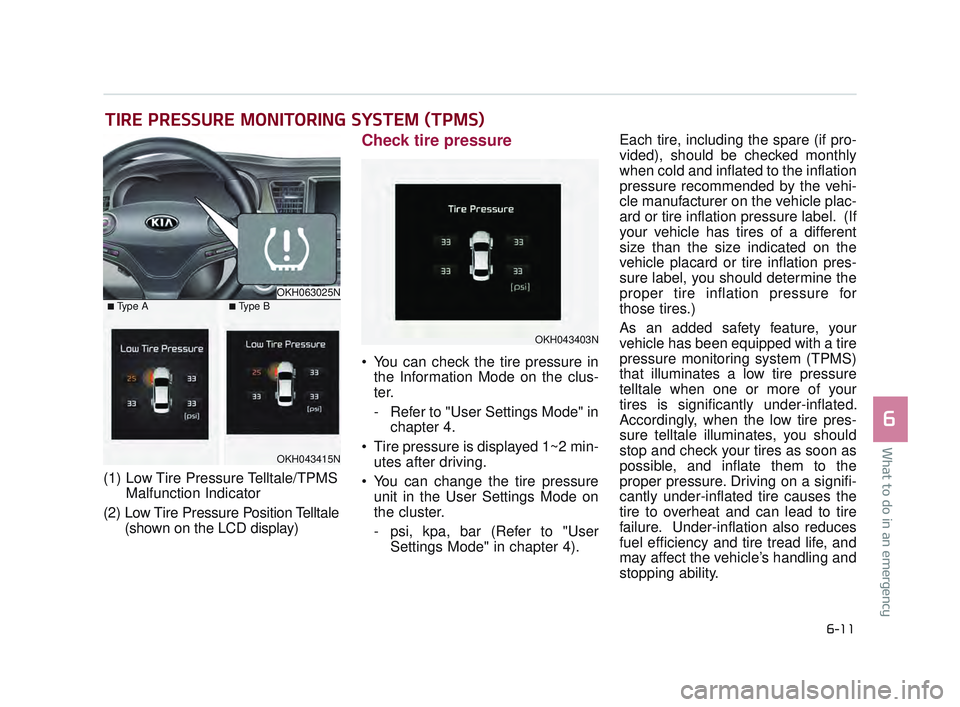
(1) Low Tire Pressure Telltale/TPMSMalfunction Indicator
(2) Low Tire Pressure Position Telltale (shown on the LCD display)
Check tire pressure
You can check the tire pressure inthe Information Mode on the clus-
ter.
- Refer to "User Settings Mode" in chapter 4.
Tire pressure is displayed 1~2 min- utes after driving.
You can change the tire pressure unit in the User Settings Mode on
the cluster.
- psi, kpa, bar (Refer to "User Settings Mode" in chapter 4). Each tire, including the spare (if pro-
vided), should be checked monthly
when cold and inflated to the inflation
pressure recommended by the vehi-
cle manufacturer on the vehicle plac-
ard or tire inflation pressure label. (If
your vehicle has tires of a different
size than the size indicated on the
vehicle placard or tire inflation pres-
sure label, you should determine the
proper tire inflation pressure for
those tires.)
As an added safety feature, your
vehicle has been equipped with a tire
pressure monitoring system (TPMS)
that illuminates a low tire pressure
telltale when one or more of your
tires is significantly under-inflated.
Accordingly, when the low tire pres-
sure telltale illuminates, you should
stop and check your tires as soon as
possible, and inflate them to the
proper pressure. Driving on a signifi-
cantly under-inflated tire causes the
tire to overheat and can lead to tire
failure. Under-inflation also reduces
fuel efficiency and tire tread life, and
may affect the vehicle’s handling and
stopping ability.
OKH063025N
OKH043415N
■Type A■Type B
OKH043403N
KH USA 6:2016 12/1/2016 11:08 PM Page 11
Page 385 of 542

Please note that the TPMS is not a
substitute for proper tire maintenance,
and it is the driver’s responsibility to
maintain correct tire pressure, even if
under-inflation has not reached the
level to trigger illumination of the
TPMS low tire pressure telltale.Your vehicle has also been equipped
with a TPMS malfunction indicator to
indicate when the system is not oper-
ating properly. The TPMS malfunction
indicator is combined with the low tire
pressure telltale. When the system
detects a malfunction, the telltale will
flash for approximately one minute
and then remain continuously illumi-
nated. This sequence will continue
upon subsequent vehicle start-ups as
long as the malfunction exists.
When the malfunction indicator is illu-
minated, the system may not be able
to detect or signal low tire pressure
as intended. TPMS malfunctions may
occur for a variety of reasons, includ-
ing the installation of replacement or
alternate tires or wheels on the vehi-
cle that prevent the TPMS from func-
tioning properly. Always check the TPMS malfunction
telltale after replacing one or more
tires or wheels on your vehicle to
ensure that the replacement or alter-
nate tires and wheels allow the TPMS
to continue to function properly.
✽
NOTICE
If any of the below happens, have
the system be checked by an author-
ized K900 Kia dealer.
1.The low tire pressure telltale/
TPMS malfunction indicator does
not illuminate for 3 seconds when
the Engine Start/Stop button is
turned to the ON or engine is run-
ning.
2. The TPMS malfunction indicator remains illuminated after blinking
for approximately 1 minute.
3. The Low tire pressure position telltale remains illuminated.
6-12
What to do in an emergency
KH USA 6:2016 12/1/2016 11:08 PM Page 12
Page 386 of 542

What to do in an emergency
6
6-13
Low tire pressure telltale
Low tire pressure position tell-
tale
When the tire pressure monitoring
system warning indicators are illumi-
nated and warning message dis-
played on the cluster LCD display,
one or more of your tires is signifi-
cantly under-inflated. The low tire
pressure position telltale light will
indicate which tire is significantly
under-inflated by illuminating the cor-
responding position light.If either telltale illuminates, immedi-
ately reduce your speed, avoid hard
cornering and anticipate increased
stopping distances. You should stop
and check your tires as soon as pos-
sible. Inflate the tires to the proper
pressure as indicated on the vehi-
cle’s placard or tire inflation pressure
label located on the driver’s side cen-
ter pillar outer panel.
If you cannot reach a service station
or if the tire cannot hold the newly
added air, replace the low pressure
tire with the spare tire.
If you drive the vehicle for about 20
minutes at speeds above 15 mph (25
km/h) after replacing the low pres-
sure tire with the spare tire, the
below will happen:
The TPMS malfunction indicator
may blink for approximately 1 minute
and then remain continuously illumi-
nated because the TPMS sensor is
not mounted on the spare wheel.
✽ NOTICE
The spare tire is not equipped with a
tire pressure sensor.
In winter or cold weather, the low
tire pressure telltale may be illumi-
nated if the tire pressure was
adjusted to the recommended tire
inflation pressure in warm weather.
It does not mean your TPMS is
malfunctioning because the
decreased temperature leads to a
proportional lowering of tire pres-
sure.
When you drive your vehicle from a warm area to a cold area or from a
cold area to a warm area, or the
outside temperature is greatly
higher or lower, you should check
the tire inflation pressure and
adjust the tires to the recommend-
ed tire inflation pressure.
The tire pressure may vary depending on various factors
including the temperature condi-
tions of parking area, driving condi-
tions and ambient temperature,
altitude above sea level.
OKH043415N
■Type A■Type B
KH USA 6:2016 12/1/2016 11:08 PM Page 13
Page 388 of 542

What to do in an emergency
6
6-15
Changing a tire with TPMS
If you have a flat tire, the Low Tire
Pressure and Position telltales will
come on. Have the flat tire repaired
by an authorized K900 Kia dealer as
soon as possible or replace the flat
tire with the spare tire.Each wheel is equipped with a tire
pressure sensor mounted inside the
tire behind the valve stem. You must
use TPMS specific wheels. It is rec-
ommended that you always have
your tires serviced by an authorized
K900 Kia dealer.
If you drive the vehicle for about 20
minutes at speeds above 15 mph (25
km/h) after replacing the low pres-
sure tire with the spare tire, the
below will happen:
The TPMS malfunction indicator
may blink for approximately 1
minute and then remain continu-
ously illuminated because the
TPMS sensor is not mounted on
the spare wheel. You may not be able to identify a tire
with low pressure by simply looking
at it. Always use a good quality tire
pressure gauge to measure. Please
note that a tire that is hot (from being
driven) will have a higher pressure
measurement than a tire that is cold.
A cold tire means the vehicle has
been sitting for 3 hours and driven for
less than 1 mile (1.6 km) in that 3 hour
period.
Allow the tire to cool before measur-
ing the inflation pressure. Always be
sure the tire is cold before inflating to
the recommended pressure.
Repair Agents
Never use a puncture-repairing
agent not approved by K900 Kia
dealer to repair and/or inflate a
low pressure tire. Tire sealant
not approved by K900 Kia deal-
er may damage the tire pres-
sure sensor.
CAUTION
KH USA 6:2016 12/1/2016 11:08 PM Page 15
Page 393 of 542
6-20
What to do in an emergency
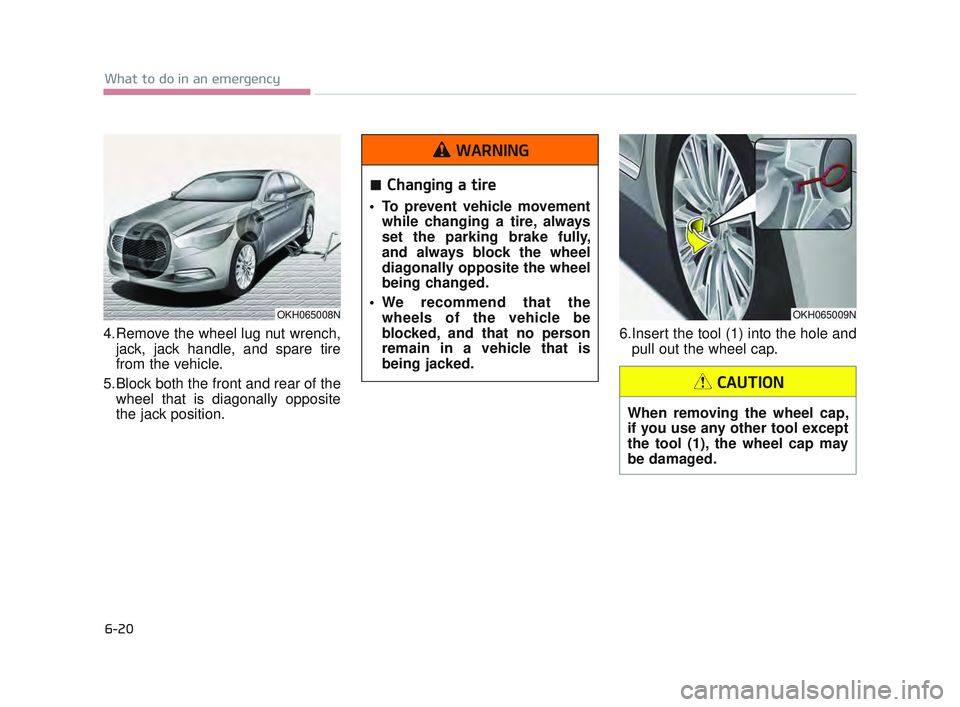
4.Remove the wheel lug nut wrench,jack, jack handle, and spare tire
from the vehicle.
5.Block both the front and rear of the wheel that is diagonally opposite
the jack position. 6.Insert the tool (1) into the hole and
pull out the wheel cap.
OKH065008NOKH065009N
Changing a tire
To prevent vehicle movementwhile changing a tire, always
set the parking brake fully,
and always block the wheel
diagonally opposite the wheel
being changed.
We recommend that the wheels of the vehicle be
blocked, and that no person
remain in a vehicle that is
being jacked.
WARNING
When removing the wheel cap,
if you use any other tool except
the tool (1), the wheel cap may
be damaged.
CAUTION
KH USA 6:2016 12/1/2016 11:08 PM Page 20