viscosity KIA K900 2017 Owners Manual
[x] Cancel search | Manufacturer: KIA, Model Year: 2017, Model line: K900, Model: KIA K900 2017Pages: 542, PDF Size: 14.89 MB
Page 125 of 542
Features of your vehicle
4
4-45
STEERING WHEEL
Electronic Hydraulic Power
Steering (EHPS)
This system uses an electromotor to
assist you with steering the vehicle.
If the engine is turned off or if the
EHPS becomes inoperative, you
may still steer the vehicle, but it will
require increased steering effort.
Should you notice any change in the
effort required to steer during normal
vehicle operation, have the EHPS
checked by an authorized K900 Kia
dealer.
✽NOTICE
If the EHPS motor pump malfunc-
tions, the steering effort will greatly
increase.
✽NOTICE
If the vehicle is parked for extended
periods outside in cold weather
(below 14°F/-10°C), the power steer-
ing may require increased effort
when the engine is first started. This
is caused by increased fluid viscosity
due to the cold weather and does not
indicate a malfunction.
When this happens, increase the
engine RPM by depressing accelera-
tor until the RPM reaches 1,500 rpm
then release or let the engine idle for
two or three minutes to warm up the
fluid.
Tilt Steering/Telescope Steering
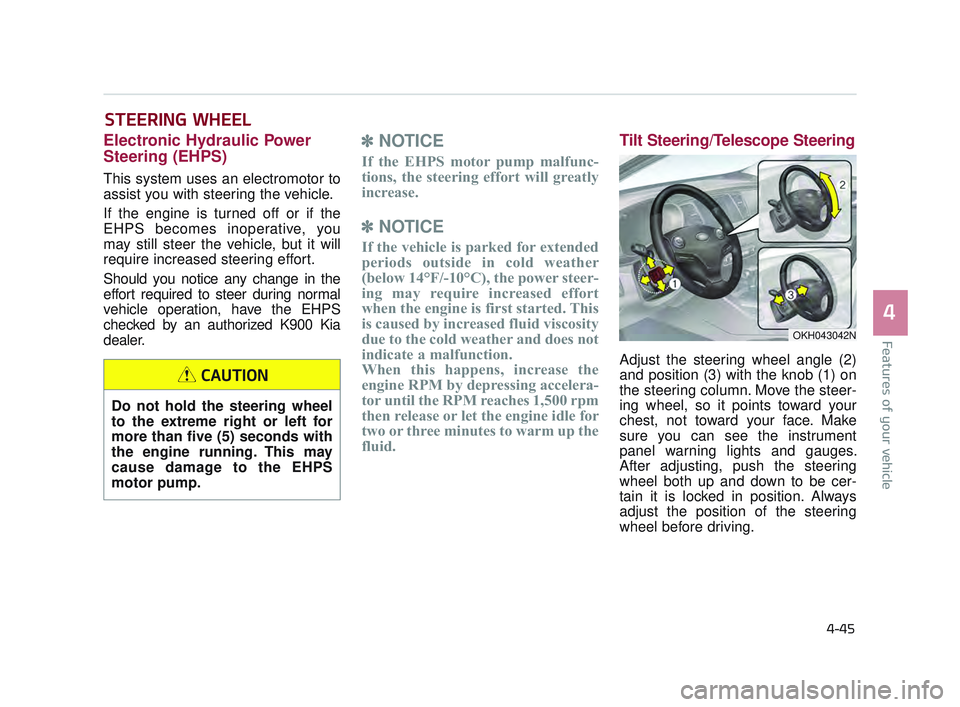
Adjust the steering wheel angle (2)
and position (3) with the knob (1) on
the steering column. Move the steer-
ing wheel, so it points toward your
chest, not toward your face. Make
sure you can see the instrument
panel warning lights and gauges.
After adjusting, push the steering
wheel both up and down to be cer-
tain it is locked in position. Always
adjust the position of the steering
wheel before driving.
Do not hold the steering wheel
to the extreme right or left for
more than five (5) seconds with
the engine running. This may
cause damage to the EHPS
motor pump.
CAUTION
OKH043042N
KH USA 4:2015 12/2/2016 10:24 AM Page 45
Page 366 of 542
Driving your vehicle
5
5-103
Change to "winter weight" oil
if necessary
In some climates it is recommended
that a lower viscosity "winter weight"
oil be used during cold weather. See
section 8 for recommendations. If
you aren't sure what weight oil you
should use, consult an authorized
K900 Kia dealer.
Check spark plugs and igni-
tion system
Inspect your spark plugs as
described in section 7 and replace
them if necessary. Also check all
ignition wiring and components to be
sure they are not cracked, worn or
damaged in any way.
To keep locks from freezing
To keep the locks from freezing,
squirt an approved de-icer fluid or
glycerine into the key opening. If a
lock is covered with ice, squirt it with
an approved de-icing fluid to remove
the ice. If the lock is frozen internally,
you may be able to thaw it out by
using a heated key. Handle the heat-
ed key with care to avoid injury.
Use approved window washer
anti-freeze in system
To keep the water in the window
washer system from freezing, add an
approved window washer anti-freeze
solution in accordance with instruc-
tions on the container. Window wash-
er anti-freeze is available from an
authorized K900 Kia dealer and most
auto parts outlets. Do not use engine
coolant or other types of anti-freeze
as these may damage the paint fin-
ish.
Don't let your parking brake
freeze
Under some conditions your parking
brake can freeze in the engaged
position. This is most likely to hap-
pen when there is an accumulation
of snow or ice around or near the
rear brakes or if the brakes are wet. If
there is a risk the parking brake may
freeze, apply it only temporarily while
you put the shift lever in P (Park) and
block the rear wheels so the vehicle
cannot roll. Then release the parking
brake.
Don't let ice and snow accu-
mulate underneath
Under some conditions, snow and
ice can build up under the fenders
and interfere with the steering. When
driving in severe winter conditions
where this may happen, you should
periodically check underneath the
car to be sure the movement of the
front wheels and the steering com-
ponents is not obstructed.
KH USA 5:2016 12/1/2016 10:57 PM Page 103
Page 521 of 542
Specifications, Consumer information and Reporting safety defects
8
8-7
*1Refer to the recommended SAE viscosity numbers on the next page.
*
2Engine oils labeled Energy Conserving Oil are now available. Along with other additional benefits, they contribute
to fuel economy by reducing the amount of fuel necessary to overcome engine friction. Often, these improvements
are difficult to measure in everyday driving, but in a year’s time, they can offer significant cost and energy savings.
*
3If the ACEA A5 engine oil is not available in your country, you are able to use API service SL, ILSAC GF-3, ACEA
A3.
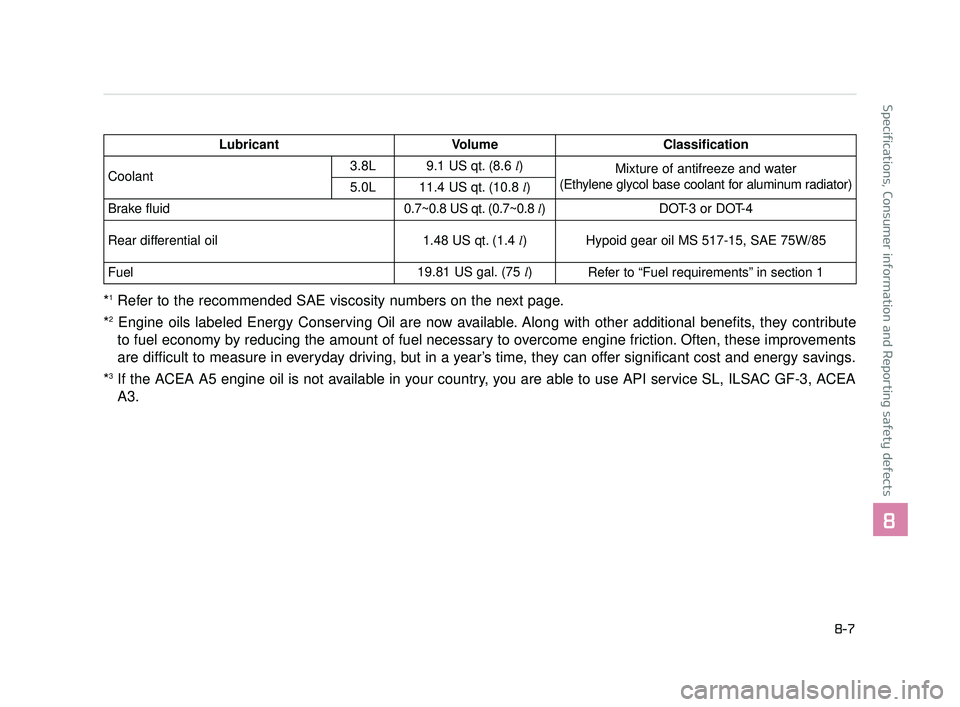
LubricantVolumeClassification
Coolant 3.8L9.1 US qt. (8.6 l)Mixture of antifreeze and water
(Ethylene glycol base coolant for aluminum radiator)
5.0L11.4 US qt. (10.8 l)
Brake fluid0.7~0.8 US qt. (0.7~0.8 l)DOT-3 or DOT-4
Rear differential oil1.48 US qt. (1.4 l)Hypoid gear oil MS 517-15, SAE 75W/85
Fuel19.81 US gal. (75 l)Refer to “Fuel requirements” in section 1
KH USA 8:2015 4/26/2016 11:01 AM Page 7
Page 522 of 542
8-8
Specifications, Consumer information and Reporting safety defects
Recommended SAE viscosity
number
Always be sure to clean the area
around any filler plug, drain plug, or
dipstick before checking or draining
any lubricant. This is especially
important in dusty or sandy areas
and when the vehicle is used on
unpaved roads. Cleaning the plug
and dipstick areas will prevent dirt
and grit from entering the engine and
other mechanisms that could be
damaged.
Engine oil viscosity (thickness) has
an effect on fuel economy and cold
weather operating (engine start and
engine oil flowability). Lower viscosi-
ty engine oils can provide better fuel
economy and cold weather perform-
ance, however, higher viscosity
engine oils are required for satisfac-
tory lubrication in hot weather. Using
oils of any viscosity other than those
recommended could result in engine
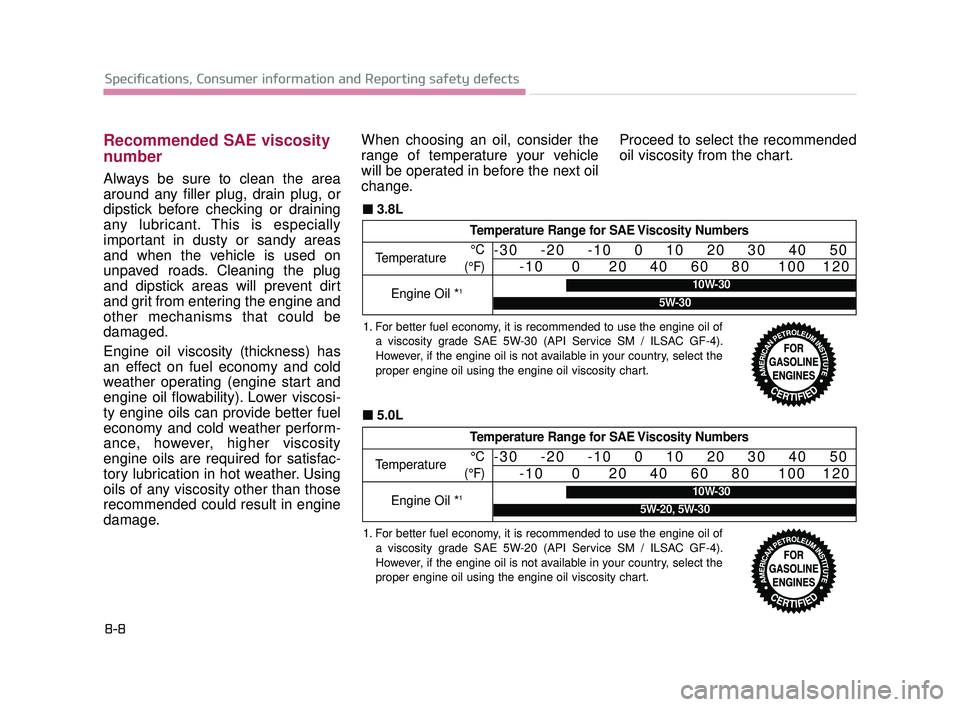
damage. When choosing an oil, consider the
range of temperature your vehicle
will be operated in before the next oil
change.
Proceed to select the recommended
oil viscosity from the chart.
Temperature Range for SAE Viscosity Numbers
Temperature
Engine Oil *
1
°C
(°F)-30 -20 -10 0 10 20 30 40 50 -10 0 20 40 60 80 100 120
1. For better fuel economy, it is recommended to use the engine oil of
a viscosity grade SAE 5W-30 (API Service SM / ILSAC GF-4).
However, if the engine oil is not available in your country, select the
proper engine oil using the engine oil viscosity chart.
10W-30
5W-30
Temperature Range for SAE Viscosity Numbers
Temperature
Engine Oil *
1
°C
(°F)-30 -20 -10 0 10 20 30 40 50 -10 0 20 40 60 80 100 120
1. For better fuel economy, it is recommended to use the engine oil of
a viscosity grade SAE 5W-20 (API Service SM / ILSAC GF-4).
However, if the engine oil is not available in your country, select the
proper engine oil using the engine oil viscosity chart.
10W-30
5W-20, 5W-30
■3.8L
■ 5.0L
KH USA 8:2015 4/26/2016 11:01 AM Page 8
Page 538 of 542

Overheats ........................................................................\
.6-9
Panoramic sunroof .........................................................4-40Sunroof open warning ...............................................4-40
Parking assist system ...................................................4-118 Non-operational conditions .....................................4-120
Operation .................................................................4-118
Parking Guide System .................................................4-124
Parking light position...................................................4-131
Power brakes ..................................................................5-27
Power Door Latch ..........................................................4-17
Power outlet .................................................................4-169
Power Trunk...................................................................4-22
Power window lock button ............................................4-34
Pre-active Seat belt (PSB) ............................................3-28
Pre-tensioner seat belt....................................................3-26
Rear curtain..................................................................4-177
Rear door lock button ....................................................4-18
Rear lamp switch .........................................................4-140
Rear seat adjustment (Power seat).................................3-13
Rear seat storage ..........................................................4-165
Rear vanity mirror........................................................4-176
Rear-Camera Display...................................................4-122 Recommended cold tire inflation pressures ..................7-54
Recommended lubricants and capacities .........................8-6
Recommended SAE viscosity number........................8-8
Record your key number .................................................4-4
Refrigerant label ............................................................8-10
Remote keyless entry system operations .........................4-7
Replacement light bulb ..................................................7-90
Reporting safety defects(U.S. only) ..............................8-15
Restrictions in handling keys.........................................4-10
Road warning ...................................................................6-2
Rocking the vehicle .......................................................5-96
Rotation (Tire) ...............................................................7-55
Scheduled maintenance service .....................................7-10
Seat belt Precautions......................................................3-29
Seat belt warning ...........................................................3-21
Seat belts ........................................................................\
3-20 Hight adjustment (front seat belt) .............................3-23
Lap/shoulder belt (3-Point system) ...........................3-23
Pre-active Seat belt (PSB) ........................................3-28
Pre-tensioner seat belt ...............................................3-26
Seat belt Precautions .................................................3-29
Seat belt warning .......................................................3-21
Seat warmer .................................................................4-171
Seatback pocket ..........................................................4-166
Seats ........................................................................\
.........3-2
Index
I-9
I
P
R
S
KH USA Index:2016 4/26/2016 9:51 AM Page 9