warning KIA K900 2019 User Guide
[x] Cancel search | Manufacturer: KIA, Model Year: 2019, Model line: K900, Model: KIA K900 2019Pages: 580, PDF Size: 15.11 MB
Page 26 of 580
39
Safety features of your vehicle
Front seat adjustment - power
The front seat can be adjusted by
using the control switches located on
the outside of the seat cushion.
Before driving, adjust the seat to the
proper position so you can easily con-
trol the steering wheel, pedals and
switches on the instrument panel.When in operation, the power seat-
consumes a large amount of electri-
cal power. To prevent unnecessary
system drain, don’t adjust the power
seat longer than necessary while the
engine is not running.
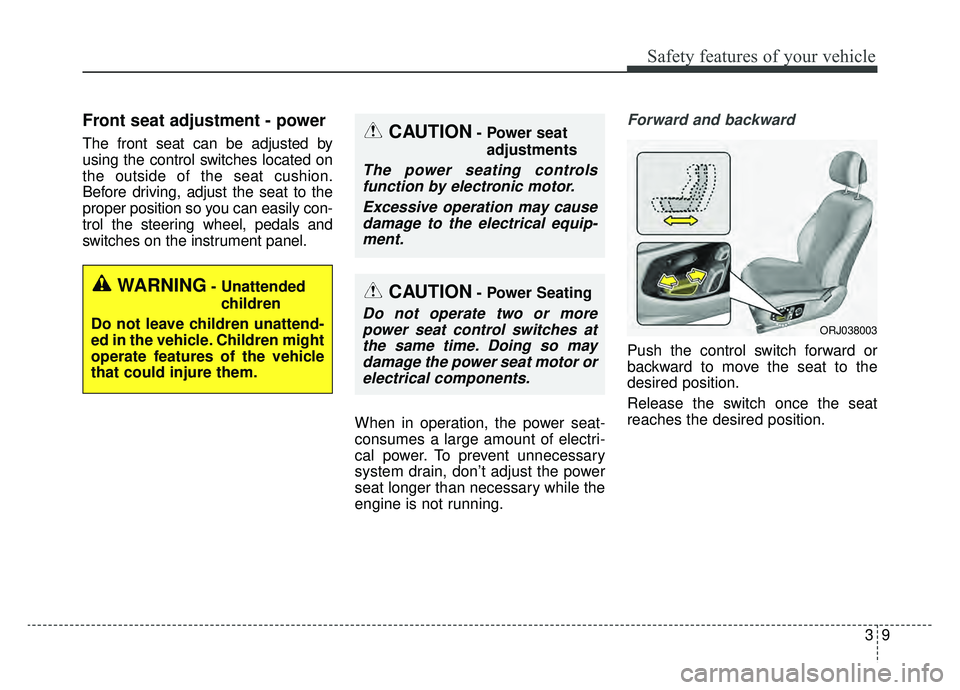
Forward and backward
Push the control switch forward or
backward to move the seat to the
desired position.
Release the switch once the seat
reaches the desired position.
ORJ038003
CAUTION- Power seatadjustments
The power seating controlsfunction by electronic motor.
Excessive operation may causedamage to the electrical equip-ment.
CAUTION- Power Seating
Do not operate two or morepower seat control switches atthe same time. Doing so maydamage the power seat motor orelectrical components.
WARNING- Unattended
children
Do not leave children unattend-
ed in the vehicle. Children might
operate features of the vehicle
that could injure them.
Page 30 of 580
313
Safety features of your vehicle
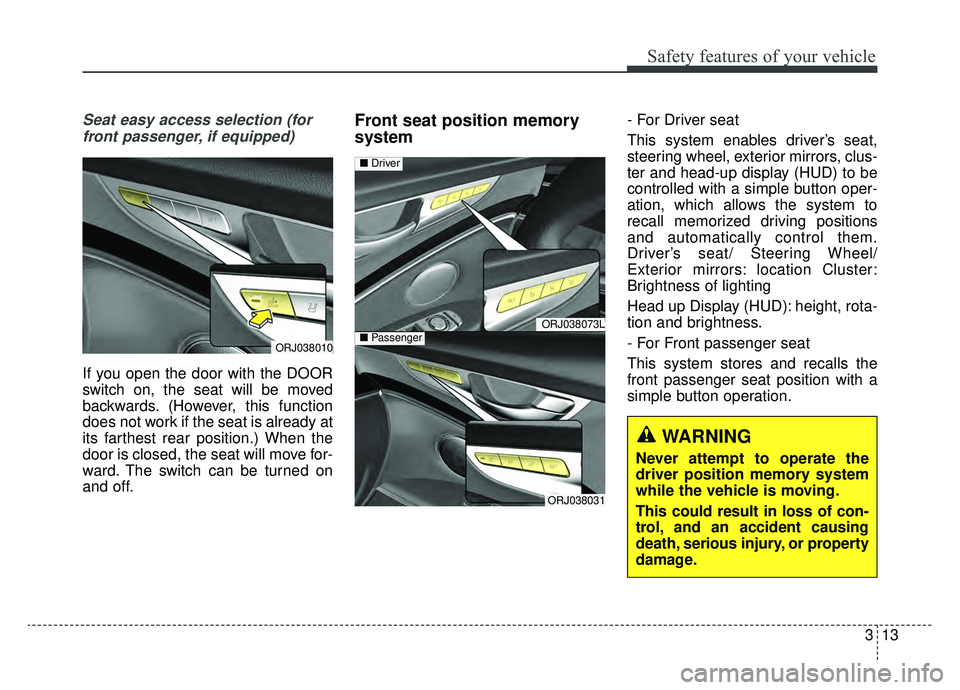
Seat easy access selection (forfront passenger, if equipped)
If you open the door with the DOOR
switch on, the seat will be moved
backwards. (However, this function
does not work if the seat is already at
its farthest rear position.) When the
door is closed, the seat will move for-
ward. The switch can be turned on
and off.
Front seat position memory
system- For Driver seat
This system enables driver’s seat,
steering wheel, exterior mirrors, clus-
ter and head-up display (HUD) to be
controlled with a simple button oper-
ation, which allows the system to
recall memorized driving positions
and automatically control them.
Driver’s seat/ Steering Wheel/
Exterior mirrors: location Cluster:
Brightness of lighting
Head up Display (HUD): height, rota-
tion and brightness.
- For Front passenger seat
This system stores and recalls the
front passenger seat position with a
simple button operation.
ORJ038010
WARNING
Never attempt to operate the
driver position memory system
while the vehicle is moving.
This could result in loss of con-
trol, and an accident causing
death, serious injury, or property
damage.
ORJ038073L
ORJ038031
■ Passenger
■Driver
Page 31 of 580
Safety features of your vehicle
14
3
Storing positions into memory
using the buttons on the door
Storing the seat positions
1. Place the shift lever in P (Park) with the ignition ON.
2. Adjust driver seat, outside rearview mirror, head up display
comfortable for the driver and
adjust front passenger seat.
3. Press SET button on the control panel. The system will beep once.
Press one of the memory buttons
(1 ,2 or 3) within 4 seconds after
pressing the SET button. The sys-
tem will beep twice when memory
has been successfully stored.
4. The message "Driver 1 ,2 or 3 set- tings saved" is displayed on the
instrument cluster display.
The number of settings that can be
saved in the system is up to 3. To set
and save the driving position setting,
press the 1 ,2 or 3 button within 4
seconds after the SET button is
pressed. Recalling positions from memory
1. Place the shift lever in P (Park)
with the ignition ON.
2. To recall the position in the memo- ry, press the desired memory but-
ton (1 ,2 or 3). The system will
beep once, then the driver’s seat
will automatically adjust to the
stored position.
3. The message "Driver 1 ,2 or 3 set- tings applied" is displayed on the
instrument cluster display.
If you press the SET button or num-
ber 1 button with the number 1 set-
ting in operation, the setting will tem-
porarily deactivate. If you press the
number 2 button, the number 2 set-
ting will activate.
If you press the number 2 button or
SET button with the number 2 button
in operation, the number 2 setting
will temporarily deactivate. Press the
number 1 button, the number 1 set-
ting will activate. If you operate the adjustment switch
of seats or exterior mirrors with the
position memory system activated,
the pre-set settings will become inef-
fective.
WARNING
Use caution when recalling the
adjustment memory while sit-
ting in the vehicle. Push the seat
position control switch to the
desired position immediately if
the seat moves too far in any
direction.
Page 34 of 580
317
Safety features of your vehicle
For maximum effectiveness in case
of an accident, the headrest should
be adjusted so the middle of the
headrest is at the same height of the
center of gravity of an occupant's
head. Generally, the center of gravity
of most people's head is similar with
the height of the top of their eyes.
Also, adjust the headrest as close to
your head as possible. For this rea-
son, the use of a cushion that holds
the body away from the seatback is
not recommended.Adjusting the height up and down
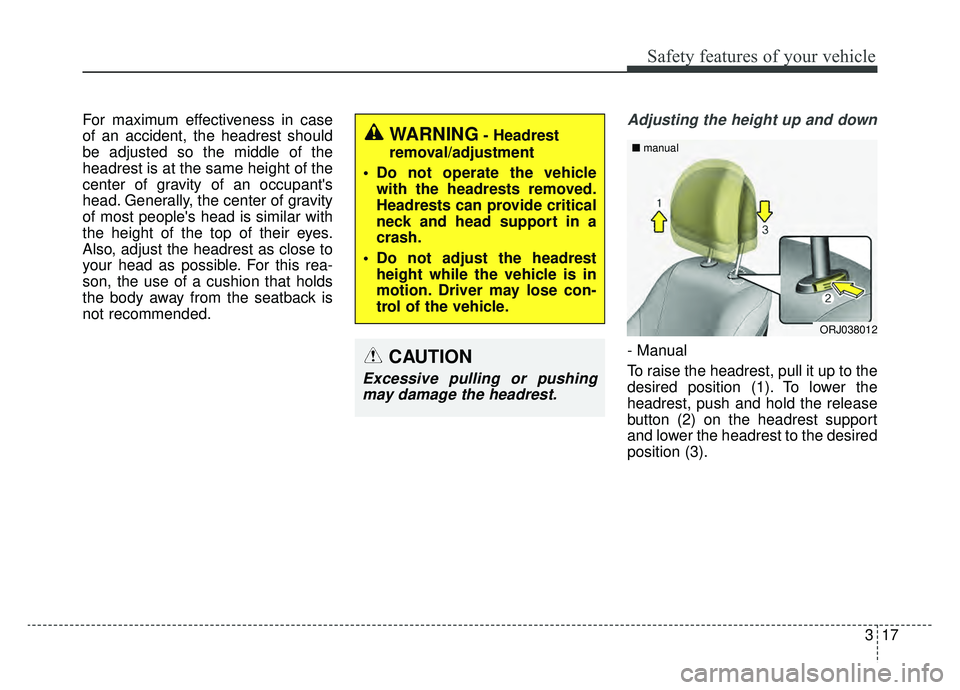
- Manual
To raise the headrest, pull it up to the
desired position (1). To lower the
headrest, push and hold the release
button (2) on the headrest support
and lower the headrest to the desired
position (3).
WARNING- Headrest
removal/adjustment
Do not operate the vehicle with the headrests removed.
Headrests can provide critical
neck and head support in a
crash.
Do not adjust the headrest height while the vehicle is in
motion. Driver may lose con-
trol of the vehicle.
CAUTION
Excessive pulling or pushingmay damage the headrest.
ORJ038012
■
manual
Page 36 of 580
319
Safety features of your vehicle
✽ ✽
NOTICE
If you recline the seatback towards
the front with the headrest and seat
cushion raised, the headrest may
come in contact with the sunvisor or
other parts of the vehicle.
Removal and reinstallation
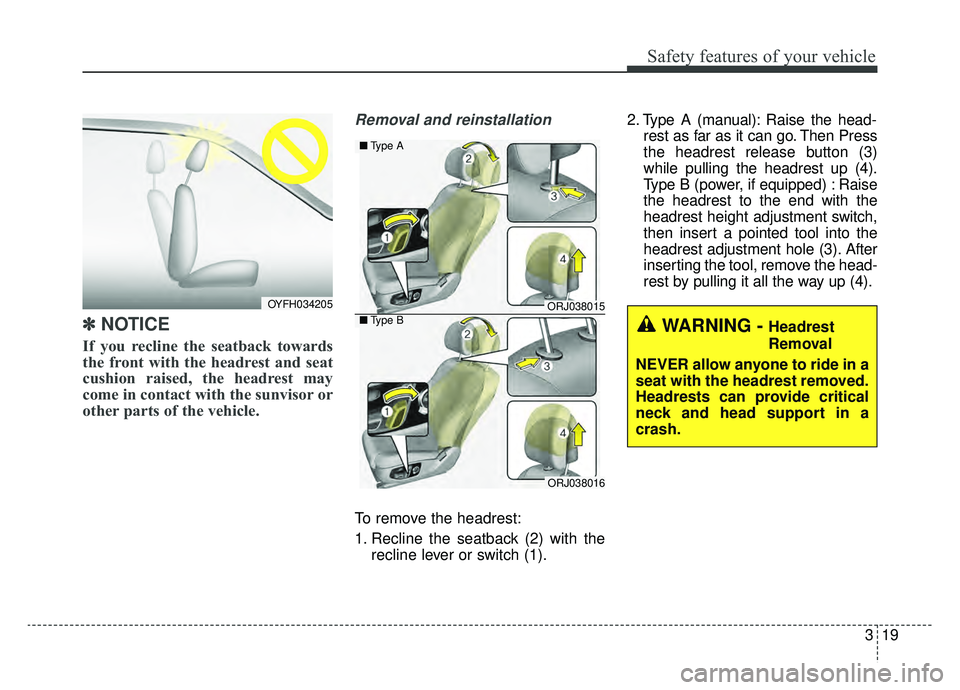
To remove the headrest:
1. Recline the seatback (2) with the
recline lever or switch (1). 2. Type A (manual): Raise the head-
rest as far as it can go. Then Press
the headrest release button (3)
while pulling the headrest up (4).
Type B (power, if equipped) : Raise
the headrest to the end with the
headrest height adjustment switch,
then insert a pointed tool into the
headrest adjustment hole (3). After
inserting the tool, remove the head-
rest by pulling it all the way up (4).
WARNING - Headrest
Removal
NEVER allow anyone to ride in a
seat with the headrest removed.
Headrests can provide critical
neck and head support in a
crash.
OYFH034205ORJ038015
ORJ038016
■ Type B
■Type A
Page 37 of 580
Safety features of your vehicle
20
3
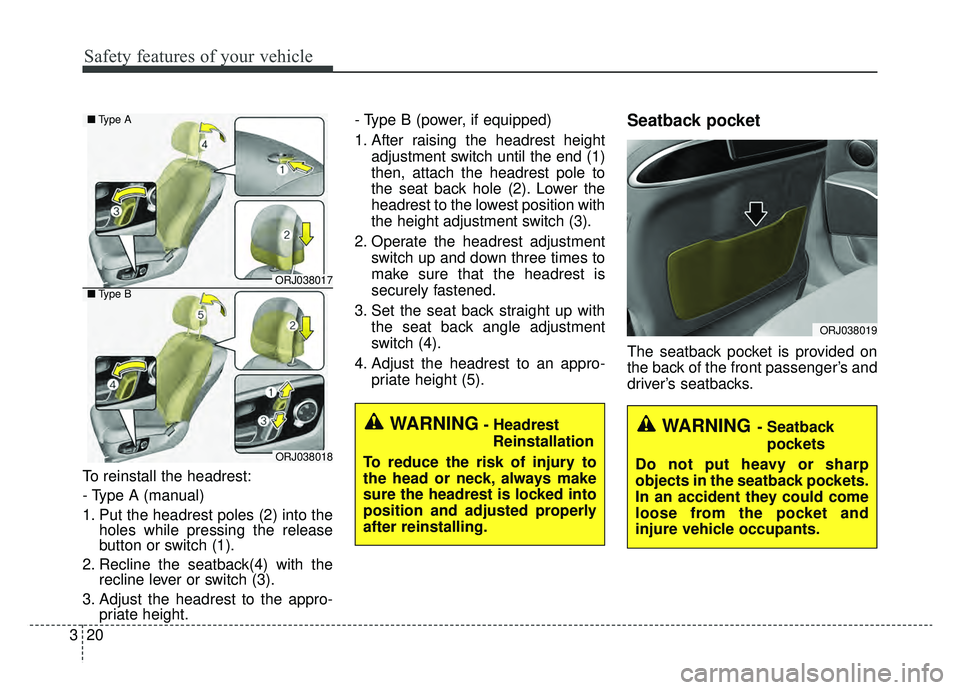
To reinstall the headrest:
- Type A (manual)
1. Put the headrest poles (2) into the
holes while pressing the release
button or switch (1).
2. Recline the seatback(4) with the recline lever or switch (3).
3. Adjust the headrest to the appro- priate height. - Type B (power, if equipped)
1. After raising the headrest height
adjustment switch until the end (1)
then, attach the headrest pole to
the seat back hole (2). Lower the
headrest to the lowest position with
the height adjustment switch (3).
2. Operate the headrest adjustment switch up and down three times to
make sure that the headrest is
securely fastened.
3. Set the seat back straight up with the seat back angle adjustment
switch (4).
4. Adjust the headrest to an appro- priate height (5).
Seatback pocket
The seatback pocket is provided on
the back of the front passenger’s and
driver’s seatbacks.
ORJ038019
WARNING- Seatback
pockets
Do not put heavy or sharp
objects in the seatback pockets.
In an accident they could come
loose from the pocket and
injure vehicle occupants.WARNING- Headrest Reinstallation
To reduce the risk of injury to
the head or neck, always make
sure the headrest is locked into
position and adjusted properly
after reinstalling.
ORJ038017
ORJ038018
■ Type B
■Type A
Page 44 of 580
327
Safety features of your vehicle
SEAT BELTS
Seat belt restraint system
For maximum restraint system pro-tection, the seat belts must always
be used whenever the vehicle is
moving. A properly positioned
shoulder belt should be positioned
midway over your shoulder across
your collarbone.
Never allow children to ride in the front passenger seat. See child
restraint system section for further
discussion. Seat belts are designed to bear upon
the bony structure of the body, and
should be worn low across the front
of the pelvis, chest and shoulders, as
applicable; wearing the lap section of
the belt across the abdominal area
must be avoided.
Seat belts should be adjusted as
firmly as possible, consistent with
comfort, to provide the protection for
which they have been designed.
A slack belt will greatly reduce the
protection afforded to the wearer.
Care should be taken to avoid con-
tamination of the webbing with pol-
ishes, oils and chemicals, and partic-
ularly battery acid. Cleaning may
safely be carried out using mild soap
and water. The belt should be
replaced if webbing becomes frayed,
contaminated or damaged.
No modifications or additions
should be made by the user which
would either prevent the seat belt
adjusting devices from operating to
remove slack, or prevent the seat
belt assembly from being adjusted
to remove slack.
WARNING- Damaged
seat belt
Replace the entire seat belt
assembly if any part of the web-
bing or hardware is damaged as
you can no longer be sure that a
damaged seat belt will provide
protection in a crash.WARNING- Twisted seat belt
Make sure your seat belt is not
twisted when worn. A twisted
seat belt may not properly pro-
tect you in an accident and
could even cut into your body.
WARNING- Shoulder Belt
Never wear the shoulder belt under your arm or behind
your back. An improperly
positioned shoulder belt can-
not protect the occupant in a
crash.
Always wear both the shoul- der portion and lap portion of
the lap/shoulder belt.
Page 45 of 580
Safety features of your vehicle
28
3
When you fasten the seat belt, be
careful not to latch the seat belt in
buckles of other seats. It's very
dangerous and you may not be
protected by the seat belt properly.
Do not unfasten the seat belt and do not fasten and unfasten the seat
belt repeatedly while driving. This
could result in loss of control, and
an accident causing death, serious
injury, or property damage.
When fastening the seat belt, make sure that the seat belt does
not pass over objects that are hard
or can break easily.Seat belt warning
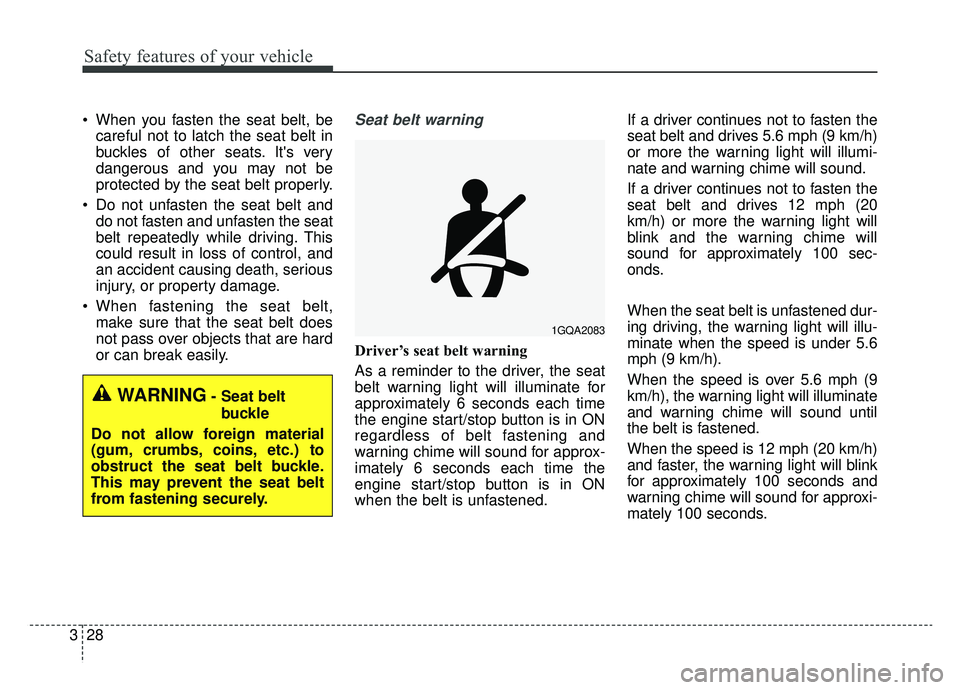
Driver’s seat belt warning
As a reminder to the driver, the seat
belt warning light will illuminate for
approximately 6 seconds each time
the engine start/stop button is in ON
regardless of belt fastening and
warning chime will sound for approx-
imately 6 seconds each time the
engine start/stop button is in ON
when the belt is unfastened. If a driver continues not to fasten the
seat belt and drives 5.6 mph (9 km/h)
or more the warning light will illumi-
nate and warning chime will sound.
If a driver continues not to fasten the
seat belt and drives 12 mph (20
km/h) or more the warning light will
blink and the warning chime will
sound for approximately 100 sec-
onds.
When the seat belt is unfastened dur-
ing driving, the warning light will illu-
minate when the speed is under 5.6
mph (9 km/h).
When the speed is over 5.6 mph (9
km/h), the warning light will illuminate
and warning chime will sound until
the belt is fastened.
When the speed is 12 mph (20 km/h)
and faster, the warning light will blink
for approximately 100 seconds and
warning chime will sound for approxi-
mately 100 seconds.
WARNING- Seat belt
buckle
Do not allow foreign material
(gum, crumbs, coins, etc.) to
obstruct the seat belt buckle.
This may prevent the seat belt
from fastening securely.
1GQA2083
Page 46 of 580
329
Safety features of your vehicle
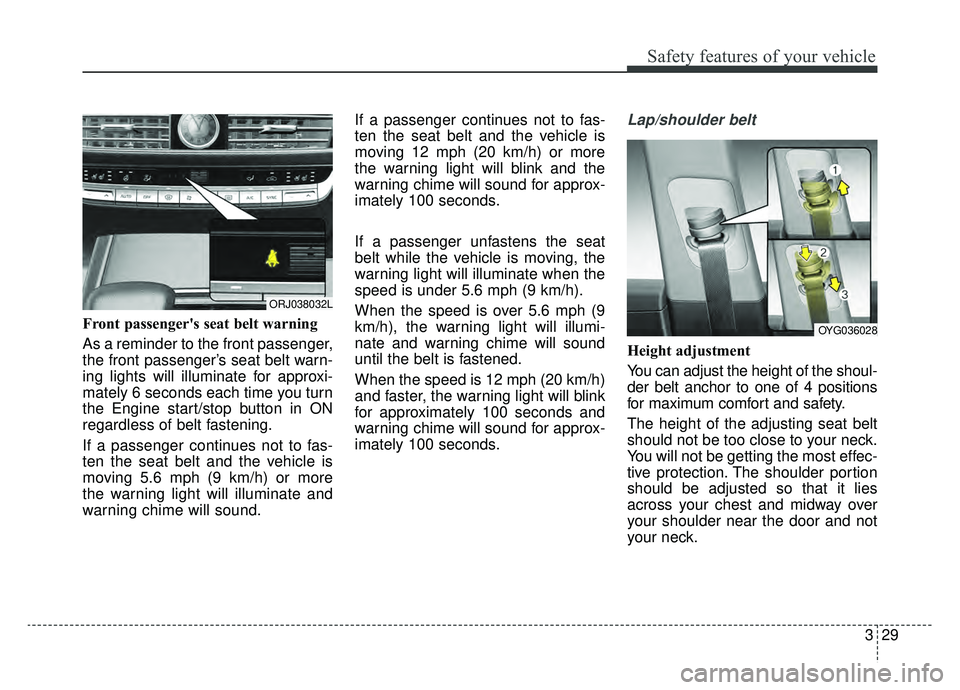
Front passenger's seat belt warning
As a reminder to the front passenger,
the front passenger’s seat belt warn-
ing lights will illuminate for approxi-
mately 6 seconds each time you turn
the Engine start/stop button in ON
regardless of belt fastening.
If a passenger continues not to fas-
ten the seat belt and the vehicle is
moving 5.6 mph (9 km/h) or more
the warning light will illuminate and
warning chime will sound.If a passenger continues not to fas-
ten the seat belt and the vehicle is
moving 12 mph (20 km/h) or more
the warning light will blink and the
warning chime will sound for approx-
imately 100 seconds.
If a passenger unfastens the seat
belt while the vehicle is moving, the
warning light will illuminate when the
speed is under 5.6 mph (9 km/h).
When the speed is over 5.6 mph (9
km/h), the warning light will illumi-
nate and warning chime will sound
until the belt is fastened.
When the speed is 12 mph (20 km/h)
and faster, the warning light will blink
for approximately 100 seconds and
warning chime will sound for approx-
imately 100 seconds.
Lap/shoulder belt
Height adjustment
You can adjust the height of the shoul-
der belt anchor to one of 4 positions
for maximum comfort and safety.
The height of the adjusting seat belt
should not be too close to your neck.
You will not be getting the most effec-
tive protection. The shoulder portion
should be adjusted so that it lies
across your chest and midway over
your shoulder near the door and not
your neck.
OYG036028
ORJ038032L
Page 47 of 580
Safety features of your vehicle
30
3
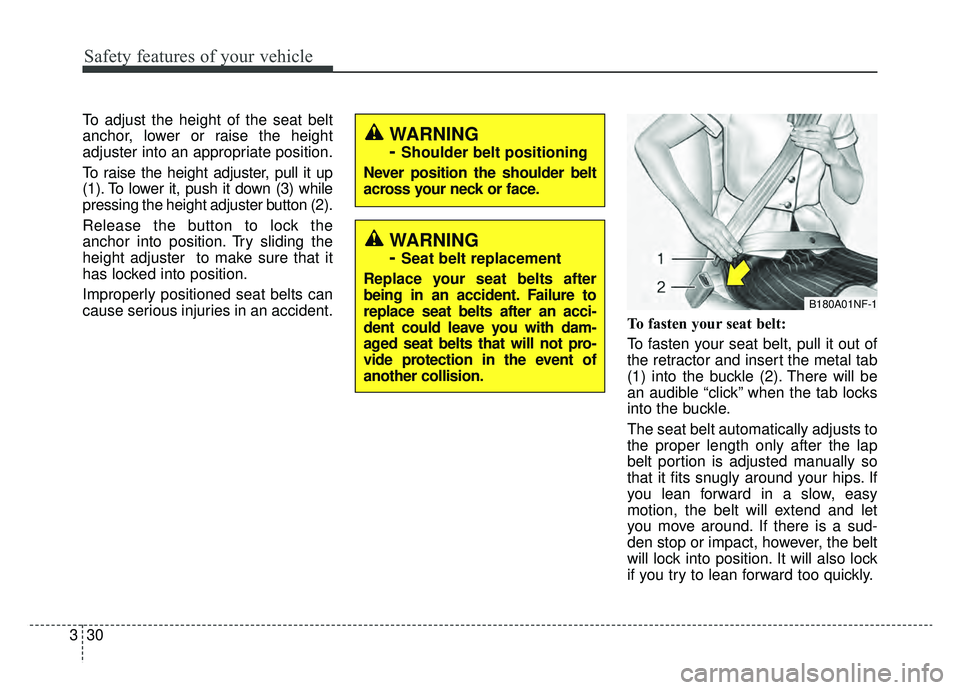
To adjust the height of the seat belt
anchor, lower or raise the height
adjuster into an appropriate position.
To raise the height adjuster, pull it up
(1). To lower it, push it down (3) while
pressing the height adjuster button (2).
Release the button to lock the
anchor into position. Try sliding the
height adjuster to make sure that it
has locked into position.
Improperly positioned seat belts can
cause serious injuries in an accident.
To fasten your seat belt:
To fasten your seat belt, pull it out of
the retractor and insert the metal tab
(1) into the buckle (2). There will be
an audible “click” when the tab locks
into the buckle.
The seat belt automatically adjusts to
the proper length only after the lap
belt portion is adjusted manually so
that it fits snugly around your hips. If
you lean forward in a slow, easy
motion, the belt will extend and let
you move around. If there is a sud-
den stop or impact, however, the belt
will lock into position. It will also lock
if you try to lean forward too quickly.
B180A01NF-1
WARNING
-
Shoulder belt positioning
Never position the shoulder belt
across your neck or face.
WARNING
-
Seat belt replacement
Replace your seat belts after
being in an accident. Failure to
replace seat belts after an acci-
dent could leave you with dam-
aged seat belts that will not pro-
vide protection in the event of
another collision.